In one NIH Toolbox study, 59% of people with complicated mild or moderate TBI and 75% with severe TBI had at least one low cognitive score, but cognitive testing for TBI still isn't a single yes-or-no event. It works best as a staged process that combines early monitoring, later domain-specific testing, and clinical context.
A family may reach this point after a crash, fall, or other head injury with no clear answer. The injured person says they can't concentrate, loses track of conversations, or forgets routine tasks. A quick emergency-room screen looks reassuring, yet returning to work exposes problems that weren't visible in a short interaction. Meanwhile, relatives, doctors, insurers, and attorneys may all ask different versions of the same question: What changed, and how can it be documented?
Neuropsychological evaluation is considered the clinical standard for describing lasting cognitive, behavioral, and emotional effects after TBI. It can support rehabilitation planning and create important documentation in a personal injury claim, but it can't establish causation by itself. The most useful record develops over time, using test results alongside medical history, symptom progression, observed behavior, prior functioning, and reports from family members.
Understanding Cognitive Testing for TBI
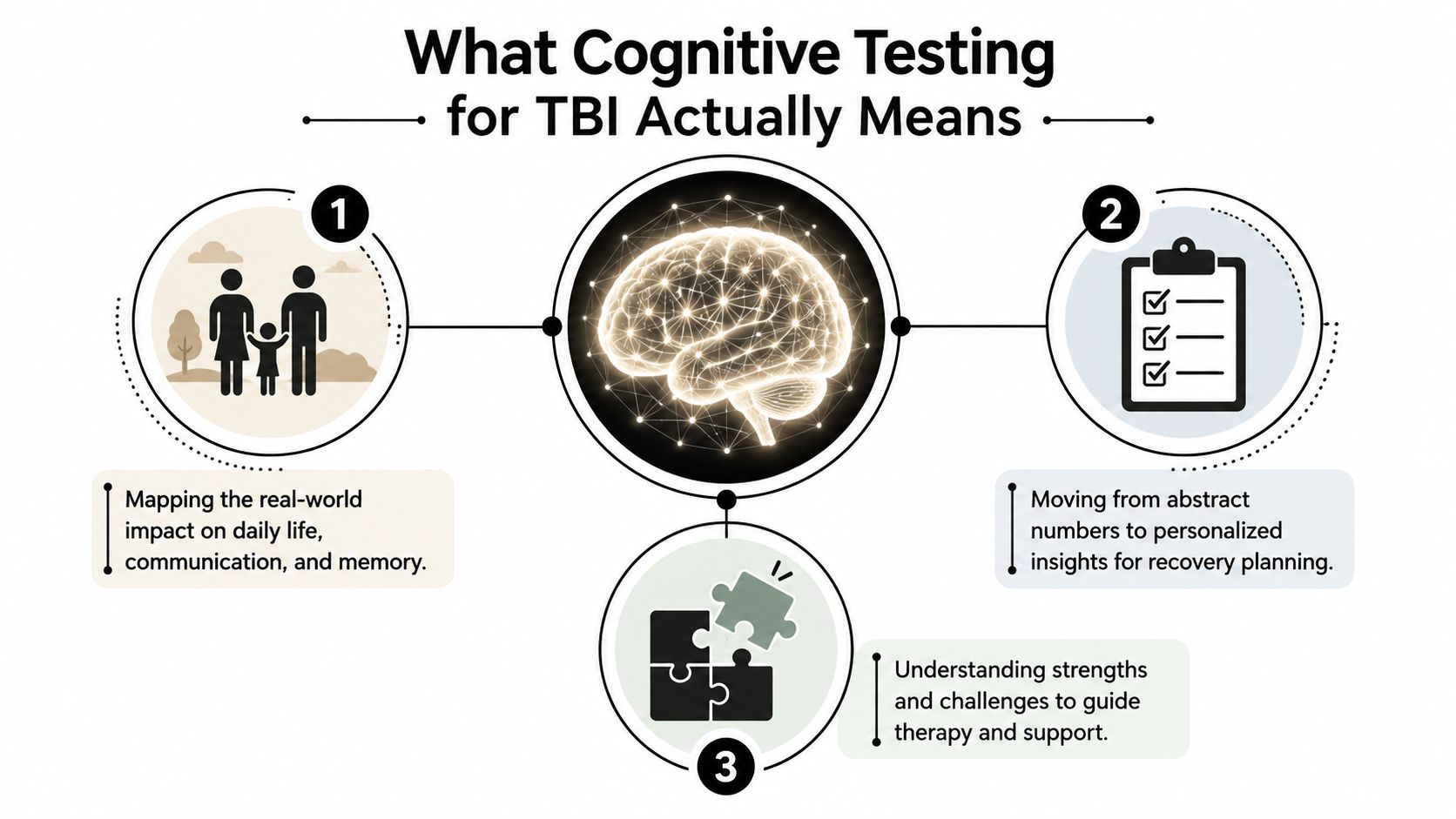
After a collision, someone may look physically recovered while struggling to follow instructions, remember appointments, or switch between tasks. A spouse may find that familiar bills have become confusing. The injured person may know something is wrong but lack the words to describe it. Cognitive testing gives clinicians a structured way to examine these changes rather than relying only on impressions.
The process resembles building a map over time, not taking one photograph. Clinicians examine attention, executive function, memory, language, and processing speed, then relate the findings to daily activities. The purpose is practical: determining whether someone can safely resume complex work, needs reminders, or may benefit from strategies that reduce distractions.
A process that changes with recovery
Early care may center on alertness, confusion, and post-traumatic amnesia. Later evaluation can identify subtler problems that appear when a person returns to school, employment, driving, household management, or social demands. A reassuring early interaction therefore cannot settle the question of long-term function.
The INCOG 2.0 guidelines recommend daily assessment of post-traumatic amnesia with the Westmead Post-Traumatic Amnesia Scale until it resolves. Afterward, they recommend assessing people with TBI across multiple cognitive domains. This supports a serial, domain-based approach, rather than dependence on one bedside screen.
Practical rule: Interpret each score alongside the person's responsibilities, observed difficulties, and recovery plan.
For legal purposes, this evolving record can show more than a diagnosis label. It may document persistent limitations, treatment needs, and changes from the person's prior baseline. It also keeps two questions separate: whether functional impairment is present, and what medical event caused it. That distinction matters when clinicians, insurers, and attorneys assess a personal injury claim.
Types of Cognitive Tests Used After Brain Injury
Clinicians choose tools based on the person's condition, the stage of recovery, and the question they need to answer. A short screen may identify a reason for closer evaluation. A battery of tests can show which abilities are affected, which remain strong, and how the pattern affects daily function.
| Test type | Examples | What it assesses |
|---|---|---|
| Brief screening tools | MoCA, MMSE | Broad cognitive concerns, orientation, memory, attention, and basic executive abilities |
| Focused paper-and-pencil measures | Trail Making Test A/B, verbal fluency | Processing speed, mental flexibility, visual attention, and word retrieval |
| Comprehensive neuropsychological batteries | Memory, attention, language, executive-function, and processing-speed measures | A detailed profile of strengths, weaknesses, behavior, and emotional effects |
| Computerized cognitive tasks | NIH Toolbox cognition tasks and other standardized platforms | Repeatable performance across selected cognitive domains |
| Symptom-validity measures | Test of Memory Malingering and related measures | Whether performance and symptom reporting can be interpreted reliably in context |
What each level can reveal
The MoCA and MMSE are useful starting points, but brief screens can miss mild or domain-specific deficits. A person may perform adequately on a short interaction yet struggle with divided attention, rapid information processing, planning, or learning new material. A broader battery tests those functions directly.
The Trail Making Test, verbal fluency tasks, and memory measures often add detail that a brief screen can't provide. Neuropsychologists also consider language background, education, sensory limitations, fatigue, pain, medication effects, and emotional symptoms when interpreting performance.
Computerized testing can add standardized, repeatable tasks, but it isn't automatically a substitute for specialist interpretation. The clinician still has to connect the score pattern to medical records and daily life. Families also sometimes confuse TBI-related cognitive symptoms with the broader subject of age-related decline. For a plain-language explanation of cognitive changes and family observations, the Velma cognitive decline resource for families may help provide useful vocabulary, although it isn't a TBI evaluation.
A full evaluation may include interviews, record review, behavioral observations, cognitive tasks, emotional measures, and symptom-validity testing. That combination matters because two people with the same injury description can have very different functional profiles.
When Cognitive Testing Is Most Useful After TBI
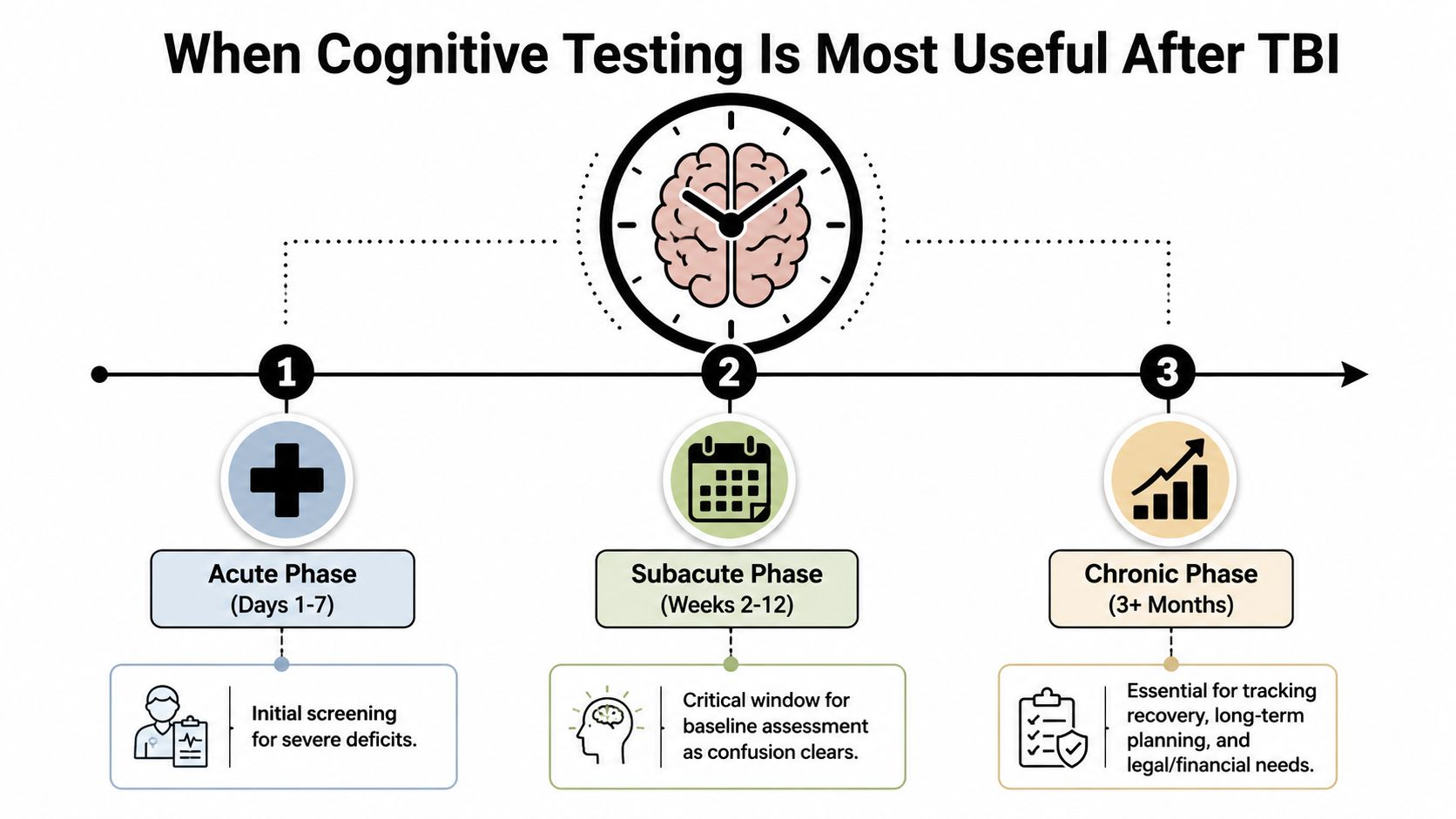
A person may complete a brief test soon after a mild TBI and still struggle later with work, multitasking, or sustained attention. Early pain, headache, poor sleep, medication effects, confusion, and emotional shock can temporarily lower performance. The result may describe the acute period rather than the problems that persist after those factors improve.
For that reason, current guidance generally advises against neuropsychological or cognitive testing during the first 30 days after mild TBI. Testing becomes more informative when symptoms continue beyond 30 to 90 days, or remain unresolved after related problems, such as sleep disturbance or headache, have been treated (timing guidance).
Timing also affects legal documentation. An early normal result may show how someone performed under limited conditions, while a later assessment can address whether difficulties continued after the initial disruption. Neither result should be treated as a complete answer without considering symptoms, treatment, records, and daily function.
Why serial assessment matters
There is no single schedule for every injury. During the acute phase, clinicians may track alertness and post-traumatic amnesia. As confusion resolves, follow-up can focus on the abilities that still interfere with school, work, household tasks, or communication. Later testing may help measure persistent limitations and guide rehabilitation.
As noted above, the INCOG 2.0 guidelines support repeated clinical observation during recovery, followed by assessment of the cognitive areas that remain affected. Recovery is better understood as a changing profile than as one permanent score. A person can improve in one area while continuing to have difficulty in another.
A 2024 NINDS recommendation emphasized the value of standardized objective cognitive testing soon after injury while noting that no specific platform has been recommended. Early scores can provide a useful reference point, but they do not establish a universal method or settle how recovery will unfold.
Families can ask what was tested, when it occurred, and which symptoms require follow-up. Keep a dated record of headaches, sleep changes, missed tasks, work problems, and observed changes. That record gives the treating team a clearer basis for deciding whether another test will answer a meaningful question or merely repeat an unstable snapshot.
Screening Tools Versus Comprehensive Neuropsychological Evaluation
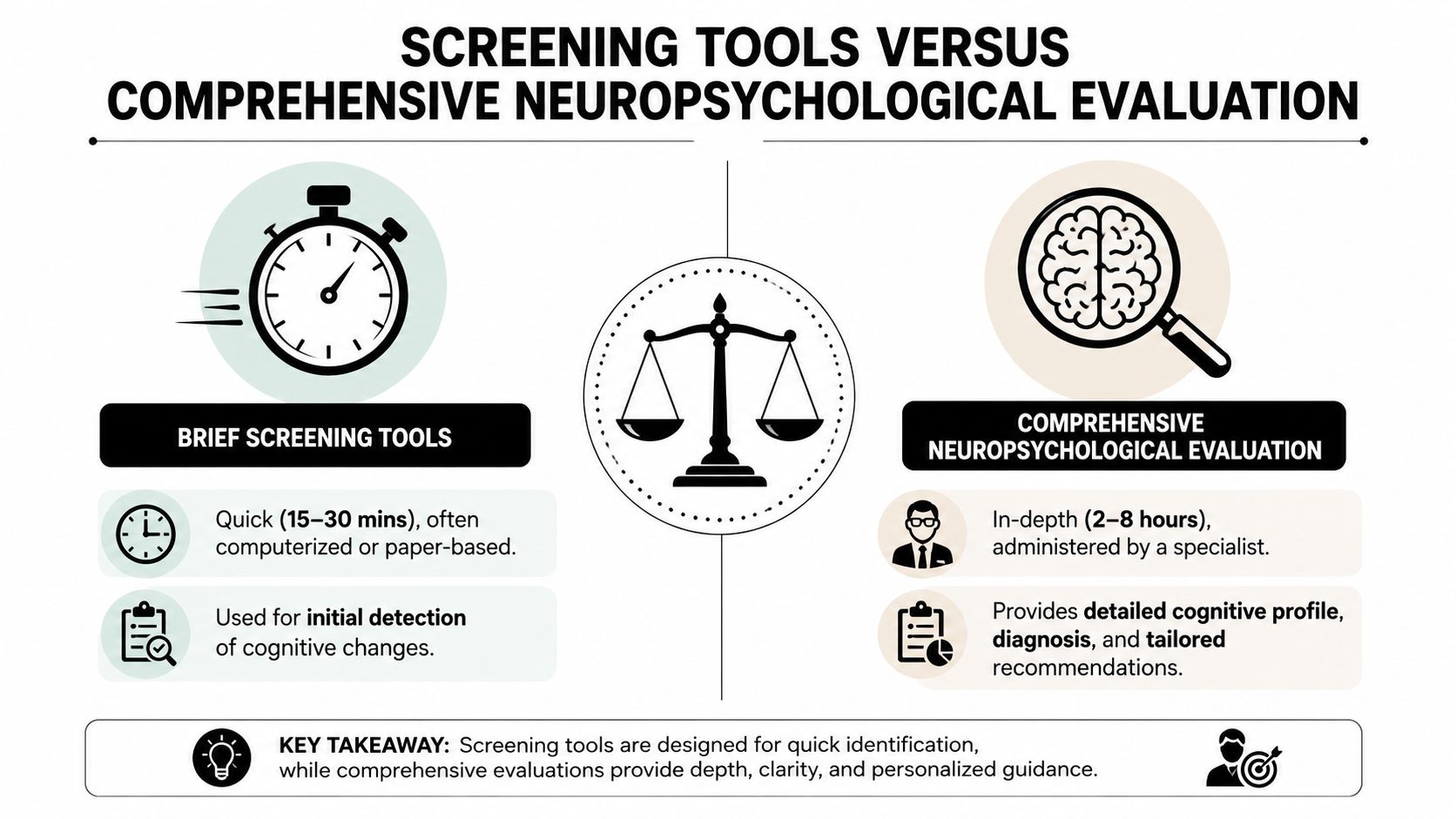
After a TBI, a person may pass a brief screen yet struggle to follow a conversation, remember instructions, or manage several tasks at once. That result is not necessarily contradictory. A brief screen and a full neuropsychological evaluation answer different questions, so treating them as interchangeable can mislead families and weaken medical or legal conclusions.
A brief screen is an efficient first check. It may alert a clinician that further assessment deserves consideration when combined with symptoms, medical history, and family observations. It does not fully map subtle difficulties with executive function, processing speed, memory learning, or multitasking in daily life. An early normal result therefore does not prove that no meaningful problem exists.
The practical difference
The MoCA and MMSE are among the most widely validated brief screening tools for TBI, while the NIH Toolbox has shown sensitivity to persistent impairment. In the review linked here, the Fluid Composite and Picture Sequence Memory Test produced the largest effect sizes among the measures examined (review of cognitive assessment tools).
A full evaluation examines a broader pattern. It combines test results with clinical information to describe cognitive, behavioral, and emotional sequelae. Areas may include episodic memory, attention, processing speed, executive function, and language. Trail Making Test A/B, verbal fluency, memory batteries, and symptom-validity measures such as the Test of Memory Malingering may be included (full neuropsychological evaluation).
| Question | Brief screen | Full evaluation |
|---|---|---|
| Is there a reason to investigate further? | Often useful | Yes, with greater detail |
| Which specific domains are affected? | Limited answer | Detailed profile |
| How do symptoms interact with behavior and emotion? | Usually limited | Considered in the clinical formulation |
| What accommodations or therapies may help? | General direction | Individualized recommendations |
| Can the results support a legal record? | Sometimes as one piece | Often more informative when properly interpreted |
The NIH Toolbox findings illustrate what a broader test battery can add. Rather than relying on a single low score, examining patterns across measures may distinguish controls from people with moderate or severe TBI more effectively (NIH Toolbox TBI findings). That distinction matters because legal questions often involve function, timing, and causation, not merely whether one screening score falls below a cutoff.
Families can review traumatic brain injury screening information for an overview of initial screening and related legal considerations. A screen may open the inquiry. The decision to pursue fuller testing should reflect symptoms, daily functioning, recovery stage, and the specific clinical or documentation question that needs an answer.
How Cognitive Testing Results Shape Treatment and Legal Outcomes
A test report becomes valuable when it changes what people do next. If attention is weak, therapy may emphasize distraction control and structured routines. If processing speed is reduced, a return-to-work plan may allow additional time, fewer simultaneous demands, or written instructions. If memory learning is affected, external reminders and repetition may become central to rehabilitation.
Clinical decisions
Neuropsychological findings can help a team identify strengths to preserve and weaknesses to accommodate. They may inform speech-language therapy, occupational therapy, cognitive rehabilitation, family education, school support, disability documentation, and graduated work planning. The report should translate scores into functional recommendations, not just list percentiles.
A clinician might write that a patient has difficulty encoding new information, but the family needs to know what that means at home. Does the person need medication organizers? Can they follow a multistep recipe? Can they safely manage finances? Functional examples make the clinical record easier to use and easier to understand.
For families seeking context about treatment planning, TBI cognitive therapy information can help explain how rehabilitation may address thinking and functioning after injury.
Legal interpretation
In a personal injury claim, testing may help document ongoing impairment, support the need for treatment, and explain lost work capacity or reduced quality of life. It can also challenge an insurer's assumption that a person who looks well must be functioning normally. Consistent records from providers, family members, employers, and evaluators can show how symptoms affect ordinary activities.
Testing still has limits. A score can demonstrate impaired performance, but a brief screen or standard battery usually can't cleanly separate TBI from pre-existing conditions, emotional distress, sleep problems, medication effects, or another neurologic disease. Testing is generally stronger for documenting functional impairment than for proving causation alone.
A careful legal analysis asks:
- What was the person's baseline before the injury?
- What symptoms appeared afterward?
- Were there earlier medical, educational, or psychiatric concerns?
- What alternative explanations did the evaluator consider?
- Do the test pattern and observed daily limitations fit together?
Research on newer tablet-based tools reinforces this caution. Such tools may identify impairment while still failing to distinguish injury-related deficits from pre-existing dementia, supporting the need for broader clinical context (cognitive screening and diagnostic limitations).
How to Prepare for Cognitive Testing After Brain Injury
Testing can feel like an exam with consequences. The injured person may worry that a poor result will be blamed on lack of effort, while a good result may be used to dismiss genuine struggles. Preparation should make the evaluation accurate, not coach someone toward a particular outcome.
Before the appointment
Bring the information that helps the evaluator understand the person behind the scores:
- Medical history: Gather emergency records, imaging reports, discharge instructions, therapy notes, and prior cognitive or psychiatric records.
- Medication list: Include prescription drugs, over-the-counter medicines, and supplements, along with changes made after the injury.
- Symptom timeline: Write down headaches, sleep disruption, dizziness, irritability, memory lapses, and work or school difficulties.
- Baseline information: Ask a spouse, relative, coworker, or teacher to describe functioning before and after the injury when appropriate.
- Questions: Note concerns about driving, employment, finances, safety, treatment, and expected follow-up.
A full night's sleep, food, hydration, and prescribed medication routines can help the evaluator measure typical functioning. Tell the provider if pain, fatigue, anxiety, language barriers, hearing problems, or visual limitations could affect performance. Those factors don't make symptoms irrelevant, but they need to be recorded and interpreted.
During and after testing
Expect tasks that may involve remembering information, solving problems, switching attention, finding words, and working quickly. The evaluator may observe behavior, ask about symptoms, and use symptom-validity measures. Those measures aren't automatically an accusation. They help determine whether the results can be interpreted confidently.
Don't hide confusion or push through severe symptoms without telling the evaluator. Ask for clarification when instructions aren't understood, request appropriate breaks, and describe what happens in daily life without exaggeration or minimization.
Medical records often contain the timeline needed to interpret results. Families can review practical guidance on how to obtain medical records and share relevant documents with the treating team and, after discussing confidentiality, legal counsel.
Common Misconceptions About Cognitive Testing for TBI
A normal early screen rules out lasting problems
A person may pass an early screen and still struggle later. Brief testing can miss demands that become visible after returning to work, school, driving, or household responsibilities. As noted above, current guidance cautions against broad testing during the first 30 days after mild TBI and supports later assessment when symptoms persist beyond 30 to 90 days or remain resistant after related problems receive treatment.
Review the test itself before treating “normal” as the final answer:
- Which cognitive domains did it measure?
- How long did the assessment last?
- Was the person in pain, fatigued, distressed, or otherwise unwell that day?
- Did problems continue in ordinary activities?
A score is one observation, like a single photograph. Daily functioning over time provides the larger picture.
A brief test proves the accident caused the symptoms
A cognitive result may document impaired performance, but it generally cannot establish that the accident caused every current complaint. Pre-existing learning differences, emotional distress, sleep disturbance, pain, medication effects, and other neurologic conditions can influence results.
A well-supported opinion compares the test pattern with the injury history, prior functioning, symptom onset, medical records, and alternative explanations. Family observations can clarify the change. For example, someone who previously managed finances independently but now makes repeated errors presents a concrete functional comparison.
Computerized testing captures everything
Computerized tools can provide standardized information and may identify possible impairment. Their results still require context from a clinical interview, medical-record review, behavioral observations, and testing that examines a broader range of abilities.
A screen can indicate that performance differs from expectation without explaining why. That distinction matters in rehabilitation, where clinicians need to choose appropriate supports, and in a personal injury claim, where causation and competing explanations must be addressed. Tablet-based tools are therefore one piece of the record, not a complete substitute for clinical judgment or a full neuropsychological evaluation.
Working with Medical and Legal Teams After TBI Testing
A cognitive evaluation should become part of a coordinated record. Give the neuropsychologist a clear injury timeline, prior functioning information, symptom history, medication list, and examples of changed behavior. Ask the treating physician to connect recommendations to actual needs, such as therapy, supervision, work restrictions, school accommodations, or sleep and headache treatment.
Legal counsel should understand both the value and limits of the report. Testing can document impairment and support damages related to treatment, lost income, assistance, and quality of life. It doesn't eliminate the need to address baseline function, causation, mitigation, and competing explanations.
Keep the record usable
Request complete reports, raw records when available through the proper process, treatment plans, work notes, and follow-up observations. Track whether recommendations were implemented and whether symptoms changed. If an evaluator's conclusion seems unclear, ask for plain-language explanations and identify which findings are objective, which are based on reported symptoms, and which depend on clinical judgment.
Families coordinating broader neurologic support may also find it useful to explore find ALS care in Reno as an example of a separate care-navigation resource. It isn't a substitute for TBI evaluation, but it illustrates why families often need help locating appropriate support while medical documentation develops.
Cognitive testing for TBI works best when clinicians and attorneys treat it as an ongoing evidence process. The family doesn't need to force one test to answer every question. They need appropriately timed evaluation, honest symptom reporting, careful interpretation, and records that show how the injury affects life over time.
Nares Law Group LLC helps injured families understand how neurocognitive testing, medical documentation, and functional limitations may affect a brain injury claim. Visit Nares Law Group LLC to learn about case guidance, treatment coordination, and the next steps for protecting your rights.