You open the mailbox or email attachment and find a stack of written questions from the other side. Your medical treatment is still underway, wage records are incomplete, and the response deadline is already running. The natural impulse is to answer quickly, guess where necessary, or let the paperwork sit until the facts feel more settled. Each of those choices can damage a personal injury case.
Interrogatories are written discovery questions answered under oath. They aren't casual correspondence, and opposing counsel won't treat them that way. A careless answer can become a contradiction at your deposition, a cross-examination exhibit, or a reason to challenge your damages claim. The right approach is disciplined and practical: identify the deadline, collect the records, answer each question precisely, preserve legitimate objections, verify the response, and keep the answers current as the case develops.
The Stack of Paperwork Just Arrived and Now What
The clock starts when interrogatories are properly served, not when you finally feel ready to deal with them. Your first job is to identify the service date, determine which procedural rules apply, and place the response deadline on a calendar with reminders. Don't wait for your lawyer's office to discover the deadline in a crowded inbox.

In federal practice, Federal Rule of Civil Procedure 33 generally requires answers and objections within 30 days after service, although the court can set a different period and a defendant generally can't be required to respond in less than 45 days after service of the summons and complaint. The federal rule is a starting point, not a universal answer. State rules can provide a different response window or special treatment when interrogatories accompany the complaint.
Practical rule: Treat every interrogatory response as future testimony. If you wouldn't want to defend the sentence at a deposition, don't put it in the response.
The stakes are especially high in injury cases. A response that omits a treating provider may complicate later disclosure. An answer that casually minimizes memory symptoms can be used against a traumatic brain injury claim. A damages answer that presents an unfinished medical picture as final can create unnecessary problems when treatment continues.
You don't need to panic, but you do need to move. Review this discovery-stage guide for a personal injury case with counsel, preserve the original requests, and start building a complete factual record immediately.
What Interrogatories Actually Are and Why Opposing Counsel Uses Them
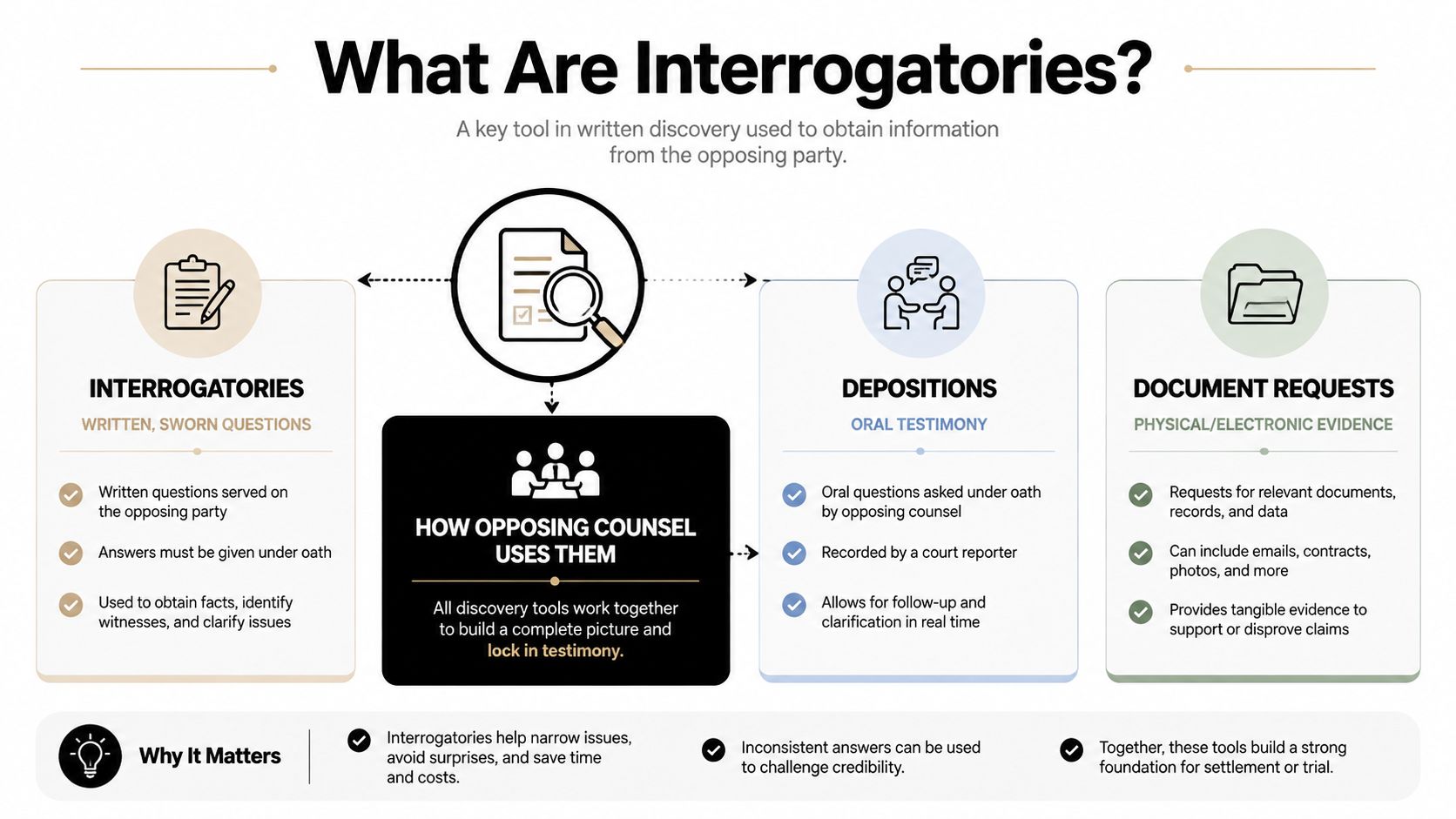
Interrogatories are formal written questions that one party serves on another during discovery. The recipient answers in writing, usually under oath or penalty of perjury, and the answers become part of the case record. They differ from a deposition, where a lawyer asks questions orally and a court reporter records the testimony, and from a document request, which demands identified categories of physical or electronic evidence.
The questions usually seek facts, not a narrative essay. Opposing counsel may ask you to identify witnesses, describe how the collision happened, list medical providers, explain prior injuries, identify lost wages, or state the damages you claim. In a trucking case, the requests may focus on lane position, visibility, fatigue symptoms, communications with witnesses, and the sequence of events before impact.
The questions are designed to narrow your story
A special interrogatory in a traumatic brain injury case might ask:
Identify every symptom you contend resulted from the collision, state when each symptom first appeared, identify each medical provider who treated it, and describe any similar symptom you experienced before the collision.
That question does several jobs at once. It tests causation, identifies witnesses and records, searches for prior conditions, and creates a written version of your testimony that opposing counsel can compare with later deposition answers.
Form interrogatories may use standardized questions approved or commonly used in a jurisdiction. Special interrogatories are drafted for the particular dispute and often target facts counsel considers important. Don't assume a standard-looking request is harmless. A routine question about prior claims or providers may affect medical causation, credibility, or the scope of discoverable records.
Interrogatories also help opposing counsel prepare for your deposition. Your answers identify the subjects they can pursue, the names they can investigate, and the points where your memory or records may be incomplete. Read the questions as a map of the other side's case theory, then prepare answers that are accurate, narrow, and supported by documents. If you need to understand how oral questioning differs, review this explanation of what a deposition is in a lawsuit.
Reading the Deadline and State Rules the Right Way
Deadline mistakes are avoidable, yet they remain one of the most damaging discovery errors. Start with the rule cited in the requests, then confirm the court's local rules, the service method, and any order that changes the default period. Don't assume the federal deadline applies just because the request looks familiar.
Under Federal Rule of Civil Procedure 33, answers and objections are generally due within 30 days after service. The court may set a shorter or longer period, and a defendant generally can't be required to answer in less than 45 days after service of the summons and complaint. Rule 33 has also been amended repeatedly, including amendments adopted in 1946, 1970, 1980, 1993, 2006, and 2007. That history matters because discovery practice changes, and old templates can become unreliable.
State rules can move the deadline substantially:
| Jurisdiction | Default Response Window | Key Exception |
|---|---|---|
| Federal practice | 30 days | The court may set a different period; a defendant generally can't be required to respond in less than 45 days after service of the summons and complaint |
| Massachusetts | 45 days | The state rule uses a longer response period |
| Florida | 30 days | A defendant generally receives 45 days when interrogatories are served with the initial complaint |
| California | Jurisdiction-specific timing | A plaintiff may propound interrogatories 10 days after service or appearance, or 5 days in an unlawful detainer proceeding |
These differences are summarized in the federal rule and the Massachusetts Rule 33 materials. Florida also limits a party to 30 written interrogatories, including subparts, which affects how requests are drafted and counted. California's propounding rules show why the date on which questions may be served and the date responses are due must be analyzed separately.
Calendar the work, not just the due date
On the day you receive the requests:
- Record the service date and the governing court.
- Calculate the response deadline under the applicable rule.
- Set reminders for the deadline and earlier review dates.
- Schedule a client interview before drafting.
- Reserve time for objections, record collection, review, signature, and service.
A response usually must be served on the requesting party, and court self-help guidance explains that it typically isn't filed with the court. Keep the complete signed response and proof of service in the case file. Silence, delay, or an unsigned document can create a waiver argument or trigger a motion to compel, so treat service and verification as part of the response itself.
Preparing Your Answers Step by Step Without Cutting Corners
Don't begin by typing an answer to the first question you see. Read the entire set, including definitions, instructions, and subparts. The definitions may expand terms such as “identify,” “incident,” “medical treatment,” or “communications,” and those definitions control how you should analyze each request.
Build the factual record first
Meet with the client before drafting. An in-person or structured video interview usually reveals details that a quick email exchange misses, including the exact order of symptoms, changes in work capacity, prior injuries, and the names of providers whose offices the client remembers only by location.
Collect the records that will test memory and support the answers:
- Collision materials: Police reports, photographs, vehicle information, incident reports, and insurance correspondence.
- Medical materials: Records, bills, referrals, prescriptions, imaging information, and provider contact details. Counsel can also use resources explaining how to obtain medical records.
- Employment materials: Wage records, attendance records, job descriptions, employer communications, and information about missed or modified work.
- Coverage materials: Relevant insurance policies, claim numbers, declarations pages, and correspondence with insurers.
- Witness materials: Names, addresses, phone numbers, statements, photographs, and social media information that may identify people with relevant knowledge.
Court self-help guidance recommends a disciplined format: calendar the deadline, restate each interrogatory verbatim, answer each separately and fully, and preserve objections with specificity while still answering any non-objectionable portion. That format creates a clean record and makes it easier to defend the response if opposing counsel later claims it was incomplete.
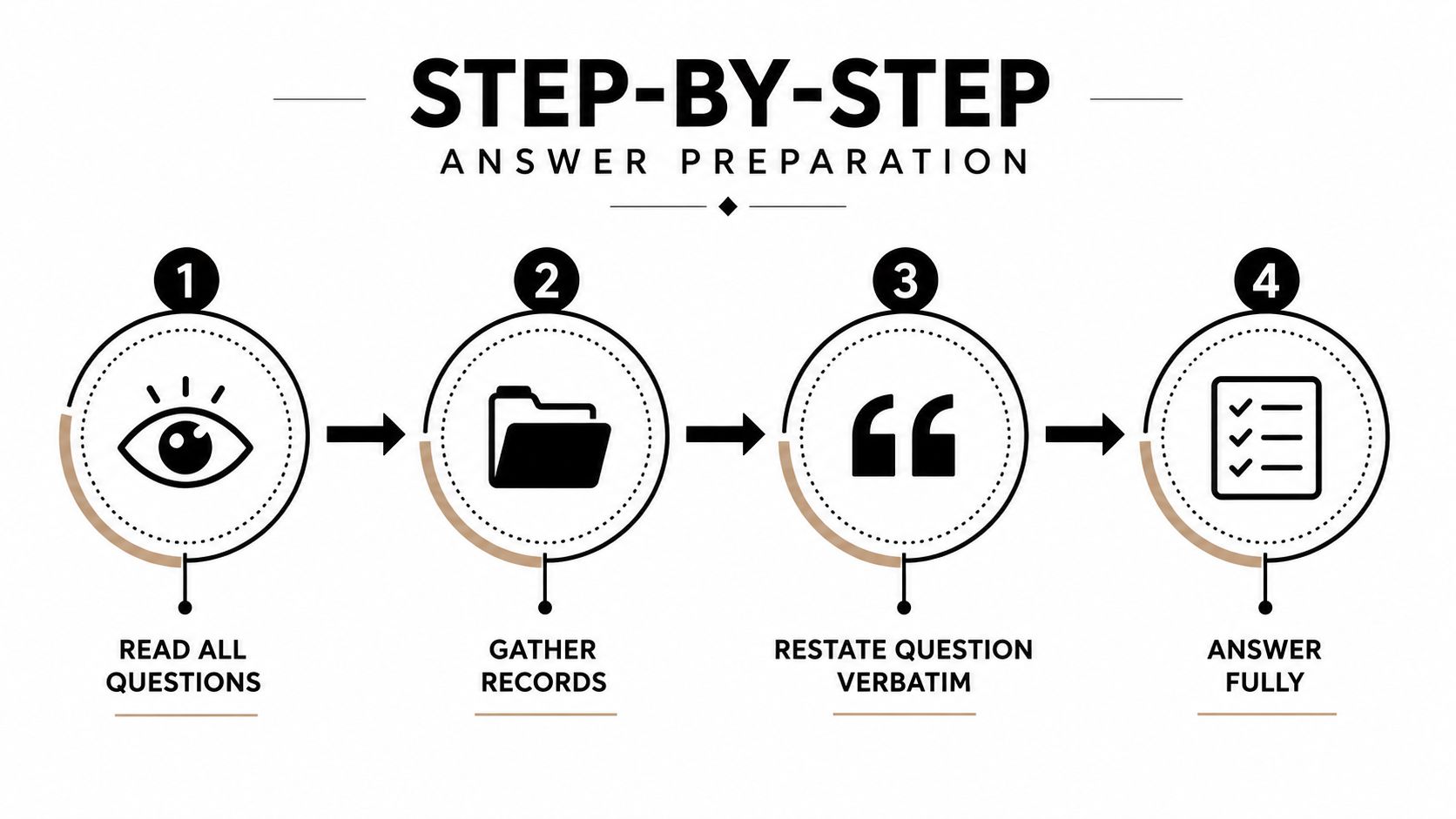
A useful response document normally includes the case caption, the complete text of each interrogatory, a numbered response or objection beneath it, and the verification page. Avoid answering with a separate free-form letter. The requesting lawyer should be able to match every answer to the precise question and every subpart.
Before finalizing, compare the draft against the complaint, medical chronology, wage records, prior disclosures, and the client's own account. Don't “improve” uncertain memories by filling gaps with guesses. State the limits of the information clearly, then identify what you can provide.
The response is generally exchanged directly between the parties rather than filed publicly with the court. That protects sensitive information and is one reason litigants sometimes mistakenly believe nothing formal happened. Keep a service record and preserve the exact version that was served.
Common Objections and When They Actually Work
An objection is not a substitute for an answer. It protects a legitimate procedural or evidentiary interest when the question exceeds the rules, but a boilerplate objection thrown at every request makes the response look evasive and can be waived.
Match the objection to the defect
Relevance may fit a request seeking information unrelated to the claims or defenses. In an injury case, a question about the collision, medical history, work loss, or claimed damages generally has an obvious connection. Don't object to a proper foundation question merely because the answer may be uncomfortable.
Overbreadth applies when the request sweeps far beyond the dispute. “Identify every communication you have had with every person who has ever known you” is materially different from a request for communications with people who witnessed the collision or discussed the claimed injuries.
Vagueness works when you cannot determine what the question asks. Identify the confusing term, explain why it prevents a meaningful response, and answer the reasonably clear portion if you can.
Undue burden requires more than saying the request is inconvenient. Explain the burden and why it outweighs the request's legitimate value. A specific explanation carries more weight than a standard phrase copied into every response.
Attorney-client privilege protects qualifying confidential communications with counsel. Work product protects qualifying materials prepared for litigation, subject to the governing rule and exceptions. Identify the privilege without revealing the protected substance, and maintain a privilege log where required.
The Fifth Amendment objection is often misused in ordinary civil discovery. A civil litigant can't automatically refuse relevant questions by invoking it. Analyze the particular risk and obtain jurisdiction-specific advice before using that objection.
For a practical reference when training a litigation team, consult this master courtroom objections for paralegals. Use it to sharpen issue spotting, not to paste generic language into every response.
A workable objection does two things: identifies the precise defect and preserves every answerable part of the request.
A strong format might read: “Responding party objects that the term ‘all communications' is vague and overbroad because the interrogatory doesn't identify a subject, time period, or connection to the claims. Subject to that objection, responding party identifies communications with the witnesses concerning the collision and claimed injuries.” That approach protects the issue while showing the court that you aren't withholding information without reason.
Privilege Verification and the Form of the Final Response
A draft becomes a usable discovery response only after counsel checks privilege, completeness, formatting, signature, and service. The last review is not clerical busywork. It determines whether the document can be relied on when the case reaches a deposition, mediation, motion hearing, or trial.
Handle privilege deliberately
When an answer withholds information based on attorney-client privilege or work product, don't write only “privileged.” State the basis with enough specificity to permit evaluation without disclosing the protected communication. If documents are withheld, track the decision in a privilege log when the applicable rules require one, identifying the type of material, general subject, date, author, recipients, and privilege asserted without exposing the substance.
Work product requires the same discipline. A lawyer's mental impressions and litigation strategy aren't treated the same way as ordinary factual materials. A client's underlying facts generally shouldn't disappear merely because counsel discussed them while preparing the case.
A final response should contain:
- The correct caption and case number.
- The exact interrogatory and every subpart.
- A separate answer or specific objection for each request.
- Clear language identifying information withheld on privilege grounds.
- A verification signed by the appropriate party.
- A certificate or other proof of service when required.
The elements of a legally binding contract aren't the same as discovery requirements, but the comparison is useful. A response needs clear language, an identifiable signer, and evidence that the document was properly delivered. A polished document with no verification or no service record is still defective.
Verification is testimony under oath
Read every answer before signing. The verification typically states that the responses are true and correct based on the signer's knowledge, information, and reasonable investigation, subject to the wording required by the jurisdiction. The party, not the lawyer, usually verifies factual answers, although the exact form and notarial requirements vary.
Don't sign a blank verification page. Don't sign a response containing guesses, unexplained “unknown” answers, or facts you haven't reviewed. If treatment is ongoing, say so accurately rather than pretending the damages picture is complete.
Here are working examples. They must be adapted to the actual questions and governing rules:
Treating providers
Responding party identifies the following providers who evaluated or treated injuries claimed from the collision: [provider name, specialty, address, and contact information]. This response is based on information presently known and will be supplemented if additional providers are identified.
Accident sequence
Before the collision, responding party was traveling [direction] on [roadway]. The collision occurred when [concise factual description]. Responding party contends that the other vehicle [specific conduct supported by available information] caused or contributed to the collision.
Prior injuries
Responding party recalls [body part or condition] before the collision and identifies [provider or facility, if known]. Responding party doesn't contend that this answer identifies every historical medical record and will supplement if the investigation identifies additional responsive information.
Lost wages
Responding party contends that the collision caused missed or reduced work beginning [date or approximate period]. The calculation is continuing because employment and medical information remain under review. Responding party presently identifies [employer and available description] and will provide an updated calculation when additional records are obtained.
Insurance coverage
Responding party identifies [insurer] as a carrier potentially providing coverage relevant to the claims, subject to the terms, conditions, limits, and applicability of the policy. The policy and claim information are being reviewed.
Answer developing damages without creating a contradiction
Suppose the interrogatory asks for the total amount of damages, but the client is still receiving treatment. A weak answer gives a final-sounding figure based only on bills received so far. A better answer separates what is known from what remains unresolved:
Responding party seeks damages for medical expenses, lost income, pain and suffering, impairment, and other losses caused by the occurrence. Medical treatment remains ongoing, and responding party cannot presently state a final amount for future medical expenses, future wage loss, or other developing damages. Based on records presently available, responding party identifies medical expenses and wage loss incurred to date as reflected in the produced records and available employment information. Responding party will supplement this response as additional treatment, bills, employment records, and expert information become available.
That answer admits the categories of loss and identifies the current evidentiary basis without claiming that the case is fully valued. It also creates a defensible record for later updates. Avoid saying “no further treatment is anticipated” unless the medical evidence and client instructions support that statement.
Before signing: Read the response aloud with the client, compare it against the records, confirm every subpart has an answer, and ask what has changed since the first draft.
Supplementing and Amending Answers as Your Case Evolves
Interrogatory responses are living testimony, not a one-time form. In a personal injury case, the facts often change after the first response because treatment continues, providers change, wage information arrives, and new witnesses surface. A response that was accurate when served can become incomplete later.
Federal Rule 26(e) generally requires supplementation in appropriate circumstances, and equivalent state rules may impose similar duties. The practical triggers are familiar:
- New medical provider: A specialist, therapist, surgeon, or pain-management provider becomes involved.
- New treatment: A procedure, surgery, diagnostic finding, or significant change affects the injury claim.
- Revised wage loss: Employer records clarify missed work, reduced hours, lost benefits, or future limitations.
- New witness: A person with relevant knowledge is identified after the initial investigation.
- Changed damages theory: Medical opinions or factual developments alter the categories of loss being claimed.
Current practitioner guidance emphasizes that supplementation failures can lead to exclusion or other sanctions, particularly when a party has information that should have been disclosed and doesn't update the response. That risk is strategic as well as procedural. Opposing counsel can use an outdated answer to challenge credibility, undermine settlement value, or argue that later information was concealed.
Create a repeatable update system
Don't rely on memory. Use a case calendar and a running discovery log.
- Flag the answer: Mark every response that says “presently known,” “to date,” or “continuing.”
- Track developments: Add new providers, treatment, bills, work records, witnesses, and relevant communications as they arrive.
- Review regularly: At each meaningful case event, compare the current facts against the served answers.
- Draft narrowly: Update only what changed, identify the original interrogatory, and state the new information clearly.
- Verify and serve: Follow the jurisdiction's requirements for signatures, verification, service, and any filing associated with the supplement.
- Preserve versions: Keep the original response, every supplement, supporting records, and proof of service together.
An answer shouldn't be amended casually to improve the story. Supplement when the facts require it, and explain the update without editorializing. If the client doesn't know a final value, say what is known, identify the limitation, and preserve the right to provide more information as the evidence develops.
Clean supplementation protects the client at three pressure points. At deposition, it gives the witness a current and organized record. At mediation, it lets counsel present damages supported by the latest treatment and employment information. At trial, it reduces avoidable contradictions that opposing counsel can turn into impeachment.
The operational checklist is simple:
- Deadline: Identify the governing rule and calendar the response date.
- Records: Gather medical, employment, collision, insurance, and witness information.
- Drafting: Restate each question, answer separately, and address every subpart.
- Objections: Use specific grounds and answer the non-objectionable portion.
- Verification: Review the completed response with the client before signing.
- Service: Serve the requesting party and retain proof.
- Supplementation: Track changes until the case resolves.
Nares Law Group LLC helps injured people and families manage discovery, medical documentation, damages evidence, negotiation, and trial strategy in motor vehicle, trucking, brain injury, and wrongful death cases. If interrogatories have arrived or your treatment is still developing, visit Nares Law Group LLC to request a consultation before an avoidable response mistake becomes part of your case.