The phone keeps ringing. A hospital social worker left a message. An insurance adjuster wants to “ask a few questions.” Someone in the family is trying to plan a service, someone else is looking for paperwork, and nobody agrees on what to do first.
That's where many wrongful death cases begin. Not in a courtroom. Not with a lawsuit. They begin in a living room, at a kitchen table, or in a parking lot outside an emergency room, when a family is still in shock and trying to function through grief.
If you're reading this, you may be dealing with two realities at once. You're mourning someone you love, and you're starting to suspect that their death should never have happened. That combination creates confusion, anger, guilt, and urgency all at the same time. Families often worry that taking legal steps will feel cold or transactional. In practice, the opposite is usually true. Clear legal action can protect your family's future, preserve the truth of what happened, and prevent an insurance company or defendant from controlling the story.
A wrongful death claim is a civil case. It is the formal legal process for holding a person or company accountable when a death was caused by wrongful conduct or negligence. But before any complaint is filed, families need a practical path through the first days and weeks.
Navigating the Unthinkable After a Sudden Loss
A sudden death tears up ordinary decision-making. People forget names, lose documents, and agree to things they barely remember later. That's normal. Grief affects attention, memory, and energy. It also creates openings for avoidable mistakes.
I've seen the same pattern again and again. One family member speaks to the insurer because they think they have to. Another cleans out a vehicle or throws away damaged property because it's too painful to look at. Someone assumes the criminal case, if there is one, will handle everything. Months later, the family learns that key proof is gone and legal deadlines didn't wait.
Practical rule: In the first days after a death, your job isn't to solve the whole case. It's to avoid losing rights while your family gets its footing.
That means slowing down just enough to separate urgent tasks from important ones. Funeral arrangements may be urgent. Returning every insurance call usually isn't. Telling your story to five different people may feel productive, but it can create inconsistencies that get used against you later.
What families need most at the beginning
The first step in learning how to file a wrongful death claim isn't drafting papers. It's creating order.
A simple approach works best:
- Choose one point person: Pick one family member to gather documents, track calls, and coordinate updates.
- Start a case folder: Use a physical folder, a notebook, or a shared digital drive. Keep every record in one place.
- Pause before signing anything: Releases, authorizations, and settlement papers can have long-term consequences.
- Write down what you know now: Dates, times, names, conversations, and your own observations fade faster than people expect.
The legal process starts before court
The actual filing step in a wrongful death case usually requires the legally authorized person, often a personal representative or estate executor, to file a complaint in the proper court and support it with evidence such as police reports, medical records, witness statements, and financial records showing losses like funeral expenses and lost income, as explained in this overview of the key steps in filing a wrongful death claim.
That matters for a simple reason. By the time the lawsuit is filed, the groundwork should already be underway. Families who treat the early period as only emotional often discover later that it was also the most important evidence-preservation phase.
Who Can File a Claim and When You Must Act
In the first week after a death, families often ask one question with complete sincerity: “Can I file this myself?” The answer depends on your relationship to the person who died, your state's law, and whether someone has been formally appointed to act for the estate.
That can feel cold at a painful time, but courts care about authority before they consider fault or damages. If the wrong person files, the case can stall while the family is still trying to bury a loved one, sort out bills, and answer calls from insurers.
Some states let certain surviving relatives file directly. Others require the claim to be brought by a personal representative for the estate, with any recovery later distributed to eligible family members. Questions about spouses, children, parents, stepchildren, unmarried partners, and dependent relatives come up early and often. A practical starting point is to confirm who can sue for wrongful death under the law that applies to your family.
Standing comes before the case can move
Lawyers call this standing. In plain English, it means the court needs the legally authorized person in front of it.
That issue becomes more complicated in real households than many people expect:
- Unmarried partners: A committed relationship does not always create a legal right to file.
- Blended families: Stepchildren and adult children may be treated differently from biological or adopted minor children.
- Dependent relatives: Financial support sometimes affects who may recover.
- Estate administration: If no personal representative has been appointed, that step may need to happen first.
I often tell families to resolve this question early, even if it feels bureaucratic. It prevents infighting, missed paperwork, and delays that eat into the time needed to investigate the death properly.
The deadline starts while life is still upside down
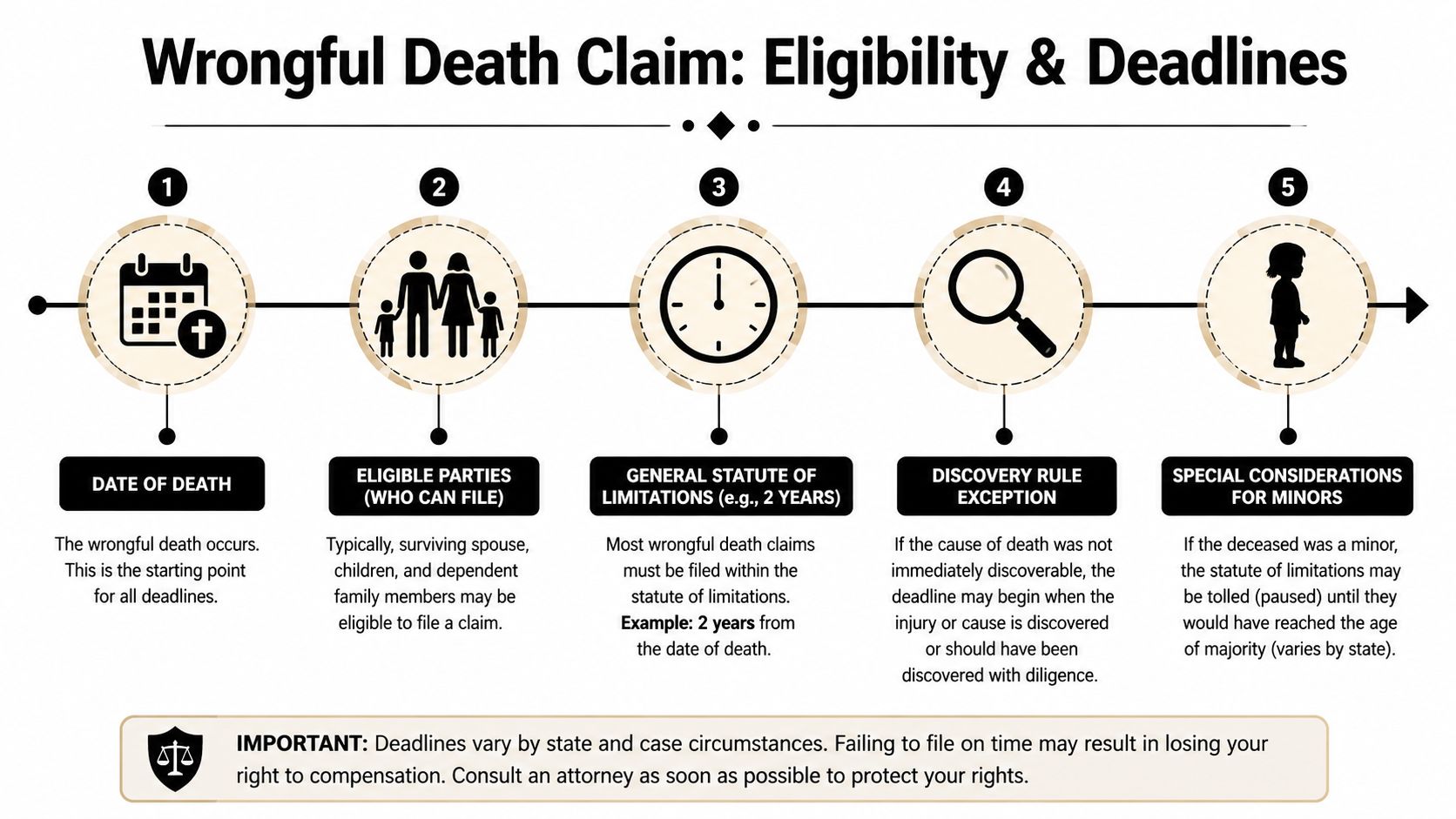
Wrongful death claims are controlled by a statute of limitations. That is the filing deadline. If it passes, the court may dismiss the case even when the evidence is strong and the loss is clear.
Florida generally applies a two-year deadline in many wrongful death cases. Families looking for a state-specific explanation can review Florida wrongful death claim limits. The exact rule can change based on the facts, the parties involved, and any exception that might apply, so families should get advice tied to their own case.
The hard part is timing rarely matches grief. The deadline usually begins on the date of death. It does not wait for a criminal investigation to finish, for the insurance company to respond, or for the family to feel ready to talk about a lawsuit.
What families should do early
You do not need every answer before taking protective steps. You do need to avoid delay.
A good early approach includes:
- Confirm who has authority to act: Find out whether an estate needs to be opened and who should serve as personal representative.
- Gather basic documents: Death certificate, will, court papers, marriage records, and contact information for immediate family.
- Keep a deadline calendar: Write down the date of death and any related dates from insurance, probate, or government notices.
- Get legal guidance before assumptions harden: Families often lose time because everyone assumes someone else has the right to file.
Some cases do qualify for exceptions, especially when the cause of death was not immediately known or another legal issue affects the time limit. Families should treat exceptions as narrow, not as a backup plan. The safer course is to act early, identify the proper claimant, and protect the case before the window closes.
Preserving Critical Evidence in the First 48 Hours
In the beginning, families often think “evidence” means official records they can request later. Some of it does. But some of the strongest proof disappears fast.
What a witness remembers today may be muddy in a week. A damaged vehicle may be repaired, moved, or sold. A text message thread can be deleted by accident. Security footage may be overwritten. That's why evidence preservation should begin in the first days after a death, and delays can undermine causation even before any filing deadline runs out, as explained in this guide to pursuing a wrongful death lawsuit.
What to save right away
Treat the first couple of days like a preservation window. You are not proving the whole case yet. You are preventing loss.
- Save communications: Keep voicemails, text messages, emails, social media messages, and call logs related to the incident.
- Photograph what you can: If appropriate and accessible, take photos or video of vehicles, property damage, road conditions, safety hazards, or visible injuries.
- Write a personal timeline: Record what happened, who called whom, what doctors said, and what you personally observed.
- List witnesses: Write down names, phone numbers, job titles, and how each person may know something useful.
- Preserve objects: Don't repair, wash, discard, or alter items connected to the death unless you've gotten legal advice.
For families dealing with a crash or other fatal event, a focused wrongful death investigation often begins with the very things people are most likely to overlook at home.
What not to do
Families can damage a strong case without realizing it.
A few common mistakes:
- Giving a recorded statement too soon: Insurance representatives may sound sympathetic, but their job is to gather information that protects their side.
- Assuming a criminal case preserves everything: A criminal investigation and a civil wrongful death claim are separate matters.
- Relying on memory: Grief distorts detail. Notes made early are far more reliable than recollections months later.
- Talking broadly on social media: Posts can be misunderstood, shared, and used out of context.
A parallel criminal case does not stop the civil filing clock. Families should not wait for an arrest, a plea, or a verdict before protecting the civil claim.
The emotional side of preservation
This part is hard because it can feel invasive. Saving painful records or taking photos may feel disloyal to your grief. It isn't. It is one way families protect the truth before time erases it.
If you're too overwhelmed to handle that task yourself, ask one trusted person to do it for you. The right time to preserve evidence is usually earlier than the right time to process it emotionally.
Documenting Your Losses and Calculating Damages
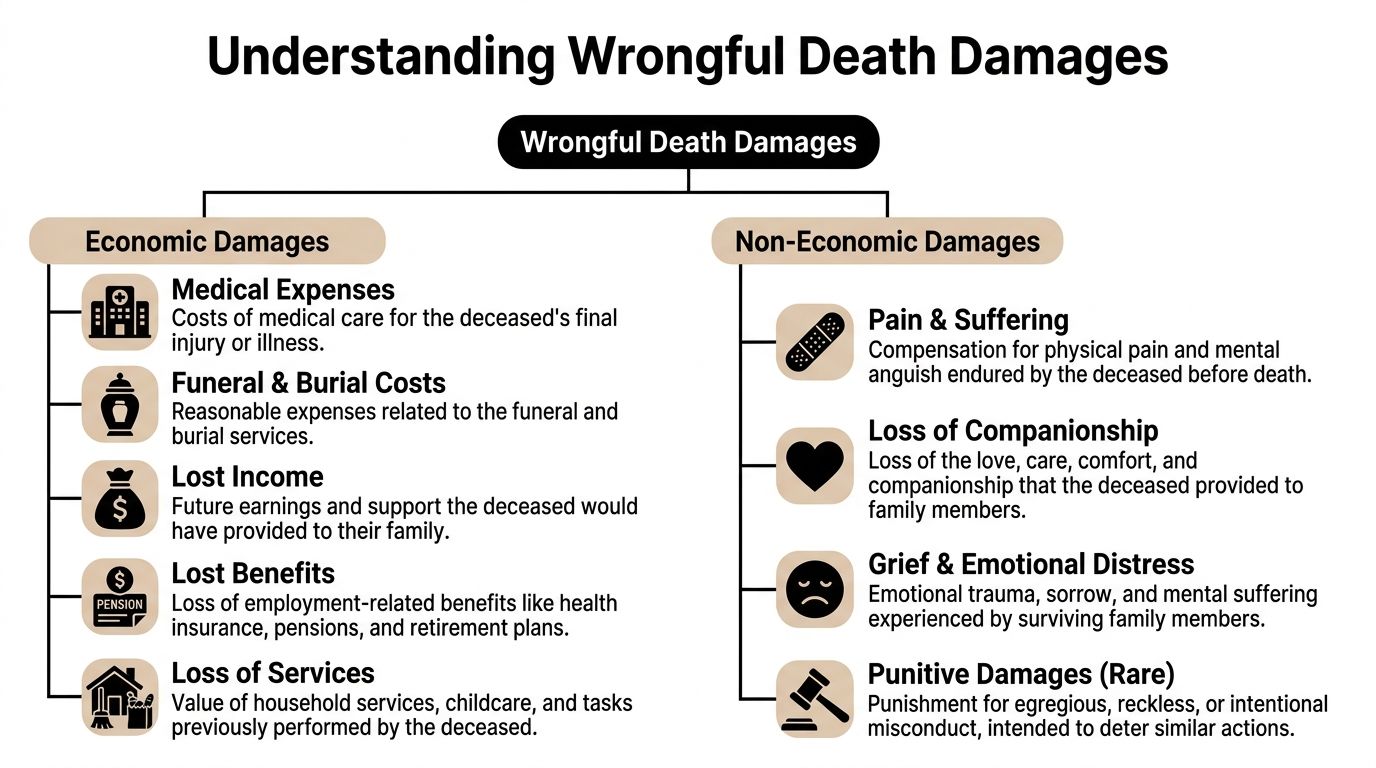
After the immediate evidence is protected, the next task is documenting what the death has cost your family. The law calls those losses damages.
That term can sound clinical. Families sometimes recoil from it because no dollar figure can represent a person's life. That reaction makes sense. A wrongful death case does not put a price on love. It creates a legal record of harm and seeks compensation for the financial and human losses the death caused.
Economic losses you can document
These are the losses that usually have paper trails. Building a strong case often requires accident reports, medical records, income records, medical bills, and funeral expenses to support economic and non-economic loss calculations, and early economic analysis can become an important advantage because discovery is often the longest phase and many cases settle before trial, according to this explanation of the wrongful death claims process.
Here's a practical document list:
| Category | Examples of proof |
|---|---|
| Final medical care | hospital bills, physician records, treatment summaries |
| Funeral and burial costs | invoices, receipts, payment confirmations |
| Income loss | pay stubs, tax returns, W-2s or similar wage records, employer letters |
| Benefits and support | retirement benefits information, health insurance records, employment benefits summaries |
| Household contributions | calendars, family budgets, childcare records, service invoices showing tasks the deceased handled |
If you want a fuller discussion of how the law approaches compensation categories, wrongful death damages is a helpful starting point.
Non-economic losses are real losses
Not every harm comes with a receipt.
A surviving spouse may lose companionship and daily partnership. A child may lose guidance, care, and stability. Parents may lose a relationship that shaped their daily lives. These harms are harder to quantify, but they are central to the case.
A useful way to think about non-economic damages is this: the law is trying to describe the lived impact of the absence. What did this person do in the home? Who depended on their advice? How did they shape routines, decisions, and emotional support?
Keep a living record of impact
Don't wait until litigation to describe the human loss. Start now.
Consider keeping:
- A family impact journal: short entries about missed milestones, changed routines, and emotional effects
- A services log: tasks the deceased performed, such as transportation, scheduling, childcare, cooking, or home maintenance
- A benefits file: any lost health coverage, retirement support, or work-related benefits
- A relationship file: photos, cards, messages, and other materials that show the depth of family connection
The strongest damages presentation combines records and real life. Bills matter. So do the ordinary routines that disappeared with the person you lost.
Hiring a Lawyer and Taking Formal Legal Action
Some families call a lawyer the same day. Others wait because they are still arranging a funeral, answering relatives, and trying to understand what happened. Both responses are normal.
The right time to call is usually when you are ready for someone else to protect the case while you protect your family. A good lawyer does more than file papers. Counsel should help stop avoidable mistakes, identify who has the legal right to bring the claim, preserve evidence that may still be in other hands, and give you a realistic view of the case. In Colorado, for instance, Nares Law Group LLC handles wrongful death matters as part of a broader injury and fatal crash practice.
What happens after you hire counsel
One of the first jobs is to create order. Families often arrive with pieces of the story scattered across text messages, hospital records, photographs, employer paperwork, insurance calls, and unanswered questions. A lawyer pulls those pieces into a case file and decides what has to happen now, what can wait, and what could be lost if no one acts quickly.
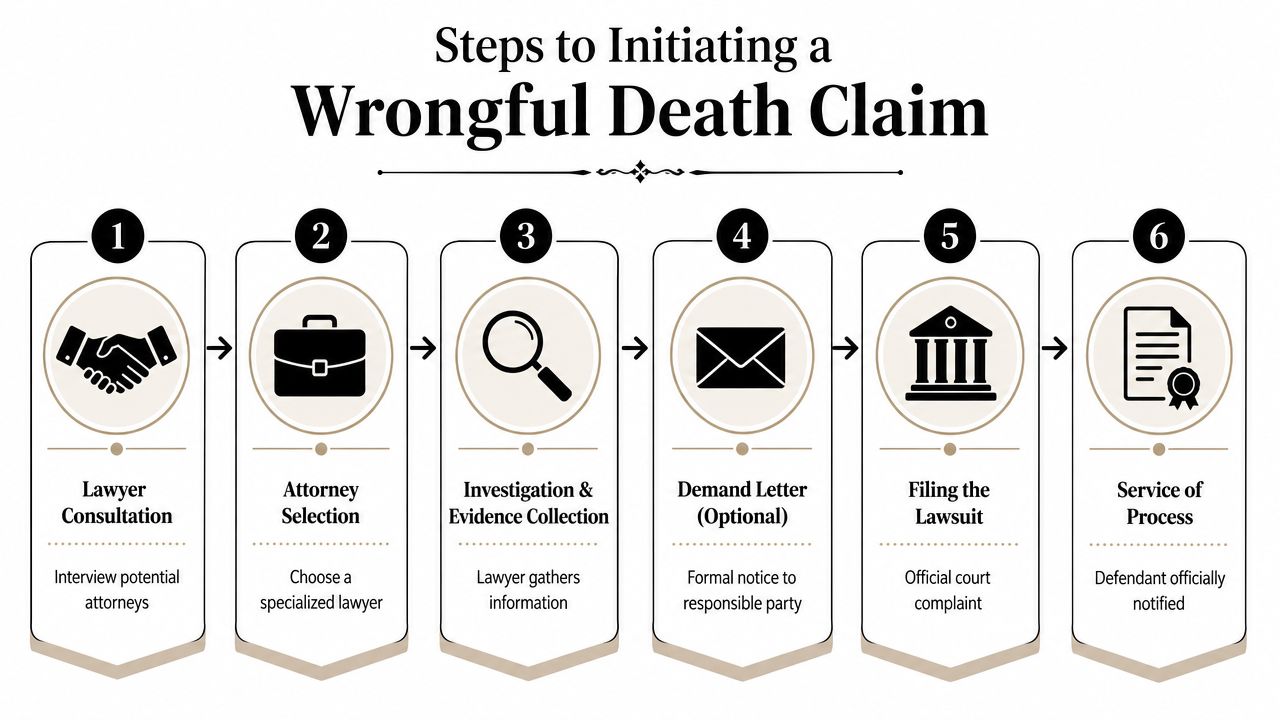
The formal process usually includes:
Initial review and deadline check
The lawyer confirms the basic facts, looks for filing deadlines, and identifies immediate risks.Investigation
Records are requested, witnesses are contacted, and outside evidence such as crash reports, video, maintenance records, or employment records is pursued before it disappears.Standing and estate review
The lawyer determines who can file the claim and whether a probate or personal representative issue must be handled first.Complaint drafting and filing
The complaint is the court document that states what happened, who is being sued, and what losses the family is asking the court to address.Service of process
Each defendant must be formally served under the court rules. If that step is done incorrectly, the case can be delayed or challenged.
A practical overview like this overview of the first steps to filing a wrongful death claim explains why early procedural mistakes can create expensive problems. A state-specific resource such as Bryan Fagan Law's guide can also help families see how filing rules work in day-to-day practice.
Here is a short video explanation of the early process:
Questions worth asking in a consultation
The best consultations answer the questions families are living with, not just legal ones. You need to know who will handle the case, what the firm needs from you now, and what pressure points may show up early.
Ask questions like these:
- Who would file the claim in our family, and does anything need to happen with the estate first?
- What evidence should we gather ourselves, and what should we leave alone so it is preserved properly?
- Do we need to stop speaking with an insurance adjuster, employer, or investigator?
- What problems do you see right away with fault, timing, or proof?
- How often will we hear from your office, and who will be our day-to-day contact?
- If settlement talks start early, how will you decide whether an offer is fair?
A complaint is the formal version of your family's case. It has to name the right plaintiff, the right defendants, the right court, and facts that support both liability and the losses your family will carry for years.
The Road Ahead Negotiation Trial and Common Pitfalls
A few months after a sudden death, many families are surprised by how ordinary the paperwork can look. Written questions arrive. Medical and employment records are requested. An insurance company asks for one more conversation. Meanwhile, the family is still trying to get through birthdays, school pickups, mortgage payments, and a grief that does not follow the court's calendar.
Once the complaint is filed and the defendant is served, the case enters the part commonly understood as litigation. That usually means discovery, settlement discussions, and sometimes trial. Deadlines still matter at this stage, and so does patience. A case can look quiet from the outside while important work is happening behind the scenes.
Discovery, negotiation, and trial
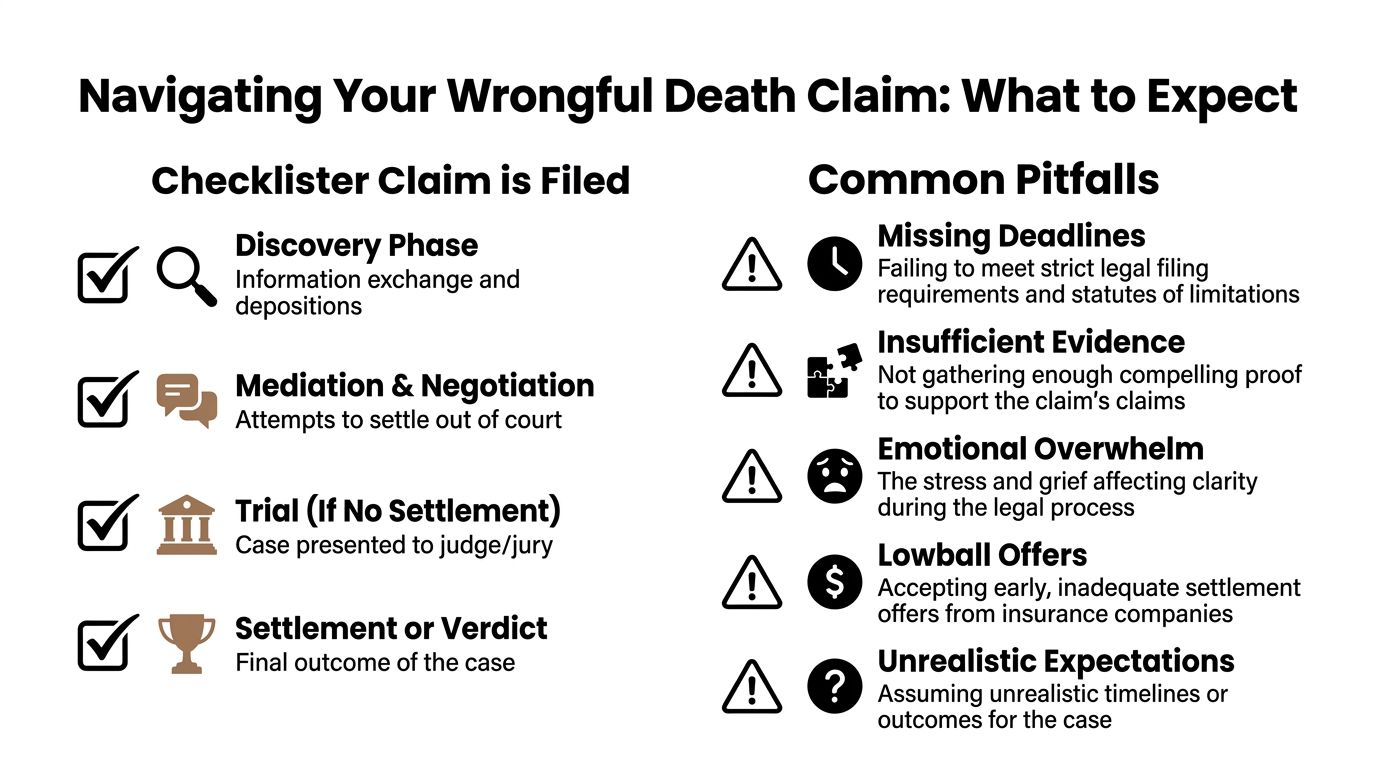
Discovery is the formal information-gathering stage. Each side can ask for documents, send written questions, and take depositions under oath. In practice, this is often where the case becomes clearer. Records may confirm what the family suspected, or they may expose a problem that needs to be addressed early.
This stage can also feel invasive. Defense lawyers may ask about the person who died, the family's relationships, finances, medical history, and daily life after the loss. Those questions are not always fair in tone, but they are often part of how damages are tested. Good preparation matters because careless answers can create confusion that lasts through the rest of the case.
Negotiation can start at almost any point. Some cases settle early. Others do not become serious until key witnesses testify or a damaging internal document surfaces. Families should understand the trade-off. An earlier settlement may bring quicker financial stability and less stress. Waiting may increase the value of the case, but it also means more delay, more uncertainty, and more emotional wear.
Trial is where a judge or jury decides the case if settlement does not happen. Trial can bring accountability in a way private negotiations cannot. It is also demanding. Family members may have to testify about painful details in a public courtroom, and the result is never guaranteed, even in a strong case.
Common pitfalls that hurt otherwise valid claims
The most common mistakes are not dramatic. They are small decisions made while people are exhausted.
- Taking a quick settlement without seeing the full picture: Funeral bills, missed income, and immediate household pressure can make early money hard to refuse. The problem is that the long-term financial and personal loss is usually not fully documented yet.
- Treating the case like it will speak for itself: Strong facts still need organized records, credible witnesses, and clear proof of the family's losses.
- Posting online or texting carelessly about the case: Photos, comments, and casual messages can be pulled out of context and used to challenge credibility or the seriousness of the loss.
- Letting too many relatives communicate with insurers or lawyers: Mixed messages create avoidable problems. One family contact person usually keeps information cleaner and reduces stress.
- Ignoring your lawyer's requests because the case feels overwhelming: Delayed forms, missing records, and incomplete answers can weaken settlement talks and trial preparation.
- Expecting the lawsuit to deliver emotional closure: A civil case can provide accountability and financial support. It does not fix the absence at the dinner table or make the process feel humane.
One pattern I see often is this: a family stays careful in the first few weeks, then relaxes once the case is filed. That is understandable, but it is risky. Cases are often won or lost in the months after filing, when documents are exchanged, witnesses are pinned down, and the defense starts testing for gaps.
Settlement talks are stronger when the defense sees a family that has stayed organized, protected key records, and is prepared to prove the case if trial becomes necessary.
A practical checklist you can print
Keep this list where the family can use it:
- Save every letter, email, bill, and benefits notice
- Use one folder, digital or paper, for case-related records
- Choose one family spokesperson for lawyers and insurers
- Do not sign releases without legal review
- Do not guess if you do not know an answer
- Keep social media quiet while the case is pending
- Update your lawyer about new expenses, counseling, wage loss, or family changes
- Prepare for delays and ask what is happening when the case seems silent
- Measure any offer against the family's future needs, not just today's pressure
- Remember that a criminal investigation and a civil claim are separate matters
A wrongful death claim cannot repair the loss. It can, however, protect a family from carrying the financial cost of someone else's wrongdoing and preserve a truthful account of what happened.
If your family is facing questions about standing, evidence, deadlines, or the first steps in a wrongful death case, Nares Law Group LLC offers consultations for families who need practical guidance after a fatal crash or other wrongful death event. The firm works with surviving families to investigate what happened, protect evidence, and move the legal process forward with clarity and compassion.