You've been injured, your medical bills are arriving, and an insurance company may already be asking questions. Your lawyer mentions litigation or trial, but the word “trial” can make it sound as if everything happens in a courtroom on one dramatic day. It doesn't. How to prepare for trial is really a question about how to manage your case for months, sometimes longer, without allowing gaps in treatment, missing documents, inconsistent statements, or avoidable surprises to weaken your position.
A personal injury case is built through ordinary decisions made long before jury selection. You attend medical appointments, preserve evidence, answer discovery truthfully, prepare for depositions, communicate changes promptly, and help your attorney understand both the strengths and the uncomfortable facts. That discipline improves the case whether the final result is a verdict or a settlement.
What Trial Preparation Actually Looks Like
Trial preparation doesn't begin when the court assigns a trial date. It begins when your lawyer starts developing the case. The work usually moves through four overlapping phases: early case management, discovery, witness and exhibit refinement, and final courtroom readiness. Each phase has its own deadlines, but information from the first phase can affect every later decision.
During early case management, your attorney investigates liability, identifies responsible parties, protects photographs and physical evidence, and tracks filing requirements. You should keep a running record of medical visits, symptoms, missed work, out-of-pocket expenses, and changes in your daily life. If you wait until trial preparation is underway to reconstruct those details, memory gaps will be mistaken for missing proof.
The four working phases
- Case development: Your lawyer establishes the factual theory, identifies potential witnesses, preserves evidence, and evaluates liability and damages.
- Discovery: Both sides exchange information through written requests, document production, depositions, and, when appropriate, medical examinations.
- Refinement: The team tests witness testimony, reviews exhibits, develops demonstratives, addresses evidentiary disputes, and integrates expert opinions.
- Final readiness: Counsel prepares motions, witness files, exhibit lists, courtroom technology, jury materials, and the daily trial plan.
Witness preparation itself isn't a single meeting. Legal literature describes it as a three-part process involving conceptualization training, skills-acquisition training, and transfer training. Research reviewing witness preparation also identifies recurring tasks, including teaching courtroom procedure, helping the attorney understand the witness's testimony, and improving the witness's delivery. A trial-preparation study found improvements in several delivery skills and overall testimony quality, while trained mock defendants were judged more credible than unprepared defendants. Those findings support a practical rule, preparation affects not only what a witness knows, but how jurors perceive credibility. The Office of Justice Programs summarizes this witness-preparation research.
Practical rule: Your case file should answer what happened, what changed medically, who can prove it, and where every supporting document is located.
Treat organization like a second job. A secure digital folder, a dated chronology, and a dependable document system can keep medical records, bills, photographs, wage records, and correspondence from becoming an unsearchable pile. Law firms that need a structured filing system may also consider a trusted document organizer for law firms, provided access controls and confidentiality requirements are handled appropriately.
The Pretrial Timeline From Filing to Verdict
After filing a personal injury complaint, your case enters deadlines that can stretch for months. The work completed early shapes discovery, expert opinions, settlement discussions, and the evidence presented at trial. A case does not advance in one sprint. It develops through stages controlled by the court, the judge, the issues, expert involvement, and the conduct of both sides.
Civil cases usually settle before trial. That does not justify light preparation. The party with organized proof, credible witnesses, and a trial-ready plan has more influence in negotiations. Cornell Law School's explanation of expert witness reports discusses these civil-case benchmarks.
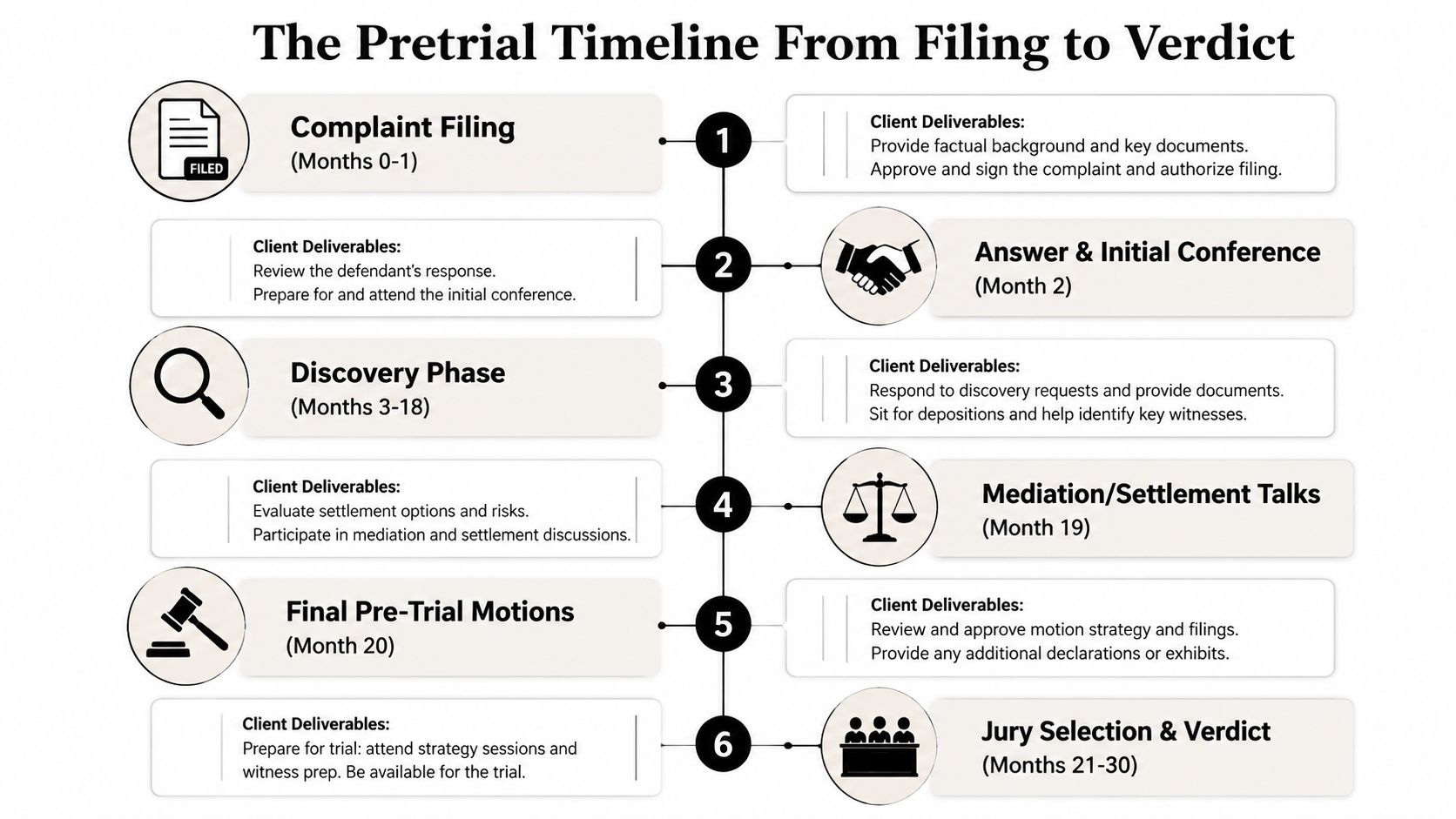
Where the major work occurs
After filing, the complaint defines the claims and the defendant responds. Confirm the factual details, identify every medical provider, supply requested records, and preserve evidence. Treat each request as case preparation, not paperwork. A wrong date or missing provider can create a credibility problem that the defense will exploit.
During discovery, expect questions about the incident, injuries, prior medical history, employment, finances, social media, and daily activities. Review deposition preparation carefully because your answers become part of the record. Tell your lawyer promptly about every new provider, diagnosis, symptom, and treatment recommendation.
As discovery closes, the case moves from collection to selection. Counsel determines which witnesses matter, which records support each legal element, which exhibits can be admitted, and which weaknesses the defense will attack. Expert disclosures in federal civil litigation must include opinions, considered facts or data, supporting exhibits, qualifications, prior testimony, and compensation. Experts need to participate early enough to shape depositions and the case theory.
Before trial, counsel prepares pretrial statements, witness and exhibit lists, examination outlines, motions, and jury instructions. The Federal Defender checklist recommends re-reviewing discovery, subpoenaing witnesses, identifying evidentiary issues, preparing trial notebooks and witness files, and conducting mock examinations. The Federal Defender trial-readiness checklist captures the right approach: preparation follows milestones, and each milestone requires a decision.
Civil litigation can also involve long waits between filing and trial. Official civil justice statistics from England and Wales reported that small claims took an average of 49.8 weeks to reach trial in January through March 2025, while fast, intermediate, and multi-track claims took 74.7 weeks. The practical rule is straightforward: preserve evidence, update medical records, and maintain an accurate treatment chronology throughout the case. Do not wait for a trial date to begin acting trial-ready.
Organizing Evidence and Medical Proof
A case can look strong in a courtroom and still fail if the proof was never organized during the months before trial. Build the file around two questions: what proves the defendant caused the incident, and what proves the injury changed your health, work, finances, and daily life. Keep those questions connected, but do not bury them in one unstructured folder.
For liability, preserve the police report, scene and vehicle photographs, surveillance footage, witness contact information, property records, inspection materials, and documents that may show a safety violation. Never edit original photographs or videos. Keep the original file, record when and how it was created, and send a copy to counsel. A missing original or unclear file history can create an avoidable credibility problem.
Damages proof requires consistent recordkeeping. Maintain emergency and hospital records, imaging, specialist notes, rehabilitation records, medication histories, neuropsychological evaluations, work restrictions, wage documentation, and explanations for treatment gaps. A brain injury often appears through a pattern of symptoms and functional changes rather than one document. Your chronology should connect each appointment to the symptom or condition it addressed, then show whether treatment changed your ability to work or manage ordinary tasks.
Build a usable evidence system
- Create one master chronology: List the incident, symptoms, providers, diagnoses, tests, treatment, work changes, and major life changes in date order. Update it after each meaningful development.
- Explain gaps promptly: If insurance problems, work demands, transportation, provider access, or fluctuating symptoms delayed care, write down the reason and tell your attorney. A documented explanation is more credible than a rushed answer at deposition or trial.
- Track expenses once: Record mileage, copayments, equipment, prescriptions, household assistance, and other out-of-pocket costs in one spreadsheet, with receipts attached.
- Preserve physical evidence: Store a damaged helmet, defective product, footwear, vehicle part, or other relevant object safely. Do not throw it away, repair it, or give it to anyone without legal advice.
- Photograph consistently: Use dated photographs to document visible injuries and changes. Ask your lawyer about appropriate intervals and privacy concerns.
| Evidence Category | Key Documentation Required |
|---|---|
| Liability | Police report, scene photographs, surveillance, vehicle damage records, witness information, inspection or safety records |
| Medical treatment | Emergency records, hospital records, imaging, specialist notes, rehabilitation records, prescriptions |
| Brain-injury proof | Cognitive complaints, neuropsychological evaluations, therapy notes, functional observations, family or coworker observations |
| Employment and income | Pay records, employer verification, missed-work records, restrictions, reduced-duty documentation |
| Out-of-pocket losses | Receipts, mileage logs, equipment invoices, medication costs, household assistance records |
| Physical evidence | Original footwear, damaged helmet, defective product, vehicle components, photographs and chain-of-custody notes |
Use a consistent folder and naming system so counsel can find the record behind every important statement. For a practical method of maintaining a litigation file, review this Attorney Assistant's case file guide. If records are missing, coordinate with your lawyer on how to obtain medical records. Do not order duplicates randomly. Track each request, the date received, and what remains outstanding.
The defense will compare your records with your testimony, employment history, and daily activities. Accurate, complete, and explainable documentation protects credibility and gives your attorney a clearer basis for evaluating the case and negotiating from a trial-ready position.
Preparing Witnesses for Direct and Cross
A witness can know the truth and still testify poorly. People ramble, guess, overstate symptoms, forget dates, become defensive, or answer questions they were not asked. Effective preparation reduces those problems while keeping the testimony natural and truthful.
Start by deciding which witnesses matter. A personal injury case may involve you, treating physicians, family members who observed changes in daily function, coworkers who saw work limitations, and eyewitnesses to the collision. Each person needs a separate plan. Your spouse should describe observed changes, not offer medical opinions. Your doctor should address diagnosis, treatment, and causation, not speculate about how the injury affected your marriage.
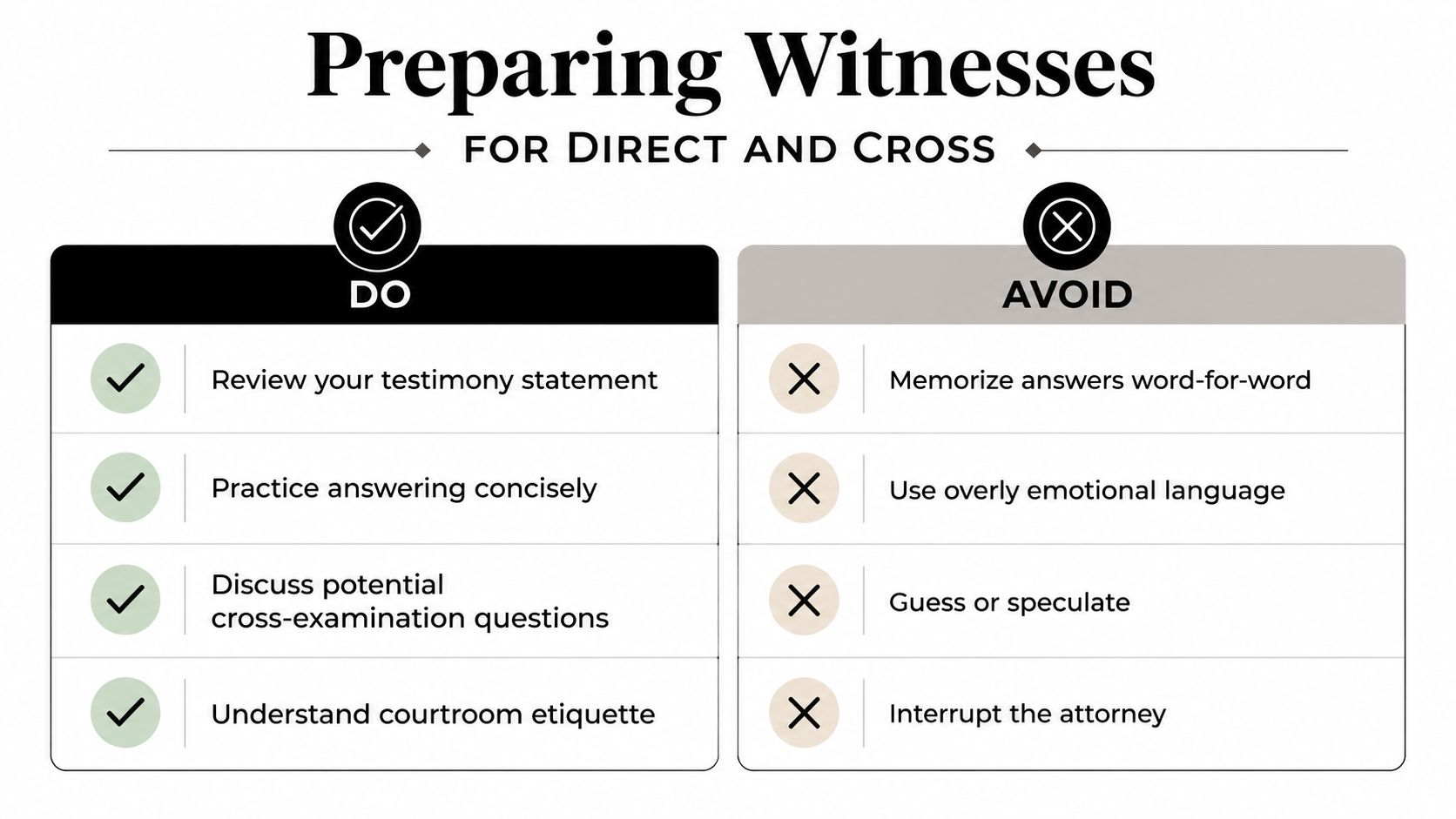
What preparation feels like
A serious session starts with the record. Counsel reviews prior statements, written discovery, medical histories, deposition testimony, photographs, and documents likely to be used at trial to identify what the witness remembers, what the records show, and where the two may appear different. That review exposes gaps early, gives the witness a chance to correct misunderstandings, and prevents avoidable surprises in court.
A brain-injury client may face questions about social-media activity. The defense may point to a photograph from a family event and ask why the client appears active while reporting fatigue or cognitive difficulty. Give a truthful account of that particular day. Explain what the photograph shows, what it does not show, and whether the activity caused symptoms afterward. Do not memorize a speech.
A treating physician may face questions about treatment costs, the basis for causation opinions, alternative explanations, or the patient's prior medical history. Preparation should help the physician separate personal knowledge, medical records, professional opinion, and information supplied by others. A clear boundary between those categories makes testimony easier to understand and harder to attack.
A spouse may struggle to describe cognitive changes without sounding coached. Counsel should use concrete examples, such as missed steps in a familiar routine, difficulty following conversations, irritability, sleep changes, or the need for reminders. The witness should report what was observed and leave medical diagnosis to qualified professionals.
Direct testimony and cross-examination
On direct examination, answer the question asked and use plain language. Explain any medical term that matters in ordinary words. Say when you do not remember. Ask for clarification if a question is unclear. Short, accurate answers usually carry more weight than a long explanation.
Cross-examination is designed to control the witness. Expect short questions, repeated premises, apparent contradictions, questions about prior injuries, and challenges to memory. Do not fight with the lawyer or volunteer favorable facts after every answer. Your attorney can ask follow-up questions when an answer needs context.
The witness-preparation literature describes preparation through conceptualization, skill acquisition, and transfer. It also identifies courtroom education, attorney understanding of testimony, and delivery modification as recurring components. The research summarized by the Office of Justice Programs reported improved testimony delivery and perceived credibility in the study discussed there.
Credibility comes from accuracy, not confidence. A witness who admits uncertainty is safer than one who guesses confidently.
Depositions deserve the same seriousness as trial testimony. A deposition is not a casual preview. The transcript may later be used to challenge you, so review the subject carefully with counsel and answer truthfully. For a process overview, read this guide explaining what a deposition is in a lawsuit.
Your communication with counsel
Your lawyer cannot prepare around information you hide. Send concise written updates whenever something changes:
- Medical changes: New providers, diagnoses, medications, tests, symptoms, or treatment recommendations.
- Work changes: Missed shifts, reduced duties, termination, promotions, or changes in income.
- Evidence changes: New photographs, messages, recordings, witnesses, or documents.
- Contact from the other side: Any call, letter, message, insurer request, or attempted conversation with opposing counsel.
- Case risks: Prior injuries, prior claims, criminal history, social-media activity, or facts you think may embarrass you.
Stop posting about the accident, your recovery, your activities, and the lawsuit. Do not discuss case strategy with friends, coworkers, or anyone who may repeat the conversation. Never delete existing posts or messages without asking your lawyer. Deletion can create a separate problem. Early disclosure gives counsel time to assess the material and address it.
Short written summaries work better than long, unfocused phone calls. Send the date, event, provider, symptom, expense, and supporting document. A disciplined client keeps counsel informed before the defense discovers the information first. Witness preparation then becomes part of months-long case management, not a rushed courtroom rehearsal.
Building Settlement Strength and Trial Readiness
A settlement offer changes after the defense sees organized proof it must answer at trial. A complete medical chronology, consistent treatment records, and a witness who can explain the injury plainly create a different negotiation than an incomplete file and a client who appears unprepared to testify.
Start with five questions:
- Can the liability witnesses withstand cross-examination?
- Can the medical experts connect the injury to the incident through reliable records and opinions?
- Can the damages evidence explain future needs and daily limitations?
- Can the exhibits make complicated facts understandable?
- Will the plaintiff proceed if negotiations fail?
Digital evidence has made trial preparation more demanding. A litigation survey found that the volume of data lawyers manage is increasing, while the number of documents or exhibits used at trial often stays the same. Respondents also identified AI-assisted case management as a competitive advantage for document analysis, transcript management, chronology creation, and case strategy. NALA summarizes those litigation-support findings.
The answer is disciplined selection, not a document dump. Counsel should reduce the record to proof that establishes liability, causation, and damages. A well-supported life-care opinion can clarify future treatment and assistance needs. Treatment gaps, unexplained changes in symptoms, or inconsistent testimony give the defense material for arguing that the injury is less serious than claimed.
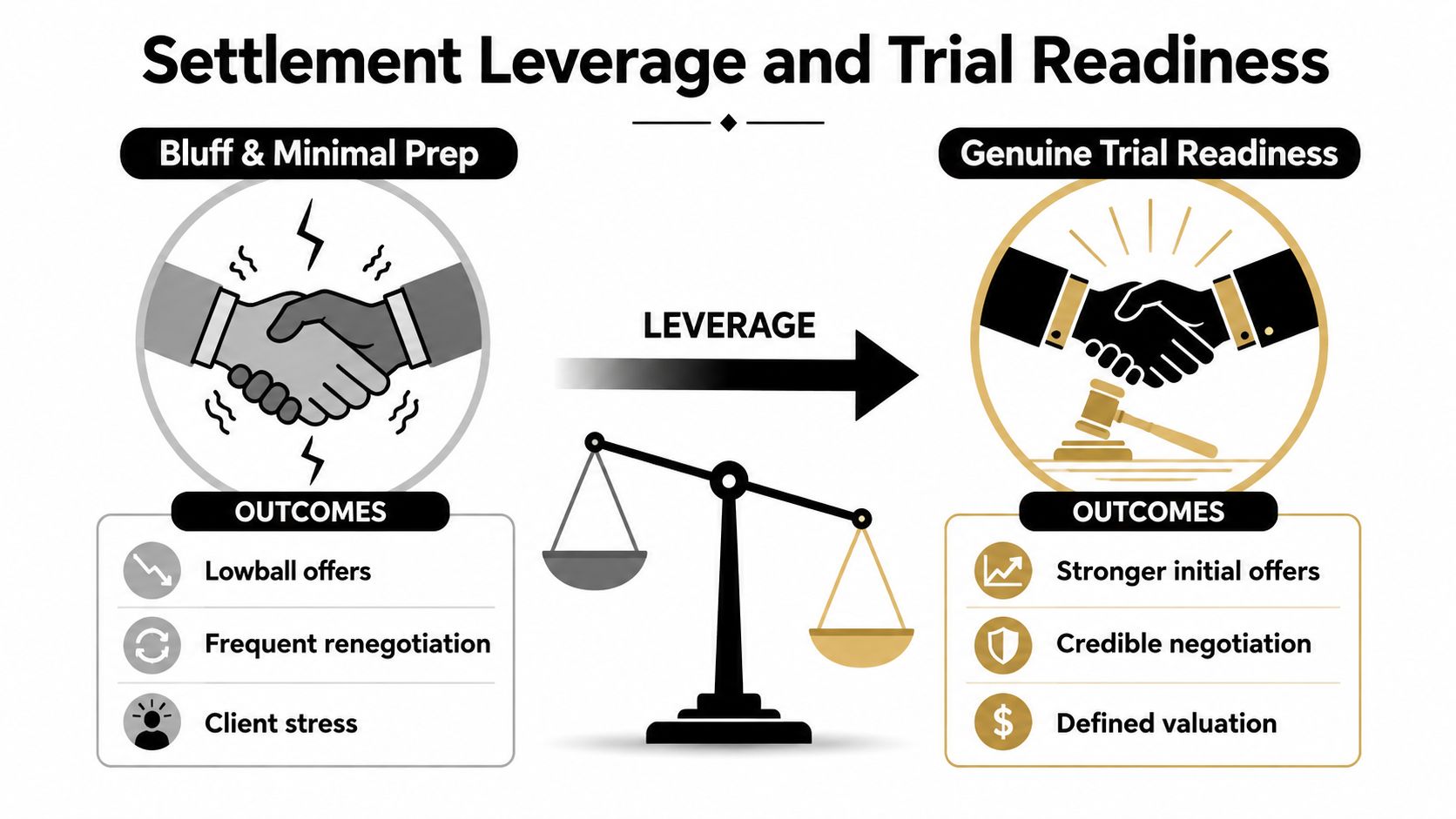
Consider a client whose treatment records are scattered across several providers. Counsel builds a dated medical chronology, matches each complaint to an examination or treatment recommendation, and identifies why care changed. At mediation, the defense can no longer characterize the treatment history as a vague series of visits. The organized record gives counsel a specific basis to demand payment for documented losses and future care.
Evaluate an offer beyond its headline amount. Discuss the risk of an adverse verdict, delay before payment, litigation expenses, appellate issues, tax considerations where relevant, and the emotional cost of testifying. Your attorney should explain the evidence-based valuation and the weaknesses a jury could exploit.
Preparation can change negotiations after a strong deposition, favorable expert exchange, or the start of jury selection. It cannot guarantee an offer or verdict. It gives your lawyer a credible reason to reject an inadequate proposal and explain exactly what proof supports that decision.
The following video provides another practical overview of settlement demand strategy:
Before negotiations become urgent, review what belongs in a persuasive settlement demand letter. The demand should reflect organized proof, not an inflated number disconnected from the record.
Courtroom Logistics and Day-Of Preparation
A plaintiff's trial morning should follow a written plan. Take prescribed medication on its normal schedule unless your doctor directs otherwise. Eat a familiar breakfast, bring approved medication and identification, and leave enough time for parking, security, and unexpected delays. Arrive early enough to speak with counsel before entering the courtroom, not while the judge is calling the case.
Ask your lawyer in advance about building entry, security restrictions, courtroom seating, exhibit displays, device rules, restroom access, and breaks. Counsel generally sits at the trial table. You may sit with the legal team or in another approved location, depending on the judge's instructions. During breaks, do not discuss testimony with other witnesses, review case materials on your phone, or post anything about the proceeding.
Dress and courtroom conduct
Wear conservative, professional clothing that fits comfortably. Avoid political statements, large logos, excessive jewelry, and painful footwear. Your clothing should remove distractions and show respect for the process.
- Arrive prepared: Confirm the courthouse, transportation, security requirements, and arrival time with your lawyer.
- Bring only what counsel approves: Carry identification, necessary medication, and requested documents. Leave personal papers at home unless counsel asks for them.
- Manage breaks: Set expectations for restroom breaks, meals, fatigue, and private conversations before trial begins.
- Protect your testimony: Listen to the entire question, pause before answering, and keep your expression neutral when a witness, exhibit, or ruling surprises you.
- Follow medical needs: Tell counsel about medication timing, fatigue, headaches, sensory sensitivity, concentration limits, or other effects of a brain injury.
Your lawyer needs this information before testimony starts. Counsel may request breaks, adjust the witness order, or arrange other accommodations. Waiting until you are overwhelmed at the witness stand limits those options and can interrupt your testimony.
The night before, lay out your clothing, confirm transportation, take medication as prescribed, and follow the sleep and nutrition plan recommended by your healthcare providers. Do not stay up memorizing answers. Review the subjects counsel identified, then rely on truthful, responsive answers. If you do not understand a question, ask for clarification rather than guessing.
Counsel should also verify the exhibit sets, witness list, demonstratives, and courtroom technology before the first session. For printed exhibit binders, courtroom packets, or presentation materials, Camelot Print & Copy legal printing can assist with production logistics. Your attorney must control the final version and check every page before filing or presentation.
Frequently Asked Questions
How long does trial preparation take?
Begin months before the court date. Your lawyer must investigate the facts, complete discovery, organize medical records, test witness accounts, address experts, file motions, and prepare exhibits. Federal timing data confirms that cases can take a long time from filing to trial, so treat preparation as ongoing case management, not a final-week task. The judiciary's 2025 statistical tables provide the federal timing data.
Should I speak with the insurance adjuster or opposing attorney?
Only if your lawyer directs you to do so. Forward every call, letter, message, and document to counsel. Do not speculate about recovery or answer questions outside your knowledge. Ask your lawyer before giving a recorded statement or signing a release.
What happens if new evidence appears late?
Send it to counsel immediately, including its source and the date you received it. Your lawyer can assess authenticity, disclosure duties, admissibility, and whether another deposition or exhibit change is needed. Do not alter, conceal, or destroy the material.
What should I do about social media?
Pause posts about the accident, injuries, activities, finances, and lawsuit. Preserve existing content, review privacy settings with counsel, and avoid discussing the case in private messages. A post may become a credibility issue even if it shows only one moment.
What if the case settles after preparation is nearly complete?
Keep preparing until signed settlement documents and required approvals are complete. Ask counsel which deposition costs, expert fees, liens, and outstanding medical balances must be resolved before funds are distributed.
How should I handle surprise testimony at trial?
Do not react publicly or argue with the witness. Write down the specific statement and tell your lawyer during the next break. Counsel can object, seek clarification, request an instruction, or adjust questioning.
Nares Law Group LLC helps injured people prepare early. Visit Nares Law Group LLC to request a consultation.