You picked up your vehicle from the body shop, the repairs look finished, and it drives normally. Then a dealer checks the vehicle history report and lowers the trade-in offer, or a private buyer asks why the car was in a collision. The repair invoice tells you what it cost to restore the vehicle. It doesn't tell you what the accident did to the vehicle's resale value.
That gap is where a Colorado diminished value claim may belong. The important question isn't whether every repaired car deserves a payout. It doesn't. The question is whether this specific collision caused a measurable market loss, whether you can prove it, and whether pursuing the claim makes financial sense. The following is the evidence filter I'd apply before sending a demand to an insurer.
When a Repaired Car Still Feels Worth Less
A repaired vehicle can be safe, attractive, and mechanically sound while still being worth less than it was before the crash. Buyers and dealers may see the accident history, question the quality of the repairs, or assume the vehicle will be harder to resell. That reaction can reduce the amount someone is willing to pay, even when the body shop did excellent work.
The repair bill is therefore only one part of the property-damage picture. In a third-party claim, you may seek the cost of repairs and the separate reduction in market value caused by the collision. Colorado's insurance regulator explains that the state has no insurance law directly addressing diminished value, so the claim framework comes from general legal principles and case law rather than a dedicated statutory formula. The Colorado Division of Insurance's auto insurance guidance is a useful starting point for understanding that distinction.
Start with the market, not your frustration
Your disappointment matters, but it isn't proof. An insurer can reasonably ask whether the market penalized your vehicle, how much of the loss came from the collision, and whether the vehicle already had age, mileage, or prior-damage issues that affected its value.
Use this initial filter:
- Identify the vehicle's pre-loss condition. Gather the trim, options, mileage, maintenance history, and any evidence showing how the vehicle was valued before the accident.
- Identify what changed. Review the damage estimate, repair order, photos, parts information, and vehicle-history report.
- Test the post-repair market. Compare your vehicle with similar vehicles that have different accident histories. A dealer's casual statement can help you investigate, but it usually isn't enough by itself.
- Separate repair quality from market stigma. A visible defect may support a repair-related claim. A clean repair with an accident record points more toward inherent diminished value.
- Decide whether the evidence justifies the effort. A claim with weak comparables can consume time without producing a meaningful recovery.
Practical rule: Don't demand compensation simply because an accident appears on a history report. Demand it when the evidence shows that buyers would pay less for this particular vehicle because of that accident.
A Colorado attorney evaluating the claim should be candid at this stage. Newer, lower-mileage vehicles and vehicles with significant structural, frame, or airbag damage often deserve closer analysis. Older vehicles, high-mileage vehicles, cars with prior accidents, and models that already carry limited resale demand may show little additional market loss. The issue isn't whether the vehicle was damaged. It's whether the collision created a provable loss beyond ordinary depreciation.
What Diminished Value Actually Means in Colorado
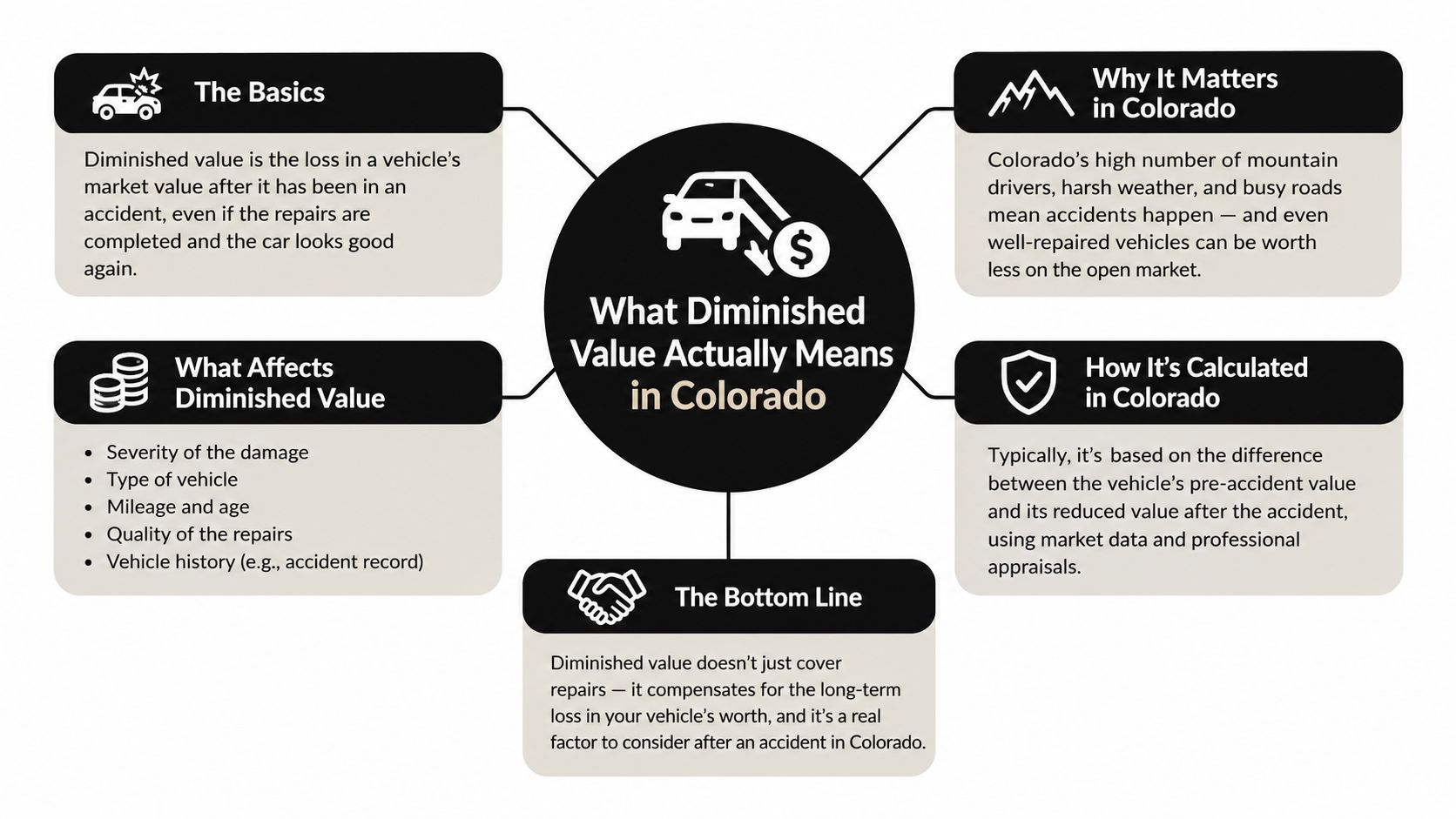
Diminished value is the difference between a vehicle's fair market value immediately before a collision and its fair market value after repairs. Consider two otherwise comparable vehicles. One has a clean history report. The other shows a significant accident, even though a reputable shop repaired it correctly. A buyer may choose the clean-history vehicle or insist on paying less for the repaired one.
That reduction is not the same as the repair bill. The repair bill measures the cost of restoring the vehicle. Diminished value measures the vehicle's remaining market penalty after the repair. Colorado claimants generally focus on the post-repair reduction in market value, particularly when the claim is made against the at-fault driver's liability insurer.
The categories you'll see in a valuation report
Inherent diminished value is the market stigma that remains after a proper repair. The vehicle may function as intended, but its accident history can affect buyer confidence, dealer pricing, and future resale.
Repair-related diminished value results from incomplete, defective, or visibly poor repairs. Misaligned panels, paint differences, warning lights, nonfunctional safety systems, or other repair defects may reduce the vehicle's value independently of the accident-history stigma.
Immediate, or pre-repair, diminished value describes the reduction between the vehicle's pre-accident value and its value immediately after the collision, before repairs occur. It can help describe the overall loss, but post-repair market value is usually the more practical focus in a completed repair claim.
The loss belongs to the vehicle owner. It isn't automatically assigned to the repair shop, and it isn't erased because the shop issued a warranty. A shop's work may be relevant to the value analysis, particularly if defects remain, but the owner is the person who owns the vehicle and experiences the resale loss.
Don't confuse the claim with shop paperwork
Body shops may ask customers to sign documents addressing payment, repairs, storage, rental arrangements, or disputes over workmanship. Read those documents carefully. A repair authorization or payment agreement isn't necessarily a release of a diminished value claim, but the exact language matters.
You should also distinguish a diminished value claim from a diminished value waiver or other release. If you signed language releasing claims connected to the accident or the repair, provide it to counsel before making a demand. Never assume the document is harmless, and don't assume it automatically eliminates your rights without reviewing what it says.
Colorado Law, Deadlines, and Who Pays
Colorado has no dedicated diminished value statute with a fixed calculation. The Colorado Division of Insurance explains the relevant auto-insurance framework and states that no Colorado insurance laws directly address diminished value. That leaves the claim to tort principles, property-damage law, policy language, and court decisions. In Larson v. Long, the Colorado Supreme Court recognized that evidence of accident-related depreciation could be admitted and that depreciation could form part of the damages.
The legal theory is direct. If another driver caused the collision, you claim the vehicle was worth less after the accident and repairs than it was immediately before the loss. You still must prove both causation and the amount of the market loss. An accident entry alone does not tell the carrier what number to pay, and it does not establish that this particular vehicle suffered a compensable reduction.
Before spending money on an appraisal, apply the market test. Review the vehicle's history, repair scope, condition, age, mileage, trim, and comparable sales. The claim is worth pursuing when those records show that buyers or dealers would discount this repaired vehicle, not only because a collision appears in a database.
The deadline is not a negotiation tactic
Colorado's general motor-vehicle property-damage limitation period is three years from the accident date under C.R.S. § 13-80-101. Colorado-focused insurance and legal materials commonly treat diminished value as fitting within that property-damage period. Keep the deadline separate from the insurer's claim process. Ongoing emails or calls do not preserve your rights by themselves.
Collect repair records, photographs, valuation materials, correspondence, and vehicle-history reports early. A carrier may keep discussing the claim while the filing period approaches. A demand letter does not necessarily stop the limitation period, and an adjuster's promise to review more documents does not guarantee that your legal rights remain protected.
Coverage determines the direction of the claim
A third-party claim goes to the at-fault driver's liability insurer. That is generally the stronger setting because the claim rests on the other driver's responsibility for property damage.
A first-party claim goes through your own policy. Collision coverage may pay for repairs subject to the policy terms, but it does not automatically include diminished value. In Lovell v. State Farm, the Tenth Circuit addressed policy language under which State Farm did not have to pay diminished value under collision coverage. Read the Tenth Circuit's decision in Lovell v. State Farm before assuming your insurer owes a separate post-repair payment.
| Factor | First-Party, Your Insurer | Third-Party, At-Fault Driver's Insurer |
|---|---|---|
| Legal basis | Your policy language controls | Tort and property-damage principles generally control |
| Typical target | Your collision or applicable coverage | The at-fault driver's liability coverage |
| Diminished value | Not automatic, policy-dependent | More commonly asserted as part of property damage |
| Main obstacle | Exclusions, coverage terms, and applicable case law | Proving fault, causation, and market loss |
| Practical approach | Review the policy before demanding payment | Build a market-based demand against the liability carrier |
Before signing a release or accepting final payment, review the distinction between collision insurance coverage and property-damage claims. That choice can determine whether you are pursuing the at-fault driver's insurer or relying on limits in your own policy.
How Insurers and Appraisers Put a Number on the Loss
Insurers often start with a formula because it gives adjusters a quick, low-cost way to limit offers. The most familiar benchmark is the 17c method, which starts with a base loss capped at 10% of the vehicle's pre-accident value, as this consumer explanation of the 17c approach describes. The formula then adjusts the result for damage severity and mileage. It is a settlement reference, not a Colorado-mandated rule. For a concrete look at how one major carrier applies these adjustments, see our analysis of diminished value claims with GEICO.
Use 17c as a starting point, not as the answer. It can miss the vehicle's trim, options, local market, repair history, structural work, airbag deployment, replacement parts, and the difference between dealer trade-in pricing and a private-party sale. A repaired luxury vehicle with documented structural damage may deserve closer analysis than a basic vehicle with limited cosmetic work.
The key question is whether buyers would discount this specific vehicle after the crash. If the likely loss is small, an appraisal fee and weeks of negotiation may not make financial sense. If the repair history creates a clear market penalty, a formula-only offer deserves a firm response.
Three types, three proof problems
| Type | What It Covers | Typical Evidence |
|---|---|---|
| Inherent diminished value | Market stigma that remains after proper repairs | Vehicle-history report, pre-loss valuation, post-repair appraisal, comparable vehicles |
| Repair-related diminished value | Loss caused by defective, incomplete, or visibly poor repairs | Repair inspection, photographs, warranty records, supplemental estimates |
| Parts-related loss | Value concerns tied to replacement parts or repair specifications | Parts invoices, OEM and aftermarket documentation, appraiser analysis |
Towing, rental, and storage costs may also result from the collision, but they are separate property-damage expenses. Keep them out of the diminished-value figure so the insurer can see exactly what amount represents market loss.
A market comparison can beat a desk formula
An independent appraiser should compare similar vehicles and explain the valuation method. The strongest report matches make, model, trim, mileage, options, condition, and location, then accounts for the accident history. A random listing proves little.
An insurer may claim its trade-in valuation already includes the accident. That offer remains only one data point. Dealer margin, inventory strategy, and negotiation posture can affect it. Your appraisal should explain why its comparables isolate the accident-related reduction rather than ordinary depreciation.
Treat the valuation as a negotiation anchor, not a guaranteed award. A careful appraisal gives you a defensible starting position, but it cannot repair weak causation evidence or overcome prior damage and poorly selected comparables.
The Evidence Package That Holds Up in Negotiation
A good demand package lets an adjuster understand the loss without reconstructing the accident from scattered emails. Gather the documents before you ask the carrier to assign a value. The goal is to show what the vehicle was, what happened to it, how it was repaired, and what the market now says it is worth.
Build the file in this order
- Repair documentation: Keep the complete repair order, final invoice, supplements, parts information, alignment records, and any warranty paperwork. These documents establish the extent of the work and whether the repair involved structural components, safety systems, or replacement parts.
- Accident documentation: Preserve the police report, claim number, photographs from the scene, and correspondence identifying the at-fault driver and liability carrier.
- Vehicle-history evidence: Obtain a current Carfax or AutoCheck report showing the accident entry. Compare it with any earlier history report that shows the vehicle's clean pre-loss record.
- Photographs: Include clear pre-repair and post-repair photographs. Close-ups matter when they show damage severity, panel replacement, airbag deployment, frame work, paint issues, or repair defects.
- Market analysis: Assemble comparable listings or sales and define the relevant market. Adjust for mileage, trim, options, condition, location, and accident history instead of using the first similar vehicle you find.
- Independent appraisal: Use an appraiser who explains the before-and-after valuation and the comparable-sales methodology. A USPAP-compliant report can carry more weight than an owner's estimate because it identifies the appraiser's process and professional basis.
Some items cost nothing beyond your time, such as photographs, invoices already in your possession, claim correspondence, and a vehicle-history report you purchase for the file. An independent appraisal costs money, so obtain one after an initial review suggests the potential loss is meaningful. Don't pay for a report that merely applies a generic formula without examining your vehicle and its market.
A compelling package doesn't contain the most pages. It contains the right proof tied to a clear valuation conclusion.
Parts and warranty records can change the discussion. OEM parts documentation may support a different market analysis than lower-cost replacement parts. A warranty can address workmanship concerns, but it doesn't automatically eliminate accident-history stigma. Put every relevant document in chronological order and label it, then send a concise demand that identifies the amount claimed and the evidence supporting it.
Filing the Claim and Negotiating With the Insurer
A Denver-area driver gets an SUV back from the shop after a collision caused by another motorist. The SUV drives properly, but the vehicle-history report now records the accident. The owner doesn't send an angry email demanding compensation. First, the owner confirms the liability carrier, obtains the final repair file, and checks whether the insurer accepts responsibility for the property damage.
The demand needs a theory, not just a number
The owner then sends a written diminished value demand with the accident information, repair records, photographs, history report, appraisal, and comparable-sales analysis. The demand explains the pre-loss value, the post-repair value, the accident-related reason for the difference, and the amount requested. It also identifies weaknesses in the insurer's likely position, including any claim that repairs restored the vehicle completely.
An insurer may respond with a 17c-derived offer or may say the repairs restored the vehicle's value. Read the offer closely. Does it address the actual trim and mileage? Does it identify comparable vehicles? Does it account for frame or airbag work? Does it rely on a generic adjustment rather than evidence from your market?
A structured counter is stronger than a higher number repeated without explanation. Respond point by point:
- Prior damage: Show which evidence separates the current collision from documented prior issues.
- Repair quality: Use the repair invoice, inspection, warranty information, and photographs to establish the work performed.
- Market loss: Tie each comparable to the vehicle's mileage, trim, options, location, and history.
- Coverage position: If the carrier is your own insurer, identify the policy language it relies on and have it explain the denial in writing.
- Amount: Explain why the appraisal is more specific to the vehicle than a blanket formula.
Don't give a recorded statement casually when the insurer is questioning coverage, prior damage, or the scope of the claim. You can cooperate with a reasonable inspection, but ask what the inspection will address and keep your own documentation. Follow up each telephone conversation with a short written summary.
For a practical intake route, you can review the Colorado diminished value claim form and organize the relevant crash and repair information before requesting legal guidance.
Here's the realistic range of outcomes. The carrier may pay the demand, negotiate toward a lower settlement, deny the claim, or reopen the valuation after receiving better evidence. If negotiations fail, counsel may send a formal demand or evaluate litigation. Colorado small claims court can hear claims involving amounts under $7,500, but verify the current jurisdictional rules before filing and consider whether the evidence and time required justify that forum.
The video below provides another overview of the insurance-claim process:
When the Fight Is Worth It and When to Bring in a Lawyer
Not every repaired vehicle supports a worthwhile claim. Before paying for an appraisal or spending weekends negotiating with an adjuster, apply four filters: the vehicle's age and mileage, the severity of the damage, the post-repair history entry, and the likely recovery after claim expenses.
A newer, lower-mileage vehicle with structural or airbag damage and no prior accident history deserves serious attention. A high-mileage vehicle with earlier damage and mostly cosmetic repairs may not. The market doesn't treat those vehicles the same way, and a claim should reflect that reality.
Use a break-even test
Suppose an insurer offers $2,000 and an independent appraisal costs $400. Those figures are the example provided for evaluating the decision, not a prediction of what your claim is worth. The simple question is whether the appraisal could reasonably produce enough additional recovery to justify its price, time, and negotiation burden.
If the evidence suggests the market loss is close to the offer, hiring an appraiser may not improve the result enough to matter. If the offer ignores severe damage and strong comparable evidence, the appraisal may be a sensible investment. The right decision depends on the vehicle and the proof, not on a promise that every accident creates a large payment.
The checklist is blunt by design:
- Vehicle condition: Age, mileage, trim, options, and pre-loss history affect the analysis.
- Damage severity: Frame, structural, and airbag work can create a more serious market concern than a minor cosmetic repair.
- History record: A documented accident matters more when the vehicle had a clean prior history.
- Economic value: Compare the likely additional recovery with appraisal fees, legal fees, time, and litigation risk.
Three reasons to involve counsel
Bring in a Colorado attorney when the insurer denies the claim, leaves a properly supported demand unanswered for 30 days, or makes an offer that ignores credible comparable-sales evidence. Those situations suggest the dispute is no longer about submitting a missing invoice. It's about legal framing, valuation, coverage, or bargaining power.
A lawyer may work on a contingency arrangement, but the agreement should explain the fee, case expenses, appraisal costs, and what happens if the claim doesn't recover. Counsel adds value by reviewing the policy, preserving deadlines, framing the demand, challenging unsupported exclusions, negotiating with the carrier, and applying litigation pressure when appropriate.
Don't hire a lawyer just because an accident appears on a report. Hire one when the evidence shows a meaningful dispute and the expected benefit justifies the cost. If the claim is weak, a candid evaluation can save you more than an aggressive demand ever would.
Questions Colorado Drivers Ask Most About Diminished Value
Can I claim diminished value after a total-loss payment? Usually, the valuation issue is handled through the total-loss settlement because the insurer pays the vehicle's pre-loss value rather than repairing it. A separate post-repair diminished value claim generally doesn't fit when the vehicle wasn't repaired and returned to service. Review the settlement documents before signing a release.
Do bodily injury limits control my vehicle claim? Property damage is generally handled under the at-fault driver's property-damage liability coverage, not the bodily injury portion. The available policy limit can restrict recovery, particularly when multiple claims compete for limited coverage. Ask the carrier to identify the applicable coverage and limits in writing.
Does my collision deductible reduce diminished value? Your deductible usually relates to your own first-party collision payment. It doesn't automatically reduce a separate third-party diminished value claim against the at-fault driver, but the exact payment history and releases matter.
What if the vehicle already had an accident? A prior accident can make the current claim harder because the insurer may argue that the vehicle had already lost value before this collision. You need evidence separating the earlier condition from the new damage and showing the additional market effect caused by the current event.
Do OEM and aftermarket parts matter? They can. Parts records may affect a buyer's perception, repair quality analysis, and appraisal methodology. Give the appraiser the complete parts and repair documentation instead of assuming the invoice speaks for itself.
What if I lease the vehicle? Check the lease agreement and notify the leasing company if required. The lessor may have an ownership interest or rules concerning repairs, appraisal, and resale loss. Don't accept a release without understanding whether it affects the lessor's rights.
How long will negotiations take? The timeline depends on liability, documentation, appraisal availability, insurer responsiveness, and whether coverage is disputed. Keep the limitation period in view while negotiations continue.
What if the at-fault driver has no insurance? Your own policy may provide a possible route, but uninsured-motorist property-damage coverage and diminished value treatment depend on the policy language and applicable law. Have the policy reviewed before assuming your collision coverage will pay.
The next step is simple. Gather the repair file, history report, photographs, insurance correspondence, and any credible market evidence, then have someone evaluate whether the loss is worth pursuing.
Nares Law Group LLC can review a Colorado crash file, repair records, appraisal materials, and the insurer's position on a diminished value claim. If the evidence supports a serious market-loss dispute, visit Nares Law Group LLC to request guidance on your options.