You picked up your car from the body shop, walked around it twice, and felt two things at once. Relief that the visible damage is gone, and dread because you know the vehicle now carries an accident history that every buyer, dealer, and appraisal tool will see.
That feeling is usually correct. A repaired vehicle can still be worth less on the open market. The gap between what your car was worth before the crash and what it's worth after proper repairs is called diminished value. And in many Colorado claims, there isn't some neat insurer-provided diminished value form waiting for you. You often have to build the claim yourself, document it carefully, and push back when the adjuster tries to treat it like an afterthought.
Your Repaired Car Is Worth Less Now What
A common scenario looks like this. Another driver hits you. Liability seems clear. The shop repairs the bumper, quarter panel, suspension, or worse. The paint matches. The panel gaps look right. You pay your deductible or the carrier covers the repair bill. Then you try to trade the vehicle in, and the dealer's number comes in lower than you expected because the car now has an accident record.
That price drop is usually inherent diminished value. It isn't about sloppy repair work. It's the market discount attached to a vehicle because it was wrecked and repaired.
What most drivers misunderstand
People often assume the repair invoice closes the file. It doesn't. Repairing physical damage and compensating lost market value are related, but they are not the same thing.
A clean title and a good repair don't erase accident history. Buyers ask questions. Dealers discount for risk. Online history reports change the negotiation before it even starts.
Practical rule: If you'd have to disclose the collision to a buyer, there's a real chance the vehicle's market value changed even if the repair looks excellent.
This issue also gets tangled up with insurance language. Drivers hear terms like actual cash value, replacement cost, collision coverage, and property damage, and it all starts to blur together. If you need a plain-English comparison for valuation concepts, Redline tools for contract analysis offers a useful calculator that helps separate those ideas. For a broader explanation of how repair costs differ from vehicle value loss, Nares Law Group also has a practical guide on property damage vs. collision.
Why the insurance company hopes you stop here
Many individuals never raise diminished value at all. They accept the repair, assume the claim is over, and move on. Insurers know that.
When a claim does get raised, the adjuster may act as if you're asking for something unusual or unsupported. You're not. You're asking to be paid for a category of loss that many drivers overlook because nobody explained it clearly.
That's why a so-called diminished value form is rarely the primary concern. What truly matters is proof. If you can show that the vehicle suffered market stigma after the collision, you're no longer making a vague complaint. You're making a documented property damage demand.
Can You Make a Diminished Value Claim in Colorado
Colorado drivers usually need one answer first. Is this even a claim I can make? In many situations, yes, but only if the claim is framed correctly.
The basic Colorado test
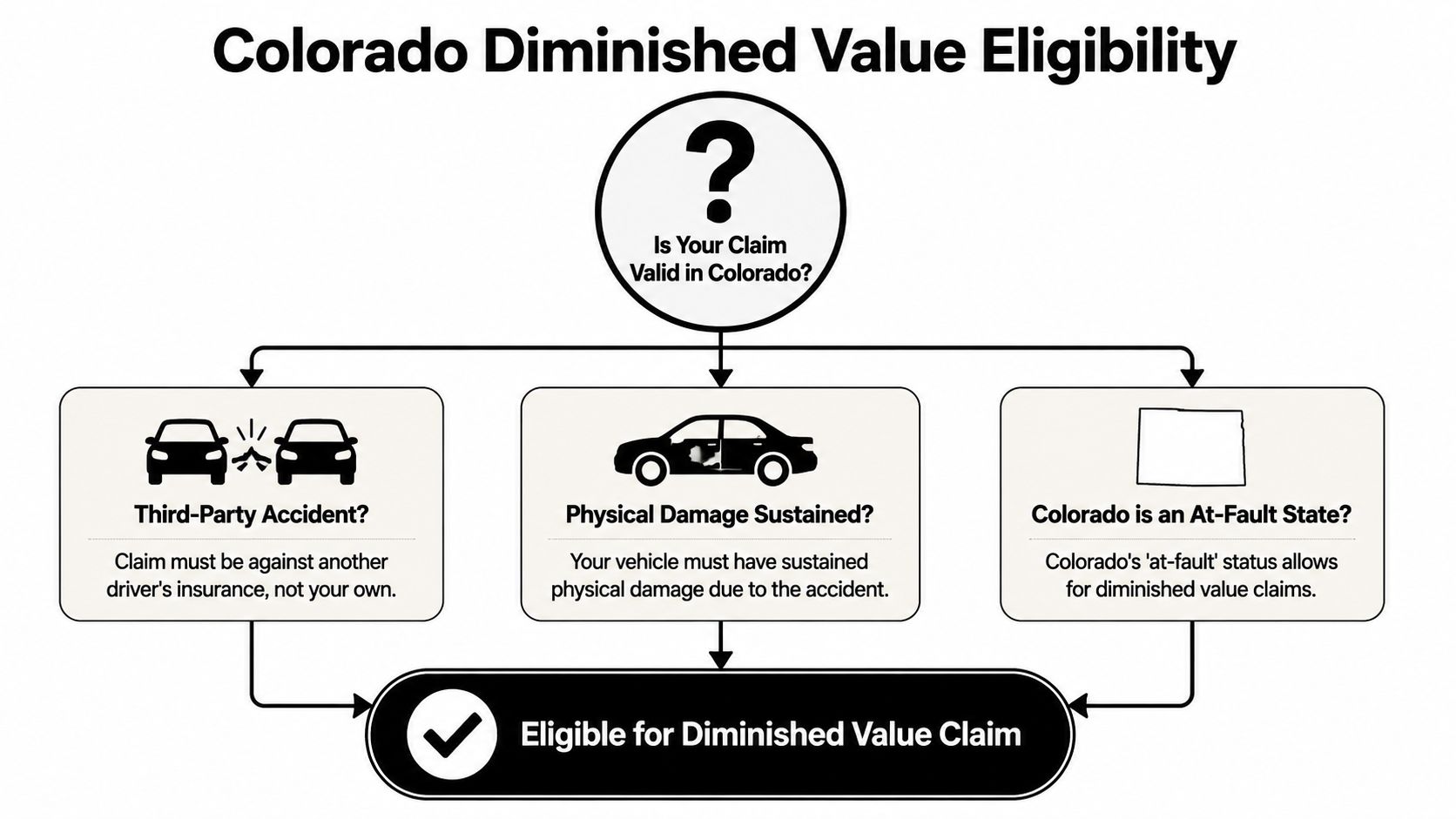
Start with these questions:
- Was another driver at fault? Diminished value is usually pursued against the at-fault driver's liability coverage.
- Did your vehicle sustain physical damage? Cosmetic fear alone won't carry a claim. There must have been actual damage from the wreck.
- Are you making a third-party claim? That means you're pursuing the other driver's insurer, not asking your own collision carrier to pay extra because you're unhappy with resale consequences.
If those answers are yes, you're likely in the right lane to pursue diminished value in Colorado.
The practical reason is simple. In an at-fault system, the claim is tied to the loss caused by the negligent driver. That includes the argument that your vehicle's fair market value dropped because of the collision history.
Vehicle type matters more than people think
Not every car takes the same market hit. A repaired commuter car and a repaired luxury or electric vehicle don't get treated the same by buyers.
Projected 2026 vehicle-segment data shows how sharply diminished value can vary. Compact cars are estimated to lose 6% to 10%, luxury sedans 15% to 25%, and electric vehicles 18% to 30%, with the loss typically pursued against the at-fault driver's liability insurance, according to Appraisal Engine's diminished value loss by vehicle segment analysis.
That matters in Colorado because the insurer may try to handle every vehicle as if it were interchangeable. It isn't. A late-model EV or luxury vehicle often carries stronger accident stigma in the market than an older basic sedan.
After you've reviewed the core eligibility points, this explainer may help visualize the process in a different format:
What usually knocks a claim out
A few patterns create trouble fast:
| Problem | Why it hurts |
|---|---|
| Claiming against your own policy without checking coverage | First-party diminished value arguments are often much harder |
| Weak liability facts | The carrier may use any fault dispute to slow or reduce payment |
| No real proof of market loss | The adjuster can label the claim speculative |
| Older or heavily worn vehicle with thin records | The insurer may argue the car already had reduced value unrelated to the wreck |
The strongest Colorado claims are clean third-party claims with clear fault, clear damage, and clear evidence that the vehicle had meaningful pre-crash value.
If your facts line up that way, the question usually shifts from whether you can make the claim to how well you can prove it.
Building an Unbeatable Case with the Right Documents
Most drivers gather the obvious papers and stop too soon. They save the repair estimate, take a few photos, maybe download the crash report, and expect the insurer to connect the dots for them.
The insurer won't. If anything, the adjuster will look for the missing piece that lets them say your claim is unsupported.
The documents people know they need
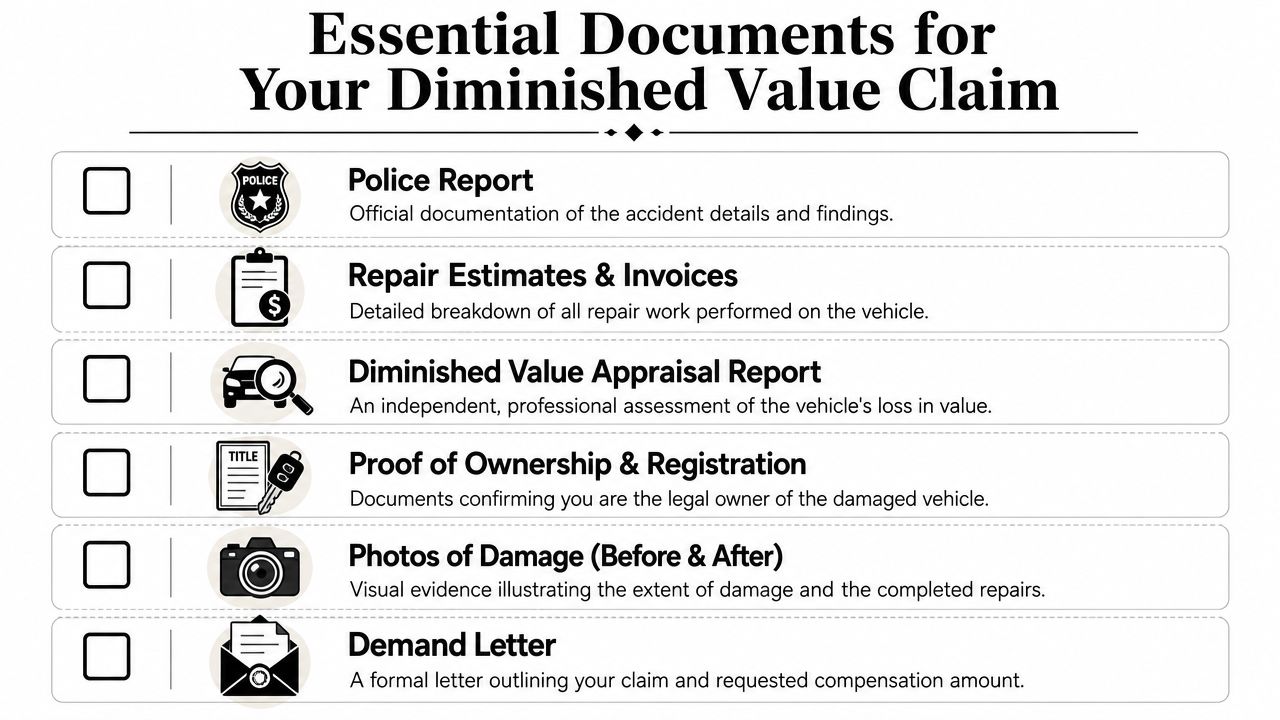
You should still gather the standard file:
- Police report: It anchors fault, parties, date, and basic crash facts. If you need help decoding the terms and boxes, this guide on how to read a police accident report is useful.
- Repair estimates and final invoices: These show the scope of damage, what parts were replaced, and whether the work suggested structural impact.
- Photographs: Keep pre-repair damage photos and post-repair condition photos.
- Ownership records: Registration, title information, and any loan or lease documents that identify the vehicle.
- Demand letter draft: Don't wait until the end to think about it. Build your file with the final demand package in mind.
Those documents matter. They're just not enough by themselves.
The undocumented evidence that changes outcomes
Here's where many do-it-yourself claims fall apart. Insurers often don't dispute that a crash happened. They dispute that your specific vehicle had enough pre-accident quality to justify a meaningful diminished value payout.
A 2025 analysis of 1,200 denied claims in New York and Georgia found that 68% of dismissals were caused by insufficient pre-accident condition documentation, not a lack of accident proof, according to AWJ Law's discussion of diminished value claim documents.
That's why I tell clients to build an evidence chain, not a pile of papers.
Include items like:
- Maintenance logs: Oil changes, dealer service records, inspections, and scheduled maintenance receipts.
- OEM parts proof: If the repair used original equipment manufacturer parts, keep the invoices that show it.
- Pre-loss photos: Even ordinary phone photos taken before the crash can help show overall condition.
- Tire and brake receipts: These help establish upkeep and condition.
- Upgrade or customization receipts: If the vehicle had legitimate value-enhancing work, document it carefully.
- Third-party post-repair quality review: If there's any concern about calibration, alignment, structural work, or finish quality, an outside inspection can separate accident stigma from repair defect arguments.
Evidence chain: You are proving three separate facts. The car had strong pre-accident condition, the crash caused real damage, and the vehicle now carries market stigma even after proper repair.
The single document that gives your claim weight
If you only invest in one serious piece of evidence, make it an independent, USPAP-compliant diminished value appraisal.
That report does two things the insurer's internal review usually won't do. First, it ties the loss to your specific vehicle rather than a generic template. Second, it gives you a concrete number backed by market analysis rather than guesswork.
Good appraisers also force clarity. They identify pre-accident value, describe damage severity, address repair quality, and explain why the market would still discount the vehicle after repair.
For organizing that material, especially if you're collecting files from shops, dealerships, body shops, and family members, these secure document collection insights from Superdocu are a practical reference.
What works and what doesn't
What works
- A neat PDF package with labeled exhibits
- Service history that shows consistent care
- OEM parts documentation when available
- Independent appraisal from a qualified professional
- A claim file that answers the insurer's objections before they raise them
What doesn't
- Sending screenshots without explanation
- Relying on the adjuster's promise to “look into it”
- Claiming a large value loss without expert support
- Ignoring pre-accident condition records because the car “looked great”
- Assuming the repair invoice proves market loss
If the insurer sees missing records, they often don't ask politely for what would help you. They use the gap against you.
How to Draft and Submit Your Diminished Value Demand
There usually isn't a universal insurer-issued diminished value form. In real claims, you often create the functional equivalent yourself. That means a written demand letter with exhibits attached.
What the letter must do
A strong diminished value demand is not dramatic. It is organized, specific, and difficult to dismiss.
It should identify:
- Who was involved in the collision and the claim number.
- Why liability rests with their insured.
- What vehicle was damaged, including year, make, model, VIN if appropriate, and mileage at loss.
- What repairs were performed.
- Why diminished value remains after repair.
- What amount you are demanding, based on your independent appraisal and supporting records.
- What documents are enclosed.
Sample language you can adapt
You don't need to sound like a lawyer to sound credible. You do need to sound precise.
I am making a third-party diminished value claim arising from the collision on [date] involving your insured. Although my vehicle has been repaired, it now carries an accident history that has reduced its fair market value. Enclosed are the repair records, photographs, maintenance documentation, and an independent diminished value appraisal supporting my demand.
If the carrier has already floated a formula-based low number, address it directly:
Your preliminary valuation does not reflect the actual market loss affecting this vehicle. My enclosed appraisal uses vehicle-specific market data rather than a generic internal formula and should be used when evaluating this claim.
Why generic formula language is a problem
Adjusters often talk as if one formula controls every case. It doesn't. According to NJ Diminished Value's FAQ discussion, there is no universally accepted standard for diminished value, and independent appraisers using market-specific sales data often secure 3 to 5 times higher settlements than a 17c baseline, especially for luxury or electric vehicles.
That's the sentence-level point you need in your letter. You are not required to accept a one-size-fits-all number if your evidence supports a market-based valuation.
How to submit it so it doesn't vanish
Address the package to the specific liability adjuster handling the at-fault driver's claim. Don't send it to a generic claims inbox unless the adjuster specifically instructs you to.
Use a submission method that creates a record:
- Certified mail with return receipt: Old-fashioned, but effective.
- Email with exhibits attached: Ask for written confirmation of receipt.
- Fax if requested by the carrier: If you need a walkthrough, these steps for online document faxing are practical.
Label every attachment. Example: Exhibit 1 police report, Exhibit 2 repair invoice, Exhibit 3 maintenance records, Exhibit 4 appraisal report.
A clean structure to follow
| Section of demand | What to include |
|---|---|
| Opening | Claim number, parties, date of loss |
| Liability summary | Short statement of why their insured is at fault |
| Vehicle information | Make, model, mileage, condition summary |
| Repair history | Shop, invoices, major damage categories |
| Valuation basis | Independent appraisal and supporting records |
| Demand | Specific amount and deadline for response |
End with a reasonable response deadline and a request that all denials or reductions be stated in writing. That one sentence often improves the quality of the adjuster's reply.
Navigating Insurer Responses and Lowball Offers
Once your demand is in, the tone of the claim often changes. The insurer may stop sounding casual and start sounding procedural. That's when many claimants get worn down.

The responses you should expect
Adjusters tend to reuse a short list of positions:
- “We don't pay diminished value.”
- “The repairs restored the car to pre-accident condition.”
- “Our formula shows only a nominal loss.”
- “We need more time to review.”
- “Your documentation doesn't establish that amount.”
Some of these are negotiation positions dressed up as final answers.
If the insurer denies diminished value exists at all, point them back to the vehicle-specific evidence and require a written explanation. If they say the repairs eliminated the problem, remind them that repair completion and market stigma are different issues.
The 17c issue in plain English
The 17c formula is often treated like a rule carved in stone. It isn't.
According to MWL Law's 50-state diminution in value survey, the industry-standard 17c formula starts with 10% of NADA retail value and then applies damage and mileage modifiers. In the example MWL provides, a $25,000 vehicle with moderate damage can produce a result of only $750, while a fair market appraisal could be closer to $6,000. The same source also notes that diminished value deadlines often differ from personal injury deadlines, with 2 to 3 years in many states.
That's why 17c becomes a lowball tool so often. It creates a neat internal number, but neat doesn't mean fair.
“Please explain in writing why your valuation relies on a capped formula rather than the vehicle-specific market data contained in my independent appraisal.”
That sentence is useful because it forces the adjuster to defend the method, not just the number.
Practical counter-language that helps
Use short, calm responses.
| Insurer says | You reply |
|---|---|
| We don't owe diminished value | My claim includes documented post-repair market loss. Please confirm your denial and basis in writing. |
| Repairs made the vehicle whole | Repair quality and market stigma are separate issues. My appraisal addresses post-repair loss in fair market value. |
| Our formula controls | Please identify the authority that makes your internal formula binding in this claim. |
| We need more time | Please confirm what additional material you need and when I should expect a written decision. |
For broader context on how carriers build and defend positions during claims, this explanation of an insurance company investigation helps people understand what's happening behind the scenes.
When patience helps and when it doesn't
A short review period is normal. Silence is not.
Reasonable follow-up usually looks like this:
- After initial submission: Confirm receipt.
- If they ask for documents: Send them in one organized package.
- If they make a low offer: Respond in writing and attack the method, not the adjuster personally.
- If they stall repeatedly: Set a firm deadline for a written position.
The key is to stay professional while building a record. If the file later lands on a lawyer's desk, a clean paper trail provides that lawyer with an advantage.
When to Stop DIY and Call a Personal Injury Lawyer
Some diminished value claims can be handled directly. Others stop being a paperwork project and become a dispute strategy problem.
Call a lawyer if the insurer keeps repeating a formula number without addressing your evidence, if the adjuster stops responding, if fault suddenly becomes disputed, or if the crash involved physical injuries along with the vehicle damage. Those cases often need a coordinated approach because the property claim and the injury claim affect each other in timing, influence, and negotiation posture.
You should also get help if your vehicle is high-value, luxury, electric, customized, or recently purchased. Those are the claims where market stigma arguments are often stronger, but insurer pushback is stronger too.
A law firm like Nares Law Group LLC handles motor vehicle injury claims and related property damage issues, including diminished value when it fits the case. In practice, that means gathering the right records, dealing with the carrier directly, and making sure the vehicle claim doesn't get lost while you're trying to recover from the collision itself.
If you're dealing with a repaired vehicle that still lost value after a Colorado crash, Nares Law Group LLC can help you evaluate whether a diminished value claim makes sense and what evidence will move the insurer. If the insurance company is delaying, denying, or lowballing the claim, contact the firm for a free consultation and practical guidance on your next step.