You’ve finally gotten the police accident report. You expected a simple summary. Instead, you’re staring at boxes, abbreviations, unit numbers, damage codes, and a diagram that may or may not resemble what happened.
That reaction is normal.
For most injured people, this document feels official enough that they assume it must be complete, neutral, and final. In practice, it’s more complicated than that. A police report is often the first written version of the crash that insurance adjusters read. It can shape how they view your injuries, the vehicle damage, and who they think caused the collision. But it’s still a human document, created quickly, often at a chaotic scene, and sometimes based on incomplete information.
That’s why knowing how to read a police accident report matters. You’re not just trying to understand what the officer wrote. You’re trying to figure out what helps your claim, what hurts it, what’s missing, and what can still be challenged.
Your First Look at the Police Accident Report
You open the report looking for one clear answer about what happened. Instead, you find codes, boxes, and a diagram that may not match the crash you remember. That moment rattles a lot of injured clients, especially when they are already dealing with pain, missed work, and calls from insurance adjusters.
Start with one ground rule. A police report is an important piece of evidence, but it is not the final word on fault, injury, or how the collision happened. Officers usually write these reports under time pressure, with limited witness access, and without the benefit of later medical records, vehicle inspections, or accident reconstruction. In a claim or lawsuit, I treat the report as a starting point to verify, challenge, and build on.
Read it twice.
The first pass is for orientation only. Do not stop at every code or try to argue with the narrative in your head. The second pass is where you mark anything inaccurate, incomplete, or slanted. Look for obvious mistakes, but also for details that insurers use to minimize claims: the number of injured people listed, the point of impact, whether anyone complained of pain at the scene, and whether the report reflects the kind of forces that can cause injury. If you need help connecting the crash description to your medical claim, this explanation of the mechanism of injury in a personal injury case gives useful context.
One practical rule helps here: treat the report as the officer’s on-scene account, not as a verdict.
That distinction matters for strategy. Adjusters often form an early view of the case from a few entries on the report before they ever read your medical records in full. If the report checks a box that suggests minor damage, no injury observed, or a contributing action by you, that framing can affect how the insurer evaluates the claim. It can also influence which parts of the file get extra scrutiny later.
A careful first review usually works best in this order:
- Confirm the basic identifiers first: names, date, time, location, vehicle information, and insurance details.
- Check the injury and damage entries next: these shape the insurer’s first impression of the crash.
- Review the narrative and diagram after that: once the basic facts are anchored, it is easier to see where the description goes off track.
- Separate factual observations from conclusions: the officer may record positions, debris, statements, and road conditions, then add an opinion about fault. Those are not the same thing, and they do not carry the same legal weight.
That last point gets missed all the time. An officer can be very helpful on scene and still reach a conclusion that does not hold up once photographs, witness statements, black box data, or treatment records come in. A flawed diagram does not just look bad. It can become the version of events that everyone else works from unless you address it early.
If something looks wrong, do not assume you are stuck with it. Flag it, save the supporting proof, and get ready to compare the report against photos, videos, medical records, repair estimates, and witness accounts. That is how this document becomes useful. Not because it is perfect, but because it shows where the case needs support.
Decoding the Key Sections of Your Report
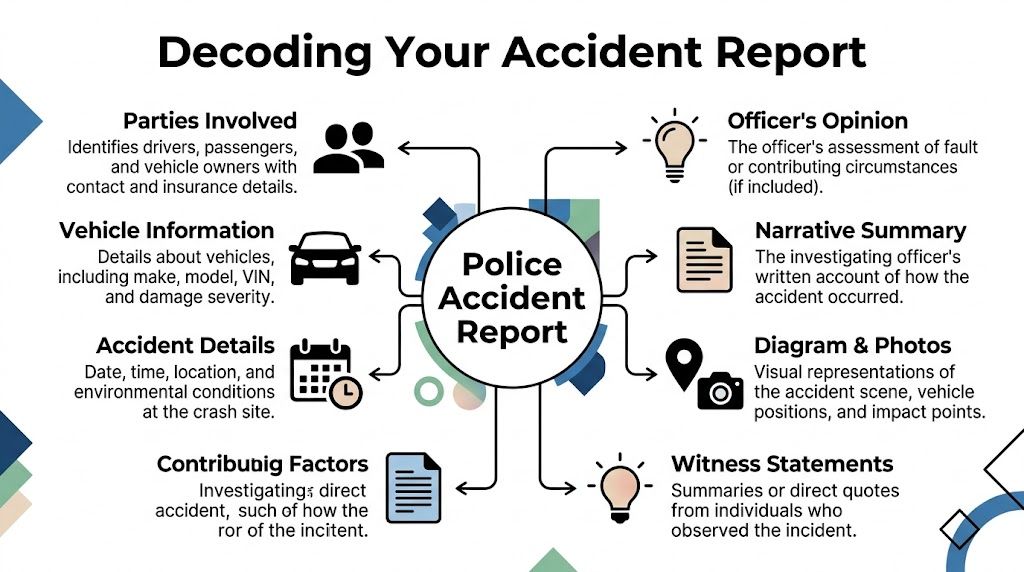
Most police crash reports vary by state, but they tend to contain the same core sections. Once you know what each section is doing, the report becomes much less intimidating and much more useful.
Accident details and identifying information
The opening page usually logs the basic framework of the crash. That means the date, time, location, roadway details, and environmental conditions. On many forms, this is also where the report identifies each vehicle as a separate unit.
Don’t skim this page. A wrong intersection, incorrect lane description, or mistaken direction of travel can ripple through the rest of the report. If the crash happened near a landmark rather than at a clear intersection, officers sometimes simplify the location. That may seem harmless until an insurer later argues the road setup was different from what you claim.
You should also check:
- Driver names and contact information
- Passenger names
- Vehicle owner information
- Insurance carrier details
- VIN and vehicle description
In some reports, Unit 1 is the first vehicle listed. In practice, adjusters sometimes read that placement as meaningful, especially when it lines up with the narrative or contributing factors section. Don’t overreact to the unit number alone, but don’t ignore how the full report frames the parties either.
Party and vehicle information
This part can look administrative, but it often creates avoidable disputes. If your vehicle model is wrong, if a passenger is missing, or if an insurance policy number is incomplete, those errors can slow down a claim and create needless arguments about who was involved.
Vehicle damage descriptions matter too. Reports may use shorthand or rating systems to characterize damage as minor. Insurers often lean on those entries to argue a collision was low impact. That’s not the same as proving nobody was hurt. A repair estimate, frame damage documentation, and medical records can tell a very different story.
If you’re trying to connect the crash to your physical symptoms, it also helps to understand the mechanism of injury in a crash. The way the body moves in a rear-end impact, side-impact collision, or rollover often explains why symptoms don’t neatly match an adjuster’s assumptions based on a cursory damage note.
The narrative and the diagram
Many people turn to these sections first, and for good reason. The narrative is the officer’s written description of how the collision happened. The diagram is the visual version of that story.
According to this discussion of New York accident report sections, the crash narrative, diagram, and contributing factors sections provide critical historical context and liability indicators. That same source explains that Page 1 typically logs the date, time, and location, while diagrams show vehicle paths and skid marks that can support reconstruction work, and the narrative explains the “how and why” of the crash.
That doesn’t mean the narrative is perfect. It means it often becomes the working storyline unless someone challenges it.
When you review the narrative, look for these issues:
- Sequence problems: Does the report put events in the wrong order?
- Missing facts: Did the officer leave out a statement about sudden braking, lane changes, distraction, or road conditions?
- Loaded wording: Terms like “failed to yield” or “unsafe speed” can affect how adjusters read the file.
- Unsupported assumptions: Sometimes a report adopts one driver’s version without much corroboration.
The diagram deserves the same level of scrutiny. A simple drawing can be more persuasive than a paragraph because people process visuals quickly. If the point of impact is wrong or the vehicle positions are reversed, that image can shape the entire claim evaluation.
A flawed diagram doesn’t just look bad. It can quietly become the version of events that everyone else works from.
Contributing factors and witness information
Many reports include coded or written contributing factors. These may reflect things like distraction, following too closely, unsafe speed, inexperience, alcohol, or fatigue. Some forms also summarize witness statements or identify who was present.
These entries can be useful, but they need context. A contributing factor is often an investigative note, not a final legal finding. Witness summaries can also be thin. Officers are writing in real time, and they may reduce a nuanced statement to a short line.
A careful read asks two questions at once. First, what did the report capture? Second, what evidence exists outside the report that fills in what it missed?
Common Codes and Abbreviations Explained
The codes on a police accident report often decide how your file is read before anyone speaks with you. An adjuster may scan a few shorthand entries, form an early view of fault, injury severity, and crash force, and evaluate the claim from there. That is why these boxes matter.
Codes are also easy to misread.
I see clients assume a number or abbreviation must carry the same meaning from one report to another. It often does not. A code on a New Jersey form can mean something different on a New York, Pennsylvania, or Colorado report. Before treating any shorthand as good or bad for your case, find the legend for that specific form and match the code to the officer’s own reporting system.
Common Police Accident Report Codes
| Code/Abbreviation | What It Means | Why It Matters |
|---|---|---|
| PDO | Property Damage Only | Insurers often point to this label to argue the crash was too minor to cause injury, especially if treatment began after the scene |
| Unit 1 / Unit 2 | Vehicles or parties identified in the report | Helps you match statements, damage descriptions, and contributing factors to the correct driver |
| Damage rating 1 or 2 | A notation often used for relatively minor visible damage | Visible damage and actual crash force are not always the same. Repair records, photos, and diagnostics may tell a different story |
| Injury location code | Body area affected, such as head or torso | Useful for checking whether the report lines up with the injuries later documented in medical records |
| Injury type code | Nature of harm, such as concussion or fracture | Shows whether the officer recorded a specific injury or only a general complaint |
| Severity code 01 | Amputation | A reminder that some coding systems are highly specific |
| Severity code 03 | Internal injuries in one coding system, and eye injuries on some state-specific forms | You have to confirm the meaning on the actual form before relying on it |
| Code 01 | No Improper Action in one contributing-factor system | Helpful if the officer did not assign misconduct to that driver, but it does not end the liability analysis |
| Code 19 | Unsafe Speed in one coding system | Can shape early fault discussions, even when the report gives little explanation for the conclusion |
| Code 31 | Texting in one coding system | Supports a distraction theory only if phone records, witness accounts, or admissions back it up |
| Code 9 | Followed Too Closely in NJTR-1 contributing-factor boxes | Frequently appears in rear-end crashes and can influence how fault is framed from the start |
| Code 8 | Fell Asleep in NJTR-1 contributing-factor boxes | Can affect both liability and damages, especially if fatigue was work-related or tied to a long drive |
Use the legend, then test what the code actually proves
A code is a starting point, not a verdict.
For example, a PDO entry may be used to minimize your injury claim. That does not mean the issue is settled. If your photos show a harder impact than the report suggests, or your repair estimate reveals structural damage behind a bumper cover, the shorthand loses force. The same is true for a contributing-factor code like unsafe speed or following too closely. Those entries can influence negotiations early, but they still need support from the scene evidence, vehicle damage, witness statements, electronic data, and medical records.
At this stage, a careful reading becomes strategic. Do not ask only, “What does this code mean?” Ask, “Who will use this code, and how do I confirm it or challenge it?”
If a code is unclear, flag it. Get the form legend, overlay, or instruction sheet from the agency that issued the report. Then compare the coded entry to the narrative, diagram, photographs, and the rest of your file. That extra step often catches the kind of mismatch that causes trouble later.
Spotting Red Flags and Critical Errors in the Report
A police report can help your case, but it can also hurt it if nobody catches the mistakes early.
The biggest error I see people make is treating the report as either perfect or useless. It’s neither. It’s an important piece of evidence that should be read critically, line by line.
Factual errors that can snowball
Some mistakes look minor but create larger problems later. Start with the objective items.
Check for:
- Misspelled names or wrong birth dates
- Incorrect vehicle plate numbers or VIN entries
- Wrong crash location
- Missing passengers
- Inaccurate insurance information
- Incorrect injury count
- Property damage assigned to the wrong vehicle
If the report says only one person was injured and multiple people later seek treatment, an adjuster may use that inconsistency to question credibility. If the report leaves out a passenger entirely, that person may end up defending their own presence in the vehicle before the case even gets to the substantive issues.
Subjective errors that shape blame
The more dangerous problems are often in the parts that look interpretive rather than administrative. A narrative can omit a key statement. A diagram can place the impact point incorrectly. A contributing-factor code can make one driver look reckless before the evidence has been fully developed.
The legal point many people miss is this. An officer’s notation about cause is not always the same thing as legal fault. This discussion of the legal weight of accident report conclusions explains that a report’s conclusions about cause may not be admissible in a legal proceeding, and that a contributing-factor code is investigative documentation, not a final legal liability determination. That kind of finding can be countered with independent evidence such as expert testimony or surveillance video.
If the report hurts you, don’t stop at “the officer said so.” Ask what evidence supports that conclusion, and what evidence contradicts it.
That’s where outside proof becomes critical. Scene photos, body shop records, black box data when available, surveillance footage, phone records, and witness interviews can all matter more than a checked box.
A short explainer can help if you’re trying to understand how these disputes develop in real claims.
What works and what doesn’t
People often call the insurer and argue emotionally that the report is “wrong.” That rarely works by itself.
What works better is a targeted response:
- identify the exact error
- separate factual mistakes from opinion disputes
- gather documents that address each issue
- present a cleaner, evidence-based version of events
A report can be unfavorable and still beatable. What matters is whether you treat it as the beginning of the evidence analysis or the end of it.
How to Obtain and Correct Your Accident Report
Getting the report is usually straightforward. Correcting it is where people hit a wall.
Police departments, state patrol agencies, or records divisions often handle report requests. Some jurisdictions make reports available online, while others require a records request by mail, in person, or through a portal. If you’re trying to locate the right process, this guide on how to obtain an incident report gives a useful starting point.
Getting the report in hand
When requesting the report, have these details ready:
- Date of crash
- Location
- Names of drivers
- Report or incident number if you have it
- Investigating agency
If you don’t yet have the report number, ask the agency what alternative information they can use to locate it. Keep a copy of every request and every response.
Correcting errors the right way
As noted in this discussion of report inaccuracies and why correction matters, police reports can contain serious mistakes, including incorrect crash diagrams that can instantly bias an adjuster and misreported injury counts. That source also highlights a major practical problem. The formal correction process is rarely explained, even though an uncorrected flawed narrative can affect settlement discussions and trial positioning.
There are two different categories of correction, and they need different strategies.
Factual corrections
These are the easiest to request because they involve objective mistakes. Think names, passenger lists, vehicle information, or the wrong crash location.
Useful support can include:
- Driver’s license copies
- Insurance cards
- Vehicle registration
- Photographs from the scene
- Medical records showing treatment soon after the crash
- Witness statements confirming who was present
Disputing the officer’s interpretation
This is harder. You usually can’t force an officer to rewrite an opinion because you disagree with it. But you can often ask that a supplemental statement, clarifying material, or additional evidence be added or considered.
For these disputes, the strongest items are usually independent records, such as:
- Dashcam or surveillance video
- Scene photographs
- Repair estimates
- Black box or event data when available
- Detailed witness statements
- Expert reconstruction analysis
Ask the agency a direct question: “What is your procedure for correcting factual errors, and what is your procedure for adding supplemental information when the parties dispute the narrative?”
That wording helps because it separates a typo from a liability disagreement. Those are not the same thing, and agencies often treat them differently.
Your Next Steps After Reading the Report
Once you’ve reviewed the report, don’t file it away and move on. Use it.
Your next job is to line the report up against everything else you have. That means photographs, medical visits, body shop records, names of witnesses, and any messages or recordings that help pin down what happened. If the report is accurate, that comparison strengthens your case. If the report is flawed, that comparison shows you exactly where to challenge it.
Use the report carefully with insurance
When an adjuster asks about the report, stick to what you know and what you can document. Don’t speculate about codes you don’t understand. Don’t agree with a narrative point just because it appears on an official form.
A better approach is simple:
- Confirm the basics: Date, parties, vehicles, and agency
- Identify any errors early: Tell the adjuster there are inaccuracies if that’s true
- Avoid legal conclusions: You don’t need to adopt the officer’s theory of fault
- Point to supporting records: Medical records, photos, witness names, and repair documentation matter
If you’re starting the broader claims process, this overview of how to file a personal injury claim can help you see where the accident report fits into the larger picture.
Preserve what the report doesn’t capture
Police reports rarely capture the full medical story. They also often miss the practical fallout, such as worsening pain, work disruption, or the way symptoms develop after the adrenaline wears off.
Protect yourself by keeping:
- All medical discharge papers and follow-up records
- Photographs of visible injuries
- Repair estimates and vehicle photos
- A pain journal or symptom log
- Witness contact information
- Any communication with insurers

Know when you need help
Some reports can be handled with a correction request and careful documentation. Others raise immediate concern.
You should strongly consider legal help when:
- The report blames you and the evidence tells a different story
- The diagram or narrative is materially wrong
- Your injuries are significant or getting worse
- A passenger or witness was omitted
- The insurer is using the report to minimize your claim
- There’s video, reconstruction evidence, or complicated vehicle damage involved
A police report matters. It can shape the first phase of a case. But it doesn’t get the final word on your injuries, your credibility, or your right to recover.
If you’re dealing with a confusing or inaccurate crash report, Nares Law Group LLC helps injured people and families understand what the report says, what it leaves out, and what to do next. If you need clear answers after a car or truck crash, the firm offers practical guidance grounded in real injury litigation.