A lot of people ask this question in the same moment. They’re sitting in the driver’s seat after getting hit from behind, hands shaking, neck tightening up, checking for blood, checking on the kids, and wondering one thing almost immediately.
Why didn’t the airbags go off?
That silence can feel wrong. You expected noise, smoke, a burst from the steering wheel, something dramatic that matched the force you felt in your body. When that doesn’t happen, it’s easy to think your car failed you or that the crash “must not have been serious” if the airbags stayed put.
Neither assumption is safe.
A rear-end collision can injure you badly even when the frontal airbags never deploy. In fact, in many rear-end crashes, that non-deployment is exactly how the system is supposed to work. Understanding that point matters for two reasons. First, it helps you make sense of what happened to your body. Second, it helps you avoid wasting time on the wrong legal theory and keep your focus on the claim that usually matters most, which is the negligence claim against the driver who hit you.
The Shock and Silence After a Rear-End Crash
You’re stopped at a light. Or maybe traffic slows on I-25 and you brake in time, but the driver behind you doesn’t. You hear tires, then impact. Your body jerks. Your head snaps. The car lurches forward.
And then there’s quiet.

No front airbag. No white cloud. No explosion from the steering wheel.
For many injured people, that’s the first confusing part of the crash. The second comes later, when soreness builds into sharp pain, dizziness starts, or the headache won’t go away. People often expect a “serious” crash to look a certain way. They think major vehicle damage or airbag deployment is what proves the event mattered. But the body doesn’t work that way.
Rear-end crashes often create the kind of back-and-forth force that leads to acceleration and deceleration injuries, including neck strain, head trauma, and back pain. If you want a plain-language explanation of that motion, this overview of acceleration and deceleration injury is a useful place to start.
Why the silence feels unsettling
Most drivers grow up with a simple idea about airbags. Big crash equals airbags. Small crash equals no airbags.
That rule sounds logical, but it isn’t how modern safety systems make decisions. Airbags don’t deploy just because a crash was frightening or because you got hurt. They deploy when the vehicle’s sensors detect a certain kind of impact in a certain direction.
Practical rule: In a rear-end collision, the fact that the frontal airbags stayed silent usually answers an engineering question, not an injury question.
Those are two different issues. Your car may have behaved normally. Your body may still have taken a hard hit.
Why this matters right away
This question affects medical care, insurance conversations, and legal strategy. If you assume the airbags should have deployed, you may start looking in the wrong direction. If an adjuster tells you no airbag means no real injury, you may start doubting what you feel.
Don’t.
The better approach is to separate the issues:
- Vehicle design: Was the airbag system supposed to deploy in this type of crash?
- Physical injury: Did the crash force your body into a motion that caused real harm?
- Legal responsibility: Who caused the collision, and what evidence proves the extent of your losses?
Once you separate those questions, the picture gets much clearer.
Why Your Car's Safety System Responded That Way
The easiest way to understand should airbags deploy in a rear end collision is to compare two very different motions.
If you run into a wall, your car stops suddenly and your body keeps moving forward. That’s a frontal deceleration problem.
If someone hits you from behind, your car gets shoved forward and your body is pushed backward into the seat before your head and neck whip through motion. That’s a different problem.
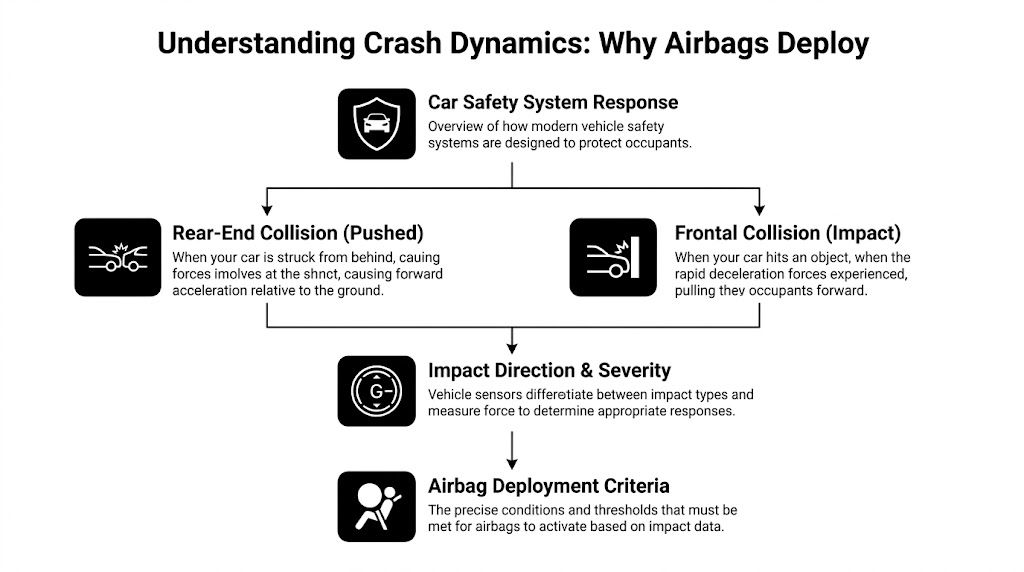
Pushed from behind versus stopped in front
Think about standing on a bus.
If the bus slams into something in front, you pitch forward. You need something in front of you to keep you from hitting hard surfaces.
If the bus gets bumped from behind and moves forward, your body first presses backward relative to the seat. In a car, that’s why the seatback, headrest, and seatbelt matter so much in a rear impact.
That distinction is the core answer.
Frontal airbags are built to protect people from moving forward into the steering wheel, dashboard, or other front interior structures. They are not built to answer every kind of crash.
Why a frontal airbag can be the wrong tool
A frontal airbag inflates with tremendous speed. NHTSA explains that frontal airbags in modern vehicles are not engineered to deploy during rear-end collisions because the crash dynamics push occupants rearward into their seats rather than forward into the steering wheel or dashboard. NHTSA also states that frontal airbag deployment thresholds are calibrated for rapid deceleration in frontal impacts equivalent to hitting a rigid barrier at 10-12 mph for unbelted occupants or 16 mph for belted ones, using accelerometers in front crash sensors, as described on NHTSA’s air bag safety page.
In plain language, the system is waiting for the kind of front-end slowdown that creates a front-impact danger. A rear-end crash usually doesn’t create that signal.
That’s why the question isn’t, “Was the crash hard?” The better question is, “Was it the kind of force this airbag was designed to answer?”
Rear-end protection comes from other parts of the car
In a rear impact, your first line of protection is usually:
- The seatback, which catches your torso
- The headrest, which helps limit violent head motion
- The seatbelt, which helps control movement and keeps you positioned
- The vehicle structure, which absorbs and channels crash forces
That can feel disappointing to hear if you were badly hurt. But it’s important. It means your lack of airbag deployment does not automatically mean your car malfunctioned.
The absence of frontal airbag deployment in a rear-end crash usually tells us the system recognized the direction of force and responded the way it was designed to.
A simple comparison
| Crash type | What the occupant tends to do | What the safety system is trying to prevent |
|---|---|---|
| Frontal crash | Moves forward | Striking the steering wheel, dashboard, or windshield |
| Rear-end crash | Gets pushed back into the seat, then may whip through motion | Neck, spine, and head motion, often managed by the seat, headrest, and belt |
That’s why, in most rear-end cases, the right legal focus isn’t “my frontal airbag didn’t deploy.” The better focus is “what did this impact do to my body, and who caused it?”
Inside the Airbag System's Split-Second Decision
A rear-end crash can leave you with real pain and a hard question. If the impact was serious enough to hurt you, why did the airbags stay silent?
The answer usually comes down to how the system classifies the event in a fraction of a second. Airbag sensors measure force, direction, and timing, then send that information to the control module, which compares what happened to stored deployment criteria.

What the system is looking for
Frontal airbags were built to answer a narrow problem: a dangerous forward-moving occupant in a frontal crash. Earlier in the article, we covered the federal research that shaped those thresholds and explains why manufacturers tuned these systems around frontal crash patterns and rapid inflation.
That design choice matters because an airbag is a timed restraint, not a cushion that helps in every direction of motion. In a rear impact, your body is first pushed backward into the seat. A frontal airbag firing during that movement may offer no benefit and, in some situations, could add force at the wrong moment.
How the module evaluates a rear-end impact
The control unit does not react to noise, surprise, repair bills, or how violent the crash felt inside the cabin. It reacts to physical data.
A simple way to understand it is to compare the system's job to a referee watching for one specific foul. If the signal does not match that foul, the whistle stays quiet. In the same way, if the crash data does not match a qualifying frontal event, the frontal airbags remain undeployed.
That often reflects proper operation, even when the occupant is injured.
If your neck snapped back, your head hit the headrest, or your low back tightened up right away, those symptoms still fit the crash. They point to a different injury pattern. This explanation of mechanism of injury helps connect the direction of force to the symptoms doctors document and attorneys use to prove harm.
Why serious injury and no airbag can exist at the same time
People often blend three different questions together after a crash:
- Did the collision injure me?
- Did the airbag system receive a qualifying frontal signal?
- Who is legally responsible for what happened?
Those questions relate to each other, but each one has its own answer.
That distinction can protect your case. If the airbag stayed off because the crash never met frontal deployment criteria, a product defect claim may lead nowhere. The stronger path is often to document the rear-impact forces, show how they injured your body, and hold the at-fault driver responsible for causing that motion in the first place.
A short visual explanation can also make the timing easier to understand:
Why selectivity is part of the safety design
Federal safety research discussed earlier found that frontal airbags reduce deaths in the crashes they are meant to address, which is why the system is selective instead of firing in every collision.
From a legal standpoint, that is an important point. A non-deployment in a rear-end crash usually shifts the focus away from the manufacturer and back where it belongs: the driver who caused the impact, the medical evidence showing what that impact did to your body, and the records needed to prove the value of your injury claim.
Are There Exceptions When Airbags Deploy in a Rear Crash
Yes. The general rule is that frontal airbags do not deploy in most rear-end collisions, but rear crashes are not always simple straight-line impacts.
Some involve angle, rotation, side loading, or a second collision after the initial hit. Those details matter.
Angled impacts and side airbags
A rear crash can include a lateral force component. For example, another vehicle may hit the left rear corner of your car instead of striking you squarely from behind. In that kind of event, side or curtain airbags may activate even though the frontal airbags do not.
That isn’t random. Different airbags respond to different threats.
Research on side airbag deployments in near-side crashes found that among belted occupants, deployment was associated with a 36% reduction in average Injury Severity Score, with statistically significant decreases in head, neck, and thoracic injuries, as reported in this PMC study on side airbag effectiveness.
Multi-impact crashes
Some rear-end collisions become chain-reaction events.
A driver strikes your car from behind. Your vehicle then gets pushed into the car in front of you, a barrier, or another object. In that scenario, the crash may begin as a rear impact but end with a frontal component serious enough to trigger the frontal airbag system.
When people say, “I was rear-ended and my airbags deployed,” this is often what happened. The deployment may have been caused by the secondary frontal impact, not the first hit from behind.
When advanced rear protection may come into play
Some newer vehicles include airbags beyond the standard frontal setup. Depending on the model and crash profile, rear-window curtain airbags or far-side thorax bags may activate in certain rear impacts.
A few situations that can change the analysis include:
- Offset rear strikes: The force comes into one corner and introduces side motion.
- Spin or yaw events: The vehicle rotates, and the system detects a broader threat than a straight rear push.
- Secondary contact: The car is shoved into another object after the initial impact.
- Advanced rear-protection features: Some vehicles have supplemental systems that respond to more complex crash patterns.
If some airbags deployed in your rear crash and others did not, that alone doesn’t show a defect. It may simply reflect that different systems answered different directions of force.
The key is always the actual crash sequence, not the label people use for it afterward.
Non-Deployment Is Not a Defect What It Means for Your Case
After a rear-end crash, many people focus on the silence. No airbag. No burst from the steering wheel. No curtain dropping down. It is easy to look at that moment and wonder whether the car failed you.
In a typical rear impact, that conclusion usually sends people in the wrong direction.
Frontal airbags are built for a particular kind of threat. If the crash forces did not match that threat, the system may have responded exactly as it was supposed to. From a legal standpoint, that matters a great deal. A claim against the manufacturer can consume time, money, and attention while producing very little if the vehicle behaved according to design.
Product liability cases also require technical proof. Lawyers and experts may need to preserve the vehicle, review crash data, study the damage pattern, and show that deployment should have occurred under the actual crash conditions. Without that proof, the case often stalls before it gains traction.
Where the claim usually belongs
For an injured driver, the stronger legal path is often much simpler. The focus usually belongs on the driver who caused the collision and on the harm that followed.
A rear-end case is often won or lost on practical evidence:
- how the other driver was operating the vehicle
- how your body moved during impact
- what symptoms appeared, and when
- what treatment you needed
- how the crash affected your work and daily life
That is the center of the case. A quiet airbag system does not erase neck pain, back injuries, shoulder trauma, or a concussion. If you are having headaches, dizziness, light sensitivity, or concentration problems, an evaluation by a head trauma specialist may become important both for your health and for documenting the injury clearly.
The limited exception
There are narrower situations where an airbag issue may deserve closer examination. That usually involves a more complex crash sequence, a vehicle with specialized rear-impact protection, or evidence that a supplemental system failed during a qualifying event.
Those cases are different because they start with specific technical facts, not frustration alone. The legal question becomes whether a particular system malfunctioned under conditions that should have triggered it. That is a much smaller category than the average rear-end claim.
Why this helps your case
Understanding the engineering helps you make a better legal decision. If your frontal airbags stayed undeployed in an ordinary rear-end crash, your lawyer can spend less time chasing a weak product theory and more time proving fault, injury, and damages against the at-fault driver.
That shift is practical. It helps preserve resources. It also keeps the case focused on what usually persuades an insurer or jury: who caused the crash, how hard the impact was, what injuries followed, and what those injuries have cost you.
| Issue | Usually worth focusing on | Usually a weaker use of time |
|---|---|---|
| Rear-end negligence claim | Driver fault, crash force, symptoms, treatment, lost wages, daily limitations | Frontal airbag non-deployment by itself |
| Possible product claim | Specific evidence of malfunction in a qualifying crash event | General belief that any serious crash should trigger airbags |
Legal takeaway: In most rear-end cases, the more productive strategy is to build the negligence claim against the driver who hit you and support it with clear medical and crash evidence.
Your Next Steps to Protect Your Health and Your Rights
The hours and days after a rear-end crash matter. They matter for your body, and they matter for your case.
Rear-end injuries often develop on a delay. You may feel “shaken up” at first and much worse the next morning. Don’t wait for that delay to turn into a documentation problem.
Get medical care early and describe the motion clearly
See a doctor promptly, urgent care, your primary care provider, or the emergency room if symptoms warrant it. Tell them exactly what happened to your body.
Don’t just say, “I was in a car accident.” Say things like:
- I was stopped and hit from behind
- My head snapped back
- My neck tightened within minutes
- I have headache, dizziness, shoulder pain, numbness, or ringing in my ears
- My symptoms got worse after the crash
That detail matters because doctors document symptoms in the context of the crash mechanism. If you’re dealing with headaches, confusion, light sensitivity, nausea, or concentration problems, ask whether you need evaluation by a head trauma specialist.
Preserve the vehicle and the crash evidence
If there’s any question about how severe the impact was, preserve the physical evidence before repairs erase it.
Collect and keep:
- Photos of all vehicles: Include wide shots and close-ups. Rear bumper damage, trunk distortion, seatback damage, and front-end contact in a chain crash all help convey the full picture.
- Interior photos: Show the seat position, headrest position, broken items, loose objects, and anything that moved in the cabin.
- The police report information: Officer name, report number, witness names, and insurance details.
- Your own timeline: Write down when symptoms began, where pain spread, when you missed work, and what activities became harder.
A rear-end crash can injure you even when the property damage looks modest. That’s why evidence should capture both the vehicle and the person.
Be careful how you talk to insurance
Insurance adjusters often ask questions that sound casual but are designed to narrow the claim. They may focus on the lack of airbag deployment as a shortcut to argue the crash was minor.
You don’t have to accept that framing.
A better response is simple and accurate. The frontal airbags did not deploy, but the crash still caused injury, and your treatment records, symptoms, and vehicle evidence will show that.
Keep your statements short, factual, and consistent. Don’t guess about speed, force, or medical conclusions if you don’t know.
Ask whether event data should be preserved
Modern vehicles may contain an Event Data Recorder, often called an EDR. In some cases, that data can help reconstruct impact direction, timing, and whether the system recorded a deployment or non-deployment event.
That information can be especially important when:
- The crash involved multiple impacts
- There’s a dispute about whether your car was pushed into something else
- An insurer is minimizing the force of the collision
- There’s a serious question about a specialized airbag system in an advanced vehicle
You usually don’t need to chase this yourself on day one. But you do need to avoid allowing the vehicle to disappear before the question is evaluated.
Track losses that people forget
Medical bills are only one part of a claim. Rear-end crashes can also disrupt sleep, parenting, concentration, driving confidence, work performance, and routine physical activity.
Start keeping a record of:
- Missed work or reduced hours
- Pain during normal tasks
- Driving anxiety
- Sleep disruption
- Household help you now need
- Follow-up appointments and mileage
Those details often become persuasive because they show how the injury changed daily life.
Know when legal help becomes important
You should seriously consider speaking with an attorney if any of these apply:
- You have persistent neck, back, or head symptoms
- The insurer says the crash was too minor to cause injury
- There was a pileup or more than one impact
- A trucking company or commercial insurer is involved
- You may need help preserving the vehicle or EDR data
- The adjuster is pushing for a fast recorded statement or quick settlement
The legal issue is usually not whether your frontal airbags should have deployed in a standard rear-end crash. The legal issue is whether someone else’s negligence caused an impact that injured you, and whether the evidence is being protected before it fades.
Common Questions About Airbags and Rear-End Accidents
Does no airbag deployment mean the crash was minor
No. It may mean the crash did not meet the deployment criteria for the frontal airbag system. Rear-end collisions can still cause neck injuries, back injuries, and head symptoms even when no frontal airbag deploys.
If I was hurt, doesn’t that prove the airbags should have gone off
No. Injury and deployment are different questions. You can be injured in a crash that does not call for frontal airbag deployment. The system responds to crash direction and force pattern, not just whether you later need treatment.
What if I was rear-ended and then pushed into the car in front of me
That may be a different situation. A chain-reaction crash can include a secondary frontal impact. In that kind of event, frontal airbags may deploy because of the later front-end collision, not because of the initial rear strike.
Can side airbags deploy in a rear crash
Yes, sometimes. If the crash includes an angle, side force, or rotation, side or curtain airbags may activate even when frontal airbags do not. The exact answer depends on the crash sequence and the vehicle’s systems.
Can the insurance company argue that no airbag means no real injury
They may try. That argument is often misleading in rear-end cases. The seriousness of your injury should be evaluated through medical findings, symptom progression, crash mechanics, and the effect on your life, not by one airbag question.
A rear-end injury claim rises or falls on evidence of negligence and harm, not on whether the steering wheel airbag remained folded inside the wheel.
When should I worry about an actual airbag defect
Usually when the crash involved more than a routine rear impact, such as a secondary frontal collision or a vehicle equipped with advanced rear-protection airbags that should have responded under the conditions present. That kind of claim needs careful technical review.
If you were injured in a rear-end crash and you’re getting mixed messages about airbags, fault, or what your case is worth, Nares Law Group LLC can help you sort through the facts, protect the evidence, and focus on the claim that matters. A clear legal strategy can make the difference between an insurance company minimizing your injuries and a case built around what happened to you.