A lot of people land on this topic on a hard day. Maybe you were just in a crash on I-25. Maybe your teenager got a ticket and now the household is juggling court dates, insurance calls, and a car that still smells like deployed airbags. Maybe an adjuster, court clerk, or employer mentioned a driver safety class, and now you're trying to figure out whether a motor vehicle accident prevention course is helpful or just another box to check.
If your family is dealing with injuries, pain, missed work, or anxiety about what happens next, that confusion makes sense. These courses sit in an odd space. They're part education, part administrative tool, and sometimes part legal strategy. They can matter after a ticket. They can matter after a crash. But they don't do everything people assume they do.
In Colorado, that distinction matters. A course may help with safer habits and sometimes with insurance or driving-record consequences, but it doesn't erase what happened, and it doesn't take away your right to pursue a personal injury claim if another driver hurt you.
What Is a Motor Vehicle Accident Prevention Course
A motor vehicle accident prevention course is a driver education program built to teach people how to recognize danger earlier, make safer decisions, and avoid common driving mistakes before they turn into collisions.
That sounds formal, but the everyday version is simpler. It's a class that tries to help drivers see trouble sooner and respond with more space, more time, and less panic.
Families often hear about these courses in a few situations:
- After a ticket: A court, DMV process, or approved provider may offer a course tied to point reduction or driver improvement.
- After a crash: An insurer, employer, or concerned family member may suggest a course as part of getting back on the road more carefully.
- For prevention: Parents, fleet managers, and commercial drivers sometimes use these programs before anything goes wrong.
What confuses many people is the name. “Accident prevention” can sound like a guarantee. It isn't. A course can teach better habits, but it can't promise that no one will ever be hit by a distracted driver, lose control in snow, or face a dangerous road condition.
A good way to think about the course is this. It's like learning how to spot a slippery floor before you step on it. The training matters, but it doesn't remove every hazard from the building.
For families in Colorado after a serious wreck, the practical questions are usually bigger than “What is this class?” The key questions are whether it helps your record, whether it changes insurance costs, whether it affects fault, and whether taking one could matter in a legal claim. Those are the issues that deserve careful attention.
The Purpose and Proven Effectiveness of Driver Safety Courses
A family in Colorado may hear about a driver safety course right after a serious wreck and wonder what it really means. Is it supposed to prevent the next crash, help an insurance claim, or show that someone is taking responsibility? The honest answer is narrower and more useful. These courses are meant to improve driving habits and judgment. They are one tool, not a cure for every risk on the road.
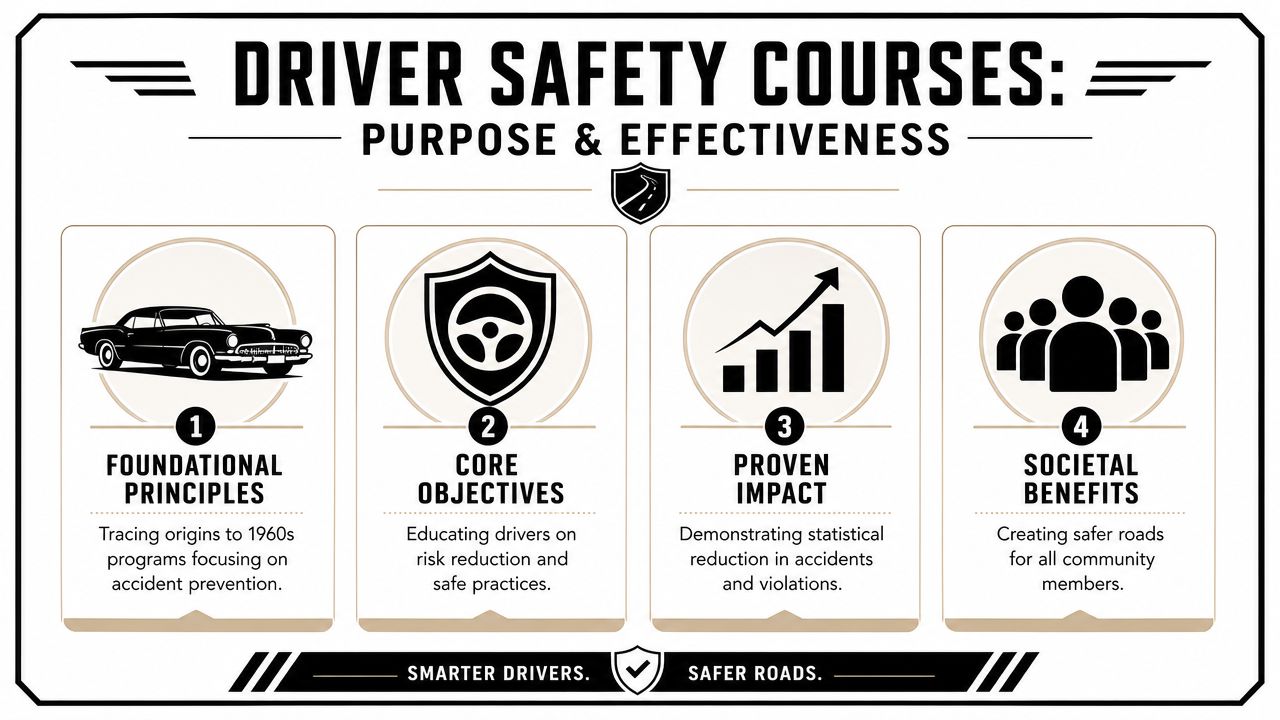
That purpose has been consistent for decades. The National Safety Council says it pioneered the first Defensive Driving Course in 1964 and has since trained more than 80 million drivers worldwide through its programs. That history helps explain why courts, employers, and insurers keep returning to these courses. They are trying to reduce repeated mistakes before those mistakes produce another injury claim, another totaled car, or another trip to the emergency room (National Safety Council defensive driving overview).
What these courses are designed to change
A good course tries to change what happens in the few seconds before trouble develops. It teaches drivers to spot patterns earlier, leave more room, control speed with more judgment, and reduce the small choices that often stack up into a collision.
That matters because many crashes do not begin with one dramatic mistake. They build like a row of falling dominoes. A driver looks down for a moment, follows too closely, misses a brake light, then reacts late. Safety training tries to interrupt that chain sooner.
Some programs also help drivers regain confidence after a traumatic event. That emotional piece should not be dismissed. A person who feels shaken after a wreck may benefit from structured review, especially if getting back behind the wheel has become stressful.
What research says, and what it does not say
Families often assume that a prevention course must lead to a clear drop in crash numbers. The research is more limited than that. The same National Safety Council overview discusses a 2021 overview of systematic reviews that found pre-license and post-license driver education improved secondary outcomes such as driving performance and self-perceived ability. It did not find a meaningful reduction in crashes or injuries in that review.
That distinction matters.
A course may help a driver perform better and make safer choices, but it is not proof that future collisions will be avoided. Road conditions, distracted drivers, weather, vehicle defects, and simple human error still exist. Training can lower risk. It cannot erase it.
For families dealing with the aftermath of a serious Colorado crash, that point has legal value. If the other driver caused the wreck, your personal injury claim does not rise or fall based on whether someone later enrolled in a class. Liability still depends on evidence such as who acted unreasonably, what injuries were caused, what treatment was needed, and how the crash changed daily life.
Why this still matters after a crash
Even with those limits, these courses can still play a practical role in recovery. They may help a driver satisfy a court or employer requirement. They may support an argument for insurance discounts or point-related benefits, depending on the program and the insurer. They may also show that a driver is taking steps to reduce future risk, which can matter in personal decisions about returning to the road.
Vehicle-based safety tools can serve a similar preventive purpose. Some families also look for ways to improve vehicle safety with blind spot monitoring, especially after a side-impact or lane-change collision.
The key is to keep expectations realistic. A motor vehicle accident prevention course can improve habits, sharpen awareness, and sometimes help with insurance or administrative issues. It does not rewrite fault, and it does not cancel the legal rights a family may have after a serious injury crash.
Exploring Different Types of Accident Prevention Programs
Not every accident prevention program serves the same purpose. Some are built for a driver who got a moving violation. Others are designed for a commercial operator, a new teen driver, or a company trying to reduce fleet risk.
That's why the phrase motor vehicle accident prevention course works better as an umbrella term than as a single product. The right course depends on why you're taking it and who is asking for it.
Common program categories
A standard defensive driving course is the commonly recognized version. It's often tied to traffic citations, general driving refreshers, and voluntary skills review.
A commercial or professional driver course usually goes deeper into work-related risk. Think delivery vans, trucking operations, rideshare work, and employer vehicle policies. These courses often pay closer attention to fatigue, route awareness, and higher-exposure driving.
A teen-focused program often supports newer drivers and their parents. Its value isn't just memorizing road rules. It's practicing judgment before inexperience turns a normal lane change into a crisis.
A fleet or employer course is less about one ticket and more about organizational risk. Businesses use these programs to encourage safer habits across multiple drivers and vehicles.
If you're also thinking beyond training and looking at vehicle-based safety support, some families choose to improve vehicle safety with blind spot monitoring as one layer of protection. That doesn't replace better driving habits, but it can complement them, especially for older vehicles that didn't come with newer warning systems.
Comparison of Motor Vehicle Accident Prevention Courses
| Course Type | Primary Audience | Main Goal | Typical Format |
|---|---|---|---|
| Standard defensive driving | Drivers with tickets, drivers seeking a refresher | Safer daily driving and possible administrative benefits | Online or classroom |
| Commercial driver training | CDL holders, delivery drivers, rideshare or employer drivers | Reduce work-related driving risk and improve road judgment | Classroom, online, or employer-led |
| Teen driver safety program | New drivers and parents | Build decision-making and hazard awareness early | Classroom, online, supervised practice |
| Fleet safety program | Employers and employee drivers | Create safer vehicle use across the organization | Company training, online modules, policy-based instruction |
How to decide which one fits
The easiest way to sort this out is to ask one question first: Why am I taking this course?
- If it's court or DMV related: Confirm the exact provider or approval requirement before enrolling.
- If it's insurance related: Ask whether the insurer requires a specific type of certificate.
- If it's about returning to driving after a crash: Focus on practical curriculum quality, not just speed or price.
- If it's for work: Check whether your employer wants a general defensive driving course or an industry-specific one.
That keeps you from paying for a class that sounds right but doesn't meet the requirement in front of you.
Inside the Curriculum What Skills You Will Build
A strong course doesn't just repeat traffic laws you already learned years ago. It tries to retrain how you notice risk. That shift is often the most useful part, especially for someone who feels shaken after a wreck and wants clearer habits instead of vague advice to “just be careful.”
The most effective programs focus on hazard anticipation, speed and space management, and distraction control. These are the key behavioral skills emphasized in defensive-driving and crash-prevention training because they help drivers recognize conflict cues earlier and scan more consistently, which is critical for avoiding common collisions (IRU defensive driving and crash prevention programme).
Hazard anticipation
Hazard anticipation means learning to notice the clue before the emergency. A child standing near a curb, a car drifting inside its lane, a driver edging out of a parking lot, or brake lights appearing far ahead all count as early warnings.
Instead of reacting at the last second, you learn to read the road like a forecast.
Speed and space management
This is about buying time. More following distance gives you more options. A safer lane position can improve visibility. Entering an intersection at a manageable speed makes it easier to respond if someone runs a red light or turns unexpectedly.
If weather is part of the concern, practical skid response matters too. This overview on what to do if your car skids helps connect classroom ideas to a real situation many Colorado drivers face.
Distraction control
Distraction control isn't limited to texting. It includes eating, adjusting navigation, handling kids in the back seat, or mentally checking out after a long day. Courses try to make drivers more deliberate about when they split attention and when they need full focus.
Small attention errors often stack. One glance away from the road, one short following gap, and one late brake can become the entire crash sequence.
A good course turns these ideas into repeatable habits. Scan sooner. Leave room. Reduce divided attention. Those skills don't make anyone invincible, but they do make the road less demanding and your reactions less rushed.
Unlocking Benefits for Your Insurance and Driving Record
For many drivers, the most concrete value of a course isn't abstract safety language. It's what the completion certificate can do for a driving record or insurance bill.
That's one reason these programs remain popular even when crash-reduction research is mixed. Administrative and financial benefits are easier to see, and in some states they're built directly into DMV and insurance systems.
What a major state program looks like
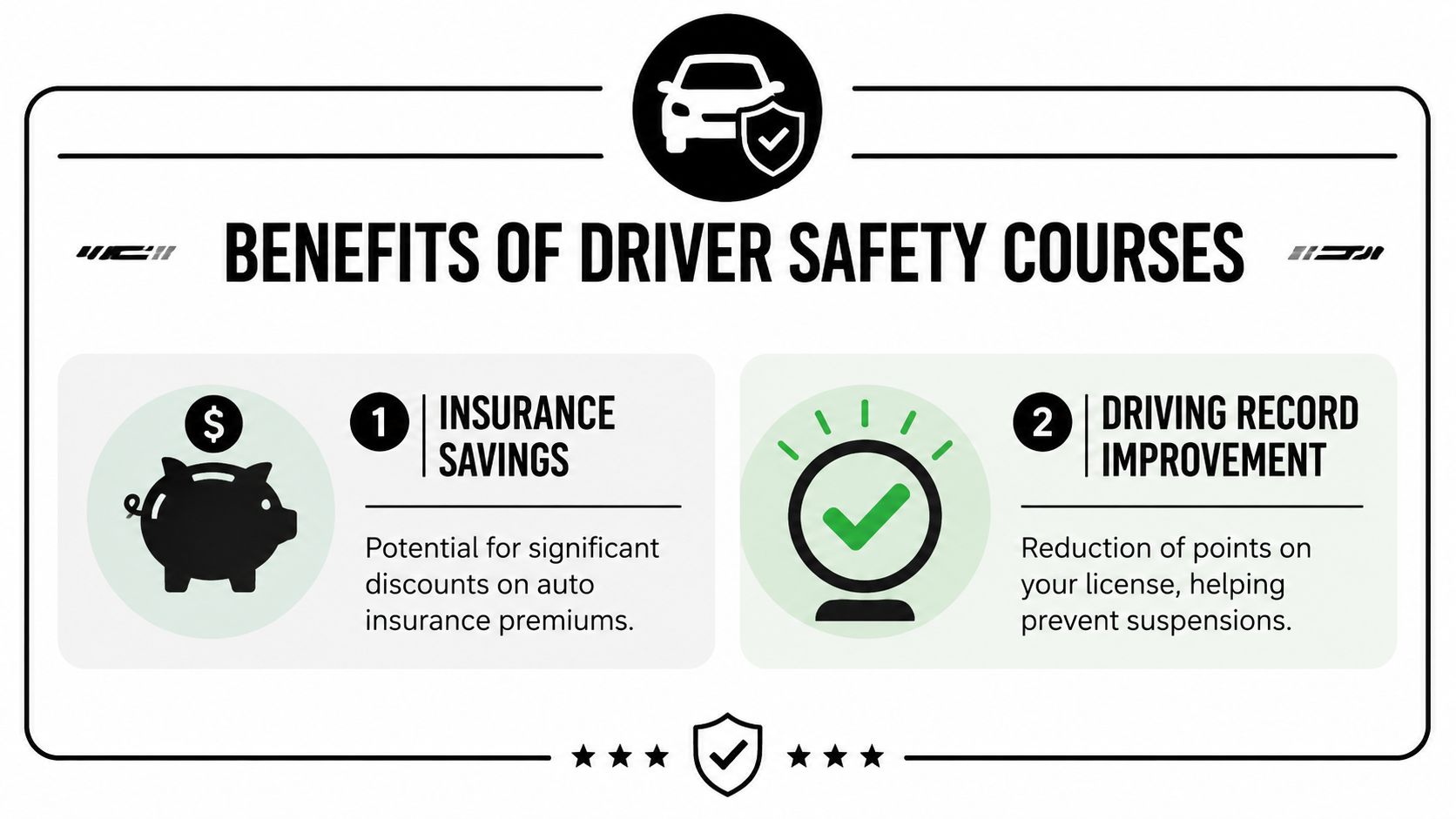
New York's DMV-approved Point and Insurance Reduction Program, often called PIRP, offers one of the clearest examples. According to the New York DMV, an approved course can provide up to a 10% reduction in the base rate of certain auto insurance premiums for three years, and it may reduce up to 4 points from a driver's total for suspension purposes under qualifying conditions. Approved providers commonly describe it as a 6-hour course available online or in the classroom (New York DMV PIRP and IPIRP details).
Even if you don't live in New York, that example shows how these courses often work in practice. They can create real, measurable value for drivers by easing part of the financial and licensing pressure that follows a violation.
If you're trying to understand how insurers view past violations more broadly, this guide to driving record's insurance impact can help frame the issue in plain language.
Why families should be careful with the fine print
The words “point reduction” often mislead people. They hear “reduction” and picture a violation disappearing. That's not usually what the term means.
Here's the practical takeaway:
- Insurance benefit: Some approved courses may support a discount, but you usually need to confirm eligibility and submit the right proof.
- License benefit: A program may help with suspension calculations in some systems, but that doesn't always mean the underlying violation vanishes.
- Process matters: Keep the completion certificate, confirm approval status, and ask whether the credit is automatic or must be requested.
Colorado drivers should also understand their broader coverage obligations while sorting out any course-related benefit. This summary of car insurance requirements in Colorado is useful if you're trying to line up policy terms, legal minimums, and post-crash questions at the same time.
The course certificate is more like a receipt with legal consequences than a magic eraser. It helps only if it's the right course, from the right provider, used the right way.
How to Choose an Approved Course in Colorado
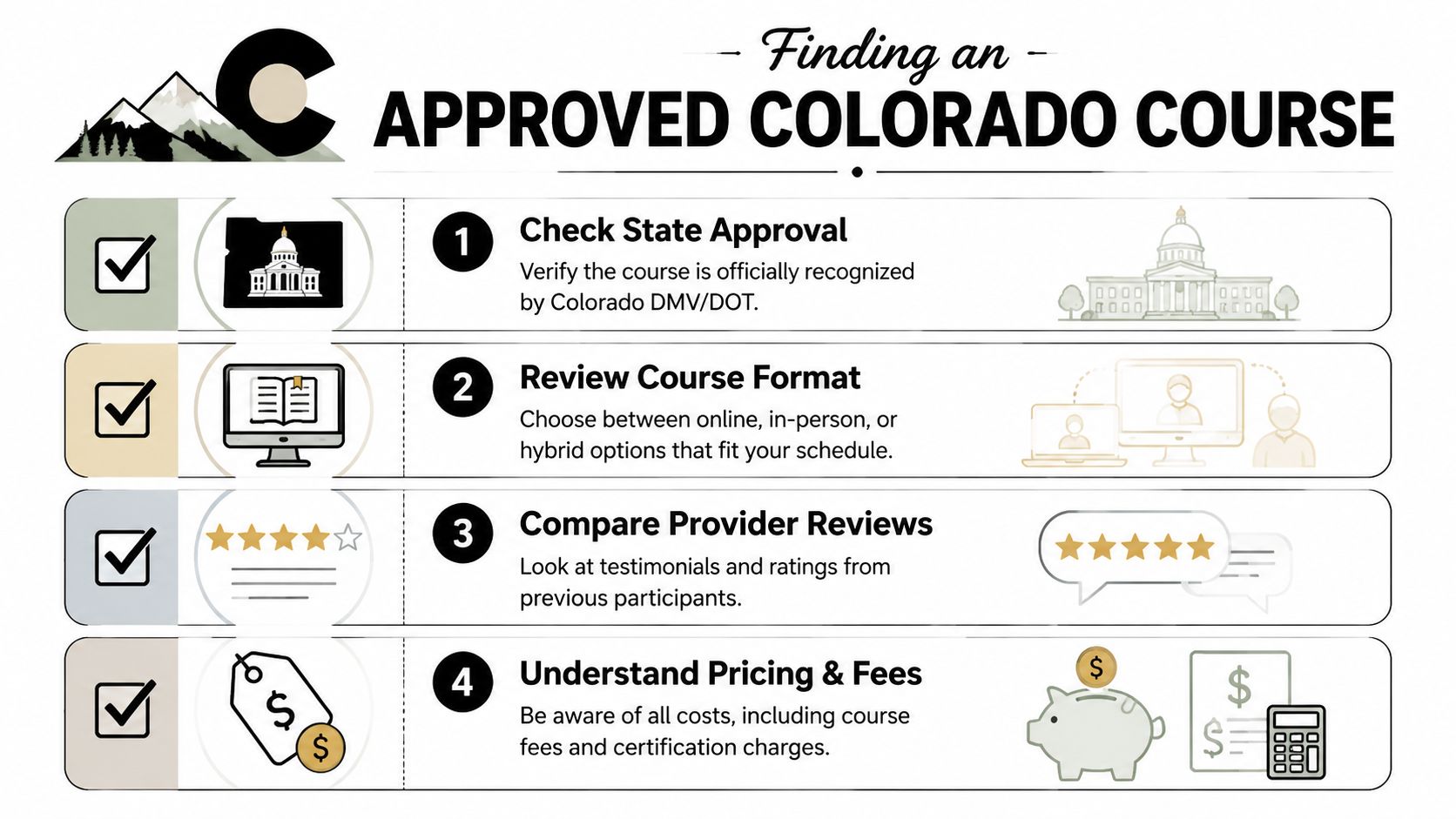
In Colorado, the safest approach is to start with the requirement, not the advertisement. Before you pay for any class, confirm who needs to recognize it. That might be a court, an employer, an insurer, or a state agency. Approval that works for one purpose may not work for another.
A lot of frustration comes from drivers enrolling in a convenient online course and learning later that the wrong agency, wrong county, or wrong insurer won't accept it.
What to verify before enrolling
Use this checklist when comparing providers:
- Approval status: Ask whether the course is accepted for your specific reason for taking it. “State approved” is only helpful if the approving body matches your actual need.
- Format that fits your situation: Online can be easier if you're recovering from injuries or balancing appointments. In-person may help if you learn better with discussion and live instruction.
- Certificate details: Make sure the provider issues written proof of completion and explains how to submit it.
- Current curriculum: Look for training that addresses modern risks, not only old rulebook topics.
That last point matters more than many people realize. Some newer programs now address driver-assist technology and telematics-based safety tools, while others still focus mostly on traditional traffic laws. Not every course has kept up, so it's worth choosing one that reflects today's driving conditions (modern defensive driving course trends).
Signs of a useful modern course
A current Colorado-relevant course should speak to the roads people drive now. That may include heavy corridor traffic, mountain weather, smartphone distraction, and the way drivers misunderstand lane-assist or collision-warning systems.
You don't need a flashy provider. You need one that answers practical questions clearly.
A simple decision filter
Ask these three questions before you register:
- Will the person or agency requiring the course accept this provider?
- Does the curriculum match the kind of driving I do?
- Will I receive completion documentation I can use without extra hassle?
If the answer to any of those is unclear, keep looking.
What These Courses Mean for Your Personal Injury Case
When a family is recovering from a serious collision, one of the hardest parts is separating what feels morally relevant from what's legally relevant. A driver taking a safety course after the crash may seem important, but it doesn't automatically change fault.
That's because a personal injury case turns on evidence about what happened, who acted negligently, what injuries followed, and what losses the injured person suffered. A later class may show concern or compliance, but it doesn't erase the driving conduct that caused the wreck.

The key legal limit
Point-related programs often have a narrow effect. As the New York DMV explains in its point reduction guidance, these programs may subtract points for suspension calculations but do not remove the violation from a driver's permanent record, and that distinction can matter in an insurance claim or lawsuit (New York DMV point and insurance reduction program explanation).
That idea carries over as a legal principle even outside New York. Administrative relief and legal accountability are not the same thing.
What injured people should keep in mind
If the other driver takes a course, that doesn't cancel your claim.
If you take a course yourself, that isn't automatically an admission of fault either. It may reflect caution, employer policy, court compliance, or a personal decision to rebuild confidence behind the wheel.
For many families, the bigger issue is how to communicate with insurers while these details are unfolding. This guide on how to deal with insurance after car accident can help you think through timing, statements, and documentation.
In a personal injury case, the course is usually a side note. The central story is still the crash, the injuries, and the evidence.
Frequently Asked Questions About Prevention Courses
Will taking a course after an accident be seen as an admission of fault
Usually, no. People take these courses for many reasons, including court compliance, employer requirements, insurance questions, or personal caution after a frightening event. The legal question of fault depends on evidence, not merely on whether someone enrolled in a class.
How long does an insurance discount from a course typically last
That depends on the state, insurer, and program. Some systems offer a defined period, while others may not offer any discount at all. The safest move is to ask your insurer in writing whether it recognizes the course, what benefit applies, and what documentation it needs.
Can I take a motor vehicle accident prevention course online in Colorado
Often, yes, depending on the purpose of the course and the provider's approval status. Online formats can be especially practical for people who are injured, caring for family members, or trying to manage appointments and work disruptions after a crash. Just make sure the course is accepted for your specific need before paying.
What's the difference between point reduction and having points removed from my record
This is one of the most important distinctions. In many systems, point reduction means points are subtracted for a limited administrative purpose, such as suspension calculations. It does not necessarily mean the underlying ticket or violation disappears from the permanent record.
If the other driver took a course, does that weaken my injury claim
Not by itself. A course doesn't erase negligent conduct. If the evidence shows the other driver caused the crash, your right to seek compensation still depends on the facts of the collision and the harm it caused your family.
Should I take one if I'm nervous about driving again after the crash
For some people, yes. A quality course can provide structure, refresh core safety habits, and make driving feel less chaotic after trauma. But it's a support tool, not a substitute for medical care, counseling, insurance planning, or legal advice.
What documents should I save if I complete a course
Keep the enrollment receipt, certificate of completion, any approval notice, and any communication with the insurer, court, employer, or agency that required it. If a dispute comes up later, that paperwork matters.
If your family is dealing with injuries, insurance pressure, or questions about how a crash affects your rights in Colorado, Nares Law Group LLC provides information and representation for people harmed in motor vehicle and truck collisions. If you're unsure whether a course, a ticket, or an insurer's request could affect your claim, getting legal guidance early can help you make careful decisions while you focus on recovery.