You’re hurt, your car is damaged, your phone won’t stop ringing, and an insurance adjuster suddenly sounds more urgent than your doctor. That’s where many people make expensive mistakes.
If you’re trying to figure out how to deal with insurance after car accident injuries in Colorado, the right approach is simple in theory and hard in practice. Protect your health. Protect the facts. Slow the claim down enough to understand what it’s worth. Insurance companies move fast when speed helps them, and slow when delay helps them.
A calm, organized response changes everything. The steps you take in the first hour, the records you save in the next few days, and the words you use with adjusters can shape the value of your case for months.
Your First Hour After the Crash
You get hit at an intersection. Your hands are shaking. The other driver says they are late for work and wants to handle it without police. Ten minutes later, a witness is gone, the cars have been moved, and the story has already started slipping in the insurer’s favor.
That first hour matters because missing facts are hard to recover later. The insurance company will build its file quickly. You need to protect your health and the record before details disappear.
Your first job is safety. If you can move without making an injury worse, get to a safer location and call 911. If anyone might be hurt, ask for medical help. Pain often shows up after the adrenaline drops, not while you are standing on the roadside trying to stay calm.

What to say at the scene
Keep your words short and factual. Exchange names, contact details, insurance information, plate numbers, and basic vehicle information. If police ask what happened, describe only what you personally saw and felt.
Do not guess about speed, distance, or fault. Do not say “I’m sorry,” even if you mean it politely. Do not argue with the other driver about whose version is right.
Practical rule: Be polite and brief. Speculation gives insurers room to recast your words as an admission.
If the other driver blurts out an apology or admits they were distracted, let the officer hear it. Do not coach them. Do not interrupt. If police create a report, get the report number before you leave. Later, you can use this guide on how to read a Colorado police accident report to spot errors before an adjuster uses them against you.
What to photograph before the vehicles move
Do not stop after one or two photos of the bumpers. That leaves out the context insurers use to challenge impact severity, point of contact, and even whether the crash happened the way you say it did.
Use your phone methodically. Capture:
- Wide scene shots showing both vehicles, lane position, skid marks, traffic signs, signals, weather, and road conditions
- Close damage photos from several angles, including each impact point, broken glass, deployed airbags, and interior damage
- Surrounding details such as debris, fluid on the roadway, construction zones, blocked sight lines, or faded lane markings
- Injury indicators like seatbelt bruising, cuts, swelling, or blood, if it can be done respectfully and safely
- Vehicle identifiers including the other car’s plate, VIN if visible, company markings on a truck, and the insurance card
Take video too. A slow walkaround with a calm narration often captures details still photos miss, especially road layout and traffic flow.
Witnesses disappear fast
Independent witnesses can make the difference between a disputed claim and a paid one. They also leave fast.
Ask for:
- Full name
- Phone number
- Email if available
- A short statement by text or audio if they are willing
Keep it simple. “Can you text me what you saw?” works better than a long conversation on the shoulder of a busy road.
Passengers should do this too if they are able. Passenger injury claims look straightforward, but they can get complicated when two insurers point fingers at each other or when everyone in the same car is making claims against limited coverage.
Seek care early, and understand why timing affects money
Waiting to “see how you feel tomorrow” often helps the insurer more than it helps you. Early treatment creates a clear link between the crash and your symptoms. Delay gives adjusters an opening to argue that you were not hurt, that something else caused the pain, or that you made the injury worse by waiting.
Get evaluated based on your symptoms. That does not mean chasing unnecessary treatment. It means getting checked promptly and following reasonable medical advice.
This also affects the hidden financial side of the claim. A small delay at the start can grow into a larger loss later. Health insurance may pay some bills, but that does not mean you keep all of your settlement. Subrogation claims can take a share back. If your injuries are documented late or poorly, you can end up with a weaker liability claim and the same medical repayment problem. That is one of the quiet traps injured people do not see coming in the first week.
If an adjuster calls while you are still at the scene or in the emergency room, do not give a recorded statement. Give your name, basic contact information, and the claim number if you have it. Save the detailed conversation for later, after you know the full picture.
Building Your Evidence File
After the tow truck leaves and the shock wears off, the claim becomes a paper trail. Insurance companies don’t pay based on how upset the crash made you. They pay based on what can be documented, organized, and tied directly to the collision.
Think of your evidence file as the spine of your case. If it’s thin, the insurer controls the story. If it’s complete, you do.
Start one claim folder and one timeline
Use whatever you will maintain. A physical binder, a cloud folder, a notes app, or all three. The format matters less than consistency.
Your file should include every document and every dated event. If the adjuster calls on Tuesday at 2:14 p.m., write it down. If you buy a brace, fill a prescription, miss work, or get referred to a specialist, save proof of it.
The documents that matter most
Some records carry more weight than others because they tie the injury, treatment, and financial loss to the crash in a clean sequence.
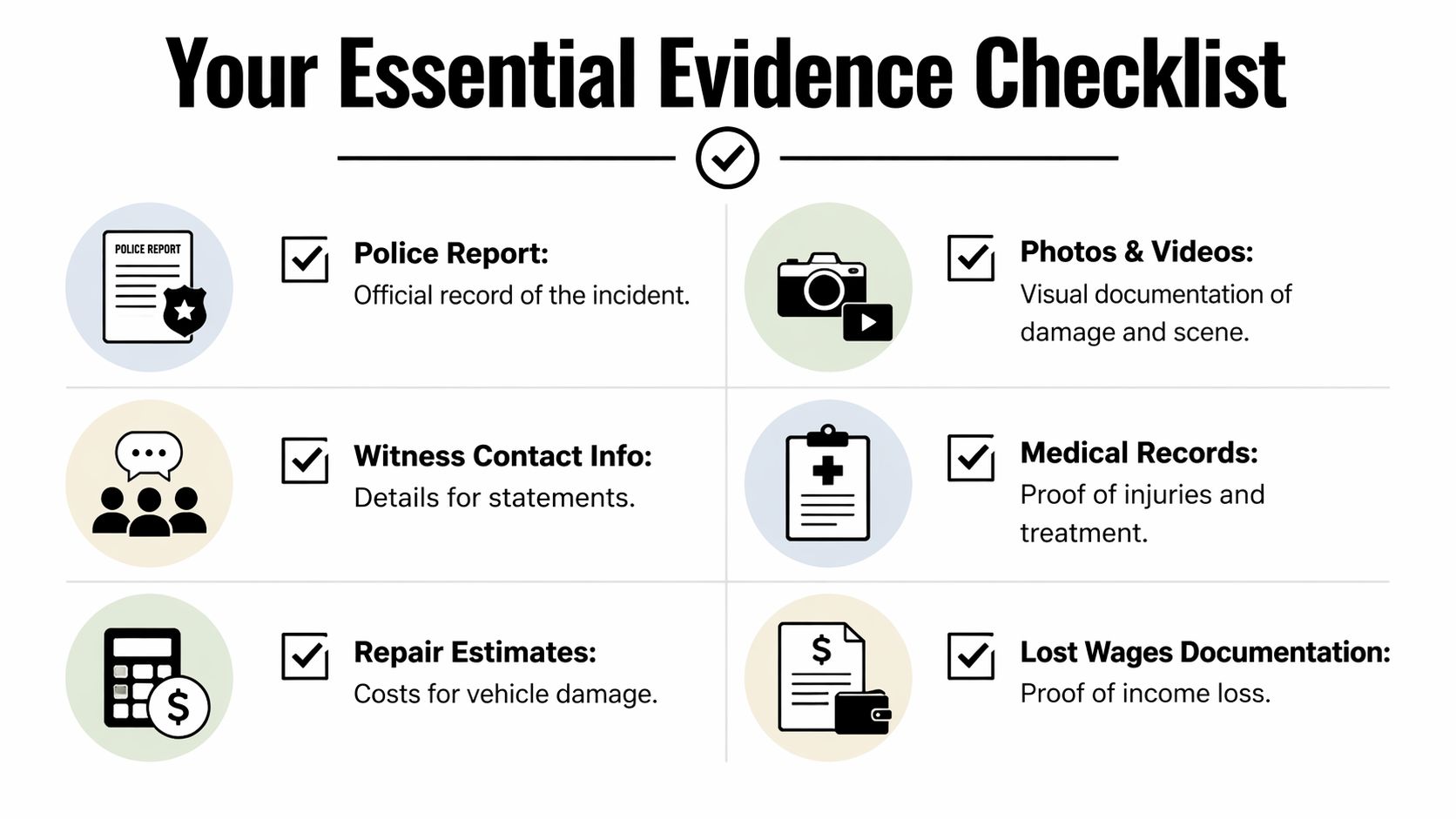
Build your file around these:
- Police report. Get the report number at the scene and request the completed report as soon as it’s available. If you need help decoding what the officer included, this guide on how to read a police accident report can help you spot useful details and potential errors.
- Scene evidence. Save original photos and videos, not just screenshots sent by text.
- Medical records. Keep visit summaries, imaging reports, discharge instructions, diagnoses, prescriptions, and referrals.
- Medical bills and receipts. Save every bill, copay receipt, mileage log for appointments, pharmacy receipt, and out-of-pocket purchase related to treatment.
- Repair documents. Keep estimates, total loss paperwork, towing invoices, storage fees, rental receipts, and repair updates.
- Income loss proof. Ask your employer for missed-day records, wage verification, and documentation of used PTO if your employer tracks it.
The strongest claims usually read like a timeline, not a stack of random papers.
Keep a symptom journal
Medical records are essential, but they often miss the daily cost of an injury. A symptom journal fills that gap.
Write down:
- pain levels
- headaches
- sleep disruption
- missed family activities
- work limitations
- driving anxiety
- side effects from medication
Keep it factual. Don’t perform for the file. If one day is better and the next is worse, record both. Credibility matters.
The hidden settlement trap most people never expect
A lot of injured people assume that if their health insurance paid the hospital or physical therapy bill, that issue is finished. It often isn’t.
In Colorado, health plans can assert subrogation rights under C.R.S. § 10-4-708, which means they may seek reimbursement from your settlement after paying medical bills upfront. According to this discussion of medical bills after a Denver car accident, 15% of 2025 auto claims involved subrogation disputes.
That surprise can shrink the money you ultimately take home.
Here’s the practical problem. Your health insurer may have paid providers at negotiated rates, then later claim repayment from your settlement. If you haven’t documented the full picture of your damages, including lost wages and pain, you’re in a weaker position when it’s time to challenge an aggressive reimbursement demand.
A simple example of how documentation helps
Assume your settlement has to cover more than medical treatment. It may also need to cover time off work, ongoing symptoms, future care concerns, and the ordinary disruption this crash caused in your life. If your file only contains treatment bills, the health plan’s reimbursement claim can feel larger and harder to push back on.
If your file also shows missed income, ongoing limitations, and the broader impact of the injury, you have a better argument that the settlement doesn’t fully compensate you and shouldn’t be carved up without scrutiny.
That’s why I tell people not to think only in terms of “What did the ER charge?” Think in terms of “What did this crash cost me in total?”
Communicating with Insurance Adjusters
The first adjuster call often comes before you have seen all the bruising, finished a full medical workup, or understood how much time you will miss from work. That timing is not accidental. Early contact helps the insurer gather statements before the claim is fully developed.
The adjuster may sound kind and organized. Treat the conversation like evidence anyway. A friendly tone does not change the insurer’s goal, which is to limit what the company pays.

What the first call is really for
Early calls serve two purposes. The insurer wants a clean version of the facts, and it wants to see how much you know about your own claim.
That matters because people often minimize injuries in the first few days. They say they are sore but fine. They guess about fault. They try to be cooperative and end up giving the insurer language it can reuse later.
Recorded statements raise the risk. Once your words are preserved, the adjuster can compare every later medical complaint against that first conversation and argue that your symptoms appeared later, were exaggerated, or came from something else.
Passengers need to be especially careful here. A passenger may have a claim against the at-fault driver, and in some crashes, against the driver of the car they were riding in. If you are hurt as a passenger, one casual statement to the wrong insurer can complicate both claims.
What you should say instead
Give basic identifying information and confirm the date and location of the crash. After that, keep your answers short.
Use language like this:
“I’m reporting the collision. I am still being evaluated and I’m not ready to give a detailed statement.”
Or:
“Please send any requests for documents or authorizations in writing.”
Or:
“I do not want to guess about injuries or discuss treatment until I have more information.”
Those responses are polite, accurate, and hard to twist.
Three mistakes that hurt otherwise strong claims
Good claims lose value in ordinary conversations. I see the same problems over and over.
- Guessing about your condition. Pain changes over the first several days. Tingling, headaches, back spasms, and concussion symptoms often show up after the adrenaline wears off.
- Trying to sound fair by filling in gaps. If you do not know your speed, the light sequence, or what another driver was doing, say you do not know.
- Signing broad medical releases. The insurer may ask for open-ended access to years of records. That can turn a car crash claim into a search through unrelated medical history.
One more warning. Do not let the property damage side of the claim bleed into the injury side without thinking it through. Repair issues, rental car pressure, and total loss disputes create stress, and that stress pushes people to settle injury claims too early. If you are sorting out car repairs at the same time, this guide on the difference between property damage and collision coverage can help you separate those issues.
Use written communication when possible
Phone calls create disputes about what was said. Email creates a record.
If the adjuster calls, answer if you need to, confirm who they are, and move the conversation into writing. That slows the exchange down in a good way. It gives you time to review what is being requested, and it reduces the chance that a casual answer becomes a problem later.
A simple pattern works well:
| Situation | Better response |
|---|---|
| Adjuster asks “How are you feeling?” | “I’m still being evaluated and will provide updates in writing.” |
| Adjuster asks for a recording | “I decline a recorded statement at this time.” |
| Adjuster asks for broad medical access | “Please send the request in writing so I can review the scope.” |
Do not let a quick offer set the value of your case
Early offers are common because they work. Bills are arriving, your car may be in the shop, and you want the problem behind you.
But a fast check can cost you more than it solves. Once you accept and sign a release, the case is usually over. If treatment continues, if your wages drop, or if your health insurer later asserts subrogation rights against the settlement, the money left in your pocket may be far less than you expected.
Keep one rule in mind during every adjuster conversation. Accuracy protects claims. Speed helps insurers.
Navigating the Colorado Claims Process
Two claims can start from the same crash and move on very different tracks. Your own insurer may be handling collision coverage or Med Pay while the other driver’s insurer is evaluating fault, damages, and how little it can pay to close the file.
That split matters because the rules are different, and so are the incentives.
First-party claims and third-party claims
A first-party claim is a claim under your own policy. Common examples include medical payments coverage, collision coverage, and uninsured or underinsured motorist coverage when those benefits apply.
A third-party claim is your claim against the at-fault driver’s insurer. That company is not your partner in the process. Its job is to protect its insured and control what it pays. People get into trouble when they assume both insurers owe the same duties or will treat the claim with the same level of urgency.
If you are dealing with car repairs while injury issues are still unfolding, this explanation of property damage coverage versus collision coverage can help you choose the right route and avoid wasting time with the wrong carrier.
Passengers need to pay especially close attention here. A passenger may have a claim against the driver of the car they were riding in, the other driver, or both. Passengers also may have access to Med Pay or other coverage under more than one policy. That sounds helpful, but it can create confusion fast if bills are paid from one source and a settlement later gets reduced by reimbursement claims.
Colorado deadlines and what they actually mean
Colorado insurers do not have unlimited time to sit on a claim. The Colorado Division of Insurance lays out claim handling standards under Regulation 5-1-14, including timeframes for acknowledging communications, conducting a prompt investigation, and providing a decision once the insurer has the information it reasonably needs. You can review those rules through the Colorado Division of Insurance claim handling regulations.
Those rules help. They do not force an insurer to value your case fairly before your medical picture is clear.
That is the trap.
An adjuster can stay polite, ask for another record, request another billing statement, and keep the file active while financial pressure builds on your side. Meanwhile, you are dealing with treatment, missed work, car trouble, and the understandable urge to be done with it. Insurers know that pressure changes decisions.
Delay creates leverage for the insurer
In practice, delay usually looks ordinary on paper. A request for records. A statement that the file is under review. A note that the adjuster is waiting on supervisor authority.
What matters is the effect. The longer the claim drags on, the more likely an injured person is to accept a number that solves today’s problem and creates a bigger one later.
That bigger problem often shows up after settlement. Health insurance, Medicare, Medicaid, or Med Pay may assert reimbursement rights. Subrogation and liens can take a meaningful bite out of the money you thought was yours to keep. I have seen people focus so hard on the gross settlement number that they never stop to ask what will be left after those claims are resolved.
A passenger can get hit twice by this issue. First, as an injured claimant trying to sort out which policy applies. Second, as the person who assumes someone else’s insurance will handle everything cleanly, only to learn later that medical payors want repayment from the settlement.
Manage the claim like a file, not a conversation
The people who handle this process best do not argue more. They document better.
Use a simple system:
- Identify each claim separately. Write down the claim number, insurer, adjuster name, and what that claim covers.
- Track requests and response dates. Keep a dated log of every document you sent and every deadline the insurer gave you.
- Ask targeted questions. If the carrier says it is waiting, ask what specific item is still needed and whether anything else is required.
- Watch for premature valuation. If treatment is ongoing, be careful about any push to settle before prognosis, future care, wage loss, and reimbursement claims are clearer.
- Check the net recovery, not just the offer. Before accepting anything, ask what medical liens, subrogation claims, or policy offsets may reduce the amount you receive.
Patience pays in such situations. A claim can look organized from the insurer’s side and still be moving toward an unfair result for you.
If the company keeps pressing for a decision before the records are complete, before treatment has stabilized, or before reimbursement claims are understood, treat that as useful information. It usually means the uncertainty favors the insurer, not you.
Negotiating a Fair Car Accident Settlement
The first settlement offer often arrives dressed up as closure. It sounds practical. It sounds efficient. It sounds like a way to move on.
It usually isn’t a fair measure of the claim.
Know what you’re actually negotiating
A settlement should account for more than the most obvious bill on your kitchen counter. It should reflect the categories of loss recognized in the claim.
At a minimum, look at:
- Economic damages such as medical expenses, lost wages, and out-of-pocket costs.
- Non-economic damages such as pain, emotional distress, and loss of enjoyment of life.
That distinction matters more in Colorado now than many people realize. According to this review of Colorado car accident settlement values in 2025, the cap on non-economic damages increased from $613,760 to $1.5 million for qualifying cases filed on or after January 1, 2025, while economic damages are not capped.
That change doesn’t mean every case is worth a high number. It does mean serious injury claims have more room than adjusters may initially suggest.
Use averages carefully
Average settlement figures can help set expectations, but they can also mislead people into accepting too little or demanding too much for the wrong reasons.
According to this Colorado settlement amounts overview, the average Colorado car accident settlement ranges from $25,000 to $30,000. The same source notes that minor crashes may settle for under $10,000, moderate injury cases often fall between $15,000 and $75,000, soft tissue and whiplash claims typically range from $5,000 to $25,000, fracture or surgery cases range from $25,000 to over $150,000, and severe injuries such as paralysis or traumatic brain injuries exceed $500,000.
Those figures are useful as reference points, not as a price tag for your case.
Averages hide the details that drive value:
- liability strength
- the quality of medical proof
- whether symptoms resolved or persisted
- insurance limits
- credibility
- how well damages are documented
Build your demand before you argue your number
A good demand letter is not emotional venting. It is an organized explanation of liability, injury, treatment, losses, and supporting documents.
Your demand package should usually include:
- a concise crash summary
- a treatment timeline
- medical records and bills
- wage loss proof
- photos
- a clear settlement demand
- a deadline for response
A demand without records is a request. A demand with records is an argument.
If your treatment is still active or key diagnoses are unresolved, it may be too early to negotiate final numbers. That’s hard for injured people to hear when bills are due, but premature settlement is one of the most common ways valid claims get undervalued.
A short explainer may help before you respond to any offer:
How to respond to a low offer
Don’t answer a weak offer with outrage alone. Answer it with specifics.
A useful counter usually does three things:
- Identifies what the offer ignores. Maybe the adjuster omitted future treatment concerns, missed work, or the daily impact of the injury.
- Points to records. Cite the chart notes, imaging, restrictions, employer letter, and receipts.
- Makes a revised demand. Ask for a specific amount you can defend.
If the adjuster focuses narrowly on your current bills, bring the conversation back to the full damage picture. If the adjuster leans on “subjective complaints,” point back to consistent treatment, documented limitations, and the legal framework that recognizes non-economic harm.
Don’t sign away leverage by accident
A settlement check usually comes with a release. Once you sign it, the claim is typically over. If your symptoms worsen later, if another diagnosis appears, or if future care becomes necessary, reopening the case is usually not an option.
That’s the negotiation pressure point. The issue isn’t just whether the offer feels decent today. The issue is whether it closes the claim for an amount that still looks fair after the full consequences of the crash become clear.
When You Need to Call a Lawyer
Some claims can be handled without legal help. A minor property-damage-only case with no meaningful injury may not justify full representation.
Many injury claims do.
The hard part is that people often wait too long to get advice. They try to cooperate, stay patient, and handle everything themselves. By the time they call, they may already have given a recorded statement, signed broad releases, or accepted a settlement frame that’s too narrow.
Red flags that should change your approach
You should strongly consider legal help if any of these are true:
- You have more than minor injuries and treatment is still ongoing.
- Fault is disputed or the police report is incomplete or unfavorable.
- The insurer wants a recorded statement or broad medical authorization.
- You missed work or expect future treatment.
- A commercial vehicle or truck was involved, which usually adds more evidence issues and more insurance layers.
- The insurer made a quick offer before your medical condition stabilized.
- Your health insurer is asserting reimbursement rights against the settlement.
- The policy limits may be too low for the harm involved.
If you’re unsure, this article on when to hire a personal injury attorney gives a practical way to evaluate timing and complexity.
Passenger claims are more complicated than most people expect
Passengers often assume their claim is simple because they were not driving. In reality, passenger claims can be among the most confusing.
According to this overview of uninsured and related car accident issues in Denver, passengers are involved in 22% of accidents, and 28% of Colorado passenger claims exhaust policy limits. Passenger claims may involve the driver’s policy, the vehicle owner’s policy, and the passenger’s own uninsured or underinsured motorist coverage.
That creates real strategy questions. Which policy should be pursued first? What if both drivers share fault? What if the available liability coverage isn’t enough? What if the passenger knows the driver and feels uncomfortable making a claim?
Those cases are exactly where people lose money by keeping the process informal.
What works and what usually doesn’t
It helps to be blunt here.
What usually works
- early evidence preservation
- prompt medical documentation
- careful communication
- waiting until the medical picture is clear enough to value the claim
- reviewing all available policies before accepting limits-based arguments
- challenging lien and subrogation issues before final distribution
What usually doesn’t
- trusting the first number because it came quickly
- trying to “sound reasonable” by minimizing pain
- assuming the insurer will point out every available coverage
- signing releases to get the process over with
- handling a passenger claim like a simple one-policy case
What a lawyer actually takes off your plate
Legal help isn’t just about filing a lawsuit. In many cases, it’s about controlling the claim before litigation becomes necessary.
A personal injury firm can take over:
- communication with adjusters
- collection and organization of records
- policy investigation
- demand preparation
- settlement negotiation
- lien and subrogation review
- litigation if the insurer won’t deal fairly
That matters because injured people are rarely in a good position to do all of that while also attending treatment, working when they can, and trying to keep family life together.
One option in Colorado is Nares Law Group LLC, which handles investigation, treatment coordination, negotiation, trial, and settlement in motor vehicle injury cases. The practical value of counsel in a case like this is simple. It lets the claimant stop managing the insurer’s process and start focusing on recovery.
The right time to call a lawyer is usually earlier than people think. Not because every case needs a lawsuit, but because many cases need protection long before they need court.
If you’re dealing with injuries, medical bills, missed work, or an insurance company that seems more interested in closing your file than understanding your losses, Nares Law Group LLC offers free consultations to help you understand your rights and options. You don’t need to guess whether the insurer’s offer is fair or whether you’re saying the wrong thing. Getting clear advice early can help you protect the claim, avoid preventable mistakes, and make informed decisions about what comes next.