After an accident, the most important question isn't just about your injuries—it's about what to do next. The simplest answer is to hire a personal injury attorney, and to do it as soon as possible. This is especially true if you’re facing serious injuries, confusing medical bills, or any argument about who was at fault. Acting quickly is the single best thing you can do to protect yourself.
The Critical First Decision After an Injury
The moments after an accident are pure chaos. You're in pain, you're in shock, and almost immediately, the phone starts ringing with calls from insurance adjusters. In that confusion, deciding whether to call an attorney is the most important decision you can make. It’s a choice that will shape your entire recovery.
Think of it this way: you wouldn't try to perform your own surgery. The legal system is just as complex. An experienced attorney has walked this path hundreds of times. They know where the insurance companies set traps, and they know how to guide you toward a fair and just outcome.
Why Acting Early Is Your Best Defense
Getting legal help right away does more than just protect your legal rights; it gives you back a sense of control. An attorney immediately gets to work preserving evidence that might otherwise disappear. They take over all communications with the insurance companies. They start building your case from a position of strength.
This allows you to do the one thing that truly matters: focus on healing.
The stakes are enormous. In the United States, there are roughly 39.5 million injury cases that require medical attention every year. These incidents create over $1 trillion in costs, from medical care to lost productivity. With about 400,000 new claims filed annually, insurance companies know they have the upper hand. Their goal is often to settle fast and cheap, especially with people who don't have a lawyer. You can learn more about how the competitive nature of injury claims affects settlement offers.
Hiring an attorney isn't about starting a fight. It's about making sure the fight is fair. It sends a clear signal to the insurance company that you understand what you're owed for your medical bills, lost wages, and pain and suffering.
So, how do you know it's time to make that call? It's less about the type of accident and more about the circumstances.
Here is a quick summary of the signs that you should contact an attorney right away.
Quick Signs You Need a Personal Injury Attorney
| Situation | Why You Need an Attorney |
|---|---|
| Your Injuries Are Serious | Any injury needing surgery, hospitalization, or long-term care involves complex future costs. An attorney ensures those costs are fully calculated. |
| Fault Is Being Questioned | If the other side’s insurer is blaming you or twisting the facts, you need someone to investigate and prove what really happened. |
| The Settlement Offer Is Low | The first offer is almost never the best offer. An attorney knows the true value of your claim and can negotiate for a fair amount. |
| The Insurer Is Stalling | If an adjuster is delaying, ignoring calls, or asking for endless documents, they are likely hoping you will give up. A lawyer forces them to act. |
These signs are red flags that the insurance company is not on your side.
Delaying the decision to get help only weakens your position. Evidence gets lost. Witnesses' memories fade. Critical legal deadlines can pass without you even knowing they exist.
By contacting a firm like Nares Law Group for a free consultation, you take the first, most powerful step toward getting your life back.
Clear Signs You Need an Attorney Now
After an accident, you’re often left wondering what to do next. While it’s smart to get legal advice after almost any incident, some situations are more than just a red flag—they’re a clear signal that you need a professional in your corner, and fast.
These are the moments where trying to handle a claim on your own can go wrong very quickly. Recognizing them is the first step toward protecting yourself. If you see your situation in any of these seven scenarios, it’s time to call an attorney.
You Suffered Severe or Long-Term Injuries
This is the big one. If your injuries are serious—a traumatic brain injury (TBI), spinal cord damage, broken bones, or anything that requires surgery or long-term care—the stakes are too high. You can’t afford to go it alone.
These injuries come with costs that stretch far into the future. We’re talking about ongoing therapy, potential future surgeries, changes to your home, and the income you’ll lose because you can't work. The insurance adjuster’s first offer won’t even begin to touch these lifelong expenses. A lawyer, on the other hand, will bring in medical and financial experts to map out the full, true cost of what this injury will mean for the rest of your life.
There Is a Dispute Over Who Was at Fault
Is the other driver’s insurance company pointing the finger at you? If so, you're walking into a battle you're not equipped to fight. In Colorado, we have a rule called modified comparative fault. It’s simple: if you are found 50% or more to blame for the accident, you get nothing.
Insurance companies are masters at twisting the facts to shift blame. They’ll take your recorded statement out of context or find a creative way to interpret the police report that saves them money. An attorney’s job is to stop that from happening. We gather the real evidence, track down witnesses, and even hire accident reconstruction experts to prove what actually happened.
This little decision tree helps make it clear.
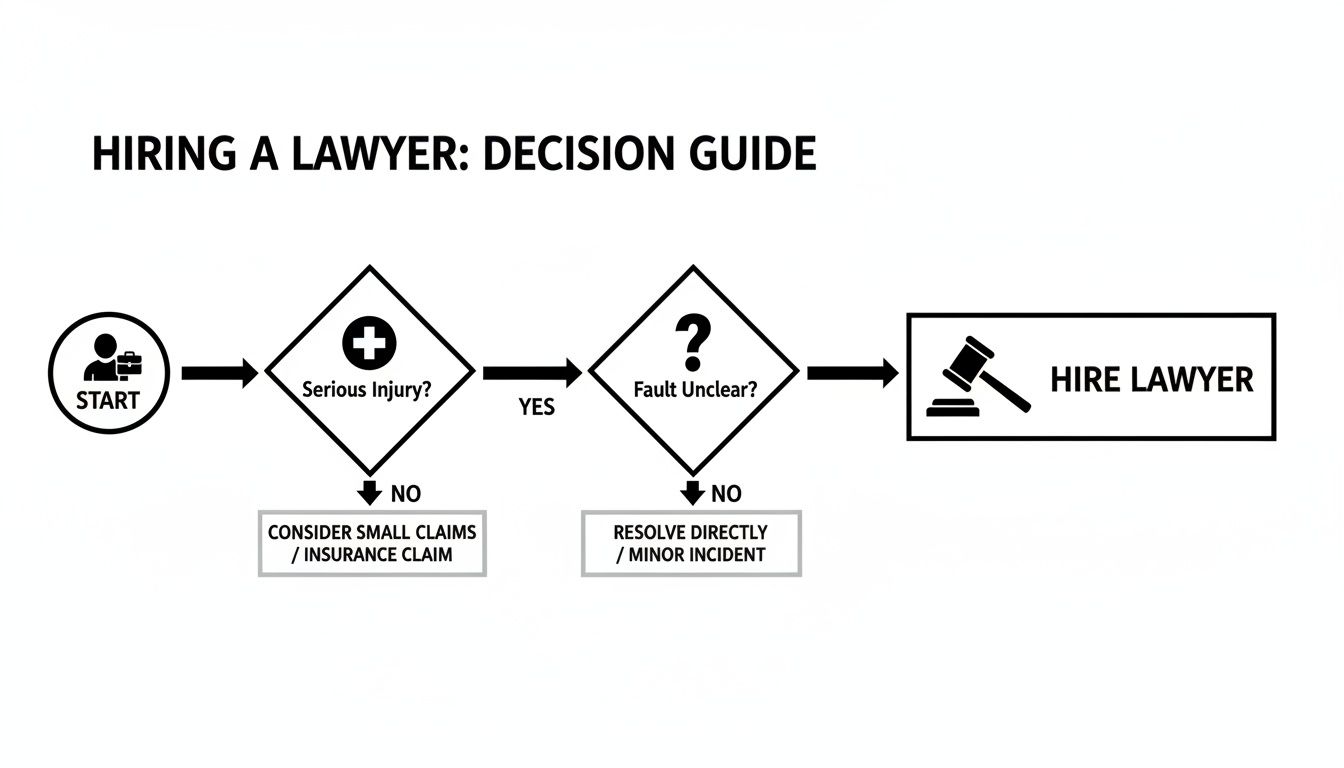
When injuries are serious or it's unclear who is at fault, the path forward points directly to getting legal help.
The Accident Involved a Commercial Vehicle
A crash with a semi-truck, a delivery van, or even a rideshare car is a completely different animal than a standard fender bender. The complexity skyrockets because you’re not just dealing with a driver. You could be facing claims against:
- The driver
- The trucking company they work for
- The manufacturer of the truck or its parts
- The company that loaded the cargo
Each one has its own insurance policy and its own team of lawyers ready to fight. On top of that, there are dense federal and state trucking regulations to untangle. You need someone who knows those laws inside and out and isn't intimidated by powerful corporate legal teams.
The Insurance Company Is Delaying or Denying Your Claim
If the insurance adjuster has gone silent, keeps asking for mountains of irrelevant documents, or flat-out denies your claim with a flimsy excuse, they aren’t just being slow. They are likely using a strategy known as "delay, deny, defend."
This is a calculated business tactic, not just bad customer service. They are hoping you’ll get so worn out and frustrated that you just give up.
An attorney shuts this down. We send a formal letter of representation, which forces them to take the claim seriously. It signals that the days of ignoring you are over and that a lawsuit is on the table if they continue to act in bad faith.
You Received an Insultingly Low Settlement Offer
The first offer is almost always a lowball. It's a test to see if you understand the real value of your claim.
Think about it. A driver in Denver gets rear-ended and their doctor says they need a $70,000 back surgery. The insurer swoops in with an offer of $15,000 to “settle this quickly.” Taking that deal would be a financial catastrophe. An experienced attorney sees this tactic from a mile away, rejects it immediately, and comes back with a demand that accounts for all of your medical bills, lost wages, and suffering.
Multiple Parties Are Involved
Multi-car pile-ups or accidents where several people were hurt can turn into a legal free-for-all. Suddenly, you have multiple insurance companies all trying to pin blame on someone else while minimizing their own payout. Trying to navigate that tangled web of competing claims is a nightmare. An attorney steps in to manage the chaos and make sure your voice is heard.
An Injury Involves a Minor
When a child is hurt, the rules change. Any settlement has to be formally approved by a court to ensure the money is truly for the child’s benefit. The funds are typically placed into a protected account that the child can’t touch until they turn 18. This court approval process is not something you can do on your own; it requires an attorney to protect the child’s settlement and their future.
Navigating Colorado's Statute of Limitations
After an accident, the clock starts ticking immediately. In the legal world, every personal injury claim has a firm deadline called the statute of limitations. Think of it as an expiration date on your right to file a lawsuit and seek compensation.
Once that date passes, your chance to hold the at-fault party financially accountable is gone for good. It doesn't matter how strong your case is or how severe your injuries are. Understanding this timeline is one of the most important things you can do to protect your rights.
In Colorado, the general deadline for most motor vehicle accidents is a three-year window. But be careful—this isn't a one-size-fits-all rule. Some claims have far shorter deadlines, especially those against government bodies, which can require you to give notice in as little as 182 days. You can find more details in our guide on the statute of limitation for a car accident.
The Dangers of Delaying Legal Action
Many people think as long as they file a claim before the official deadline, they're in the clear. This is a common and dangerous misunderstanding. The real question isn't just about meeting a legal deadline; it's about preserving the evidence that your entire case will be built on.
The longer you wait to get help, the weaker your case becomes. Critical proof starts to disappear almost right away.
- Witness Memories Fade: Someone who saw everything clearly on the day of the crash will have a hazy, uncertain memory a year later. Details get lost, and confidence wavers.
- Surveillance Footage Is Erased: Most businesses overwrite their security camera footage every 30 to 90 days. The video that proves exactly how the accident happened could be gone forever.
- Vehicle Data Disappears: Modern cars and commercial trucks are equipped with event data recorders (EDRs) that capture vital information like speed, braking, and steering. This data can be easily erased or overwritten if it’s not preserved quickly.
Hiring an attorney right away allows them to send out spoliation letters. These are formal legal notices that legally require the other party to preserve all relevant evidence. That single action can be the difference between a case you can prove and a case you will lose.
The question isn't just "when should I file my claim?" but "when should I start building my case?" The answer is always immediately. Delaying gives the insurance company a head start and allows crucial proof to vanish.
The best time to speak with a lawyer is as soon as possible after the accident—and always before you sign anything from an insurance company. With over 164,559 personal injury lawyers in the U.S. and a very low unemployment rate of just 0.8% for attorneys, there are dedicated specialists ready to act. Delaying means you miss the most important window to gather evidence.
Protecting Your Claim's Integrity from Day One
When you act quickly, you take control. An early investigation secures the facts before they can be forgotten, twisted, or lost completely. It puts your attorney ahead of the insurance adjuster's tactics and allows them to build a case founded on solid proof, not just your word against theirs.
Waiting until you feel "ready" or until your medical treatment is finished is a risk you simply can't afford. The clock is always ticking—not just on the statute of limitations, but on the strength and integrity of your claim itself. The very first steps you take often determine the final outcome.
What a Personal Injury Attorney Does for You

When you hear "lawyer," you probably think of courtrooms and dramatic trials. This is one of the biggest misconceptions we see, and it leads too many people to try handling a serious injury claim on their own. It can be a devastating mistake.
The truth is, an attorney's most critical work often happens long before a trial is even on the table. Think of your lawyer as the general contractor for your entire case. While your focus is on healing, they are managing every single detail, building your claim, and protecting you from the insurance company's tactics from day one.
Conducting a Thorough Investigation
The moment you hire us, the real work begins. We immediately launch an independent investigation into your accident, and this goes far deeper than just reading a police report.
Evidence disappears quickly. We take immediate action to preserve it before it’s lost forever. This isn't something you can do on your own. It includes:
- Securing the Scene: Sending investigators to photograph the site, tracking down and interviewing witnesses, and firing off legal notices to preserve things like security footage or a commercial truck's black box data.
- Hiring Experts: Bringing in accident reconstruction specialists, engineers, or top medical experts to analyze the evidence and provide testimony that powerfully supports your story.
- Gathering Documents: Systematically collecting every piece of relevant paperwork—police reports, every medical record and bill, employment files—to create a complete, undeniable picture of the accident and how it has impacted your life.
This aggressive, early investigation is the foundation of your case. It lets us establish the facts from a position of strength, preventing the other side from controlling the narrative.
Managing All Communications
One of the most immediate feelings of relief our clients describe is handing off the phone. No more stressful, manipulative calls from insurance adjusters trying to get you on a recorded line or pressure you into a quick, lowball offer.
Once you have a lawyer, all communication must go through us. We become your shield. Every email, phone call, and document request is managed by our team, ensuring you never say something that can be twisted and used to devalue your claim.
Your attorney becomes your official spokesperson, making sure every word exchanged with the insurance company is strategic and protective. This frees you to focus 100% on your recovery.
Calculating the Full Value of Your Claim
An insurance adjuster’s job is to save their company money. They will never tell you what your claim is truly worth. Our job is to calculate the full and fair value of all your damages—past, present, and future.
This goes far beyond just your current medical bills and lost paychecks. We dig deeper to account for:
- Future Medical Needs: The projected cost of ongoing physical therapy, future surgeries, necessary medications, or specialized in-home care.
- Lost Earning Capacity: The income you will lose over your lifetime if your injuries keep you from returning to your job or advancing in your career.
- Pain and Suffering: The real human cost of your injuries—the physical pain, the emotional trauma, and the loss of your ability to enjoy life as you once did.
Getting these numbers right takes experience and often requires us to bring in economic and vocational experts. This is one of the most critical steps, ensuring you don’t accept a settlement that leaves you with massive uncovered costs down the road. You can learn more about how a case unfolds by reviewing the stages of a personal injury case.
Negotiating a Fair Settlement and Preparing for Trial
With a rock-solid investigation and a detailed calculation of your damages, we draft a formal demand letter to the insurance company. This document lays out our legal arguments and demands a specific, fair settlement. This is where the real negotiations begin.
It’s true that around 95% of personal injury cases settle out of court. But the secret to getting a great settlement is having an attorney the insurance company knows is ready and willing to go to trial. Research consistently shows that clients with lawyers receive payouts more than three times higher than those who go it alone. And with the personal injury field growing, over 72% of legal leaders aim to hire more staff by 2026, underscoring the demand for proven trial advocates. You can discover more insights about legal hiring trends on PrimeLegalStaff.com.
Insurance companies keep files. They know which law firms will fight and which ones will fold for a low offer. A firm with a proven reputation in the courtroom, like Nares Law Group, negotiates from a position of absolute strength. We make it clear that if a fair offer isn’t on the table, we'll see them in court. That willingness to go the distance is what secures the best possible outcome for you—often without ever needing to step inside a courtroom.
How to Prepare for Your Free Consultation

You’ve decided to meet with an attorney. What now? That first meeting is more than just an introduction. It’s your opportunity to get clear answers and decide if you’ve found the right team to fight for you.
Walking in prepared changes everything. It turns a potentially overwhelming conversation into a productive strategy session. When you have your information organized, we can get a sharp, immediate sense of your situation. That lets us give you real, specific advice right from the start.
Think of it like seeing a specialist for a complex health issue. You’d bring your medical history and a list of symptoms. The same logic applies here. A little prep work goes a long way.
To make it easier, we’ve put together a simple checklist of what to bring. Don't worry if you can't find every single item—just gather what you can. Every piece helps us start building a strong foundation for your case.
Your Consultation Checklist
| Category | What to Bring | Why It's Important |
|---|---|---|
| Accident Details | The official police or incident report. | This provides an objective, third-party account of what happened. |
| Visual Evidence | Any photos or videos from the scene, of your injuries, or of property damage. | Visuals are incredibly powerful and help us see the accident's impact. |
| Medical History | All medical records, bills, discharge papers, and notes you've received so far. | This establishes the extent of your injuries and the financial costs you're already facing. |
| Financial Impact | Recent pay stubs or other proof of income before the accident. | This helps us calculate and prove your lost wages. |
| Insurance Info | Your own policy details and any letters or emails from an insurance company. | This gives us a clear picture of available coverage and the adjuster’s position. |
| Witness Info | A list of anyone who saw the accident, including names and contact details if you have them. | Eyewitness testimony can be crucial for confirming the at-fault party’s negligence. |
Don't let the paperwork intimidate you. The goal isn’t to show up with a perfectly complete file. It's to give your attorney a strong starting point. If you’re having trouble getting certain documents, like the official crash report, we can help. In fact, our guide on how to obtain an incident report can walk you through the process.
Your Story Is the Most Important Piece
Beyond the documents, the most critical element is your story. The facts and timelines are built around your personal experience of what happened and how it has affected your life.
Before we meet, take a few minutes to jot down a simple narrative. It doesn’t have to be perfect. Just a straightforward account of the accident, a timeline of your medical treatment, and a list of the ways your life has changed since. Who have you seen for treatment? What can’t you do now that you could do before?
Finally, bring your questions. This meeting is as much for you to interview us as it is for us to evaluate your case. You need to feel confident in the team you choose.
Ask about our experience with cases like yours. Ask about our strategy. Ask how we communicate with clients. A good attorney will welcome your questions and give you transparent answers. This isn't just a consultation; it's the start of a partnership.
Of course. Here is the rewritten section, adopting the voice, tone, and style of the provided examples.
Common Questions About Hiring an Injury Lawyer
Making the call to an attorney brings up a lot of questions. It's completely normal to worry about the cost, whether you have a case, and what the whole process looks like. We’ve had these conversations thousands of times.
Here are some honest answers to the questions we hear most often.
How Much Does It Cost to Hire a Personal Injury Attorney?
This is usually the first and biggest worry, but the answer should bring some relief. Like most experienced personal injury firms, we work on a contingency fee basis.
Think of it as a partnership. It means you pay zero upfront fees to get us started on your case. No retainers, no hourly bills stacking up. Our fee is simply a percentage of the money we win for you, either through a settlement or a court verdict.
In other words: If we don’t win your case, you owe us nothing in attorney fees. This system levels the playing field, making sure that your ability to get justice doesn't depend on the money you have in the bank.
What if the Accident Was Partially My Fault?
Even if you think you might be partly to blame, don't just assume you don't have a case. It's a common mistake that can cost you dearly. Colorado law has a specific rule for this called modified comparative fault.
This rule says you can still be compensated for your injuries as long as you are found to be less than 50% at fault. If you are assigned a share of the fault, your final recovery is just reduced by that percentage.
So, if a jury awarded you $100,000 but found you were 10% at fault for the crash, you would receive $90,000. This is where having an attorney becomes absolutely critical. We fight to gather the evidence that minimizes your percentage of fault and protects your right to a fair recovery.
Will I Have to Go to Court if I Hire an Attorney?
Probably not. People often picture dramatic courtroom battles, but the reality is that the vast majority of cases—about 95%—settle before a trial ever begins. Hiring a lawyer doesn't mean you're going to court; it actually makes a fair settlement more likely.
The key is hiring a firm that isn't afraid to go to trial. Insurance companies are smart. They know which lawyers will take a low offer to avoid the courtroom and which ones are prepared to fight all the way. A firm's reputation for being trial-ready is its most powerful negotiating tool. That willingness to go to court is often the very reason it's not necessary.
Can I Handle a Minor Injury Claim Myself?
You can try, but it's a huge risk. An injury that seems "minor" right after an accident, like stiffness or a headache, can easily turn into a chronic condition requiring long-term care.
Insurance adjusters are professionals whose job is to pay out as little as possible. They might offer a quick check that feels fair in the moment, but it almost never accounts for future medical bills, lost wages, or the true impact on your life.
Getting a free consultation is the smartest first step. It costs you nothing to learn what your claim is really worth and make sure you aren't leaving money on the table—money you will almost certainly need for your recovery down the road.
Your Next Steps Toward Justice
After an accident, everything can feel confusing and uncertain. We wrote this guide to cut through that noise, giving you a clear sense of when you should call a lawyer and what a good legal team really does for you.
The most important takeaways are simple. Acting fast is your single best defense. Getting an attorney involved early—especially when injuries are serious or the other side is already blaming you—is the only way to make sure crucial evidence is saved and your rights are protected. This isn’t about being aggressive. It’s about making sure the story is told fairly from the very beginning.
You Don't Have to Face This Alone
If you've been hurt in an accident in Colorado, please know this: you are not on your own. The legal system is intimidating by design, and insurance companies employ entire teams of people whose only job is to pay you as little as possible. Trying to take them on yourself, all while trying to heal, is an uphill battle you were never meant to fight.
The decision to hire an attorney is a decision to empower yourself. It's about handing off the stress, the deadlines, and the fight to a dedicated advocate so you can focus on the one thing that truly matters: your healing.
A compassionate legal team does more than just give advice. They create a clear path forward when you can’t see one. This gives you the room to breathe, knowing a professional is in your corner, fighting for your best interests every single day.
Take Control of Your Recovery
Feeling empowered starts with one small step. You now have the information you need to make a choice for your future. Instead of letting an insurance adjuster decide what your health and future are worth, you can take back control of the story and secure the resources you actually need to rebuild your life.
We are here to provide that support with compassionate advocacy and trial-tested experience. Your journey toward justice begins with two simple actions:
- Schedule a Free Consultation: Your first step is a no-cost, no-pressure conversation about your case. We will listen to your story, go over what happened, and give you honest answers about your options. It's a chance to find clarity without any commitment.
- Focus on Your Healing: Once you have a legal team fighting for you, you can let go of the weight. We handle the investigation, the phone calls, the paperwork, and all the negotiations. Your only job is to put all your energy into your physical and emotional recovery.
By taking these steps, you stop being a victim of your circumstances and become an active partner in your own recovery. You can leave the legal fight to us and focus on what’s most important—getting your life back.
If you’re ready to move forward, Nares Law Group is here to help you navigate the path to justice and recovery. Contact us today to schedule your free, confidential consultation and let us start fighting for you.