The days after a head injury rarely feel dramatic in the way movies suggest. More often, they feel uneven. You may be home from the hospital, answering simple questions, and still feel like your mind is misfiring. One afternoon you can follow a conversation. The next morning you lose your train of thought halfway through making coffee. Family members notice irritability, headaches, light sensitivity, or a strange kind of fatigue that sleep doesn’t fix.
That’s one reason brain injuries are so hard on families. The injury may be invisible, but the disruption is constant. Work becomes uncertain. Driving may feel risky. Paperwork piles up while the injured person struggles to remember what was just said. People around you may expect a quick recovery because they can’t see a cast or stitches.
In that fog, clarity matters. The national brain injury institute matters because it gives survivors and families something they often don’t have early on. A structured way to understand what changed, what needs treatment, and what documentation can show the full reality of the injury.
Navigating the Fog After a Brain Injury
On Monday, your spouse seems mostly fine. By Wednesday, they cannot follow a short conversation in a grocery store. On Friday, they snap at the kids, forget a bill, and sleep for three hours in the middle of the day. Families often tell me that this swing is the most unsettling part. The injury does not act in a straight line, and that makes people question what they are seeing.
That confusion has consequences.
A brain injury can disrupt attention, processing speed, balance, sleep, mood, and tolerance for light, noise, or busy environments. Those problems do not always show up clearly on an initial scan. But they still affect work, parenting, driving, school, and basic routines at home. I often tell families that early brain injury symptoms can act like a wiring problem behind a wall. The house still stands, but key systems do not work the way they should.
Why the confusion lasts
General medical care handles the immediate emergency. It does not always answer the harder daily questions. Why does a simple errand trigger exhaustion. Why does screen time cause headaches. Why can someone hold a normal conversation for ten minutes and then lose track of what was just said.
Families need a clearer record than a stack of disconnected notes. They often benefit from organized follow-up, symptom tracking, and targeted treatment such as traumatic brain injury cognitive therapy when memory, focus, or mental stamina have changed.
Brain injury recovery includes medical treatment, but it also includes rebuilding daily function and proving what changed.
That second part matters in Colorado injury claims. Insurance companies often focus on what is easy to count. An ambulance bill. A CT scan. A few therapy visits. Brain injuries rarely fit that narrow frame. The bigger losses are often reduced work capacity, missed promotions, strain on relationships, and the need for long-term care that was not obvious in the first week.
What a roadmap changes
A structured brain injury program can change the case and the care at the same time. It gives treating providers a better baseline. It gives families language for symptoms that felt hard to explain. It also gives an attorney objective medical findings that connect the crash to the problems now disrupting daily life.
That is the practical value here. Better evaluation does more than guide treatment. It helps document the full extent of the injury, including the parts that do not show up in a cast, scar, or single imaging report.
For many families, that is the first real break in the fog.
What Is the National Brain Injury Institute
A family may leave the emergency room with one scan, a short discharge sheet, and a long list of questions. The injured person looks alert, yet forgets appointments, gets overwhelmed by noise, or cannot track a simple conversation. In that moment, the problem is not only treatment. It is also getting a clear, organized picture of what changed and how to prove it.
The National Brain Injury Institute functions like a coordinated brain injury program. It brings evaluation, treatment planning, and medical documentation into one framework so providers are not working from scattered pieces. That matters for care. It also matters for a Colorado injury claim, where insurers often challenge symptoms they cannot see on a basic scan.
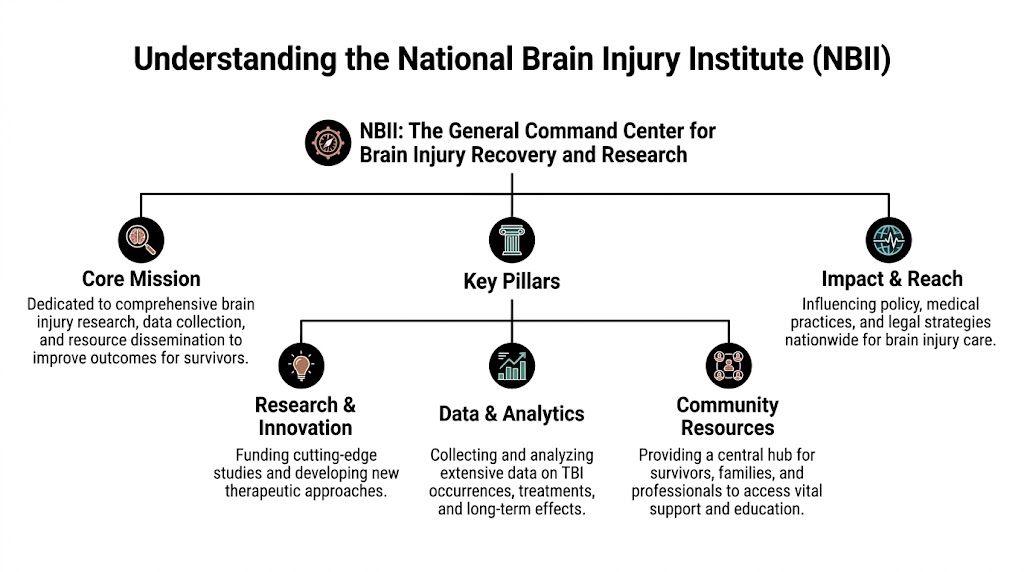
NBII is known for using a standardized neurological assessment process after a traumatic brain injury. That evaluation looks at how the brain is functioning across cognitive, motor, and sensory domains. In practice, that means the assessment is not limited to whether someone has headaches or a normal CT result. It examines memory, attention, balance, coordination, processing speed, and related deficits that often affect work and daily life.
Why a standardized assessment matters
Families often come in with a binder full of records that do not speak to each other. One provider documents dizziness. Another notes sleep problems. A third focuses on anxiety. Each note may be accurate, but the overall picture stays blurry.
A standardized model helps organize the injury into something both doctors and attorneys can use. It can show what changed after the crash, how those changes affect function, and which symptoms are likely connected. That is the difference between a loose set of complaints and a documented injury pattern.
The trade-off is simple. A coordinated assessment takes more time than a quick office visit. But for many survivors, that added structure produces a stronger treatment plan and a better record of the injury.
The core functions
NBII’s role is easiest to understand in three parts.
| Function | What it means for a survivor and family |
|---|---|
| Assessment | Creates a baseline of brain-related problems after the injury |
| Treatment planning | Points the survivor toward the right mix of follow-up care |
| Consistent documentation | Gives medical and legal teams a shared record of functional loss |
This kind of framework is especially helpful when symptoms are subtle. A person may still walk, talk, and appear fine to others, but struggle to manage deadlines, multitask, tolerate light or noise, or keep emotions in check. Those are real losses. They also require careful documentation if the case is going to reflect the full harm.
Why lawyers pay attention to NBII findings
In brain injury cases, the legal fight often centers on proof. Insurance carriers may argue that the client recovered, that the symptoms are stress-related, or that daily problems have nothing to do with the collision. Objective testing and organized clinical findings help answer those arguments.
That is why many families benefit from working with a Colorado brain injury attorney with certified brain injury specialist training. The right lawyer does more than collect records. The lawyer understands how to use medical findings to connect the crash, the symptoms, and the long-term consequences in a way that is clear and credible.
NBII sits at that intersection. It helps define the medical reality of the injury, and that same record can strengthen the legal case for full compensation.
Key Programs and Resources for Survivors and Families
Families usually want concrete help, not abstract descriptions. They want to know what they can access, what those services do, and how those services fit into daily life after a crash.
The need is broad. The National Health Council’s discussion of brain injury states that annually, there are 3.5 million TBI-related medical encounters and deaths in the U.S. and that TBI leads to long-term disabilities for over 5.3 million Americans. That’s why survivors often need more than a single appointment. They need a longer runway.

The cornerstone resource
The most important starting point is the Complete Neurological Assessment Battery. This is the tool families should understand first because it creates the baseline that everything else can build on.
It looks at several domains of function, including:
- Cognitive performance: attention, memory, processing, and other thinking skills
- Motor function: coordination, movement-related issues, and physical control
- Sensory function: how the brain is handling input such as light, sound, balance, and other signals
That matters because many survivors don’t have a single symptom. They have a cluster. One person may have headaches plus slowed thinking. Another may struggle with balance, noise tolerance, and emotional regulation. A strong assessment helps separate those pieces and show how they interact.
What families can actually use
Beyond the assessment itself, survivors and caregivers often look for support that makes everyday life more manageable. A brain injury specialist can help identify where formal treatment ends and practical guidance begins. That’s one reason many families seek professionals with deeper TBI training, including a certified brain injury specialist perspective when they’re trying to understand the bigger picture.
Useful resources often include:
- Care coordination: help connecting evaluation results to therapy, follow-up visits, and symptom management
- Family education: clear explanations of why the injured person may seem different, inconsistent, or easily overwhelmed
- Long-term planning support: guidance when symptoms affect work, independence, transportation, or caregiving needs
- Documentation for outside stakeholders: records that can help employers, schools, insurers, and legal teams understand functional loss
A short educational video can also help families hear brain injury concepts explained in plain language:
What helps and what usually doesn’t
Some approaches move recovery forward. Others leave families stuck.
What tends to help:
- Early organized evaluation: symptoms are easier to connect to the injury when documented clearly
- Consistent follow-up: patterns become visible over time
- Family involvement: the people at home often notice deficits the survivor minimizes or can’t fully perceive
- Function-based planning: treatment works better when tied to work, school, driving, sleep, and home demands
What often doesn’t help:
- Relying only on normal imaging: brain injury symptoms can still be serious even when scans don’t tell the whole story
- Waiting for symptoms to “just pass”: delay can complicate treatment and documentation
- Treating each symptom in isolation: headaches, memory issues, fatigue, and sensory problems often overlap
- Expecting the survivor to explain everything perfectly: the injury itself can interfere with self-reporting
Families often carry the hidden workload of brain injury. Good resources recognize that and support the caregiver, not just the patient.
How to Access National Brain Injury Institute Services
Families under stress need a usable path, not a maze. Accessing national brain injury institute services usually starts with identifying who is going to make the connection and what information needs to travel with the survivor.
Common entry points
Individuals typically come into a specialized brain injury network through one of several routes:
A treating doctor or hospital referral
This is common when symptoms continue after the initial crash care.A therapist or rehabilitation provider
Sometimes the need for deeper evaluation becomes obvious only after therapy begins.An attorney handling a crash case
In injury claims, lawyers familiar with brain injury often recognize when a client needs structured neurological evaluation instead of scattered appointments.
Each route can work. What matters is speed, completeness, and follow-through.
What to gather before the first contact
Before reaching out, families should pull together the practical record of what happened and what changed afterward.
A strong starting file usually includes:
- Crash records: police report, incident details, and insurance information
- Initial medical records: emergency care, urgent care, imaging, discharge instructions
- Symptom timeline: headaches, confusion, dizziness, memory issues, sleep changes, light sensitivity, mood shifts
- Work and daily-life changes: missed shifts, reduced duties, trouble driving, household limitations
- Observer notes: family or close friends can often describe changes more clearly than the injured person can
This doesn’t need to be perfect. Even a handwritten timeline can help.
What the process often looks like
Once a referral is made, the family can usually expect a sequence that feels more structured than ordinary follow-up care.
| Stage | What happens |
|---|---|
| Intake | The provider gathers history, records, and symptom information |
| Assessment | Standardized testing measures how the brain injury is affecting function |
| Review of findings | The survivor and family get a clearer explanation of the deficits and their likely impact |
| Next-step planning | Recommendations may include treatment, follow-up evaluation, and documentation for other needs |
Bring another person to appointments when you can. Brain injury often affects memory, attention, and recall, which makes it harder to absorb instructions in real time.
How to prepare for the appointment
Preparation doesn’t mean studying for a test. It means making the survivor’s real-world difficulties visible.
Bring examples. If the injured person gets lost driving a familiar route, write that down. If grocery shopping causes overload, note that. If they can read a paragraph but can’t retain it, include that too. Specific examples often reveal more than broad labels like “not feeling right.”
The best evaluations don’t depend on heroic memory from the patient. They combine records, symptoms, observed changes, and formal testing to produce a grounded picture of what the injury is doing.
Strengthening Your Colorado Legal Case with NBII Data
Insurance companies often handle brain injury claims differently from broken-bone cases. A fracture shows up on an image. A brace or surgery gives the adjuster something concrete to point to. Traumatic brain injury is often harder for them to see, so they look for ways to minimize it.
They may argue that the person seems fine. They may say the symptoms are stress, age, prior history, or exaggeration. They may point to a normal scan as if that ends the discussion.
That’s exactly where structured NBII data becomes powerful.
Why objective findings change the case
A legal claim rises or falls on proof. In a Colorado motor vehicle case, it’s not enough to say, “Something is wrong.” The evidence has to show what changed, how the change connects to the crash, and why the harm affects earnings, care needs, and daily life.
NBII’s standardized assessments help by producing organized findings tied to function. That gives lawyers and experts something firmer than symptom complaints alone. Instead of a vague narrative, the case can point to documented deficits in cognitive, motor, or sensory domains.
What that looks like in practice
When a case is built well, NBII-related evidence can help answer the questions insurers and juries usually ask:
Is this a real brain injury or just a complaint of symptoms?
Standardized testing helps move the discussion from opinion to measurable impairment.Did the crash actually change the person’s functioning?
Careful history and post-injury findings can show before-and-after differences.Why does this matter if the person can still do some things?
Brain injury often reduces consistency, stamina, speed, and tolerance rather than eliminating ability altogether.What future care is reasonable?
Organized findings support the need for continuing treatment, monitoring, and accommodations.
Lawyers handling these claims also need to understand the medical vocabulary behind the records. That includes knowing how to use neurological tests for brain damage in a way that makes sense to non-medical decision-makers.
What works and what usually fails
Some legal strategies fit brain injury cases. Others don’t.
What works:
- Building the timeline early: document symptoms close to the collision and track how they evolve
- Using consistent medical records: scattered treatment notes can weaken the story
- Showing daily-life consequences: missed work, sensory overload, communication breakdowns, and lost independence matter
- Preparing for credibility attacks: invisible injuries invite skepticism, so objective documentation matters more
What fails:
- Relying on emergency room records alone: those records are important, but they usually don’t capture the full course of a TBI
- Treating a good day as proof of recovery: inconsistency is common after brain injury
- Reducing the case to headaches only: many of the most serious consequences involve cognition, behavior, fatigue, and executive function
- Waiting too long to organize evidence: the longer the gap, the easier it is for an insurer to argue the symptoms came from something else
The strongest brain injury cases don’t ask a jury to take a leap of faith. They walk the jury through a careful chain of proof.
In Colorado claims, that difference can shape settlement negotiating power in a major way. A case supported by objective neurological evaluation is much harder to brush aside as subjective noise.
A Vital Resource for Attorneys and Medical Providers
For professionals, the value of the national brain injury institute is consistency. Brain injury cases become harder when each provider uses a different framework, records symptoms differently, or addresses only one slice of the patient’s deficits.
Attorneys need evidence that can stand up under scrutiny. Medical providers need a system that captures the full injury without forcing the family to assemble the puzzle alone. NBII helps both groups work from a shared foundation.
Why attorneys use structured brain injury data
In litigation and pre-suit negotiation, standardized assessment results do more than fill a chart. They give counsel a defensible way to explain impairment, causation, and damages.
That matters in several settings:
- Complex motor vehicle and trucking cases: the medical story must stay coherent across multiple experts
- Co-counsel referrals: a national framework can help maintain consistency when firms collaborate across jurisdictions
- Settlement evaluation: objective data improves how future care and function loss are understood
- Trial preparation: jurors need a clear narrative grounded in evidence, not just symptom descriptions

Why providers benefit too
Medical providers often face a different problem. They know the patient is struggling, but routine office visits may not capture the true extent of impairment. A coordinated brain injury program can deepen the record while also helping the patient get more appropriate support.
That creates a practical synergy.
| Professional | Benefit of NBII-aligned evaluation |
|---|---|
| Attorney | Stronger proof of functional loss and a clearer damages narrative |
| Treating provider | Better documentation and more targeted referrals |
| Patient and family | More coordinated care and less confusion about next steps |
The patient is the one who benefits most when legal and medical teams understand the same evidence. Better documentation tends to support better advocacy. Better advocacy often protects access to the care and resources the patient needs.
Conclusion Building Your Team for the Road Ahead
Brain injury recovery is rarely a straight line. It’s a long project that asks a lot from the injured person and from everyone who loves them. The national brain injury institute can play a critical role on the medical side by turning confusion into assessment, treatment direction, and usable documentation.
That medical work matters on its own. It also matters when a crash claim must prove what the injury has really taken from a survivor’s life.
The strongest path forward usually comes from a team approach. Specialized medical providers identify and document the deficits. Family members supply the daily truth of what has changed. An experienced personal injury law firm coordinates the larger case, deals with the insurer, and fights for the resources needed to rebuild a life with stability and dignity.
Recovery may still be hard. But with the right team, it doesn’t have to be directionless.
If you or a loved one is dealing with the aftermath of a traumatic brain injury after a crash, Nares Law Group LLC can help you understand your options, coordinate the right evidence, and pursue compensation that reflects the full impact of the injury. Their team serves injured families in Colorado and brings focused experience in motor vehicle collisions, trucking cases, and brain injury claims.