Loss of consortium is a legal claim that compensates a spouse or family member for the loss of companionship, affection, comfort, and shared life caused by a loved one's serious injury. It recognizes that when an injury changes one person's body or mind, it can also change the marriage, household, and daily routines that held the family together.
A crash, a fall, or a traumatic brain injury can leave one partner alive and present, but unable to give the same emotional support, intimacy, help around the home, or participation in family life. The law has a name for that invisible harm, and for many families, that recognition matters as much as any number on a medical bill.
The Invisible Toll of Serious Injuries on Families
A spouse comes home from the hospital after a truck wreck, and the outside of the house looks the same while the life inside it has changed. The injured partner may still be present, but now they are exhausted, confused, in pain, or unable to join the routines that once made the household feel like a partnership. Loss of consortium exists because the law recognizes that serious injury can take away companionship, affection, comfort, and sexual relations, not just income or medical stability.
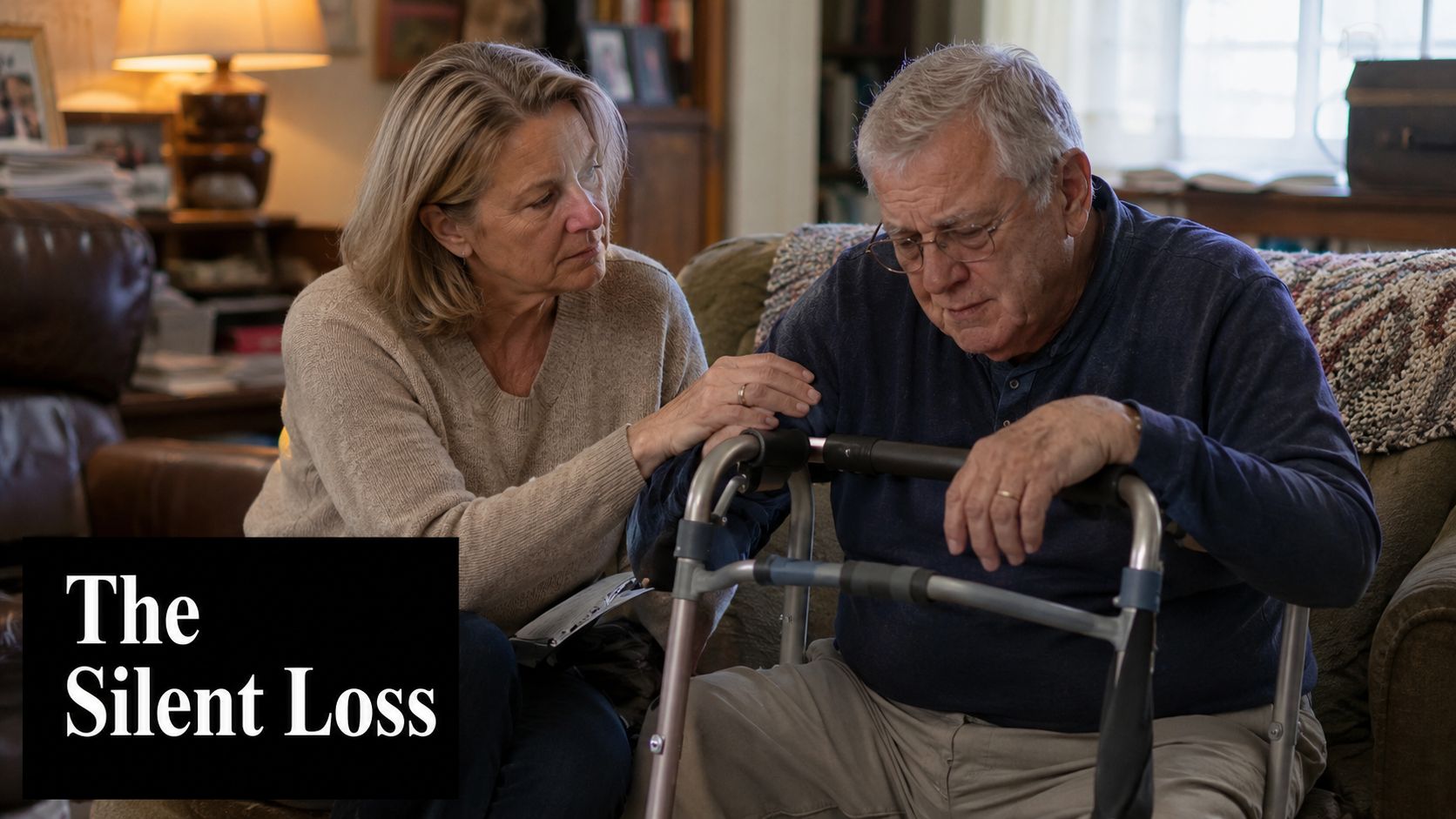
The law also recognizes the quieter losses that families feel every day. Shared dinners disappear. Help with the children changes hands. Conversation gets shorter, intimacy may fade, and one spouse can end up carrying the home alone. Legal references describe consortium as the loss or impairment of intangible relationship benefits, including shared activities and household services, which is why a spouse's separate damages can matter even when the injured person already has claims for medical bills and pain and suffering.
That burden often falls hardest on the caregiver. If you are managing the appointments, the paperwork, the household tasks, and the emotional strain at the same time, managing caregiver stress can give you a place to start while you sort out the legal side.
Practical rule: If the injury changed the relationship itself, not just the injured person's physical condition, that change may matter in a consortium claim.
Colorado families often see this after catastrophic crashes, truck wrecks, traumatic brain injuries, and wrongful death cases, where the strain on the relationship can last long after the first medical emergency passes.
Understanding the Legal Elements of Loss of Consortium
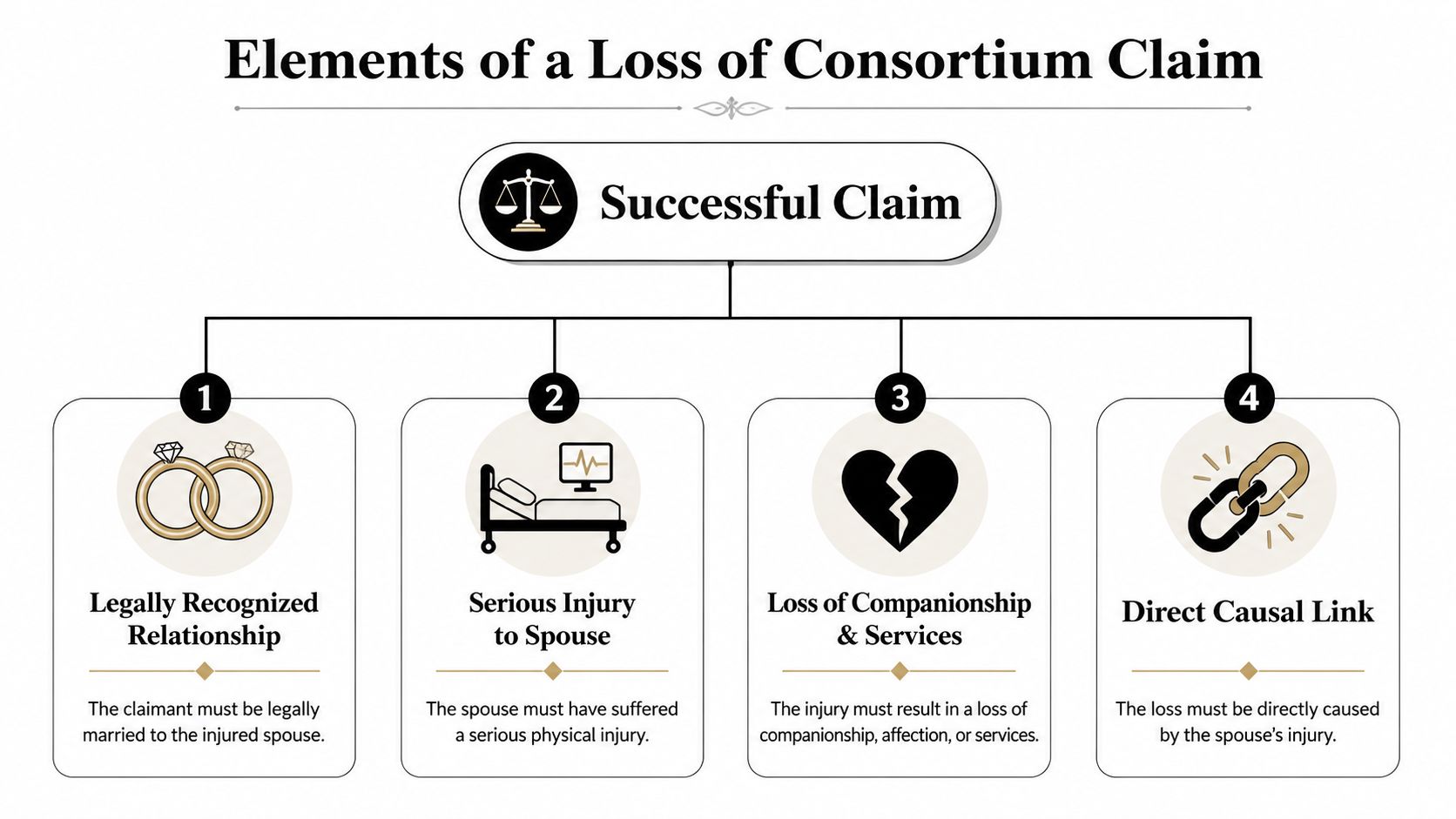
A claim for loss of consortium usually rests on four parts. There must be a legally recognized relationship, most often a marriage. There must also be a tortious injury to the spouse or family member. The uninjured person then has to show a real loss, and that loss must be connected to the injury through causation Expert Institute on loss of consortium proof.
What the law is looking for
The relationship part matters because consortium is not a general complaint about hardship. Courts usually want proof that the relationship was legally recognized when the injury happened, and Colorado families should expect documentation to matter from the start. A marriage certificate, medical records, and a timeline showing when the injury changed daily life can all help build that proof.
The injury part is specific too. Consortium claims arise from a tortious injury, which means an injury caused by someone else's wrongful conduct. That is why these claims often appear alongside the injured spouse's personal injury case, rather than as a stand-alone complaint about the strain of caregiving Cornell Law School's overview of loss of consortium.
The loss itself reaches beyond emotional upset. It can include the loss or impairment of companionship, affection, comfort, sexual relations, and the practical benefits of a shared life. A claim of this kind treats the relationship as something the law can recognize when serious injuries take away ordinary parts of married life Plaintiff Magazine on loss of consortium doctrine.
An example makes that easier to see. If a traumatic brain injury leaves one spouse unable to join family activities, contribute emotionally, or participate in intimacy the way they did before, the law may view that as a real relational loss, not just a hard adjustment. The important part is tying the change to the injury, not to ordinary marital strain.
Colorado families also need to think about timing and who the law allows to file. If the injury happened before the marriage, the claim can be harder to support because the legal relationship was not in place yet. In some cases, the answer depends on whether the governing law recognizes claims by spouses only or by a broader group of family members, which is why it helps to review who can bring a wrongful death claim when a case involves a fatal injury.
Who Can File a Loss of Consortium Claim
A loss of consortium claim usually starts with a spouse, because marriage creates the legal relationship the law is most likely to recognize. Older rules were much narrower, but modern courts have moved away from the idea that only one spouse could claim this kind of harm. The point is straightforward, the law now recognizes that serious injury can affect both partners in a marriage, not just the person with the physical injury.
Relationship status and timing matter
The relationship must exist when the injury happens. If a couple marries after the injury, the claim is often much harder to support because the legal bond was not in place when the loss began.
Other family members may have rights in some situations, but those rights depend on the state and the type of case. Children, parents, unmarried partners, and other relatives may sometimes recover in limited circumstances, especially in wrongful death cases, but the rules are not the same everywhere. In a case involving a fatal injury, the better question is often who the law allows to file, not who feels the loss most.
Courts usually start with legal status, then examine the relationship itself. They want to know whether the bond was real, stable, and already part of daily life before the injury changed it.
Colorado families also need to sort out whether the claim sits beside a personal injury case or a wrongful death claim, because standing can change depending on the type of lawsuit. A helpful starting point is this overview of who can sue for wrongful death, since the family members allowed in that setting are not always the same as those in a consortium claim.
The relationship has to mean more than a title on paper. Courts look for proof that the marriage or other qualifying relationship was in place and functioning when the injury disrupted ordinary life, which is why early documentation matters so much.
Proving the Impact on Your Relationship and Daily Life
A consortium claim often turns on ordinary details. The law is trying to measure a real loss that does not show up on a receipt, so the strongest proof usually comes from the day-to-day changes the injury caused. Expert legal sources describe this proof as fact-intensive and tied to the relationship's stability, the spouses' life expectancy, and how long the injury is expected to last.
Evidence that strengthens the case
Start with medical records that show functional limits. If the injured spouse cannot drive, lift a child, manage fatigue, or communicate normally because of a traumatic brain injury, those restrictions matter because they explain why the relationship changed. Medical records usually form the backbone of the claim, but they rarely tell the whole story by themselves.
Family testimony fills in the missing parts of daily life. A spouse can explain how meal prep, bedtime routines, shared decision-making, affection, or intimacy changed after the injury. Friends, relatives, and sometimes therapists can also help show that the change was visible and lasting, not just a rough patch that passed on its own.
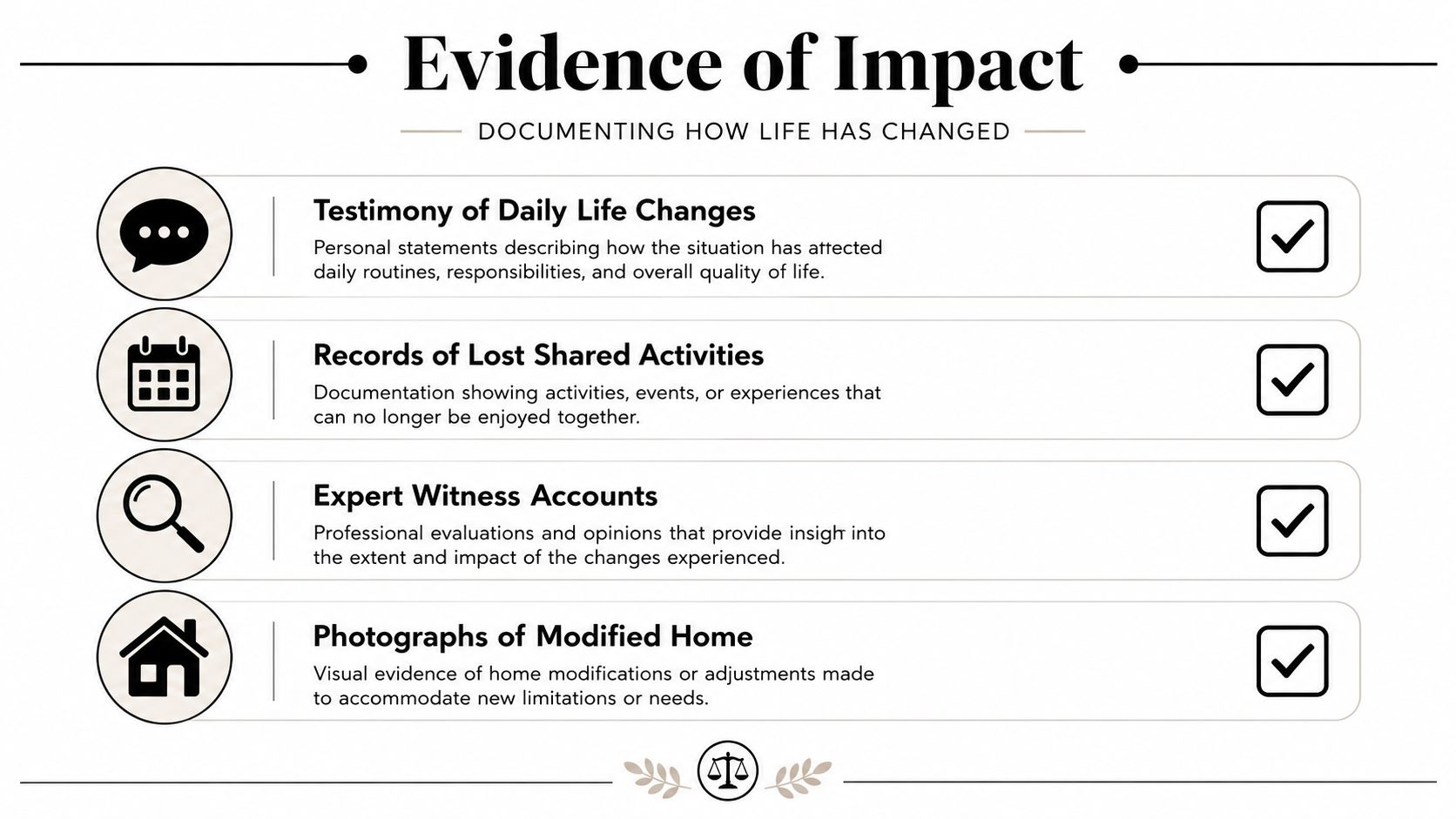
A strong file often includes:
- Testimony of daily life changes, especially from the uninjured spouse.
- Records of lost shared activities, such as family events, hobbies, or routines that stopped after the injury.
- Expert witness accounts, usually from medical professionals or therapists who can explain the prognosis.
- Photographs of modified home life, if the household had to adapt to new limitations.
The best evidence ties the injury to the loss. If the spouse used to help with childcare, household duties, or emotional support, and the injury took those contributions away, the claim becomes much easier to understand. A wife caring for a husband with a brain injury, for example, can show how the relationship shifted from mutual partnership to full-time caregiving.
Keep the focus on concrete changes. “Everything is harder” is too vague. “He no longer attends our child's appointments, cooks, or joins us at dinner” is useful.
The future matters too. If doctors believe the impairment is permanent, the claim may need to account for the rest of the marriage or expected lifespan, depending on the jurisdiction and facts. The same long-term view often comes up in loss of enjoyment of life claims, because injuries that alter companionship often also affect how a family lives together.
How Loss of Consortium Damages Are Calculated
There is no receipt for companionship, so there is no fixed formula either. Courts and insurers look at the seriousness and permanence of the injury, the nature of the relationship before the injury, the age and life expectancy of the spouses, and the impact on household life and services.
The factors that shape value
A long, stable marriage usually looks different from a relationship that was already under strain. That does not mean only a close or conflict-free relationship can support a claim. It means the pre-injury reality helps show what changed, and what the family lost.
The injury's severity and duration matter just as much. A temporary setback may support a smaller claim than a permanent condition that changes communication, affection, or household roles for years. In permanent-injury cases, damages may be measured over the rest of the marriage or expected lifespan, which is why prognosis and functional limitations matter so much.
Age matters because it affects the length of the expected relationship, but it does not control the case by itself. Two couples can have similar injuries and very different outcomes depending on whether one spouse can still participate in daily life, shared activities, and intimacy. That is also why amounts vary sharply by state and facts, since juries and judges are weighing a human loss, not tabulating a bill.
A useful way to think about valuation is this:
| Factor | Why it matters |
|---|---|
| Severity of injury | More serious limitations usually mean a deeper relational loss. |
| Permanence | Long-term impairment can extend the loss far into the future. |
| Relationship history | A strong pre-injury bond helps show what changed. |
| Household disruption | Loss of services, parenting help, or companionship affects value. |
| Jurisdictional approach | State law and local jury practice shape the range of outcomes. |
The claim is separate from the injured person's personal injury recovery. That separation matters because the injured spouse may already be claiming medical bills and lost wages, while the consortium claim focuses on the relationship loss the family suffered. For a related discussion of how courts view life-impact damages, see loss of enjoyment of life.
Colorado Rules and Timing Considerations for Consortium Claims
A serious injury can strain a marriage long before the legal paperwork catches up. In Colorado, that means families need to pay attention to timing early, because a loss of consortium claim usually moves with the underlying personal injury case, not after everything else has been sorted out.
Why the deadline matters
Colorado's personal injury filing deadline controls the underlying case, and related claims can rise or fall with it as well. For a plain-English overview of the filing window, see Colorado personal injury statute of limitations overview. If the deadline passes, a court can dismiss the claim before anyone gets to explain the loss of companionship, intimacy, or help at home.
That is why early medical documentation matters. Some injuries look manageable at first, then reveal their full effect only after treatment begins and daily life starts to change. Families often wait because they hope the condition will improve, and that reaction makes sense. The risk is that the legal clock keeps running while everyone is still trying to understand what the injury really means.
Colorado cases also benefit from careful recordkeeping. Save medical appointments, therapy notes, work restrictions, and notes about changes in parenting or routine household tasks. Those records help show the insurer that the relationship loss is not abstract, it is part of everyday life. If the case reaches trial, they help the jury see how the injury changed the family's normal pattern.
Colorado practical point: Do not assume an insurer will recognize the emotional toll on its own. Build the record early, while the changes are still recent and easier to document.
Timing matters during settlement talks too. If the injured spouse is still receiving treatment, the full extent of the impairment may still be unclear, and that affects how the claim should be valued. A short recovery and a lasting limitation do not tell the same story, and duration of incapacity often drives the size of the loss.
The timing issue also follows Colorado procedure. If you are trying to understand how long a claim can stay open before the deadline becomes a problem, it helps to review Colorado's personal injury time limits early rather than after negotiations stall. Families in Denver and across the state often do better when they document the human loss at the same time they protect the legal claim, so the marriage's changed reality does not get reduced to a thin claims file.
How Nares Law Group Helps Injured Families Recover Consortium Damages
Loss of consortium claims demand more than sympathy. They require a case built around medical proof, relationship evidence, and timing discipline, all while the main injury claim is moving through treatment, negotiations, and possibly trial. That's where a firm that handles serious injury cases can make the process less chaotic for a family already under pressure.
Nares Law Group LLC, a Denver-based personal injury firm, handles motor vehicle crashes, truck wrecks, traumatic brain injuries, and wrongful death matters, and it coordinates every phase of a case from investigation through settlement and trial. In a consortium case, that matters because the relationship claim has to fit cleanly with the broader injury case, without losing sight of the spouse's separate loss.
The firm also offers co-counsel opportunities in complex matters, which can be useful when a consortium issue is tied to a larger trucking or brain injury case. For families, the practical value is clear. One legal team can help organize the medical records, document the change in household life, and push back when an insurer treats the claim like an afterthought.
If you're dealing with a serious injury that changed your marriage or family life, a consultation can help you understand whether the facts support a claim and what evidence you should gather now. A focused review is often the fastest way to see whether the law recognizes the loss you're living with.
Frequently Asked Questions About Loss of Consortium Claims
A serious injury can change the shape of a marriage in ways people outside the home do not always see. The legal system recognizes that loss in a limited way, so families often have practical questions about when a claim exists and what it can cover.
Can I file a consortium claim if the injury happened before we were married? Usually that is difficult, because the relationship must generally exist at the time of injury. Timing matters because the law looks at the loss as part of an existing marital relationship, not one that started later.
What if the injury is temporary rather than permanent? A temporary injury can still support a claim if it affected companionship, intimacy, help with daily tasks, or the shared life of the marriage. Permanent injuries usually raise larger future-loss questions, because the harm may last far beyond the first stage of treatment.
How does a consortium claim affect the injured spouse's settlement? It is separate from the injured person's own claim, but the two usually move together in the same case. The court or insurer should treat the relationship loss as its own category rather than folding it into medical bills or wage loss, because those numbers do not capture the strain on family life.
Can I file in a wrongful death case? Sometimes, yes, depending on state law and the relationship involved. The rules vary, so it helps to understand who may sue in that setting, especially if you are comparing that issue with a consortium claim.
Families preparing for a first consultation should bring medical records, the marriage certificate if applicable, a timeline of treatment, and notes about how daily life changed. Written examples help more than general statements, such as missed routines, changes in household duties, or the ways injury altered emotional closeness. For firms that also need help shaping educational material for clients, B2B editorial services for legal can be a useful resource, but the family's first job is to preserve evidence and meet deadlines.
If a serious injury has changed your marriage, home life, or ability to share the life you built together, Nares Law Group LLC can review the facts and explain whether a loss of consortium claim fits your situation. Visit Nares Law Group LLC to ask about your options, protect the deadline, and get guidance on the evidence that can support your family's claim.