You may be living this issue already, even if you've never heard the legal term for it.
Before the crash, your weekends had a shape to them. You drove your kids to practice. You hiked, cooked, rode your bike, worked in the yard, played music, met friends, or handled errands without planning every movement. After the injury, the calendar may still fill up, but your life feels smaller. You cancel more. You sit out more. You need help for things you used to do automatically.
That loss often doesn't show up on a hospital bill. It also doesn't disappear just because you survived. The National Safety Council reports that the lifetime odds of dying in a motor-vehicle crash are 1 in 95 in its 2023 odds of dying data. For many people, the legal problem isn't death. It's living afterward with a body, mind, or personality that no longer lets them participate in the life they built.
Colorado personal injury law has a name for that harm. It's called loss of enjoyment of life.
The Life You Lost After an Injury
A serious injury usually changes life in ordinary places first.
It shows up when you can't lift your child into the car seat. When dinner out feels like too much effort because sitting hurts. When your spouse stops asking if you want to go for a walk because the answer is always no. When people say, “At least you're okay,” and you know that isn't quite true.
In practice, loss of enjoyment of life often begins there. Not in a courtroom. In the gap between who you were before the injury and what your day-to-day life looks like now.
Where clients feel it first
Some people notice it in recreation. A skier can't return to the slopes. A runner gives up races. A rider stops getting on a motorcycle. Others feel it in family life. They can't travel comfortably, play on the floor with grandchildren, or take part in routines that used to make a household feel normal.
A person recovering from a neck injury may spend months focused on pain control, imaging, appointments, and function. That's necessary. But the loss runs deeper than treatment. For someone trying to understand the physical side of that process, this guide to cervical fracture rehabilitation gives a useful picture of how long and layered recovery can be.
Some losses are dramatic. Many are quiet. Both matter.
Why this belongs in a legal claim
Medical bills pay for care. Lost wages address time away from work. Neither one explains what it means to lose your independence, your favorite routines, or the parts of life that made you feel like yourself.
That's why this category of damages matters. It gives the legal system a way to recognize that an injury can take more than money. It can take pleasure, confidence, identity, and connection.
In Colorado cases, this part of a claim needs to be built carefully. It isn't enough to say, “Life feels different now.” The law responds best to proof. That means showing what your life looked like before, what changed after, and why those changes trace back to the injury.
Beyond Medical Bills The True Meaning of Lost Enjoyment
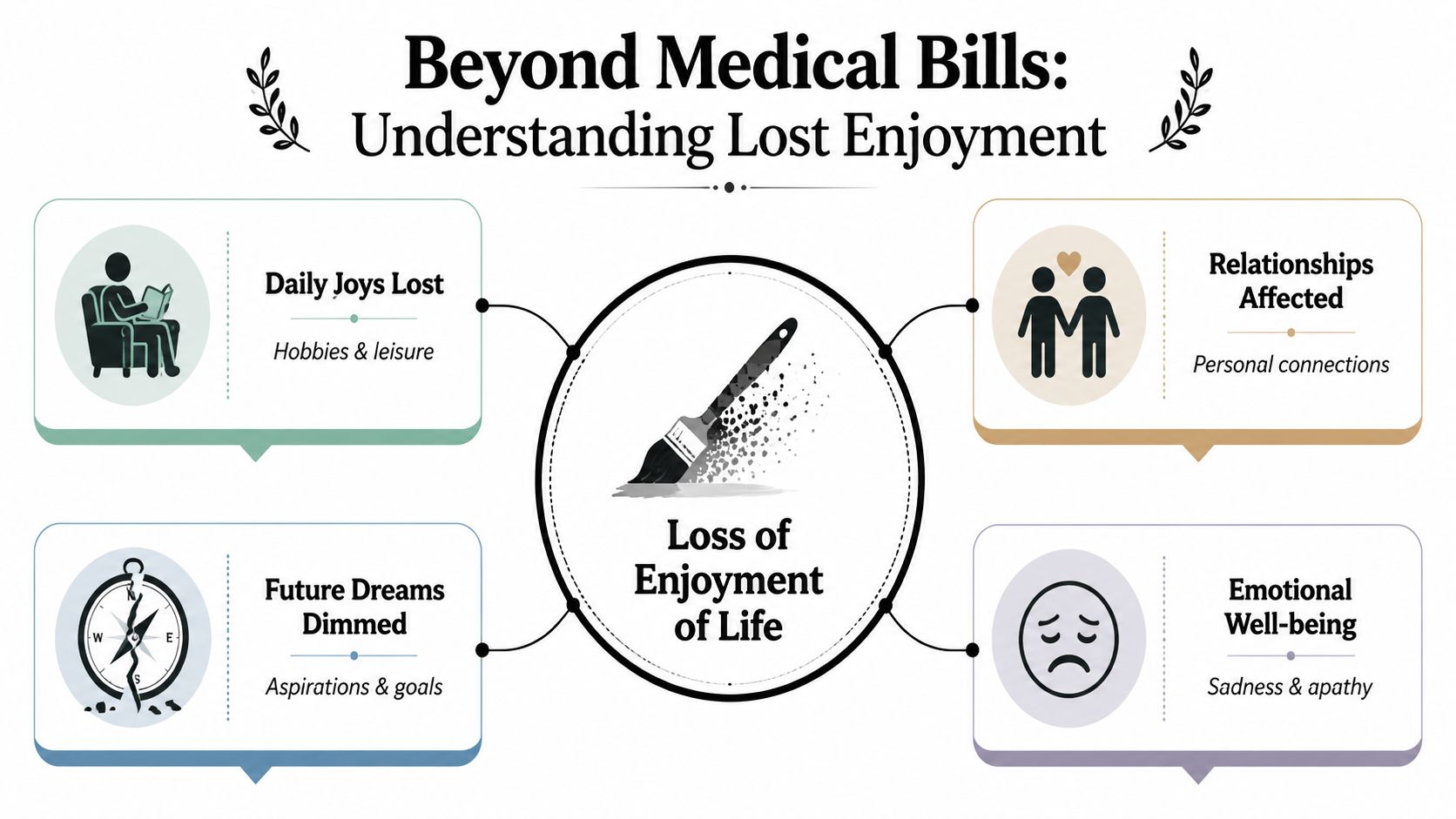
Loss of enjoyment of life developed as part of non-economic damages, meaning damages for harm that doesn't come with a simple invoice. It is distinct from pain and suffering because it focuses on the loss of life's pleasures and requires proof of pre-injury and post-injury lifestyle change, as explained in this discussion of how loss of enjoyment of living is calculated.
What the term actually means
Think of it this way. A person can still be present in their life and yet no longer fully participate in it.
They may be able to dress themselves, attend work in some limited way, or show up to family events. But the color has drained out of daily living. They can't fish, hike, dance, travel easily, coach, garden, kneel at church, play an instrument, sit through a movie, or focus long enough to read. The routines still exist. The enjoyment doesn't.
That's what this damage category is trying to address.
How it differs from pain and suffering
Clients often hear these phrases together and assume they mean the same thing. They don't.
Pain and suffering is about the negative experience of injury. Physical pain. Mental anguish. Fear. Frustration. Sleeplessness. Emotional strain.
Loss of enjoyment of life is about the absence of positive experience. It asks a different question. What can't you enjoy anymore that mattered to you before?
A simple comparison helps:
- Pain and suffering covers what hurts.
- Loss of enjoyment of life covers what's gone.
One person may have significant pain and still preserve much of their routine. Another may have less obvious pain but lose the activities and relationships that gave shape to daily life. Both losses are real, but they are not identical.
Practical rule: If a jury can understand exactly what used to bring you purpose or pleasure, and exactly why you can't do it now, the claim becomes much more concrete.
Why this claim is often undervalued
Insurance companies tend to focus on what they can count quickly. Bills. wage loss. treatment dates. procedure codes.
Loss of enjoyment of life doesn't fit neatly into that system. It requires context. It depends on storytelling supported by evidence. It asks people evaluating the claim to look at a human life, not just a ledger.
That's why vague descriptions usually fail. “I'm not the same anymore” may be true, but it isn't enough by itself. A stronger presentation shows the specific ways an injury stripped away daily pleasures, family roles, social participation, and independence.
How Is Lost Quality of Life Valued in a Claim
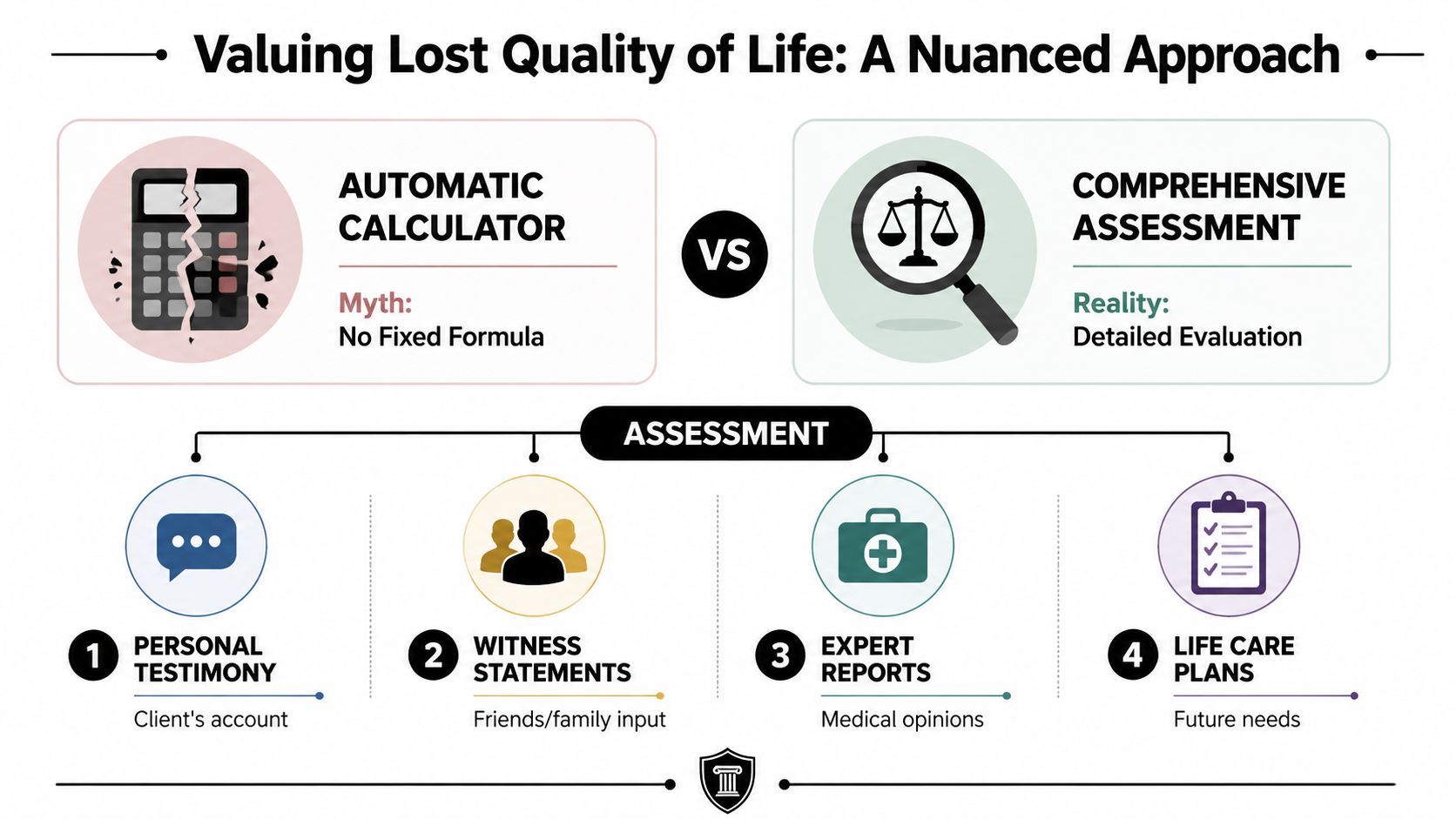
There is no fixed formula for valuing loss of enjoyment of life. Lawyers, insurers, and juries often use estimates as starting points, then test those estimates against the evidence.
The multiplier method
One common approach is the multiplier method. As described in Forbes Advisor's explanation of pain and suffering calculations, this method applies a factor of 1.5 to 5.0 to economic damages. The same source gives an example of $75,000 in economic damages multiplied by 3.5, producing $262,500 in non-economic damages.
That does not mean every case gets that number. It means the method offers a framework.
The main fight is over the multiplier itself. A mild injury with a shorter impact tends to support a lower number. A permanent injury that changes mobility, relationships, and independence pushes the analysis upward.
The per diem method
The second common approach is the per diem method. That method assigns a daily value to the loss over the period of impact. The same Forbes Advisor source notes daily figures such as $150 to $300.
This method can make sense where the duration of harm is clear and the day-to-day effect is easy to describe. It can be harder to use persuasively when the injury causes uneven symptoms or when the loss is permanent and evolves over time rather than staying the same each day.
What actually moves value
Methods are only tools. Evidence is what gives them force.
A convincing valuation usually depends on whether the file answers questions like these:
How severe is the limitation
A person who can no longer walk long distances, tolerate light, regulate emotions, or participate in family routines presents a different claim than someone with intermittent discomfort.What activities mattered before the injury
A claim gets stronger when the evidence shows real habits, not abstract preferences.How long will the loss last
Temporary restrictions and permanent lifestyle changes are not valued the same way.Can experts connect the dots
Medical and other specialists often explain why these limitations are consistent with the injury.
For long-term cases, future planning can matter too. A proper life care planning analysis can help show how permanent limitations affect not just treatment but the practical shape of daily life going forward.
A calculator can start a conversation. It can't prove the value of your life as it was actually lived.
Proving What Was Lost Evidence and Expert Testimony
Loss of enjoyment claims are won or lost on proof.
The strongest cases show a clear before-and-after picture. The claim becomes harder when the evidence is thin, generic, or gathered too late. According to Cornell Law School's overview of damages, claim strength turns on four factors: injury severity, pre-injury activity level, duration of impact, and quality of medical documentation. That same source states that claims supported by detailed lifestyle journals and witness testimony achieve an 80-90% success rate in settlement, while weakly documented claims are often reduced or fail.
The evidence that usually works
You do not need a dramatic video montage to prove this claim. You need consistent, believable evidence from multiple angles.
| Evidence Type | Purpose | Example |
|---|---|---|
| Medical records | Connect the injury to real limitations | Restrictions on lifting, walking, concentration, balance, or driving |
| Photos and videos | Show pre-injury activities and identity | Hiking trips, coaching, dancing, travel, home projects |
| Personal journal | Capture daily limitations in real time | Missed events, frustration with fatigue, inability to finish ordinary tasks |
| Family and friend statements | Confirm before-and-after change | Spouse describes lost routines, sibling notes withdrawal from social life |
| Work-related evaluations | Show practical functional limits | Testing used to assess work-related capabilities after injury |
| Expert reports | Explain why losses are medically and psychologically real | Neuropsychology, rehabilitation, vocational opinion |
What clients should start collecting
Good evidence is usually ordinary evidence preserved early.
Pre-injury proof
Gather photos, calendars, travel records, club involvement, race registrations, team schedules, and messages that show what your life looked like before.Daily notes
Keep a short journal. Record what you tried to do, what you couldn't finish, what you missed, and what help you needed.Witness list
Identify people who knew you before the injury and still see you now. A spouse, sibling, coworker, coach, neighbor, or close friend can often explain the change better than a stack of records.Treatment consistency
Follow through with medical care and report limitations clearly. If you stop mentioning symptoms, the defense may argue the problem resolved.
Expert testimony often makes the difference
In serious cases, experts turn personal loss into admissible proof. Treating physicians can explain physical restrictions. Psychologists can discuss mood and function. Vocational specialists can address how injuries alter everyday capacity, not just employment. A fuller discussion of that process appears in this explanation of expert witness testimony.
What doesn't work well is exaggeration. Jurors notice overstatement quickly. So do adjusters.
Keep the record honest and specific. “I can't coach baseball because I can't stand through practice or throw a ball without pain” is stronger than “I can't do anything anymore.”
Real-World Examples in TBI and Trucking Cases
Traumatic brain injury and trucking cases often expose the hardest part of loss of enjoyment claims. The loss isn't always visible.
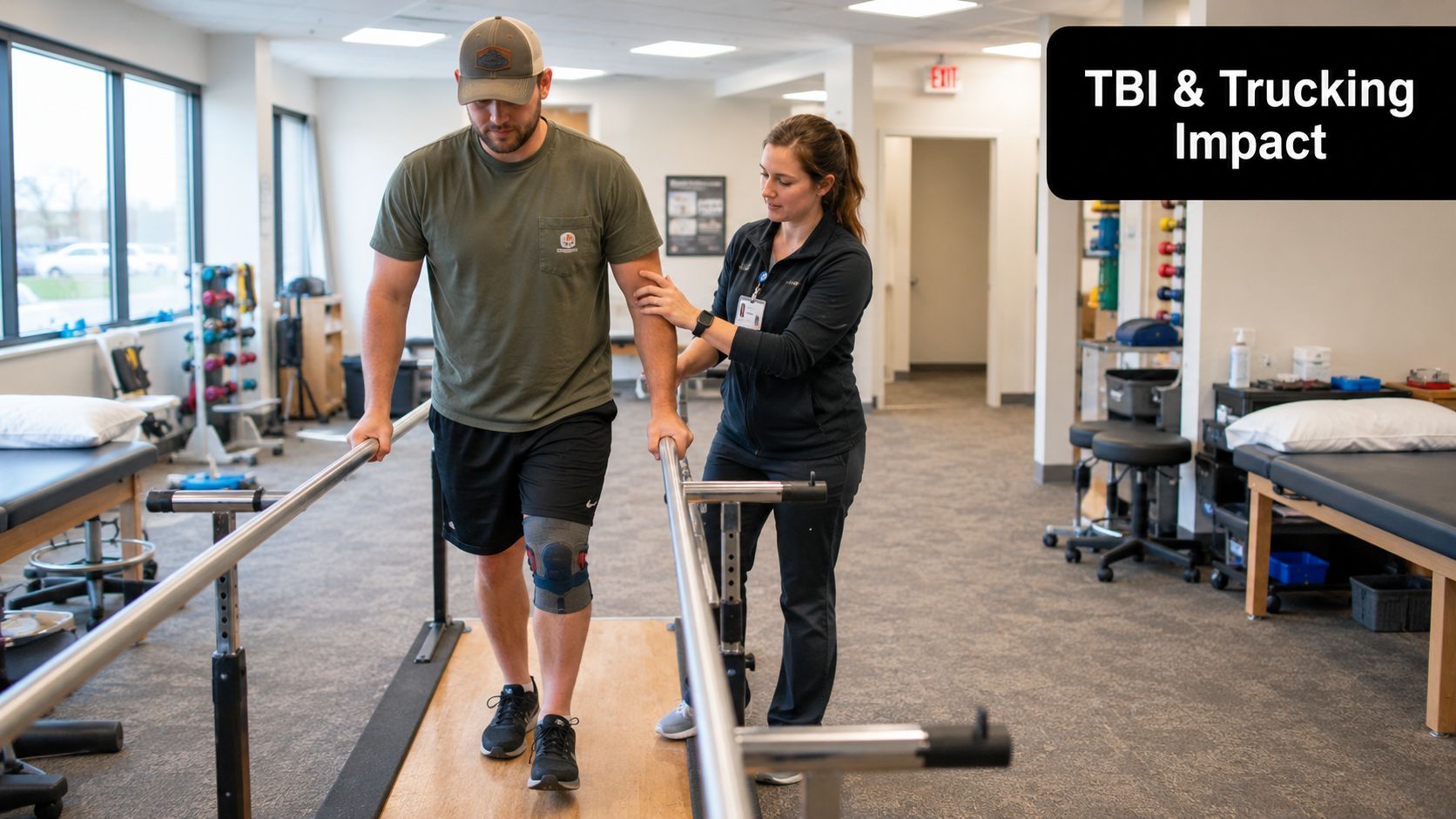
TBI changes life in ways scans don't fully show
The CDC states that about 1.7 million people in the United States sustain a traumatic brain injury annually, and its traumatic brain injury information also supports a point trial lawyers see often: many survivors live with cognitive or behavioral change that other people can't easily see.
A TBI client may still walk, talk, and appear outwardly functional. But home life may tell a different story. The patient who used to manage family schedules can no longer organize simple tasks. The parent who loved noisy birthday parties now becomes overwhelmed in minutes. The spouse who was funny, patient, and social becomes irritable, withdrawn, impulsive, or emotionally flat.
That kind of loss doesn't fit neatly into a hobby list.
Why third-party proof matters so much in brain injury cases
TBI cases create a special proof problem. The injured person may not be the best historian of their own change. Memory problems, poor insight, slowed processing, or personality shifts can interfere with self-reporting.
That's why these cases often depend on:
Neuropsychological assessment
Testing can show deficits in memory, executive function, attention, and processing speed.Behavioral observations
Spouses, adult children, friends, and coworkers often provide the clearest before-and-after picture.Function-based examples
Instead of saying “he isn't the same,” strong evidence shows specific changes in parenting, conversation, social judgment, or ability to complete ordinary routines.
In TBI litigation, the story often comes from the people who lost the person they knew, even though that person survived.
Trucking crashes often produce permanent disruption
Truck wrecks tend to raise the stakes because the injuries are often more severe and the recovery path is longer. A person may survive with orthopedic trauma, chronic pain, brain injury, or reduced mobility that reshapes every part of daily life.
In those cases, proving loss of enjoyment means showing the full chain of impact. What did the crash change at home, at work, in relationships, in self-care, and in independence? The answer is rarely limited to one symptom.
For people dealing with that kind of case, understanding the legal context of truck accidents in Colorado can help frame why these claims demand deeper investigation than a standard fender-bender claim.
Understanding Colorado's Approach to These Damages
Colorado recognizes non-economic harm, including diminished quality of life. In practical terms, that means a jury can consider more than bills and lost income when an injury permanently alters how someone lives.
What Colorado juries are asked to consider
Colorado cases use pattern jury instructions that allow juries to evaluate non-economic damages, including impairment of quality of life. That matters because it places this issue inside the formal damages analysis, not on the sidelines as an emotional afterthought.
For injured people, the takeaway is simple. If the case reaches a jury, the law gives jurors a framework to consider what the injury took from your daily life, your relationships, your routines, and your independence.
Why Colorado specifics matter
Colorado law also places limits on some non-economic damages. The exact application of any cap can depend on the kind of claim, the date the claim arose, and whether facts exist that affect how the cap is applied. That means lawyers have to analyze the statute carefully rather than making assumptions from a generic internet article.
This is one reason Colorado-specific case preparation matters. The same injury story can be framed very differently depending on how the jurisdiction treats non-economic damages, what the jury instructions allow, and what proof is needed to separate ordinary pain complaints from a real quality-of-life claim.
What clients should do with that information
Colorado law does not change the basic job of proof. It sharpens it.
If you're pursuing this element of damages, focus on these points early:
Build the before-and-after timeline
Start with the routines, responsibilities, and activities that defined your life before the injury.Tie limitations to medical evidence
It's not enough to describe loss emotionally. The file should also show why those restrictions exist.Don't treat this as secondary
Clients sometimes spend months documenting treatment and wage loss, then wait too long to preserve quality-of-life evidence.
A careful Colorado claim has to respect both the human story and the state-law framework that governs how that story reaches a jury.
How Nares Law Group Builds Your Claim
A spouse says, "He survived the crash, but he is not living the same life." That sentence often captures this part of a case better than a stack of bills.
The work starts with your actual life
A persuasive claim begins with specifics. In our office, that means mapping out what the injured person did before the collision and what has changed since. We look at routines, parenting, home responsibilities, exercise, social life, travel, hobbies, and the ordinary habits that gave structure to the day.
That work matters even more in Colorado TBI cases.
A brain injury client may appear outwardly fine and still lose concentration, patience, memory, stamina, or judgment. Those losses often show up first at home, with friends, or in activities the medical chart barely mentions. Family members, coworkers, coaches, and close friends can become some of the strongest witnesses because they saw the before and the after in daily life.
Evidence has to be built into a valuation case
Collecting records is only the start. The job is to organize the proof so an adjuster, mediator, or jury can follow it without guessing.
A well-prepared file usually answers four questions:
Who was this person before the injury
What did they value, and how did they spend their time?What medical problem caused the loss
Which diagnosis, symptoms, or functional restrictions explain the change?How does the loss show up in daily life
What can they no longer do, or no longer do the same way?What is likely to happen over time
Is recovery expected, incomplete, or limited by permanent deficits?
Nares Law Group LLC handles this kind of case development in Denver personal injury matters, including motor vehicle, trucking, TBI, and wrongful death claims. The work usually involves witness interviews, treatment record review, expert coordination, and a before-and-after presentation that connects the medical proof to life outside the clinic.
The trade-off in settlement talks
Insurance carriers usually focus on categories they can total quickly. Quality-of-life harm takes more work to evaluate, so weak presentation gets discounted.
That is why settlement value often turns on preparation. A demand package has to show the loss in concrete terms. Calendars, photos, work history, testimony from people close to the client, treating provider opinions, and neuropsychological evidence in TBI cases can all help put a number on what was taken away.
There is also a practical choice in every serious case. Settle early with an incomplete record, or spend the time building proof that can withstand scrutiny. The right path depends on the injury, the available witnesses, the medical timeline, and how much dispute there is over causation.
Frequently Asked Questions About Loss of Enjoyment Claims
Is loss of enjoyment of life the same as pain and suffering
No. Pain and suffering addresses the hurt of the injury itself. Loss of enjoyment of life addresses what the injury keeps you from enjoying. One focuses on suffering. The other focuses on the loss of pleasure, participation, and ordinary living.
Do I need direct proof of hobbies to bring this claim
No. Hobbies help, but they are not the whole claim.
A strong case may involve lost recreation, but it can also involve losing the ability to parent the same way, travel comfortably, participate socially, manage a household, maintain intimacy, read, concentrate, worship, or live independently. The best proof is specific proof of what mattered in your real life.
What if my injury is mostly cognitive or emotional
That issue comes up often in brain injury cases.
A person may look physically normal and still have a major loss of enjoyment of life because attention, memory, emotional regulation, or personality changed. In those cases, third-party observations and neuropsychological evidence are often more persuasive than a generic list of missed activities.
Can this be claimed if I'm still able to work
Yes. Employment is only one part of a life.
Some people return to work and still lose a large part of their enjoyment outside work. They may come home exhausted, withdraw socially, stop engaging in family routines, or give up activities that once defined them. A paycheck doesn't erase that loss.
Does every serious injury support this type of damage claim
Not automatically. The key is proof that the injury caused a meaningful reduction in your ability to enjoy life as you lived it.
Temporary discomfort with little lifestyle change may not support much value here. A lasting injury with documented effects on routine, identity, and relationships usually presents a stronger claim.
Can family members help prove my case
Very often, yes.
Spouses, children, siblings, close friends, and coworkers can explain what changed. In some cases, they are the most credible witnesses because they can describe both the person before the injury and the person living with its consequences now.
Is there a cap on these damages in Colorado
Colorado law can limit non-economic damages, but the answer is not as simple as one sentence because application can depend on the claim and legal details specific to the case. That issue should be analyzed under current Colorado law rather than guessed at from a general article online.
Can loss of enjoyment matter in a wrongful death case
Yes, but the legal framing changes. In a wrongful death setting, the law looks at different categories of harm than it does in a personal injury claim brought by the injured survivor. The details depend on the claim structure and the relationship of the person bringing it.
Do I really need a lawyer for this part of the case
If the injury is serious, it's usually wise to get legal help.
This is one of the easiest categories for an insurer to minimize and one of the hardest categories for an injured person to value alone. The problem isn't just legal wording. It's evidence, timing, witness development, expert coordination, and presenting the loss in a way that feels credible rather than exaggerated.
What should I do first if this sounds like my situation
Start documenting your life now.
Keep a journal. Save photos. Make a list of people who knew you before the injury. Tell your doctors about the activities you can't do anymore. Don't assume you'll remember these details later. You likely won't.
If an injury has taken away the parts of life that made you feel like yourself, Nares Law Group LLC can help you evaluate whether that loss belongs in your Colorado claim and what evidence may be needed to prove it.