You may be dealing with a hard truth that doesn't show up on an X-ray or a pay stub.
After a serious crash, especially one involving a traumatic brain injury, many people can still do some things. They can answer emails some days. They can drive short distances. They can hold a conversation. Insurance companies use that to argue the person is “fine” to work. But being able to do isolated tasks isn't the same as being able to hold a job, compete in the labor market, keep pace, tolerate stress, or build a career over time.
That gap is where a vocational rehabilitation expert becomes essential.
In a personal injury claim, this expert doesn't just talk about jobs in the abstract. A good one helps prove what the injury took from your working life, what options remain realistic, and what that loss means in economic terms. In brain injury cases, that work often becomes the bridge between medical symptoms and real damages.
Defining the Vocational Rehabilitation Expert's Role
A vocational rehabilitation expert is best understood as a career and earning-capacity analyst. The expert studies your pre-injury work life, your education, your training, your medical restrictions, and the labor market you now face. Then the expert gives a professional opinion about whether you can return to your old work, whether you need retraining, what jobs are realistically available, and how your injury affects your ability to earn.
That sounds technical because it is. But the practical question is simple. What can you do now, and what has this injury cost you in the world of work?
More than job placement
People sometimes assume vocational rehabilitation is only about helping someone find a new job. In litigation, the role is much broader. The expert may evaluate:
- Return-to-work capacity: Can you perform your prior occupation safely and consistently?
- Transferable skills: Which skills from your earlier work still translate into other jobs?
- Labor-market fit: Are there actual jobs in your region that match your restrictions, background, and experience?
- Earning capacity: Has your career path narrowed, stalled, or effectively ended?
In other words, this expert doesn't just ask whether you can work. The expert asks whether you can compete and earn in a real labor market.
A strong vocational opinion turns “I'm struggling” into a structured, defensible explanation of vocational loss.
Why courts and lawyers take this field seriously
This isn't a fringe specialty. The modern U.S. vocational rehabilitation system is anchored in the Rehabilitation Act of 1973, which shaped the legal framework for disability-related employment services used today. The field commonly relies on structured methods such as transferable-skills analysis and labor-market research. One close occupational analog, rehabilitation counselors, had a median annual wage of $46,110 in May 2024, with 1% projected employment growth from 2024 to 2034 and about 10,000 openings per year, mainly from replacement needs, according to the U.S. Bureau of Labor Statistics profile for rehabilitation counselors.
That matters because juries, judges, and claims professionals respond better when damages are tied to an established discipline rather than broad assertions from a treating doctor or from the injured person alone.
A practical example
Take a person with a brain injury who used to manage projects, supervise teams, and handle deadlines across multiple tasks. On paper, that person may still be employable. In practice, slowed processing speed, fatigue, irritability, and poor concentration may destroy the ability to perform that role competitively.
The vocational rehabilitation expert puts structure around that reality.
For families looking at specialized support in adjacent contexts, resources like telehealth vocational guidance for autism can also help show how vocational planning increasingly has to account for neurocognitive and functional differences, not just job titles.
Inside the Vocational Evaluation Process
Individuals often feel anxious before a vocational evaluation because they are unsure what will happen. They anticipate it as a test they can fail. However, that's typically a misunderstanding.
A proper evaluation is a structured investigation. The expert isn't trying to trap you. The expert is trying to document your vocational reality in a way that holds up under scrutiny.
Early in the process, it helps to see the workflow clearly.
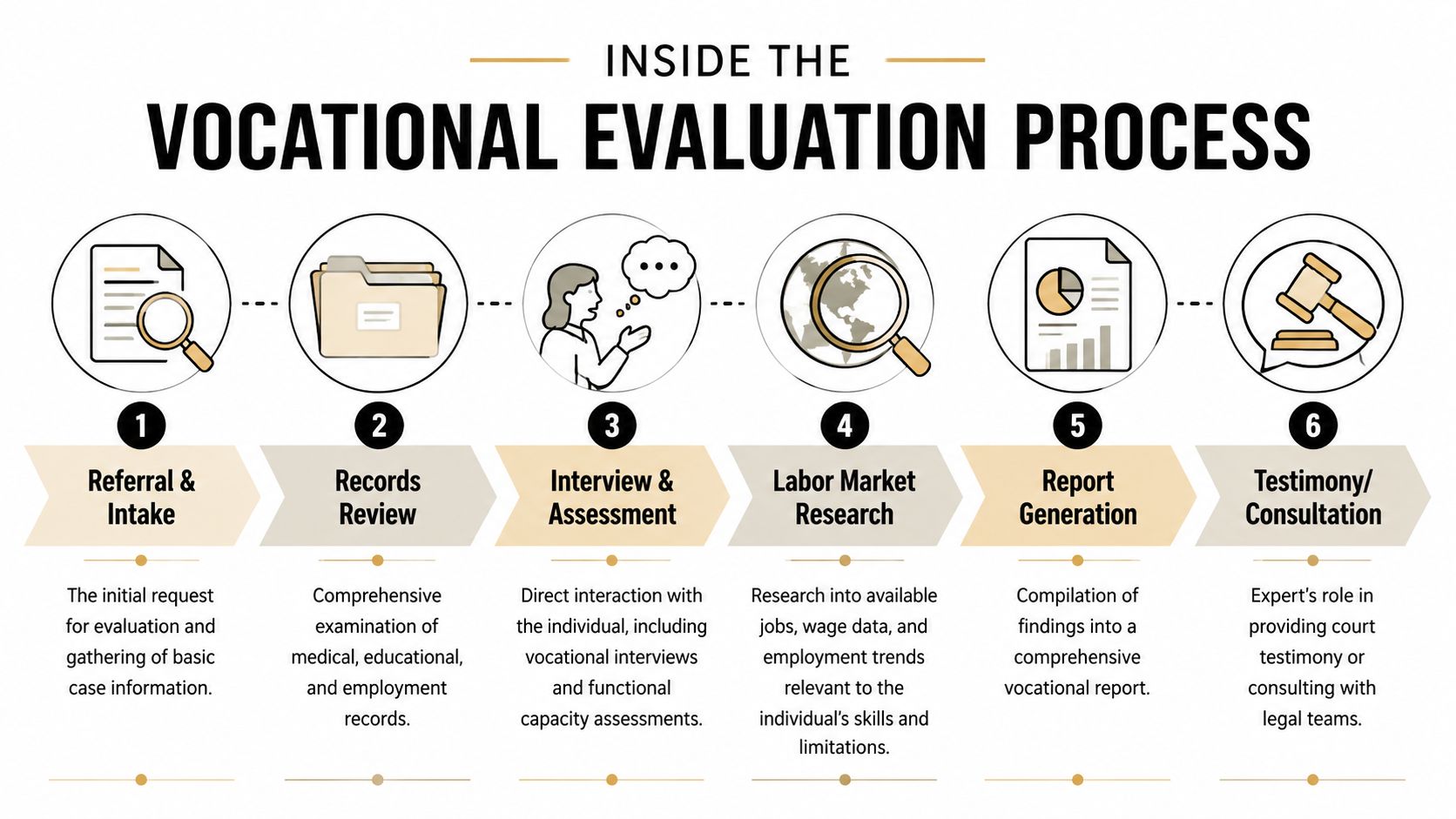
What the expert reviews first
Before any interview, the expert usually studies the core records. That often includes medical records, imaging reports, therapy notes, neuropsychological testing if available, employment records, education history, licenses, training certifications, and tax or wage documentation.
The reason is straightforward. A vocational opinion built on your memory alone is easier to attack. A vocational opinion tied to records is harder to shake.
What the interview feels like
The interview is usually detailed but conversational. Expect questions about your work history, your day-to-day symptoms, what changed after the injury, how long you can sit or stand, how you handle concentration, whether you need reminders, and how fatigue affects function over a full day.
In brain injury cases, the most important answers are often not dramatic. They are the small losses that employers notice quickly:
- Task persistence: starting work is different from finishing it on schedule
- Reliability: bad days, missed appointments, or cognitive overload can matter more than raw intelligence
- Pace: employers hire for sustained production, not occasional flashes of capability
- Social function: conflict tolerance, judgment, and impulse control can be decisive in office and service roles
Practical rule: Tell the expert about your worst functional barriers and your average day, not your best day.
A polished, optimistic interview can damage a valid claim if it leaves out the inconsistency that now defines your working life.
Later in the process, many clients find it helpful to watch a plain-language overview like this one:
Testing and labor-market work
Some evaluations include vocational testing. That isn't the same as a school exam. These tools can help the expert assess aptitude, learning style, reading demands, clerical strengths, or other work-related abilities. In a TBI case, test results are usually most useful when they are interpreted alongside medical and neuropsychological evidence rather than in isolation.
The labor-market portion is where the opinion becomes concrete. A serious expert doesn't merely list categories like “light office work” or “remote customer service.” The expert identifies actual occupational pathways, evaluates whether they match your restrictions, and studies whether the jobs are realistically available.
What comes out at the end
The final report should answer a few hard questions clearly:
- What work could this person perform before the injury?
- What work can this person perform now?
- What barriers make continued employment unstable or unrealistic?
- What is the effect on future earning capacity?
If those answers are vague, the report won't help much. If they are specific, tied to records, and grounded in labor-market analysis, the report can become one of the most important damages documents in the case.
Credentials and Methodologies That Withstand Scrutiny
Not every person who talks about work capacity is qualified to testify persuasively about it. In litigation, credentials matter. Methodology matters more.
A credible vocational rehabilitation expert should bring both.

The credentials that signal real expertise
Two of the most important credentials in this space are the Certified Rehabilitation Counselor (CRC) designation and the American Board of Vocational Experts credential at the Fellow or Diplomate level. In Social Security and federal settings, additional procedural requirements can matter as well, including federal contracting requirements for certain testimony roles.
Those letters after a name don't guarantee quality. But they do show the expert has entered a recognized professional framework rather than marketing themselves as a consultant.
The methods that keep opinions admissible
The stronger question to ask is this: what process did the expert use?
For testimony to hold up, especially in Social Security or federal matters, the expert must perform a Transferable Skills Analysis, often called a TSA. That means identifying what skills from prior work can transfer to other occupations and doing so through recognized occupational frameworks. The analysis must reconcile the Dictionary of Occupational Titles (DOT) with current information from O*NET and Occupational Employment and Wage Statistics (OEWS). The expert also must explain how job-number estimates were derived and how differences between these systems were handled. If that methodology isn't articulated, the testimony can be excluded.
That point is practical, not academic. Weak methodology gives the other side an opening to argue that the expert relied on outdated descriptions, inflated job counts, or occupations that don't match the client's restrictions.
The title “expert” doesn't protect bad analysis. Courts look for a process they can follow.
Questions worth asking before retention
When lawyers vet a vocational rehabilitation expert, several questions reveal a lot quickly:
- What credentials do you hold? Ask for CRC, ABVE, and any specialized experience with brain injury cases.
- How do you perform a TSA? The answer should mention DOT, O*NET, OEWS, and reconciliation of differences between them.
- Can you defend your job-number methodology? If the answer is soft or evasive, that's a warning sign.
- How do you work with future care evidence? In larger cases, the vocational opinion often needs to align with a broader life care planning framework.
A polished CV is useful. A defensible method is what wins motions, survives deposition, and supports damages at trial.
Translating Injury into Damages The Expert's Role in Court
A jury may understand that an injury hurts. The harder task is proving how that injury reshaped a person's economic future.
That is where the vocational rehabilitation expert becomes a damages witness, not just a rehabilitation witness.
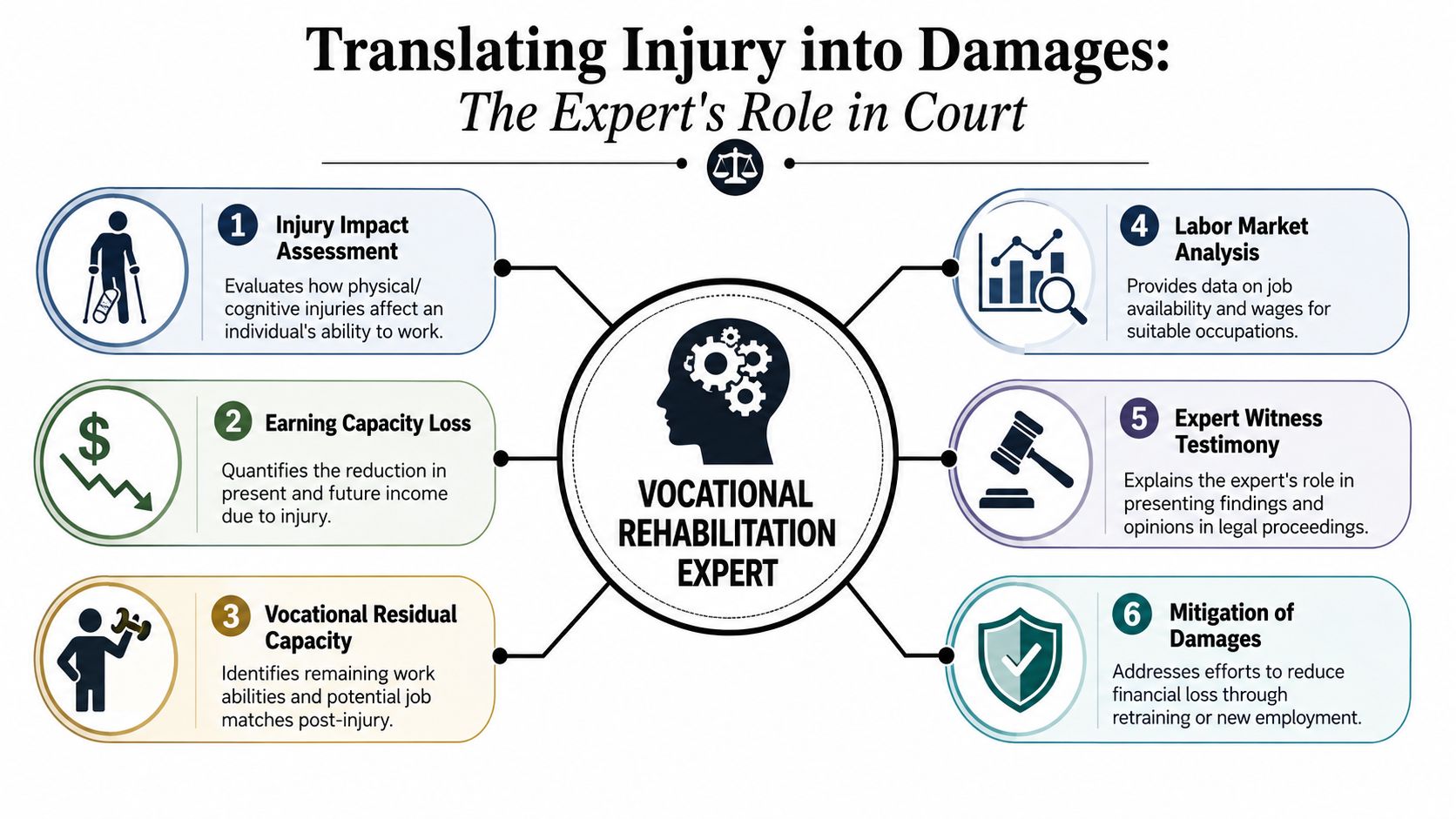
Scenario one with obvious physical limits
Consider a construction worker with serious orthopedic injuries after a crash. Before the injury, the path is easy to understand. Heavy physical work. A known work history. Clear physical demands.
After the injury, the vocational expert studies whether the worker can return to that same type of labor. If not, the expert looks at transferable skills, educational background, and realistic alternatives in the regional labor market. The opinion isn't just “he can't do construction anymore.” The opinion has to identify what jobs, if any, are available that fit the worker's restrictions and background.
In that analysis, the expert must conduct a Labor Market Analysis rather than rely only on generalized salary surveys. The expert identifies specific job titles, determines whether they match the client's functional limits, and quantifies available jobs tied to the selected DOT titles. Courts often reject future-income damage opinions when the expert doesn't quantify the number of available jobs for the identified titles.
Scenario two with a less visible injury
Now take an office professional with a traumatic brain injury. This is often the more contested case.
The person may still look capable. They may speak well. They may even return to work briefly. But if concentration drops, fatigue builds, memory slips, and emotional regulation weakens, the person may no longer be able to handle deadlines, multitasking, client contact, or supervisory responsibility.
A strong vocational expert translates those deficits into labor-market consequences:
- Lost access to prior roles: the old occupation may now be functionally out of reach
- Reduced competitiveness: the person may qualify only for narrower, lower-demand jobs
- Interrupted advancement: the injury may cut off promotion tracks, management roles, or credential-building paths
- Instability risk: even if a job can be obtained, keeping it may be the primary problem
That is often the difference between a minor wage-loss argument and a serious diminished-earning-capacity claim.
What else belongs in the damages picture
A complete vocational opinion doesn't stop at wages. It may also account for:
| Damage component | Why it matters |
|---|---|
| Retraining costs | A new work path may require schooling, certifications, or transitional support |
| Assistive devices | Work may only be possible with accommodations such as ergonomic equipment |
| Lost household services | Injury can reduce a person's ability to perform unpaid but economically valuable work at home |
Those items matter because the economic harm from a serious injury is rarely limited to a paycheck.
In court, the best vocational testimony doesn't exaggerate. It narrows the case to what can be proven and then proves it carefully.
This also explains why lawyers often coordinate vocational evidence with other litigation support, including expert personal injury fraud investigation resources when claim credibility is being challenged. Different experts answer different attacks.
And when the vocational opinion is ready for deposition or trial, it becomes part of the larger framework of expert witness testimony in injury litigation, where every assumption must be explained, not implied.
Practical Guidance on Finding and Retaining an Expert
Timing matters. If the case plainly involves lost earning capacity, don't wait until the eve of mediation or shortly before trial to start looking for a vocational rehabilitation expert.
Late retention creates predictable problems. Records are incomplete. Testing gets rushed. The expert has less time to evaluate failed return-to-work efforts, evolving restrictions, and labor-market realities. In brain injury cases, delay also lets the defense build its own narrative first.
What to look for in the right expert
The right expert for a TBI or complex injury case is not just credentialed. The expert should be able to deal with nuance, inconsistency, and modern work patterns.
Ask direct questions such as:
- How many brain injury cases have you handled? You want someone who understands fatigue, executive dysfunction, memory loss, and behavioral change.
- How do you analyze interrupted or inconsistent work history after injury? A simplistic “worked after the crash, therefore no loss” approach misses the point.
- How do you assess remote, hybrid, and freelance work? That issue matters more now than many lawyers realize.
- Are you comfortable testifying if the answer is partial capacity rather than total disability? Many valid claims involve a narrowed labor market, not complete inability to work.
The remote and gig-work problem
One of the biggest modern mistakes is assuming that if a person can work from home, the earning-capacity issue disappears. It doesn't.
With 20.1% of U.S. workers teleworking in 2023, remote work remains a meaningful part of the labor market, as noted in Robson Forensic's discussion of the field and telework conditions in major markets in its overview of vocational rehabilitation expert methodology. But a good expert distinguishes between the ability to perform isolated remote tasks and the ability to earn consistently in remote, hybrid, or gig arrangements.
That distinction matters because nonstandard work often raises practical questions that weak experts skip:
- income volatility
- irregular hours
- platform-based documentation
- self-direction demands
- reduced supervision
- productivity tracking
- client acquisition pressure in freelance settings
A person with cognitive fatigue may technically be able to do some remote work and still be vocationally devastated in any realistic sense.
Reading the report like a client, not a technician
When you receive the report, don't focus only on the conclusion. Read for the chain of reasoning.
A useful report should tell you:
- what records were reviewed,
- which restrictions were accepted,
- what occupations were considered,
- why certain jobs were ruled in or out,
- and how the expert reached the earning-capacity opinion.
If the report jumps from diagnosis to damages without that middle analysis, it leaves room for attack.
The best clients help their own case by giving the expert complete records, honest work history, failed job-attempt information, and real descriptions of what happens on an ordinary day. That's not oversharing. That's evidence.
How Nares Law Group Coordinates Experts for Maximum Recovery
In serious injury litigation, hiring a vocational rehabilitation expert isn't enough by itself. The value comes from coordination.
A vocational opinion works best when it lines up with the medical record, the neuropsychological findings, the day-in-the-life evidence, the economic damages model, and the legal theory of the case. If those pieces develop in separate silos, the defense will find the gaps.
Why early coordination matters in brain injury claims
This is especially important in TBI cases because delayed vocational intervention can distort the picture. The Brain Injury Association of America summarized a TBI Model Systems study reporting that 75% of participants discontinued vocational rehabilitation before services could be offered or completed, that receiving vocational rehabilitation services was the most important factor for achieving employment success, and that participants sought services an average of nine years after injury. The same summary notes severe financial difficulties among participants and use of supports such as assessments, transportation, and basic living-expense help. Those findings appear in the Brain Injury Association of America summary of the TBI vocational rehabilitation study.
For litigation, the takeaway is clear. Delay can make a real vocational loss look like a personal choice, failed motivation, or a messy work history when it is instead the result of injury and lack of coordinated support.
What coordinated legal work looks like
In a well-run case, counsel doesn't just send the client to an expert and wait for a report. The legal team helps assemble the right foundation:
- Medical chronology: so the expert sees the progression of symptoms and restrictions
- Employment evidence: job duties, prior promotions, licensing track, and post-injury work attempts
- Collateral information: statements from family, coworkers, or supervisors who saw the change
- Damages integration: coordination with economists and other experts so the vocational opinion feeds a coherent damages model
Good expert work is cumulative. Each disciplined step makes the next opinion harder to challenge.
Why this affects recovery
The practical result is stronger causation and stronger damages proof.
When the vocational evidence is developed early and tied tightly to the rest of the case, it becomes much harder for the defense to say the client chose not to work, could earn the same in another role, or failed to mitigate. The case stops looking like a general complaint about hardship and starts reading like a documented loss of earning power with a traceable mechanism behind it.
That difference often shapes settlement posture long before anyone enters a courtroom.
Secure Your Future with the Right Legal and Vocational Team
A serious injury can take more than health. It can take a profession, a promotion path, a sense of identity, and the ability to support a family the way you expected to.
A vocational rehabilitation expert helps prove that loss with structure and credibility. The right expert identifies what work was possible before the injury, what remains realistic now, and how that change affects long-term earning capacity. In complex brain injury claims, that analysis is often the missing link between symptoms and substantial damages.
Method matters. Credentials matter. Timing matters. And coordination matters most of all when the case involves cognitive injury, inconsistent functioning, or a defense argument that the person “should be able to do something.”
If your claim includes lost income, diminished career opportunity, or long-term work disruption, vocational evidence isn't optional. It's part of showing the full value of the harm. And when that opinion is aligned with a broader economic damages calculation strategy, it gives the claim the foundation it needs.
If you or your family is facing the fallout from a crash, truck wreck, or traumatic brain injury, Nares Law Group LLC can help you build the right legal and expert team to prove the full extent of your losses. The firm handles complex injury cases with a trial-ready approach, clear communication, and focused damages development so clients have a real chance at securing their future.