You open the envelope, see Independent Medical Examination, and your stomach drops.
A common reaction is to assume it's just another doctor's appointment, or perhaps a second opinion that could help clarify matters. That assumption is usually incorrect. When an insurance company schedules an independent medical examination, it's taking a formal step that can affect treatment approvals, settlement advantage, and how your injury gets described on paper from that point forward.
That's why this letter feels different. It is different.
If you're dealing with a car crash or truck wreck in Colorado, you need to treat the IME like a legal event with medical language around it. You don't need to panic. But you do need to prepare. A rushed, careless, or one-sided exam can create a report that follows your case for months or longer. A well-prepared claimant, by contrast, gives the insurer less room to twist the facts.
That Letter in the Mail An Introduction to the IME
The letter usually arrives when you're already overwhelmed. You're managing pain, trying to keep up with appointments, answering calls from adjusters, and figuring out how daily life got so complicated so fast. Then the insurer tells you to appear for an “independent” medical examination.
That word, independent, is where a lot of the confusion starts.
The exam may sound neutral. It may sound like a doctor is stepping in to sort out a disagreement. But if you're on the receiving end of one of these notices, your instincts are probably already telling you something else. You're right to be cautious.
You should walk into an IME with the mindset that every statement you make may later appear in a report written for someone else's benefit.
In injury practice, I've seen clients make the same understandable mistake over and over. They try to be agreeable, they assume the doctor has read everything, and they treat the meeting like a normal appointment. Then they're shocked when the written report downplays symptoms, skips important history, or suggests they're doing better than they are.
An IME doesn't have to sink your case. But it can become a problem if you go in unprepared.
Why this feels so stressful
An IME creates pressure for three reasons:
- It isn't your choice: The request usually comes from the insurer or defense side.
- It impacts negotiation power: The report may shape negotiations and disputes about care or causation.
- It sounds more neutral than it is: The wording can make people lower their guard.
The good news is that this process gets much less intimidating once you understand what the exam is for, what your rights are, and how a weak report can be challenged.
What an Independent Medical Examination Really Is
An independent medical examination is not a treatment visit. It is a medico-legal assessment performed by a non-treating physician to answer specific referral questions such as causality, future care needs, and work restrictions. In some systems, the report deadline is strict. Washington Labor & Industries, for example, requires submission within 14 days of the exam or receipt of test results, as explained on Washington L&I's IME and impairment rating information page.
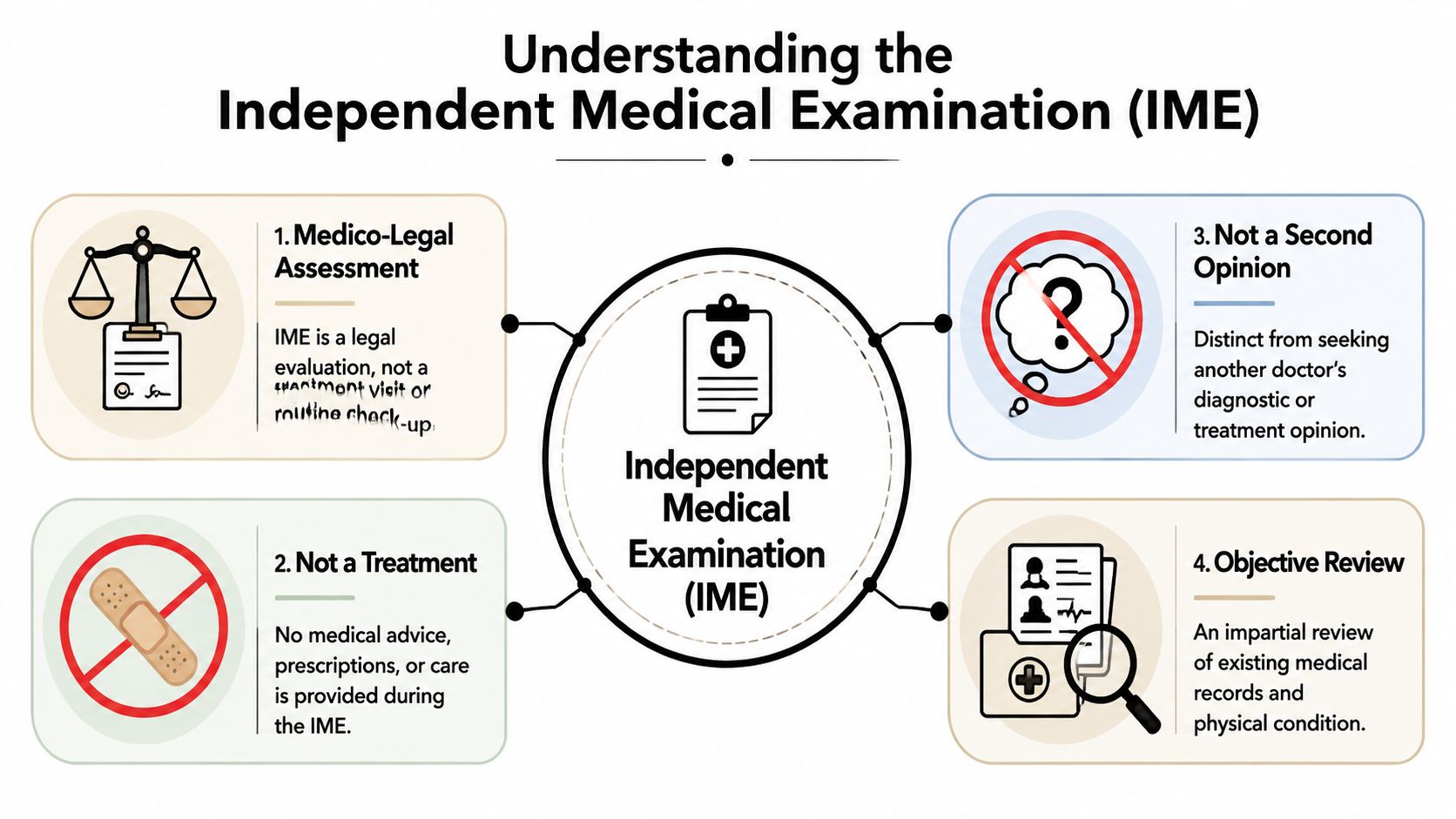
The easiest way to think about it is this. Your treating doctor is there to help you heal. The IME doctor is there to answer questions for a file. That's a very different job.
Think inspection, not treatment
If your car is damaged after a crash, the body shop repairs it. The insurance appraiser inspects it for the claim. Those are two separate roles. An independent medical examination works in a similar way.
The IME doctor is typically asked questions like:
- What caused the condition: Is the injury related to the crash, work event, or something else?
- What limits exist now: Are there restrictions on lifting, standing, driving, or other activity?
- What care is still needed: Is future treatment reasonable, necessary, or related?
- Has recovery plateaued: Has the person reached maximum medical improvement?
That last point matters because these exams often influence arguments about whether treatment should continue or whether an insurer should keep paying.
What the IME is not
A lot of frustration comes from expecting something the exam was never designed to provide. An IME is not:
- A normal doctor visit: You shouldn't expect diagnosis and treatment planning for your benefit.
- A confidential therapeutic relationship: The doctor is not acting as your personal physician.
- A second opinion you requested for your own care: The referral questions come from the requesting side.
Practical rule: Don't go to an IME looking for help. Go in prepared to be evaluated.
That doesn't mean every examiner is careless or unfair. Some are careful and thorough. But the structure of the process matters. The examiner isn't there to build trust with you over time. The examiner is there to produce a report.
Why Insurance Companies Request an IME
Insurance companies don't request an IME just to gather background. They request one because a medical report can be a powerful tool in a dispute.
In plain English, they want a doctor they selected to weigh in on the parts of your case that affect money. Causation. Severity. Duration. Need for future care. Restrictions. Recovery. Those are the pressure points.

A New York workers' compensation analysis describes IMEs as “speciously named” and states that examiners are paid by and selected exclusively by insurance companies, with reports that often become central to claim denials, as discussed in NYCOSH's report on how IMEs lack independence and harm injured workers.
That doesn't mean every report is false. It does mean you should understand the built-in incentive problem.
What the insurer is usually trying to prove
An IME request often appears when the insurer wants support for one or more of these positions:
- Your injuries aren't as serious as claimed
- The crash didn't cause all of your symptoms
- You had a prior condition that explains the problem
- You've recovered enough that more care isn't needed
- Your restrictions should be reduced
- Your claim value should be lowered
Sometimes the insurer already has a theory and wants a report that fits it. Other times it's looking for enough ambiguity to create a bargaining advantage.
Why the word independent can mislead people
People hear “independent medical examination” and assume balance. But the exam is often better understood as adversarial evidence gathering. The doctor may be licensed, professional, and courteous. Even so, the exam exists because someone on the other side wants written opinions that can be used in negotiation or litigation.
That's why underpreparing is costly.
What usually doesn't work is showing up casually, chatting too much, and assuming the truth will sort itself out. What works better is staying accurate, concise, and observant. If the exam is fair, that helps you. If the exam is sloppy, your preparation helps expose it later.
Your Rights During an IME in Colorado
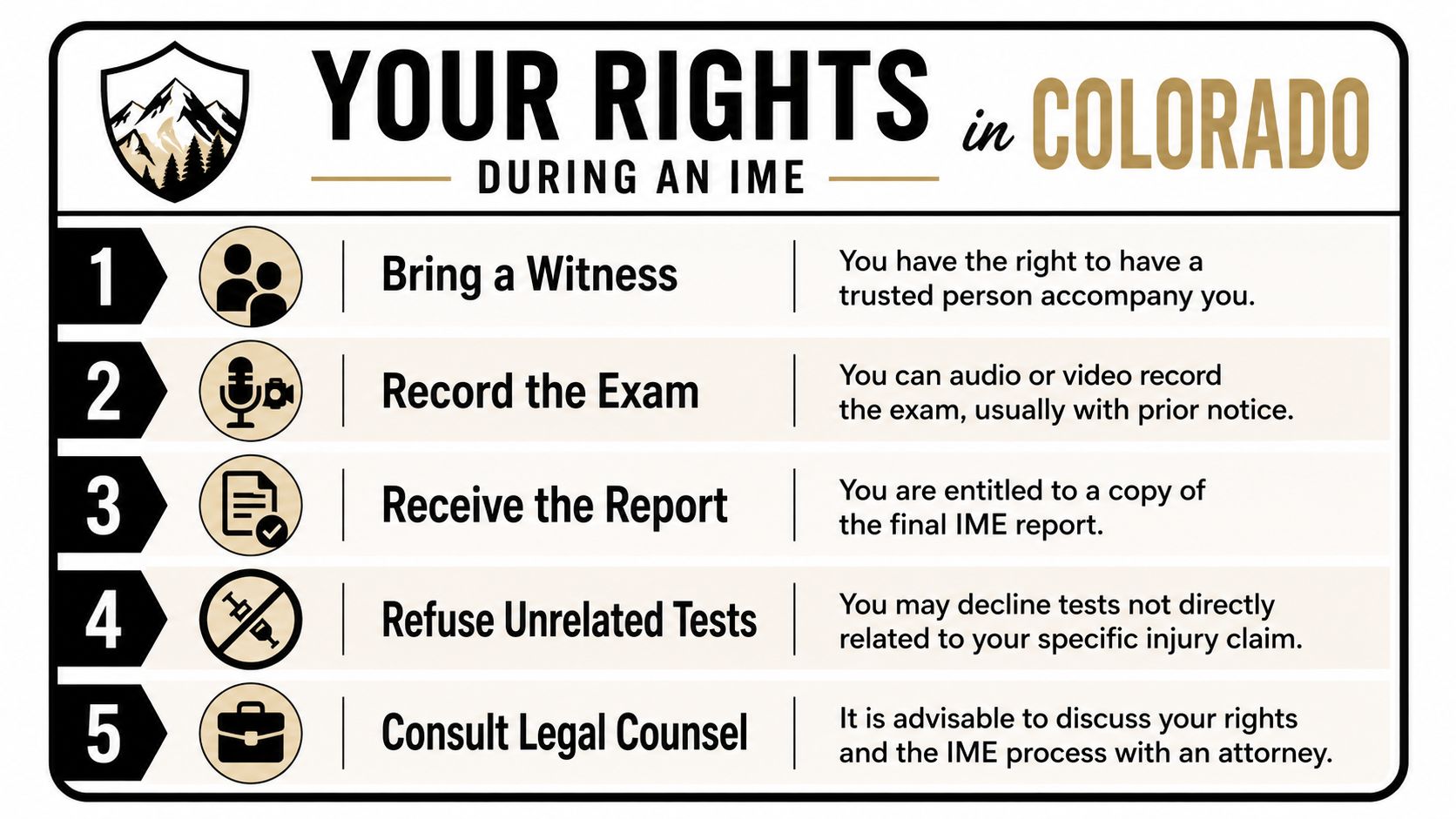
Colorado claimants often feel powerless before an IME because the process looks formal and medical at the same time. But formality cuts both ways. You don't walk in stripped of all protections.
Rules vary by jurisdiction. New York, for example, has been described as giving claimants no right to bring anyone into an IME, while other states have moved toward more transparency. That's why understanding Colorado-specific rights involving accompaniment and recording, and documenting how long the exam lasts, matters so much.
What to confirm before the exam
Before the appointment, pin down the logistics in writing through your lawyer if you have one. If you don't, keep your own paper trail.
Important questions include:
- Can the exam be recorded: If so, what notice must be given?
- Can a witness attend: If yes, are there limits on where that person can sit or what they can do?
- What is the scope of the exam: What body parts or claimed injuries are at issue?
- Will forms be required beforehand: If so, review them carefully before signing anything.
If Colorado procedure in your setting allows recording or accompaniment, use those rights properly and early. Don't assume the office will volunteer that information.
What the examiner should and should not do
An IME should stay tied to the issues in dispute. The examiner may ask medical history questions that relate to your claimed injury, prior similar symptoms, treatment history, and current limitations. But the exam is not supposed to become a free-form fishing expedition into every private detail of your life.
Watch for warning signs such as:
| Concern | Why it matters |
|---|---|
| Questions far outside the claimed injury | They may be trying to build distraction or blame-shifting |
| Very short physical exam | A superficial exam may not support strong conclusions |
| Misstatements of your answers during the visit | Those errors often reappear in the final report |
| Pressure to agree with the examiner's framing | Casual remarks can later be recast as admissions |
If the doctor asks an inappropriate question, don't argue. Answer only as needed, note what happened, and tell your attorney afterward.
Protect yourself in real time
You don't need to be combative. You do need to be alert.
Use this approach:
- Be polite, not chatty: Small talk can turn into report language.
- Answer what was asked: Don't fill silences with guesses or extra detail.
- Describe limits accurately: Don't exaggerate. Don't minimize.
- Notice the clock: Start time, end time, waiting time, and actual hands-on exam time all matter.
- Write down your observations right after: Don't rely on memory later.
A rushed exam can still produce a confident-looking report. Your notes may be the first step in showing why that report shouldn't carry much weight.
How to Prepare for Your IME Appointment
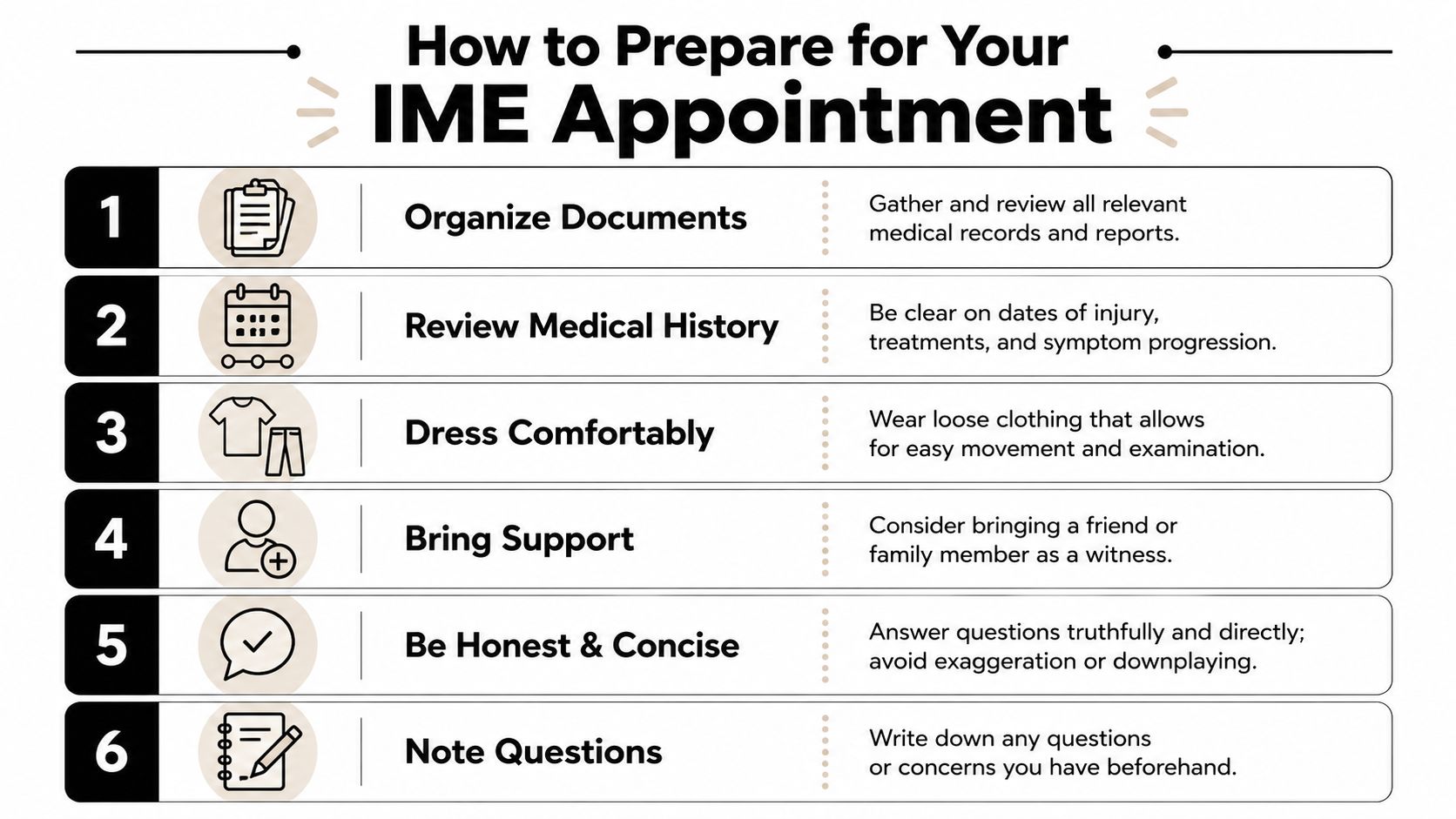
Preparation changes the tone of the entire appointment. The goal isn't to sound rehearsed. The goal is to stay accurate under pressure.
Before the appointment
Start with your timeline. You should know the basic sequence of your case without needing to guess. Date of injury. Main symptoms. Major providers. Important scans or treatment milestones. Current restrictions. Areas that still hurt. Activities that trigger symptoms.
Then keep your day ordinary. Don't try to “perform” injury, but don't overexert yourself beforehand either. If you push through unusual errands, a long workout, or a demanding day just to prove you're tough, you may walk in looking better than you feel most of the time.
A few practical prep steps help:
- Review your records lightly: Refresh your memory on treatment history and diagnoses.
- Choose simple clothing: Wear something that allows movement if the injury area needs to be examined.
- Bring essentials only: Identification, appointment notice, and anything your attorney told you to carry.
- Think about insurance contact: If you're still fielding adjuster pressure generally, this guide on how to deal with insurance after a car accident can help you avoid common communication mistakes.
During the appointment
The best approach is calm precision. You're not there to win the doctor over. You're there to avoid giving the report unnecessary openings.
Use these rules:
- Tell the truth exactly as you know it: If you don't know, say you don't know.
- Don't guess about medical terms: Describe symptoms in everyday language.
- Keep answers focused: Long narratives often get shortened in ways that hurt you.
- Show pain accurately: If a movement hurts, say so when it hurts.
- Don't volunteer legal opinions: You don't need to argue fault, coverage, or claim value.
A strong IME presentation is boring. It is steady, consistent, and hard to distort.
After the appointment
Do your write-up immediately. Not that evening if you can avoid it. Not the next day. Right after.
Capture details such as:
- Arrival and departure times
- How long you waited
- How long the doctor spent with you
- Questions asked
- Physical tests performed
- Statements that seemed odd, dismissive, or leading
- Whether the doctor reviewed records in front of you
- Who else was present
Those notes can become extremely useful later if the report says the exam was thorough when it wasn't, or if the doctor attributes statements to you that you never made.
How IME Reports Are Used and Challenged
Once the report is issued, it can influence almost every pressure point in your case. The insurer may cite it to question ongoing treatment, reduce settlement offers, dispute causation, or argue that your limitations are minor. A polished report can look persuasive even when the underlying reasoning is thin.
The issue is not whether the report sounds confident. The issue is whether the examiner separated objective findings from opinions about causation and functional capacity. That distinction matters because these reports often drive compensation decisions, and lawyers challenge them by testing the examiner's reasoning, exposing failures to review the full record, and showing departures from evidence-based analysis, as described in NYRC's discussion of what an IME is and when it is used.
What a weak IME report often looks like
A problematic report usually doesn't announce itself. It looks formal. It may sound measured. But when you read closely, the flaws tend to fall into patterns.
Common weaknesses include:
- Selective history: The report mentions prior issues but ignores the crash-related change in symptoms.
- Thin examination detail: Strong conclusions rest on a very limited physical exam.
- Conflating findings and opinions: The doctor presents assumptions as though they were observed facts.
- Ignoring treating records: Important therapy notes, imaging, or specialist opinions are brushed aside.
- Overstating certainty: The report sounds more definitive than the available information supports.
How lawyers dismantle them
A bad IME isn't the end of the case. It is a document, and documents can be tested.
A focused challenge usually includes some combination of the following:
Treating doctor rebuttal
Your treating physician may be able to address the IME point by point, especially on mechanism of injury, symptom progression, and ongoing limitations.Record comparison
The IME gets lined up against the full chart. Missing records, misquoted history, and skipped findings matter.Deposition of the IME doctor
Under oath, broad conclusions often narrow quickly. A doctor who sounded certain on paper may admit limited record review or concede alternate explanations.Timeline reconstruction
Your post-exam notes can help show whether the report's description of the visit matches what happened.
If your file is large, using a structured tool to organize records before rebutting an IME can save time. Some lawyers and clients use tools like discover PDF AI's healthcare agent to sort treatment records, flag chronology issues, and pull out contradictions for closer legal review.
If the insurer leans on the report to deny or restrict benefits, a broader strategy may be needed. This overview of how to appeal an insurance claim denial gives a useful starting point for understanding the next stage.
The IME report matters, but it is not the final word. It is one piece of evidence, and some pieces break apart under scrutiny.
How Nares Law Group Protects Your Interests
Independent medical examinations have been part of American injury and disability systems since the early 1900s, and a widely cited review describes them as a century-old feature that evolved into structured forensic tools used in litigation and benefits decisions, as noted in Johns Hopkins' review of IME facts and fallacies. That history matters because it explains why these exams carry so much weight. They are not side issues. They are built into how claims get fought.
That's exactly why legal guidance before and after the exam can change the outcome.
A strong law firm doesn't just tell you to show up and “be honest.” It prepares you for the actual risks. That means helping you understand the scope of the exam, preserving your rights where available, identifying red flags in the examiner's process, and comparing the final report against the full medical record instead of accepting it at face value.
What practical help should look like
Good representation around an IME usually includes:
- Pre-exam coaching: What to expect, what to bring, and how to answer without hurting your case.
- Rights protection: Recording, witness issues, and objection handling where applicable.
- Report analysis: Checking whether the examiner skipped records, misstated history, or blurred opinion with fact.
- Medical coordination: Getting meaningful rebuttal input from treating providers.
- Litigation strategy: Using cross-examination, records, and expert analysis to reduce the report's impact.
For clients with head injuries, symptom timing and recovery patterns are often misunderstood or oversimplified in IME reports. A plain-language resource like this concussion recovery timeline can help families frame the kinds of issues that deserve close medical and legal attention.
If you're still deciding whether this is the point to get legal help, this guide on when to hire a personal injury attorney is a practical place to start.
You do not have to walk into an independent medical examination blind. You also do not have to accept a slanted report as the truth just because it arrived on a doctor's letterhead.
If you've been ordered to attend an IME after a Colorado crash, Nares Law Group LLC can help you prepare, protect your rights, and respond if the report is unfair or inaccurate. A free consultation can give you a clear plan for what happens next.