After a serious Colorado crash, individuals often know two things right away. They're hurt, and life has become more complicated overnight.
The police report may say where the vehicles ended up. Medical records may list diagnoses. Pay stubs may show missed work. But none of those documents, standing alone, fully explain what the wreck has done to your body, your job, your family, and your future.
That gap is where expert witness testimony often matters most. If you've been wondering what is expert witness testimony, the short answer is this: it's testimony from a qualified professional who helps the court understand something that ordinary people usually can't explain on their own.
In a personal injury case, that can make the difference between a partial story and the full one.
Your Story Needs More Than Just the Facts
A truck slams into your vehicle on I-25. Weeks later, you're still in pain. Your doctor has ordered more imaging. You can't work the same hours. Your spouse notices you're more forgetful, more irritable, more tired. The insurance company asks for proof.
That request sounds simple. It rarely is.
A fact witness can say your car was crushed. A family member can describe how you've changed since the crash. Your employer can confirm you've missed work. All of that matters. But those pieces still leave hard questions unanswered.
Where the missing pieces usually are
The biggest questions in an injury case often sound like this:
- Cause: Did this crash cause the injury?
- Severity: Is this a temporary problem or a long-term one?
- Future care: Will you need treatment months or years from now?
- Work impact: Can you return to the same job, schedule, or income path?
- Value: What does all of this mean in practical financial terms?
That's where an expert comes in. Not as a performer. Not as someone hired to say whatever a lawyer wants. A strong expert acts more like a translator.
They take complicated subjects such as brain imaging, crash dynamics, rehabilitation planning, or earning capacity, and turn them into clear, grounded explanations a judge or jury can follow.
Practical rule: The law doesn't just want opinions. It wants informed opinions that connect technical knowledge to the real facts of your case.
Why injured clients feel confused here
Many people hear the phrase “expert witness” and picture a courtroom drama. A doctor in a suit. Fancy terms. A battle of hired opinions.
In real life, the role is more personal than that. An expert may help explain why your headaches fit the mechanics of a rear-end impact. Another may show why your future care won't end with the bills you already have. Another may explain why returning to your old work is no longer realistic.
When your injuries are serious, the case isn't only about what happened that day. It's about what happens next. Expert testimony helps tell that part of the story in a way the legal system can use.
The Expert Witness vs The Eyewitness
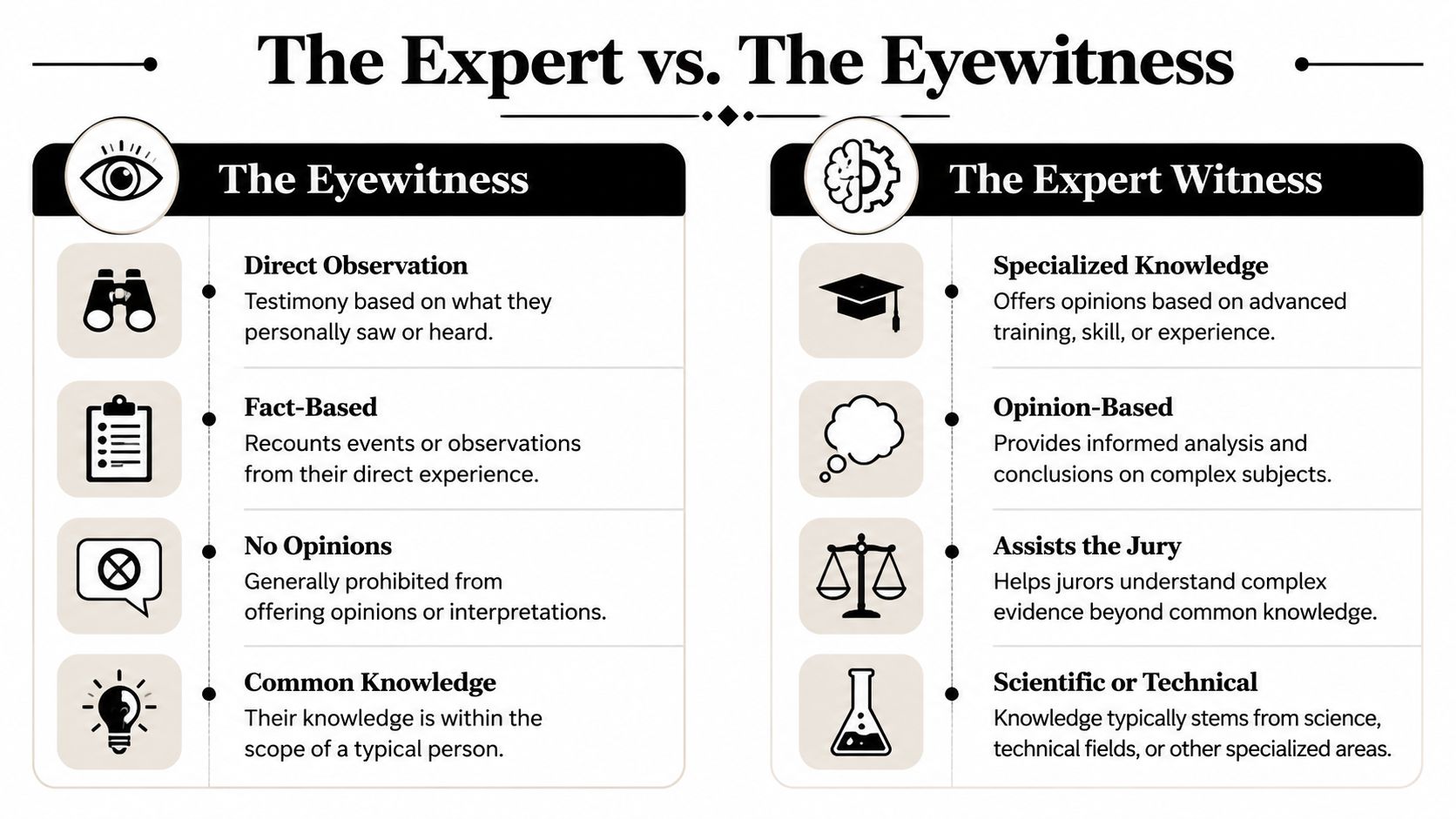
An eyewitness tells the court what they personally saw, heard, or experienced. An expert witness does something different. The expert uses specialized knowledge to interpret evidence and offer an opinion.
That distinction matters more than is commonly understood.
One saw the play. One explains it.
Think of a football game.
A fan in the stands can say, “The receiver got hit hard right after the catch.” That's useful. It's direct observation.
A professional commentator can add, “The defender lowered his helmet, the contact point was high, and that kind of hit often creates a specific type of rotational force.” That second statement goes beyond simple observation. It interprets events using training and experience.
Court works in much the same way.
The law draws this line clearly. Only qualified experts may offer opinion testimony, while lay witnesses are limited to facts they personally observed. A court decides whether someone is qualified through voir dire, which is a pre-trial process that examines the person's education, training, skill, or practical experience relevant to the issue. That distinction appears in the Rule 702 framework described by Cornell Law School's Rule 702 reference.
What an eyewitness can and can't do
An eyewitness might say:
- What they observed: “The truck drifted into the next lane.”
- What they heard: “I heard brakes and then a loud impact.”
- What they noticed after: “The driver looked dazed.”
An eyewitness usually can't say:
- Medical causation: “That impact caused a traumatic brain injury.”
- Engineering analysis: “The speed and angle prove brake failure.”
- Economic forecasting: “This person will lose earning capacity for years.”
Those last opinions require specialized knowledge.
Why this matters in your case
Insurance companies often take advantage of this gap. They may not dispute that a crash happened. They may dispute what the crash caused.
That's why expert testimony is powerful. It can connect the dots between event and outcome.
An expert's opinion isn't supposed to be a guess. It's supposed to be a professional conclusion built on knowledge, training, experience, and a review of the evidence.
If you're asking what is expert witness testimony in practical terms, this is the simplest answer: it's the part of the case where a qualified professional explains what the raw facts mean.
Meeting the Standards of a Colorado Courtroom
A client may hear, “We have a doctor who supports your case,” and assume that settles it.
It does not.
In a Colorado injury case, the court looks closely at whether that expert can give the opinion your case needs. The judge's job is to screen out opinions that sound confident but are not grounded in careful work. That matters to you because an expert can shape how clearly your injuries, future care, and financial losses are understood.
What the judge is really checking
Courts usually focus on three practical questions.
| Standard | What it means in everyday language |
|---|---|
| Qualified | Does this person have the right background for this specific issue, not just an impressive title? |
| Helpful | Will this opinion explain something the jury cannot sort out on common sense alone? |
| Reliable | Is the opinion tied to enough facts, a sound method, and an honest application of that method to your case? |
A simple way to picture it is a home repair problem. You would not ask a brilliant heart surgeon to inspect a cracked foundation. The surgeon may be highly trained, but not in the field that answers your problem. Courtrooms work in much the same way. The question is not whether the witness is smart. The question is whether the witness is the right fit for this exact issue.
That reliability question often becomes the hardest part.
A respected doctor can still be excluded if the opinion jumps too quickly from “you were in a crash” to “the crash caused every symptom.” An engineer can be challenged if the reconstruction does not match the physical evidence. A financial expert can be limited if the future loss estimate rests on assumptions that do not fit your work history, medical records, or recovery path.
Why lawyers spend so much time vetting experts
Clients sometimes assume the goal is to find someone persuasive.
The goal is to find someone careful.
A good expert has to show how they got from the records, scans, photographs, measurements, testing, and work history to the final opinion. In plain terms, they need to show their math, even when the subject is medicine or accident analysis. If your case involves how a collision happened, a Colorado accident reconstruction specialist may need to explain the method used and why it fits the scene evidence.
That preparation protects your case. It also protects your financial future. If an opinion about future treatment, permanent limits, or lost earning ability is weak, the insurance company will attack it. If the judge agrees, the jury may never hear that part of your story.
What this means for you
You may not sit in every hearing or read every motion about expert admissibility. You will still feel the effect.
When the court allows a well-prepared expert opinion, your case gains a translator. Medical terms become understandable. Work restrictions become concrete. Future costs stop sounding abstract and start sounding real.
When an expert is excluded, the problem is not just technical. It can reduce what you are able to prove about your recovery, your daily limitations, and the money you will need later.
That is why this stage of the case matters so much from a client's side. The courtroom is deciding whether the professional opinions behind your claim are strong enough to carry part of your story.
The Team of Experts Your Injury Case May Need
A serious injury claim often needs more than one expert because one person usually can't answer every important question. A crash involves mechanics, medicine, work limitations, and future costs. Different professionals handle different parts of that picture.
The experts who explain how life changed
An accident reconstructionist studies how the crash happened. They may review vehicle damage, roadway evidence, photographs, electronic data, and witness statements. Their job is to answer questions about speed, lane position, impact angles, braking, visibility, and sequence of events.
If you want a closer look at that role, this overview of an accident reconstruction specialist explains how that analysis fits into injury litigation.
A medical expert explains the injury itself. That could be a treating physician or another specialist, depending on the issue. They help answer whether the collision caused the condition, how severe it is, what treatment was necessary, and whether lasting symptoms are medically consistent with the crash.
A life care planner looks forward. This expert maps out likely future medical needs, such as therapy, medications, follow-up care, supportive devices, or long-term assistance if the injury is permanent.
The experts who explain work and money
A vocational rehabilitation expert focuses on your ability to work. They assess your restrictions, job history, skills, education, and the practical effect of your injuries on employment.
An economist then takes those work and care findings and translates them into financial terms. They may evaluate lost wages, reduced earning capacity, and the economic value of future needs identified elsewhere in the case.
Here's a simple way to think about the lineup:
| Expert Type | Their Role | The Question They Answer |
|---|---|---|
| Accident Reconstructionist | Rebuilds how the collision occurred using physical and technical evidence | How did the crash happen, and who likely caused it? |
| Medical Expert | Explains diagnosis, causation, treatment, and prognosis | What injuries did this crash cause, and how serious are they? |
| Life Care Planner | Projects future treatment and support needs | What care will this person likely need going forward? |
| Vocational Rehabilitation Expert | Assesses work limits and job options after injury | How has this injury changed the person's ability to work? |
| Economist | Calculates financial impact based on medical and vocational findings | What are the likely economic effects of those losses? |
How they work together
These experts don't operate in isolation.
A reconstructionist may help establish the force and mechanics of impact. That information can support the medical analysis. The medical findings can shape the life care plan. The life care plan and work limitations can support the economist's calculations.
When the case is built correctly, each expert answers one part of a larger question: what happened, what harm it caused, and what it will take to make the injured person financially whole as much as the law allows.
The Lifecycle of an Expert From Retention to Trial
Most clients never get a clear explanation of what an expert does from the day they're hired to the day they testify. That uncertainty can make the process feel more mysterious than it is.
In reality, the path is fairly structured.
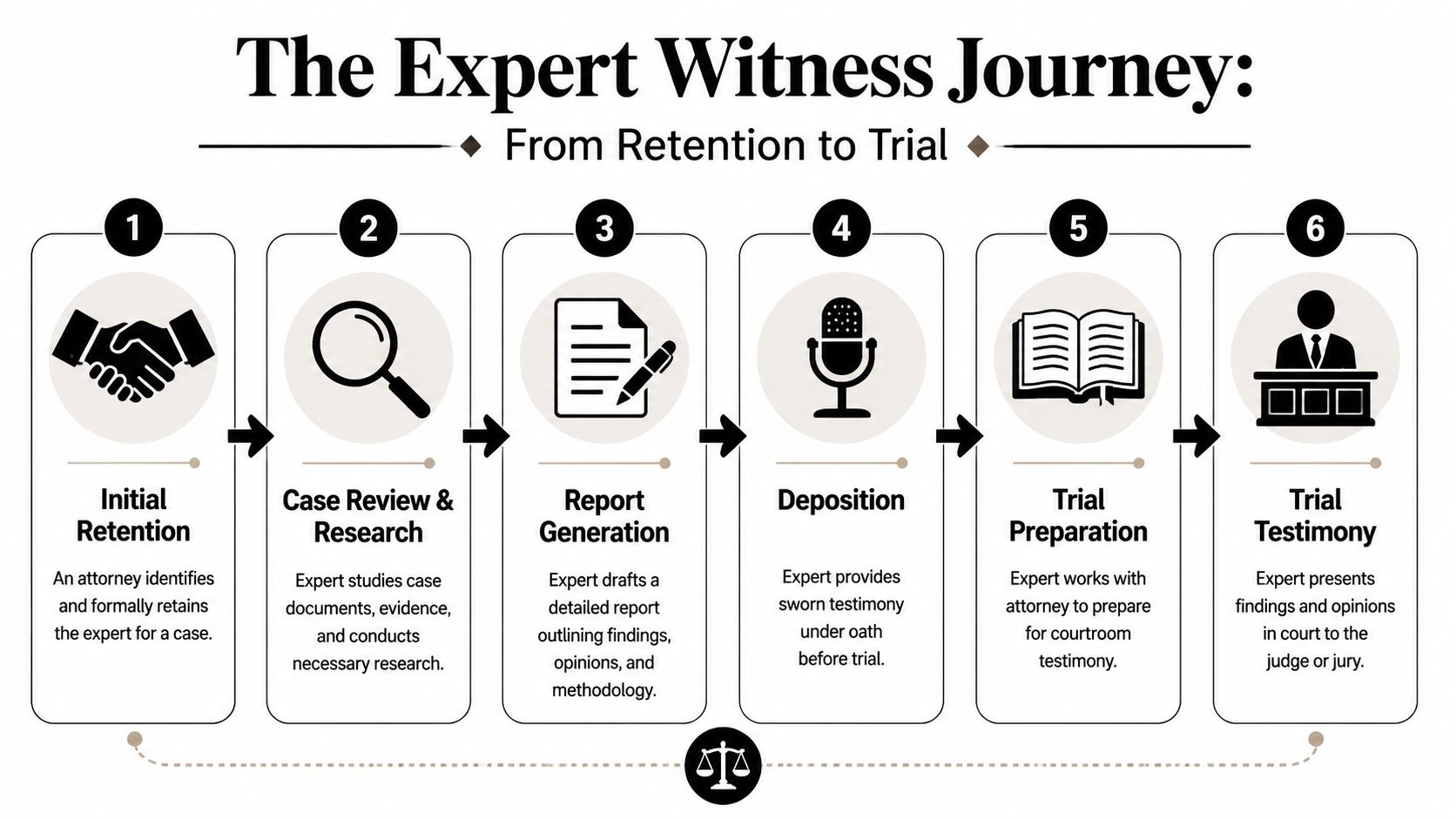
Step one through step three
Retention comes first. Your lawyer identifies a professional whose background fits the issue in your case. The fit matters. A qualified expert in one area may not be the right person for another.
Case review comes next. The expert studies the records and evidence. Depending on the field, that might include medical files, imaging, photographs, repair records, crash reports, employment information, or deposition testimony.
Then the expert forms opinions and prepares a report. This written report is important because it usually shows what the expert considered, what conclusions they reached, and how they got there.
A good report is not vague. It connects facts to analysis.
The deposition stage
Later, the opposing lawyer usually gets to question the expert under oath in a deposition. This is a formal interview, not a surprise attack.
If you want a plain-English overview of that process, this guide on what a deposition is in a lawsuit helps explain why depositions matter and how they fit into a case.
During the deposition, the defense will often probe for weak spots:
- Scope questions: Is the expert straying beyond their true specialty?
- Foundation questions: What records did they review, and what did they leave out?
- Method questions: Did they use a recognized process, or did they jump to a conclusion?
- Bias questions: Are they being careful, or just advocating for the side that hired them?
Lawyers preparing for this phase often study strong questioning techniques. For readers who want to understand how these challenges are framed, this resource on mastering witness examination techniques gives useful context.
Trial preparation and testimony
If the case doesn't settle, the expert may testify at trial. By then, both sides usually know the opinions, the records reviewed, and the main areas of disagreement.
This is also where credentials alone stop carrying the day. As Expert Institute's discussion of expert witnesses explains, an expert can be challenged or excluded even if highly credentialed. Courts often focus on methodology, peer review, error rates, and general acceptance rather than titles alone.
Before trial, lawyers also prepare the expert to explain technical ideas in ordinary language. A jury doesn't need a lecture. It needs a clear explanation.
Here's the video version if you prefer to learn visually.
The process is adversarial by design. That isn't a sign that something has gone wrong. It's how courts test whether an opinion is strong enough to rely on.
How Experts Turn Evidence into Compensation
A personal injury case has to answer two different questions. Who caused the harm. And what will that harm cost you over time.
Those are legal questions, but they affect very practical parts of your life. Can you pay for future treatment? Will you be able to return to the same job? Will your family have to cover needs that did not exist before the injury?
Proving fault and proving loss
Some experts help show how the event happened. In a crash case, for example, an accident reconstruction expert may study vehicle damage, road markings, timing, and visibility to explain how the collision likely occurred. That can matter if the insurance company claims the other driver was not at fault, or says you share more blame than you do.
Other experts help show what the injury has taken from you.
A medical expert explains the diagnosis, treatment, and likely future problems. A vocational expert looks at how the injury affects your ability to work. An economist places a dollar value on lost earning capacity and other financial losses. In a serious case, a care planner may map out the treatment, equipment, support, and daily assistance you may need in the years ahead. That is why life care planning for serious injury claims often becomes a major part of the case.
This part of the case often decides whether a settlement reflects your real losses or only the bills already sitting on the table.
How expert opinions become dollars
Insurance adjusters and juries do not automatically see the full cost of an injury. They usually see fragments. An emergency room bill. A missed paycheck. A few months of physical therapy.
Experts connect those fragments into a timeline.
For example, a doctor may explain that a back injury will likely cause chronic pain and limit lifting. A vocational expert may then explain that those limits rule out the kind of work you did before. An economist can then calculate the income gap created by that change. Step by step, the case moves from "you were hurt" to "here is what this injury will likely cost over the course of your life."
That connection matters in Colorado personal injury cases because the largest losses are often future losses. If your case is valued only by what has happened so far, you may be left paying for tomorrow with a settlement based on yesterday.
Why careful expert work matters to your recovery
Strong expert work gives your claim shape. It turns medical records, work history, and future care needs into a clear explanation of what happened to your body, your job, and your financial future.
Without that explanation, the defense has room to argue that your pain is temporary, your limitations are minor, or your future needs are too uncertain to count. With it, your attorney has a clearer way to show why fair compensation should cover more than the obvious costs.
For an injured client, that is the main point of expert testimony. It is not about making the case sound more technical. It is about helping the court or the insurer see the full human and financial impact of what happened to you.
Common Questions About Expert Witnesses
A lot of injured clients ask the same practical question first. How does an expert affect my case, my costs, and the money my family may need later?
Here are the answers that usually matter most in a Colorado personal injury case.
Do I have to pay the expert myself
That depends on your agreement with your lawyer. In many injury cases, the law firm advances case costs and seeks repayment later under the representation agreement.
Ask about this early. A clear answer helps you understand the financial side of the case and avoids surprises while you are already dealing with medical treatment, missed work, and household bills.
Will I need to meet the expert
Sometimes.
A medical expert or vocational expert may need to interview you or perform an evaluation. Other experts work mainly from records, imaging, photographs, wage information, and other documents. Your attorney usually arranges the process and tells you what to expect, so the meeting does not feel like a test you have to pass.
What if the insurance company hires its own expert
That is common.
Insurance companies often hire their own doctors or other specialists to challenge the seriousness of an injury, the cause of a condition, or the cost of future losses. Then the focus shifts to which opinion is grounded in better facts, clearer reasoning, and a more complete picture of your life after the injury.
For a client, that matters because competing experts can affect settlement value. A well-prepared expert can help prevent the defense from shrinking your claim down to a few medical bills and a short recovery window.
Does having an expert mean my case is going to trial
No. Many cases with experts still settle.
In fact, expert work often helps resolve a case before trial because it shows the insurance company what a jury may hear if the case does not settle. Clear expert opinions can make the future costs of your injury harder to dismiss or downplay.
Why does all of this matter so much
Because an injury can change far more than one doctor visit or one missed paycheck.
A broken bone may heal, but pain may continue. A back injury may limit lifting long after the first round of treatment ends. A brain injury may affect concentration, stamina, or the kind of work you can handle. Expert testimony helps translate those changes into plain, provable terms a court or insurer can understand.
For clients asking what expert witness testimony is, the clearest answer is this. It is a way to show how your injury affects your body, your work, and your financial future, so your case is valued on the full reality of your loss, not just the part that is easiest to see.
If you or your family are trying to understand a serious injury case after a Colorado crash, Nares Law Group LLC offers guidance for people facing medical uncertainty, lost income, and pressure from insurance companies. You can reach out for a free consultation to get clear answers about your rights, your next steps, and what it may take to build the strongest case possible.