The first days after a serious crash often feel less like recovery and more like triage. Your phone keeps ringing. One doctor wants imaging. Another office says they need a referral first. The pharmacy says the prescription hasn't gone through. The adjuster wants a statement. Meanwhile, you're trying to remember what day it is, keep your job informed, and get through normal life with pain, dizziness, or a loved one who isn't acting like themselves.
That kind of overload is common after a major motor vehicle collision, and it's especially brutal in brain injury cases. Families think the hard part will be the medical treatment. In practice, the system itself can become a second injury. Missed appointments, conflicting instructions, delayed authorizations, and incomplete records can slow recovery and also weaken the paper trail that later proves what the crash cost you.
That's where case management services become more than a convenience. Done well, they bring order, follow-through, and documentation to a process that otherwise falls apart at the seams.
Your Recovery Needs a Quarterback
After a serious wreck, individuals don't need one more person giving advice. They need someone who can take the moving pieces and run the playbook.
A case manager fills that role. Think of this person as the quarterback for your recovery. The surgeon handles surgery. The neurologist handles neurological issues. The physical therapist handles rehab. Your attorney handles the legal claim. The case manager helps those parts work together instead of colliding.
In brain injury matters, that coordination matters even more. A person may look outwardly fine but still be struggling with memory gaps, fatigue, irritability, headaches, sensory overload, or trouble following multi-step instructions. Families often feel like they're repeating the same story to every provider, every insurer, and every school or employer contact. A good case manager reduces that repetition and catches details before they disappear.
I've seen the difference between a file that contains scattered records and a file that tells a coherent story. The first leaves gaps. The second shows what happened, what care was needed, what barriers got in the way, and why the injury changed daily life. In a serious crash or traumatic brain injury case, that distinction can matter just as much as any single MRI or office note.
Practical rule: If your recovery involves more than one provider, more than one insurance issue, or more than one major life disruption, coordination isn't optional. It's part of the treatment process.
Case management services can help you regain some control. They can also create a cleaner, more reliable record of what you're dealing with. For an injured person, that means fewer dropped balls. For a legal claim, it means damages are documented in real time instead of reconstructed months later.
What Case Management Services Actually Involve
Case management sounds abstract until you break it into tasks. It functions as a structured workflow. Guidance for HCBS case management identifies distinct functions such as assessment, service-plan development, coordination, advocacy, reassessment, and discharge, while also requiring detailed client files with assessments, plans, progress notes, communications, and referrals in separate records maintained for each client through the Georgia HCBS case management manual.
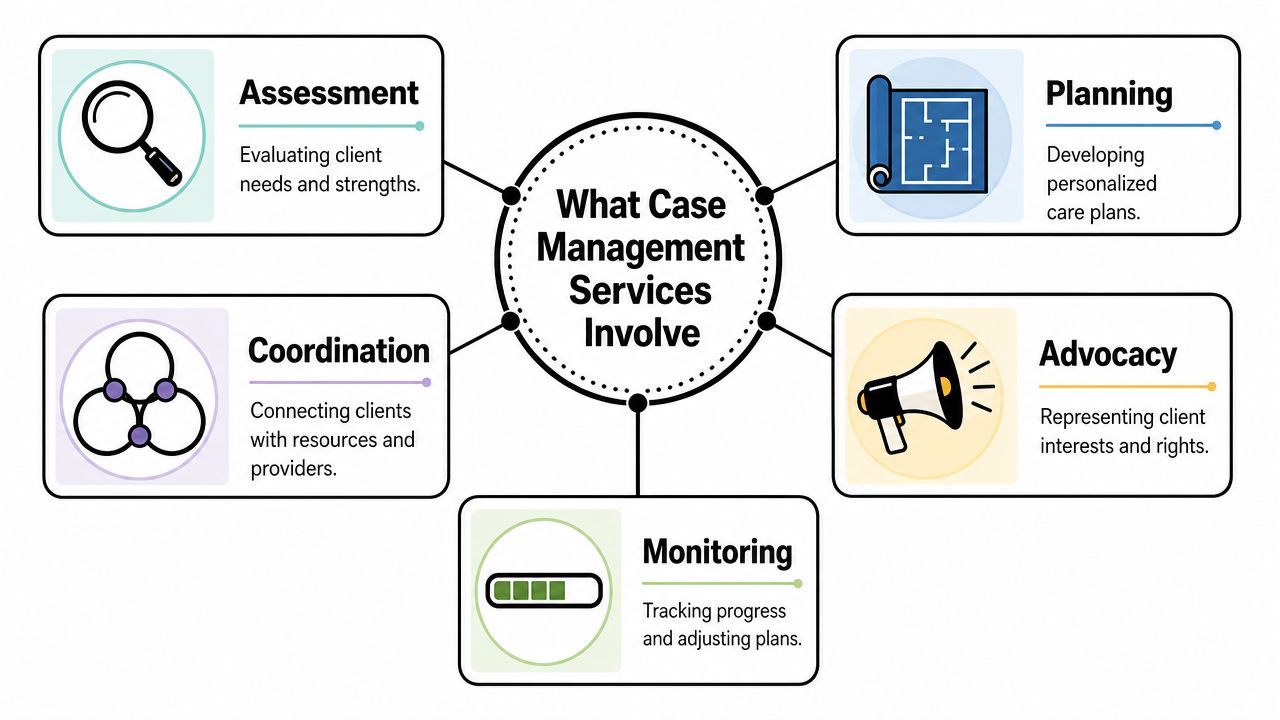
Assessment means more than intake
Assessment isn't just a clipboard and a diagnosis list. A capable case manager looks at the whole situation.
That includes questions like these:
- Medical needs: What providers are involved, what treatment has already happened, and what follow-up is time-sensitive?
- Functional limits: Can you drive, bathe safely, tolerate screens, climb stairs, cook, remember instructions, or return to work?
- Home reality: Are there children at home, stairs at the entrance, transportation barriers, or a spouse who has suddenly become a caregiver?
- Coverage issues: Which policies may pay, what approvals are needed, and where are delays likely to happen?
The point is to see the full picture, not just the diagnosis code.
Planning turns chaos into a sequence
Once the facts are clear, the case manager helps build a service plan. In plain terms, that means deciding what needs to happen first, who needs to do it, and what can wait.
For a crash victim, that might include:
- Getting post-discharge follow-up scheduled before the referral expires.
- Making sure medications are filled and reconciled.
- Arranging physical, occupational, or cognitive therapy.
- Identifying transportation or home access problems.
- Flagging records and bills that need to be preserved.
That plan matters because recovery often breaks down in transitions. Hospital to home. Emergency care to specialist care. Acute symptoms to long-term rehab. Those handoffs are where people get lost.
Coordination is the daily labor
This is the part families usually feel most grateful for. Coordination is phone calls, scheduling, confirming, re-sending, following up, and making sure one provider knows what the other recommended.
A good case manager may:
- Call the specialist's office to move an appointment up because symptoms have worsened.
- Confirm transportation so the patient doesn't miss treatment.
- Track referrals and authorizations so care isn't delayed by paperwork.
- Relay updates between treating providers when recommendations overlap or conflict.
Coordination sounds simple until you're the injured person trying to do it with pain, confusion, or a concussion.
Good case management isn't a stack of referrals. It's follow-through until the referral turns into actual care.
Advocacy and monitoring protect the plan
Advocacy means speaking up when the system isn't working. That can include pushing for appropriate follow-up, clarifying restrictions, or making sure a patient isn't treated like a chart instead of a person.
Monitoring means the plan doesn't sit in a drawer. It gets updated as recovery changes. Someone notices if the patient is falling behind, getting worse, or facing a barrier no one addressed the first time.
When case management services work well, they don't just make life easier. They create a reliable timeline of needs, setbacks, services requested, and services received. In a personal injury claim, that record can become one of the clearest windows into the cost of an injury.
Medical Versus Social Case Management
People often use the term case management as if it's one thing. In practice, there are different lanes. After a major injury, the two that matter most are medical case management and social case management.
Medical case management centers on treatment. Social case management centers on daily living, stability, and access to basic supports. In a severe injury case, those lanes overlap constantly. A person can't benefit from a neurologist appointment if they have no ride, no child care, no accessible housing, and no way to keep their benefits active.
For families dealing with cognitive injury, it also helps to understand whether the professional involved has deeper injury-specific knowledge. A certified brain injury specialist often brings a more precise understanding of symptom patterns, behavioral changes, and the mismatch between how someone looks and how they are functioning.
Medical vs. Social Case Management at a Glance
| Area of Focus | Medical Case Management | Social Case Management |
|---|---|---|
| Treatment coordination | Schedules specialists, rehab, imaging, and follow-up care | Helps remove practical barriers that prevent attendance |
| Insurance navigation | Tracks authorizations, referrals, and coverage issues tied to care | Assists with benefits applications and community support access |
| Medication issues | Works through refill, formulary, and provider communication problems | Helps address cost, transportation, and routine barriers affecting adherence |
| Home needs | Flags equipment or clinical safety concerns | Helps with housing, food, transportation, and caregiving support |
| Family support | Explains treatment flow and provider recommendations | Connects families to respite, community programs, and day-to-day help |
| Legal value | Documents the medical course, delays, and treatment needs | Documents the life disruption that follows the injury |
Why many serious cases need both
A spinal injury can require both wound care coordination and wheelchair access planning. A brain injury can require both neurology follow-up and help managing missed bills, transportation, and workplace communication.
Public-facing program descriptions also show that case management can extend beyond medical referrals into help with food, housing, benefits, medication, transportation, psychiatric support, and legal-resource linkage through Radiant Health Centers' case management overview. That's important because many injured people assume case management is just advice. Often, it's much more hands-on.
If the injury changed both your body and your routine, you probably need more than a medical calendar. You need support that covers the life around the injury too.
In litigation, that distinction matters. Medical records prove treatment. Social case management records often help prove disruption.
Benefits for Brain and Motor Vehicle Injury Victims
Brain injuries and major crash injuries create a special kind of disorder. Symptoms don't arrive neatly. Orthopedic injuries can affect mobility, sleep, and work at once. Brain injury symptoms can fluctuate by the hour. A person may do well in a ten-minute office visit and then fall apart trying to handle groceries, noise, paperwork, or a school meeting.
That is exactly why case management services can be so useful in these claims.
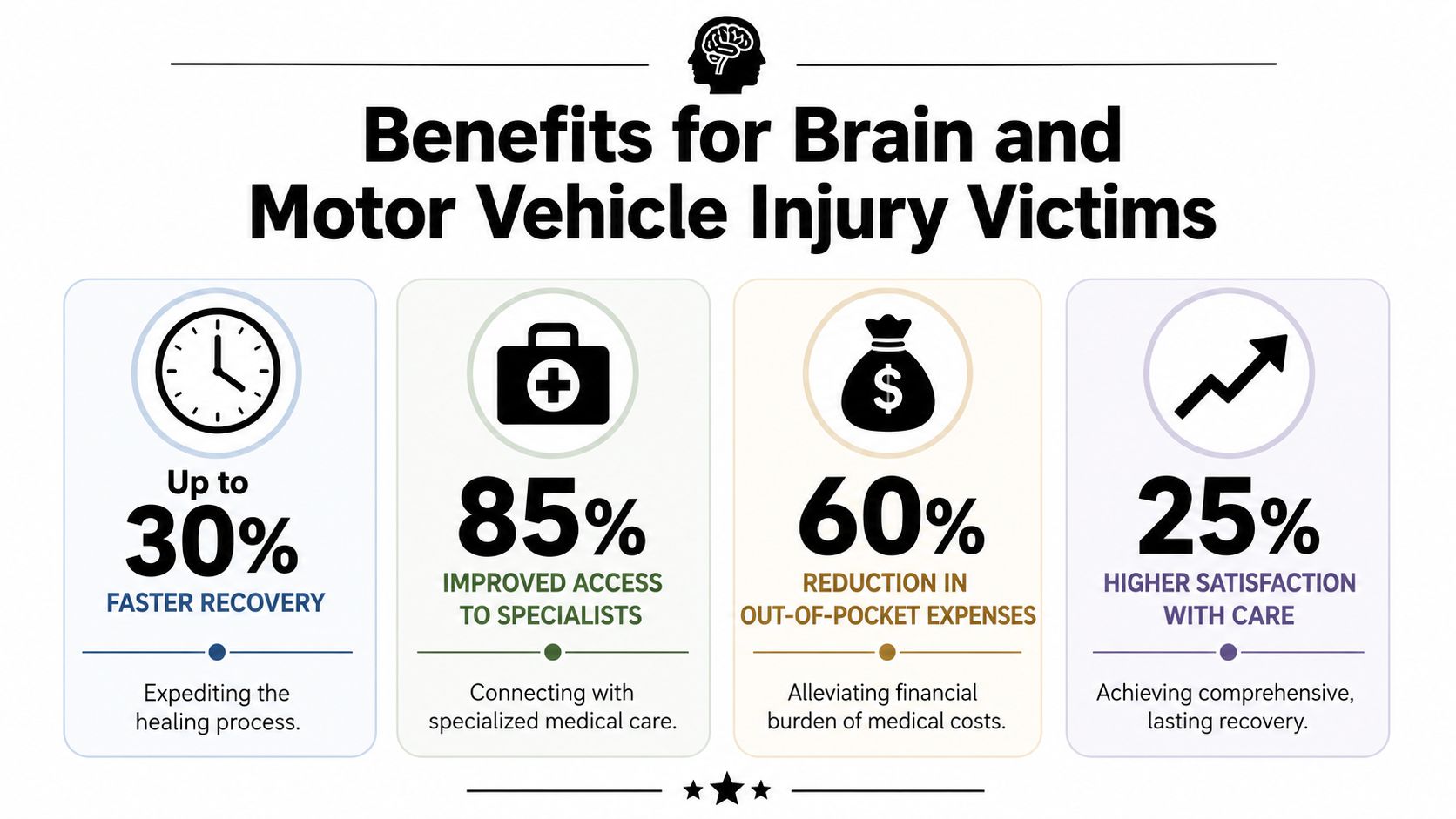
Why brain injury cases benefit so much
In a concussion or traumatic brain injury case, the patient often can't serve as their own project manager. Memory problems, slowed processing, fatigue, and irritability can make scheduling, tracking symptoms, and reporting changes much harder than people realize.
A case manager can help by:
- Tracking patterns: Headaches after screen time, increased dizziness in busy environments, or fatigue after therapy can be recorded instead of forgotten.
- Bridging communication: Family members, therapists, neurologists, and employers may all be seeing different parts of the problem.
- Documenting the non-linear course: Brain injury recovery rarely moves in a straight line. Setbacks matter and should be recorded.
That last point matters legally. Insurance carriers often look for tidy stories. Brain injury rarely offers one. Case management helps create a timeline that reflects reality instead of forcing symptoms into a simple narrative.
A brief overview like this can help families understand how the role fits into injury recovery:
Why complex crash cases need active coordination
Motor vehicle injury cases often involve several providers at once. An orthopedist may focus on fracture healing. A physical therapist may push mobility goals. An occupational therapist may identify home barriers. None of that automatically gets woven into one usable picture.
Measured outcomes show that case management is not just administrative. In a Pathways to Work evidence snapshot covering 21 interventions, 18 interventions had calculable earnings outcomes, with short-term annual earnings increasing by $410 on average, long-term annual earnings increasing by $490 on average, and long-term employment rising by 1 percentage point. In healthcare measurement, URAC's 2020 aggregate report, based on six organizations and 507,686 unique cases, reported a 10.57% medical admission rate within 30 days for patients in general case management and found that 97.72% of complaints were addressed within the program-year among organizations submitting valid data for that measure, as summarized in the Pathways to Work case management evidence snapshot.
For an injury claim, the practical value is straightforward:
- It captures causation in real time: Why one missed appointment happened, why progress slowed, why more support was needed.
- It shows seriousness through consistency: Repeated coordination needs often reflect real impairment.
- It helps prove future needs: Ongoing supervision, equipment, transportation support, or home changes don't appear out of nowhere.
If home access has become part of the problem, families often need concrete examples to understand what modifications may help. This practical guide for wheelchair home modifications is a useful starting point when you're trying to translate mobility limits into day-to-day solutions.
Who Pays for Case Management Services
The first question most families ask is simple. Who's paying for this?
The answer depends on where the case started, what policies exist, and whether the service is being used as part of treatment, discharge planning, long-term support, or claim-related recovery coordination. The encouraging part is that case management isn't some fringe service insurers have never heard of. It's an established part of the healthcare sector.
Industry data indicates U.S. medical case management services generated an estimated $21.0 billion in revenue in 2025 after growing at a 7.3% CAGR from 2020 to 2025, and the number of businesses reached 30,618 in 2026 after expanding at a 12.7% CAGR from 2021 to 2026, according to IBISWorld's medical case management services industry report. That scale is one reason multiple payment pathways exist.
Common payment paths after an accident
In personal injury practice, payment often works like a waterfall rather than a single source.
- Health insurance first in many situations: If the case manager is tied to covered treatment or care coordination, health insurance may be part of the answer.
- Auto coverage where available: Depending on the policy and state, medical payments coverage or no-fault style benefits may fund parts of care coordination.
- Liability claim reimbursement arguments: In serious injury cases, case management can become part of the damages picture when it was reasonably necessary because of the injury.
- Workers' compensation in work-related crashes: If the collision happened on the job, workers' comp may have its own case management structures or approved vendors.
- Public benefits and waiver programs: Some long-term support services may be available through Medicaid-connected programs or disability-related services.
What families should do early
Don't wait until bills pile up to ask who can authorize services. Ask at the beginning.
A few practical steps help:
- Request policy information early. Auto, health, umbrella, and employer-related policies can all matter. If a serious crash raises questions about higher coverage, it's worth understanding excess liability insurance.
- Get written confirmation when possible. Verbal promises from a carrier don't help much six weeks later.
- Ask whether preauthorization is required. Some services are denied because the process wasn't followed.
- Keep prescription delays separate from treatment delays. If medications are getting stuck in claim processing, this patient's guide for faster prescriptions gives a practical overview of common bottlenecks.
Payment problems often look like treatment problems from the patient's side. They're not the same thing, and they should be documented separately.
That distinction matters in a legal claim. If care was delayed because funding, authorization, or insurer communication failed, the record should show that clearly.
How to Request and Get the Most from Your Services
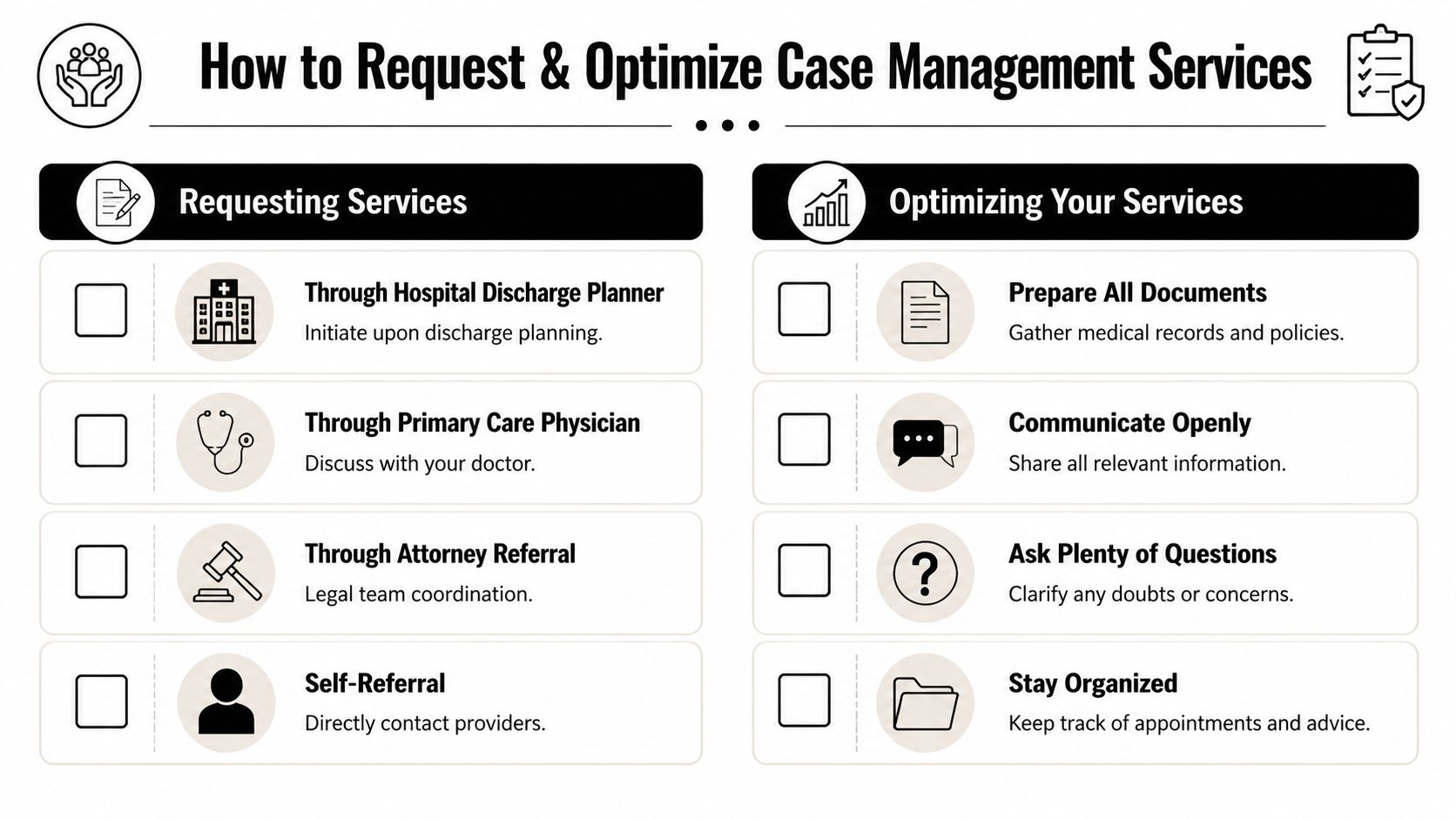
Case management works best when it starts early and stays organized. Many people qualify for some level of help but never receive it because nobody makes the request plainly or follows through after discharge.
How people usually get referred
The doorway into case management is often ordinary.
- Hospital discharge planning: If you're leaving the hospital with follow-up needs, ask whether a discharge planner or social worker can initiate case management.
- Primary care or treating specialist: A doctor who sees the bigger picture may be willing to refer when appointments, symptoms, and home needs are piling up.
- Insurance carrier programs: Some plans have internal case managers. Those can be useful, though families should still keep their own records.
- Self-referral or attorney-coordinated referral: In more complex injury cases, families sometimes seek independent support directly.
Questions worth asking before you say yes
Not every case manager is the right fit for every injury. Ask practical questions, not just credential questions.
- Have you handled brain injury or serious crash cases before? Experience with cognitive overload, rehab coordination, and family education matters.
- How do you communicate? Some families need email summaries because phone calls get forgotten.
- What happens after referral? Ask how often follow-up occurs, whether home visits happen, and what the first month usually looks like.
- How do you document barriers and missed care? That answer tells you whether the person thinks like a coordinator or just a scheduler.
Virginia-focused guidance on service-plan documentation emphasizes that service encounters should connect back to the plan, with reassessments commonly occurring at 3, 6, or 12 months, and that monitoring often includes periodic site or home visits and face-to-face meetings based on need, as discussed in this case management documentation training. In other words, strong case management isn't a one-time intake. It's a repeated check, verify, adjust cycle.
How to help your own case manager help you
You don't need a perfect spreadsheet. You do need a basic system.
Try keeping:
- A simple symptom log: Note bad days, missed activities, and what triggered problems.
- A communication list: Track who called, what they said, and what was promised.
- A document folder: Store discharge papers, referrals, medication lists, and denial letters together.
- A question list for each appointment: Brain injury patients especially benefit from writing questions down ahead of time.
The best records are not fancy. They're consistent.
From a legal standpoint, that consistency matters. When your notes, the case manager's records, and the treating providers' records line up, your claim becomes easier to explain and harder to dismiss.
How Nares Law Group Integrates Case Management
A family can do everything right after a serious crash and still end up with a weak paper trail. The neurologist recommends follow-up testing. The patient misses two appointments because no one arranged transportation. A spouse starts supervising medications and sleep because of memory problems. Everyone is working hard, but the record stays thin. In a personal injury case, that gap matters.

How the legal and care sides work together
In catastrophic injury cases, recovery and proof need to move in sync. I tell clients that a good case manager works like the person keeping traffic moving at a busy intersection. Referrals, follow-ups, home needs, caregiver help, and provider recommendations all have to connect. If they do not, the treatment plan drifts and the damages story gets harder to prove.
That is why a law firm handling brain injury and complex motor vehicle cases should treat case management as part of claim development. The questions are practical, not abstract. What care was recommended but never started? What happens at home when the patient has headaches, confusion, dizziness, or poor impulse control? Who is filling in the gaps every day, and how often?
Those answers help tie the medicine to daily function. They also help explain future care needs in a way a claims adjuster, mediator, or jury can effectively follow.
Why this matters in a damages case
Insurance companies usually start with the easy numbers: hospital bills, imaging, therapy charges, prescription costs. Those records matter, but they rarely show the full cost of a brain injury or a high-force crash.
Case management records can show the parts of the loss that often go undocumented:
- missed care caused by memory, fatigue, or confusion
- transportation and scheduling barriers linked to the injury
- safety problems at home
- unpaid help from a spouse or family member
- the difference between occasional assistance and ongoing supervision
That detail can change the value discussion. It gives context to why treatment was inconsistent, why recovery took longer than expected, and why support needs may continue after the formal treatment window ends.
Not every case needs a formal case manager. In a straightforward injury with a short treatment course, it may not make sense. In brain injury cases, trucking collisions, and other complex motor vehicle claims, it is often one of the clearest ways to document how the injury changed a person's life, not just what showed up on a bill.
For families and professionals trying to find key case manager resources, that guide is a useful starting point for understanding the different coordination and support roles that appear in serious injury recovery.
Nares Law Group LLC can coordinate legal investigation, treatment documentation, negotiation, and trial preparation within the same case. In the right file, that includes working alongside qualified case managers so the care plan, provider records, and damages presentation support each other instead of competing with each other.
The strongest claims are built from consistent records over time. In practice, case management often becomes the link between what a client is living through and what the case can prove.
If you or your family is dealing with a serious crash, a brain injury, or a recovery process that already feels too complicated to manage alone, Nares Law Group LLC can help you evaluate the legal case and the practical support structure around it. The goal isn't just to file paperwork. It's to build a recovery and documentation plan that protects your health, your finances, and your right to full compensation.