A crash can end in minutes and still leave your life feeling scrambled days later.
Your car may be in the shop. The police report may already be filed. Friends may ask if you're okay, and you may say yes because nothing looks obviously broken. But then small things start happening. You lose your train of thought mid-sentence. Bright light feels sharp. You snap at your family and don't know why. You read the same email three times and still can't process it.
That’s where many people get stuck. They assume a serious brain injury would be obvious. They think a headache, dizziness, or brain fog means they should “rest and wait.” Sometimes rest helps. Sometimes that delay costs you medically and legally.
A head trauma specialist helps sort out that confusion. This isn’t just a doctor who checks whether you hit your head. It’s a clinician, or often a team, trained to tell the difference between ordinary stress after a crash and signs that your brain needs targeted care. Just as important, they help create a clear medical record of what happened, what symptoms you have, and what recovery may require.
That matters if you’re trying to heal. It also matters if an insurance company later questions whether your symptoms are real, serious, or related to the collision.
If you're in Colorado after a car or truck crash, the hardest part is often not knowing the right next step. This guide is built to make that step clearer.
The Hidden Aftermath of a Crash
The most unsettling part of a head injury is often how ordinary it can look from the outside.
You go home after a wreck. Maybe your scans are pending, or maybe the emergency room tells you to monitor symptoms. You expect soreness in your neck or shoulder. What catches you off guard is the mental shift. You can’t focus on a simple task. Noise feels overwhelming. You forget what someone just told you.
That experience is common enough that it deserves respect, not self-doubt.
A lot of people talk themselves out of care because they didn’t black out, didn’t need stitches, or walked away from the scene. But brain injuries don’t always announce themselves with dramatic signs. Sometimes they arrive as subtle changes in concentration, mood, sleep, balance, or tolerance for light and sound.
Why subtle symptoms matter
Your brain is your control center. If a crash disrupts it, even mildly, the effects can show up in dozens of daily moments.
It's similar to a phone that still turns on after being dropped, but now freezes, overheats, and glitches. The outside casing may look mostly fine. The internal function is the problem.
A head trauma specialist looks past the “you seem okay” impression and asks better questions:
- How are you thinking: Are you slower, foggier, or more forgetful than usual?
- How are you feeling: Are you more anxious, irritable, or emotionally flat?
- How is your body responding: Do you have dizziness, nausea, headaches, or balance trouble?
- What changed after the crash: Can you tie symptoms to a clear before-and-after pattern?
Brain injuries are often judged first by what others can see, but the most important symptoms may be the ones only you can feel.
The public health stakes are not small. The CDC’s 2021 data shows over 69,000 TBI-related deaths, about 190 each day, and nearly 224,000 hospitalizations, which is why specialized evaluation after a motor vehicle crash is so important (National Center for Biotechnology Information summary of CDC-linked TBI data).
When confusion needs a name
Many injured people don’t need reassurance. They need a roadmap.
A head trauma specialist gives symptoms a structure. Instead of “I just feel off,” you begin to learn whether you may be dealing with a concussion, a more complex traumatic brain injury, vestibular dysfunction, memory impairment, visual symptoms, or a mix of issues that need coordinated treatment.
That shift matters. Once symptoms are identified clearly, treatment gets more precise. Documentation gets stronger. Family members understand what’s happening. Employers get better medical guidance. And you stop blaming yourself for not bouncing back fast enough.
Understanding Your Head Trauma Care Team
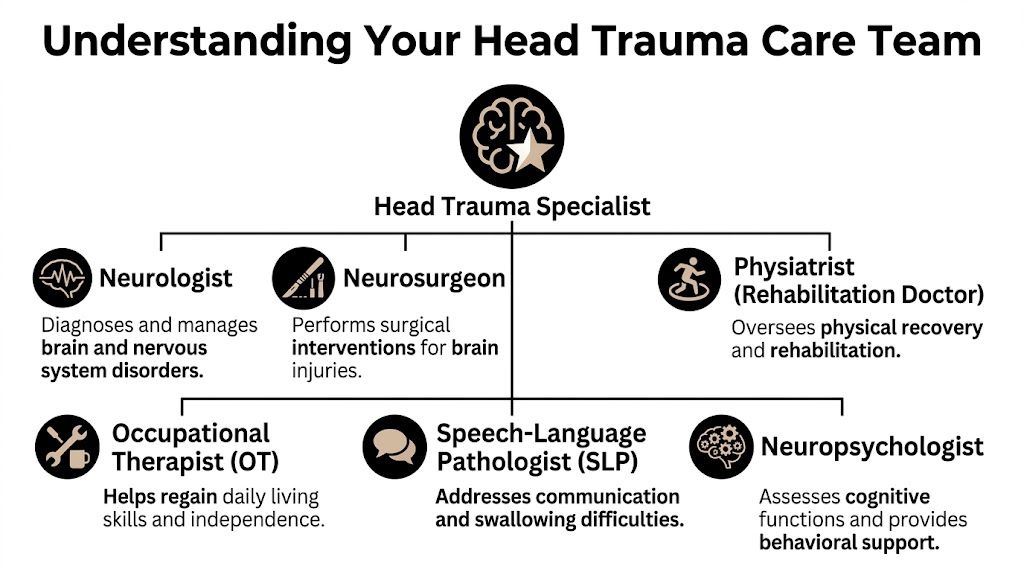
“Head trauma specialist” sounds like one person. In real life, it usually means a team.
That can feel confusing at first. You may be referred to several professionals and wonder why one doctor isn’t enough. The simplest way to think about it is this. Your brain injury team works like a pit crew. Each person handles a different part of the problem, and recovery goes better when they coordinate.
The core roles people hear about most
A neurologist focuses on how the brain and nervous system are functioning. If you have headaches, dizziness, nerve-related symptoms, seizures, cognitive complaints, or persistent post-concussion issues, this doctor often helps evaluate and manage them.
A neurosurgeon handles structural brain problems that may require surgical judgment. A neurosurgeon is generally not needed for a concussion. But if imaging shows bleeding, swelling, pressure, or another serious abnormality, this specialist becomes central.
A neuropsychologist evaluates how your brain is performing in real-world ways. Memory, attention, processing speed, problem-solving, and emotional changes often live here. This specialist is especially important when someone says, “My scan was fine, but I’m not functioning like myself.”
A physiatrist, also called a rehabilitation doctor, helps organize recovery when symptoms affect daily life. If you need therapy, return-to-work planning, activity restrictions, and long-term rehab coordination, this doctor often becomes the person connecting the dots.
The therapists who often do the daily work
A strong care team may also include therapists whose work is highly practical.
- Occupational therapist: Helps with day-to-day skills, routine management, sensory tolerance, and return to normal activities.
- Speech-language pathologist: Works on communication, cognitive-linguistic issues, and sometimes swallowing problems.
- Physical therapist: Often addresses balance, dizziness, neck issues, and guided physical progression after a concussion.
- Case manager or care coordinator: Keeps referrals, records, scheduling, and transitions from falling apart.
Practical rule: If you’re being sent to multiple professionals, that usually doesn’t mean your case is disorganized. It often means your symptoms affect more than one brain function.
Your Head Trauma Specialist Team at a Glance
| Specialist | Primary Focus | When You Might See Them |
|---|---|---|
| Neurologist | Brain and nervous system symptoms | Persistent headaches, dizziness, nerve symptoms, seizure concerns, ongoing concussion complaints |
| Neurosurgeon | Structural brain injury and surgical decision-making | Abnormal imaging, bleeding, pressure concerns, skull or brain complications |
| Neuropsychologist | Thinking, memory, attention, behavior, emotional function | Trouble concentrating, memory issues, work problems, normal scans with ongoing symptoms |
| Physiatrist | Rehabilitation planning and function | Need for coordinated rehab, return-to-work guidance, symptom management across multiple therapies |
| Occupational Therapist | Daily living skills and independence | Trouble managing routine tasks, overstimulation, work or home function issues |
| Speech-Language Pathologist | Communication and cognitive-linguistic support | Word-finding trouble, slowed thinking, communication frustration |
| Physical Therapist | Balance, movement, dizziness, neck-related symptoms | Vertigo, gait issues, activity intolerance, physical recovery after concussion |
Why this matters for a Colorado injury claim
Insurance companies often prefer simple stories. Brain injuries rarely stay simple.
A multidisciplinary team creates a fuller picture. One provider may document headaches. Another may document memory deficits. Another may record how those symptoms affect driving, work, childcare, or sleep. Together, that tells the truth more accurately than any single office note could.
That’s one reason people get confused when they hear “specialist.” They expect one expert. What they often need is a coordinated system.
The Critical Timeline for Seeking a Specialist
The worst timing mistake after a crash is telling yourself, “I’ll wait a few days and see if this clears up.”
That instinct is understandable. It’s also risky.
Some head injury symptoms show up immediately. Others unfold as the body reacts to trauma. You may feel shaken but functional at first, then notice worsening headaches, heavier fatigue, trouble sleeping, irritability, or difficulty concentrating over the next stretch of time. That delay can trick people into believing the problem isn’t real or isn’t connected to the collision.
Why early care matters medically
Early evaluation gives doctors a baseline. It captures what symptoms appeared, when they began, how severe they were, and whether they’re changing.
Without that baseline, your care can become fragmented. Each later appointment starts with guesswork. You’re trying to remember what happened, when it changed, and whether the symptom existed before the crash. That’s hard for anyone, especially for someone with a brain injury.
Prompt specialist care also helps direct you to the right level of treatment. Some people need monitoring and rest guidance. Others need therapy for dizziness, cognitive problems, or visual symptoms. A smaller group needs urgent intervention for a more serious brain injury.
Why early care matters legally
The legal side is more straightforward than people think. Records created close to the crash usually carry more weight.
If you wait too long, the insurer may argue that your symptoms came from stress, a later event, a preexisting issue, or poor follow-through. Even if that argument is weak medically, delay gives them room to make it.
The long-term stakes are serious. According to the CDC, more than 55% of people with moderate to severe traumatic brain injuries are unable to return to work two years after injury (brain injury statistics summary). That’s why early and consistent specialist care matters for both treatment and documentation of lost earning capacity.
A useful timeline mindset
Don’t think in terms of “Do I feel terrible enough?” Think in terms of “Has my brain function changed after this crash?”
If the answer may be yes, act.
A practical approach looks like this:
- Get evaluated right away if you have any concerning symptoms after a crash.
- Follow referral instructions quickly if the ER, urgent care, or primary doctor suggests neurological or concussion follow-up.
- Track symptoms daily in simple language. Headache, sleep, memory, mood, noise sensitivity, dizziness, work trouble.
- Return if symptoms evolve instead of assuming a normal first exam closes the issue.
The best time to build a clean medical record is when events are fresh, symptoms are current, and no one has to reconstruct your story later.
Waiting can feel easier in the moment. It often makes everything harder after that.
What to Expect During Your Evaluation and Treatment
Patients feel less anxious once they know what an appointment will look like.
A head trauma evaluation is usually not one giant test. It’s a series of smaller decisions. The specialist is trying to answer a few practical questions. Did the crash likely affect your brain? How is that showing up in your daily function? Is the issue improving, staying stuck, or getting worse? What should happen next?

What happens at the first visit
The first visit often begins with history, not machines.
Expect questions about the crash itself, whether you hit your head, whether you lost consciousness, what symptoms began afterward, and what has changed since. The specialist may also ask about sleep, mood, work performance, prior concussions, medications, and whether family members have noticed behavioral changes.
Then comes the exam. That may include attention, memory, balance, eye movement, coordination, speech, and reflex checks. Some tasks feel simple. That doesn’t mean they’re unimportant. A brief balance or recall test can reveal patterns that match concussion or other traumatic brain injury symptoms.
Why scans are only part of the picture
People often assume CT or MRI tells the whole story. It doesn’t.
A CT scan is commonly used early because it can quickly look for urgent issues like bleeding or other acute structural problems. An MRI may be used later in some cases to look more closely at brain structures.
But some people with real symptoms have imaging that appears normal. That’s where functional and neurocognitive testing becomes important. In mild TBI cases, tools such as ImPACT can help identify cognitive deficits and predict prolonged recovery in 15% to 20% of cases, and early intervention within 72 hours can lead to 40% faster symptom resolution compared with standard care (Eastern Association for the Surgery of Trauma archived guidance).
If your doctor is looking beyond routine imaging, you may also hear about advanced tools such as diffusion tensor imaging of the brain, which is often discussed in legal and medical contexts when conventional scans don’t fully explain persistent symptoms.
Common parts of treatment
Treatment depends on the type of injury and the symptoms you have. There isn’t one universal plan.
Some people need a period of reduced cognitive and physical strain. Others need active rehabilitation because too much rest for too long can also slow progress. Your plan may include several of these:
- Structured rest guidance: Temporary reduction in heavy physical exertion, intense screen time, or mentally draining tasks.
- Return-to-activity progression: Gradual reintroduction of exercise, work, and daily demands.
- Vestibular therapy: Often used for dizziness, motion sensitivity, balance problems, or nausea.
- Cognitive rehabilitation: Helps with attention, memory, organization, pacing, and mental stamina.
- Speech-language support: Useful when communication or processing speed becomes a problem.
- Medication management: Sometimes used for headaches, sleep disruption, or related symptoms.
Here’s a useful overview for patients and families who want to see how concussion care is commonly explained in plain terms.
What recovery often feels like
Recovery rarely moves in a straight line.
You may have a better day and assume you’re done, then feel wiped out after a noisy store, long work call, or busy family event. That doesn’t always mean you’re getting worse. It may mean your brain is still struggling with load, stimulation, and endurance.
A good specialist helps you learn your limits without making you afraid of activity. That balance matters. The goal isn’t to keep you in a dark room forever. The goal is to reduce setbacks while rebuilding function safely.
What to bring to appointments
A little preparation can make the visit far more productive.
Bring:
- A symptom list: Short notes about headaches, dizziness, memory trouble, sleep, mood, light sensitivity, and work issues.
- Crash details: Date, location, type of impact, and whether symptoms started immediately or later.
- Prior records if you have them: ER papers, imaging reports, discharge instructions.
- A support person if possible: Someone else may notice changes you’ve normalized.
When patients feel frustrated, it’s often because they expected a single test to settle everything. Head trauma care usually works differently. The specialist is building a pattern from your story, your exam, your testing, and your progress over time.
How Your Specialist Supports Your Legal Case
Medical treatment and legal strategy often move on parallel tracks, but in a brain injury case they shouldn’t be disconnected.
That’s the gap many injured people in Colorado run into. They know they need care. They know they may have a claim. What they don’t know is how the timing and structure of treatment affect both.
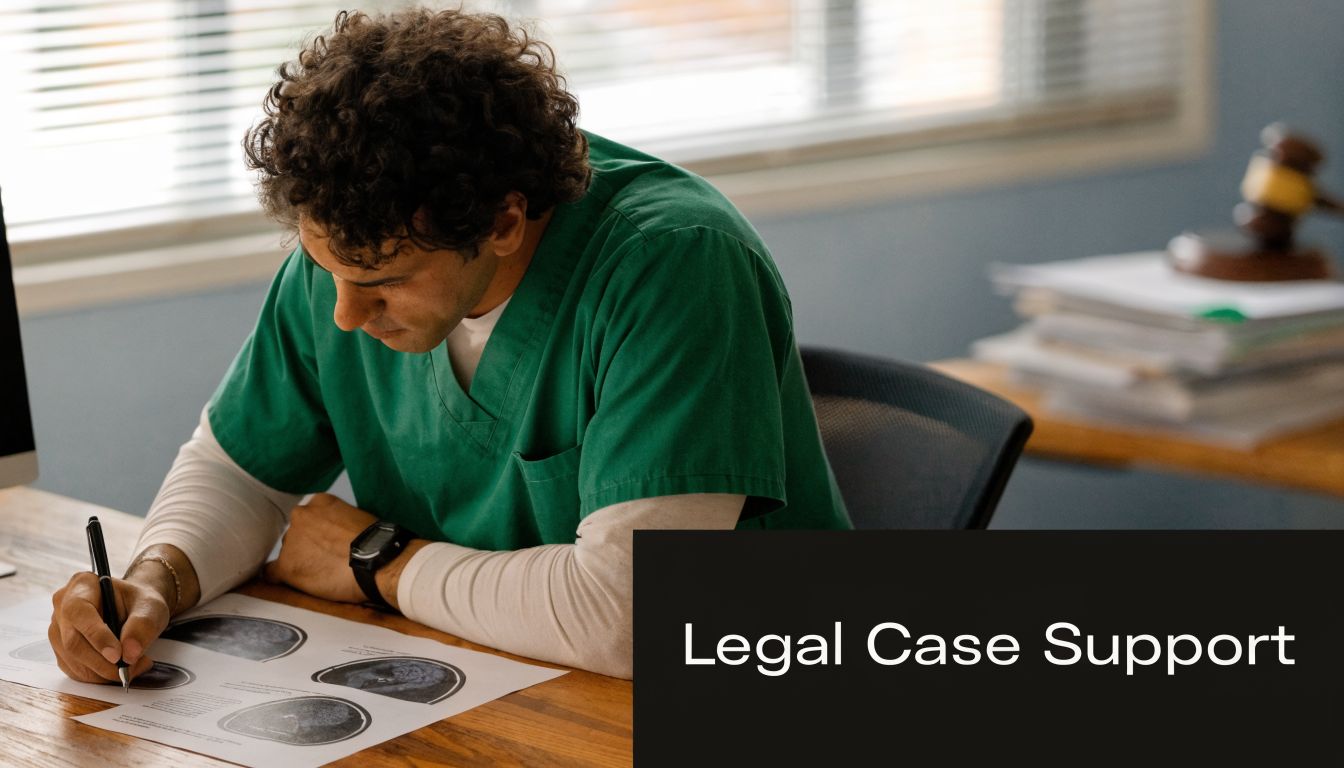
Public guidance rarely explains that sequence well. There is a documented gap in explaining how accident victims should coordinate medical evaluations with legal proceedings, even where Colorado has respected resources like the Marcus Institute for Brain Health (Marcus Institute for Brain Health overview).
Treatment records are also evidence
Your specialist’s job is to treat you, not build a lawsuit. But the records they create often become the backbone of your injury claim.
Those records may document:
- Causation: Whether the crash is consistent with your symptoms.
- Diagnosis: What type of brain injury or post-concussive condition is being treated.
- Functional impact: How symptoms affect work, driving, parenting, sleep, and daily life.
- Prognosis: Whether improvement is expected, incomplete, or likely to require long-term support.
Insurance adjusters often focus on visible injuries because they’re easier to value. A specialist’s records help show the invisible parts of a brain injury in a disciplined, clinical way.
Treatment notes and legal proof are not the same thing
Many cases weaken at this point.
A treating doctor may write, “Patient reports headaches and poor concentration.” That helps medically. But a legal claim often needs more detail. How often? How severe? What tasks trigger symptoms? How does this affect income, household tasks, or the ability to return to prior work?
That doesn’t mean doctors should become lawyers. It means your care needs to be organized thoughtfully so the record reflects reality.
A strong brain injury case often depends on consistent documentation across time, not one dramatic note. Follow-up visits matter. Therapy notes matter. Neuropsychology findings matter. Work restrictions matter. So do records showing why you missed appointments, changed jobs, or couldn’t tolerate normal activity.
Why sequencing matters
The order of events can shape how persuasive your claim becomes.
A cleaner sequence often looks like this:
- Immediate evaluation after the crash
- Specialist referral when symptoms suggest brain involvement
- Consistent follow-up with documented changes
- Legal review of the medical timeline and evidence
- Case development based on prognosis, losses, and future needs
Someone pursuing a claim related to a traumatic brain injury can better understand the legal side through resources from a traumatic brain injury law firm.
The strongest legal narrative usually isn’t invented later. It’s preserved in real time through careful medical care.
What this means for you
If you suspect a brain injury, don’t separate “getting better” from “protecting my case.” In Colorado crash claims, those are often the same process.
The doctor identifies the injury. The care team tracks the consequences. The records show the progression. That medical foundation is what allows a legal claim to reflect the true cost of what happened.
Key Questions to Ask Your Head Trauma Specialist
A good appointment isn’t just about getting answers. It’s also about asking the right questions.
Many patients freeze once the visit starts. They forget what they meant to ask, or they assume the doctor will automatically cover what matters most to them. A short written list helps. It keeps the conversation practical and makes it easier to leave with a plan.
Questions about diagnosis
Start with clarity.
- What type of brain injury do you think I have, if any?
- Do my symptoms fit a concussion, a more significant traumatic brain injury, or something else?
- Are there symptoms that concern you more than others right now?
- If my scan is normal, how do you explain what I’m feeling?
These questions help replace vague fear with specific medical language.
Questions about testing and treatment
Once you understand the working diagnosis, ask what the doctor is using to confirm it and what they want you to do next.
- What tests do I need, and what is each test looking for?
- What symptoms should lead me to call you sooner or go to the ER?
- Do I need therapy for balance, cognition, speech, or daily functioning?
- What activities should I limit right now, and for how long?
If you don’t understand why a treatment was recommended, say so. A strong specialist should be able to explain the reason in plain language.
Questions about work and daily life
This area gets overlooked, but it matters significantly.
Ask:
- Can I safely drive, work, exercise, or care for my children the way I normally do?
- Should I have written restrictions for my employer?
- What does overexertion look like for this injury?
- How do I tell whether I’m improving or just having a temporary good day?
Questions about documentation and follow-up
These are especially important after a crash.
- Will your notes reflect how these symptoms affect my daily function?
- Do you want me to keep a symptom journal between visits?
- How often should I follow up?
- When would you refer me to another specialist?
Bring your questions on paper. Brain injury symptoms can make it harder to think on the spot, and there’s no prize for trying to remember everything from memory.
You don’t need to sound medical. You just need to be direct. The best appointments often come from ordinary questions asked clearly.
How to Find the Right TBI Specialist in Colorado
Finding the right specialist can feel harder than it should.
You may be dealing with pain, missed work, insurance confusion, and family stress at the same time. Add in unfamiliar medical titles and it’s easy to delay care because you don’t know where to start.

Start with the most direct referral path
If you were seen in an emergency room or urgent care, review your discharge paperwork first. It may already suggest follow-up with neurology, concussion care, rehabilitation medicine, or another specialty.
If not, call your primary care doctor and describe the crash and your current symptoms clearly. Don’t just say, “I’m still sore.” Say, “Since the collision I’ve had headaches, memory trouble, dizziness, and trouble concentrating.” That language helps the office route you appropriately.
Look for the right fit, not just a nearby name
The right provider is someone who regularly sees traumatic brain injury patients and understands how symptoms can affect work and daily function.
When you call a practice, ask practical questions:
- Do they routinely evaluate post-crash concussion or TBI patients?
- Do they coordinate with neuropsychology, therapy, or rehabilitation when needed?
- How quickly can they see new patients with recent motor vehicle injuries?
- Do they provide detailed functional documentation in their records?
A provider can be excellent in general neurology and still not be the best fit for an accident-related brain injury case. Experience with TBI patterns matters.
Use vetted networks carefully
In Colorado, many injured people also find specialists through their attorney’s medical network. That can be helpful when the network is built around quality, communication, and real experience with traumatic brain injury.
A law firm may know which doctors are responsive, which clinics document functional problems well, and which specialists understand the difference between routine treatment notes and the fuller record a serious injury case may require. If you want a sense of what that vetting process can involve, this resource on vetting neurologists for traumatic brain injury assessment and treatment is a useful starting point.
Keep your search organized
A simple notebook or phone note can save you trouble later.
Write down:
- Who referred you
- When you called
- What symptoms you reported
- What appointment was offered
- What records the office requested
That log helps you move faster and shows that you acted diligently if appointment delays happen.
Colorado has strong medical resources. The challenge usually isn’t whether help exists. It’s finding the right door quickly enough, and making sure the care you receive is thorough, coordinated, and well documented.
Frequently Asked Questions About Head Trauma Care
Do I still need a specialist if my CT scan was normal
Possibly, yes.
A normal CT can rule out certain urgent structural problems, but it doesn’t automatically rule out a concussion or other functional effects of a traumatic brain injury. If you still have headaches, memory issues, dizziness, or cognitive changes after a crash, a specialist may still be appropriate.
How soon should I see a head trauma specialist after a car crash
As soon as you reasonably can if symptoms suggest your brain may have been affected.
The earlier you’re evaluated, the easier it is to connect symptoms to the crash, direct treatment properly, and create a useful medical record. Waiting can blur the timeline and complicate both care and any later injury claim.
What’s the difference between a concussion clinic and a neurologist
A concussion clinic often focuses on mild TBI and post-concussion symptoms, especially early management and rehab coordination.
A neurologist looks more broadly at disorders of the brain and nervous system. Some neurologists have deep experience with concussion. Some concussion clinics are multidisciplinary and include therapists. The best choice depends on your symptoms and how complex your case is.
What if my symptoms started days after the crash
That can still matter.
Not every brain injury symptom appears immediately. Delayed headaches, dizziness, concentration problems, or mood changes should still be reported and evaluated, especially if they began after the collision and weren’t part of your normal baseline before.
When is specialist care absolutely urgent
Severe cases require immediate, expert management.
In serious traumatic brain injury, neurocritical care teams focus on keeping intracranial pressure below 22 mmHg because sustained elevation can increase mortality 2 to 3 fold (PubMed summary of severe TBI management guidance). That level of monitoring is one reason severe head trauma should never be handled casually.
Can a specialist help with symptoms that seem emotional, not physical
Yes.
Brain injuries can affect mood, frustration tolerance, sleep, anxiety, and emotional regulation. Those symptoms aren’t “less real” than dizziness or headaches. They’re often part of the injury picture and may need targeted treatment or referral.
What should I do between appointments
Keep it simple and consistent.
- Track symptoms daily: Short notes are enough.
- Follow restrictions: Don’t test your limits just because you have one better day.
- Save records: Imaging reports, work notes, therapy schedules, discharge papers.
- Tell the truth about function: If grocery shopping, driving, or screen time knocks you out, document that.
Can family members help if I’m too foggy to manage this well
They often should.
A spouse, parent, adult child, or trusted friend can help notice changes, attend appointments, track symptoms, and keep paperwork organized. Brain injuries often make organization harder at the exact moment good organization matters most.
Do I need legal guidance while I’m still treating
Many people benefit from getting legal guidance early, especially when symptoms are ongoing or the crash involved significant negligence.
That doesn’t mean treatment stops being the priority. It means someone helps protect the timeline, preserve records, and reduce the risk that avoidable mistakes weaken your claim while you’re trying to recover.
If you or a loved one is dealing with possible brain injury symptoms after a Colorado crash, Nares Law Group LLC can help you understand the path forward. The firm works with injured people facing motor vehicle and truck accident trauma, including traumatic brain injury cases that require careful medical coordination and strong legal advocacy. A conversation can help you protect your health, your records, and your right to full compensation.