You should retain an insurance dispute attorney as soon as a claim is denied, significantly underpaid, or delayed past reasonable processing, because insurers rarely change their position once the initial decision is made. In 2024, more than 3,500 homeowners-policy coverage lawsuits and over 3,000 business-liability coverage lawsuits were filed in federal district courts, showing how often coverage fights move beyond routine claims handling. Lex Machina's insurance coverage analysis confirms that these disputes have become a recurring part of civil practice.
You may be sitting at a kitchen table with a denial letter, medical bills, repair estimates, or an adjuster who stopped returning calls. The insurer may describe the decision as final, but “final” usually means the claims department has committed to a position. Your job isn't to argue louder. It's to preserve evidence, identify the policy language that controls, and put a lawyer in a position to create consequences for an unsupported decision.
An insurance dispute attorney can challenge a denial, investigate whether the carrier undervalued the loss, pursue an appeal or negotiation, and file suit when the facts and law justify it. The right time to act is before frustration destroys your records or a policy deadline limits your options.
When You Need an Insurance Dispute Attorney
A claim often starts innocently. You report a crash, submit medical records, answer the adjuster's questions, and wait. Then the calls slow down. The adjuster asks for the same documents again, says the review is still pending, or sends a check that covers only a fraction of the damage. You protest, and the insurer responds with a policy exclusion you hadn't heard about before.
That is the moment to stop treating the dispute as ordinary customer service.

The warning signs
You don't need to wait for a lawsuit. Contact counsel promptly when:
- The insurer denies coverage: A denial based on an exclusion, late notice, causation, residency, cooperation, or another policy provision deserves a legal review.
- The offer doesn't match the loss: A low settlement may reflect missing medical documentation, ignored future treatment, disputed liability, or an incorrect reading of your coverage.
- The claim stalls without a clear reason: A short administrative delay isn't automatically misconduct. Repeated requests, unexplained silence, or shifting explanations are different.
- The carrier demands a recorded statement or examination: Give no statement casually when the answers could affect coverage or liability. Ask whether counsel should attend.
- A deadline is approaching: Policies, statutes, demand procedures, and lawsuit deadlines can affect your rights. Don't assume an ongoing conversation pauses them.
The NAIC complaint data summarized by ValuePenguin shows that claim handling accounted for 65.2% of closed insurance complaints in 2024. Delays represented 22.2%, while unsatisfactory settlements or offers represented 12.2% of claim-handling complaints. Those categories describe the exact problems many claimants experience before hiring counsel.
Practical rule: If the insurer has made a written decision, your next move should be strategic, not emotional.
You may still resolve a modest, well-documented claim through an internal appeal or negotiation. But once the carrier has committed to a denial or materially undervalued payment, an attorney can test the decision against the entire policy, endorsements, claim file, communications, and applicable Colorado remedies. Waiting months rarely makes the file stronger. It usually gives the insurer more time to build a defense around its original position.
Evidence You Should Collect Before Hiring Counsel
An attorney can't build influence from a story alone. Bring a clean record showing what you bought, what happened, what you submitted, and how the insurer responded. A well-organized packet lets counsel spend the first meeting analyzing the dispute instead of hunting for basic documents.
Start with the coverage file
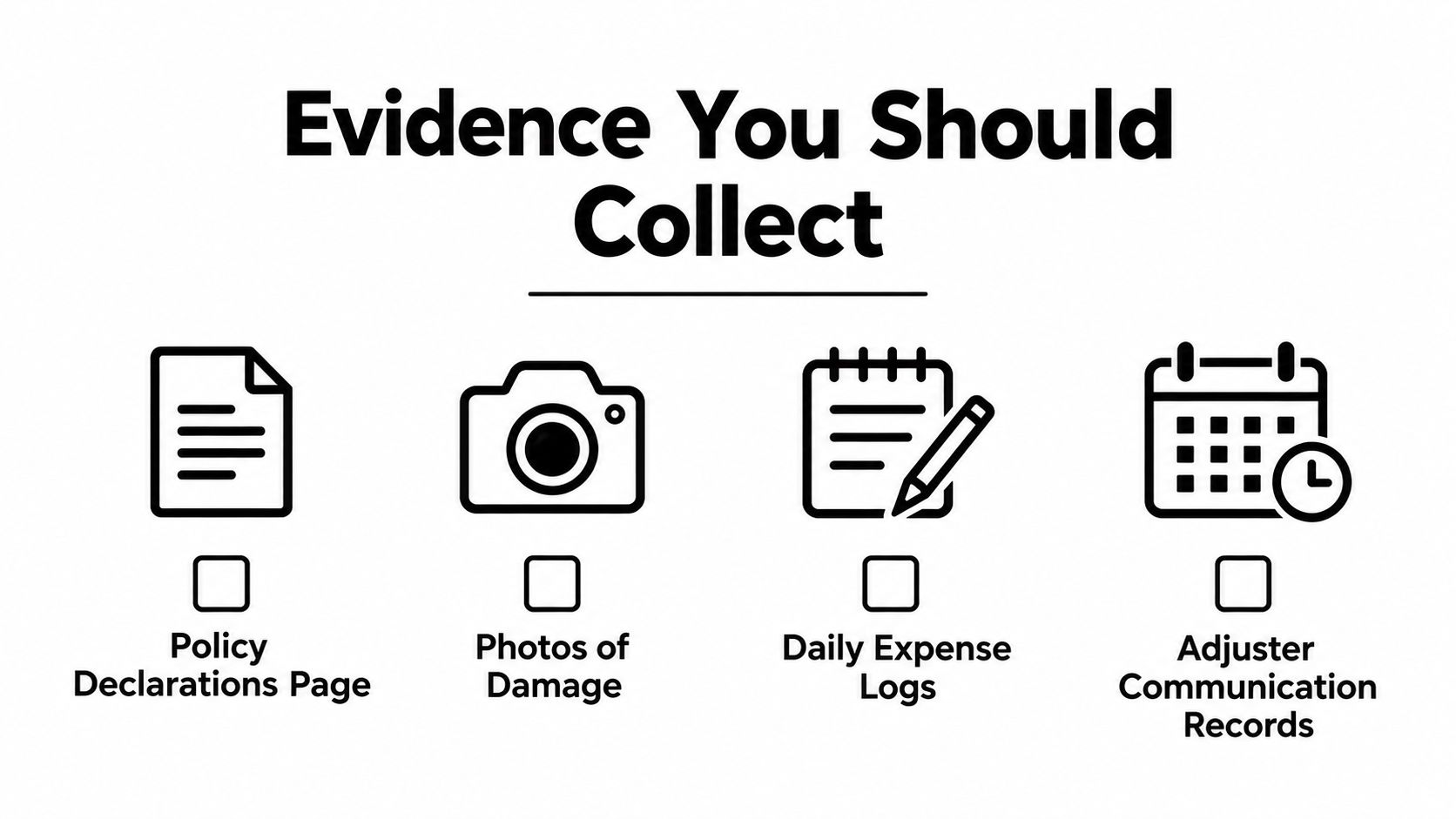
Collect the complete policy, not just the declarations page. Include every endorsement, rider, amendment, renewal document, certificate, and applicable schedule. A coverage dispute may turn on language outside the section you first read.
Then add:
- The denial or reservation-of-rights letter: Preserve the envelope or electronic transmission showing when you received it. The insurer's stated reason matters because a later explanation may not match the original decision.
- The claim number and adjuster information: Include names, phone numbers, email addresses, employer information, and any third-party administrator involved.
- Every communication: Save emails, letters, text messages, portal messages, voicemail recordings, and notes from calls. Record the date, participants, promises, and documents requested.
- Photographs and video: Keep original files when possible. Don't edit or overwrite metadata, and preserve images showing conditions before cleanup or repairs.
- Bills and estimates: Gather itemized medical bills, repair estimates, invoices, receipts, prescriptions, rehabilitation records, and payment explanations.
- Income documentation: For an injury claim, collect pay stubs, employer correspondence, time records, tax documents, and evidence showing missed work or reduced capacity.
- A personal timeline: Write events in chronological order while your memory is fresh. Include the incident, treatment, notices, inspections, submissions, calls, decisions, and out-of-pocket expenses.
The Nares Law Group guide to disputing an insurance claim offers a practical framework for organizing a denial and preparing an appeal.
Preserve the facts, not just the paperwork
Don't guess at dates or exaggerate symptoms. Mark uncertainty clearly. If a document is missing, write down who had it and when you requested it. Keep a separate log of ongoing treatment, daily limitations, travel, household help, and expenses.
Before the consultation, create a digital folder with descriptive filenames and a short index. Don't send confidential material to random websites, post photographs or commentary about the dispute publicly, or delete messages that make you uncomfortable. Your attorney needs the complete record, including facts that don't seem favorable.
How an Insurance Dispute Attorney Works Your Case
A serious attorney doesn't begin by sending an angry letter. The work starts with a conflict check, a basic assessment of jurisdiction and deadlines, and a decision about whether the firm can handle the matter effectively.
Intake and policy analysis
At intake, counsel identifies the insured parties, the carrier, other potentially responsible parties, and the type of dispute. The attorney then reads the policy as a contract, including definitions, exclusions, conditions, notice provisions, cooperation requirements, appraisal clauses, arbitration language, and endorsements.
That review should answer concrete questions. What coverage was purchased? What does the insurer say happened? Which facts support or undermine that position? Did the carrier investigate reasonably, and did it explain the decision consistently?
The insurer's investigation can shape the case. Learn more about why documenting an insurance company investigation matters before responding to requests or agreeing to an interview.
Demand and negotiation
Counsel assembles the proof into a demand package. Depending on the dispute, that may include medical opinions, repair evidence, wage documentation, photographs, witness statements, expert analysis, policy excerpts, and a structured explanation of why the carrier's position fails.
If you're preparing an administrative appeal, examples of denied insurance claim templates can help you understand the information a written response should address. A template isn't a substitute for policy analysis, but it can prevent an appeal from becoming a short emotional objection with no supporting record.
Negotiation should have a purpose. Your lawyer should know the minimum acceptable resolution, the evidence that changes valuation, and the point at which further discussions only help the carrier delay.
Alternative dispute resolution and litigation
Appraisal may fit a narrow valuation disagreement. Mediation can help when both sides understand the evidence but need a structured settlement process. Arbitration may be required or permitted by the policy, though its procedures and consequences need careful review.
Litigation becomes appropriate when the carrier won't correct a material error, the damages justify the cost, or a legal ruling is necessary. Filing a complaint starts the case, but the substantive work includes discovery, depositions, expert testimony, motions, settlement conferences, and trial preparation. A lawyer who says “we'll see” at every stage without explaining the next action isn't giving you meaningful representation.
Understanding Fee Structures and Cost Risk
Fee arrangements should be clear before representation begins. For many injury-related insurance disputes, a contingency fee means the attorney receives an agreed share of a recovery instead of charging by the hour. You don't pay attorney fees from money you never recover, but the written agreement must explain the percentage, whether it changes after filing suit, and how expenses are handled.
An hourly arrangement can make sense for a discrete coverage opinion, policy review, or business dispute where the client needs advice but may not seek a damages recovery. It can also create pressure for a person already facing medical bills and lost income. Ask for an estimate of the work required, the billing rate for each lawyer or professional, invoice timing, and whether the firm requires a retainer.
A flat fee may work for a narrowly defined task, such as reviewing a denial letter or preparing a limited appeal. It becomes risky when the scope is vague. “Handling the claim” could mean one letter or years of litigation.
Review the agreement for:
- Case expenses: Clarify who pays filing fees, records charges, experts, investigators, travel, mediation, deposition transcripts, and exhibits.
- Recovery accounting: Confirm whether expenses come out before or after the fee is calculated.
- No-recovery responsibility: Ask whether you owe litigation expenses if the case ends without payment.
- Termination terms: Understand what happens if you change counsel or reject a settlement.
- Communication duties: Confirm who updates you and how often.
The Nares Law Group contingency-fee explanation provides useful context for comparing this structure with hourly representation. Don't sign until you can explain the agreement in your own words.
Why Insurance Disputes Are Growing in Colorado
A Colorado claimant can do everything right and still face a denial, delay, or low settlement offer. The insurer controls the claim file, dense policy language shapes the decision, and the first evaluation often sets the direction of the dispute.
Complaint patterns show how widespread these conflicts are. In 2024, accident and health insurance generated 36.6% of complaints, auto insurance generated 35.3%, and homeowners insurance generated 18.0%, according to the NAIC complaint figures reported by ValuePenguin. Private passenger auto insurance had the highest complaint rate by coverage type at 17.9%, followed by general homeowners insurance at 9.9% and individual accident and health insurance at 8.9%.
What Colorado claimants should understand
The dispute may concern far more than the amount of a check. An injured driver may need to interpret uninsured or underinsured motorist coverage while treatment continues. A homeowner may need to address causation, exclusions, repairs, and proof of loss. A business may face layered questions involving interruption, liability, cyber incidents, or another complex risk.
Valuation is becoming harder across the industry. Recent reporting states that 64% of North American carriers reported increased claims complexity, while 49% identified social inflation and litigation pressure as major severity drivers in the cited study. Insurance Business's coverage of that industry report describes claims that may become more difficult to evaluate even when overall volume changes.
That problem reaches Colorado claimants directly. A carrier may rely on standardized systems, reserve practices, or automated review, while your loss turns on specific people, documents, damage, and timing. Your attorney should test the actual investigation, identify missing evidence, and compare the insurer's explanation with the policy and the facts.
The strongest advantage usually comes from a documented mismatch between the policy, the evidence, and the insurer's explanation.
Colorado's legal rules can change the pressure on an insurer. Bad-faith and statutory remedies depend on the policy, the conduct, the injury, and the procedural posture. A long-run empirical study found unfavorable outcomes in state supreme court insurance-related decisions around 55.2% for tort bad faith, 58.8% for breach of express contract, and 56.0% for excess-judgment claims. The St. Mary's University analysis also reported claim payments 12.4% higher in states allowing tort-based bad-faith actions.
These figures do not predict your result. They show why counsel must assess the available remedy, proof, forum, and timing instead of labeling every denial a bad-faith case. If you are researching how insurers market and price claims, this insurance lead generation guide explains the carrier side of the business. Keep your attention on the evidence and legal rights in your own file.
Questions to Ask Before Retaining an Attorney
Interview the lawyer as carefully as the lawyer evaluates your case. You're not looking for the most confident promise. You're looking for a clear theory, a credible plan, and someone prepared to take responsibility for the hard parts.

Ask these questions directly:
- How many insurance disputes do you personally handle? A lawyer who mainly handles unrelated matters may not spot coverage conditions, bad-faith theories, or procedural traps.
- Who will work on my file? Identify the responsible attorney, support team, and person who will answer substantive questions.
- What is your current theory of the dispute? The answer should connect the policy language to the facts, not merely repeat that the insurer acted unfairly.
- What evidence is missing? A strong lawyer can tell you what would strengthen or weaken the case.
- What happens before a lawsuit? Ask about an appeal, demand, appraisal, mediation, regulator complaint, or other appropriate route.
- Are you prepared to litigate? Ask how the firm handles discovery, depositions, experts, dispositive motions, and trial.
- How do you value the claim? The lawyer should explain the categories of damages and the risks affecting settlement.
- What will I pay if there is no recovery? Get expenses, fees, and termination terms in writing.
Check the engagement agreement before signing. Search disciplinary history through the applicable licensing authority, review whether the firm has an accessible office and communication process, and ask for an explanation of the next action and expected timing. Anyone promising a guaranteed result is selling confidence, not legal judgment.
Moving Forward with Confidence
You don't need to become an insurance expert to protect yourself. You need to recognize the decision point, preserve the file, and avoid giving the carrier unnecessary control over the story.
Start with the denial, delay, or low offer. Save the full policy and every communication. Build a timeline. Gather medical records, bills, repair proof, wage evidence, photographs, and expense logs. Then speak with an insurance dispute attorney who can explain the coverage, the available remedies, the costs, and the practical alternatives to litigation.
Many disputes can be resolved without a trial. That doesn't mean you should negotiate from a weak position. A properly prepared appeal or demand can expose a missed fact, correct a valuation error, or show the insurer that continued delay will create greater risk. If the carrier refuses to move, your lawyer should already understand what litigation would require.
The right attorney won't promise that every claim will win. They will tell you what the policy says, what the evidence proves, what remains uncertain, and what they recommend doing next. That clarity restores control when an insurer's decision has left you feeling powerless.
Nares Law Group LLC helps injured people challenge denied, delayed, and undervalued insurance claims, including disputes involving motor vehicle crashes, truck wrecks, traumatic brain injuries, and wrongful death. Visit Nares Law Group LLC to review practical resources and request a consultation about your Colorado insurance dispute.