You're standing in a hospital hallway with a death certificate in your hand. Your spouse, parent, or child is gone, and between calls to relatives and arrangements you never expected to make, you type, “How much can I sue for wrongful death?” The results offer everything from $250,000 verdicts to news reports about $10 million or more, leaving you with more questions than answers.
Those figures aren't necessarily contradictory. A wrongful death claim doesn't have one national price tag. The outcome depends on the state, the legal claims available, the deceased person's income and responsibilities, the surviving beneficiaries, statutory caps, insurance, and whether the defendant has assets that can satisfy a judgment.
Why There Is No Single Wrongful Death Number
The first search result may show a modest settlement. The next may describe a multimillion-dollar trial. Neither number tells you what your family's claim is worth without its legal context.
A wrongful death case is built from several layers. The state where the claim is filed determines which damages are available and whether a statute limits non-economic recovery. The deceased person's relationship to the claimants affects who may recover and how the law divides the proceeds. The conduct that caused the death may determine whether punitive damages are possible.
Collectability adds another ceiling. A jury can return a large verdict, but the practical recovery may be limited by insurance coverage, applicable policies, the defendant's assets, and legal rules that restrict claims against certain parties. The actual value is often smaller than the verdict potential because the law and the defendant's resources control what can be paid.
Practical rule: Don't ask only what a jury might award. Ask what damages the law allows, what evidence proves them, and what source of payment exists.
The cause and circumstances of death also matter before anyone calculates damages. Medical records, accident evidence, witness accounts, and an investigation into the cause of death can affect liability. Families considering whether additional examination may clarify what happened can review this wrongful death autopsy guide as an informational starting point, then discuss the decision with qualified professionals.
The broad answer to “how much can you sue for wrongful death” is therefore a layered calculation, not a single national number. The sections below separate those layers so you can see where a claim gains value, where a statute cuts it back, and why the defendant's ability to pay may matter as much as the damages evidence.
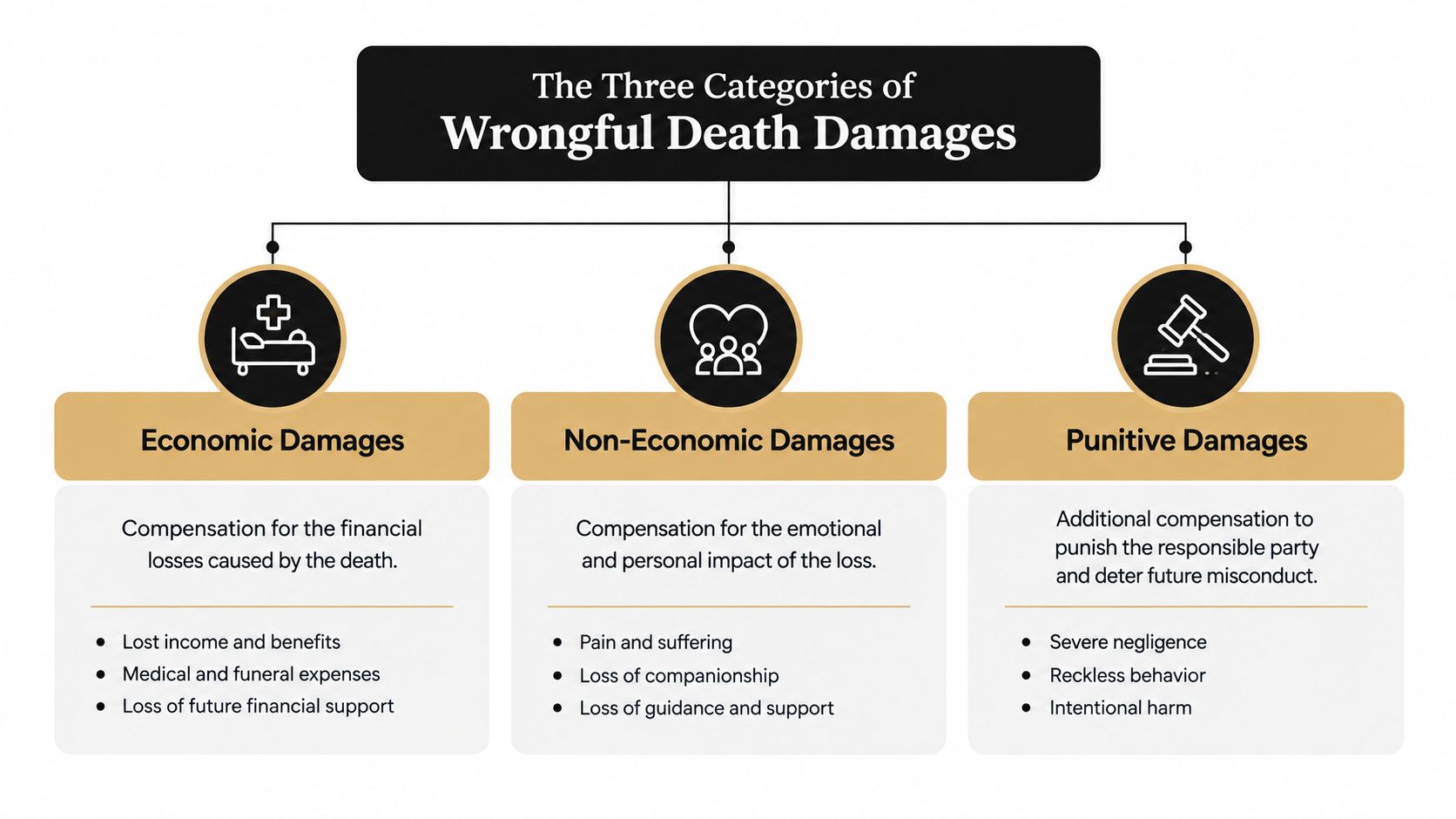
The Three Categories of Wrongful Death Damages
Think of the claim as a household budget prepared after the family's primary provider has died. Some entries are easy to document. Others describe losses that are very real but don't appear on a bank statement. A third category exists to punish exceptionally serious misconduct rather than reimburse the family.
Economic damages are the measurable loss
Economic damages resemble the visible rows on a budget spreadsheet. They may include the income, benefits, and financial support the deceased person would likely have provided. They can also include the value of household services, such as childcare, cooking, home maintenance, and transportation.
Depending on the circumstances and state law, this category may include medical bills, funeral expenses, burial costs, and lost financial support. The evidence usually comes from pay records, tax documents, employment benefits, household schedules, expert projections, and bills.
Non-economic damages describe human loss
Non-economic damages address losses that don't have a receipt. They may include grief, loss of companionship, loss of guidance, emotional suffering, and loss of consortium. The law may treat these damages differently depending on the claimant's relationship to the deceased and whether the case involves medical malpractice or another type of claim.
A spouse's loss may be measured differently from a child's loss. Some statutes also distinguish between one claimant and multiple claimants, making the number and identity of beneficiaries important to the calculation.
Punitive damages punish serious misconduct
Punitive damages aren't designed to replace wages or compensate grief. They're intended to punish conduct that goes beyond ordinary carelessness and to deter similar behavior. Fraud, malice, or reckless indifference may support a punitive claim where the applicable law permits it.
The same incident can therefore produce economic damages, non-economic damages, and potentially punitive damages, but each category has a different purpose and proof requirement. A state may cap one category while leaving another generally uncapped, and it may apply separate rules to a survival action.
How Economic Damages Are Calculated Step by Step
Economic damages begin with evidence, not a guess about what a family “should” receive. The calculation usually asks what the deceased person contributed, how long that contribution would likely have continued, and what expenses arose because of the fatal injury.
A financial expert may start with earnings and employment benefits, then account for taxes, personal consumption, work-life assumptions, and the present value of future losses. Families can explore the mechanics of this process through the economic damages calculation resource, while recognizing that the correct method depends on the jurisdiction and evidence.
Build the income and benefits component
A typical analysis may examine:
- Past earnings: Pay records, tax returns, bonuses, commissions, and other compensation help establish the historical baseline.
- Future support: The analysis considers expected career progression, retirement contributions, health insurance, and other employment benefits.
- Household services: The value of childcare, home maintenance, transportation, and similar work may be calculated separately when the deceased provided those services.
- Personal consumption: The deceased person's expected personal spending may be deducted so the family doesn't claim money that wouldn't have supported the household.
The expert may then calculate the value of future losses in present dollars. That process isn't the same as merely multiplying annual income by the number of years until retirement. It requires assumptions about employment, benefits, taxes, household needs, and the deceased person's expected contribution.
Add expenses tied to the death
Medical treatment before death, funeral expenses, and burial costs may form additional economic damage lines when the governing law permits them. Bills and payment records are especially important because these amounts are usually easier to verify than future projections.
A family should preserve pay stubs, tax returns, employer benefit summaries, bank records, childcare invoices, household schedules, medical bills, funeral contracts, and receipts. Missing documentation doesn't automatically defeat a claim, but it makes the calculation harder to defend.
The strongest economic model shows the math line by line. It doesn't hide a large total behind a single multiplier.
There's no reliable universal total for a working parent, business owner, retiree, or child. Two families with similar incomes may have very different losses because their household roles, dependents, benefits, medical expenses, and applicable laws differ.
Wrongful Death Versus Survival Action Side by Side
A fatal injury can create two separate legal claims. The wrongful death claim generally seeks compensation for losses suffered by surviving family members. A survival action preserves claims the deceased person could have brought had they lived, including losses incurred between the injury and death.
| Factor | Wrongful Death | Survival Action |
|---|---|---|
| Who brings it | Eligible surviving beneficiaries or the personal representative, depending on state law | The estate or personal representative |
| Whose losses it measures | The family's losses after the death | The deceased person's losses before death |
| Possible damages | Lost support, household services, companionship, guidance, and other legally recognized family losses | Medical bills, pre-death lost wages, and conscious pain and suffering where permitted |
| Who receives the recovery | Eligible beneficiaries under the governing statute | The estate, then distribution under estate and probate rules |
| Timing rules | Governed by the applicable wrongful death statute of limitations | May have a separate limitations rule or procedural requirement |
| Double recovery | Cannot duplicate amounts claimed elsewhere | Cannot duplicate the same medical, wage, or other loss |
Consider a father who dies after a serious injury. He leaves a spouse, two adult children, and an estate that pays $80,000 in final medical bills. The wrongful death claim may seek the spouse's lost financial support, household services, and consortium, along with any losses the adult children can legally claim. The survival action may seek the $80,000 in medical bills, lost wages during the period before death, and compensation for conscious pain and suffering if the jurisdiction allows it.
The estate and the family must coordinate these claims carefully. The same medical bill can't be recovered twice, and one claim's payment may affect how the total proceeds are allocated. The distinction materially changes case value because the claims use different injury periods and may have different beneficiaries.
For a plain-language discussion of this division, see the explanation of wrongful death damages and compensation. A lawyer should also identify every filing deadline early because missing a limitations period can end a valid claim before damages are evaluated.
State Noneconomic Damage Caps Across the United States
A wrongful death verdict does not produce one universal payout. State law may cap grief, loss of companionship, and other non-economic harm while leaving economic losses uncapped. The applicable ceiling can also depend on the claim type, the number of claimants, the filing date, and whether insurance or another collectible source can pay the judgment.
A 2026 survey reported Colorado's wrongful-death non-economic cap at $2.125 million, with inflation indexing beginning in 2028. It listed Maine's cap at $1 million for non-economic harms tied to wrongful death. It also listed New Hampshire's limits as $150,000 for a spouse and $50,000 for children and parents, illustrating how sharply statutory recovery can differ between jurisdictions. See the survey of damage caps across the United States for that comparison.
Maryland shows why a cap figure must be tied to a date and claimant count. The same 2026 survey listed $935,000 for two or more wrongful death claimants. Recent 2026 legislative coverage lists $980,000 for one claimant and $1,470,000 for two or more claimants under an updated schedule. A filing made after that schedule's effective date uses the updated figure. The practical lesson is simple: confirm which law governed when the case was filed instead of copying the largest or most recent number.
Colorado illustrates category-based limits
For Colorado wrongful death cases filed on or after January 1, 2025, economic damages, including medical bills, funeral expenses, and lost financial support, are generally uncapped. Non-economic damages for grief, loss of companionship, and emotional suffering are capped at $2,125,000, subject to possible inflation increases. The cap does not apply when the death resulted from a felonious killing, as described in Colorado Revised Statutes section 13-21-203.
Claimant count and claim type can change the result
The table below shows 2024 caps for comparison. Colorado's $381,000 figure applied to filings before January 1, 2025, not to cases governed by the later framework. Several states have since raised their limits, so confirm the current number for the filing date before relying on any figure here.
| State | 2024 Cap | Scope | Key Exception |
|---|---|---|---|
| Colorado | $381,000 | Earlier wrongful-death non-economic framework | Filings on or after January 1, 2025 use the updated framework |
| Maryland | $875,000 | Earlier listed wrongful-death non-economic framework | Scheduled increases and claimant-count rules |
| California | $250,000 | Medical-malpractice non-economic damages | Other wrongful deaths may follow different rules |
| New Hampshire | Varies by claimant | Wrongful-death non-economic recovery | Spouse and child or parent limits differ |
| Maine | $1 million | Non-economic harms tied to wrongful death | Scope depends on the claim and statute |
Medical malpractice may carry its own sub-cap. Federal claims, including FELA or the Jones Act, may displace state limits. Venue, statutory exceptions, the legal theory, insurance coverage, and the defendant's assets all affect what a family can collect. A high verdict can therefore exceed the amount ultimately paid. The 50-state wrongful death survey provides another comparison, but the governing filing-date rules control.
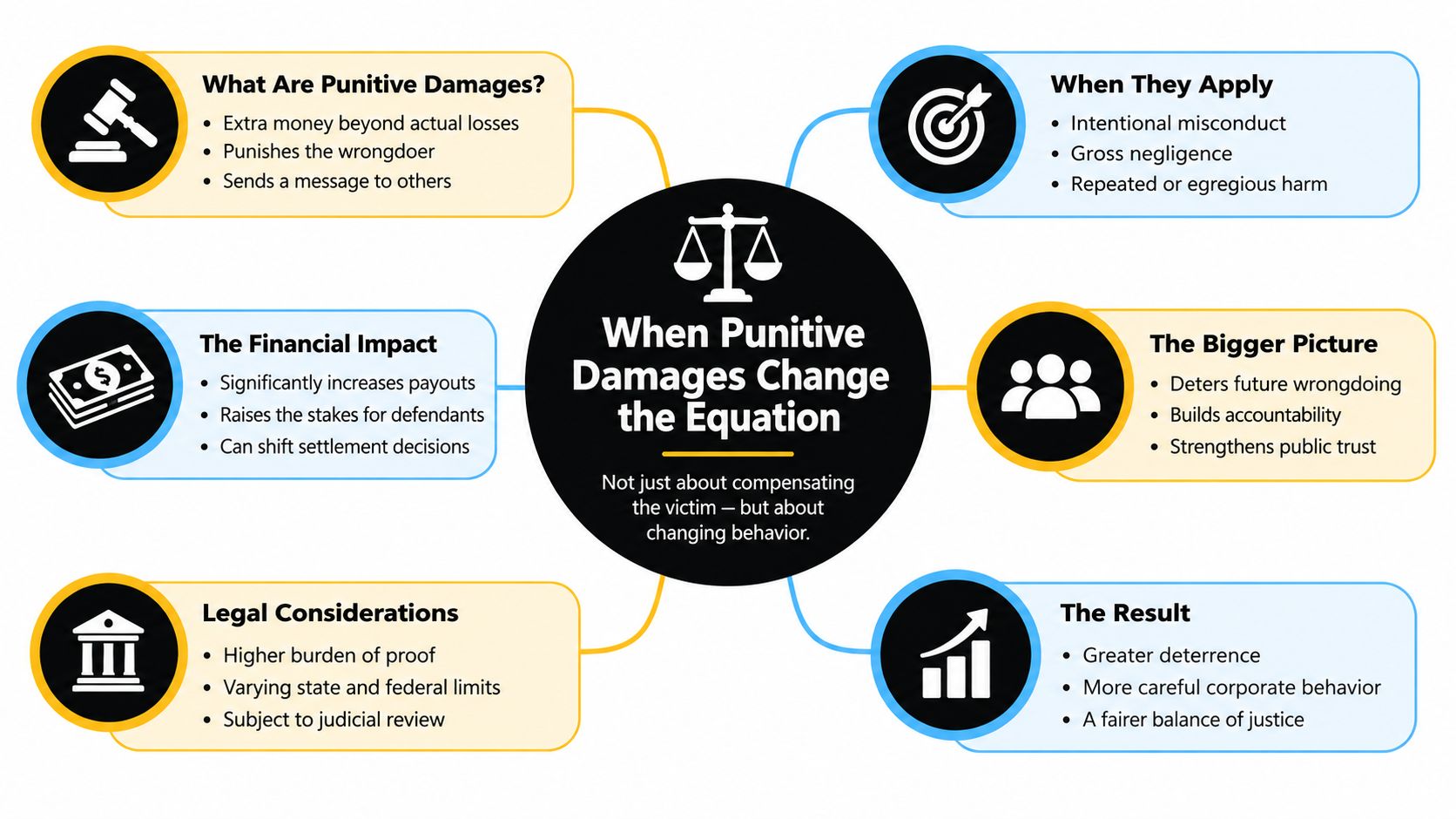
When Punitive Damages Change the Equation
Punitive damages enter the analysis only when the defendant's conduct is sufficiently blameworthy under the governing law. Ordinary negligence, such as a momentary lapse in attention, may support compensatory damages without supporting punishment. The evidence generally must show something more serious, such as fraud, malice, or reckless indifference.
A fatal trucking case may raise punitive questions when a driver falsifies logs and knowingly ignores hours-of-service rules. A drunk-driving case may raise them when a bar overserves a patron or when a driver with a history of dangerous conduct chooses to drive again. The facts must be proven, and the applicable statute may impose additional limits or procedures.
Punishment requires a different proof strategy
The family must separate proof of the death and financial loss from proof of the defendant's state of mind. Driver logs, dispatch records, company policies, prior complaints, alcohol-service records, surveillance footage, electronic data, and witness testimony may become central.
Punitive damages are also subject to constitutional review. In State Farm v. Campbell, the Supreme Court identified guideposts that include the relationship between punitive and compensatory damages, with a 9-to-1 ratio often discussed as a constitutional reference point rather than an automatic formula. Courts review the award against the particular defendant and facts.
For a focused explanation of the category, families can review what punitive damages are. The key question isn't whether a death feels deserving of punishment. It's whether admissible evidence proves the legal standard and whether the defendant's conduct falls within a statute that permits punitive recovery.
Putting It All Together to Estimate Claim Value
A practical valuation asks which limit controls. Start with the provable economic loss, add legally available non-economic damages, assess punitive exposure, then test the result against statutory caps, claimant rules, insurance, assets, venue, and litigation risk.
Publicly discussed settlement ranges can run from $250,000 to $10 million or more, but that span isn't a prediction for an individual family. It reflects how widely the inputs can vary. A high-income wage loss, multiple eligible claimants, uncapped categories, strong liability evidence, and substantial insurance may support a very different result from a case involving limited economic loss or a strict medical-malpractice cap.
| Claim Profile | State and Key Rule | Economic and Non-economic | Punitive Exposure | Realistic Settlement Band |
|---|---|---|---|---|
| 35-year-old professional earning $90,000, two dependents, $1 million policy | Colorado, subject to the applicable wrongful-death framework | Economic loss may be substantial; non-economic recovery is subject to the statutory cap | Depends on evidence of aggravated conduct | Must be tested against the $1 million policy and collectability |
| 80-year-old retired spouse with minimal economic loss | Maryland, claimant-count and claim-type rules matter | Economic damages may be limited; non-economic recovery depends on eligible claimants and the governing cap | Usually fact-dependent and unavailable for ordinary negligence | Driven by non-economic rules, evidence, insurance, and assets |
| Fatal trucking collision with strong punitive evidence | Texas, subject to Texas law and case-specific rules | Economic and non-economic damages depend on proof and applicable limits | Potentially significant if reckless conduct is proven | Depends heavily on policy limits, parties, and collectability |
| Medical-malpractice death | California, medical-malpractice rules apply | Non-economic recovery is subject to the applicable statutory framework | Depends on the facts and governing law | Must account for the malpractice cap, insurance, and economic proof |
The table uses the facts provided as valuation scenarios, not promised outcomes. In Maryland, published 2026 legislative materials describe scheduled increases in non-economic caps. Other 2026 summaries state that Colorado's medical-malpractice wrongful-death cap reached $810,000 for injuries occurring in 2026, while California's malpractice-related cap continues stepping upward annually toward $1 million. These rules show why the claim's category matters as much as the injury's severity. The Maryland legislative material is available in this 2026 legislative fiscal note.
Pressure-test any valuation
Ask the lawyer handling the claim:
- What damages are included? Request separate totals for lost support, household services, medical costs, funeral expenses, non-economic damages, and any survival claim.
- Which cap applies? Confirm the state, filing date, claim type, claimant count, and any medical-malpractice or statutory exception.
- Who can recover? Identify every beneficiary and explain how the law allocates proceeds.
- What insurance exists? Review policies for the driver, employer, property owner, medical provider, and any other potentially responsible party.
- What assets are collectible? A judgment is only useful if a defendant or insurer can satisfy it.
- What evidence supports liability and value? Preserve records, electronic data, employment documents, medical evidence, and witness testimony before they disappear.
Probate can affect who controls a survival action and how settlement proceeds move through the estate. Families can use this explanation of a probate wrongful death settlement estate to understand why estate administration may run alongside the injury case.
A detailed review of wrongful death lawsuit payouts can help families identify the questions that matter before accepting an insurer's first position. The actual ceiling is rarely the largest verdict reported in the news. It's usually the smallest controlling number among legally available damages, statutory limits, insurance, and collectable assets.
Nares Law Group LLC evaluates wrongful death and survival claims, preserves evidence, and pursues compensation through negotiation or trial for families facing fatal accident claims. Visit Nares Law Group LLC to request a consultation and discuss how the applicable damages categories, caps, and available insurance may affect your case.