You pick up your car from the body shop, walk around it twice, and the paint looks right. The panels line up. The repairs are done. On paper, the problem is over.
But it isn't.
Once that accident lands on the vehicle history, buyers, dealers, and appraisers don't look at your car the same way. A repaired vehicle can still be worth less because it was wrecked. That's the gap many people run into when they start a diminished value claim with GEICO. GEICO may act like the repairs solved everything. In the market, they often didn't.
At Nares Law Group, we see how frustrating this is for drivers after a crash. You've already dealt with the collision, the repair shop, the rental, and the adjuster. Then you learn your car's resale value took a hit anyway. The good news is that diminished value is a real claim. The harder truth is that GEICO often forces you to prove it carefully, and their first number is rarely the one you should accept.
Your Car Was Repaired But It's Not Whole
A common scenario goes like this. Your car was in good condition before the crash. You weren't at fault. The repairs are finished, and the shop says the vehicle has been restored. Then you try to trade it in, or you start checking comparable listings, and the accident history follows the car everywhere.
That's the point where it becomes clear that repair bills and diminished value are two different losses.
Repairs address physical damage. Diminished value addresses the financial loss that remains after the vehicle is fixed. A dealer may discount the car. A private buyer may hesitate. Another buyer may insist on paying less because the vehicle now carries an accident record.
A clean-history car and an accident-history car are not treated the same in the used market, even when both look fine on the lot.
GEICO knows these claims exist. But in practice, the company often narrows the issue to its own internal calculation, pushes back on unsupported estimates, and hopes the owner will accept a small offer just to move on. That's where a lot of valid claims get undervalued.
The path forward isn't to argue louder. It's to build a cleaner record than GEICO has. You need the repairs completed, the right appraisal, the right supporting documents, and a demand package that forces the adjuster to respond to evidence instead of brushing you off with a formula.
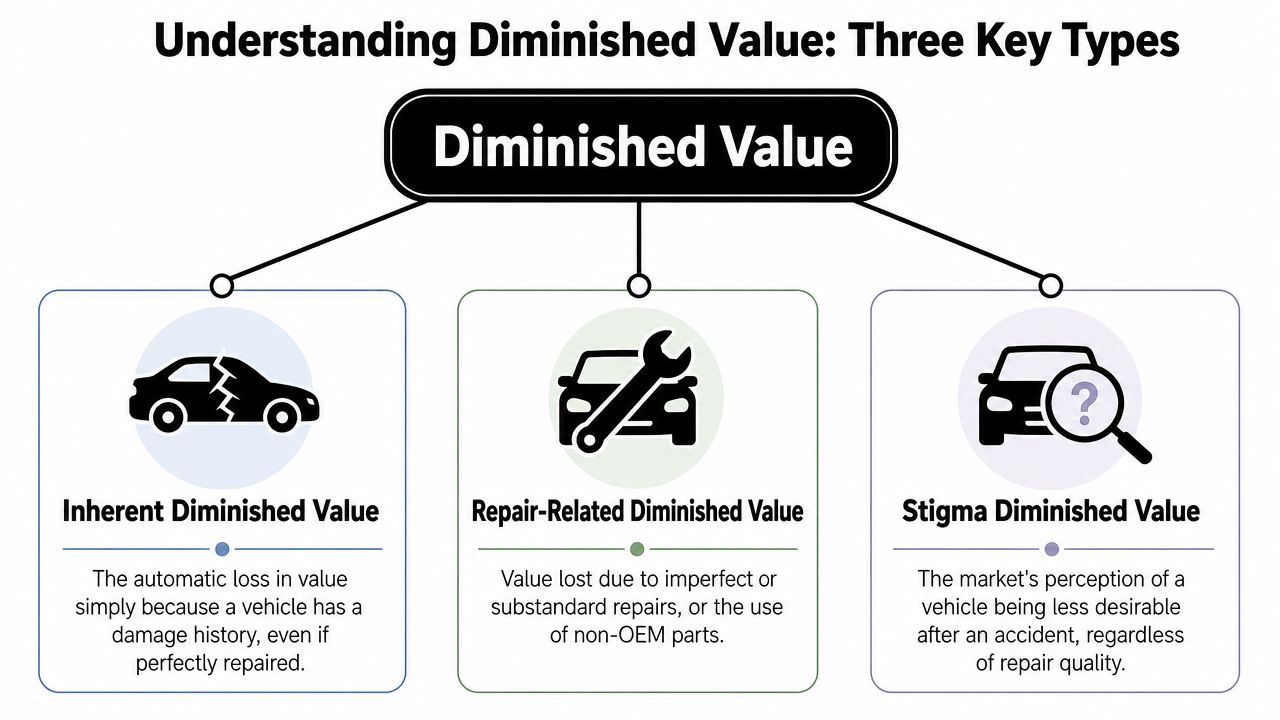
Understanding the Three Types of Diminished Value
Not every value loss is the same. If you're filing a diminished value claim with GEICO, the terminology matters because adjusters often hide behind vague language. Once you understand the categories, it's easier to focus on the kind of loss your claim is really about.
Inherent diminished value
This is the concept commonly understood when diminished value is mentioned. Inherent diminished value is the loss that exists because the vehicle now has an accident history, even if the repairs were done well.
Think of two identical used cars. Same year, same make, same trim, similar mileage. One has never been in a collision. The other was repaired after an accident and now shows that history. Most buyers pay less for the repaired one. That market discount is inherent diminished value.
This is usually the core issue in a third-party claim against the at-fault driver's GEICO policy.
Repair-related diminished value
This type of loss comes from the quality of the repair itself. If the paint doesn't match, panels don't align, parts are not comparable to what was there before, or the work leaves visible flaws, the car may lose additional value because the repair is imperfect.
That can matter, but it often turns into a separate fight over workmanship. If your body shop did clean work, repair-related diminished value may not be the main argument.
Stigma diminished value
Some people use the word "stigma" to describe the market's reaction to a car with damage history. In practical terms, this overlaps with what many claims describe as inherent diminished value. Buyers don't just evaluate the metal and paint. They react to the record attached to the VIN.
Here's a simple way to sort the three:
| Type | What causes the loss | Typical claim focus |
|---|---|---|
| Inherent diminished value | Accident history itself | Most GEICO third-party claims |
| Repair-related diminished value | Flawed or incomplete repairs | Important when workmanship is an issue |
| Stigma diminished value | Buyer perception after an accident | Often discussed alongside inherent loss |
Why this distinction matters with GEICO
If you call GEICO and say, "My car lost value," the adjuster may answer as if you're complaining about repair quality. That can send the discussion in the wrong direction.
A stronger approach is to frame the issue correctly. You're claiming a market loss that remains after proper repairs because the vehicle is no longer a clean-history vehicle. That is a recognized loss concept. It isn't speculation, and it isn't the same thing as saying the shop did bad work.
Use the right phrase with the adjuster. "My claim is for inherent diminished value after completed repairs."
That small shift helps keep the claim focused on the actual economic loss instead of a side argument about whether the body shop did its job.
Building an Ironclad Case for Your Claim
GEICO doesn't pay diminished value because a vehicle owner feels shortchanged. GEICO pays when the file contains enough credible proof to make denying or minimizing the claim harder.
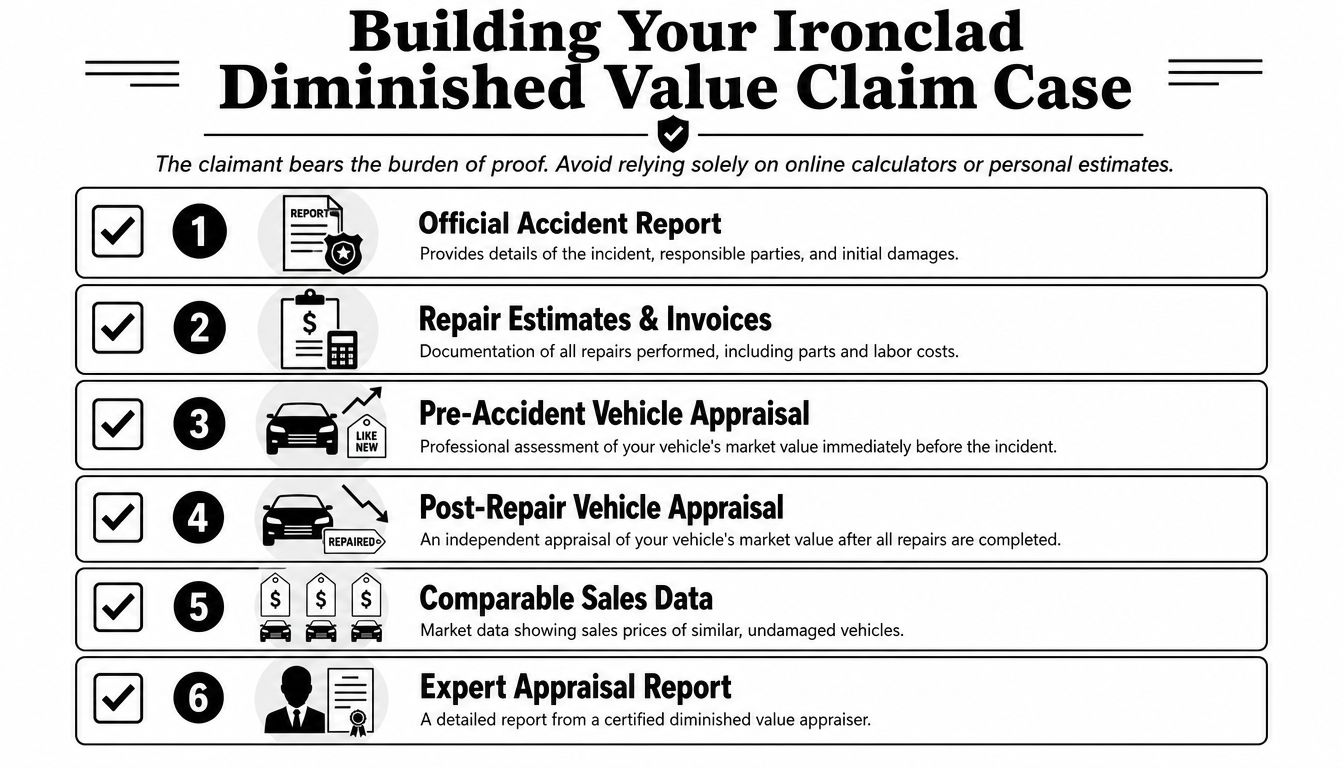
That's why the burden of proof matters so much here. Online calculators, informal guesses, dealer chatter, and your own opinion about what the car is worth won't carry much weight. For most claims, the turning point is an independent appraisal that meets the right standards.
Start with the records that define the vehicle
Before you order an appraisal, gather the documents that show what happened and what condition the car was in.
A solid file usually includes:
- The crash report so fault and basic accident facts are documented.
- Repair invoices and estimates showing what parts were replaced and what work was performed.
- Photos of the damage and completed repairs so the appraiser can tie the valuation to the actual impact.
- Service and maintenance records if they help show the vehicle was well kept before the collision.
- Comparable listings for similar vehicles with and without accident history, especially if the price difference is obvious.
Those items don't replace an appraisal. They support it.
The appraisal is the center of the case
A licensed, independent, USPAP-compliant appraisal is what turns a complaint into evidence. According to Snapclaim's explanation of GEICO diminished value claims, claims supported by professional USPAP-compliant appraisals show a 60 to 70 percent higher settlement acceptance rate, and counter-offers backed by third-party valuation and accident-history comparables typically increase payouts by 25 to 40 percent over GEICO's initial offer. The same source explains that GEICO's methodology mirrors a formula using pre-accident value × 0.10 cap × damage modifier (0.25 to 1.0) × mileage modifier, and it notes that appraisals need to be licensed, non-computer-generated, and USPAP compliant to withstand adjuster scrutiny.
That tells you two things.
First, this isn't a paperwork formality. Second, GEICO is already working from a system designed to constrain the number before the conversation even starts.
If liability or crash mechanics are being disputed in the broader case, evidence work may also overlap with reconstruction issues. In that setting, a lawyer may coordinate with specialists such as an accident reconstruction expert while keeping the property loss side organized.
What a useful appraisal should do
A weak appraisal gives GEICO room to dismiss it. A useful one does the opposite.
Look for an appraisal that:
- Measures actual market value loss rather than broad retail theory.
- Explains the appraiser's method instead of just spitting out a number.
- Uses real comparables that fit your vehicle and market.
- Identifies the post-repair stigma of the accident history in a way an adjuster can evaluate.
This video gives a practical overview of how the proof side of a diminished value claim works:
Why GEICO's formula shouldn't be your final number
GEICO often starts from an internal formula because formulas are predictable, scalable, and insurer-friendly. They are not the same thing as an actual market analysis. The cap and multipliers can drag down a claim before anyone looks seriously at what buyers in your market would do with an accident-history vehicle.
Practical rule: Treat GEICO's first formula-based number as a starting position, not a valuation verdict.
What works is evidence anchored in the market. What doesn't work is hoping the adjuster will volunteer a better number on their own.
Submitting Your Diminished Value Claim to GEICO
Once the repairs are complete and your evidence is organized, the submission itself should be simple, direct, and formal. This is not the place for a long emotional narrative. The file needs to tell GEICO what happened, what you are claiming, and what supports it.
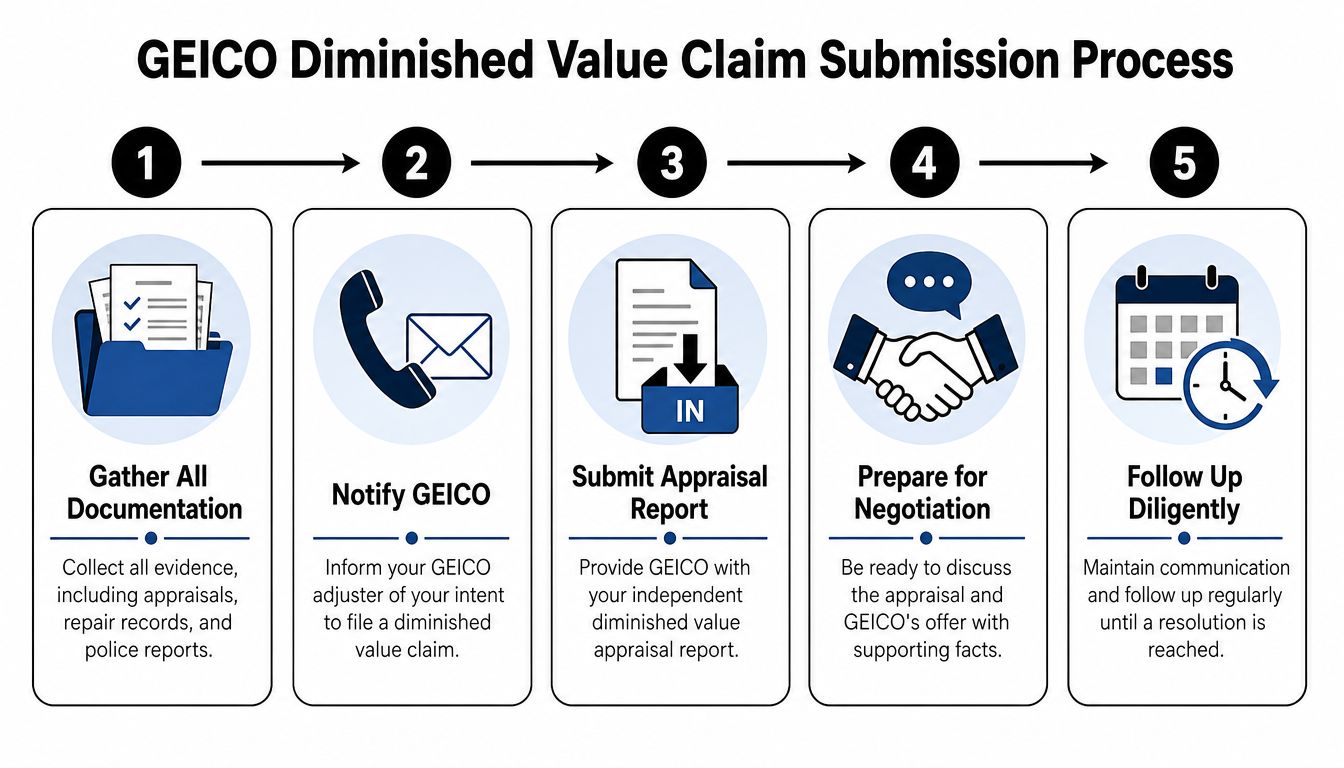
Repair first, then submit
GEICO rejects diminished value claims until repairs are finalized. A step-by-step methodology described by Diminished Value of Georgia's GEICO claim guide puts the process in four phases: complete the repairs first, obtain a certified USPAP-compliant independent appraisal, submit a formal demand with the appraisal report, and then negotiate against GEICO's initial offer during a 2 to 3 week review period. The same source warns against relying only on GEICO's internal valuation, skipping a licensed appraisal, or settling too early without counter-offer evidence.
That sequence matters. If you submit too soon, GEICO can say the vehicle's final post-repair condition hasn't been established.
What to include in the demand package
Your package should be organized as if someone unfamiliar with the file will read it cold. Include:
- A demand letter identifying the claim number, vehicle, date of loss, and the amount you are seeking.
- The full appraisal report from the independent appraiser.
- Repair records showing the work is complete.
- Supporting exhibits such as photos, comparable listings, and the crash report.
If you need a starting point for presenting the claim information in one place, Nares Law Group provides a diminished value claim form that helps organize the underlying facts before submission.
A sample demand letter you can adapt
Re: GEICO claim number [insert number]
I am submitting a diminished value claim arising from the collision on [date] involving my [year, make, model]. Repairs to the vehicle have been completed. Although the vehicle has been repaired, it has suffered a measurable loss in market value due to its accident history.
Attached is an independent licensed appraisal that evaluates the vehicle's post-repair diminished value using market-based analysis. I am requesting payment in the amount stated in that appraisal. Also attached are the repair invoice, photographs, and supporting records.
Please confirm receipt of this package and advise in writing of GEICO's position after review.
How to send it and what to expect
Email is common. Portal upload can work too. Certified mail creates a clearer paper trail if the claim has already been difficult.
After submission, expect a review period. During that time, keep your follow-up disciplined.
- Ask for written confirmation that the materials were received.
- Keep every email and note every phone call with dates and names.
- Request a written explanation if GEICO disputes the appraisal or issues a lower number.
The strongest submissions don't overtalk the claim. They document it.
How to Negotiate When GEICO Lowballs Your Offer
Most diminished value claim GEICO disputes don't end with the first response. They move into negotiation, and GEICO usually has a pattern. The adjuster may lean on internal formulas, say the repairs returned the vehicle to pre-accident condition, question your appraisal, or imply their offer is as far as they can go.
None of that means your claim is weak.
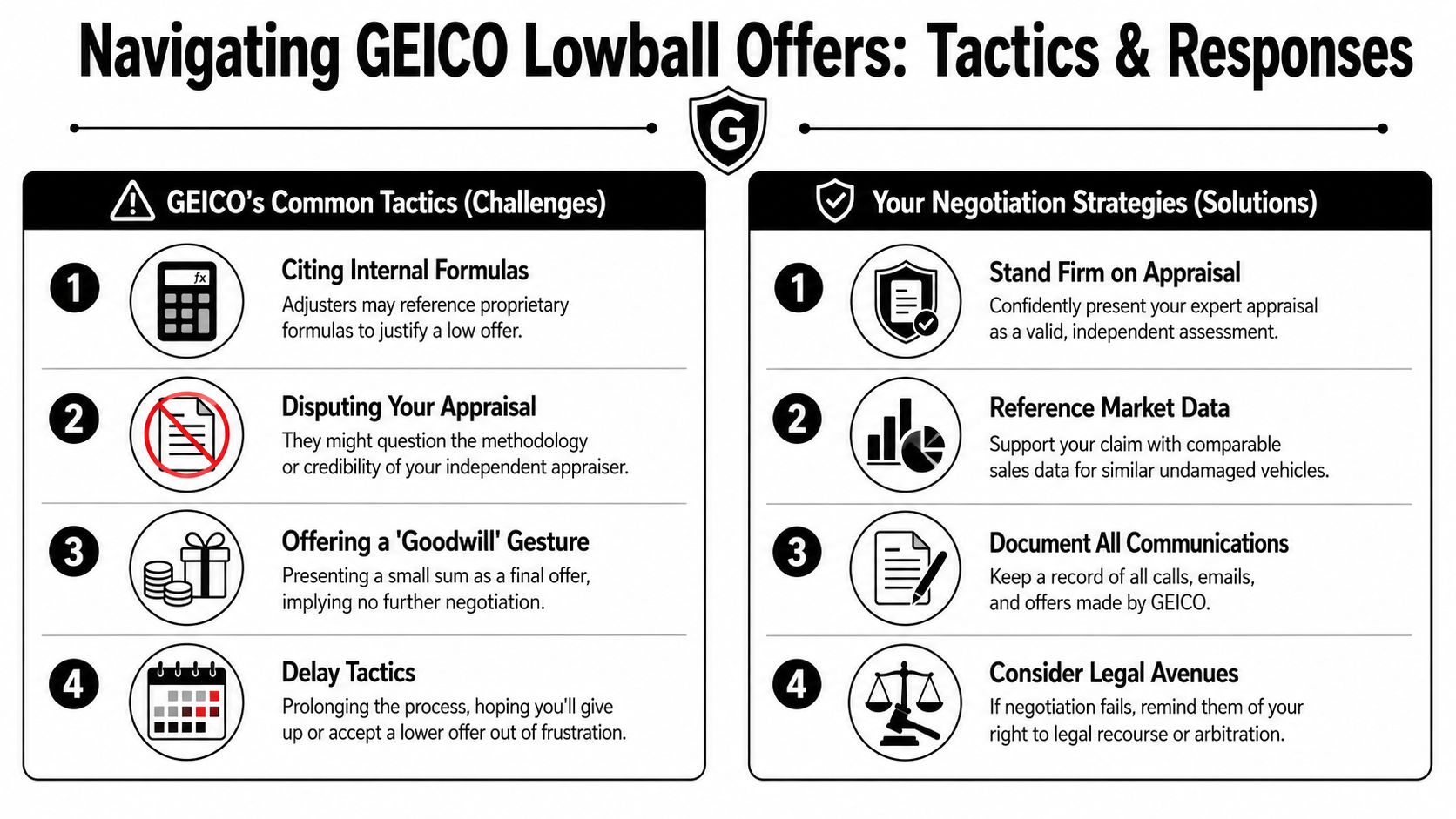
The internal formula problem
One underappreciated issue is that diminished value isn't automatic in every state. Forbes Advisor's discussion of diminished value claims notes that in states such as Texas, insurers are not obligated to pay diminished value once the vehicle is fully repaired. The same article explains that the 17c formula used by GEICO in some states caps the base loss at 10 percent of the car's value, which creates a built-in ceiling many drivers don't understand when they receive a low offer.
That matters in negotiation because GEICO may present a formula result as if it were the natural answer. It isn't. It's an internal method with limits that often compress the claim.
Common GEICO responses and how to answer them
Here is where many owners lose their advantage. They react to the adjuster's tone instead of responding to the adjuster's reasoning.
| GEICO position | Better response |
|---|---|
| The car was repaired to pre-accident condition | Repairs address physical damage. They don't erase accident history in the resale market. |
| Your appraisal is too high | Ask GEICO to identify the specific methodology objection in writing. |
| We used our formula | Point back to market-based comparables and the independent report. |
| This is our final offer | Treat that as a negotiation position unless and until the file is truly closed. |
Ask GEICO to respond to the evidence, not just restate its number.
Build each counter around proof
When GEICO says the car is restored, your response should focus on market reaction.
When GEICO says the appraisal is inflated, ask what part of the method they dispute.
When GEICO leans on mileage or damage modifiers, push the discussion back to real comparable vehicles instead of abstract multipliers.
A calm written response often works better than a heated phone call. If you want a broader primer on dealing with adjuster tactics in a claims setting, Mattiacci Law has useful expert advice on injury adjusters that applies to the negotiation mindset here as well.
Escalation options when GEICO stalls
Not every claim needs a lawyer. Some do.
You should think about escalation when:
- GEICO won't address the appraisal directly and keeps recycling canned responses.
- The claim is tied to larger accident issues such as disputed fault or a broader injury case.
- The value gap is meaningful enough that a token increase still leaves a serious loss unpaid.
- You need outside review of the insurer's handling through a complaint or litigation option.
If the facts of the accident, the damage history, or the insurer's position are already becoming contested, review of the file may need to extend beyond the appraisal itself. In those situations, a lawyer may conduct an insurance company investigation to evaluate the claim record, communications, and handling choices.
Negotiation works best when each response narrows the dispute. GEICO wants to make the issue sound subjective. Your job is to keep converting it back into documentation.
Colorado Rules Deadlines and When You Need a Lawyer
Colorado drivers should pay attention to two separate questions. First, how long do you have to act? Second, when does a do-it-yourself claim stop making financial sense?
Deadlines matter because diminished value is still a property damage issue, and property claims are time-sensitive. Colorado law can also intersect with fault allocation. If you share some responsibility for the crash, that can affect what you recover.
The hidden costs and reductions people miss
One practical problem with a diminished value claim is cost. As Avvo's legal answer discussing diminished value appraisals puts it, "the fee for the appraiser is not going to be reimbursable from the insurance company." That means the appraisal expense comes out of your pocket, and in some cases the cost-benefit analysis is real.
The same Avvo discussion also notes negligence reduction, meaning if the claimant has some share of liability, the diminished value offer may be reduced by that percentage. People are often surprised by that because they assume the argument is only about the car's value. It isn't. Fault still matters.
When handling it yourself may be enough
A self-managed claim can work when the facts are straightforward:
- Liability is clear and GEICO has already accepted fault.
- The vehicle repairs are complete and well documented.
- You have a credible appraisal and GEICO is at least engaging with it.
- The amount in dispute is manageable relative to the effort and expense involved.
When legal help is the better move
You should talk to a lawyer if GEICO stops negotiating in good faith, if the vehicle is newer or higher value, if the diminished value claim is part of a larger injury case, or if the paperwork and back-and-forth have become overwhelming.
That decision isn't about being aggressive. It's about efficiency. A claim that starts as a property issue can quickly overlap with liability disputes, policy limits, offsets, and broader settlement strategy. When that happens, piecemeal handling often costs more than it saves.
If you're dealing with a diminished value claim against GEICO and want practical guidance on whether to push the claim yourself or bring in counsel, Nares Law Group LLC can evaluate the facts, the documents you've gathered, and the insurer's response so far. Sometimes the right next step is a tighter demand package. Sometimes it's legal representation. Either way, clarity early usually saves time and money later.