Partial disability generally means you can still do some work, but an injury prevents you from returning to your prior position or earning equivalent wages. For example, a delivery driver may return to light duty at lower pay, earning less even though the driver isn't completely unable to work.
That situation creates a difficult middle ground. The doctor says you can work, the employer offers modified duties, and the insurance adjuster points to your return as proof that the claim is over. Meanwhile, your paycheck is smaller, your restrictions affect what jobs you can perform, and your future earning capacity may still be uncertain.
The answer to what is partial disability depends on the system handling the claim. Workers' compensation, private disability insurance, Social Security, and veterans' benefits can use different definitions, tests, and payment formulas. A label that supports benefits under one program may not qualify under another.
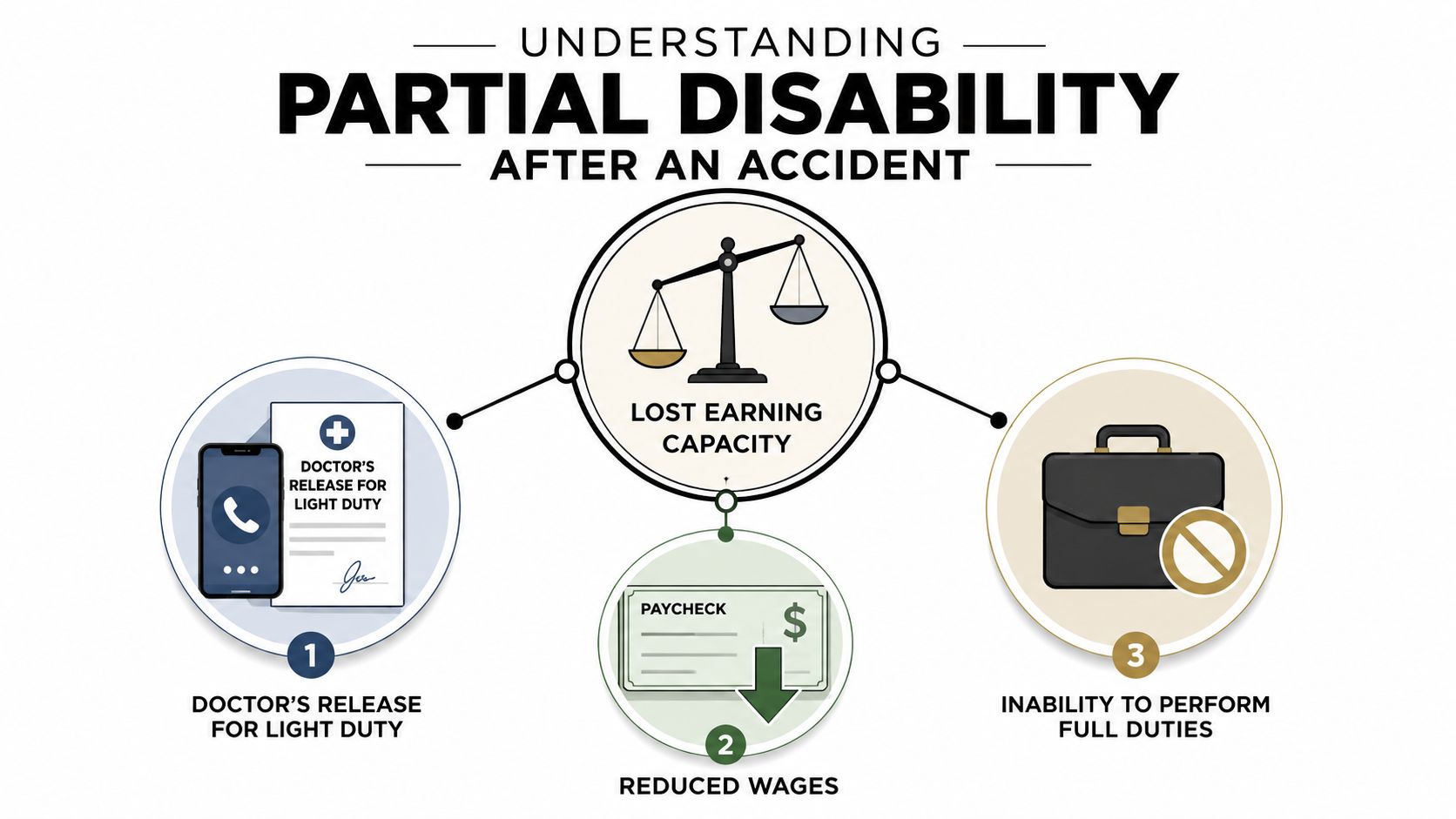
Understanding Partial Disability After an Accident
The morning after a crash, an adjuster may call while you're still attending medical appointments. Your doctor may release you to light duty, but your employer may have only limited work available. You return for shorter shifts or easier tasks, and your paycheck drops. You're working, but you're not earning what you earned before the accident.
That's the practical meaning of partial disability. It usually describes a worker who has lost part of their wage-earning capacity or ability to perform normal job duties, while remaining capable of some gainful work. Federal workers' compensation rules connect disability to the inability to return to the position held at injury or earn equivalent wages, rather than to a diagnosis alone (20 CFR § 10.402).
The delivery driver example
Suppose a delivery driver develops a back injury after a collision. The driver can answer phones, organize routes, or perform office work, but can't safely lift packages or spend a full day behind the wheel. A light-duty position may preserve some income, yet the driver still has a measurable wage gap and cannot perform the original job.
Whether that gap produces benefits depends on the claim. Workers' compensation may evaluate wage loss and work restrictions. A private policy may ask whether the driver can perform the material duties of the occupation and whether income has fallen enough to trigger coverage. Social Security generally looks for total disability, while a veterans' program applies its own service-connected disability rules.
Practical rule: “I can work” doesn't answer the legal question by itself. The important questions are what work you can do, under which restrictions, and what you can earn.
If you're also trying to understand the broader civil claim, a plain-language explanation of what an injury settlement is can help separate a settlement with an at-fault party from disability benefits paid under an insurance or government program. Those are different sources of recovery, and accepting one can affect the other.
How Medical Impairment Differs From Legal Disability
The doctor describes the damage. The law asks what that damage costs you in real terms. A medical evaluation may identify limited motion, nerve damage, pain, cognitive problems, or another lasting effect. A legal disability analysis connects those findings to your actual job, comparable work, and ability to earn.
That distinction matters after a crash. Two people can have similar diagnoses but very different claims. One may return to desk work with restrictions. The other may be unable to lift, climb, drive, or maintain the concentration required by a physically demanding job.
Impairment is an input
Colorado, for example, separates scheduled losses involving areas such as extremities, eyes, vision, and hearing from whole-person losses involving the spine, lungs, or mental function (Colorado Division of Workers' Compensation benefits guidance). That classification can affect how a medical rating becomes compensation.
A rating describes a lasting medical limitation. It does not, by itself, decide whether you can work, what duties you can perform, or how much income you have lost. Modified work may remain possible, while the original position is no longer safe or practical.
Disability is the practical result
State systems commonly express permanent partial disability as a percentage of impairment or disability. Minnesota states that permanent partial disability ratings have been assigned as a percentage of disability to the body as a whole since 1984. California explains that permanent disability ratings range from 1% to 99%, with 100% reserved for permanent total disability (Minnesota permanent partial disability guidance).
The same medical rating can lead to different results under workers' compensation, a private disability policy, Social Security, or a veterans' program. Each system uses its own definition, evidence, and benefit rules. Your work history, job demands, restrictions, wages, and applicable formula shape the outcome.
For an accident victim, the label affects more than paperwork. It can shape wage-loss benefits, settlement discussions, and a return-to-work plan. A diagnosis starts the analysis. The key question is how the injury changes your working life and earning capacity.
How Partial Disability Is Calculated and Converted to Benefits
After a crash, a delivery driver may return to dispatch work but earn less than before. The benefit calculation asks how the injury changed the driver's wages or work capacity, then applies the rules of the relevant system. That process can affect wage-loss payments, settlement potential, and the pace of a return-to-work plan.
Partial disability benefits generally follow two paths. One compares pre-injury wages with current earnings. The other converts an impairment rating into a benefit period under a statutory schedule. These paths may look similar on paper, but they measure different consequences.
Wage-loss formulas
Federal employee compensation illustrates the wage-loss approach. Under 20 CFR § 10.403, an employee with no dependents receives 66 2/3% of the wage-loss difference, while an employee with at least one dependent receives 75% of that difference (20 CFR § 10.403).
Florida's temporary partial disability rule uses a more specific formula. It pays 80% of the gap between 80% of average weekly wage and post-injury earnings, subject to a cap of 66.67% of average weekly wage. The result is a calculation, not just a percentage of the old paycheck. The governing rule determines which wage figures enter the calculation and how high the benefit can go.
For the delivery driver, the administrator would compare the applicable pre-injury wage measure with post-injury earnings, apply the required percentage, and check the cap. The final payment depends on the jurisdiction, documented wages, and whether the benefit is temporary or permanent.
Impairment schedules
Some systems use a different method. They take an impairment percentage and multiply it by a statutory benefit period. Pennsylvania sets a maximum partial-disability payment period of 500 weeks, Vermont multiplies an impairment percentage by 330 weeks, and Ohio uses a schedule based on percentages of 200 weeks (Minnesota Department of Labor and Industry overview).
| System | Formula | Key cap or threshold |
|---|---|---|
| Federal workers' compensation | A set share of the difference between pre-injury wages and post-injury earning capacity | 66 2/3% for an employee with no dependents, or 75% with at least one dependent |
| Florida temporary partial disability | 80% of the gap between 80% of average weekly wage and post-injury earnings | Cap of 66.67% of average weekly wage |
| Vermont permanent partial disability | Impairment percentage multiplied by a statutory benefit period | 330 weeks |
| Ohio permanent partial disability | Percentage-based schedule multiplied by a statutory period | Schedule based on 200 weeks |
Private disability policies may require an income-loss threshold, such as a 20% loss of income, or may focus on reduced hours, slower work, or inability to perform material occupational duties (Cornell Law School's partial disability overview). Before accepting an insurer's calculation, compare the policy language with medical restrictions, payroll records, and actual job duties. A functional capacity evaluation may help when the insurer disputes what work you can safely perform.
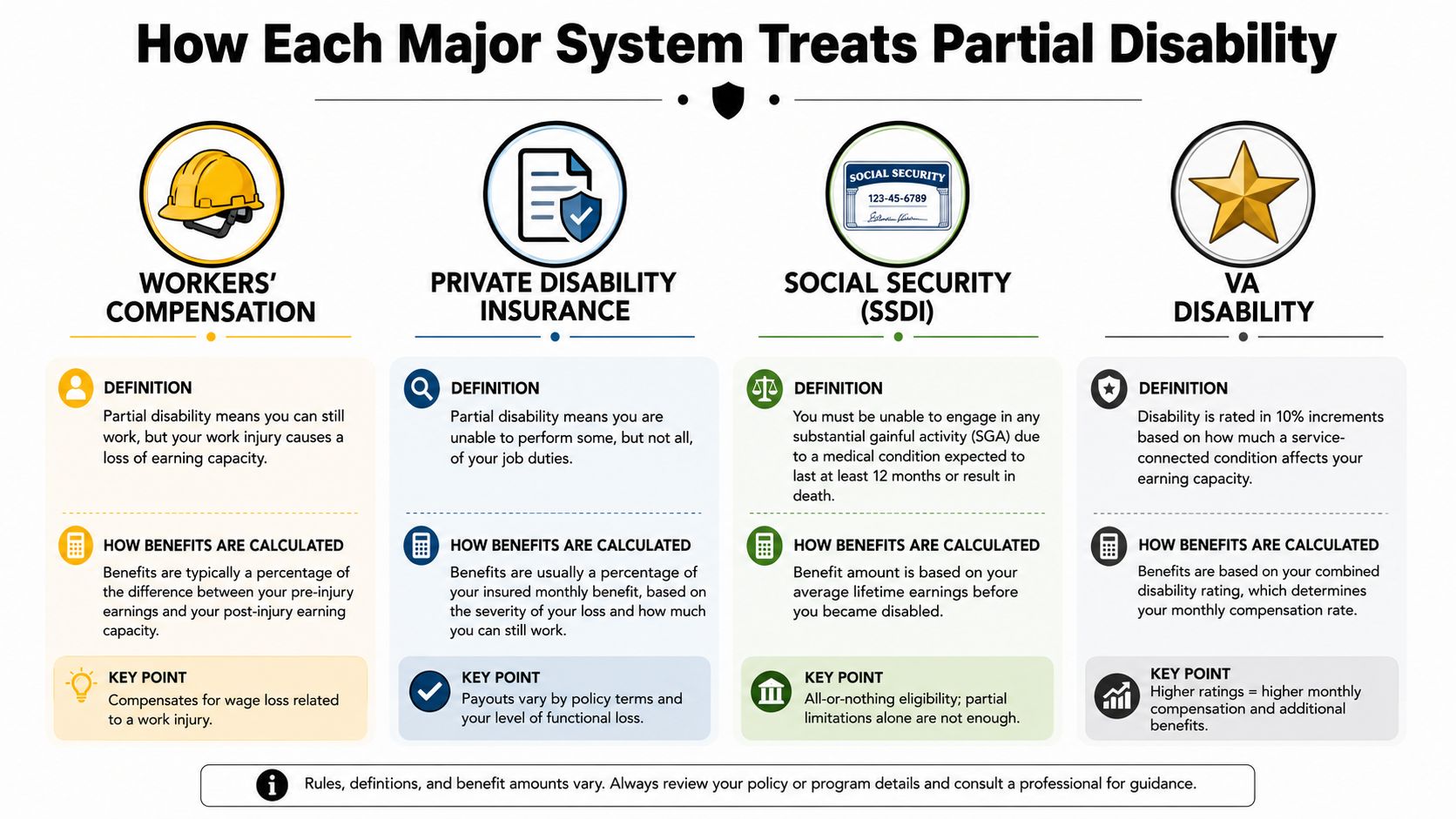
How Each Major System Treats Partial Disability
After a crash, you may still work, but only with shorter hours, lighter duties, or a slower pace. The label partial disability can describe that reduced capacity in one system and mean something entirely different in another. The program comes first, followed by its policy language, legal test, medical evidence, and wage records.
| System | How it generally treats partial disability | What usually drives the result |
|---|---|---|
| Workers' compensation | Often recognizes temporary or permanent partial disability when a work injury reduces earning capacity or function | Wage loss, restrictions, impairment rating, job duties, and state formula |
| Private disability insurance | May pay when you can work only in a limited way or suffer policy-defined income loss | Own-occupation or any-occupation language, material duties, and policy threshold |
| Social Security | Does not pay for partial disability. The program recognizes total disability under its own eligibility rules | Whether the condition prevents substantial work under Social Security's disability standard (SSA disability application information) |
| VA disability | Uses its own service-connected disability rating framework | Service connection, medical evidence, and the applicable VA rating rules |
Workers' compensation is the system most often associated with partial wage-loss benefits after a work injury. Federal guidance connects the analysis to the worker's prior position and equivalent earning capacity. As a result, work restrictions and vocational evidence may matter as much in practice as the diagnosis itself. A federal workers' compensation resource such as LifeWorks Integrative Health federal comp can help explain that process.
Private disability insurance turns on the contract. An own-occupation policy may ask whether you can perform your specific profession. An any-occupation policy may ask whether you can perform other suitable work. The same injury can therefore produce different answers under an insurance policy and a workers' compensation claim.
Social Security creates a sharper distinction. A person may receive workers' compensation wage-loss benefits while failing to meet Social Security's total-disability standard. Veterans must also keep the VA rating analysis separate from both programs. Medical restrictions, job demands, and realistic alternative work can affect how the claim is presented, and a vocational rehabilitation expert may help assess those employment options.
A Real-World Walkthrough After a Motor Vehicle Crash
Maya is a hypothetical client injured in a rear-end collision. She leaves the emergency room with neck pain and symptoms consistent with a traumatic brain injury. Over the following weeks, she attends physical therapy, reports persistent headaches and concentration problems, and struggles to complete the same workload she handled before the crash.
Her treating doctor eventually releases her to light duty. Maya's employer lets her work reduced hours and removes tasks requiring prolonged driving and heavy physical activity. She returns because she needs income, but her paycheck is lower and her supervisor documents that she needs more time to complete certain assignments.
The claim develops in stages
Maya's medical records establish the diagnosis and treatment history. Her doctor's work restrictions connect the condition to specific job functions. Her pay stubs show the income difference, while employment records explain what changed after the crash.
If the injury is work-related, a workers' compensation administrator may evaluate her temporary wage loss and later request a permanent impairment assessment. The rating is only one piece of the analysis. Her actual restrictions and reduced earning capacity help show how the injury affects her work.
The at-fault driver's insurer may also contact Maya about a bodily-injury settlement. The adjuster may emphasize that she has returned to work and suggest that her future losses are limited. Maya shouldn't treat that early position as a final valuation. Her symptoms, restrictions, treatment response, and long-term work outlook may still be developing.
Settlement choices can overlap
Maya also has to account for the relationship between workers' compensation benefits and a personal injury settlement. If a workers' compensation carrier paid medical expenses or wage benefits, it may assert reimbursement or subrogation rights against money recovered from the at-fault party. The amount and enforceability depend on the governing law and the case documents.
That overlap affects negotiation power. Maya needs a clear accounting of benefits paid, projected medical needs, wage loss, impairment evidence, and any asserted lien before she evaluates a settlement. Accepting a disability payment may provide immediate financial support, but it doesn't automatically resolve the separate third-party claim.
A return to work can create evidence in both directions. It may show effort and residual capacity, while the restrictions and lower earnings may support the partial-disability analysis.
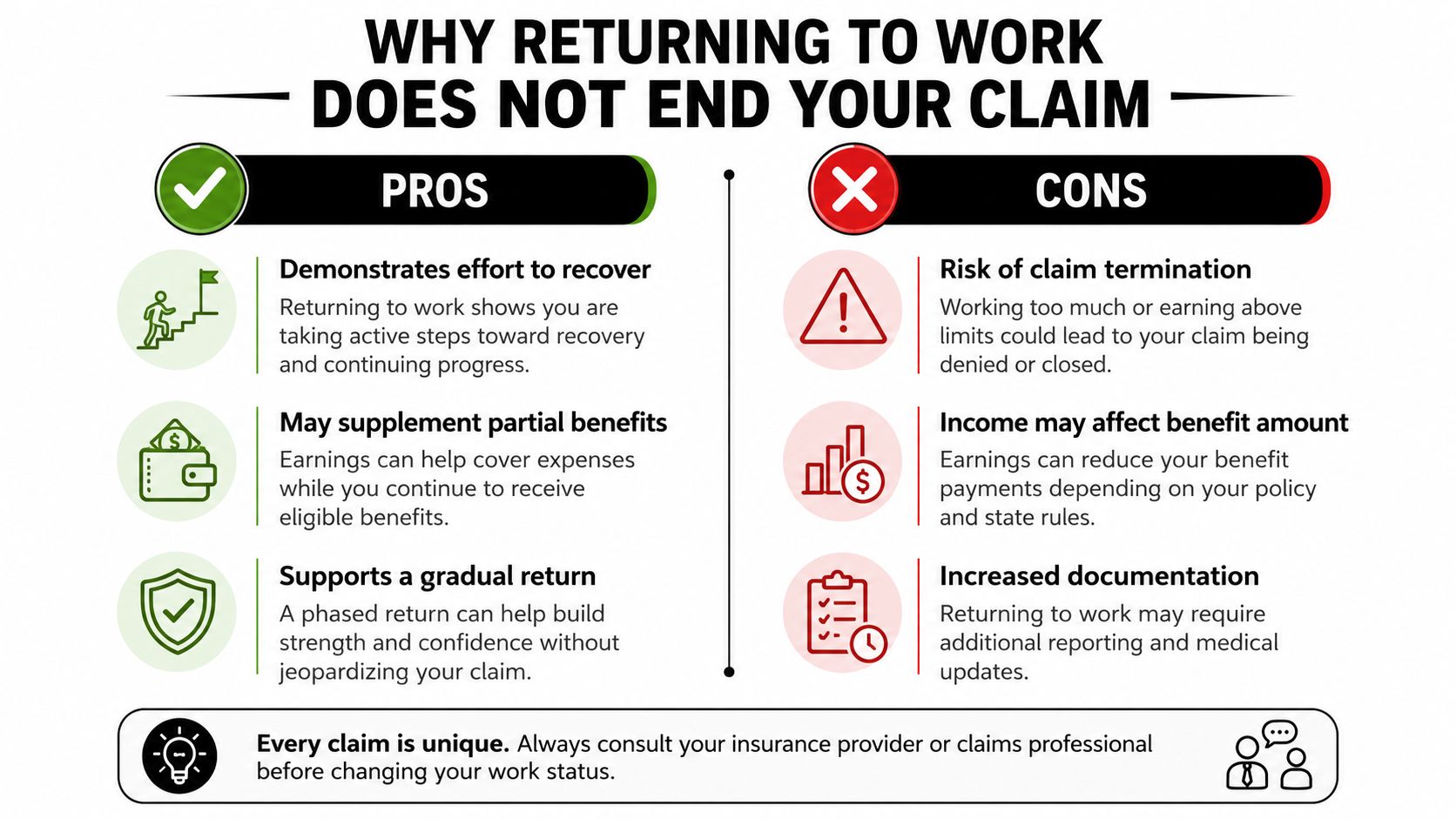
Why Returning to Work Does Not End Your Claim
A worker who returns to lighter duties has shown some capacity, but capacity alone does not answer the legal question about lost earnings. The relevant comparison is between the work and income available after the accident and what the worker could reasonably do and earn before the injury. That distinction matters across disability systems because the same return-to-work facts can affect wage benefits, settlement value, and the plan for resuming regular duties.
Work can look different after injury
Light duty may remove lifting, climbing, driving, or repetitive tasks. A phased return may involve shorter shifts. An employer may provide a temporary accommodation, yet the worker may be unable to maintain the former pace, work the same overtime, or qualify for the same position.
A return can therefore show both progress and continuing loss.
Document the practical changes. Keep work restrictions, modified-duty offers, schedules, pay records, and communications about missed or shortened shifts. If you accept lower-paying work because your original job is no longer physically or cognitively possible, record that reason and preserve evidence showing how the transition occurred.
Protect the record
Insurers may compare your statements, social media, job performance, and medical restrictions. Accuracy matters. Do not exaggerate symptoms, but do not minimize them to appear cooperative. Explain what tasks you can perform, what causes difficulty, and whether symptoms worsen during or after work.
Medical evidence should also match the work record. Tell treating providers about restrictions, reduced hours, changes in duties, and problems that continue after a shift. If an insurer arranges an examination, remember that it is different from treatment with your own physician. Learn how the process works before attending an independent medical examination, and answer truthfully without guessing.
Returning to work may support recovery while documenting the limits that remain. Those limits can help show why partial disability continues and how the injury affects earnings and future work choices.
Common Pitfalls and How Accident Victims Protect Themselves
Partial-disability claims often weaken through small documentation failures rather than one dramatic mistake. Treat the claim like a running file, not a single form.
Accepting restrictions without review: A light-duty release may affect wages, job assignments, and future arguments about work capacity. Ask what the release permits, what it prohibits, and how the employer will apply it before agreeing to a new role.
Losing wage records: Save pay stubs, schedules, time records, overtime information, and written explanations for reduced hours. A wage-loss claim is difficult to prove when the income trail is incomplete.
Settling before the medical picture stabilizes: A lump-sum agreement may close issues that later become important. Before signing, understand whether the settlement addresses future medical care, permanent impairment, wage loss, and any right to reopen the claim.
Ignoring reimbursement claims: Workers' compensation payments and a personal injury settlement may overlap. Request a written accounting of benefits paid and any asserted lien before negotiating the net amount you will receive.
Underreporting symptoms: Tell treating providers about headaches, concentration problems, sleep disruption, pain, weakness, and work-related difficulties. Keep a contemporaneous symptom journal that records what happened, what task triggered it, and how long the effect lasted.
Protect personal information while organizing your records. A practical guide from Digital Footprint Check explains why sensitive identifying information deserves careful handling.
Consider legal advice when the insurer disputes restrictions, challenges the impairment rating, denies wage-loss benefits, or seeks a release before you understand the long-term consequences. Early review can prevent a rushed decision from becoming permanent.
Next Steps and Answers to Common Questions
After a crash, start by building a reliable record. Report the injury through the proper channel, follow reasonable medical instructions, and request medical records, work restrictions, bills, and employment documents. Keep a timeline linking symptoms, appointments, missed work, modified duties, and pay changes. That record helps connect medical limits to actual wage loss.
A practical timeline
Early on, focus on accuracy rather than predicting the final result. At follow-up visits, ask the treating provider to describe restrictions through specific tasks, such as lifting, driving, standing, or concentrating. As the condition becomes clearer, request formal impairment information and ask the insurer to explain in writing how it calculated benefits.
Before settlement, identify every source that paid benefits or medical expenses. Review reimbursement or subrogation rights, compare the proposed lump sum with future needs, and do not sign a release until you know which claims and benefits it closes.
Questions readers often ask
How long do partial disability benefits last?
There is no universal duration. Some systems tie wage-loss benefits to continuing reduced earning capacity, while others use statutory periods. Pennsylvania, for example, sets a maximum partial-disability payment period of 500 weeks. Vermont and Ohio use impairment-based schedules with different statutory periods. The governing system and the injury classification determine the practical timeline. (Minnesota DLI overview)
Can someone receive partial disability from more than one source?
Possibly. Programs may coordinate payments, apply offsets, or use different eligibility tests. As discussed earlier, a workers' compensation finding does not guarantee Social Security eligibility because Social Security uses its own total-disability standard rather than paying for partial disability. (SSA disability application information)
What happens if the injury worsens after settlement?
The answer depends on the release, settlement order, governing law, and whether future claims were preserved or closed. Have the documents reviewed before signing, particularly if doctors have not determined your long-term restrictions.
Partial disability connects medical limits, job duties, and income. Track all three. A return to modified work may show some earning ability without proving that your losses have ended.
Nares Law Group LLC helps accident victims evaluate reduced earning capacity, medical restrictions, wage loss, and settlement issues after motor vehicle and truck crashes. Visit Nares Law Group LLC to request a consultation and discuss the evidence needed to protect your claim.