Late at night, after the calls stop and the house gets quiet, a lot of people do the same thing. They sit down with a phone or laptop, type in truck accident settlement calculator, and hope a number will make the situation feel more manageable.
That instinct makes sense. You're dealing with pain, paperwork, missed work, and questions nobody prepared you for. You want to know what your case might be worth, whether the insurance company is lowballing you, and how you're supposed to plan for the next few months when you don't even know what the next few weeks look like.
A calculator can help a little. It can show you the pieces that usually go into a claim. But it can't tell your story, and it can't measure the parts of a serious trucking case that matter most when injuries are life-changing.
Searching for Answers After the Crash
The search usually starts with urgency.
You may have gone to the hospital, talked to your employer, and heard from an insurance adjuster before you even had time to understand what happened. Then the bills begin arriving. Your vehicle may be unusable. Your body may not feel the same. If you suffered a head injury, your confusion may be part of the injury itself, not a personal failing.

For many families, an online calculator feels like a lifeline because it promises something simple. Enter bills. Enter missed work. Get an answer. If you're trying to understand how truck claims differ from ordinary car wrecks, this overview of Colorado truck accident cases can help frame why these crashes are often more complex from the very beginning.
Why the calculator feels comforting
A calculator gives structure to chaos. It tells you that your case has parts, and that those parts can be counted. That's reassuring when everything else feels unstable.
It also creates the impression that settlement value is a math problem with a clean answer. Sometimes that's useful. More often, it's incomplete.
Most people aren't looking for a formula because they're greedy. They're looking for a formula because they're scared.
That's normal. A serious truck wreck can put you in a position where every decision feels expensive. You may worry about saying the wrong thing to an insurer, accepting too little, or waiting too long while your family struggles.
What the calculator can and can't do
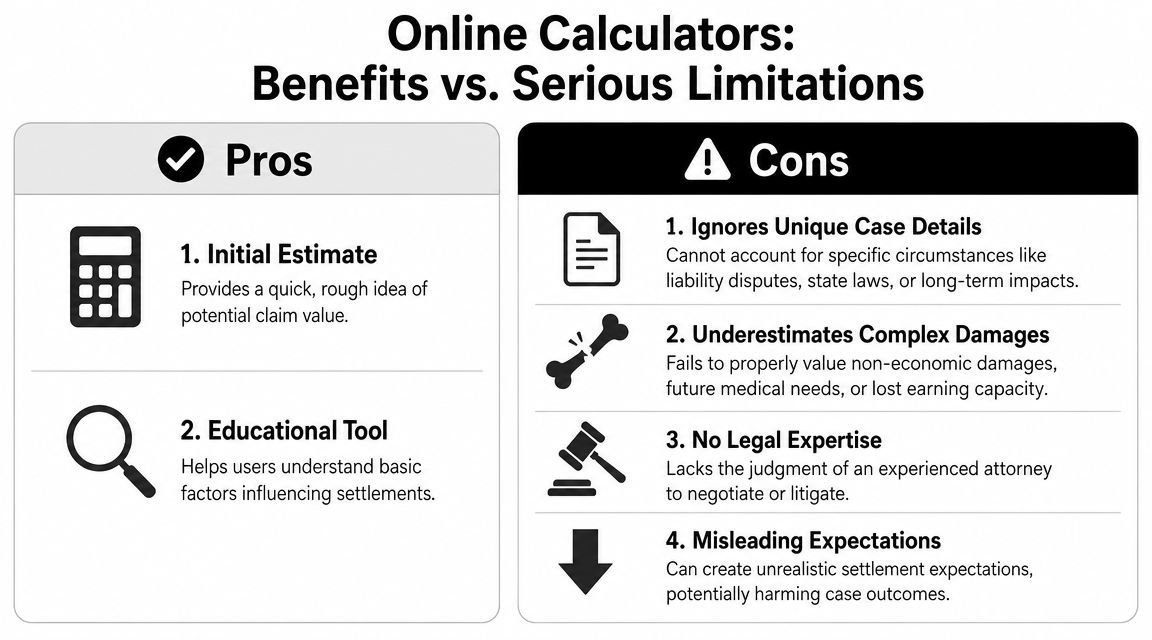
A truck accident settlement calculator works best as an educational tool. It can help you identify the categories of loss that matter in a claim. It can also show why documenting treatment, wages, and property damage matters so much.
What it can't do is answer the harder questions. Will you need future treatment? Is your brain injury still unfolding? Is the trucking company adequately insured? If a jury would value the harm one way, can the defendant pay that amount?
Those questions decide real outcomes.
So if you've opened a calculator and felt both hopeful and unsettled, that's not contradiction. That's your instincts telling you the estimate may be useful, but it isn't the whole picture.
The Building Blocks of a Truck Accident Claim
Before any calculator can estimate value, it has to measure damages. That's the legal word for your losses.
A simple way to think about damages is to picture a house being built. The visible structure matters, but it only stands because of the pieces underneath. In a truck accident claim, each bill, record, report, and personal consequence becomes one of those pieces.
Economic damages
Economic damages are the losses you can usually document with records. These are the numbers a calculator handles most easily because they show up on paper.
That often includes medical bills, lost income, property damage, and other out-of-pocket costs. In more serious cases, it can also include future care and future loss of earning ability, although online tools often handle those poorly or leave them to rough guesses.
If you're trying to understand how lawyers organize and evaluate these losses, this guide to economic damages calculation gives a useful framework.
Non-economic damages
Non-economic damages are harder to put into a spreadsheet, but they're no less real. This category covers the human cost of the crash.
Pain. Sleep disruption. Anxiety around driving. The loss of independence that comes from not being able to work, lift your child, think clearly, or return to the routines that made life feel like yours.
Practical rule: If a loss changed your daily life but doesn't come with a receipt, it may still matter legally.
That distinction is where many readers get stuck. They assume that if something can't be easily counted, it can't be claimed. That's not how personal injury law works. The challenge isn't whether those losses exist. The challenge is proving them in a way an insurer, opposing lawyer, or jury can understand.
Types of truck accident damages
| Damage Category | What It Covers | Examples |
|---|---|---|
| Economic damages | Financial losses that can usually be documented | Medical treatment, lost wages, vehicle repair, future care |
| Non-economic damages | Human losses that don't come with simple invoices | Pain, suffering, emotional distress, reduced quality of life |
Insurance language adds another layer of confusion. Many people also aren't sure how liability coverage differs from broader auto coverage. For that piece of the puzzle, Select Insurance Group auto advice offers a practical consumer explanation that can help you separate policy terms from legal damages.
Why these categories matter
These categories don't exist just for legal jargon. They shape how a claim is valued, negotiated, and challenged.
If your economic losses are incomplete, the starting point is weak. If your non-economic losses are poorly documented, the insurer may act as if they barely exist. That's why a claim isn't just a stack of bills. It's a record of what the crash has cost you, financially and personally.
How Settlement Calculators Estimate Your Claim
You type in your medical bills, lost income, and a few facts about the crash. A calculator gives you a number in seconds. That can feel reassuring at a time when almost everything else feels uncertain.
What the calculator is really doing, though, is much simpler than many people expect. It is using a basic formula to turn part of your loss into a rough estimate. That can help you learn the language of a claim, but it is not reading your records the way a lawyer, insurer, or jury would.
The multiplier method
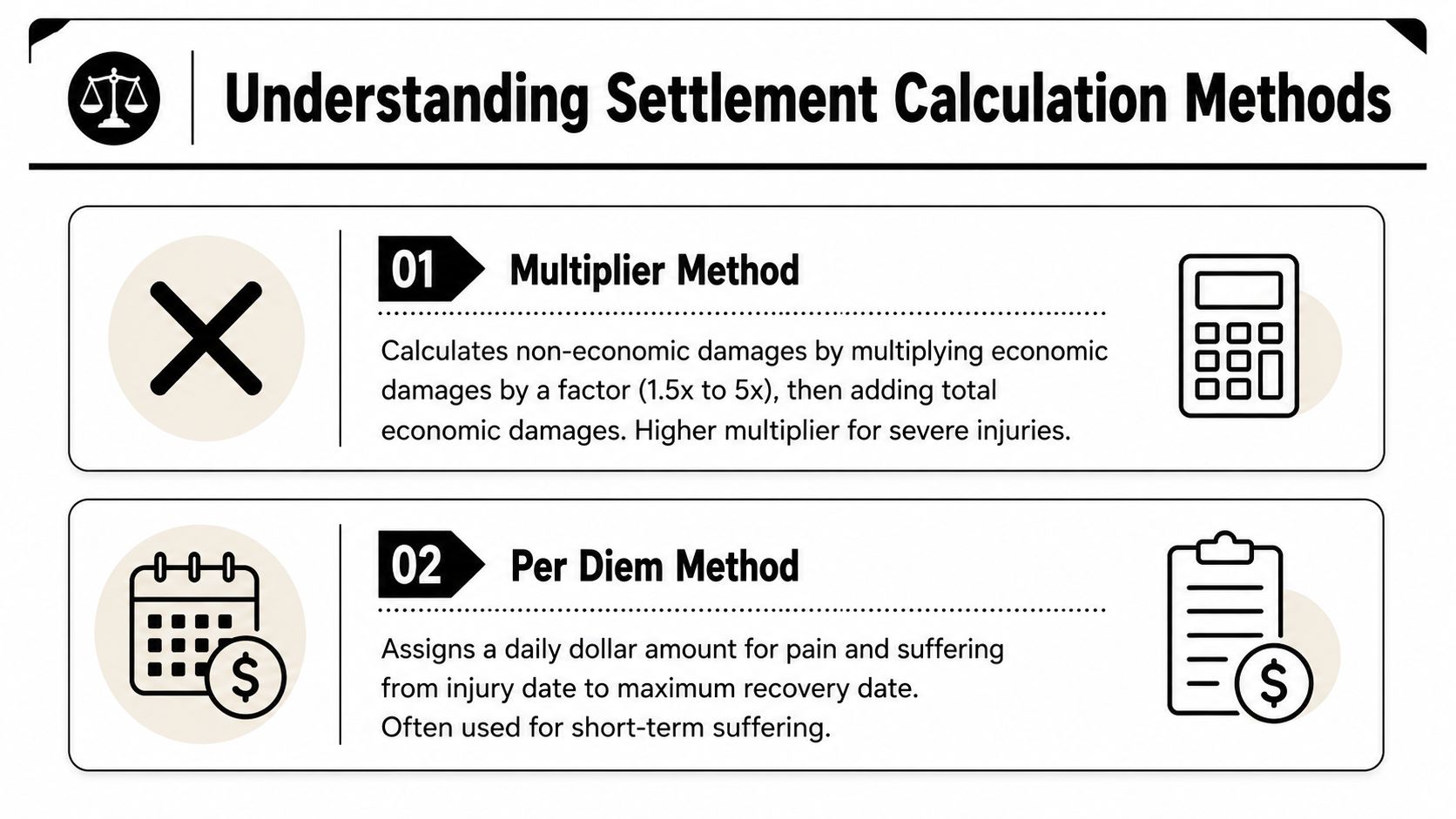
One common approach starts with your economic damages, such as medical bills and lost wages, and then applies a multiplier to estimate pain and suffering. In this discussion of truck settlement calculator formulas, the multiplier is described as commonly ranging from 1.5 to 5, with a sample calculation using $100,000 in economic losses and a multiplier of 3 to reach a $400,000 total estimate.
That sounds tidy because it turns a hard question into basic math. If the injury seems more serious, the multiplier goes up.
The problem is that the multiplier is not a fixed rule. It is a judgment call. An insurance adjuster may argue that your treatment was short, your symptoms should have resolved sooner, or your records do not support a higher figure. Your lawyer may look at the same file and see lasting limitations, ongoing pain, or signs of a brain injury that deserve far more weight.
A calculator cannot resolve that disagreement. It just picks a lane.
The per diem method
Another formula uses a daily rate. It assigns a dollar amount to each day you lived with pain, restrictions, or disruption, then multiplies that amount by the length of your recovery.
As noted in the same source, one example uses $200 per day over 300 days to estimate non-economic damages. Many readers find this easier to follow because it connects suffering to real time. If getting dressed, driving, sleeping, or working was harder every day, a daily value feels more concrete.
But this method still depends on opinion at two pressure points. Who chooses the daily rate? And who decides when your recovery ends?
Those questions become much harder in serious truck cases. A person with a traumatic brain injury may improve for a while, then struggle with memory, concentration, fatigue, or mood changes months later. A simple day-count formula does not capture that well.
What calculators are actually measuring
Online calculators usually measure the parts of a claim that are easiest to plug into blanks. They work a bit like a recipe card that asks for a few ingredients but ignores the size of the meal, how many people it must feed, and whether the kitchen even has what the recipe assumes.
Here are some of the judgment calls hiding behind the number:
- Which economic losses get entered: Some people include only current bills. Others try to add future treatment, rehabilitation, or lost earning capacity.
- How the injury is labeled: A temporary strain and a life-changing brain injury do not belong in the same box, even if a short online form treats them that way.
- How long symptoms will last: Ongoing headaches, cognitive problems, chronic pain, and emotional changes often do not fit neatly into a recovery timeline.
- How persuasive the proof is: The same injury can be valued very differently depending on medical records, specialist opinions, work history, and testimony from the people who see your daily limitations.
That is why a calculator gives you a starting estimate, not a dependable answer.
In truck cases, the missing pieces are often the ones that matter most. Future damages can dwarf current bills, especially with TBIs and other injuries that change how you work, think, or function over time. The trucking company's insurance limits, excess coverage, and financial stability also shape what a claim may be worth in the real world. A calculator cannot investigate those issues. It can only show you that your case is more complex than a single formula makes it look.
Why Online Calculators Are Dangerously Incomplete
You get home from the hospital, open a settlement calculator, type in your medical bills and missed paychecks, and a number appears on the screen. It feels concrete. It feels like an answer. In a truck accident case, it usually is not.
These tools leave out the parts of the claim that take real investigation. A serious trucking case may involve a brain injury that is still developing, several insurance policies, a motor carrier with layered corporate entities, and a defendant that looks substantial until you examine what can be collected. A calculator cannot test any of that. It only sorts a few visible facts and gives them a mathematical finish.
Averages can point you in the wrong direction
Published settlement figures show how misleading a single headline number can be. One review of truck accident settlement amounts and insurance minimums reported an average settlement of $103,654.08, a median of $30,000, and a minimum settlement of $900.
That spread is the warning sign.
An average can rise because a small number of very large cases pull it upward. A median can look more ordinary while still telling you almost nothing about your injury, your future care, or the proof available in your case. If you compare your calculator result to a broad public average, you may anchor your expectations to a number that was never built for your facts.
Insurance limits shape real-world value
People often focus on harm first. Insurance companies focus on exposure.
The same source notes federal minimum insurance levels for certain trucking operations, including $300,000 for some smaller trucks carrying non-hazardous cargo, $750,000 for larger trucks carrying non-hazardous cargo, $1,000,000 for some private tankers carrying oil, and $5,000,000 for private carriers transporting hazardous cargo. Those figures matter because a claim's paper value and its collectible value are not always the same.
That can feel unfair, and sometimes it is. If your losses are very high but the available coverage is limited, the case may require a much closer look at other defendants, umbrella policies, brokers, maintenance companies, shippers, or corporate relationships that an online form never asks about.
Solvency is part of the answer too
A calculator usually asks what you lost. It rarely asks who can pay.
That missing question matters in catastrophic injury and wrongful death cases. A company may own the truck but have limited reachable assets. A policy may exist but have exclusions, disputes, or competing claims. A judgment on paper can look strong and still be hard to collect in full.
This is one reason a calculator is better treated as a teaching tool than a valuation tool. It can help you spot categories of damage. It cannot tell you whether the person or company responsible has the coverage and financial ability to satisfy the claim.
Future damages are often the largest missing piece
This issue is even more serious when the injury involves a traumatic brain injury.
A TBI does not always announce its full impact in the first weeks after a crash. You may notice headaches, memory lapses, trouble concentrating, fatigue, irritability, or changes at work that seem subtle at first. Months later, those same symptoms may affect income, independence, and daily life in ways no online calculator could have predicted from an intake form.
That is why future damages deserve careful work. Projecting future medical care, lost earning capacity, and long-term support often requires doctors, vocational experts, and other specialists. This overview of expert witnesses in trucking accident trials helps show how those experts fit into a serious truck case.
If you are confused by that, your reaction is normal. Estimating a future loss is less like totaling receipts and more like mapping a road you have not finished traveling.
A calculator still has a limited use
Used carefully, a calculator can still help.
- It can remind you to gather bills, wage records, and other documents.
- It can show you that damages usually include more than one category of loss.
- It can prepare you to ask better questions when you speak with counsel.
For a broader consumer overview of what legal help in these cases often involves, Liberty Legal Network's guide is a useful starting point.
The problem begins when a quick estimate starts to feel like a reliable settlement figure. In truck cases, the hardest questions are often the ones calculators miss entirely. How long will the injury last? What will future care cost? How will a TBI change work and daily function? How much insurance is really available, and can the defendant pay? Those answers usually determine the case far more than the number a website gives you in thirty seconds.
The Role of a Truck Accident Attorney
You may already have a number from a calculator on your screen and still feel no closer to an answer. That is common. In a truck case, the hard part is rarely plugging in bills. The hard part is figuring out what the case will really cost you over time, what proof will hold up, and how much money is available to pay the claim.
A truck accident attorney handles those questions the way a contractor handles a cracked foundation. The goal is not to guess from the sidewalk. The goal is to inspect what is underneath, find the weak points, and document what it will take to fix the damage.
If you want a broad consumer overview of what truck accident counsel typically handles, Liberty Legal Network's guide gives a readable starting point.
What legal work changes the value discussion
A lawyer looks beyond the visible losses. That often means gathering driver qualification files, maintenance records, black box data, dispatch records, witness statements, and company policies. Those details can change who is responsible, how strongly fault can be proven, and how much pressure the trucking company feels to settle fairly.
That work matters even more when the injury is likely to outlast the first round of treatment.
A traumatic brain injury is a good example. Early records may focus on the crash, the emergency room visit, and the obvious symptoms. Months later, the bigger losses can start to come into focus. Slower thinking, headaches, sensory overload, fatigue, missed work, personality changes, and trouble managing daily tasks. A calculator usually has no way to measure that arc. A lawyer builds proof for it, often with doctors and other specialists. This explanation of expert witnesses in trucking accident trials shows how those professionals fit into a serious case.
A lawyer is not just assigning a dollar amount
The job is also to test the practical value of the claim.
That includes questions many injured people do not know to ask yet. How much coverage applies? Is there one policy or several? Is the trucking company financially stable? Are there layers of commercial insurance? Is another defendant involved, such as a broker, maintenance company, or cargo loader? A calculator cannot answer those questions, but they can shape the outcome as much as the injury itself.
Lawyers also deal with timing and insurance tactics. Adjusters may push for a statement before the full medical picture is clear. They may treat a gap in care like proof that you healed, even when the actual reason was cost, confusion, or a delayed diagnosis. They may focus on today's bills while downplaying the future effects of a brain injury or permanent limitation. Part of your attorney's role is to slow that process down, organize the evidence, and connect the records to your actual life.
Nares Law Group LLC offers a truck accident settlement estimator as an informational tool. Used carefully, a tool like that can help you organize basic facts. It cannot investigate the trucking company, project future TBI-related losses, or determine whether enough insurance or assets exist to satisfy a serious claim.
A calculator gives you a starting point. An attorney turns scattered facts into a case that can stand up to scrutiny.
Your Next Steps After a Truck Accident
If you've used a truck accident settlement calculator, treat the result as a prompt, not a promise.
The more serious the injury, the less likely a quick online estimate is to reflect reality. That's especially true if you may be dealing with a brain injury, long-term disability, or questions about the trucking company's coverage.
A calm checklist you can follow
- Keep treating: Follow your doctors' recommendations and attend appointments. Gaps in treatment can make a real injury look less serious on paper.
- Save everything: Hold onto discharge papers, bills, photos, repair information, work records, and any messages from insurers.
- Don't give a recorded statement casually: The trucking company's insurer is evaluating exposure, not protecting your future.
- Write down what you're experiencing: Pain levels, sleep problems, confusion, missed events, and daily limitations can help show the human impact of the crash.
- Ask questions early: If something feels unclear, that doesn't mean you're behind. It means the situation is complicated.
When to get legal advice
You don't need to wait until every bill arrives or every symptom resolves. In many truck cases, early legal guidance helps preserve evidence and prevents avoidable mistakes.
That matters even more when the injuries involve cognition, memory, or emotional changes. Families often sense that something is wrong before a scan or report fully explains it. A thoughtful legal review can help you evaluate not just current losses, but the risks that may unfold later.
The right next step isn't guessing better. It's getting a clearer picture of what your case involves.
If you were hurt in a trucking crash and need a clearer answer than an online calculator can provide, Nares Law Group LLC offers confidential consultations for injured people and families dealing with truck wrecks, traumatic brain injuries, wrongful death, and insurance disputes. You can talk through what happened, what may be missing from a simple estimate, and what steps may help protect your claim and your future.