A settlement agreement is a legally binding contract that ends a dispute without a trial, and federal court research found an estimated aggregate settlement rate of 66.9% in 2001–2002. If you're asking what a settlement agreement is, you're probably holding a document that looks simple on the surface but can permanently change your rights, your finances, and what happens next.
A settlement agreement is a legally binding contract that ends your legal dispute in exchange for compensation, without going to trial. For many injured people, that moment arrives after weeks or months of medical appointments, missed work, calls from insurance adjusters, and the constant pressure of not knowing what the future will cost.
Then the offer shows up.
Part of you may feel relief. Money is finally on the table. Another part of you may feel uneasy, because you know signing something this important shouldn't feel like guessing. That instinct is right. A settlement agreement is not just a check. It is a final decision about your claim, and in most cases, once you sign, you can't reopen the same case later just because your injuries turned out to be worse than expected.
That Offer in Your Hands What It Really Means
The most common version of this story starts the same way. You were hurt in a crash. You focused on treatment, tried to keep your household steady, and answered the insurance company's questions because you thought cooperation would move things along. Then a packet arrives with numbers, signature lines, and language that feels more serious than the adjuster made it sound.
That reaction is normal.
When clients ask what is settlement agreement in plain English, I tell them to think of it as the moment a legal claim turns into a binding bargain. You agree to end the dispute. The other side agrees to pay money or perform some other obligation. In return, you usually give up the right to keep fighting over that incident.
Why this matters emotionally and financially
A settlement can feel like closure, but closure has a price. The document doesn't just reflect what happened to you. It also locks in what the case is worth today, before tomorrow's uncertainties arrive.
That is why people often feel pulled in two directions at once:
- Relief: Money could help with treatment, rent, car replacement, or time off work.
- Fear: You may worry the amount won't stretch far enough if your condition changes.
- Pressure: Insurance companies often present settlement as the easy way to move on.
- Confusion: The paperwork may look routine even though the consequences are permanent.
Practical rule: Never judge a settlement agreement by the number alone. Judge it by what you're receiving, what you're giving up, and what risks remain in your future.
Settlement isn't unusual or suspicious. It's how many civil cases end. In federal court research covering two districts, settlement rates varied by case type, and tort cases in the Eastern District of Pennsylvania reached 87.2% during 2001–2002, showing how often injury-related disputes resolve without trial in that dataset (federal settlement research).
If you've never reviewed legal paperwork before, it can help to see how lawyers approach agreement language in other contexts too. A practical guide on how to review your separation agreement is useful because it highlights the same habit that matters here: slow down, read for consequences, and don't assume standard language is harmless.
The Anatomy of a Settlement Agreement
A settlement agreement works a lot like a peace treaty. Two sides have a live conflict. Neither side wants the uncertainty, expense, or delay of continuing forever. So they put the terms in writing and agree on what ends now and what happens next.
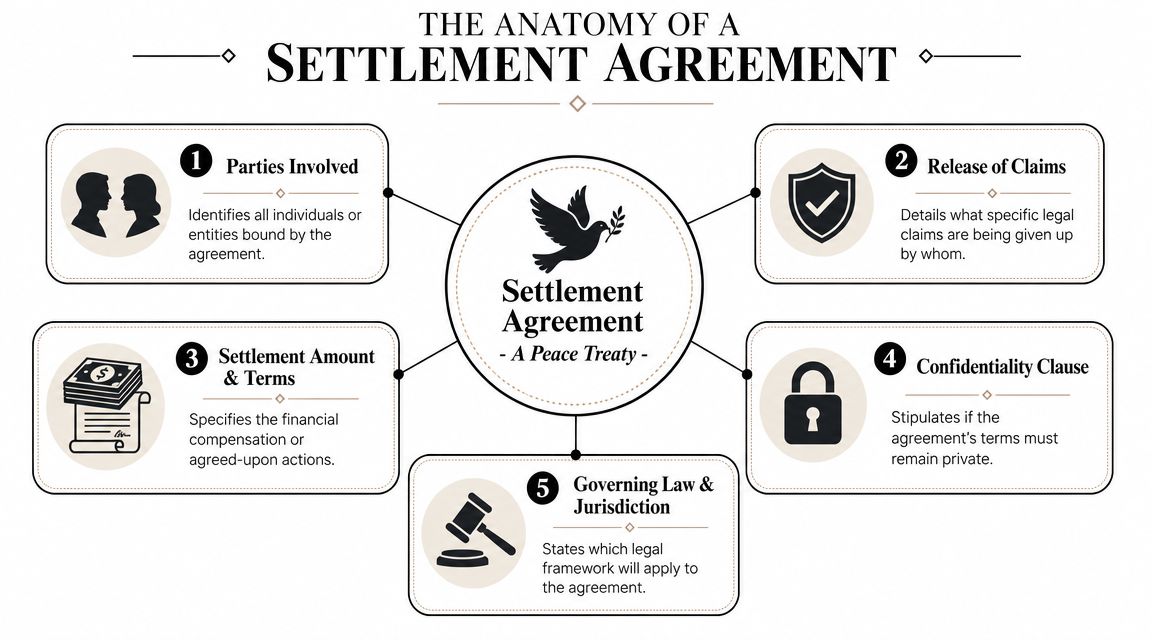
The legal engine underneath that peace treaty is contract law. A settlement agreement is an enforceable private contract where one side pays money, or agrees to some other performance, in exchange for a release of liability. Once it's signed, the claimant generally gives up the right to sue again over the same incident, and the defendant gets closure (plain-language definition of settlement agreement).
The three parts that matter most
Most personal injury settlement agreements come down to three core ideas.
Payment
This is the consideration. In ordinary language, it's what you are getting in exchange for ending the claim. It might be a single payment, a series of payments, or another negotiated term.Release
This is what you are giving up. The release says which claims are being resolved and who is protected from future legal action.Closure
This is the finality. The case ends, the dispute stops, and both sides take on whatever duties the agreement spells out.
What should be clearly identified
A good agreement should be specific enough that nobody has to guess later. At minimum, the document should clearly identify:
- The parties: Who is bound by the agreement.
- The claims: What legal issues are being released.
- The payment terms: How much is being paid, by whom, and when.
- Additional conditions: Confidentiality, no-admission language, or other obligations.
For people who want a step-by-step view of how the written agreement fits into the broader claim, this overview of the settlement process in a personal injury case is a helpful companion.
A short video can also make the concept easier to absorb before you read line by line.
Settlement versus verdict
A verdict is a decision imposed by a judge or jury after litigation. A settlement is a negotiated result both sides accept voluntarily.
That trade-off is practical, not abstract:
| Issue | Settlement | Trial verdict |
|---|---|---|
| Control | You help decide the outcome | A judge or jury decides |
| Timing | Usually faster | Usually slower |
| Risk | More certainty | More uncertainty |
| Privacy | Often more private | Court proceedings are more public |
The wrong settlement is one you sign just to end the stress. The right settlement is one you understand well enough to live with later.
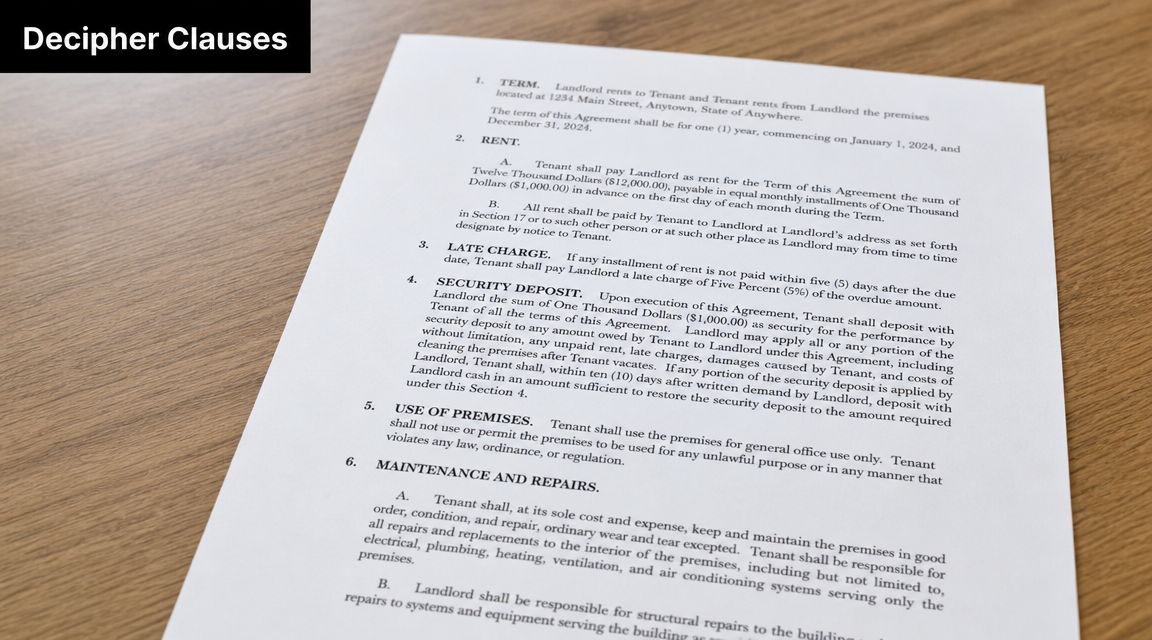
Decoding the Fine Print Common Clauses
You finally have an offer on paper. The number may catch your eye first, but the clauses that follow decide what that money really buys you, what rights you give up, and how much control you keep after the case ends.
Release of all claims
This clause usually carries the most weight. It states which claims end once you sign and payment is made.
Some releases are narrow. Others are broad enough to cover known injuries, unknown complications, and claims against people or businesses you did not realize were included. That is where injured clients can get trapped. If treatment is still developing, if a doctor has not ruled out future surgery, or if symptoms keep changing, a broad release can leave you holding the risk instead of the defendant.
Read this part slowly and ask direct questions:
- Who is being released? The named defendant, related companies, insurers, employees, contractors, or others.
- What claims are included? Only the claim already filed, or any claim connected to the incident.
- Does it cover future harm? That matters if recovery is still uncertain.
A settlement should bring closure, not a surprise six months later when a new medical problem appears and the case is already closed.
Confidentiality and nondisclosure
Confidentiality clauses often sound simple until you try to live with them. The agreement may limit what you can say about the amount, the facts, or the terms of settlement, and it may list the few people you are allowed to tell.
That can affect ordinary life more than clients expect. Can you discuss it with your adult children? Can you explain the outcome to a friend who loaned you money during recovery? Can you post anything online about the case, even without naming the amount?
Ask for concrete examples. A clause is much easier to judge when it is translated into real situations instead of abstract legal wording.
No admission of fault
Defendants often insist on language stating that payment is not an admission of liability. Clients understandably dislike this provision because it can feel as if the other side is writing a check while avoiding responsibility.
Still, this clause is common, and it usually does not change the practical result. You receive compensation without having to prove fault at trial. The trade-off is emotional as much as legal. Some clients can accept that. Others care a great deal about a formal finding of responsibility. Neither reaction is wrong, but you should recognize the difference before signing.
Review periods and legal waivers
Any clause that asks you to waive legal rights deserves extra attention. In some settings, the law requires specific protections before a waiver is valid, especially where the signer may be giving up important statutory claims.
Even outside those settings, the basic lesson is the same. Clear language matters. Time to review matters. The chance to get legal advice matters. If an agreement pressures you to sign quickly, buries the waiver in dense wording, or assumes you understand more than you do, stop and get clarification.
Fast signatures help the party who drafted the document.
Other clauses that deserve plain-English review
A few shorter provisions can create real problems later if no one explains them well:
- Payment timing: The exact deadline for payment and what happens if it is late.
- Dismissal terms: Who files the dismissal and whether payment must clear first.
- Non-disparagement: Whether you are restricted from criticizing the defendant after settlement.
- Breach and enforcement: Where a future dispute will be handled and whether attorney's fees can be recovered.
- Confidentiality penalties: Whether violating the clause triggers repayment or other financial consequences.
The goal is not to read the agreement like a law professor. It is to understand what daily life looks like after you sign, after the calls stop, and after the money arrives. That is the point where the fine print becomes real.
Lump Sum vs Structured Settlements
You may reach the point where the case value finally feels real, then face a second decision that carries just as much weight. Do you take the money now, or over time?
I tell clients to treat this as a recovery decision, not just a payment option. The right answer depends on what your life will need after the case is over. Rent, treatment, lost earning capacity, family support, and your own comfort with handling a large sum all matter.
Lump-sum payment
A lump sum puts the full settlement in your hands at once. That can bring real relief if you are behind on bills, need to secure housing, replace a vehicle, or pay for care that cannot wait.
It also shifts more responsibility to you on day one.
For some people, that control is the right fit. For others, it creates pressure. I have seen clients feel safer with immediate access to cash, and I have seen others worry that one large deposit will have to carry them much longer than it first appears. If future treatment or support is uncertain, a lump sum requires careful planning from the start.
Structured settlement
A structured settlement pays part or all of the recovery on a schedule, often monthly, yearly, or in larger planned installments. It can work well when the injury will affect your finances for years and you want income to arrive in a steadier pattern.
That schedule can protect against spending too much too soon, but it also limits flexibility. If a major expense comes up early, the payment structure may feel too rigid. Before agreeing to one, ask how the timing lines up with your actual needs, not an ideal version of your future.
This choice also affects how other financial issues play out. If your case involves reimbursement claims, a workers' compensation lien on a personal injury settlement can reduce what you keep, no matter how the settlement is paid. And if you are already dealing with old tax problems separate from the injury case, IRS tax debt relief may be part of the broader financial conversation.
Lump Sum vs. Structured Settlement at a Glance
| Factor | Lump-Sum Payment | Structured Settlement |
|---|---|---|
| Access to money | Immediate access | Paid over time |
| Flexibility | High. You decide how to use it | Lower. Payment schedule controls access |
| Budgeting help | Depends on your planning | Creates a built-in payment schedule |
| Future care planning | You must set funds aside yourself | Can match long-term needs more closely |
| Emergency response | Easier to cover urgent costs | Harder if you need a large amount quickly |
| Risk of spending too fast | Higher for some claimants | Lower for some claimants |
The best structure is the one that fits the life you will be living after the signature, not the relief you feel on settlement day alone.
A good settlement plan accounts for both. Money can solve today's pressure and still need to protect next year's stability.
Hidden Costs Liens and Taxes
The number written into a settlement agreement is often the gross figure, not the amount that lands in your bank account. That difference catches people off guard all the time.
You deserve to know the net result before you sign.
Liens can follow the settlement check
If a hospital, health insurer, workers' compensation carrier, or other payor covered treatment tied to your injury, that entity may assert a lien or reimbursement claim against the settlement. In simple terms, they may say, "We paid injury-related expenses, and we want to be repaid from the recovery."
That issue needs attention before distribution, not after. If you want a practical look at one common version of this problem, this explanation of a workers' compensation lien on a personal injury settlement is useful.
Fees and case costs
Attorney fees and case costs also come out of the settlement according to the fee agreement and the expenses advanced in the case. Ask for the breakdown in writing. Not because you distrust anyone, but because settlement is the moment when every number should become concrete.
A clean payout discussion should identify:
- Attorney fees: What percentage or formula applies under your agreement.
- Case costs: Filing fees, records, experts, or other out-of-pocket litigation expenses.
- Medical liens or reimbursements: Who is claiming repayment and on what basis.
- Net proceeds: What you should expect to receive.
Taxes aren't one-size-fits-all
Tax treatment depends on what the settlement is paying for. In general, compensation tied to physical injuries is often treated differently from amounts tied to emotional distress alone or lost wages. The safe move is to ask both your attorney and a qualified tax professional how the settlement is likely to be characterized.
If you already have tax problems unrelated to the injury case, that can affect how you plan around a payout. In that situation, a practical resource on IRS tax debt relief may help you understand possible options before funds arrive.
Ask one direct question before signing: "What is my expected take-home amount after liens, fees, costs, and any tax issues are addressed?"
That answer won't remove every uncertainty, but it will keep you from making a decision based on the wrong number.
Red Flags to Watch For Before You Sign
A bad settlement offer rarely announces itself as bad. It usually arrives dressed as urgency, convenience, or "standard paperwork." Insurance companies and defense representatives know injured people are under strain. Some use that strain to push for a cheap and early resolution.

Watch the behavior, not just the document
If the other side says you need to sign immediately, stop and ask why. Real deadlines can exist, but artificial pressure is common. An early offer may sound attractive when bills are mounting, yet early is often when your future medical picture is least clear.
Other warning signs include:
- Vague language: If key terms can mean several things, the party who drafted them may benefit later.
- Broad waivers: If the release reaches further than the dispute itself, you may be giving up more than you intend.
- Missing payment details: An agreement should say how and when payment will happen.
- Discouraging legal review: Anyone telling you not to talk to a lawyer is telling you something important about the deal.
- No accounting for future care: A quick check now can look very small if treatment continues.
Cheap peace is still expensive
A low offer can become an expensive mistake if it closes out claims for future treatment, wage loss, or lasting impairment. The danger isn't just unfairness. It's permanence.
If you're comparing offers and trying to understand how fees affect the result, this page on car accident lawyer fees can help frame the discussion.
One practical option for review is Nares Law Group LLC, which handles settlement negotiations, written releases, and post-settlement issues such as liens and distribution in personal injury matters. Whether you work with that firm or another lawyer, the important point is the same: have someone read the agreement whose job is to protect your future, not close the file fast.
Your Checklist Questions to Ask Before Signing
The safest way to approach a settlement agreement is with questions, not assumptions. If you can't get clear answers, you're not ready to sign.

Keep this checklist in front of you when you review the document:
- Do I understand every clause? If a sentence is confusing, ask for it to be translated into plain English.
- What claims am I releasing? Make sure you know exactly what rights end when you sign.
- Does this amount cover future medical needs and losses? A present payment has to account for future consequences.
- Have all liens and deductions been identified? Don't evaluate the deal by the gross figure alone.
- What is my expected net recovery? Ask for the actual take-home estimate.
- How and when will payment be made? Get the timeline and method in writing.
- Can I talk about the settlement, and with whom? Know what confidentiality really requires.
- Have I had enough time to review this without pressure? Rushed decisions are where expensive mistakes happen.
A settlement agreement can be a smart, fair resolution. It can also be a document people regret because they signed it while exhausted, worried, or underinformed. You don't need to know every legal term before the paperwork arrives. But before you sign, you do need clear answers about your rights, your obligations, and your future.
If you're weighing an injury settlement and want a clear explanation of what the paperwork means before you give up your rights, Nares Law Group LLC helps injured people review offers, understand releases, address liens, and make informed decisions about settlement.