A crash can turn ordinary money worries into something much heavier. One day you're driving to work or picking up your kids. The next day you're dealing with pain, missed time from work, repair questions, and medical bills that keep arriving before the insurance company has paid anything.
For many people, the first legal question isn't about fault. It's simpler and more urgent: Can I even afford a lawyer? That question gets even harder when you're already stressed, not sleeping well, and trying to make careful decisions with limited energy.
Car accident lawyer fees confuse people because the headline number isn't the whole story. The percentage matters. But so do case costs, the stage of the case, the wording of the fee agreement, and what happens if the case doesn't recover money. In Colorado, the details in the written contract matter too.
The First Question After a Crash Is It Worth It?
If you're hurt and bills are stacking up, hiring a lawyer can feel like adding one more financial problem to the pile. That's a reasonable fear. Few individuals regularly hire injury lawyers, and they don't know whether they're walking into an hourly bill, a retainer, or some kind of open-ended expense.
The good news is that car accident cases usually don't work that way. In most injury cases, the fee structure is built around the idea that an injured person may not have cash available at the start. That is why many firms handle these cases through a contingency arrangement instead of asking for money upfront.
Why the cost question feels so urgent
Right after a crash, people are usually trying to solve several problems at once:
- Medical treatment: You may need follow-up care before you know how serious the injury really is.
- Lost income: Missing work can hit your budget faster than almost anything else.
- Insurance pressure: Adjusters often want statements, records, and quick decisions.
- Uncertainty: You may not know whether your case will settle quickly or become a fight.
That mix makes legal cost feel risky. You don't want to sign something you don't understand. You also don't want to walk away from help just because the pricing sounds mysterious.
The right question usually isn't “Is a lawyer expensive?” It's “How is the lawyer paid, and what comes out of my recovery?”
If you're still deciding whether legal help makes sense, this guide on when to hire a personal injury attorney can help you think through timing and circumstances.
What clarity should look like
A trustworthy fee conversation should leave you knowing three things:
- How the attorney gets paid
- What separate case expenses may arise
- What you could owe, if anything, if the case is unsuccessful
Those points sound basic, but they're where most confusion starts. Once you understand them, car accident lawyer fees become much easier to evaluate calmly.
How Contingency Fees Make Justice Accessible
A contingency fee means the lawyer's fee depends on recovering money for you. If there is no recovery, there is no attorney fee. That is the core idea.
Rather than paying a lawyer hourly, as you would an accountant or contractor, you and the lawyer agree that the lawyer will be paid from the case's outcome. The fee is a pre-agreed share of the money recovered.
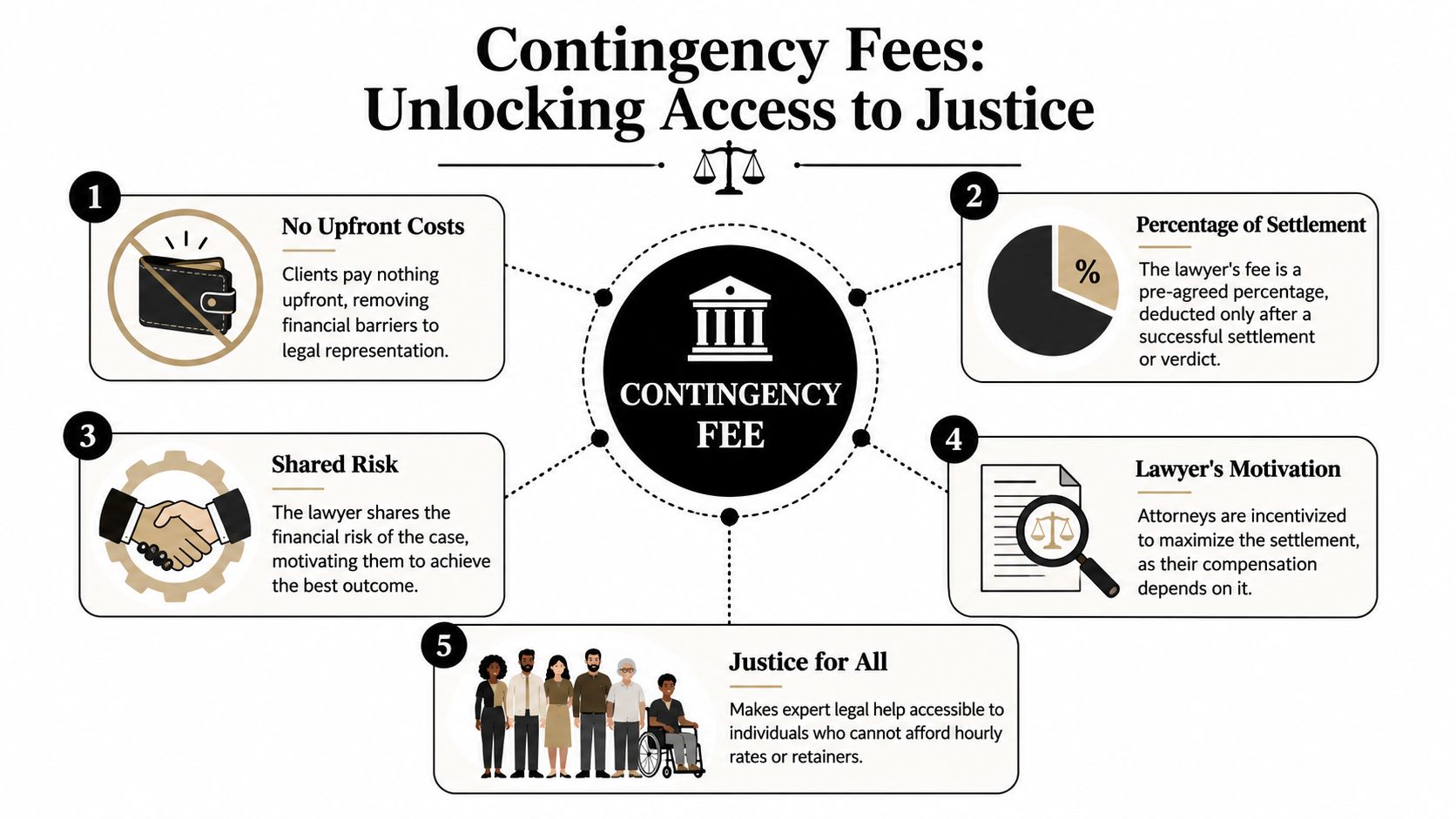
That structure matters because injury claims often arrive at the worst possible time financially. According to this discussion of accident legal representation costs, car accident lawyer fees are commonly structured as contingency fees, meaning the client pays nothing upfront and the lawyer is paid only if money is recovered. The same source states that a widely cited Martindale-Nolo finding places the average car accident attorney fee between 25% and 40% of the recovery, while the American Bar Association notes contingency arrangements are often about one-third of the recovery.
What no fee unless you win usually means
People often hear “no fee unless we win” and assume that covers every dollar connected to the case. It usually refers to the attorney's fee for legal work. That's important, but it isn't the whole financial picture.
Here is the basic framework:
- Attorney fee: The lawyer's compensation for time, strategy, negotiation, and litigation work.
- Case costs: Separate expenses used to investigate and prove the claim.
- Recovery-based payment: The lawyer's fee is paid from money recovered in settlement or verdict, rather than from your pocket at the start.
This short video gives a useful overview of how that arrangement works in practice:
Why this model helps injured clients
Contingency fees became common because they shift financial risk away from the injured client and toward the law firm. That makes legal representation more accessible when someone is already dealing with medical bills, lost wages, and disputed liability.
In plain language, the firm is saying: we'll invest work now and get paid later only if we recover money.
Practical rule: If a lawyer says the case is contingency-based, ask them to explain the difference between the fee for legal work and the costs of building the case.
That one question clears up a lot of hidden confusion early.
Decoding Fee Percentages Settlement vs Trial
Many people expect one flat percentage. In reality, car accident lawyer fees often change based on how far the case goes.
A case that resolves before a lawsuit is filed is usually less expensive for the firm to handle than a case that moves through filing, discovery, expert work, trial preparation, or appeal. That is why fee agreements often use different percentages for different stages.
Why the percentage can increase
A useful benchmark appears in this overview of settlement percentages in accident cases. It explains that many firms cluster around the one-third mark, while the range widens as litigation intensifies. It also notes typical contingency fees of 30% to 40%, with simple pre-suit resolutions often near 33.3% and trial-ready or appealed cases moving toward 40%.
That increase isn't arbitrary. Litigation adds work and expense such as:
- Formal filing: Preparing and filing a lawsuit starts a more demanding process.
- Discovery: Lawyers exchange documents, written questions, and evidence.
- Depositions: Witnesses, parties, and sometimes doctors give sworn testimony.
- Experts: Some cases need technical or medical analysis to prove fault or damages.
- Trial preparation: Exhibits, motions, witness prep, and courtroom strategy take time.
A fee that rises with litigation reflects that the lawyer is taking on more labor, more overhead, and more risk.
Why a higher fee isn't always a bad sign
Clients sometimes see a higher trial percentage and assume the arrangement is unfair. Sometimes it's a realistic reflection of what the case may require.
If a claim is heavily disputed, a lower percentage may not be available because the lawyer expects to spend much more time and money getting the case ready for trial. That doesn't mean every case should go to court. It means the agreement should appropriately reflect the likely path of the case.
If you'd like a clearer sense of common arrangements, this explanation of what percentage personal injury lawyers take can help you compare terms more confidently.
A fee agreement should tell you not only the percentage, but also when that percentage changes.
Colorado-specific point to keep in mind
Colorado clients should expect a signed written contingency fee agreement. That isn't just good practice. It's part of professional responsibility. A proper agreement should spell out the fee structure and help you understand how the financial terms work before you commit.
When the writing is vague, confusion usually shows up at the end of the case, when the settlement statement arrives and emotions are already high.
Understanding Case Costs and Expenses
This is the part many people don't realize they need to ask about. Fees and costs are not the same thing.
The fee pays the lawyer for legal work. Costs are the out-of-pocket expenses required to investigate, document, and present the claim. If you only focus on the percentage and ignore costs, the final numbers can still surprise you.
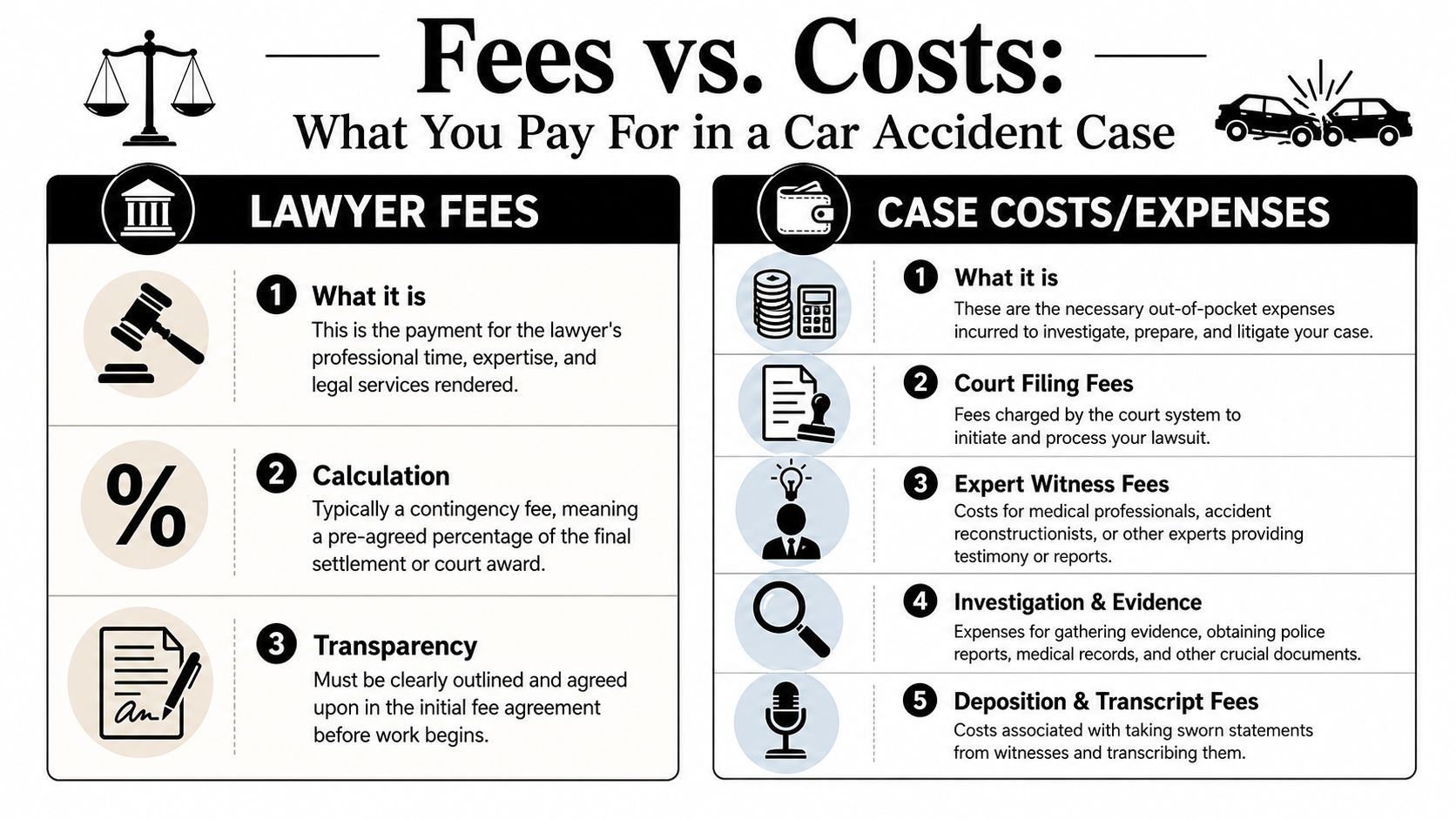
According to this explanation of car accident legal charges, contingency agreements usually separate attorney compensation from case expenses. The same source explains that a lawyer may front costs for deposition transcripts, accident reconstruction, medical-record retrieval, and expert witnesses, then recoup those costs from the settlement after the fee is calculated.
Common examples of case costs
A car accident claim may involve costs such as:
- Medical records and bills: Providers often charge for record retrieval.
- Court filing fees: These are paid to open a lawsuit.
- Deposition transcripts: Testimony has to be recorded and transcribed.
- Expert witness fees: Doctors, reconstruction experts, or other specialists may be needed.
- Investigation expenses: Evidence collection can require time and outside services.
Some cases stay relatively lean. Others become document-heavy and expert-driven.
Why two clients with the same settlement may take home different amounts
The financial figures demonstrate their true impact. Two people could both recover the same gross amount and still receive very different net amounts.
One case might settle early with modest expense. Another might require multiple experts, depositions, and months of litigation. Even if the fee percentage were the same, the second client could take home less because the reimbursable costs are higher.
A few questions can prevent confusion:
- Are costs deducted before or after the fee is calculated?
- What kinds of expenses will the firm advance?
- Will I receive updates as costs accumulate?
- If the case is lost, who is responsible for those costs?
Ask for the answer in writing, not just in conversation.
A Colorado transparency habit worth adopting
Before signing, ask the firm to walk you through a mock settlement statement. It doesn't need exact future numbers. It should show the order of deductions so you can see how fee, costs, medical bills, and liens might affect the final disbursement.
That kind of explanation is where clients often separate clear firms from confusing ones.
Sample Fee Calculations From Settlement to Your Pocket
Abstract explanations help, but examples make the issue easier to grasp. Here are two simplified stories using the same gross recovery amount.
The first case resolves before suit. The second becomes more complex and reaches a litigated stage. The point isn't that one path is always better. The point is that the path changes the economics.
According to this article on how fee percentages affect net recovery, in U.S. markets car accident lawyers typically charge about 33% to 40% of the recovery, and the fee is applied to the gross recovery. The same source gives a straightforward example: a $100,000 settlement at 33.33% yields a $33,333 attorney fee before costs, while a 40% fee on the same $100,000 recovery yields $40,000, reducing the client's net recovery by $6,667 on the same gross settlement.
Case A and Case B side by side
| Item | Case A: Pre-Litigation Settlement | Case B: Litigated Award |
|---|---|---|
| Gross recovery | $100,000 | $100,000 |
| Attorney fee percentage | 33.33% | 40% |
| Attorney fee | $33,333 | $40,000 |
| Subtotal after attorney fee | $66,667 | $60,000 |
| Reimbursed case costs | Varies by case | Varies by case |
| Client's net recovery | Subtotal minus costs and other obligations | Subtotal minus costs and other obligations |
What these examples show
Case A is the simpler scenario. The claim resolves earlier, the fee is lower, and there may be fewer expenses to reimburse. That doesn't guarantee a larger net in every real case, but it usually creates less financial drag.
Case B reflects a case that required more procedural work. The higher fee percentage alone changes the net position before costs are even added. If litigation also created larger expenses, the gap can widen further.
If you want help estimating how injuries, insurance, and case path may affect value more broadly, this motor vehicle accident settlement estimator is a useful starting point.
Same gross recovery, different route, different take-home amount.
The part clients often miss
Clients understandably focus on the settlement headline. Lawyers and insurers may use that gross number when talking about resolution. But the amount that reaches your pocket depends on the full chain of deductions.
That is why transparent firms explain net recovery, not just gross recovery.
Questions to Ask Before Signing a Fee Agreement
A good consultation should leave you calmer, not more confused. If you feel rushed, pressured, or embarrassed to ask basic money questions, stop and slow the process down.
The fee agreement is one of the most important financial documents in your case. In Colorado, a contingency arrangement should be in a signed writing, and you should have the chance to review it carefully before signing.
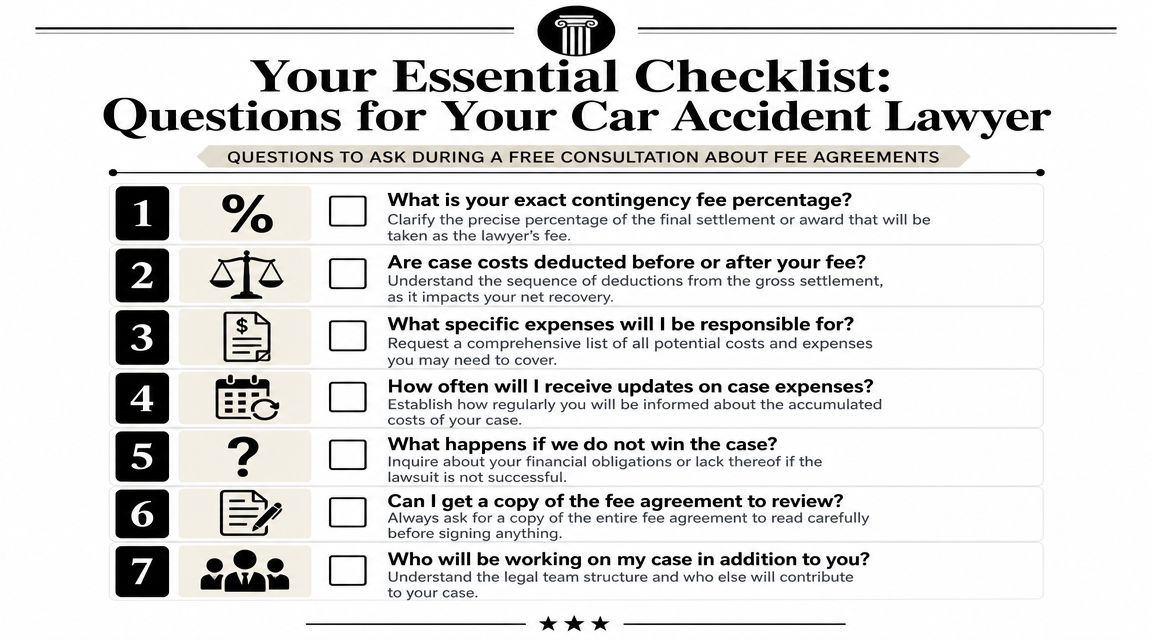
The questions that matter most
Many clients care most about what happens to costs if the case is lost. As this discussion of accident-lawyer cost questions notes, attorney fees are commonly contingent, but case costs such as filing fees and expert witnesses may be handled differently depending on the contract and firm policy.
Bring these questions to every consultation:
- What is your exact contingency fee percentage? Ask whether the percentage changes if the case settles, is filed, goes to trial, or reaches appeal.
- How are case costs handled? Ask what expenses the firm typically advances and how those are tracked.
- Are costs deducted before or after your fee is calculated? That order can affect your net recovery.
- What happens if we lose? This is one of the most important questions in the entire meeting.
- Will I get a written closing statement? You should be able to see how every dollar is distributed.
- Who will work on my case? Some clients hire one lawyer and mostly communicate with staff.
- Can I take the agreement home and review it first? You should never feel pushed to sign on the spot.
What a clear answer sounds like
A clear answer is specific. A vague answer is dangerous.
Here is the difference:
| Question | Clear answer | Vague answer |
|---|---|---|
| Fee percentage | “It is one rate before suit and another if litigation is required, and both are in the contract.” | “It depends, but it's standard.” |
| Costs | “We advance listed costs and explain how reimbursement works.” | “Don't worry about that part.” |
| If the case is lost | “The agreement explains whether you owe any costs.” | “We'll deal with that later.” |
One practical way to compare firms
If you're interviewing more than one lawyer, ask each office for the same three things:
- A sample fee agreement
- A sample closing statement
- A verbal explanation of who pays costs if the case loses
Nares Law Group LLC is one Colorado firm that handles personal injury cases on a contingency-fee basis and offers consultations for motor vehicle injury matters. Whether you speak with that firm or another one, compare the documents, not just the promises.
You are not being difficult by asking money questions. You are being careful.
Frequently Asked Questions About Lawyer Fees
Can you negotiate car accident lawyer fees
Sometimes, yes. Fee terms are set by contract, so it's fair to ask questions and discuss the structure. But don't focus only on the percentage. Ask about costs, communication, trial readiness, and who will handle the file day to day.
What happens if I change lawyers mid-case
You can usually change lawyers, but that can affect how fees are handled later. The first lawyer may claim a share for work already performed. That issue should be discussed before you switch so you understand how it could affect your recovery.
What does co-counsel or fee-sharing mean
In some complex cases, especially trucking or catastrophic injury matters, one firm may work with another. If that happens, the client should be told how representation is structured and how the fee arrangement is handled. The key question is whether your total fee changes or whether firms are dividing the agreed fee between themselves.
Does a higher fee always mean a better lawyer
No. A higher percentage can reflect case stage, complexity, or contract structure. It does not automatically prove higher quality. Look for clarity, responsiveness, courtroom experience, and a fee agreement you can understand.
If the lawyer says no fee unless we win, am I guaranteed to owe nothing
Not necessarily. That phrase often refers to attorney fees, not every possible case expense. The agreement must answer what happens to costs if no money is recovered.
If you were hurt in a crash and want a clear explanation of your options, Nares Law Group LLC offers consultations for Colorado injury cases and can explain how contingency fees, case costs, and settlement distribution would apply to your situation.