You may be reading this with an ice pack on your ankle, a discharge paper on the kitchen table, and a lot of questions running at once. You fell in a grocery store, slipped on apartment stairs, tripped on a broken walkway, or got hurt in a parking lot. Now the property owner or insurer may be acting like what happened was just an accident.
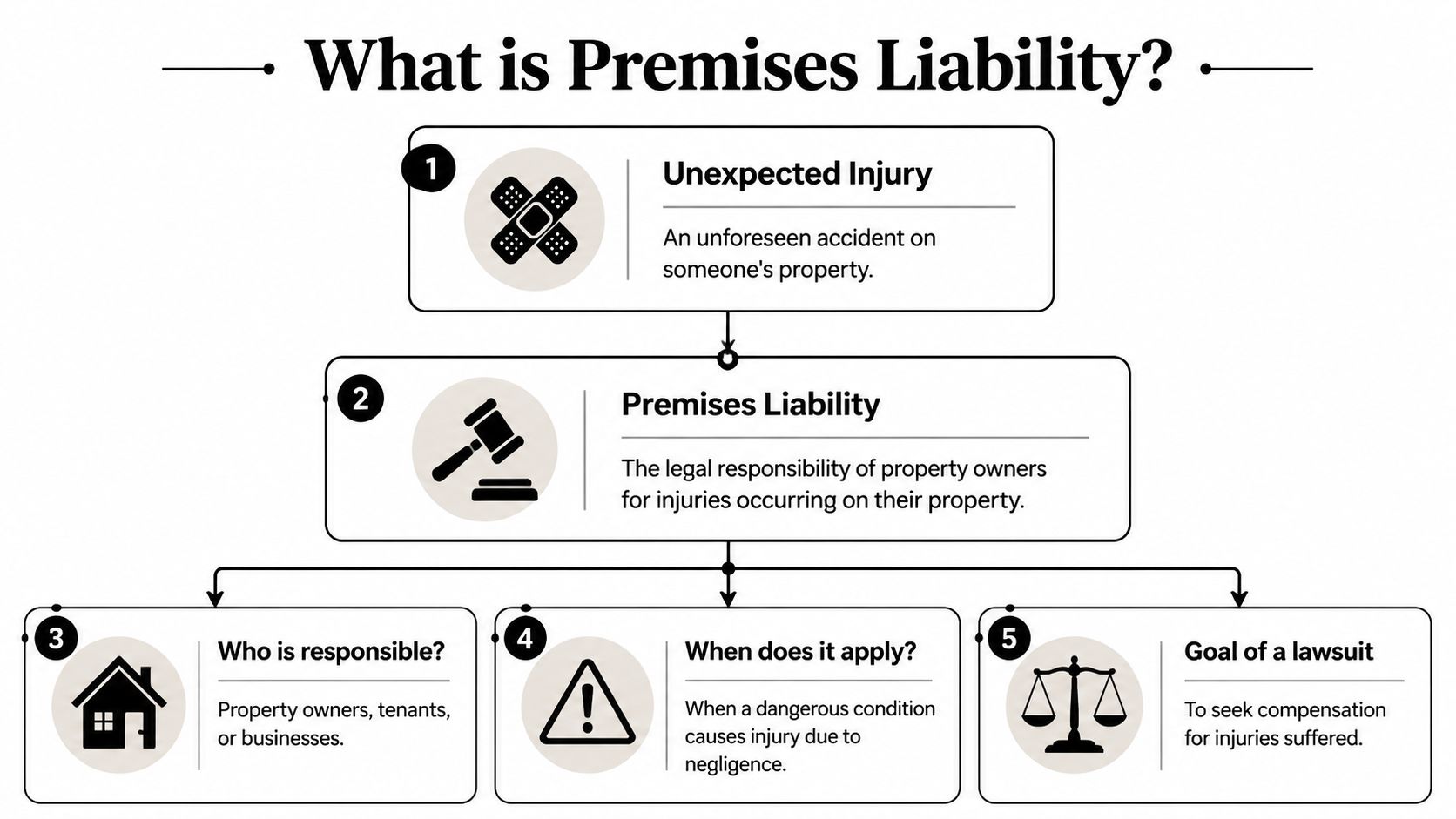
Colorado law doesn't treat every unsafe property injury as “just one of those things.” A premises liability lawsuit is the legal process for asking whether someone responsible for a property failed to make it reasonably safe, and whether that failure caused your injury. When people understand how these cases work, they usually feel less overwhelmed and more in control.
What a Premises Liability Lawsuit Really Means
A premises liability lawsuit centers on broken trust. When a business opens its doors to customers, when a landlord maintains common areas, or when a property occupant invites people in, the law expects reasonable care.
A simple analogy helps. If you invite a friend to dinner, you wouldn't leave a loose step, a hidden spill, or a broken handrail without warning them. Property law works in a similar way. The person or business in charge of the property has a duty to address hazards they know about, or hazards they should have found through reasonable attention.
It is not limited to slip and falls
People often hear “premises liability” and think only about wet floors. The category is broader than that. It can involve unsafe stairs, poor lighting, falling objects, broken sidewalks, inadequate maintenance, hazards in parking areas, or conditions on property that create danger nearby.
What matters is not the label. What matters is whether a dangerous condition existed and whether a person with responsibility for the property failed to act reasonably.
Practical rule: The key question is usually not “Did I get hurt on someone else's property?” It's “Who had control over that area, and what should they have done before I was injured?”
Why these cases matter
These claims aren't rare side issues in civil court. Premises liability cases made up 17% of tort cases disposed of in state courts in one Bureau of Justice Statistics data set, and in 75% of those cases the defendant was a business, according to this summary of premises liability case statistics and trends. That tells you something important. Businesses and commercial property operators are often the ones defending these cases because they control spaces used by the public every day.
A lawsuit isn't about punishing every accident. It's about accountability when a preventable hazard causes real harm. If you're facing medical bills, time away from work, or pain that changed your routine, the legal system gives you a way to ask for compensation and answers.
The Four Elements of a Successful Claim in Colorado
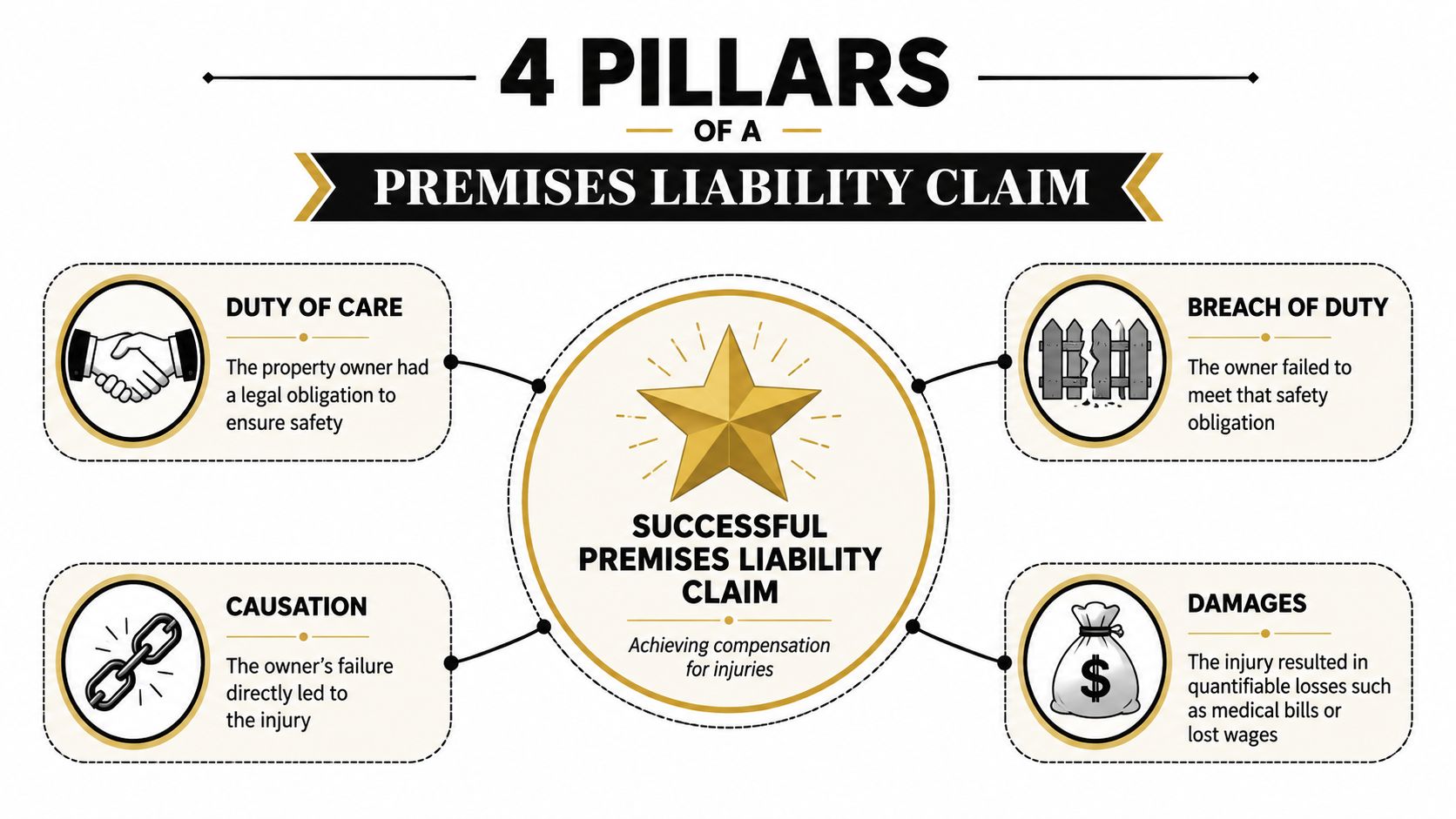
Colorado premises cases still rest on familiar negligence principles. You must prove four core elements, and one missing piece can sink the claim.
Duty and who actually controlled the property
The first issue is duty. The law asks whether the defendant owed you a duty of reasonable care. In a premises case, that usually turns on possession and control, not just whose name is on a deed. The legal rule is stated in ICLE's discussion of premises liability negligence principles, which explains that the foundation of a premises liability case requires proving duty, breach, causation, and damages, and that liability depends on possession and control rather than ownership alone.
That means a tenant, store operator, management company, or another party in charge of the area may be the proper defendant. If you fell on stairs in an apartment complex, for example, the question may be whether the landlord or manager controlled that common area. If you were hurt inside a leased retail store, the store itself may be central because it controlled the customer space.
Breach, causation, and damages
Once duty is established, the next question is breach. Did the responsible party fail to act reasonably? A missing warning sign near a fresh spill, ignored ice accumulation, or a handrail left unrepaired can all be examples depending on the facts.
Then comes causation. You have to connect the unsafe condition to the injury. If a customer slips, falls, and immediately reports pain in the same body part later diagnosed in the ER, that's the kind of chain lawyers work to document.
Finally, there are damages. Those include the losses that flowed from the injury, such as medical treatment, lost income, and personal suffering.
Why your visitor status matters in Colorado
The way Colorado, like other states, distinguishes among categories of visitors often blindsides many people. The broad categories are invitees, licensees, and trespassers.
| Visitor status | Common example | Why it matters |
|---|---|---|
| Invitee | A customer in a store | The highest level of protection generally applies |
| Licensee | A social guest in a home | The duty is narrower than for a customer |
| Trespasser | A person on property without permission | The duty is limited in most situations |
A customer entering a coffee shop to buy a drink is there for the business's benefit. A friend attending a backyard barbecue is usually there as a social guest. Someone climbing a fence into a closed area is in a different category altogether.
Your legal status works like the starting line in a race. It doesn't decide the result, but it changes the rules you begin with.
That's why the same broken step can lead to very different legal analysis depending on why you were there and what the property occupant knew.
How to Prove the Property Owner Was Negligent
Evidence wins or loses these cases. Not suspicion. Not frustration. Not the fact that you were badly hurt. The most common fight is over notice. Did the property owner know about the hazard, or should they have known?
A Colorado-specific point matters here. A 2025 Colorado State Bar study found that 38% of dismissed premises liability cases were rejected because the plaintiff failed to prove the property owner had enough time to discover and fix the condition. In other words, many cases fail on constructive knowledge, not because the injury wasn't real.
Here's the practical difference:
- Actual knowledge means someone really knew. A tenant complained about a broken stair. An employee saw the spill. A manager got an email about poor lighting.
- Constructive knowledge means the condition existed long enough, or was obvious enough, that a reasonable inspection should have found it.
The evidence that makes notice easier to prove
Start by thinking like a timeline builder. You want to show what the hazard was, where it was, how long it likely existed, and what happened after the injury.
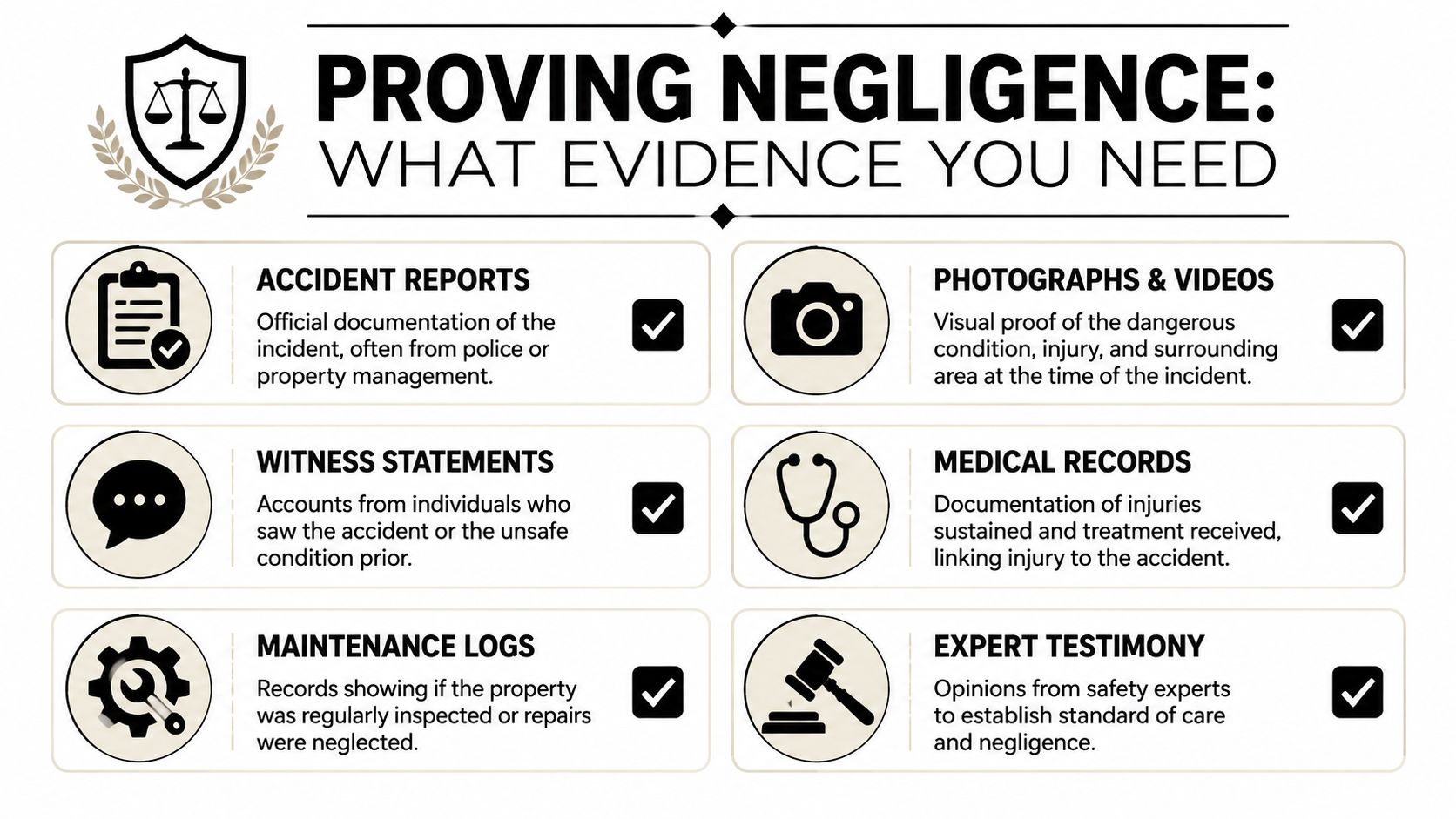
Useful proof often includes:
- Photographs and video: Take wide shots and close-ups. Show the spill, broken edge, missing light, uneven surface, or lack of warning signs.
- Incident reports: If a store manager or property supervisor writes a report, that may lock in the time, place, and early descriptions.
- Witness information: A witness might say the puddle had been there a while, or that staff walked by it.
- Medical records: These connect the event to the injury and document how quickly symptoms appeared.
- Maintenance records: Inspection logs, repair requests, and complaint records can show whether the property was being monitored.
- Expert review: In some cases, a safety expert can explain why the condition violated ordinary safety practice.
This walkthrough on how to investigate a premises liability case gives a useful overview of how lawyers piece those records together.
What constructive knowledge looks like in real life
Suppose you slipped near a freezer in a grocery store. If the water had just spilled seconds before you stepped there, proving negligence may be hard. If witness statements, video, or maintenance gaps suggest the leak had been recurring for hours or days, your case becomes very different.
That same reasoning applies to stairs and walking surfaces. Design and maintenance details matter. If your injury involved steps, visibility, traction, and edge definition may become important. Resources on digital accessibility for stair treads can help people understand why stair safety details are not cosmetic. They affect whether users can perceive and move through the hazard safely.
A short explainer may help if this all still feels abstract:
The strongest premises liability lawsuit usually tells a time story. Not just “this was dangerous,” but “this was dangerous long enough that someone responsible should have caught it.”
Understanding the Compensation You Can Pursue
When people ask what a case is worth, they're usually asking a more personal question. How will I pay for what this injury has done to my life?
Compensation in a premises liability lawsuit usually falls into two broad categories: economic damages and non-economic damages. Thinking in those buckets helps.
Economic damages
These are the losses you can point to on paper.
A few examples include:
- Medical bills for emergency care, imaging, surgery, medication, physical therapy, and follow-up treatment
- Lost wages if you missed work while healing
- Future care costs if the injury requires ongoing treatment or support
- Out-of-pocket expenses tied to the injury, such as travel for appointments or help at home
If you fractured a hip after falling on unsafe stairs, economic damages might include the ambulance, hospital stay, orthopedic care, and time away from your job.
Non-economic damages
These are real losses, even though they don't come with a receipt.
They can include pain, emotional distress, physical impairment, inconvenience, and loss of enjoyment of normal life. A back injury that leaves you unable to sleep comfortably, exercise, or pick up your child affects your life in ways a billing statement won't fully capture.
A settlement or verdict is supposed to address both what the injury cost you and what the injury changed for you.
Managing expectations
Not every valid case becomes a major verdict. The value depends on injury severity, clarity of liability, quality of evidence, and how well the damages are documented.
At the same time, these cases can be significant. Only about 39% of premises liability cases are successful for plaintiffs at trial, but some verdicts have exceeded $14 million, as described in GBW's discussion of premises liability case results and trends. That doesn't mean every case is worth a large amount. It means serious injuries paired with strong proof can lead to substantial recovery.
Colorado Deadlines and Common Legal Defenses
A good case can still be lost if it's filed too late or if the defense frames the facts better than the injured person does. Timing and defenses matter as much as the injury itself.
The filing deadline in Colorado
In many jurisdictions, including Colorado, the general filing deadline for a premises liability claim is two years from the date of injury. Claims involving government entities can trigger much shorter notice requirements. Missing a deadline can end the case before it begins.
If you want a broader comparison resource, this guide for PI attorneys on state limits gives a helpful national overview. For Colorado-specific timing, this article on the statute of limitations for personal injury in Colorado is a practical place to start.
Defenses you're likely to hear
Property owners and insurers often use a familiar set of arguments. They may say:
- The hazard was open and obvious: You should have seen it and avoided it.
- They lacked notice: The spill, crack, or defect appeared too recently for them to discover it.
- Someone else controlled the area: The wrong party was sued.
- Your own actions caused the fall: Footwear, distraction, speed, or inattention become part of the defense story.
Colorado also applies modified comparative fault, which means your own carelessness can reduce what you recover. If the defense can persuade a jury that you share blame, the value of the claim may drop. In some cases, that issue becomes the central fight.
Why commercial cases are often hard fought
Commercial defendants are common in this area of law. In one study, premises liability cases accounted for 17% of tort cases in major counties, and businesses were defendants in 75% of them, as noted earlier in the article. Businesses often have insurers, risk managers, and counsel involved early. That usually means incident reports are controlled, surveillance footage may disappear if not requested quickly, and narratives start forming almost immediately.
A wet floor case can turn into a records case. A stair fall can turn into a maintenance-history case. A parking lot injury can become a control-and-boundaries dispute. That's why delay helps the defense.
Your First Steps After an Injury on Unsafe Property
The hours after a fall or other property injury are chaotic. People are embarrassed, hurting, and often eager to go home. But those first steps can protect both your health and your case.
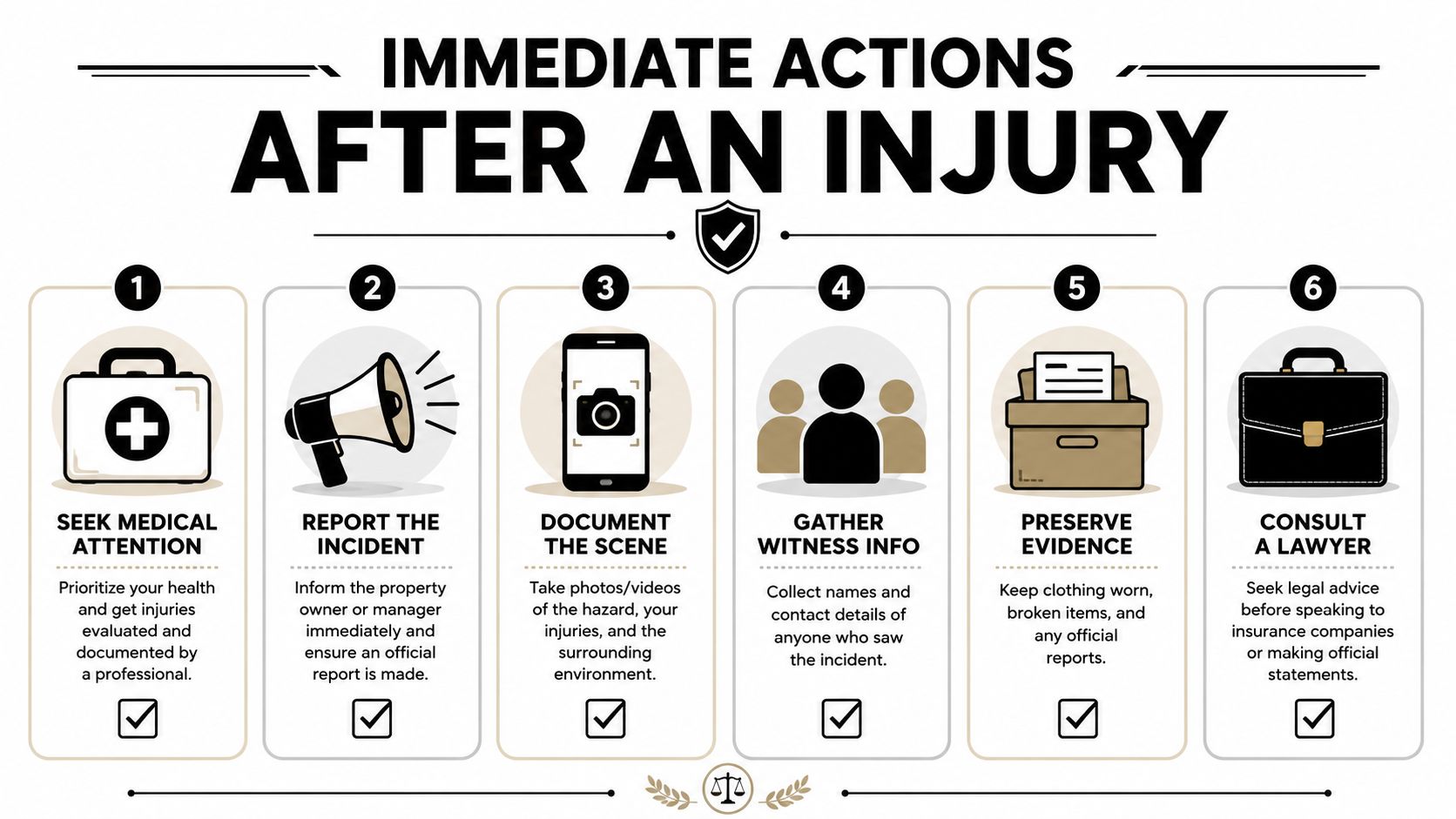
What to do right away
- Get medical attention first. Even if you think it's “just sore,” symptoms often worsen later. A prompt evaluation creates a clean medical record.
- Report the incident. Tell the manager, landlord, employee, or property representative. Ask that an incident report be made.
- Document the scene. Use your phone. Capture the hazard, your shoes, lighting, weather, warnings, and the surrounding area.
- Collect witness names and numbers. Independent witnesses often make a big difference.
- Preserve what you were wearing. Don't wash or throw away your shoes and clothing if they may matter later.
- Be careful with insurers. Don't give a recorded statement before you understand your rights.
Why these steps matter
Each step fills a gap the defense may later try to exploit. No report means they may question whether it happened there. No photos means they may say the condition wasn't dangerous. No early medical treatment means they may argue something else caused the injury.
If you're looking for legal help, Nares Law Group LLC handles investigation, treatment coordination, negotiation, trial, and settlement in injury cases, including premises claims. Whether you hire that firm or another lawyer, the key is to speak with counsel before evidence fades and before an adjuster shapes the story for you.
FAQ Navigating Your Premises Liability Lawsuit
How long does a premises liability lawsuit take
It depends on liability, injury severity, medical treatment, and whether the case settles or goes to trial. A claim may resolve through negotiation after treatment becomes clearer. If fault is disputed, a lawsuit, discovery, expert review, and trial preparation can stretch the timeline much longer.
The right mindset is to think in phases, not in one date on the calendar. Investigation comes first. Then medical development, negotiation, and possibly litigation.
Will I have to go to court
Not always. Many claims resolve without a full trial. But good settlements usually happen because the injured person is prepared to prove the case if needed.
That preparation includes documents, witnesses, records, and a clear theory of negligence. Cases settle better when the defense knows you can present them well in court.
When should I hire an attorney
Sooner than one might expect. If your injuries are serious, the property owner denies fault, a business or insurer is involved, or the hazard may disappear quickly, legal guidance early on usually helps.
Lawyers can send preservation requests, gather maintenance records, review control of the property, and evaluate whether your visitor status changes the legal duty owed to you.
Does my status as a visitor really change my case
Yes. And many people are confused about exactly how. A common point of confusion for 42% of consumers is how visitor status affects a claim in their state, especially when comparing situations like being a customer versus a social guest. That confusion is one reason generic online guides often leave people uncertain about whether they have a viable claim.
If you want more direct answers to common concerns, this premises liability FAQ addresses many of the practical questions people ask after getting hurt.
If you were injured on unsafe property and need help understanding whether you have a claim, Nares Law Group LLC offers Colorado-focused guidance on investigation, deadlines, insurance issues, and the evidence needed to move a premises liability lawsuit forward.