After an accident, many individuals ask the same question before they ask about court, evidence, or deadlines.
How am I supposed to pay for a lawyer when I'm already dealing with medical bills, missed work, car repairs, and calls from the insurance company?
That worry is real. You may be hurting, trying to keep your household running, and wondering whether legal help is only for people who can afford a large retainer. A contingency fee agreement is often what changes that picture. It lets an injured person hire a personal injury lawyer without paying attorney's fees up front, which is why this kind of agreement matters so much in crash and injury cases.
Your Guide After an Injury
A serious wreck can turn an ordinary week upside down. One day you're driving to work or picking up your kids. The next day you're scheduling doctor visits, talking with body shops, missing shifts, and trying to understand paperwork that suddenly feels urgent.
Individuals don't often call a lawyer because they love legal documents. They call because life became unstable. They want someone to deal with the insurance company, gather records, explain next steps, and protect them from signing something that costs them later.
That's where a contingency fee agreement comes in. Think of it less like buying a service and more like opening a door that seemed locked. Instead of paying by the hour, you and the lawyer agree that the lawyer's fee will come from the recovery if the case succeeds.
Why this matters when money is tight
In the United States, the standard contingency fee charged by most attorneys typically falls between 33.3% and 45% of the total recovery, and it generally does not exceed 50%. Most lawyers charge about 33% to 35%, depending on the case and when it resolves, according to Gilman & Bedigian's discussion of contingency fee limits.
That structure exists for a simple reason. If someone had to pay hourly legal bills after a crash, many valid cases would never be brought at all.
A contingency arrangement opens the courthouse doors to people who might not otherwise have the financial means to afford litigation.
For an injured client, that can be the difference between facing a powerful insurance company alone and having an advocate who knows how to investigate, negotiate, and, if needed, litigate.
The emotional side of the agreement
Clients often feel embarrassed asking, “Can I even afford to hire you?” You shouldn't. It's one of the most important questions you can ask.
A good lawyer won't brush that off. They'll explain the fee agreement in plain English, tell you how costs work, and make sure you understand what happens if the case settles, if a lawsuit is filed, and if the case doesn't recover anything. The right agreement should reduce stress, not add to it.
What Is a Contingency Fee Agreement
A contingency fee agreement is a written contract between you and your lawyer. It says the lawyer gets paid a percentage of the money recovered for you, rather than charging hourly fees as the case moves along.
The easiest way to understand it is to think of it as a partnership with shared risk. You bring the facts, the injuries, the medical history, and the authority to make decisions in your case. The law firm brings time, legal strategy, negotiation skill, and the work needed to build the claim.
A simple partnership analogy
If you hired a contractor by the hour, you'd pay whether the project turned out well or poorly. A contingency fee agreement works differently. The lawyer's payment depends on getting a result for you.
That means your lawyer has a direct stake in moving the case forward and trying to obtain a recovery. The arrangement aligns the lawyer's interests with yours in an unusually practical way.
Core idea: If there is no recovery, there is generally no attorney's fee.
That point matters because people often confuse fees with costs. The attorney's fee is the lawyer's compensation for legal work. Case costs are separate expenses tied to pursuing the claim. I'll explain that distinction later, because it's where many clients get surprised.
Why injury cases often use this model
Personal injury cases fit contingency arrangements because the client is usually under pressure already. They may be out of work. They may be paying for treatment. They may also be dealing with an insurer that wants a quick statement or a quick settlement before the full impact of the injury is clear.
A contingency fee agreement helps level that field. Under Cornell's Legal Information Institute overview of contingency fees, this structure is widely used in personal injury matters, and the attorney often fronts litigation costs that are repaid from a successful recovery.
What the agreement should make clear
A sound agreement shouldn't feel mysterious. At minimum, you should be able to answer these questions after reading it:
- What percentage applies: Is the fee one rate before filing suit and another after litigation begins?
- How costs are handled: Are costs advanced by the firm, and when are they reimbursed?
- What work is included: Does the representation cover settlement only, litigation, trial, or related claims too?
- What happens at the end: Will you receive a written breakdown showing where the money goes?
If you can't answer those questions, you're not ready to sign yet.
How Contingency Fees Are Calculated and Paid
You settle your case for a number that sounds like relief. Then the settlement statement arrives, and the first question is usually not, “What was the fee percentage?” It is, “What will I receive?”
That is the right question.
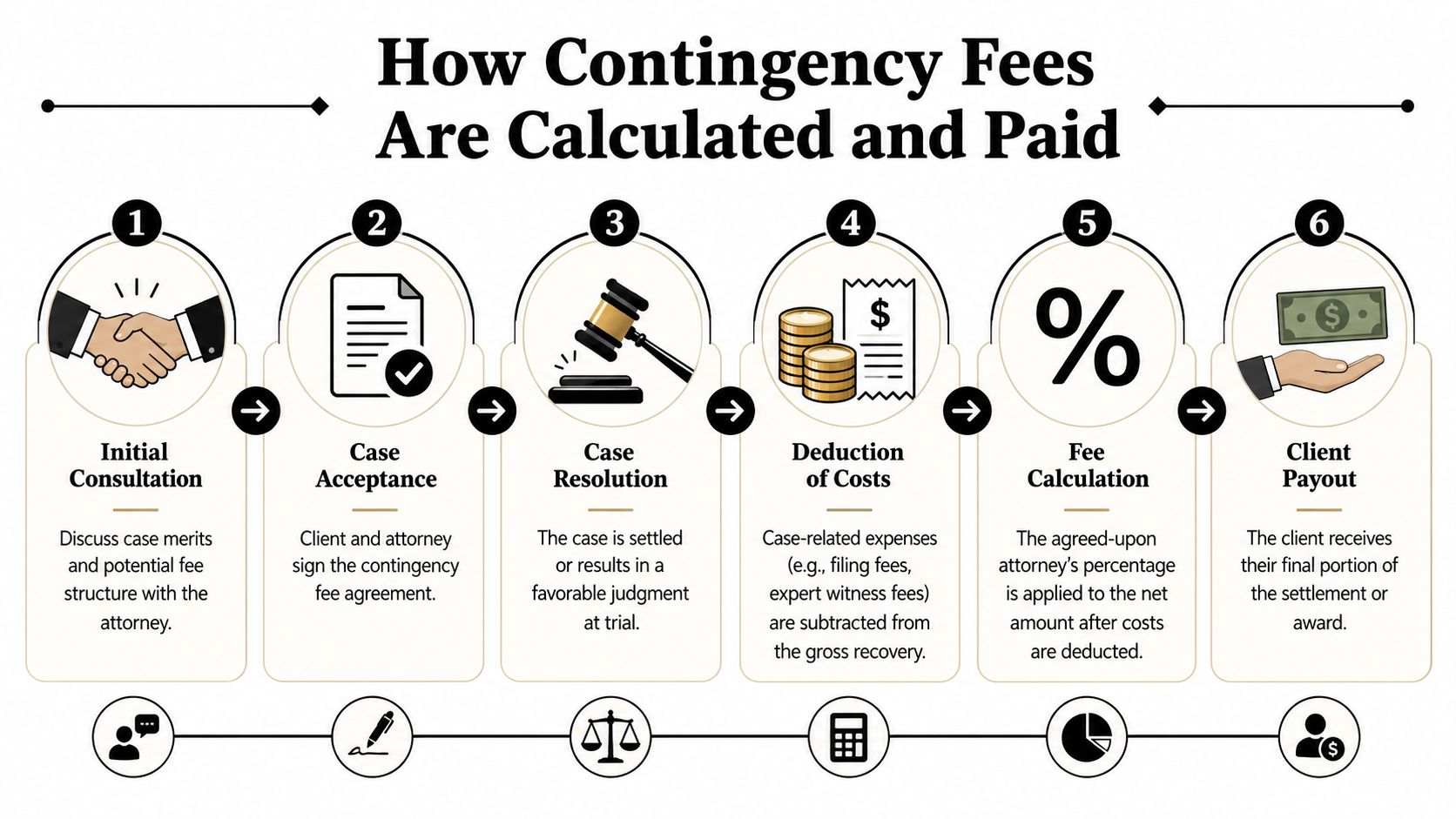
A contingency fee is usually paid out of the money recovered at the end of the case. The recovery is then divided step by step. Start with the full settlement or verdict amount. Apply the attorney's fee under the contract. Subtract any case costs that must be reimbursed. What remains is the client's net amount, subject to any medical liens, insurance reimbursements, or other obligations tied to the claim.
Here is the visual overview many clients find helpful.
The percentage is only one part of the math
Many injury cases use a tiered fee. A lower percentage may apply if the case settles before a lawsuit is filed. A higher percentage may apply if the case moves into litigation, where the lawyer may need to handle depositions, expert witnesses, court hearings, and trial preparation.
That structure can make sense. More work and more risk often come with a filed lawsuit.
Still, the percentage alone does not tell you what lands in your bank account. A settlement statement works like a receipt after a large repair. The top number matters, but so does every line underneath it.
A concrete example
Say a case settles for $100,000 and the fee under the contract is 33⅓%.
If the fee is calculated on that amount, the attorney's fee would be $33,333. If the firm also advanced case costs, those costs may be deducted too, depending on the agreement. If costs were $5,000, the remaining amount before any other obligations would be $61,667.
That example is simple on purpose. It shows why two clients with the same settlement amount can walk away with different net amounts.
One detail many clients miss is how case costs are treated. That is the costs-versus-fees trap. Fees pay the lawyer for legal work. Costs pay for the expenses of building the case. They are not the same thing, and your contract should treat them separately.
If you want to see how settlement terms can affect payout timing and obligations, this guide on what a settlement agreement usually includes can help connect the dots.
The order of payment matters
Ask the lawyer to show you a sample closing statement before you sign. You want to see the order of deductions, not just the percentage.
Gross recovery
The total amount recovered through settlement or judgment.Attorney's fee
The fee percentage is applied as the contract requires.Case costs
These may include medical records, filing fees, deposition transcripts, expert bills, or investigator charges.Other claim-related deductions
In some cases, medical liens or reimbursement claims must also be resolved from the recovery.Net client amount
This is the amount the client receives after all agreed deductions are made.
That sequence sounds straightforward, but one contract detail can change the result: whether costs are deducted before or after the fee is calculated. A small wording difference can have a real effect on your net recovery. This is one reason state-specific rules matter so much, especially in places like Colorado, Texas, and New York where fee practices and disclosure expectations can differ.
If you want a broader picture of how money gets distributed in injury claims, this personal injury settlement guide gives a useful plain-language overview.
The short video below can also help you hear the concept explained in a more conversational format.
Practical rule: Don't sign a contingency fee agreement until someone shows you a sample closing statement with the fee, costs, and your projected net recovery all listed separately.
Decoding Your Contract Key Clauses to Understand
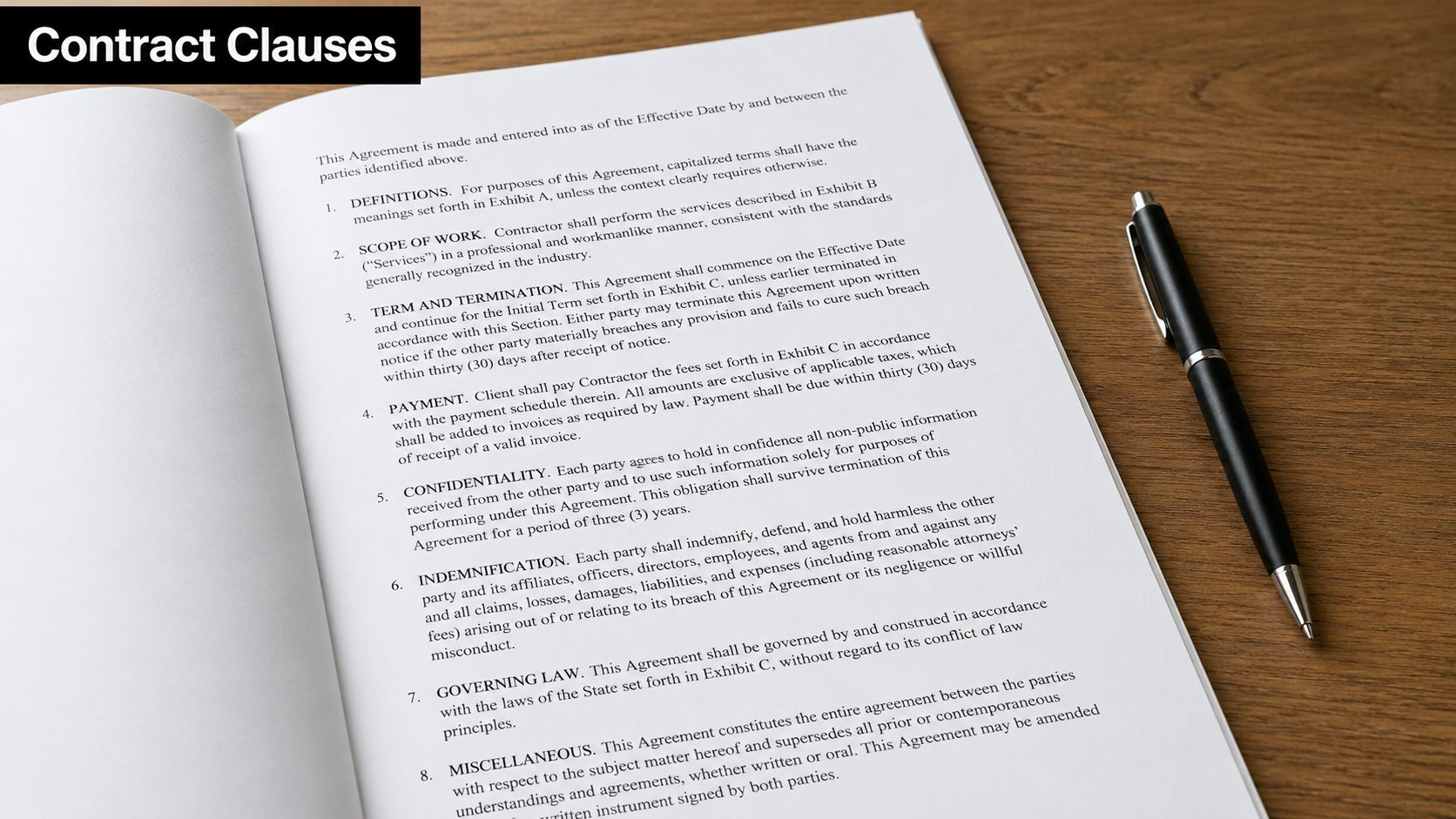
A contingency fee agreement is more than a percentage on a page. It is the rulebook for how money, responsibilities, and expectations will be handled in your case.
If the contract is clear, you'll usually feel calmer after reading it. If it's vague, that's a signal to slow down and ask better questions.
The fee clause
This is often the first consideration, and for good reason. The contract should state the exact fee percentage, and it should say whether that percentage changes if a lawsuit is filed or if the matter goes further.
A clause may read something like this:
“Attorney's fee shall be a percentage of the recovery as stated in this agreement. A different percentage may apply if litigation is commenced.”
You don't need perfect legal phrasing. You need clarity. If the agreement uses a tiered structure, it should say when the higher tier starts.
The costs clause
This is the clause that deserves slower reading. It explains whether the firm advances expenses and how those expenses are reimbursed.
A sample clause might say:
“Client authorizes Attorney to advance reasonable case costs. Advanced costs will be reimbursed from any recovery.”
That sentence sounds harmless, and often it is. But it raises follow-up questions. What counts as a “reasonable” cost? Are there limits? What happens if there is no recovery? Is the client ever personally responsible for reimbursing those costs?
The scope of representation
Some agreements cover only the personal injury claim against the at-fault party. Others may exclude appeals, separate insurance disputes, or related matters unless a new agreement is signed.
Look for language that answers these questions:
- What is included: Investigation, negotiation, lawsuit, trial preparation
- What is excluded: Appeals, bankruptcy issues, unrelated claims
- Who makes key decisions: Settlement authority should remain with the client
For many firms, the signing process is now electronic. If you're reviewing a contract remotely, tools for legal document eSignatures can make execution easier, but convenience should never replace careful review.
Why written detail protects you
In California, a contingency fee agreement must be in writing and include specific disclosures, including the fee rate and how costs affect recovery. The California Lawyers Association explains these requirements in its discussion of transactional contingency fee agreements. The point is transparency. Written detail reduces confusion and protects both client and attorney.
That same principle is useful even outside California. If a term matters, it should appear in writing.
You should also understand the relationship between a fee agreement and the final settlement paperwork. If you're not sure how settlement documents differ from fee contracts, this explanation of what a settlement agreement is can help separate the two.
If a lawyer explains the contract patiently and invites questions, that's usually a better sign than a lawyer who says, “It's standard, just sign.”
Beyond the Fee Percentage Costs You Still Might Pay
“No win, no fee” is helpful language, but it can create a dangerous misunderstanding. Many clients hear it and assume it means they will never owe anything if the case doesn't work out.
That is not always true.
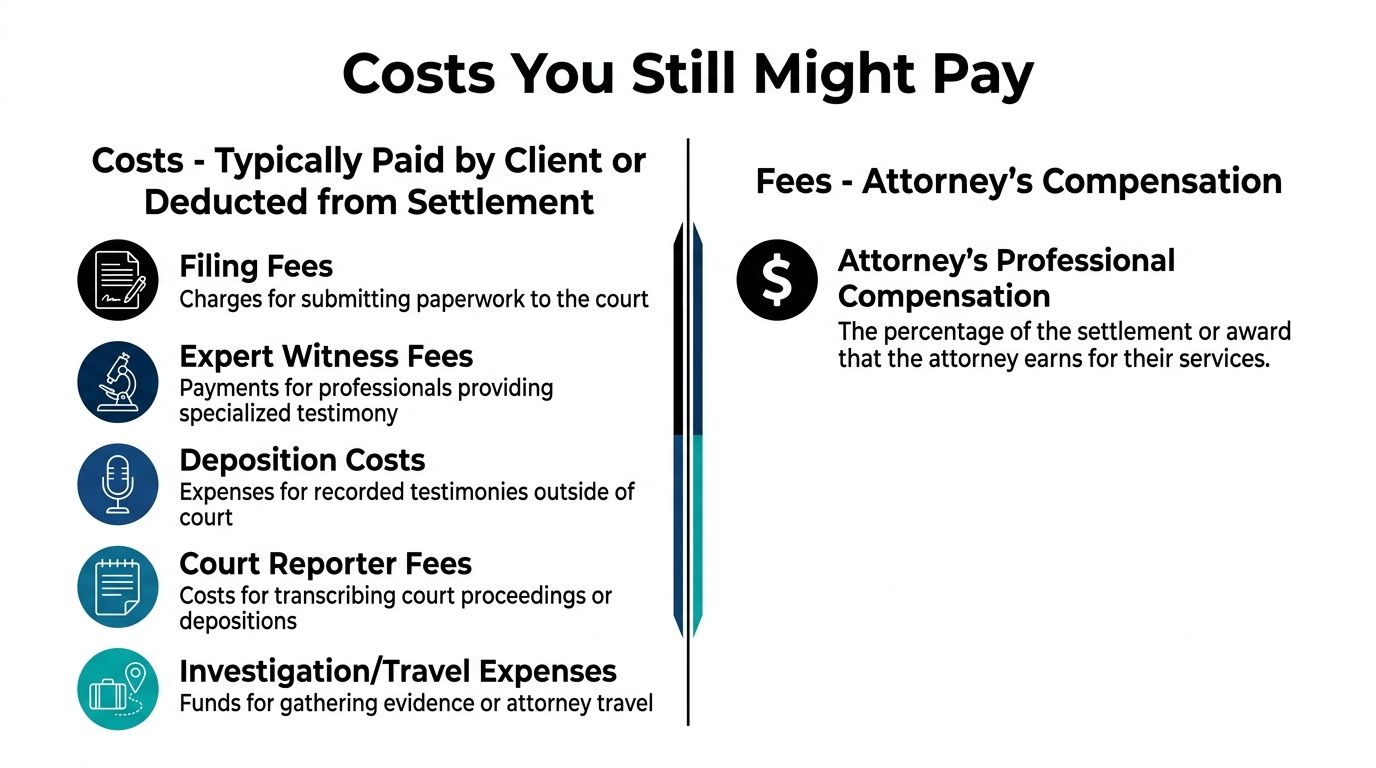
Attorney's fees and case costs are different. Fees are the lawyer's compensation. Costs are the out-of-pocket expenses used to pursue the case.
What counts as a case cost
Common examples include:
- Filing fees for court papers
- Expert witness fees when a doctor, engineer, or specialist is needed
- Deposition expenses for sworn testimony
- Court reporter charges for transcripts
- Medical record retrieval and investigation expenses
Some firms advance these costs and recover them only from a successful settlement. Some contracts put more risk on the client. The agreement controls.
The transparency gap
A 2025 American Bar Association survey found that 12% of personal injury clients were surprised to learn they could still be liable for case costs even if they lost their case, as described in this discussion of contingency fee transparency questions.
That surprise usually comes from one problem. Nobody separated the word “fee” from the word “cost” early enough.
Before you sign, ask one direct question: “If there is no recovery, will I owe any case costs, and if so, which ones?”
Where subrogation adds another layer
Even when a case is successful, the amount you take home can be affected by issues outside the attorney's fee and litigation costs. Health insurers, government benefit programs, or other payors may assert repayment rights against the recovery.
If that term is new to you, this explanation of what a subrogation claim is can help you understand why a settlement can involve more deductions than clients expect.
This is why a trustworthy lawyer doesn't stop at saying, “We work on contingency.” They also explain the full financial picture in plain language, including costs, liens, and repayment issues.
State-Specific Rules for Colorado Texas and New York
If you live in Colorado, Texas, or New York, you should assume one thing from the start. The exact wording and handling of a contingency fee agreement can vary by state, by court, and by case type.
The safest approach is to treat state rules as a layer of protection, not a replacement for careful review. A written contract can be technically valid and still leave a client confused if nobody explains it.
What tends to matter most by state
For injured clients, the practical questions are usually the same across jurisdictions:
- Is the agreement in writing
- Does it clearly explain the fee
- Does it say how costs are handled
- Are there added protections for certain case types, such as claims involving minors or specialized proceedings
Below is a comparison built for readability, not legal shorthand.
Contingency Fee Rules in CO, TX, and NY
| State | Standard Fee Range | Rules on Case Costs | Specific Client Protections |
|---|---|---|---|
| Colorado | Often follows the general personal injury contingency model used in U.S. practice. The exact percentage depends on the contract and stage of the case. | The agreement should clearly state whether the firm advances costs and whether those costs are reimbursed from any recovery or may remain the client's responsibility in some outcomes. | Clients should insist on a written agreement that spells out fee percentage, cost handling, scope of work, and settlement authority. |
| Texas | Often follows the same general contingency structure seen in personal injury litigation, with the percentage changing if litigation becomes necessary. | Cost language should be reviewed carefully because “no fee” does not automatically answer who pays expenses. | Clients should ask for plain-language explanations of how litigation expenses, medical liens, and final disbursement will be handled. |
| New York | Personal injury matters often use contingency arrangements, but case-specific rules and court oversight can affect certain matters. | Cost treatment depends on the written agreement and should be reviewed before signing. | Written transparency remains the key protection. Clients should ask whether any special rules apply to their claim before signing. |
Why the contract matters more than assumptions
I'm avoiding a false sense of precision here for a reason. Readers often search for a single statewide percentage or a single statewide rule, then assume that answer resolves everything. It doesn't.
The more useful question is this: What does your actual contract say, and does it match the rules that apply to your case?
If you're hiring counsel in one of these states, ask for a written walkthrough of the agreement. If the lawyer can't explain it without jargon, keep looking.
Hiring Your Attorney Red Flags and Green Flags
By the time you're ready to hire a lawyer, you don't just need a fair fee. You need someone who explains the agreement well enough that you can make a calm decision.
That's where patterns matter. Good lawyers tend to behave in recognizable ways. So do bad ones.
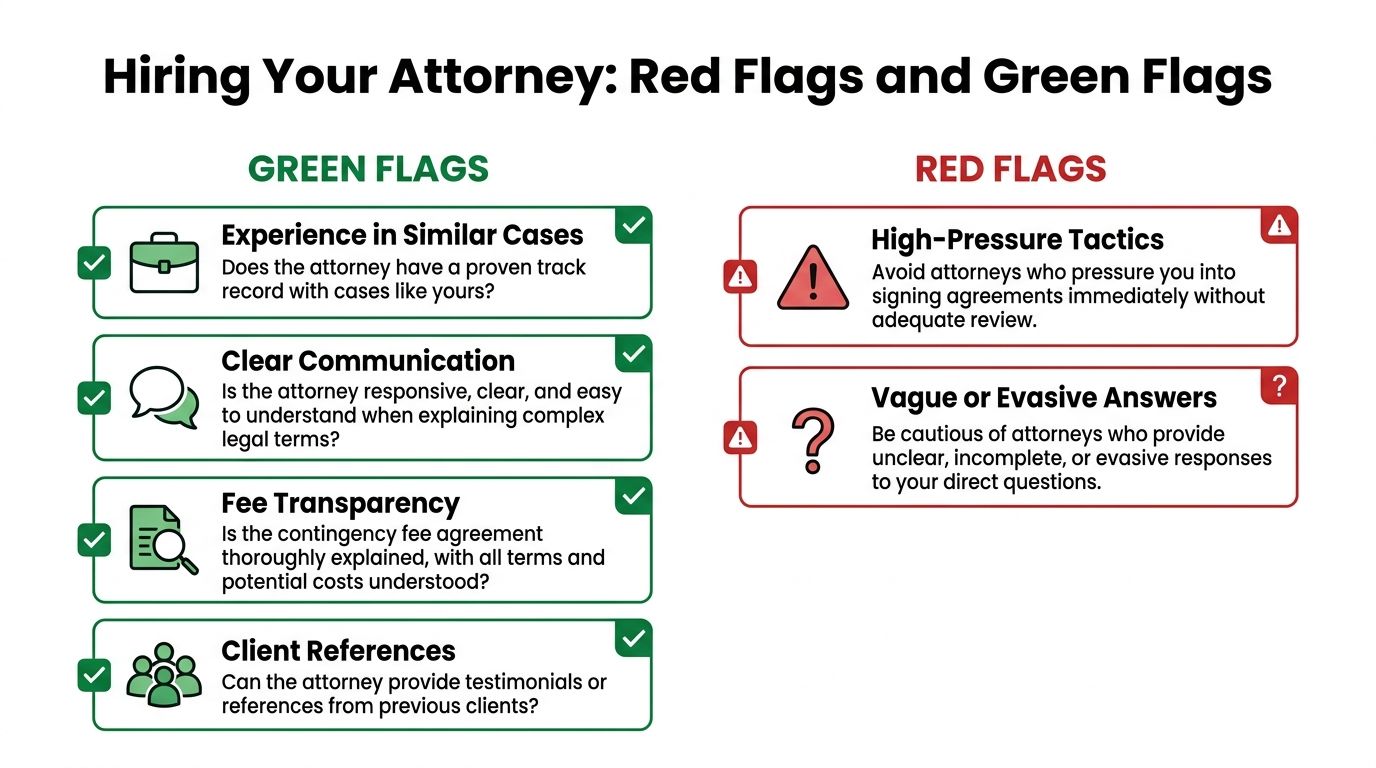
Green flags worth noticing
A trustworthy attorney usually does several things consistently.
- They explain the agreement before asking for a signature. You should hear a plain-language discussion of the fee, the costs, and what happens at the end of the case.
- They welcome detailed questions. Good counsel doesn't act annoyed when you ask who pays for records, experts, or court filings.
- They define the scope clearly. You should know whether the representation includes settlement, suit, trial, and related issues.
- They talk about expectations candidly. If you want a quick outside perspective on what many clients value, this article on client expectations for legal counsel offers a practical checklist.
One useful step before signing any representation agreement is reading about when to hire a personal injury attorney. Timing affects evidence, insurance communication, and strategy.
Red flags that should slow you down
Some warning signs show up early.
- Pressure to sign immediately. If someone won't give you time to read the contract, that's a problem.
- Vague answers about costs. If the lawyer keeps repeating “no win, no fee” without explaining expenses, keep asking.
- Promises of a guaranteed result. No ethical lawyer can promise a settlement amount or outcome.
- A contract that feels incomplete. If the percentage is clear but the rest is fuzzy, the agreement isn't ready.
A practical hiring mindset
You are not being difficult by reading carefully. You are doing exactly what an injured client should do.
Among the firms practicing in Colorado, Texas, and New York, some handle injury cases on a contingency basis and explain the full process, including fee structure, litigation costs, and settlement distribution. Nares Law Group LLC is one such option for people dealing with motor vehicle crashes, truck wrecks, brain injuries, and wrongful death matters.
The best signing experience feels less like a sales pitch and more like a conversation. You understand the numbers. You understand the risks. You know what questions to ask later. That's the standard you should expect.
If you were hurt in a crash and want a contingency fee agreement explained in plain English before you sign anything, Nares Law Group LLC offers consultations for injured clients and families who need clarity about fees, costs, and the next steps in a personal injury case.