A dog bite can turn an ordinary Colorado Springs day into a blur of pain, confusion, and second-guessing. One minute you're walking through a neighborhood, chatting with a friend, or watching your child near a park. The next, you're bleeding, shaken, and trying to decide whether you need urgent care, whether the dog has its shots, and whether you're somehow overreacting.
You're not overreacting.
Dog bite injuries are often more complicated than they look at first. Some wounds seem small and then become infected. Some victims feel “fine” until the adrenaline wears off. Some physical injuries heal, but the fear lingers every time a dog barks or runs toward them. If you're searching for a dog bite attorney in Colorado Springs, you probably need more than a definition of the law. You need a clear path.
The Moment After a Dog Bite
It might happen on a trail edge near a busy park, on a sidewalk in your neighborhood, or outside an apartment building where you thought you were safe. A dog pulls loose, rushes forward, and bites before you have time to process what's happening. Individuals typically don't respond like they do in movies. They freeze. They stumble backward. They try to calm the animal. Then they look down and realize they're hurt.
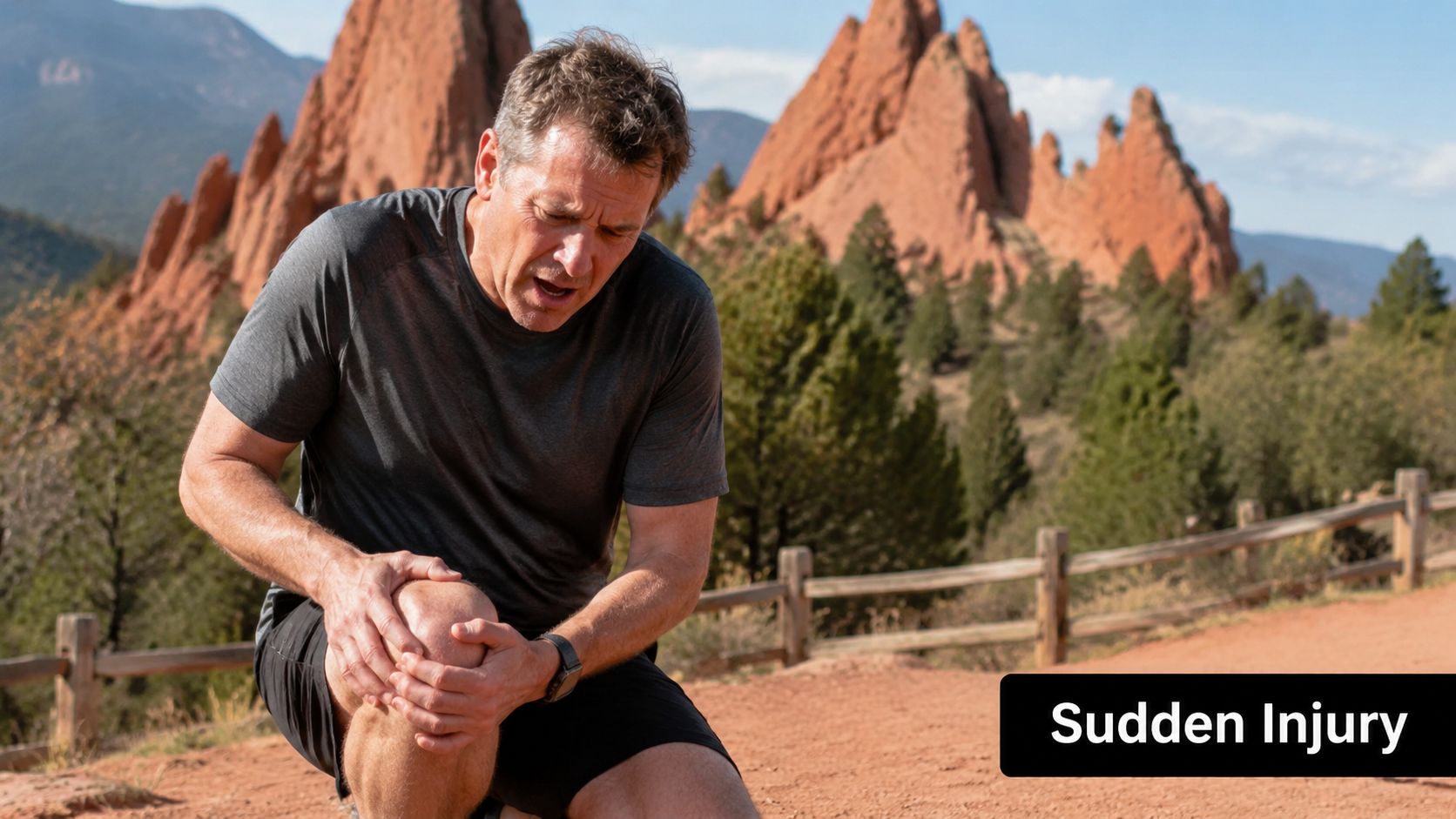
In those first minutes, people usually have the same thoughts. “Is it deep?” “Do I need stitches?” “Who owns this dog?” “What if I can't afford treatment?” If a child was bitten, the panic is even sharper. If you already live with a disability or mobility issue, a bite can feel like your world just got smaller.
That reaction is normal. Dog bite injuries combine physical pain with a sudden loss of safety. Even if the owner apologizes, even if the wound seems manageable, your body and mind are trying to catch up.
Why this moment feels so disorienting
A dog bite is more than a cut or puncture. It's a fast, violent event that can leave you dealing with:
- Shock and adrenaline that hide how serious the injury is
- Embarrassment if the attack happened in public
- Confusion about who to call and what to document
- Fear that speaking up will make you seem unreasonable
If the bite happened during an outdoor outing, practical first-aid guidance can help you stabilize the situation before you get formal care. This guide to dog first aid on trails is written for real outdoor conditions and can be useful when you're away from immediate help.
The first goal is simple. Get safe, get treated, and preserve the facts before they disappear.
There is a path forward, even if everything feels scattered right now. Medical care matters. Documentation matters. The details that seem minor today can become central later when an insurer starts asking questions or downplaying what happened.
Immediate Steps to Protect Your Health and Your Claim
The hours after a bite matter. Think of this as your legal first-aid kit. What you do now can protect both your recovery and your ability to seek compensation later.
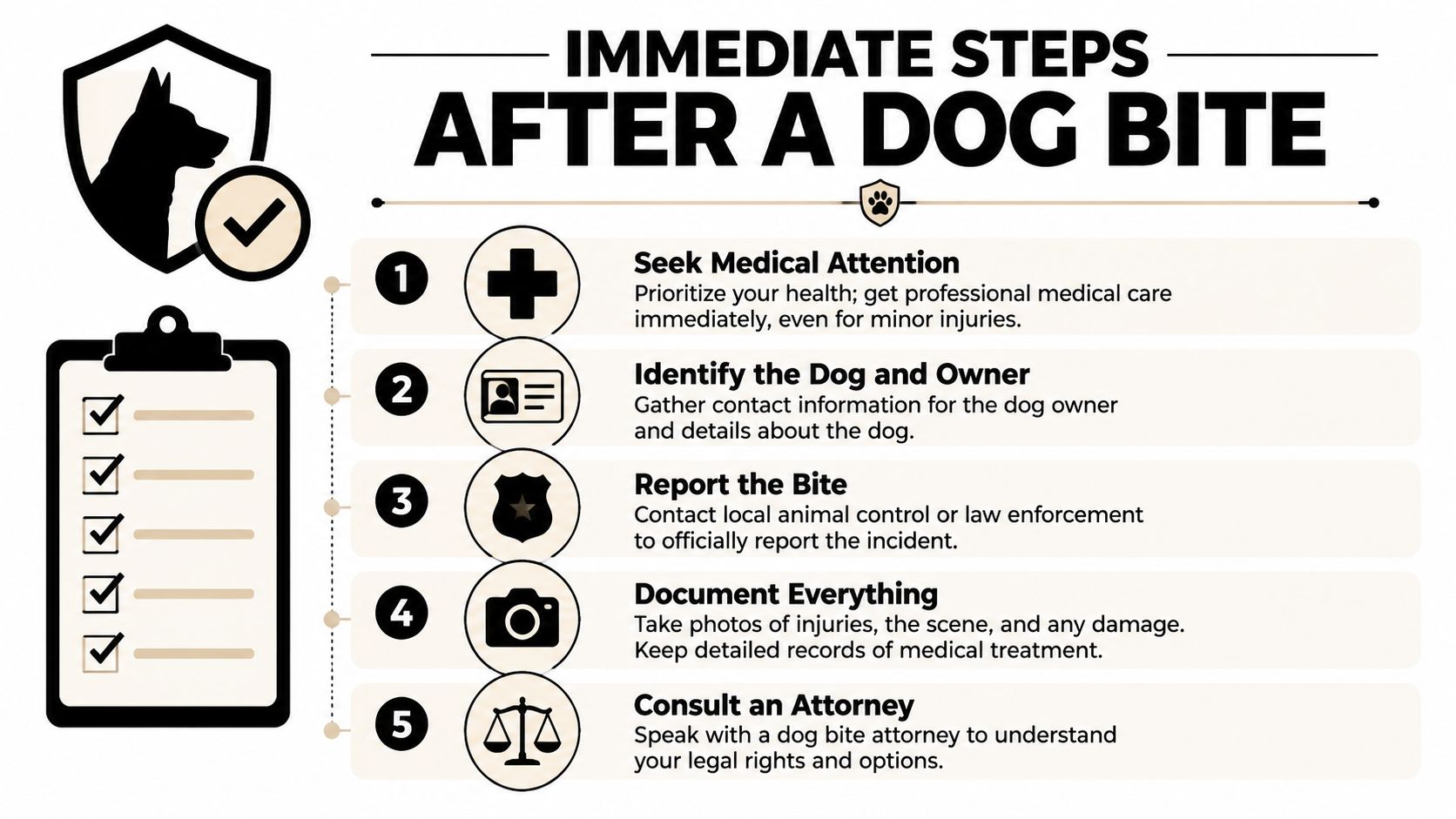
Five actions to take right away
Get medical care first.
Even a wound that looks minor can involve infection risk, tissue damage, or scarring. Medical records also create a timeline. If you wait too long, the insurance company may argue that your injuries weren't serious or weren't caused by the bite.Identify the dog and the owner.
Get names, phone numbers, address information, and whatever you can learn about the dog. If you can do so safely, note the breed, color, size, and whether anyone mentioned rabies vaccination status.Report the bite.
A formal report creates an independent record. In Colorado Springs, animal-related incidents are commonly reported through local animal control channels, including the Humane Society of the Pikes Peak Region's Animal Law Enforcement. That report can later help confirm when and where the attack happened.Document what you see before it changes.
Take photos of the wound, torn clothing, blood on the ground, the location, and, if possible, the dog. Bruising and swelling often look different a day later than they do in the first hour.Talk to a lawyer before giving detailed insurance statements.
You don't need to know every legal rule before making this call. You just need to avoid saying something incomplete or inaccurate while you're still in pain and under stress.
Colorado Springs takes this issue seriously. Local animal control and public health data indicate that hundreds of dog bite reports are filed each year in Colorado Springs, which makes these cases a recurring local safety concern, as noted by Brylak Law's discussion of Colorado Springs dog bite injuries.
What to collect if you can
Some evidence disappears fast. A short list helps.
- Photos of injuries: Take them immediately, then again over the next several days.
- Witness names: Bystanders often leave before police or animal control arrive.
- Clothing and shoes: Don't wash or throw away damaged items.
- Care records: Save discharge papers, prescriptions, invoices, and follow-up instructions.
If you want a plain-language overview of what a claim usually involves after an injury, this personal injury claim filing guide can help you understand the sequence.
A quick visual walkthrough can also make those first steps easier to remember:
Practical rule: If you have to choose between “handling it later” and creating a record now, create the record now.
Understanding Colorado Dog Bite Laws
Colorado dog bite law works a little like two different roads leading to the same destination. One is a faster route, but only certain cases qualify. The other is a slower road that requires more proof.
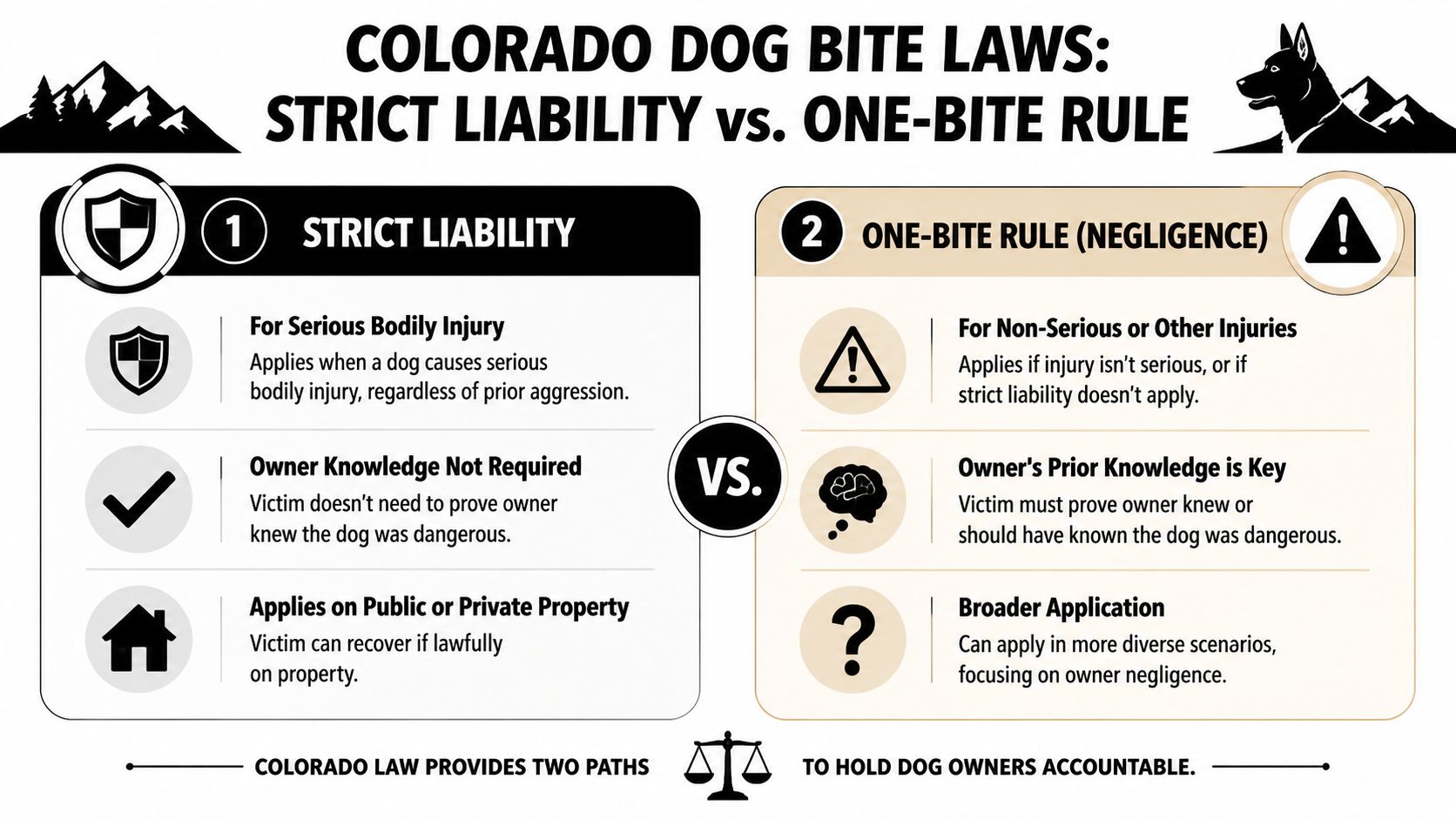
Under Colorado law, strict liability under C.R.S. § 13-21-124 applies exclusively when the victim sustains severe bodily injury. For non-severe injuries, the case shifts to a negligence framework requiring proof of duty, breach, causation, and damages, as explained in this overview of Colorado dog bite law.
The express lane of strict liability
Strict liability means the owner can be held responsible without you having to prove the dog had a known history of aggression. But this route is limited. It applies only when the injury qualifies as severe bodily injury.
The legal definition matters. Severe bodily injury includes harm involving substantial risk of death, permanent disfigurement, or broken bones. If your injury falls into that category, your attorney doesn't need to spend the case proving the owner knew the dog was dangerous before the bite happened.
That distinction confuses many people. They hear “Colorado is a strict liability state” and assume every bite case works the same way. It doesn't.
The local road of negligence
If the injury doesn't meet the severe-injury threshold, the case usually proceeds under negligence principles. That means your lawyer must prove four building blocks:
| Element | What it means in plain language |
|---|---|
| Duty | The owner had a responsibility to act reasonably and prevent foreseeable harm |
| Breach | The owner failed to meet that responsibility |
| Causation | That failure led to the bite |
| Damages | You suffered actual harm, such as medical costs, lost income, or pain |
A simple example helps. Suppose a dog owner lets a reactive dog roam without a leash in a shared area. The dog bites someone. The question becomes whether the owner acted reasonably. If not, that breach can support a negligence claim.
Why this split changes case strategy
This two-track system affects what evidence matters most. In one case, the focus may be on the severity of the injury itself. In another, the fight may center on the owner's conduct, warning signs, prior incidents, leash control, or failure to separate the dog from visitors.
If you want a deeper explanation of how these rules operate in Colorado, this Colorado dog bite law resource lays out the core framework.
Some dog bite claims are about proving the injury crosses a legal threshold. Others are about proving the owner crossed a line of reasonable care.
That's why two people with dog bite injuries can have very different legal paths, even when the bites happened in similar places.
How a Lawyer Builds Your Dog Bite Case
A dog bite case is built the way a careful doctor builds a diagnosis. One symptom is not enough. Your lawyer looks for a pattern that makes the full story hard to dispute.
That matters because insurance companies often treat these claims like puzzles with missing pieces. If a record is incomplete, if a witness disappears, or if the emotional harm is brushed aside as "just stress," the value of the claim can shrink fast. A lawyer's job is to gather each piece early and fit it into a clear, credible timeline.
The first goal is to preserve what can disappear
Some evidence fades within days. Bite marks heal. Security footage gets deleted. Witnesses forget small details that later become important.
A dog bite attorney in Colorado Springs usually starts by collecting the records and observations that anchor the case in something more than memory. That often includes:
- Animal control reports that document the attack and may show prior complaints
- Medical records that link the bite to treatment, infection risk, surgery, scarring, or nerve damage
- Witness statements from people who saw the attack or knew the dog had shown aggressive behavior before
- Photos and video from phones, doorbell cameras, nearby businesses, or apartment security systems
- Employment records if the injury caused missed work or limited duties
Lawyers also look for absences that tell their own story. Was there no leash, no warning, no barrier, no effort to secure the dog after earlier warning signs? Those facts can be as important as what happened during the attack itself.
Then the lawyer builds a theory the insurer cannot easily dismiss
Evidence by itself is a stack of papers. A legal claim turns that stack into a story with structure.
If the case depends heavily on the seriousness of the injury, the lawyer may focus on surgical notes, specialist opinions, infection treatment, permanent scarring, or loss of function. If the dispute centers on the owner's careless conduct, the lawyer may emphasize control failures, prior incidents, housing rules, leash violations, or ignored complaints. The strategy changes based on the facts, much like using a different route when one road is blocked.
Hidden injuries often need more proof than visible ones
This is one of the most overlooked parts of a dog bite claim. People understand stitches and scars. They do not always understand panic attacks, sleep disruption, fear of walking outdoors, or a child who now cries at the sight of any dog.
Psychological trauma, including cynophobia, often requires careful documentation to be taken seriously. A lawyer may use counseling records, therapist opinions, family observations, school reports, and journals that show how daily life changed after the attack. That proof can matter even more when the victim is a child, an older adult, or a person with a disability, because those victims may struggle to explain their fear in a way an insurer accepts without question.
Good case preparation includes the losses outside the hospital
Clients often expect the case to revolve around emergency treatment alone. In practice, lawyers also examine practical costs that spread out after the bite. Follow-up care, scar treatment, transportation to appointments, time away from work, and out-of-pocket medical balances can all shape the claim.
For people facing immediate billing pressure, resources such as Pounds Health medical bill help may help explain ways to address unpaid medical charges while the legal claim is still pending.
Much of the work happens quietly
Clients usually see forms, phone calls, and settlement discussions. They may not see the hours spent requesting records from multiple providers, comparing witness accounts, reviewing insurance coverage, organizing photographs by date, and preparing the file as if it may need to go to trial.
That quiet work is often what separates a thin demand from a persuasive one. A well-built case does more than show that a bite happened. It shows how the attack changed your body, your routines, your sense of safety, and, in some cases, your child's development or your ability to live independently.
Recovering Full Compensation Beyond Medical Bills
Many victims make the same mistake early on. They add up the emergency room bill, maybe a few follow-up visits, and assume that's the value of the case. That approach often leaves out the parts of the injury that affect daily life the most.
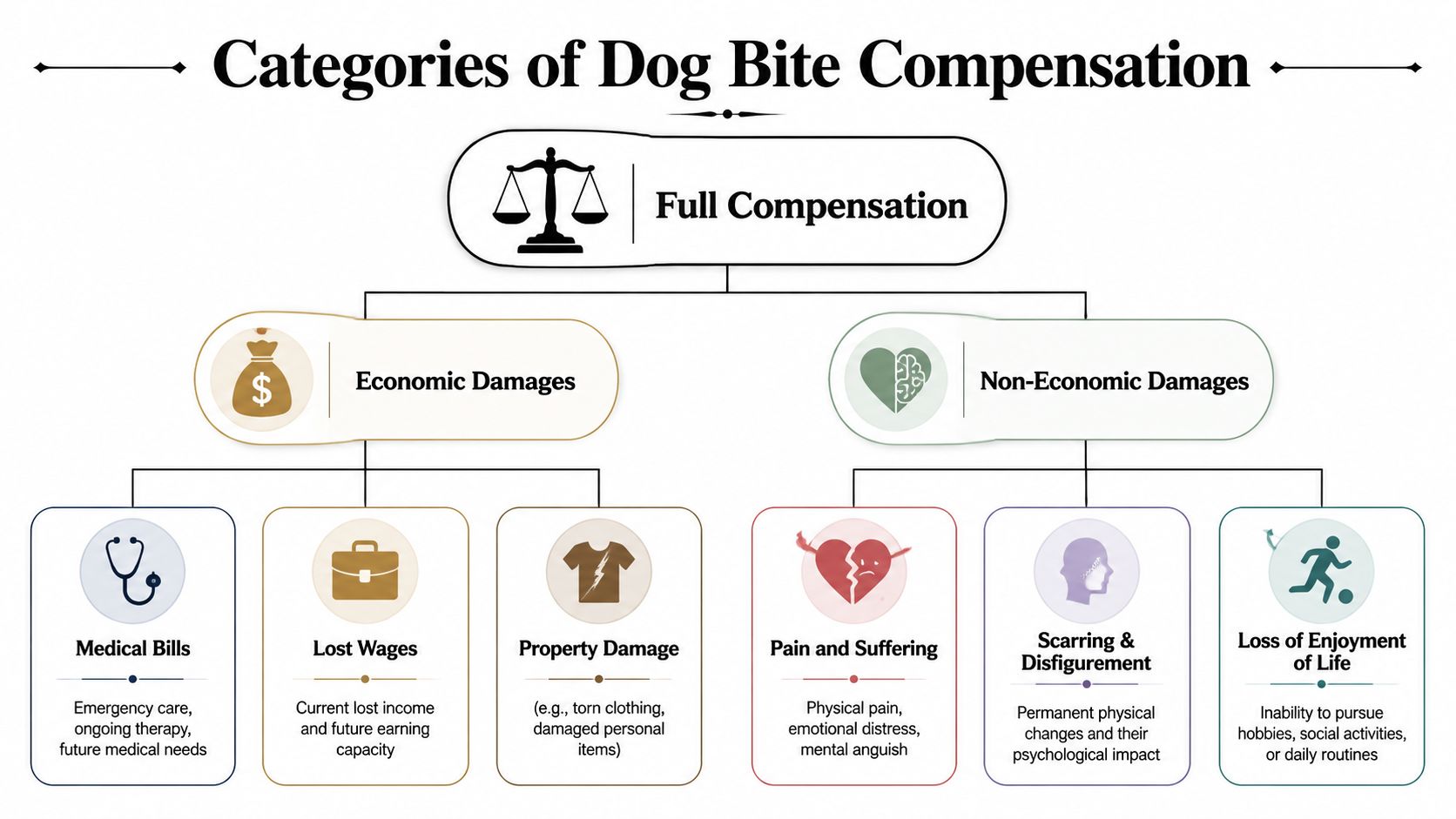
The visible losses are only part of the picture
Economic damages are the most concrete. They often include medical bills, lost wages, and other financial losses tied directly to the attack. Those are easier to document because they show up in invoices, payroll records, and treatment notes.
Non-economic harm is different. It includes pain, emotional distress, scarring, disfigurement, and changes in how you live day to day. If a bite leaves facial scarring, limits your mobility, or makes you afraid to walk through your own neighborhood, the harm doesn't stop when the stitches come out.
The hidden damage insurers often undercount
One of the biggest gaps in many dog bite claims is long-term psychological trauma. Existing Colorado Springs dog bite content often misses this issue, even though psychological trauma such as cynophobia and PTSD can persist for years and is routinely excluded from settlement calculations unless it is specifically litigated, as discussed by McCormick & Murphy's dog bite page.
That matters because fear after a bite can reshape ordinary life. Adults may stop walking certain routes. Children may panic around pets they once loved. A person who depends on walking for exercise or transportation may start avoiding parks, sidewalks, or apartment common areas.
If the injury changed how you sleep, move, socialize, parent, work, or leave the house, that change belongs in the case analysis.
How lawyers prove invisible injuries
Psychological harm has to be documented with care. You can't tell the insurer you're anxious and expect them to value it fairly. A lawyer may use:
- Therapy records showing persistent symptoms
- Psychological evaluations that connect the trauma to the attack
- Family observations describing changes in behavior or mood
- Daily-life evidence such as missed activities, avoidance patterns, or work impact
Medical debt adds another layer of stress while the claim is pending. If you're trying to manage treatment costs at the same time, this practical guide on Pounds Health medical bill help may help you think through bill negotiation options.
Full compensation means accounting for the injury you live with, not just the one captured in the first hospital photo.
How to Choose the Right Colorado Springs Attorney
Not every personal injury lawyer handles dog bite cases with the same depth. Some focus on moving files quickly. Others are prepared to dig into the harder parts of the claim, especially when the victim is a child, has a disability, or has injuries that don't show up neatly on an X-ray.
That difference matters because many Colorado Springs dog bite discussions overlook the legal strategy needed when a victim is a minor or has a pre-existing disability, even though insurers may use those procedural gaps to limit recovery, as noted in this discussion of Colorado Springs dog bite representation.
Questions worth asking in a consultation
Bring a short list. You don't need to sound like a lawyer. You just need to hear how the attorney thinks.
How do you handle claims involving children?
A useful answer should mention guardian involvement, approval issues, and the practical steps needed to protect a minor's interests.How would you prove psychological trauma in a dog bite case?
Listen for specifics such as therapy records, mental health experts, and day-to-day functional changes.What if the physical injury looks modest but the long-term impact is serious?
This question exposes whether the lawyer only values visible injuries.How do you approach cases involving disabled clients or pre-existing conditions?
A careful lawyer should explain that vulnerability does not cancel a valid claim.
Signs of a thoughtful attorney
A good fit usually does a few things early. The lawyer asks detailed factual questions, explains what records matter, and doesn't rush to throw out a number before seeing the evidence.
Here's a quick comparison:
| What you hear | What it may suggest |
|---|---|
| “We can settle this fast.” | Speed may be the priority over full case development |
| “Tell me about your treatment and daily limitations.” | The lawyer is evaluating the full impact |
| “Did anyone witness the dog's behavior before the bite?” | The lawyer is thinking ahead about proof |
| “We'll need to review fees carefully.” | The lawyer is treating the relationship transparently |
Fee structure matters too. If you want a plain explanation of contingency arrangements and common cost questions, this overview of personal injury lawyer fees can help you prepare before you sign anything.
A consultation isn't just for the lawyer to evaluate your case. It's also your chance to evaluate whether that lawyer sees the parts of your injury that others miss.
Frequently Asked Questions About Dog Bite Claims
What if the dog owner is a friend or family member
That's common, and it's one reason people hesitate to call a lawyer. Many claims involve insurance rather than a person writing a check directly. A lawyer can explain how to protect your rights while handling the situation with as little added strain as possible.
Can I still have a case if I was on the owner's property
Maybe. The details matter. Why you were there, whether you had permission, and what happened right before the bite can all affect the claim. Don't assume you have no case based on one fact alone.
What if the dog owner doesn't have homeowner's insurance
Insurance is important, but it isn't the only issue a lawyer reviews. Depending on the facts, there may be other policies, property-related issues, or defendants worth examining. The right answer depends on the specific setting of the attack.
Could I be blamed for the bite
Possibly, if the owner claims you provoked the dog or ignored warnings. That doesn't automatically defeat your case. It means the facts need to be developed carefully, early, and with supporting evidence.
How long do I have to act
Time limits apply, and waiting makes evidence harder to preserve. Medical records can be gathered later. Fresh witness memories usually can't.
Do I need a lawyer if the owner already admitted fault
Yes, or at least a consultation is wise. People apologize at the scene and then insurance adjusters frame the story differently later. An admission helps, but it doesn't replace documentation, legal analysis, and proof of damages.
If a dog bite has left you hurt, anxious, or unsure what to do next, Nares Law Group LLC offers consultations for injured people who need guidance on evidence, insurance, and the full value of a personal injury claim. A clear legal assessment can help you understand your options and decide on your next step with confidence.