A dog bite can turn an ordinary day into a mess of pain, paperwork, and worry. You may be dealing with stitches, swelling, infection concerns, missed work, and a flood of questions about who pays for what. If the bite happened in Denver or anywhere else in the state, dog bite law colorado matters because it directly affects whether you can recover money for treatment and lost income.
Colorado gives injured people meaningful legal protection, but the rules aren't always intuitive. Some claims fit under a strong statute that helps victims. Others require a different path. Insurance companies know that confusion works in their favor.
This guide is built for the person who's hurt, overwhelmed, and trying to make sound decisions quickly. The goal is simple. Help you understand what the law says, what compensation may be available, what defenses you may face, and what to do next to protect both your health and your claim.
The Aftermath of a Dog Attack
You take a walk through a Denver park. A dog seems excited, then suddenly lunges. Seconds later, you're on the ground or backing away, heart racing, trying to understand what just happened. Maybe the owner says, "He's never done that before." Maybe people gather. Maybe you're bleeding and too stunned to ask the questions you should.
That confusion is normal. After a dog attack, individuals don't start by thinking about statutes or insurance coverage. They think about whether they need urgent care, whether the wound will scar, whether they can still work tomorrow, and whether the dog could hurt someone else.

Colorado sees enough bite incidents that no injured person should feel isolated in this situation. The risk is significant across the state. In Denver alone, 1,717 biting incidents were recorded from 2017-2019, while El Paso and Pueblo Counties reported 1,845 bites between 2022 and 2024, according to KOAA's reporting on Colorado dog bite incident totals.
A dog bite claim is about more than blame. It's about stabilizing your life after an unexpected injury. Medical bills can start immediately. Lost wages can hit before the bruising fades. If you're trying to understand the basics of what these cases involve, Nares Law Group's dog bite case information gives a practical overview.
You don't need to have every answer on day one. You do need to start protecting your health and your rights right away.
Understanding Colorado's Strict Liability Dog Bite Law
Colorado uses a rule that often surprises people. In many places, injured victims expect they'll have to prove the dog owner knew the dog was dangerous. Under Colorado law, that isn't always the fight.
What strict liability means
Think of strict liability like responsibility that attaches because of what happened, not because of what the owner meant to do. A simple analogy is a defective product. If a product fails in a way the law recognizes, the focus shifts quickly to the harm and the defect, not to whether the company intended the failure. Colorado's dog bite statute works in a similar way for qualifying bite cases.
Under C.R.S. § 13-21-124, an owner is liable for a victim's economic damages if their dog causes serious bodily injury, regardless of the dog's past behavior. Serious bodily injury means an injury involving a substantial risk of death, permanent disfigurement, or the protracted loss or impairment of any body part or organ, as explained in Chalat Law's summary of Colorado dog bite law.
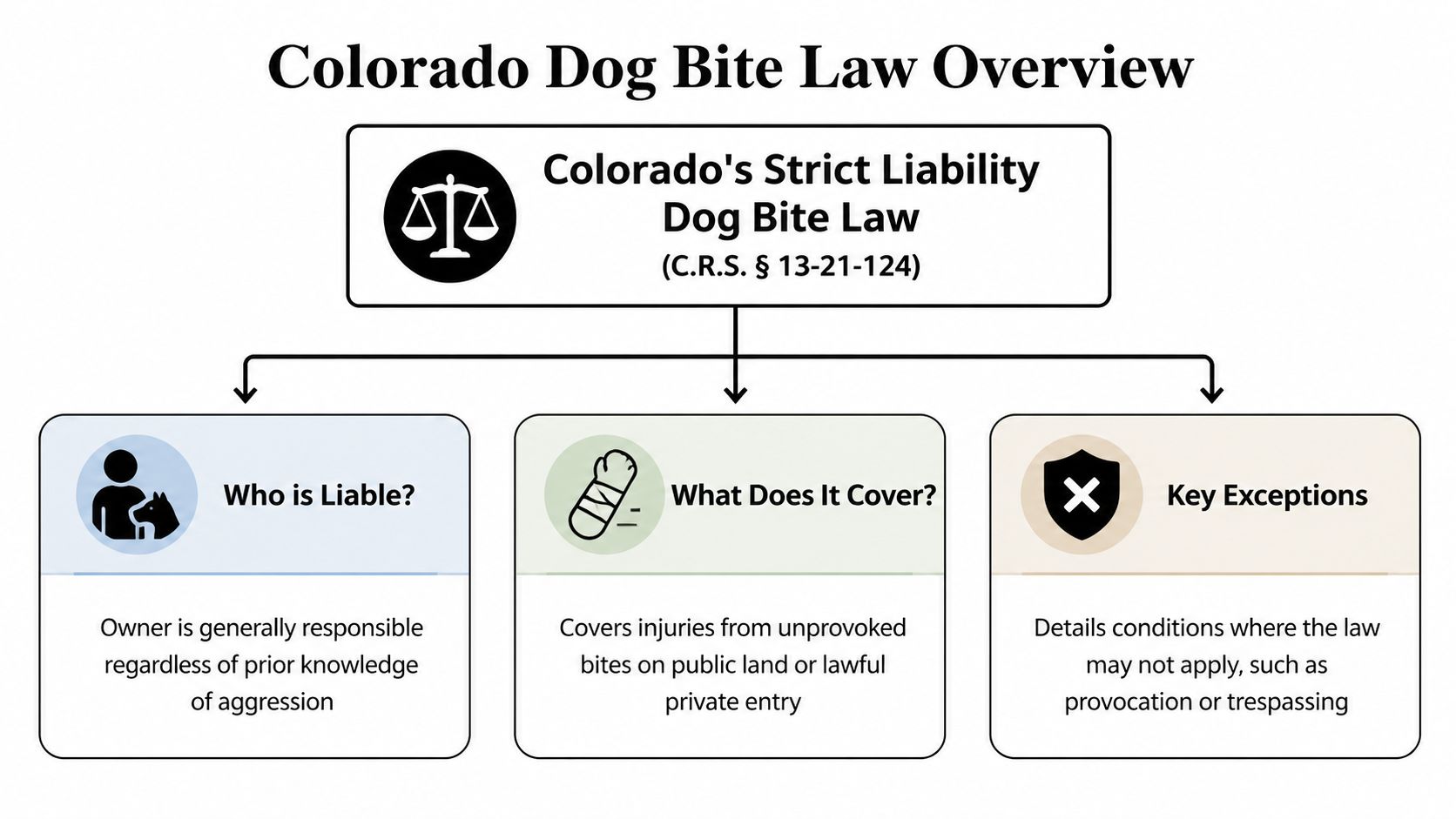
That means the owner's common response, "We had no idea the dog would do this," may not defeat a claim under the statute. Prior aggression isn't the key. The injury and the legal requirements are.
Why serious bodily injury matters so much
Many readers misunderstand that Colorado doesn't treat every bite the same under the strict liability statute. The law is especially powerful when the bite causes serious bodily injury, often shortened to SBI.
Here's a practical consideration:
| Legal question | Why it matters |
|---|---|
| Was it a dog bite? | The statute applies to bites, not every dog-related incident. |
| Was the person lawfully present? | Lawful presence affects whether the victim can use the statute. |
| Did the bite cause serious bodily injury? | SBI is the key that unlocks statutory economic damages. |
A superficial nip and a devastating bite wound don't get treated the same way. If the injury involves permanent disfigurement, fractures, major impairment, or a substantial risk of death, you're much more likely to be in the core area this law was designed to address.
Practical rule: In a serious case, medical records are not just treatment documents. They're proof documents.
What the statute gives you and what it doesn't
Colorado's statute is victim-friendly in one important way. It removes the need to prove the owner knew the dog was dangerous before the attack. That saves injured people from having to chase old complaints, neighborhood stories, or prior bite evidence just to establish basic liability.
But the statute isn't unlimited. It is centered on economic damages. In plain language, that means measurable financial losses such as medical bills and lost wages. It does not automatically hand over every category of compensation an injured person may want to pursue.
That distinction matters because victims often assume "strict liability" means "the owner pays for everything." That's not always true. It may establish a strong starting point, but a complete recovery often requires careful attention to the facts, the injuries, and sometimes additional legal theories.
Lawful presence and exceptions
Another common point of confusion is location. The bite doesn't have to happen only on a sidewalk or in a park. A person can be on public property or on private property lawfully and still be protected.
Lawful presence usually means you had a right to be there. A guest, delivery person, invited visitor, or someone otherwise allowed on the property may qualify. Problems arise when the owner or insurer argues trespassing, provocation, or another exception.
A helpful way to frame the law is this:
- The statute helps victims when a qualifying bite causes serious bodily injury.
- The injury threshold matters because not every wound triggers the statute in the same way.
- The setting matters because lawful presence is part of the analysis.
- The owner's lack of prior knowledge usually isn't a winning defense in a qualifying strict liability case.
If you're injured, don't let the owner's surprise become your legal roadblock. In many Colorado cases, that isn't the issue that controls.
What Compensation Can a Victim Recover
Once you know the owner may be legally responsible, the next question is usually immediate and personal. What bills can be covered, and what losses count?
Economic damages and everyday reality
Economic damages are the most concrete part of a dog bite claim. They are the losses that show up on invoices, pay stubs, receipts, and treatment records. In a serious bite case, those losses can pile up fast.
A simple example helps. Say a person is bitten on the forearm while visiting a friend. The injury requires emergency treatment, follow-up care, antibiotics, imaging, and time away from work because gripping and lifting are painful. Those financial losses are easier to identify because they have paper trails.
Economic damages can include:
- Emergency care such as ambulance transport, urgent care, or an ER visit
- Hospital and physician charges tied to wound care, surgery, imaging, and follow-up appointments
- Medication costs for antibiotics, pain management, or infection treatment
- Lost wages when you miss work during treatment and recovery
- Future medical needs if scarring, mobility problems, or other complications require additional care
These categories matter because they're often the backbone of a statutory claim in Colorado.
Non-economic damages are different
Now for the part many victims find frustrating. A dog bite doesn't only create bills. It can leave fear, sleep disruption, visible scarring, embarrassment, and pain that changes how you move through daily life. Those harms are real, but they don't come with neat receipts.
Non-economic damages usually refer to losses like pain, emotional suffering, inconvenience, and the impact of disfigurement on daily life. In Colorado dog bite cases, recovering those damages may require more than merely showing a qualifying bite under the statute. It may depend on proving negligence or another basis for broader recovery.
That doesn't mean those damages are unavailable. It means the path is often more fact-specific.
For readers trying to understand that difference in greater detail, this explanation of how pain and suffering damages are calculated helps clarify why these losses are handled differently from straightforward medical bills.
A useful way to organize your claim
When you're recovering, think in two folders.
| Folder | What goes inside |
|---|---|
| Bills and income records | Medical invoices, pharmacy receipts, work absence records, wage documentation |
| Human impact records | Photos of wounds, scar progression, notes about pain, limits on sleep, anxiety around dogs, day-to-day disruption |
The first folder supports economic damages. The second helps explain the full human cost of the injury, especially if your case supports a claim beyond bare out-of-pocket loss.
Keep every receipt and every appointment summary. Small expenses can become part of a much larger financial picture.
Insurance companies often act as if only the obvious emergency bill matters. That's too narrow. A proper claim looks at the full financial arc of the injury, not just the first day of treatment.
Common Defenses Dog Owners Use in Colorado
Dog owners and their insurers don't usually open with, "Yes, we'll pay everything this injury has cost you." They look for ways to narrow the claim, deny it, or shift part of the blame onto you.
The insurance playbook
In many cases, the defense strategy is less about disputing that a bite happened and more about changing the story around it. The goal is simple. Reduce what they owe by arguing that the victim caused, invited, or escalated the incident.
The most common themes are:
- Provocation. They may argue you teased, startled, cornered, grabbed, or otherwise provoked the dog.
- Trespassing. They may claim you were not lawfully on the property when the bite happened.
- Comparative fault. They may say your own choices contributed enough to cut down or eliminate recovery.

These defenses matter because they target the parts of the case that are often murkiest after a chaotic incident. Who moved first. What was said. Where everyone was standing. Whether there was a gate, a warning, a leash, or an invitation.
Comparative fault can shrink or block recovery
Colorado follows a modified comparative fault rule. A victim's compensation can be reduced by their percentage of fault, and if the victim is found to be 50% or more at fault for provoking the incident, they are barred from recovering any damages at all, as described in McCormick & Murphy's discussion of Colorado comparative fault in dog bite cases.
That rule is one reason early statements matter so much. A casual comment like "I guess I shouldn't have tried to pet him" can get pulled into a much bigger argument later.
Here's how these defenses often show up in real life:
| Defense argument | What they're trying to prove |
|---|---|
| You provoked the dog | Your actions caused the bite, so the owner's responsibility should be reduced or barred |
| You weren't allowed there | You were trespassing, so statutory protection shouldn't apply |
| You ignored warning signs or obvious risk | You knowingly accepted danger and should bear part of the loss |
Why victims get unfairly blamed
People often assume provocation means cruelty or obvious harassment. It doesn't have to be framed that way by an insurer. They may try to label ordinary conduct as unreasonable conduct.
A child reaching toward a dog. A visitor stepping through an open gate. A delivery driver moving past a fence line. A guest trying to back away while the dog advances. Insurers can recast those facts in the light most favorable to the defense.
The first version of events is often the one the insurer tries hardest to preserve. Make sure your version is complete, accurate, and documented.
How to respond without hurting your case
If the owner or insurer starts suggesting you caused the attack, don't get dragged into a casual debate. Stick to facts. Where were you. Why were you there. What did the dog do. What happened immediately before and after the bite.
Helpful evidence often includes:
- Photos of the scene that show gates, fences, walkways, or lack of warning signs
- Witness names and contact details before people disappear back into their day
- Clothing and damaged items that show force, position, and the nature of the attack
- Prompt medical records that match the injury pattern and timing
The defense doesn't need a perfect story to create friction. It only needs enough uncertainty to pressure you into accepting less. That's why careful documentation matters from the start.
Your Immediate Action Plan After a Dog Bite
The first hours after a bite are about health. The next few days are about health and evidence. If you treat this period like a detective would, you protect both.
Step one gets priority
Get medical care. Even if the wound looks manageable, dog bites carry infection risk, tissue damage, and complications that aren't always obvious at first glance. A small puncture can turn into a bigger medical problem than it first appears.
Tell the provider exactly how the bite happened and where on the body you were injured. If you have numbness, weakness, trouble moving a limb, facial injury, or deep tearing, say so clearly. Those details matter for treatment and for the legal record.
Build your evidence while the facts are fresh
Once immediate care is handled, start preserving proof. Waiting is one of the most common mistakes. Scenes change, bruising evolves, and people forget what they saw.
Use your phone and make a simple evidence file.
- Photograph the injuries early and often. Take clear images the same day, then continue as swelling, bruising, stitches, and scars change.
- Capture the location. Photograph the yard, sidewalk, park area, gate, leash, fencing, and any signage.
- Save damaged property. Torn jeans, bloodied shoes, ripped bags, or broken glasses can help tell the story.
- Write a short timeline. Include where you were, why you were there, what the dog did, and what the owner said afterward.
Reporting matters
Colorado requires dog bites to be reported to public health authorities. That reporting isn't just bureaucratic. It can create an official record, help identify the dog, and support public safety steps such as vaccination verification and follow-up.
If law enforcement, animal control, or public health personnel respond, get names, report numbers, and any available incident information. Keep it all in one place.
A short checklist can help:
| Task | Why it matters |
|---|---|
| Seek treatment immediately | Protects your health and creates medical documentation |
| Report the bite | Creates an official record and may help identify the dog and owner |
| Document injuries and scene | Preserves evidence before it changes |
| Collect witness information | Supports your version of events |
| Avoid detailed insurer statements | Prevents incomplete or harmful admissions early on |
Be careful with insurance contact
Soon after a bite, an insurance representative may call sounding calm and helpful. Sometimes they ask for a recorded statement. Sometimes they ask you to summarize what happened "just for the file." Be careful.
You're not required to make their job easier at your expense. If you speak with an insurer, keep it brief and factual. Don't guess. Don't minimize your injuries. Don't agree with leading language like "So the dog was just startled, correct?"
This short video gives practical guidance on protecting a personal injury claim while you're still in the early stages of recovery.
If more than one dog attacked
Multi-dog attacks create extra confusion. Victims often struggle to identify which dog bit them, which owner controlled which animal, and which insurance policy may apply. Don't assume that uncertainty ruins the claim.
Instead, document everything you can about each animal, each owner present, and the sequence of the attack. If neighbors or bystanders recorded video, ask for copies immediately. In multi-dog cases, the scene evidence can matter even more than memory.
If you're physically able, preserve evidence before cleaning it up. Blood, torn fabric, and scattered personal items can all become part of the proof.
What not to do
Some mistakes are avoidable:
- Don't delay treatment because you're embarrassed or hoping it will improve on its own.
- Don't throw away damaged clothing after you get home.
- Don't post detailed commentary online about the incident or your recovery.
- Don't accept a quick payment without understanding what losses it may cut off later.
A dog bite claim is built one piece at a time. The strongest cases often start with ordinary, disciplined steps taken in the first few days.
How Nares Law Group Secures Justice for Victims
A serious dog bite claim has several moving parts at once. Medical proof, scene evidence, insurance coverage, witness accounts, and legal defenses all develop on different timelines. That complexity is why injured people often need a structured process, not scattered advice.
Turning facts into a claim
The legal work usually starts with investigation. That means identifying the owner, locating insurance, preserving records, gathering photographs, securing witness statements, and pinning down where and how the attack happened. In a disputed case, small details can decide whether an insurer treats the matter as a straightforward injury claim or a fight about fault.
The next layer is damages. Serious bite injuries often involve more than the first treatment bill. A proper case file may include records from emergency care, follow-up visits, plastic surgery consultations, physical limitations affecting work, and evidence of ongoing symptoms such as numbness, scarring, or restricted function.
Countering the common pressure points
Insurers tend to press on the same weak spots. They question whether the injury meets the legal threshold. They argue the victim provoked the dog. They suggest the person wasn't lawfully on the property. They try to close the file before the long-term picture is clear.
That is where organized legal representation matters. Nares Law Group's Colorado dog bite lawyer page describes assistance with investigating claims, dealing with insurers, and pursuing compensation tied to medical expenses and lost wages.
A practical legal approach often includes:
- Evidence control by collecting records before they disappear or become harder to obtain
- Damage development through medical documentation that connects the bite to current and future losses
- Defense response that addresses provocation, trespassing, or comparative fault arguments with actual proof
- Negotiation strategy that resists early low-value offers based on incomplete information
Why this matters for recovery
For an injured person, the legal burden isn't just paperwork. It's also mental bandwidth. You're trying to heal, keep up with appointments, handle work disruptions, and make smart decisions while someone else may be trying to reduce your claim.
The right support shifts those burdens. Instead of chasing records and fielding insurer calls alone, you can focus more of your energy on treatment and daily stability. In serious cases, that can make a real difference in both financial recovery and peace of mind.
A strong dog bite case doesn't come from outrage alone. It comes from evidence, timing, and disciplined follow-through.
Frequently Asked Questions About Colorado Dog Bite Claims
How long do I have to file a dog bite claim in Colorado
Colorado dog bite claims are subject to a filing deadline, and the deadline matters more than many people realize. If you wait too long, you may lose the ability to recover compensation even if the facts are strong.
The key practical point is simple. Don't use the full time if you can avoid it. Early action helps preserve witness memories, scene evidence, medical records, and insurance information. Waiting makes every part of the case harder.
What if the insurance company offers money right away
Quick money can feel like relief when bills are already coming due. But early offers often arrive before the full medical picture is known. If you accept too soon, you may sign away claims tied to later treatment, future wage loss, scarring, or complications.
Before agreeing to anything, make sure you understand:
- What claims the release covers
- Whether the offer includes all current medical bills
- Whether future treatment is still possible
- Whether lost income has been fully accounted for
If the paperwork is broad, a fast settlement can close the door on important parts of your case.
What happens if my damages are greater than the owner's insurance coverage
This is a common and stressful problem. In some cases, the owner's homeowner's or renter's policy may not be enough to cover the full harm. That doesn't automatically end the claim.
Depending on the facts, there may be additional paths to explore, such as claims against other responsible parties, direct pursuit of the owner's personal liability, or disputes over whether the insurer handled the matter properly. The right next step depends on the ownership, the property, the policy language, and the size of the losses.
What if more than one dog attacked me
Multi-dog attacks are harder because they create factual overlap. Which dog made contact. Which owner controlled which dog. Whether multiple households or policies are involved. Those questions can complicate both liability and insurance recovery.
That said, confusion is not the same as defeat. These cases often turn on scene evidence, witness accounts, video, animal control records, and owner identification. If more than one dog was involved, preserving those details early is especially important.
Does a Beware of Dog sign defeat my case
Not automatically. A warning sign can become part of the defense argument, especially if the owner claims you assumed a known risk or ignored posted warnings. But a sign does not erase every duty or every possible claim.
The legal effect depends on where you were, why you were there, whether you had permission to be there, what the sign said, and what happened before the bite. A posted warning is a fact. It is not always the final answer.
What if the dog never bit anyone before
That issue matters less in Colorado than many people expect. In a qualifying case, the owner's lack of prior knowledge isn't necessarily the deciding factor. Colorado's strict liability framework was designed so victims don't have to prove the owner had advance notice of aggression in order to pursue certain losses.
This is one reason people should be cautious about accepting the owner's reassurance that the dog had "never done this before." That statement may feel important emotionally, but it may not control the legal outcome.
Do I need a lawyer if the bite seems straightforward
Not every case requires the same level of legal work, but even a case that looks simple at first can become complicated quickly. Issues about serious bodily injury, lawful presence, comparative fault, insurance exclusions, and future medical costs can surface after the initial treatment phase.
A lawyer can be especially helpful when:
- The injury is severe or scarring is visible
- The insurer disputes fault
- A child was injured
- Multiple dogs or multiple owners were involved
- The policy limits may be too low
- You're missing work or facing future treatment
The central question isn't whether the incident feels dramatic enough. It's whether you can confidently protect the value of the claim on your own while you're also trying to recover.
If you were injured by a dog in Colorado and you're dealing with medical bills, missed work, or pressure from an insurance company, Nares Law Group LLC can help you understand your options and take the next step with clarity.