A dog bite isn't just an injury. It’s a sudden, violent moment that shatters your sense of safety. One minute everything is normal, and the next, you're dealing with pain, fear, and a future that feels uncertain. If you're looking for a dog bite lawyer in Colorado, you already know this isn't something you can just walk off. You need to protect yourself, and you need to do it now.
The Reality of Dog Bites in Colorado
These attacks are not just freak accidents; they are a serious and growing problem across our state. A dog bite often leaves more than just a physical wound. People we work with are left facing deep lacerations, broken bones, and even permanent scarring.
The emotional toll is just as real. The shock and trauma can linger for months or years, often leading to post-traumatic stress disorder (PTSD) that makes it hard to feel safe again.
This isn't just about pain and suffering, either. The financial fallout can be devastating. In 2024 alone, U.S. insurers paid out a staggering $1.57 billion for dog-related injury claims. The average cost per claim has shot up to $69,272—an 18.3% jump from the previous year. These numbers tell a clear story: injuries are getting more severe, and the cost of recovery is skyrocketing. You can see more data on these rising dog bite claim costs to understand just how serious this has become.
Your Immediate Action Plan
In the chaos after a dog attack, it’s hard to think clearly. But the first few hours are absolutely crucial for your health and your legal rights. What you do—and what you don't do—can make all the difference.
Here's a quick-reference guide outlining the essential actions to take immediately after an incident to protect your health and preserve your legal rights.
Critical First Steps After a Dog Bite
| Immediate Step | Why It's Critical for Your Case |
|---|---|
| Seek Medical Care | Your health comes first. A medical report creates an official record of your injuries, linking them directly to the attack. |
| Gather Information | Get the owner's name and contact info, witness details, and photos of your injuries and the scene. Evidence disappears quickly. |
| Report the Bite | Contact your local animal control agency. An official report creates a public record of the incident, which is vital for your claim. |
| Contact a Lawyer | Don't talk to the owner's insurance company alone. An experienced lawyer will protect you from lowball offers and manage the process. |
Following these steps methodically helps build the foundation for a strong personal injury claim.
This simple flowchart breaks it down into the three most important steps.
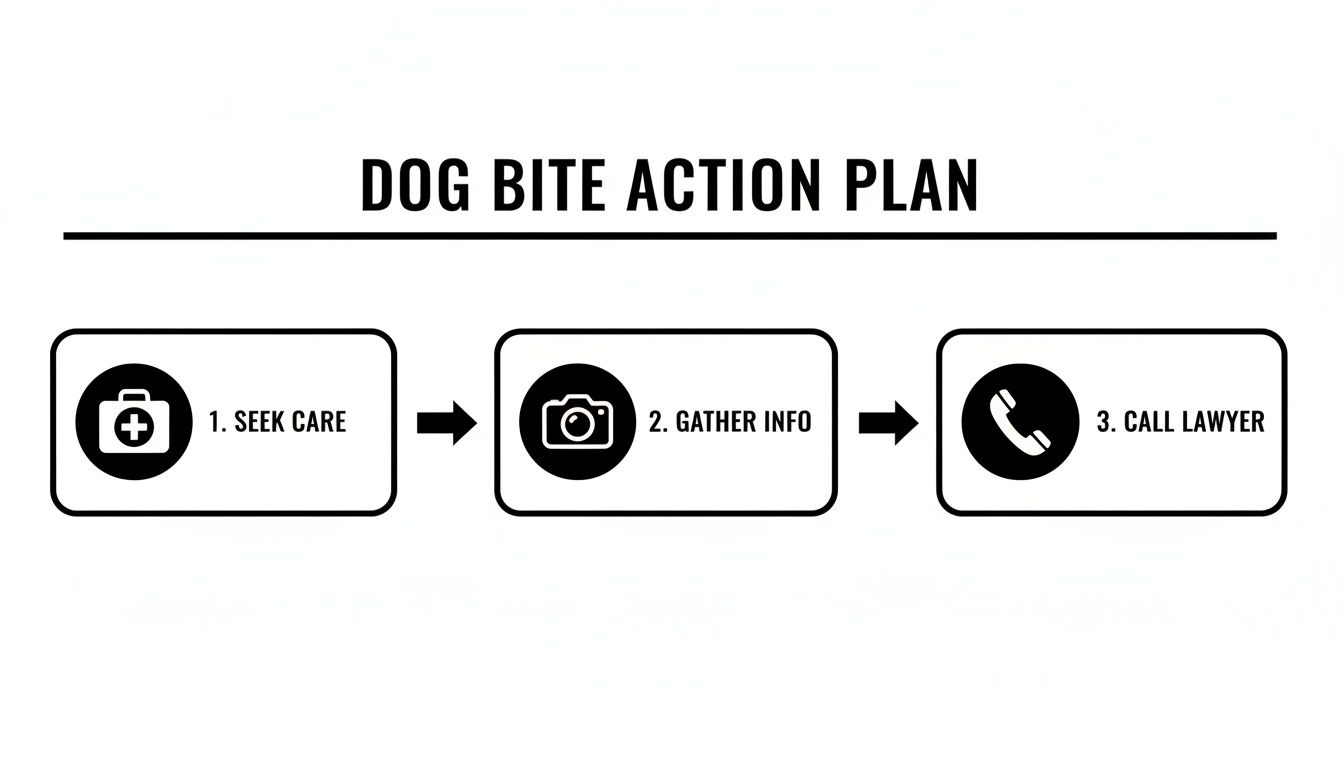
Each step builds on the last. Seeking medical care documents the harm. Gathering evidence proves what happened. And calling a lawyer ensures your rights are protected from day one.
The Bottom Line: A dog bite is a serious medical and financial event. The rising cost of claims proves it. You're not just up against a dog owner; you're up against their insurance company, and their only goal is to pay you as little as possible.
With so much on the line, you can't afford to go it alone. An experienced dog bite lawyer in Colorado is your best advocate. We work to hold negligent owners accountable and fight for the full compensation you need for your medical bills, lost wages, and the very real impact this has had on your life. Without a dedicated lawyer on your side, you risk being left with a settlement that doesn't even begin to cover your long-term needs.
Understanding Colorado's Strict Liability Dog Bite Law

After a dog bite, the legal path forward can feel confusing. But Colorado has a specific law designed to protect victims, and understanding how it works is the first step toward getting the help you need. The state has thankfully moved on from old, unfair rules.
Today, Colorado operates under a powerful statute: C.R.S. 13-21-124. This law establishes strict liability for dog owners whose animals cause serious injuries.
This is a game-changer for victims. In simple terms, strict liability means the dog’s owner is automatically on the hook for the economic fallout of a serious bite. It doesn't matter if the dog had a perfect record or had never shown a hint of aggression before. The owner is still responsible.
It’s a bit like a rear-end car accident. The law usually assumes the driver who hit the car from behind is at fault. Colorado's dog bite law works in a similar way, getting rid of the outdated "one-bite rule" that used to let owners off the hook the first time their dog attacked.
The Two Pillars of a Strict Liability Claim
For this strict liability rule to kick in, your case needs to stand on two key pillars. An experienced Colorado dog bite lawyer will focus on proving these two points right away.
First, you must have been lawfully on the property when the bite happened. This covers public places like parks and sidewalks. It also includes private property if you were an invited guest or had a legitimate purpose for being there, like a mail carrier or delivery person. Trespassers are generally not protected by this rule.
Second, the bite must have resulted in a “serious bodily injury.” This isn't just any minor nip or scratch; it’s a specific legal standard.
A "serious bodily injury" is defined as an injury which, either at the time of the actual injury or at a later time, involves a substantial risk of death, a substantial risk of serious permanent disfigurement, a substantial risk of protracted loss or impairment of the function of any part or organ of the body, or breaks, fractures, or burns of the second or third degree.
What does that mean in the real world? It means injuries like deep cuts needing stitches, broken bones from being knocked over, or nerve damage will almost certainly trigger the strict liability law. A skilled dog bite lawyer in Colorado will use your medical records and doctor’s reports to clearly show that your injury meets this critical legal definition.
Economic vs Non-Economic Damages
Here’s where things get a little more complicated. While Colorado’s strict liability law is a huge help, it does have a major catch: it only automatically covers your economic damages. These are the direct, out-of-pocket financial losses you’ve suffered because of the attack.
Economic damages covered under strict liability include things like:
- Medical Expenses: The full cost of everything from the ER visit and hospital stay to surgery and physical therapy.
- Future Medical Treatment: The projected cost for necessary future care, such as scar revision surgery or ongoing therapy.
- Lost Wages: The income you lost from being unable to work while you recovered.
- Loss of Earning Capacity: Compensation if the injury permanently reduces your ability to earn a living down the road.
What the statute doesn't automatically cover are your non-economic damages. These are the deep, personal losses that don’t come with a price tag but dramatically affect your life—the pain and suffering, emotional trauma, permanent scarring, and the loss of enjoyment in life.
To get compensation for these critical non-economic damages, we have to prove the owner was also negligent. This means showing they knew their dog was dangerous, ignored local leash laws, or were careless in some other way that led to the attack. This is where a seasoned dog bite attorney is absolutely essential. We dig deeper than the basic statute to build a case for the full compensation you truly deserve.
How a Dog Bite Lawyer Builds Your Winning Case
After a dog attack, getting fair compensation isn’t a given. It’s a fight. You’re up against insurance companies whose entire business model relies on minimizing what they pay out. An experienced Colorado dog bite lawyer steps in to handle that fight for you, building an undeniable case while you focus on one thing: healing.
Think of it this way: your lawyer is the architect of your claim. They don’t just file paperwork; they meticulously construct a case from the ground up, designed to withstand every tactic the insurer will throw at it. That work starts the second you hire them.
Launching an Immediate Investigation
The first 48 hours after an attack are everything. Evidence vanishes. Witness memories fade. A skilled lawyer moves immediately to lock down the facts.
This isn't just about snapping a few photos. It's a full-scale evidence preservation mission.
- Securing the Scene: An investigator might be sent to document exactly where the attack happened. They're looking for broken latches, weak points in a fence, or anything that shows the owner was negligent.
- Interviewing Witnesses: Eyewitnesses provide an objective account that can shut down the owner's excuses. Your lawyer will get their statements on record while the details are still sharp.
- Obtaining Official Reports: Your attorney will immediately pull the animal control and police reports. These documents often contain crucial details about the dog’s history of aggression or the owner’s prior violations.
This fast-acting approach stops the dog owner and their insurance company from twisting the story. It builds your case on a foundation of hard evidence, not a "he said, she said" argument.
Calculating the Full, True Value of Your Claim
Here’s where many unrepresented victims get hurt a second time. An insurance adjuster will often make a quick, lowball offer that seems to cover your initial ER bills. It’s a trap.
A real calculation of your claim goes so much deeper.
Your claim’s value isn't just about the bills you have today. It's about every single loss you will endure because of the attack—medical, financial, and personal. A proper legal valuation accounts for a lifetime of consequences, not just a single moment in time.
A thorough lawyer documents every single loss, both the ones with a price tag and the ones without. For a more detailed look at the legal principles at play, you can learn more about the role a Denver personal injury attorney plays in these cases. They compile a comprehensive demand package that includes:
- All Present and Future Medical Costs: This covers everything from the initial surgery to future needs you might not even be thinking about yet, like scar revision procedures, physical therapy, or counseling for trauma and PTSD.
- Complete Lost Income and Earning Capacity: This isn’t just about the paychecks you missed while recovering. If your injury affects your ability to do your job in the future, that loss is calculated, too.
- Valuing Pain and Suffering: Your lawyer will assign a real dollar value to the daily pain, the emotional trauma, the permanent disfigurement, and the loss of being able to enjoy your life. This is often the most significant part of a dog bite claim.
Negotiating from a Position of Strength
Armed with a case that’s fully investigated and documented, your lawyer doesn't just ask for a fair settlement—they demand it. The insurance company sees that your attorney has done the work and is ready to prove every dollar requested.
This preparation is your leverage. It allows your lawyer to shut down the insurance company's typical arguments, like blaming you for the attack or claiming your injuries aren't that serious.
Most importantly, a good lawyer prepares every case as if it’s going to trial. This readiness is what forces a settlement. Insurers know that fighting a well-prepared attorney in court is an expensive and risky gamble for them. That pressure is what brings them to the table with a serious offer, turning a potential courtroom battle into a successful outcome for you.
Calculating the Full Value of Your Dog Bite Claim

It’s a common story. An insurance company calls shortly after a dog attack, ready with a quick settlement offer. For many victims, accepting it feels like the easiest way to move on. But these first offers are almost never what you're truly owed. They’re designed to close a file, not to make you whole.
Understanding the full, long-term impact of a dog bite is the only way to know what fair compensation really looks like. A claim is much more than just a pile of medical bills. It's an honest accounting of every loss you've suffered and will continue to face. An experienced dog bite lawyer in Colorado knows how to separate these losses into two critical categories: economic and non-economic damages.
The Tangible Costs: Economic Damages
Think of economic damages as anything with a clear price tag. These are the direct, calculable financial losses that stemmed from the attack. A proper accounting doesn't just look at what you’ve already paid; it anticipates the costs that are still to come.
These damages are the foundation of your claim and typically include:
- Past Medical Bills: Everything from the ambulance and ER visit to surgeries, hospital stays, and follow-up appointments.
- Future Medical Care: This is crucial. It covers projected costs for things like scar revision surgery, physical therapy, or counseling for trauma down the road.
- Lost Wages: This is simple compensation for the paychecks you missed while you were recovering and unable to work.
- Diminished Earning Capacity: If the injury permanently impacts your ability to do your job or earn what you did before, this calculates that long-term loss of income.
These costs add up fast, often growing far beyond what victims initially expect. For a better sense of the factors involved, you can use tools like our free settlement calculators.
Valuing the Invisible Wounds: Non-Economic Damages
This is where a lowball offer truly fails. Non-economic damages are the profound, personal losses that don’t come with a receipt but dramatically alter your quality of life. These invisible wounds are often the most significant part of a dog bite claim.
A scar on your face is more than a medical issue; it's a daily reminder of trauma. The fear that keeps you from enjoying a walk in the park is a real loss. True compensation must account for this human cost.
An insurance adjuster won't volunteer this compensation. Proving it requires a lawyer who can effectively tell your story and show the deep, personal impact the attack has had on your life.
Key non-economic damages include:
- Pain and Suffering: Compensation for the physical pain, discomfort, and recovery process you have to endure.
- Emotional Distress: This covers the very real psychological toll, including anxiety, depression, new fears, and post-traumatic stress disorder (PTSD).
- Permanent Scarring and Disfigurement: This is valued based on the severity and visibility of scars, especially those on the face, neck, or hands that affect self-esteem and social life.
- Loss of Enjoyment of Life: This addresses your inability to go back to the hobbies, activities, and daily routines that once brought you joy.
The risk of dog attacks is a serious and growing concern, particularly for people who work out in our communities. Postal workers are especially vulnerable, with over 5,300 attacks reported nationwide in 2022. That same year, Denver saw 19 postal worker bites, which surged to 34 in 2024, placing the city 10th in the nation for such incidents.
This trend mirrors a city-wide problem, as Denver's total reported dog bites jumped from 813 in 2021 to 1,223 in 2024. These numbers show just how real the danger has become.
Who Gets Bitten Most Often in Colorado?
A dog attack can happen to anyone, but these incidents aren't as random as they might seem. When you look at the data, both here in Colorado and nationally, a clear and heartbreaking pattern emerges. Certain people are far more likely to become victims than others, and understanding who they are is the first step in preventing these tragedies.
The most difficult statistics involve our children. Their small size, natural curiosity, and inability to read a dog’s warning signals put them at an overwhelming risk for serious bites.
The Alarming Risk to Children
Children aren't just slightly more at risk; they are, by far, the primary victims of dog bites nationwide. Out of the roughly 4.5 million bites that happen each year, 800,000 are serious enough to need medical care—and kids make up the largest portion of those injured. In fact, children account for about 51% of all bite victims, with kids between 5 and 9 years old being especially vulnerable.
What's most disturbing is where these attacks happen. Around 80% of the time, the dog isn't a stray. It’s a dog the child knows, often in a familiar place like their own home or a friend’s house. This Aurora dog bite overview explores these devastating trends in more detail.
Because they are smaller, children often suffer bites to the head, face, and neck. These are the most severe injuries, frequently requiring reconstructive surgery and leaving behind not just physical scars, but deep emotional trauma that can follow a child for life. As a dog bite lawyer in Colorado, I’ve seen these tragic outcomes too many times. It’s why holding a negligent owner accountable is absolutely critical.
On-the-Job Dangers for Colorado's Workforce
After children, another group faces a significant and growing risk: people whose jobs require them to be on or near private property. Every day, their work puts them in the path of territorial, anxious, or poorly supervised dogs.
This includes a huge range of essential workers we all rely on:
- Postal Workers: Mail carriers visit nearly every home, every day, making them one of the most frequently bitten groups of professionals.
- Delivery Drivers: With the boom in online shopping, drivers for Amazon, UPS, FedEx, and DoorDash are more exposed than ever before.
- Utility Workers: Meter readers and repair technicians often have to enter a yard to do their job, sometimes without any warning that a dog is present.
- Landscapers and Contractors: These professionals spend hours working on a property, increasing the chances of a dangerous encounter.
For these workers, a dog bite isn't just an injury. It's a serious workplace hazard that can mean lost wages, long-term disability, and even the end of a career.
When a bite happens on the job, the legal side can get tricky. You might have a workers' compensation claim and a separate personal injury case against the dog's owner. An experienced dog bite lawyer in Colorado knows how to handle these overlapping claims to make sure you get all the compensation you deserve from every possible source.
Answering Your Questions About Colorado Dog Bite Claims

After a dog bite, your mind is probably racing with questions. The path forward can feel confusing and overwhelming, but getting clear, honest answers is the first step. Here are some of the most common concerns we hear from victims just like you.
How Long Do I Have to File a Lawsuit?
In Colorado, there's a strict deadline for filing a dog bite lawsuit. You have two years from the date of the attack to take legal action. This is called the statute of limitations.
Once that two-year window closes, your right to seek compensation is almost always lost for good. That’s why it's so critical to speak with a dog bite lawyer in Colorado quickly. We can make sure your rights are protected while we work to preserve evidence before it’s lost. You can read more about how these deadlines work in our overview of Colorado's statute of limitations for personal injury.
What if the Dog Owner Is a Friend or Relative?
This is one of the most common and difficult situations we see. The thought of suing a neighbor, friend, or family member feels awful, and no one wants to ruin a relationship over this.
Here’s the thing to remember: you aren’t suing them personally. A dog bite claim is almost always made against the owner’s homeowner’s or renter’s insurance policy. That insurance exists for precisely this reason—to cover unexpected accidents. An experienced lawyer knows how to manage these sensitive cases by directing all communication to the insurance company, allowing you to focus on your recovery and preserve your relationship.
Can I Still Get Compensation if I Was Partially at Fault?
Colorado operates under a modified comparative fault rule. In simple terms, this means you can still recover damages even if you were partially responsible, as long as your share of the fault is less than 50%.
For example, if a jury decides you were 10% at fault for the incident, your final compensation award would just be reduced by that 10%. Insurance companies love this rule. They will often try to twist the facts to place as much blame as possible on you, hoping to reduce what they have to pay or deny your claim completely.
Your lawyer's job is to build a strong case that clearly demonstrates the owner's liability and counters any attempts to wrongfully blame you for the attack. This is a critical part of securing the full compensation you deserve.
Should I Accept the Insurance Company's First Offer?
No. Never accept an initial settlement offer from an insurance company without talking to a lawyer first. These first offers are almost always intentionally low.
The insurance adjuster’s job is to close your case for the least amount of money possible. Their first offer won't come close to covering the true cost of your injuries, including future medical treatments, lost income, and the pain and emotional trauma you’ve endured.
A skilled dog bite lawyer in Colorado knows how to calculate the real, long-term value of your claim. We have the experience to negotiate for a settlement that truly accounts for everything you've been through.
If a dog attack has turned your life upside down, you don't have to face the legal battle alone. The team at Nares Law Group LLC is here to provide the guidance and advocacy you need to secure a hopeful future. Contact us today for a free, no-obligation consultation to understand your rights and options.