Most car accident claims resolve anywhere from 3 months to 3 years or longer, depending on the injuries, the evidence, and whether fault is disputed. The right timeline isn’t the fastest one. It’s the one that gives you enough time to understand your medical condition, document your losses, and avoid settling for less than your case is worth.
Right now, you may be dealing with pain, calls from insurance adjusters, car repair issues, and bills that don’t stop just because your life did. That combination makes one question feel urgent: how long to settle a car accident claim, and how long do you have to live in this limbo?
The honest answer is that the process follows a pattern, but the pace depends on what kind of case you have. A straightforward crash with minor injuries can move relatively quickly. A trucking case, a brain injury case, or any claim with disputed fault usually takes longer because more has to be proven, and more is at stake.
That’s frustrating. It’s also normal.
A good claim process should feel less like chaos and more like a roadmap. There are stages. There are decision points. There are moments when waiting protects you, and moments when pushing harder moves the case forward. If you understand those trade-offs, the timeline stops feeling random.
The First Question After a Crash "How Long Will This Take?"
The question isn't typically asked out of curiosity. It's posed because they’re hurting, missing work, and trying to figure out how long life will stay off balance.
A common scene looks like this: the crash happened days ago, maybe weeks. Your neck still hurts. You’ve already been to urgent care or the ER. The other driver’s insurance company has called more than once. Someone is asking for a recorded statement. Another person is talking about resolving the claim quickly. Meanwhile, your family wants to know what happens next, and you don’t have a clear answer.
That uncertainty is often worse than the paperwork.
What helps is understanding that a settlement timeline usually isn’t one big wait. It’s a series of smaller steps. First, the claim has to be investigated. Then your doctors need time to understand your injuries. Then the case has to be valued. Then the insurer has to respond to the evidence. If they refuse to be reasonable, the file may need to move into litigation.
A fast offer can feel like relief. Sometimes it’s just an insurer buying the claim before the full damage is visible.
That matters even more in Colorado cases involving concussions, traumatic brain injuries, and truck wrecks. Some injuries don’t reveal their long-term impact right away. If you settle before the picture is clear, you usually can’t reopen the claim later because the bills kept coming.
If you’re also trying to manage adjuster calls, this guide on dealing with insurance after a car accident can help you avoid early mistakes while your case is still taking shape.
The Four Stages of a Car Accident Claim Journey
A car accident claim works a lot like building a house. You don’t start with paint colors. You start with the foundation. In a claim, that foundation is evidence, medical proof, and a clear picture of your losses.
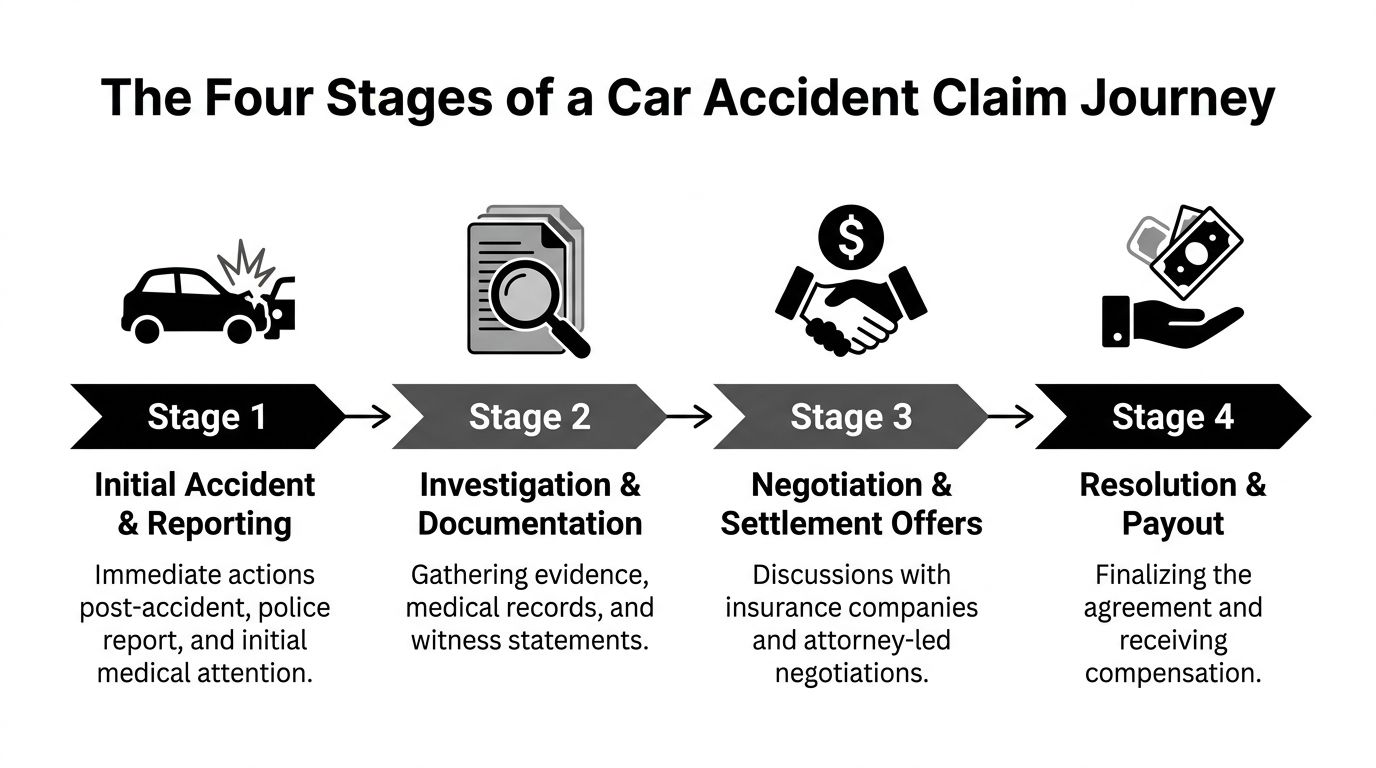
On average, car accident claims take about 1.5 years to resolve, though timelines vary widely. Evidence collection can take 2 to 6 months, claim valuation can take another 2 to 6 months, negotiation by demand letter may conclude in 4 to 6 weeks if the insurer is reasonable, and a lawsuit can add 1 to 2 years before trial, as outlined in this discussion of auto accident settlement timelines.
Stage one is investigation and evidence gathering
At this point, the claim starts to become a case.
The legal team or claimant gathers the police report, photographs, witness statements, medical records, repair estimates, wage information, and any available video or electronic data. In a truck crash, this can also include driver logs, company records, and vehicle data that may disappear if no one moves quickly to preserve it.
Think of this stage as collecting puzzle pieces before anyone tries to argue about the final picture.
If key evidence is missing, the insurer has more room to deny fault, minimize the impact of the crash, or question whether your injuries came from something else.
Stage two is medical treatment and recovery
This is the part many people underestimate.
Your case value depends heavily on your medical story being complete, consistent, and supported by records. That doesn’t mean you must be perfectly healed. It means your doctors need enough time to understand what changed, what treatment worked, what didn’t, and whether future care will be needed.
For some clients, this stage is short. For others, especially people with orthopedic injuries, head injuries, or ongoing neurological symptoms, this stage is the longest and most important one.
Practical rule: the claim usually shouldn’t move toward final settlement until the medical picture is stable enough to value honestly.
Stage three is the demand and negotiation
Once liability and damages are documented, the injured person or attorney sends a demand package to the insurer. This is not just a letter asking for money. It is the organized presentation of the case.
A strong demand package typically does four things:
- Explains fault clearly: It shows why the other driver, trucking company, or responsible party should be held accountable.
- Connects the injuries to the crash: It ties medical records, symptoms, and treatment to what happened.
- Documents losses: It includes medical expenses, lost wages, and the practical effect on daily life.
- Sets the negotiation framework: It gives the insurer a reason to evaluate the file seriously rather than casually.
If the insurer responds in good faith, this stage may end in settlement. If not, the back-and-forth can stall quickly.
Stage four is resolution, by settlement or litigation
Many people assume the case ends at this point. Sometimes it does. At other times, however, an influential position commences.
There are two basic paths:
Settlement before suit
The parties agree on a number, sign releases, and move to payment processing.Litigation
A lawsuit is filed because the insurer refuses to pay fair value, disputes liability, or keeps dragging the process out.
Litigation sounds intimidating, but it is often just the formal structure needed to force progress. Filing suit creates deadlines, allows discovery, and shows the insurer that the injured person is not going to accept a low offer just to end the stress.
A claim doesn’t become strong because time passes. It becomes strong because each stage is completed in the right order and with the right proof.
Key Factors That Speed Up or Slow Down Your Settlement
Some cases move quickly because the facts are clean and the injuries are limited. Others take much longer because one or more pressure points complicate the file.

The three biggest drivers are usually injury severity, liability, and insurer behavior. If you understand those three, you can usually understand why your case is moving the way it is.
Injury severity changes the clock
Minor injuries usually produce shorter timelines because the treatment period is shorter and the losses are easier to document. More serious injuries take longer because doctors need time to determine what the crash caused and what recovery will look like.
That delay is not wasted time. It’s the process of turning a vague injury claim into a provable damages claim.
A person with soreness that resolves after conservative care presents one kind of file. A person with surgery, cognitive symptoms, or long-term work restrictions presents a very different one. The second case takes longer because it should.
Fault disputes create drag immediately
When liability is obvious, a claim can move forward without spending months arguing over how the crash happened. Rear-end collisions with clear records often fall into this category.
Multi-vehicle crashes, commercial truck wrecks, and collisions with conflicting stories do not.
Disputed liability in multi-vehicle or commercial truck accidents can stretch settlement timelines to 1 to 2 years or longer, while clear-fault minor injury cases may resolve in 2 to 6 months. If litigation is added because fault is disputed, that can extend the process by 6 to 18 months, according to this overview of car accident claim timing in disputed cases.
When several vehicles are involved, insurers often point fingers at each other before they ever discuss your damages. In a truck case, there may be disputes over the driver, the carrier, maintenance, loading, or the sequence of impacts. That doesn’t just slow things down. It changes what evidence must be collected.
Insurance company behavior matters more than people expect
Some adjusters evaluate claims promptly and negotiate within a normal range. Others delay responses, demand repeated documents, challenge obvious treatment, or push quick settlements before the medical picture is clear.
That’s where frustration builds.
A delay is not always a sign that something has gone wrong. Sometimes it means the insurer sees exposure and is trying to improve its position. Sometimes it means the claim is not yet ready. Sometimes it means the file needs more pressure.
This video gives a useful overview of why some cases stall and what that often signals:
What tends to help and what tends to hurt
A few habits consistently move claims in the right direction.
- Prompt treatment helps: Early medical care creates a timeline that connects the crash to the injury.
- Consistent follow-through helps: Gaps in treatment give insurers room to argue that the injury wasn’t serious.
- Organized records help: Bills, work-loss proof, and symptom documentation make valuation easier.
- Rushing hurts: Quick settlement pressure often appears before the actual cost of the injury is known.
- Loose communication hurts: Casual statements to adjusters can create avoidable disputes over fault or symptoms.
Some of the longest cases aren’t the ones with the worst injuries. They’re the ones where serious injuries meet disputed fault and an insurer that won’t negotiate honestly.
Why Maximum Medical Improvement Is the Most Important Milestone
If you remember one concept from this article, make it Maximum Medical Improvement, or MMI.
MMI does not mean you are back to normal. It does not mean you feel great. It means your doctors have enough information to say your condition has either stabilized or reached a point where future treatment needs can be predicted with some confidence.
That distinction matters because settlement is final. Once you sign the release, you generally don’t get to come back later and ask for more because your symptoms worsened or a specialist recommended more care.
Don’t settle before the inspection is complete
A useful analogy is a house sale. You wouldn’t sell a damaged house before the inspection report comes back if the buyer gets to lock in the price and walk away forever. You would want to know whether the issue is cosmetic or structural.
The same logic applies to injury claims.
Moderate injuries often take 3 to 9 months to reach MMI, and settling with incomplete treatment documentation can undervalue a claim by 40 to 60%, according to this explanation of why MMI affects claim value.
In practice, insurance pressure and client stress often collide. The insurer wants closure. The injured person wants stability. But if the medical record is still developing, a fast check can become an expensive mistake.
This is especially important in brain injury cases
Traumatic brain injuries rarely behave like a simple bruise. Some symptoms show up early. Others become clearer over time.
A person may seem “mostly okay” in the first weeks, then struggle later with headaches, memory lapses, fatigue, mood changes, sensory sensitivity, or trouble working through a normal day. Family members often notice the change before the medical chart fully captures it.
That is why timing matters so much in TBI cases. The claim has to reflect the injury you sustained, not the one the insurer prefers to classify quickly.
Settling before MMI can solve today’s bill problem by creating next year’s uncovered treatment problem.
What the treatment stage is really doing
During treatment, your doctors and providers are building the evidence that explains the long-term effect of the crash. That may include referrals, imaging, therapy notes, specialist opinions, and work restrictions.
If you want a clearer look at that phase, Nares Law Group has a helpful explanation of the treatment stage of a personal injury case.
The key point is simple. Waiting for MMI is not delay for delay’s sake. It is how you protect the future value of the claim.
Colorado-Specific Rules You Must Know
Colorado adds its own rules to the settlement timeline, and those rules affect both bargaining power and risk. If you don’t know them, it’s easy to make a decision that feels efficient in the moment but costs you later.

The filing deadline is not flexible
Colorado motor vehicle claims are governed by a filing deadline, and missing that deadline can destroy an otherwise valid case. If you’re unsure how that deadline applies to your crash, this guide on the Colorado personal injury statute of limitations is a good place to start.
The practical takeaway is straightforward. You can’t wait until settlement talks collapse to begin taking the claim seriously.
Colorado is an at-fault state
Colorado follows an at-fault system for car crashes. That means the claim is usually pursued against the driver or company that caused the wreck.
In real life, that leads to arguments over who did what, whether someone changed lanes unsafely, whether a truck driver was following too closely, or whether a distracted driver reacted too late. Those fault disputes can shape the timeline as much as the injuries do.
Comparative negligence can change the value
Colorado also applies modified comparative negligence. In plain English, fault can be shared.
A simple example helps. If a person is found 20% at fault, the value of the recovery is reduced by that same share. That is why early statements, photographs, witness names, and scene evidence matter. The more clearly the crash can be reconstructed, the less room there is for an insurer to inflate your percentage of blame.
TBI cases require extra caution in Colorado
The local rule discussion directly encounters the medical reality.
For injuries such as TBIs, symptoms can take 12 months or longer to fully manifest, and many Colorado claimants who settle too early later face uncovered medical expenses because they resolved the claim before understanding the long-term impact, as discussed in this article on settling a Colorado car accident claim too soon.
That is one reason “fast” is not a useful goal by itself. In Colorado, the better goal is to move efficiently without cutting off your rights or underestimating future care.
In a brain injury case, patience is often part of the legal strategy, not a sign that nothing is happening.
Med-Pay coverage can also be important for immediate medical bills while the liability claim develops, but it should be coordinated carefully so short-term relief doesn’t create confusion in the larger case.
Sample Timelines From Minor Collisions to Complex Wrecks
Readers usually want examples because examples make the timeline feel real. The chart below shows how the same claim process can unfold very differently depending on the injuries, the fault issues, and whether litigation becomes necessary.
Car Accident Settlement Timeline Examples
| Case Type | Key Factors | Typical Timeline | Resolution Path |
|---|---|---|---|
| Minor rear-end collision | Clear fault, prompt treatment, soft-tissue injuries that improve with conservative care, complete records | A few months, often near the shorter end of the overall range | Pre-suit negotiation after treatment stabilizes |
| Moderate injury crash | Ongoing treatment, more significant medical proof needed, possible procedure or surgery, some disagreement over fault or causation | Often closer to the middle of the overall range | Demand, extended negotiation, possible suit if the insurer undervalues the claim |
| Commercial truck wreck with TBI | Complex liability, multiple parties, serious long-term symptoms, specialist treatment, future care questions, heavier evidence burden | Often at the longer end of the overall range and sometimes beyond it | Litigation is frequently needed before meaningful settlement talks occur |
Why the minor case usually moves faster
A lower-impact collision with clear responsibility can often be evaluated sooner. The treatment course is shorter. The records are easier to gather. The insurer has less room to argue.
That doesn’t mean every minor case settles immediately. It means fewer unknowns are holding the file open.
Why the middle category often frustrates people most
Moderate cases are the ones that often feel slow because the injuries are real, but not always obvious on day one. The person may need months of treatment before a doctor can say whether the condition will fully resolve.
During that period, the insurer may act as if the claim should already be settled. That pressure can be hard to ignore when bills are arriving, but it usually reflects the insurer’s timeline, not the medical timeline.
Why truck and TBI cases follow a different path
Complex wrecks take longer because every layer of the case is more demanding. Liability may involve several defendants. The medical proof may require specialists. The long-term impact may not be fully known for quite some time.
In those cases, filing suit can move the case toward resolution by forcing document exchange, testimony, and accountability. That sounds backward to non-lawyers, but in practice it often creates the first serious negotiation environment.
A lawsuit doesn’t always slow a case down. Sometimes it’s the only way to stop an insurer from wasting months in shallow negotiations.
When to Call a Lawyer to Protect Your Claim
Not every crash requires immediate legal representation. Some do. The issue isn’t just whether a lawyer can make the process easier. It’s whether you need someone protecting the value of the claim before the insurer shapes it in its favor.
Red flags that mean you should get legal help
Call a lawyer promptly if any of these are true:
- You have a serious injury: Brain injuries, fractures, surgery cases, and truck wreck injuries usually need early evidence preservation and careful medical documentation.
- Fault is being disputed: If the other side is blaming you, the case can lose value quickly unless someone starts building the liability file.
- An adjuster wants a quick statement or fast settlement: That usually means the insurer wants information or closure before the case is mature.
- There are multiple vehicles or a commercial policy involved: Those claims are rarely simple, even when they look simple at first.
- You’re worried about future care: If your condition is still changing, settlement timing becomes a legal and medical judgment, not just a financial one.
What a lawyer actually does for the timeline
A good attorney doesn’t just “speed things up.” Their primary role involves moving the case forward in the right order, preserving evidence, coordinating the record gathering, managing insurer communication, and deciding when negotiation has stalled enough that litigation should begin.
After settlement is reached, payment usually arrives within 30 to 60 days, though proactive attorneys can reduce delays by handling liens and paperwork efficiently, sometimes cutting the wait by 20 to 50%, as explained in this overview of post-settlement payment timing.
Nares Law Group LLC is one example of a firm that handles investigation, treatment coordination, negotiation, trial, and settlement in motor vehicle and truck injury cases. The right fit, though, is any attorney who understands serious injury valuation and is prepared to litigate when needed.
A free consultation is often the fastest way to find out whether your case is on a normal track or whether something needs immediate attention.
Taking Control of Your Recovery and Your Timeline
A car accident claim can feel like something being done to you. In reality, there are parts of the timeline you can influence.
You can get medical care promptly. You can follow treatment recommendations. You can keep records. You can avoid giving careless statements. You can recognize when an early offer is really an early exit for the insurance company. And you can get help before a manageable claim becomes a damaged one.
The biggest shift in mindset is this: the right question is not only how long to settle a car accident claim. It’s how long should this claim take to reflect what the crash cost you.
For a minor case, that answer may be relatively soon. For a Colorado TBI or trucking case, the safer answer is often to wait until the medical and legal picture is developed enough to demand full value with confidence.
You don’t have to like the timeline. But once you understand what drives it, you can make better decisions inside it.
If you were hurt in a crash and need straight answers about timing, medical documentation, insurance pressure, or whether it’s time to file suit, Nares Law Group LLC offers free consultations for injured people and families dealing with car wrecks, truck accidents, traumatic brain injuries, and wrongful death claims. A conversation early in the process can help you protect the claim before the timeline starts working against you.