A lot of people call a lawyer because their body hurts after a crash. Just as many should call because their mind won't settle down.
You may have walked away from a Colorado collision with no dramatic visible injury, only to find that fallout starts later. You grip the steering wheel too tightly. You wake up at 3 a.m. replaying the impact. You snap at your family, forget simple tasks at work, and feel guilty because other people keep saying you were “lucky.”
That kind of suffering is real. The law often recognizes it. But emotional distress damages aren't automatic, and they aren't based on a vague statement that you're upset. They depend on facts, documentation, timing, and the steps you take starting now.
The Invisible Injuries After an Accident
A common client story goes like this. The bruises faded. The emergency room visit ended. Everyone expected life to get back to normal. But weeks later, the person still couldn't drive past the intersection where the crash happened without shaking.
That's the part many injury survivors don't expect. The accident ends in seconds, but the fear keeps showing up in ordinary moments. Grocery store parking lots feel dangerous. Sleep becomes light and broken. Work takes twice the effort because concentration disappears.
What this looks like in daily life
Emotional distress after an accident often shows up in ways people minimize at first:
- Driving fear: You avoid highways, certain streets, or driving at night.
- Sleep disruption: Nightmares, insomnia, or waking up tense become routine.
- Mood changes: Irritability, sadness, panic, numbness, or sudden crying spells take over.
- Relationship strain: Family members notice you're withdrawn, distracted, or easily overwhelmed.
- Work problems: You miss shifts, lose focus, or can't handle the same workload.
Some people develop symptoms that fit a recognized condition, including acute stress reactions or post-traumatic symptoms. If you're trying to understand what early trauma symptoms can look like and what care may involve, this overview of treatment for acute stress disorder can help you put language to what you're experiencing.
You don't need to "tough it out" to prove you're strong. In a legal claim, pretending you're fine usually makes your case harder, not stronger.
Why this matters in a Colorado injury claim
In a personal injury case, emotional distress damages are part of the broader category of non-economic harm. That means the law may compensate the mental and emotional consequences of an injury, not just the hospital bill or the missed paycheck.
But the legal system doesn't see what your spouse sees at midnight, or what you feel when you hear brakes screech. You have to show it. The sooner you start documenting what changed, the stronger your position becomes.
What Legally Counts as Emotional Distress
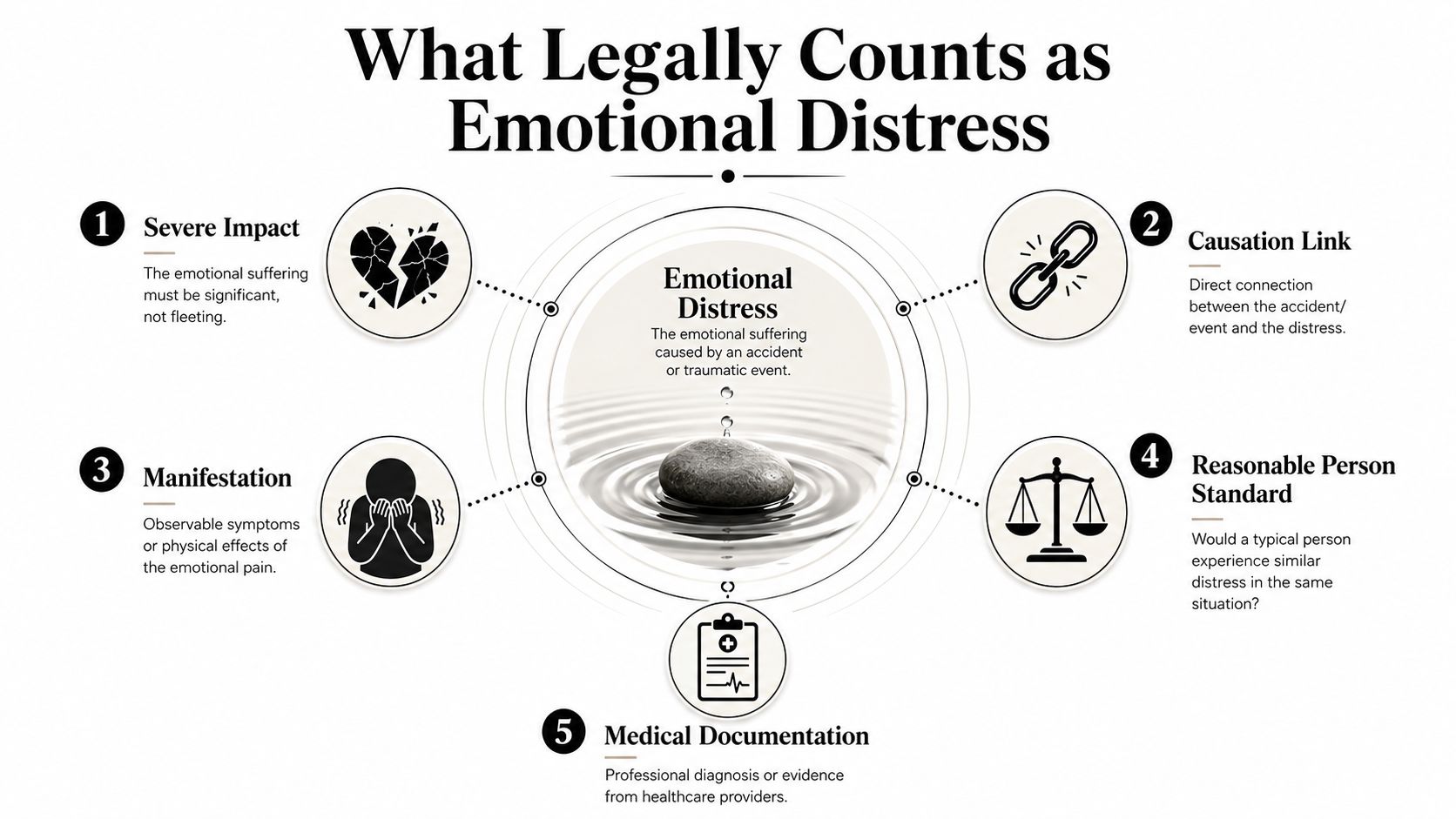
When lawyers talk about emotional distress, we aren't talking about a bad day or ordinary frustration. We mean serious mental or emotional suffering tied to a specific wrongful event.
A useful way to think about it is a stone dropped into a pond. The collision, assault, or traumatic event is the stone. The ripples are everything that follows. Anxiety. Depression. PTSD. Panic attacks. Sleep loss. Loss of enjoyment of life. Trouble working. Trouble parenting. Trouble being yourself.
The law looks for more than feelings
Courts generally treat emotional distress damages as non-economic damages. To recover them, a plaintiff usually needs to show severe psychological harm with objective manifestations such as diagnosed anxiety, depression, PTSD, or physical symptoms like sleep loss and panic attacks that are directly linked to the event, as explained in this discussion of how courts evaluate proof of emotional distress.
That causation piece is where many people get stuck. It's not enough to say, “I'm anxious.” The question becomes, “Can you show this defendant's conduct caused this anxiety?”
Courts often look for a direct forensic link between the incident and your distress, while separating out pre-existing conditions. That doesn't mean a person with prior anxiety has no claim. It means the evidence has to show what changed, when it changed, and why.
For a closer look at how trauma-related injuries fit into injury claims, this resource on PTSD and other psychological harm helps connect the medical reality to the legal claim.
Common forms of legally recognized distress
A few examples help:
| Experience | Why it may matter legally |
|---|---|
| Diagnosed PTSD after a violent crash | Shows a recognized condition tied to trauma |
| Panic attacks when driving | Shows ongoing functional impact |
| Depression after loss of mobility or independence | Connects emotional harm to the injury's consequences |
| Insomnia and nightmares | Provides observable symptoms |
| Withdrawal from family and social life | Shows behavioral change others can confirm |
Later in life, some survivors also need counseling that addresses emotional abuse, trauma patterns, or chronic fear responses. In that situation, a plain-language explanation of ByBS&Thrive emotional abuse therapy may help you understand how treatment can support healing and documentation at the same time.
A short overview can also help if you're more comfortable learning by video:
The Two Paths to a Claim Negligent vs Intentional Harm
Not every emotional distress claim follows the same legal theory. Most fall into one of two paths. Harm caused by carelessness, or harm caused by extreme deliberate conduct.
Negligent infliction
This path usually grows out of ordinary accident cases. A distracted driver runs a red light. A trucking company ignores safety rules. A property owner creates a dangerous condition and someone gets hurt.
The conduct isn't designed to terrorize you. It's careless. But the emotional fallout can still be severe.
In many negligence-based claims, courts focus on whether the plaintiff was physically impacted or placed in immediate danger. People often hear the phrase zone of danger and assume it means something abstract. It doesn't. It usually means you were close enough to the danger that a reasonable person would fear immediate harm.
Intentional infliction
This path is different. The conduct has to be much more extreme.
Think of a road rage driver who chases another car, traps it, screams threats, and creates a terrifying confrontation. Or a person who intentionally engages in conduct so outrageous that ordinary negligence language doesn't fit.
The emotional harm in those cases isn't a side effect of carelessness. It's the expected result of extreme behavior.
Practical rule: If your story begins with “they were reckless,” you're usually in negligence territory. If it begins with “they meant to terrify me” or “their conduct was outrageous,” intentional harm may be the better frame.
Negligent vs intentional emotional distress
| Element | Negligent Infliction (NIED) | Intentional Infliction (IIED) |
|---|---|---|
| Core idea | Harm caused by carelessness | Harm caused by extreme or outrageous conduct |
| Typical example | Car crash, truck wreck, unsafe premises | Threats, stalking, severe harassment, terrifying confrontation |
| Mental state | Defendant failed to use reasonable care | Defendant acted intentionally or with extreme disregard |
| Proof focus | Danger, impact, causation, resulting distress | Outrageous conduct and severe distress it caused |
| Common confusion | “No one meant to hurt me, so I can't claim this” | “They were rude, so it must be intentional” |
Where people get confused
People often think emotional distress is only available if someone acted maliciously. That isn't true. A serious collision caused by negligence can trigger real psychological injury.
Others make the opposite mistake. They assume every upsetting event creates an intentional-infliction claim. It doesn't. The law sets a high bar for extreme and outrageous conduct. Rudeness, ordinary conflict, and unpleasant behavior usually won't meet it.
In Colorado cases, the label matters less than the underlying facts at the beginning. What happened, how close you were to danger, what symptoms followed, and what evidence exists will shape the legal path.
Building Your Case How to Prove Emotional Distress
Feelings start the story. Evidence proves it.
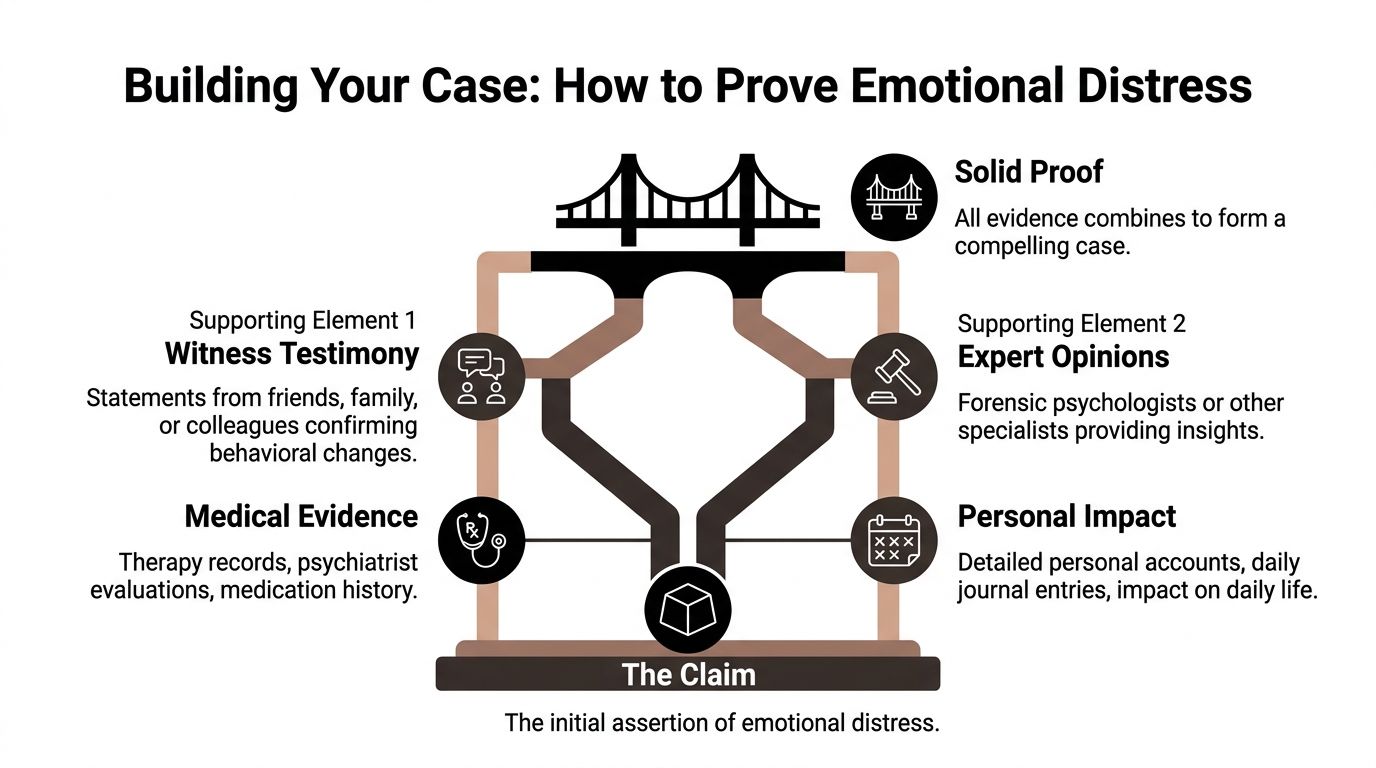
I often describe this as building a bridge. On one side is your lived experience. Fear, panic, grief, sleeplessness, and the sense that life hasn't felt normal since the incident. On the other side is the courtroom or insurance adjuster asking, “What backs that up?” A strong claim needs both sides connected.
What evidence actually helps
Courts expect a direct link between the defendant's act and the harm. They also expect evidence. According to this explanation of how to prove pain and suffering, proof is much stronger when it includes treatment records, witness observations, and detailed documentation of how daily life changed.
Here are the pieces that usually matter most:
- Mental health records: Therapy notes, psychologist evaluations, psychiatrist records, and diagnosis history can show severity and continuity.
- Medical records outside therapy: Your primary care doctor may have documented anxiety, sleep loss, panic symptoms, headaches, or stress-related complaints.
- Medication evidence: Prescriptions for anxiety, depression, or sleep disruption can support the timeline.
- Witness statements: Spouses, friends, co-workers, and relatives can describe changes in your mood, habits, memory, or social life.
- Your own journal: Day-by-day notes often become some of the clearest proof because they capture symptoms while they're happening.
What to start doing today
If you're in Colorado and you think your emotional suffering may become part of a claim, do these things now:
- Write a symptom log tonight. Note sleep problems, panic episodes, driving avoidance, nightmares, crying spells, and missed activities.
- Get evaluated. A therapist, psychologist, psychiatrist, or primary care doctor can create treatment records that matter later.
- Tell the truth consistently. Use the same plain language with doctors, family, and your lawyer. Inconsistent stories create doubt.
- Save outside proof. Calendar cancellations, work emails, missed-school notes, and pharmacy records can all help.
- Ask one or two trusted people to observe changes. Their future statements may support your case.
The best journal isn't dramatic. It's specific. “I couldn't drive on I-25 today and had to pull over because my hands were shaking” is better than “felt bad.”
Why the whole-person picture matters
Trauma isn't only psychological. It can affect sleep, concentration, appetite, physical tension, relationships, work performance, and pain levels. If you want a useful framework for describing that overlap, this article on understanding the biopsychosocial model gives a practical way to explain how one traumatic event can disrupt multiple parts of life at once.
That broader picture often helps juries and insurers understand that emotional distress isn't vague. It's measurable through changes in function, treatment, and behavior.
Putting a Number on Pain How Your Claim Is Valued
A client often asks this after the first few conversations: “How do you put a dollar amount on something no one can see?”
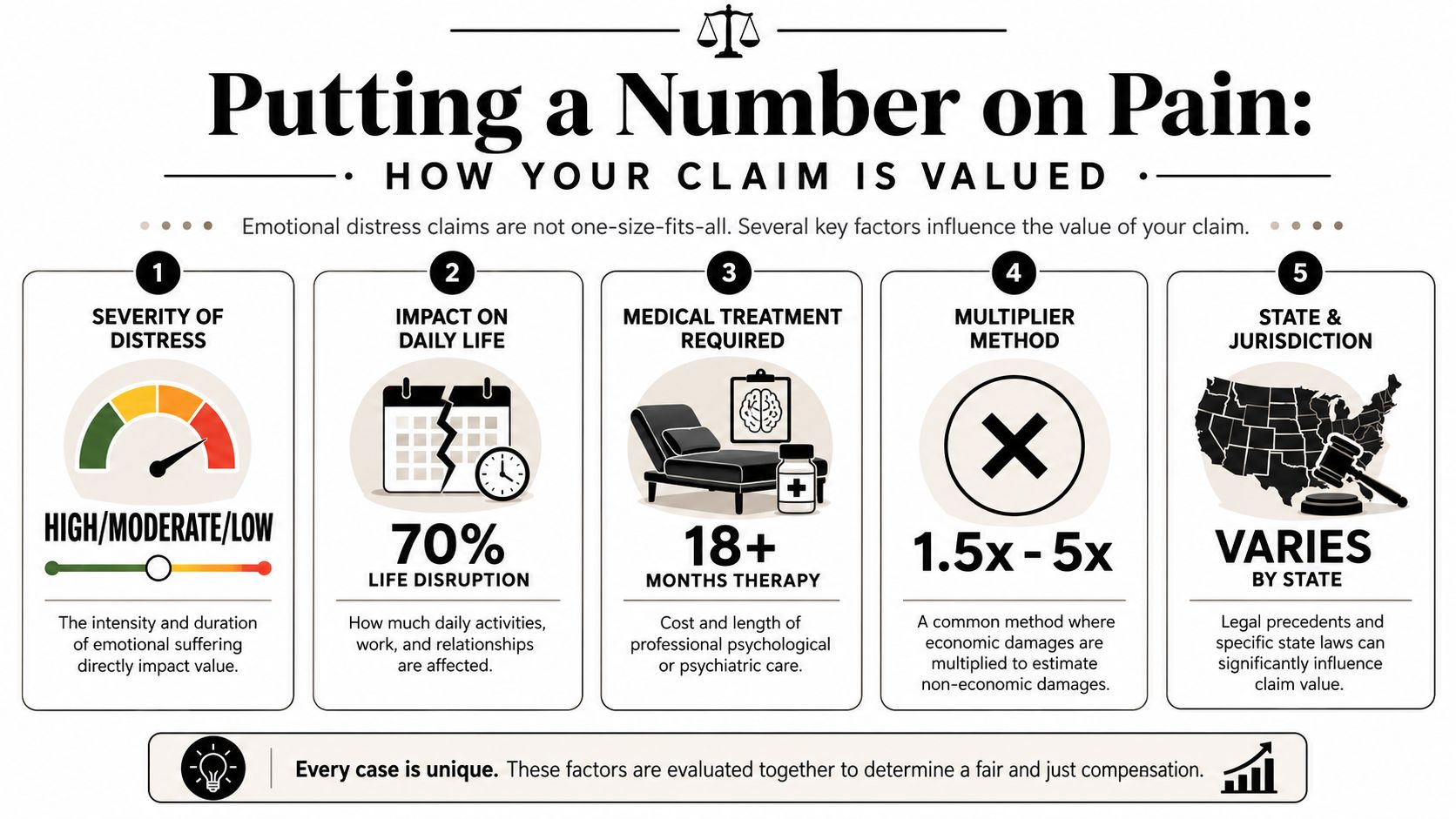
The short answer is that the law uses tools, patterns, and proof. It does not use a receipt. Emotional distress is more like valuing damage after a house fire that filled every room with smoke. You may not have one broken object to point to, but the harm still reached your sleep, your work, your relationships, and your sense of safety.
Two common ways claims are evaluated
Lawyers and insurance companies often begin with two familiar approaches.
The first is the multiplier method. It starts with economic losses, such as medical bills, therapy costs, and lost income, then applies a number that reflects how serious and long-lasting the emotional harm appears to be. A case with brief anxiety and limited treatment may be valued very differently from one involving PTSD symptoms, months of counseling, and major changes in daily life.
The second is the per diem method. This approach assigns a daily value to the suffering and applies it over a supported period of time. It tends to make more sense when the timeline is clear and well documented, such as when records show panic attacks for six months, ongoing therapy, medication changes, or an inability to drive after a crash.
Neither method is a rule. Both are starting points for negotiation and trial preparation.
What actually pushes value up or down
The strongest claims usually show a clear before-and-after story. That means more than saying you feel different now. It means showing how the injury changed your life in concrete ways.
A few factors often carry real weight:
- the severity of the event
- whether symptoms were diagnosed and treated
- how long the distress lasted
- whether it affected work, parenting, school, sleep, or relationships
- whether your records and witness accounts match each other
- how credible and specific your day-to-day documentation is
This is why the steps you take today matter. Your journal, therapy attendance, prescription history, missed-work records, and messages showing canceled plans all help translate suffering into evidence. Evidence is what gives a valuation room to grow.
Real-world numbers need caution
You will find articles online that list settlement ranges, averages, and verdict figures for emotional distress claims. Those numbers can give rough context, but they can also mislead people if they are treated like a price list. One person may have severe symptoms but weak documentation. Another may have moderate symptoms and excellent proof, a sympathetic witness, and strong medical support.
Colorado cases add another layer. State law can affect what is recoverable, especially when emotional distress is part of a broader non-economic damages claim. For a practical Colorado-specific explanation of how these damages are analyzed, see this guide on how to calculate pain and suffering damages in Colorado.
A practical way to think about value
A claim is usually worth what you can prove, explain, and connect to the event.
If you want to help your case hold its value, act like you are building a timeline for someone who was not there. Save the therapy appointment summaries. Keep the pharmacy receipts. Write down the nights you woke up shaking, the routes you no longer drive, the family events you skipped, and the work mistakes that started after the accident. Those details are often what turn “pain and suffering” from an abstract phrase into a believable damages claim under Colorado law.
Colorado Rules and Important Deadlines
Colorado law matters because even a strong emotional distress claim has to fit inside state rules on timing and damages.
The first deadline issue is the statute of limitations. In plain English, that's the legal clock. If you wait too long, the court can bar your claim no matter how legitimate the harm is. The exact filing deadline depends on the type of case, and accident victims shouldn't guess about it.
Why fast action matters in Colorado
People often delay because emotional injuries feel less urgent than fractures or surgery. That's understandable, but dangerous. The strongest evidence usually exists early. Medical histories are fresh. Witnesses still remember changes they saw. Journals start close to the event. Insurance companies also begin evaluating your credibility long before a lawsuit is filed.
If your case involves a motor vehicle or truck collision, talk with a Colorado attorney early enough to preserve records, evaluate deadlines, and decide what documents should be gathered now instead of later.
Colorado caps on non-economic damages
Colorado also places legal limits on certain non-economic damages. Emotional distress damages often fall within that broader category. In practical terms, a cap means a judge or jury may believe your suffering has a certain value, but state law can limit how much is recoverable in some cases.
That point frustrates many people because it feels disconnected from the lived experience of trauma. But it's part of the legal reality, and it affects settlement strategy from the beginning.
A few practical consequences follow:
- Expect legal rather than emotional valuation. Your suffering may be real and profound, but the final recovery may still be shaped by statutory limits.
- Documentation matters even with caps. Strong proof still affects settlement posture, credibility, and how the rest of the damages are argued.
- Case type changes the analysis. Wrongful death, catastrophic harm, and other claims may involve different rules or additional considerations.
A damages cap doesn't make emotional harm less serious. It just means Colorado law may limit one part of the financial recovery.
The safest approach
Don't rely on what a friend, adjuster, or internet forum says the deadline is. Colorado injury law has details that can change the analysis. The practical move is simple. Gather your records, keep treating, and get legal advice before the clock becomes the fight.
Protecting Your Claim and When to Call an Attorney
Two people can walk away from the same Colorado crash with very different recoveries. One follows up with doctors, writes down panic episodes, saves work emails about missed days, and gets help when sleep and concentration start falling apart. The other assumes the insurance company will understand and waits. Months later, both are still struggling, but only one has a clear record that shows how the accident changed daily life.
That is the practical side of protecting an emotional distress claim. You do not have to prove everything today. You do need to start preserving the story while it is still fresh.
Treatment comes first because your health comes first. It also matters legally. If anxiety, trauma symptoms, depression, irritability, or sleep problems are interfering with life after an accident, get evaluated and follow through with reasonable care. A claim is harder to prove when the medical record is silent, especially if the insurance company argues your symptoms must not have been serious.
Steps you can take today
- Keep the appointments you can reasonably attend. Consistent treatment creates a timeline that connects the accident to your symptoms.
- Follow through on referrals and care plans. Counseling, medication follow-up, and specialist visits show that you are trying to recover, not letting the problem drift.
- Start a simple symptom journal. Write down panic attacks, nightmares, mood changes, triggers, missed events, and days when basic tasks felt harder than usual.
- Save the everyday proof. Keep bills, visit summaries, prescriptions, work excuses, performance write-ups, and messages that show changes at home or work.
- Use care on social media. One cheerful photo can be taken out of context and used to suggest you are doing fine when you are not.
A journal helps because memory fades fast. Emotional injury often shows up in patterns, not one dramatic moment. Three weeks of poor sleep, snapping at your kids, avoiding traffic, and leaving work early tells a clearer story than saying months later, "I was stressed."
When a lawyer becomes necessary
Some cases stay manageable for a while. Others get complicated quickly.
You should strongly consider legal help if the adjuster says your emotional distress is "too subjective," blames everything on a pre-existing mental health history, questions gaps in treatment, pushes for a quick recorded statement, or offers a settlement before the full impact of the injury is clear. Those are signs the disagreement is no longer just about paperwork. It is about how your story will be framed.
An attorney helps organize the claim the way a contractor organizes a rebuild after a house fire. The damage may be real, but someone still has to document each room, connect each repair to the event, and push back when the insurer says the damage was already there. In a Colorado emotional distress case, that can mean gathering treatment records, identifying witnesses who saw the change in you, working with experts when needed, and presenting the timeline in a way that makes sense to an insurer, judge, or jury.
Nares Law Group LLC handles investigation, negotiation, and litigation in Colorado injury cases involving crashes, traumatic injuries, and wrongful death.
One more point matters. Passivity hurts these claims. Waiting rarely improves the evidence. If you are dealing with emotional fallout after an accident, act today. Get care, start the journal, save the records, and ask questions early.