You may be living this right now. The crash is over, but your life still doesn’t feel like your life. You wake up stiff. You forget things you never used to forget. Driving makes your chest tighten. A trip to the grocery store feels like a task you have to recover from.
Those losses are real, even if they don’t show up on a receipt.
That’s the heart of how to prove pain and suffering. In a Colorado injury claim, the hard part usually isn’t showing that a collision happened. The hard part is showing what the collision has done to your day-to-day life, your body, your emotions, your work, your relationships, and your future.
Insurance companies tend to reduce suffering to a line item. Juries don’t. They respond to facts that make the harm understandable and credible. A strong claim doesn’t rely on a checklist alone. It builds a story backed by records, witnesses, images, and expert support, especially when the injury is partly invisible, like a traumatic brain injury.
Understanding What Pain and Suffering Really Means
A serious accident changes ordinary moments first.
You may not notice it in the emergency room. You notice it later, when you need help carrying laundry, when you stop sleeping through the night, when you snap at your kids because your head hurts, or when you sit in your car outside work trying to steady yourself before walking in.

That human cost is what the law calls pain and suffering. It sits inside the broader category of non-economic damages, which are different from bills, wage statements, and other direct financial losses. If you want a plain-language explanation of that category, Nares Law Group has a useful overview of non-economic damages.
What the law is trying to capture
Pain and suffering usually includes more than physical pain alone.
It can cover the daily ache in your neck after a rear-end crash. It can also cover the fear that hits when traffic slows, the frustration of depending on other people, the embarrassment of visible scars, and the loss of hobbies or routines that used to define your life.
Common forms of suffering include:
- Physical pain from the injury itself, treatment, surgery, headaches, nerve symptoms, or chronic discomfort.
- Emotional distress such as anxiety, grief, depression, panic, irritability, or trauma responses.
- Loss of enjoyment of life when you can’t do the things that made life feel normal or meaningful.
- Disfigurement or scarring when your appearance changes and that change affects confidence or daily interactions.
- Functional limitations when ordinary tasks become slower, harder, or impossible.
Why clients struggle to prove it
People often assume their suffering is obvious.
It usually isn’t obvious to an adjuster reading a file. That adjuster sees codes, dates, and treatment notes. If the file doesn’t clearly connect the injury to the way you now live, the carrier will often argue that you’re healing well, exaggerating, or dealing with something unrelated.
Practical rule: Pain and suffering is not proven by saying you hurt. It’s proven by showing how the injury keeps showing up in your life.
This is especially true with traumatic brain injuries. A person with a TBI may look fine in a short conversation. That same person may still be dealing with memory problems, fatigue, headaches, mood changes, sensory overload, or trouble organizing basic tasks.
The difference between hurting and proving hurt
The legal system doesn’t compensate suffering because it sounds sympathetic. It compensates suffering when the evidence makes it concrete.
That means your claim has to answer questions like these:
- What changed after the crash?
- How often do those problems happen?
- Who has seen the changes?
- What records support them?
- What does your future look like if the symptoms continue?
A powerful case turns private suffering into credible evidence. That’s the difference between a file that gets minimized and a file that demands attention.
Building a Compelling Case with Tangible Evidence
A strong pain and suffering claim is built the same way a strong house is built. One piece of proof won’t carry the load by itself.
Medical records matter. Your own journal matters. Photos matter. Witness statements matter. What works is the combination.
Start with records that tie pain to the injury
Medical documentation is the backbone of the claim because it gives your symptoms context and timing.
The first records often matter more than clients realize. Emergency room notes, imaging, follow-up visits, physical therapy records, prescription histories, counseling notes, and specialist visits all help show that your suffering didn’t appear out of nowhere. It followed the crash.
The records also help establish severity. In personal injury cases, the multiplier method is a foundational way to calculate pain and suffering. It uses total economic damages, such as medical bills and lost wages, and applies a factor from 1.5 to 5, with higher multipliers often used for severe, long-term injuries like traumatic brain injuries. One example is $30,000 in medical bills multiplied by 3, which results in $90,000 in pain and suffering damages, as explained in this discussion of the multiplier method for pain and suffering calculations.
That formula doesn’t prove the claim by itself. Your evidence is what justifies the number.
Keep a journal that shows daily impact
A pain journal works because suffering happens between appointments.
Doctors may see you for minutes. You live with the injury every day. A good journal fills that gap. It shows frequency, duration, setbacks, and the ordinary frustrations that don’t make it into every chart note.
Useful entries often include:
- Pain details such as where it hurts, when it flares, and what activities make it worse.
- Sleep problems including trouble falling asleep, waking up from pain, or needing medication.
- Mood changes like irritability, sadness, panic, brain fog, or emotional shutdown.
- Activity limits such as trouble lifting, driving, reading, concentrating, bathing, or caring for children.
- Missed moments including canceled plans, skipped events, or hobbies you can’t tolerate anymore.
Keep it honest. Don’t write like you’re trying to impress a jury. Write like you’re leaving a record for your future self.
A simple sentence can carry weight: “Tried to attend my daughter’s game. Left after twenty minutes because the noise triggered a headache.”
Use photos and video to make suffering visible
Visual proof helps because many injuries don’t look dramatic in a chart.
Photographs can document bruising, scarring, medical devices, swelling, or the progression of visible healing. Video can do even more. A short clip of you struggling to get up stairs, needing help to get dressed, or pausing during a conversation because of cognitive fatigue can be more persuasive than paragraphs of description.
The most effective visuals are usually ordinary. They show real life, not staged suffering.
Good examples include:
- Home task footage showing difficulty with cooking, cleaning, laundry, or getting in and out of bed.
- Mobility evidence showing how slowly you move or how often you need support.
- Cognitive struggle clips for TBI cases, such as losing track of a task or needing repeated prompts.
- Before and after comparisons when you have pre-injury photos that reflect a more active, independent routine.
Bring in the people who knew you before
Family, friends, and coworkers can do something your medical records can’t. They can compare the person you were before the crash to the person you’ve been since it happened.
That comparison matters. Pain and suffering becomes more believable when other people can describe concrete changes they’ve seen over time.
Ask witnesses to focus on specifics:
- At home they might describe your need for help, reduced patience, or inability to manage routines you once handled easily.
- At work a coworker might explain missed deadlines, concentration problems, or reduced stamina.
- In social settings a friend might describe how you leave early, decline invitations, or stop participating in activities you used to enjoy.
Build the story, not just the file
The best evidence doesn’t sit in separate piles. It lines up.
Your therapy records should match what your journal reflects. Your spouse’s statement should match the practical limitations shown in your video. Your physical therapy notes should match the changes your employer has noticed.
That consistency is what makes a claim hard to dismiss.
| Evidence Type | What It Proves | Pro Tip |
|---|---|---|
| Medical records | Diagnosis, treatment, symptoms, and recovery course | Make sure you tell providers about all symptoms, including sleep, mood, headaches, and concentration problems |
| Pain journal | Daily impact between appointments | Write short entries often. Specific details are stronger than dramatic language |
| Photographs | Visible injuries and healing progression | Take date-stamped photos in normal lighting |
| Videos | Real-world limitations and daily struggle | Record ordinary tasks, not staged demonstrations |
| Family and friend statements | Before-and-after changes in personality and function | Ask them to use examples instead of conclusions |
| Coworker or employer observations | Work-related changes in stamina, focus, and reliability | Preserve emails, performance notes, or schedule changes when available |
| Prescription and therapy history | Ongoing treatment for pain or emotional distress | Keep a full timeline so the defense can’t suggest the problem resolved quickly |
What usually doesn’t work
Some evidence sounds useful but falls flat.
A stack of records with no explanation won’t tell the story. General statements like “she’s not the same” are weaker than examples. Sporadic journal entries written months later can look less reliable. And if your social media shows you smiling at an event without context, the defense may try to use it as proof that you’re fine.
One practical option is working with a firm that helps clients track treatment and function as the case develops. Nares Law Group LLC offers that kind of case evaluation process, which can help organize the evidence instead of leaving clients to piece it together on their own.
The Crucial Role of Medical and Expert Witnesses
Your claim doesn’t rest on documents alone. People matter too.
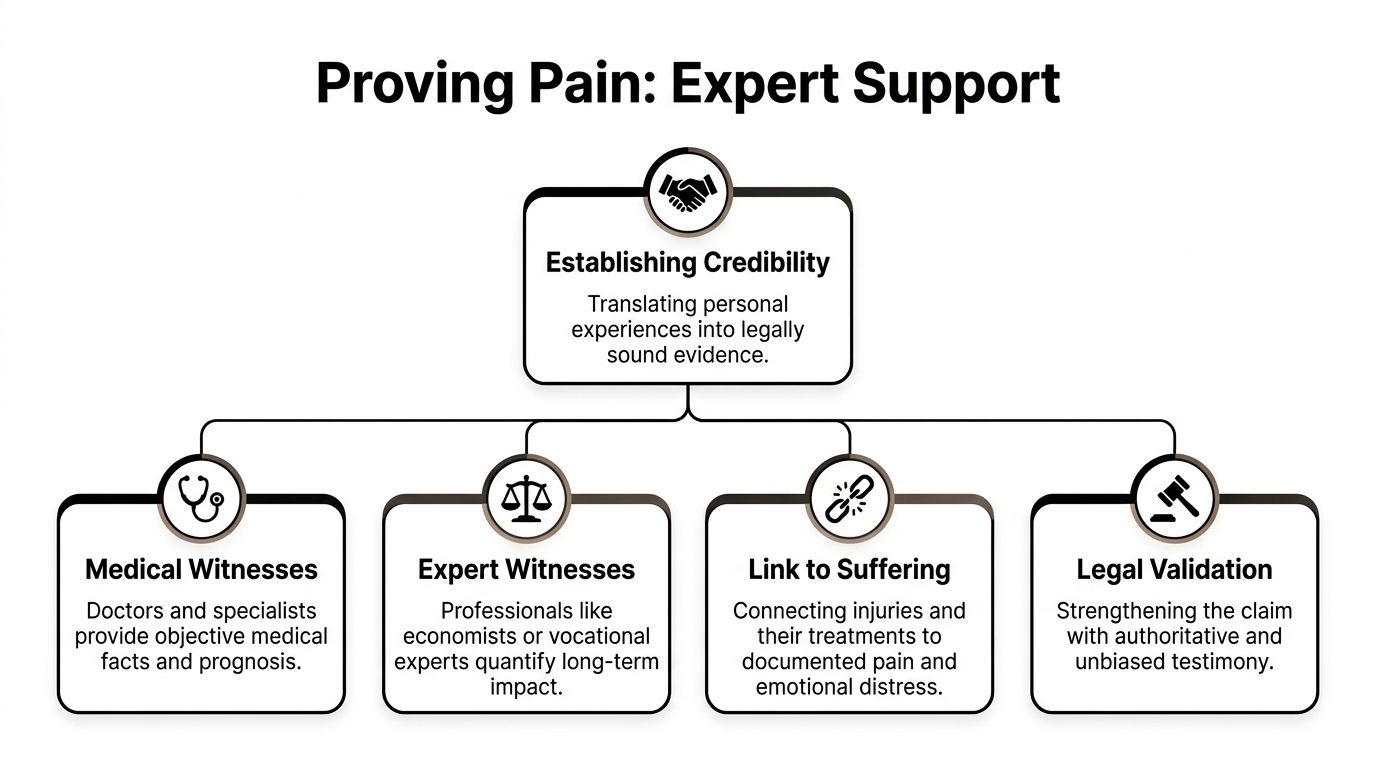
When a doctor, specialist, or expert explains your condition clearly, they do more than repeat your complaints. They translate your experience into evidence that an insurance company, judge, or jury can trust.
Treating doctors connect the dots
Your treating physician often provides the most grounded testimony because that doctor has seen your symptoms over time.
A good treating doctor can explain what injuries you sustained, what treatment you needed, how you responded, what symptoms persisted, and whether future problems are likely. That matters because pain and suffering claims often rise or fall on credibility and causation.
A physician’s prognosis also becomes important when the defense argues that you should’ve recovered by now.
The question isn’t just whether you were hurt. It’s whether the medical evidence shows this crash caused the suffering you still live with.
TBI cases need specialized proof
Many claims weaken at this point.
Traumatic brain injury cases are uniquely challenging because standard evidence often misses invisible symptoms. Specialized evidence can make a major difference. According to this discussion of how to prove pain and suffering in TBI cases, trucking-related TBI claims settle 40% lower without tools such as neuropsychological testing and life care plans.
That same source highlights another important strategy. Compare pre-injury baselines, such as work performance records, with post-accident evaluations. That helps counter the common defense argument that the symptoms were pre-existing or unrelated.
For families dealing with brain injury questions, there’s also useful background on diffusion tensor imaging of the brain, which can help frame discussions around imaging and brain trauma in complex cases.
Other experts can strengthen the narrative
In serious cases, especially truck crashes, one expert rarely covers the full picture.
Different professionals may serve different roles:
- Neuropsychologists can evaluate memory, attention, processing speed, and executive functioning.
- Psychologists or therapists can explain depression, anxiety, trauma symptoms, and emotional fallout.
- Vocational experts can connect cognitive or physical limits to reduced work capacity.
- Life care planners can describe the long-term structure of treatment and support a person may need.
Each of these witnesses helps answer a practical question jurors often have: if this person looks okay for an hour in court, what is life like the other twenty-three hours of the day?
What makes expert testimony persuasive
The best experts don’t overstate. They stay grounded in records, testing, and observed function.
That’s why the preparation behind the testimony matters. If the expert has a full treatment timeline, understands the before-and-after picture, and can explain the limits in plain English, the testimony becomes far more useful than a technical report sitting in a file.
How Pain and Suffering Is Calculated
Clients often ask the same question in different ways. How do you put a dollar amount on something this personal?
There isn’t a receipt for fear, headaches, humiliation, or losing the ability to enjoy your own life. But claims still have to be valued. In practice, lawyers, insurers, and juries usually work from a few recognized methods and then test those methods against the evidence.

If you want a general overview of the process, this page on how to calculate pain and suffering damages is a helpful starting point.
The multiplier method
The multiplier approach starts with economic damages.
Those are the financial losses with clearer numbers attached, such as medical bills and lost wages. The theory is straightforward. The more serious and disruptive the injury, the higher the multiplier that may be used to estimate non-economic harm.
What affects the multiplier in real life?
- Severity of injury matters. A short-lived strain won’t be viewed the same way as a brain injury.
- Length of recovery matters because longer suffering usually carries more weight.
- Permanence matters because lasting impairment changes the value of the claim.
- Quality-of-life loss matters when the injury reshapes work, family roles, or independence.
The formula can sound clean on paper. The argument about what multiplier is justified is where cases are fought.
The per diem method
The per diem method values suffering by the day. It assigns a daily amount to your pain and then multiplies that amount by the number of recovery days.
That approach can be persuasive when symptoms are continuous and well documented. According to this explanation of the per diem method for pain and suffering claims, daily rates often fall between $100 and $250. One example given is $200 per day over 180 days of recovery from a traumatic brain injury, producing $36,000 in damages. That source also notes that prescription histories and therapy records help substantiate the daily impact.
The strength of the method is its simplicity. It asks a jury to think about suffering in human time rather than abstract totals.
Here’s a brief explainer before the next point.
Choosing the right lens for the case
Neither method wins automatically.
A short recovery with obvious medical bills may fit more neatly into a multiplier argument. A prolonged recovery with heavy day-to-day limitations may be easier to explain through per diem reasoning. In severe cases, lawyers often evaluate the claim through both lenses when shaping a demand.
What matters most is not the label. It’s the support behind the number.
Case valuation rule: A damages model is only as strong as the evidence that supports the severity, duration, and credibility of the suffering.
The trade-offs adjusters and juries see
Insurance companies usually look for ways to shorten the suffering period, downplay the severity, or separate emotional symptoms from the crash.
That’s why unsupported numbers often fail. If someone demands a large pain and suffering figure without treatment continuity, corroborating witnesses, or proof of daily limitations, the demand can sound inflated. On the other hand, when the records, images, and testimony all point in the same direction, the valuation becomes much harder to attack.
A good calculation also accounts for the type of injury.
For visible orthopedic injuries, jurors may understand the pain more intuitively. For brain injuries, headaches, dizziness, cognitive fatigue, or emotional dysregulation, you often need stronger narrative support because the suffering doesn’t announce itself the moment someone walks into the room.
What readers should take from the numbers
The formulas help organize negotiation. They do not replace the story.
Pain and suffering isn’t paid because a calculator says so. It’s paid because the evidence shows the injury changed your life in ways that are consistent, documented, and credible.
Critical Mistakes That Can Weaken Your Claim
A good claim can lose value long before trial.
Not because the injury isn’t real, but because small decisions create openings for the insurance company. Most of these mistakes aren’t malicious. They’re normal reactions from people trying to get through a hard season. The defense will still use them.

Gaps in treatment
This is one of the most common problems.
If you stop treatment for long stretches, adjusters often argue that you must have improved. Sometimes there’s a real reason. You couldn’t get an appointment, you lost transportation, you were caring for your family, or you thought the symptoms would pass. Even then, the gap can still be used against you unless the record explains it.
This issue is especially important when a claim uses a per diem framework. A common pitfall is underestimating recovery duration, and insurers often try to cap recovery at 180 days, which can increase denials by 40% if the claim isn’t supported by a physician’s prognosis affidavit, as described in this discussion of pitfalls in proving pain and suffering.
Downplaying symptoms to your doctors
Many people try to be tough in the exam room.
They say they’re “fine,” “better,” or “getting by,” even when daily life is still rough. That instinct is understandable. It’s also dangerous for the claim. If the chart says you’re improving and says nothing about headaches, panic, sleeplessness, or memory issues, the insurer may later argue those symptoms were never serious.
Tell your providers the truth. Not the dramatic version. Not the minimized version. The accurate version.
Posting on social media
A single photo can be taken out of context.
You may attend a birthday dinner and spend the next day in bed. The post won’t show the recovery time. It won’t show the pain medication. It won’t show that you left early. It will show you smiling, standing, or being present, and that may be enough for the defense to argue inconsistency.
A safer approach is simple:
- Pause public posting about your activities, trips, workouts, and family events while the claim is active.
- Ask friends and family not to tag you in photos or comments about what you’re doing.
- Assume the defense will look for anything that appears to conflict with your claimed limitations.
Giving a recorded statement too early
The at-fault carrier may sound polite and reasonable. That doesn’t make the process neutral.
Recorded statements often lock people into incomplete descriptions before symptoms have fully developed. That’s a particular problem in concussion and TBI cases, where the full pattern may not be clear right away.
Ignoring visual proof
Some clients think photos and video feel too personal or unnecessary. In reality, visual evidence can be one of the clearest ways to show a jury what words struggle to convey. The same source above notes that strong visual evidence, including videos of daily struggles, has boosted awards by as much as 35% in jury studies when compared with cases relying on testimony alone.
Don’t assume people will picture your daily limitations accurately. Show them.
Treating the claim like a pile of paperwork
The final mistake is broader than the others. Some claims never become persuasive because no one organizes the evidence into a coherent before-and-after account.
A pain and suffering case is not a stack of bills plus a demand letter. It’s a documented explanation of how this injury altered a real person’s life.
When You Need a Lawyer to Fight for You
Some injury claims can be handled with basic documentation and persistence. Others can’t.
You should seriously consider legal help when the insurer moves fast with a low settlement, disputes fault, says your symptoms were pre-existing, or questions whether your condition is “serious enough” to justify pain and suffering damages. Those are all signs that the case will require more than sending records and asking for fair treatment.
This becomes even more important in cases involving traumatic brain injuries, permanent limitations, trucking collisions, or wrongful death. These claims usually need tighter evidence, stronger witness preparation, and a clear damages model that accounts for the long view.
A lawyer’s job in these cases isn’t just to argue. It’s to build the proof. That can include organizing treatment records, preserving witness statements, preparing visuals, working with doctors and specialists, and pushing back when the defense tries to shrink the story down to a few isolated chart notes.
If you’re wondering whether you really need counsel, ask a practical question. Can you gather the evidence, frame the narrative, respond to insurer tactics, and value the case accurately while also healing and keeping your life together?
Many people can’t. That’s not a failure. It is typical of serious injury litigation.
If you’re dealing with the fallout from a crash and need help showing the full reality of your pain, Nares Law Group LLC can evaluate your case, help preserve the evidence that matters, and explain your options in clear terms.