A mother gets a late-night call from the hospital. A spouse hears that a crash on I-25 wasn't an accident in the ordinary sense, but the result of someone else's careless choice. In moments like that, grief and legal questions arrive together.
Losing a loved one is disorienting on its own. When the death was caused by negligence or a wrongful act, families often need more than sympathy. They need a clear explanation of what happened, what the law considers wrongful death, and what steps protect their rights. A wrongful death claim is a civil case brought for the losses surviving family members suffer after a preventable death.
Wrongful death examples often sound simple on the surface. A fatal car wreck. A surgical mistake. A fall at work. But each case turns on proof. Who owed a duty of care? What conduct broke that duty? Can the family connect that conduct to the death? What evidence will an insurer, judge, or jury trust?
The law can feel cold during a human crisis. It helps to think of a wrongful death claim as a case file built piece by piece. One section explains what happened. Another shows why the conduct was legally wrongful. Another documents the losses left behind. When those parts fit together, a family can pursue accountability and financial support.
The examples below go beyond a simple list. Each one is framed like a mini case file, with a factual summary, the legal elements, common damages, evidence to gather, and practical next steps. The aim is to make a hard subject easier to understand in plain language.
1. Wrongful Death from Motor Vehicle Accidents
Traffic negligence is one of the clearest wrongful death examples because the basic duty involved is widely understood. Every driver must use reasonable care. That means following traffic laws, paying attention, staying sober, and keeping a vehicle in safe condition.
Globally, motor vehicle accidents remain the leading cause of unintentional fatalities in this context, with the World Health Organization reporting about 1.3 million deaths annually worldwide from car accidents. In everyday terms, that means fatal crash litigation often starts with ordinary acts of carelessness that had catastrophic consequences.
Factual summary and legal elements
A typical case may involve a driver who was speeding through an intersection, looking at a phone, driving under the influence, or drifting into another lane. In Colorado, the legal question usually isn't just whether a crash happened. It's whether the defendant's conduct fell below the level of care a reasonable driver should have used.
The legal building blocks are straightforward:
- Duty of care: The driver owed others on the road a duty to drive safely.
- Breach: The driver broke that duty through careless or reckless conduct.
- Causation: That breach directly caused fatal injuries.
- Damages: The surviving family suffered losses because of the death.
If you're trying to understand the proof side in more detail, this guide on how to prove wrongful death explains the evidence chain families usually need.
Typical damages, evidence, and next steps
Damages in a fatal crash case often include medical bills incurred before death, funeral and burial expenses, lost financial support, and the loss of the loved one's companionship and care. Think of damages as the law's way of documenting what the family lost, both economically and personally.
Practical rule: Get the crash report, scene photos, and witness names as early as possible. Skid marks fade, vehicles get repaired, and memories change fast.
Useful evidence often includes:
- Police reports: These identify the parties, location, and initial findings.
- Vehicle data: Modern cars may store speed, braking, and steering information.
- Witness statements: Neutral third-party observations can be powerful.
- Medical records and autopsy findings: These help connect the collision to the death.
A real-world example might involve a pedestrian killed in a marked crosswalk by a distracted driver, or a family pursuing a claim after a highway collision caused by an impaired motorist. The details differ, but the legal structure stays much the same.
2. Wrongful Death from Trucking Accidents
A trucking death case usually starts with a crash and quickly becomes a corporate records case. The driver matters, but so do the company, maintenance history, loading practices, dispatch decisions, and electronic data.

These are some of the most complex wrongful death examples because more than one party may share responsibility. A truck driver may have made the final mistake, but the root cause can reach back to training failures, maintenance shortcuts, or pressure to stay on the road too long.
Factual summary and legal elements
Common scenarios include brake failure, fatigue-related lane departures, underride collisions, jackknife wrecks, and rollovers. In a case like this, the family's legal team often looks for evidence that the trucking company knew of risks and failed to act.
Potential defendants can include:
- The truck driver: for careless driving, fatigue, distraction, or impairment
- The trucking company: for hiring, training, supervision, or scheduling failures
- Maintenance contractors: for poor inspections or repairs
- Manufacturers: if a defective part contributed to the crash
An attorney handling these claims will often preserve driver logs, onboard data, maintenance records, and dispatch communications right away. Families looking for more issue-specific information can review this 18-wheeler accident lawyer resource.
Typical damages, evidence, and next steps
In plain language, a trucking case often works like an airplane investigation. You don't just ask who was holding the wheel. You ask what the system allowed, ignored, or concealed.
Evidence to gather and preserve may include:
- Electronic logging device records: These can show hours worked and rest periods.
- Black box data: This may reveal speed, braking, and engine activity before impact.
- Inspection and maintenance files: These help uncover skipped repairs or known defects.
- Company safety records: Prior violations can matter when proving negligence.
Later in the process, video can help families understand how this kind of evidence gets used in real cases.
A realistic example is a fatigued commercial driver who drifts across lanes and causes a fatal multi-vehicle crash, while company records suggest schedules left little room for safe rest. The family's claim may reach far beyond the driver alone.
3. Wrongful Death from Traumatic Brain Injuries
Not every fatal injury causes death at the scene. Some of the hardest wrongful death examples involve a person who survives the initial event, receives treatment, and then dies from complications tied to a traumatic brain injury.
A brain injury case often turns on timing and medical detail. A fall, crash, impact, or blow to the head may seem survivable at first. Then swelling, bleeding, infection, or secondary complications change everything.
Factual summary and legal elements
These cases can arise from motorcycle crashes, unsafe premises, workplace falls, sports impacts, or assaults. The central legal issue is causation. Can the family show that the original negligent event led to the brain injury, and that the brain injury led to death?
That requires a tight timeline. Lawyers and medical experts often line up:
- the initial incident,
- emergency treatment,
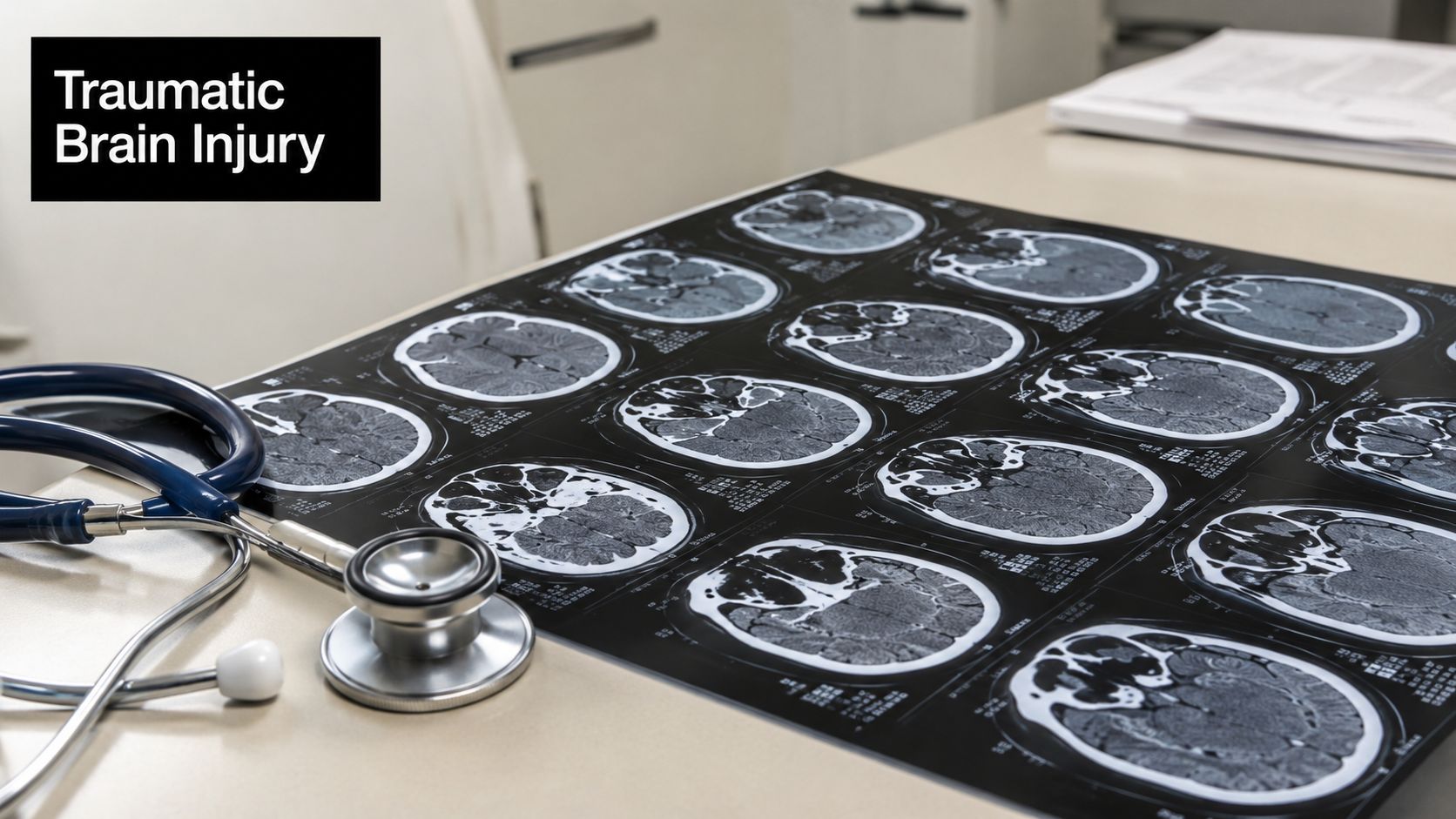
- scans such as CT imaging,
- changes in neurological status,
- surgical decisions,
- and the final cause of death.
A family may also need to address defense arguments that another illness, a later event, or delayed treatment broke the causal chain.
Typical damages, evidence, and next steps
Damages can include pre-death medical expenses, funeral costs, lost income and support, and loss of companionship. In many brain injury cases, there may also be significant evidence of the person's suffering between the injury and death.
Brain injury cases often look simple in conversation and highly technical in court. The timeline usually wins or loses the dispute.
Helpful evidence includes:
- Complete hospital records: Especially emergency, ICU, neurology, and neurosurgery records
- Imaging studies: CT scans and MRIs often become central exhibits
- Autopsy findings: These can confirm hemorrhage, swelling, or related causes
- Expert medical opinions: Specialists help explain how the injury progressed
A common example is a person who suffers head trauma in a crash, appears stable, and then deteriorates because of delayed intracranial bleeding. Families dealing with the aftermath of head trauma may find context in this resource on memory loss after head trauma, especially where symptoms developed over time.
4. Wrongful Death from Premises Liability
Some fatal events happen because a property was unsafe, not because a driver made a bad decision. A broken stair, faulty wiring, missing security measures, toxic exposure, or an unprotected pool can all become the basis for a wrongful death claim.
These wrongful death examples focus on the duty of owners, landlords, businesses, and managers to keep their property reasonably safe or warn people about known dangers. The exact duty can vary with the visitor's status and the facts, but the core idea is simple. If you control a dangerous place, you may have to fix it or warn about it.
Factual summary and legal elements
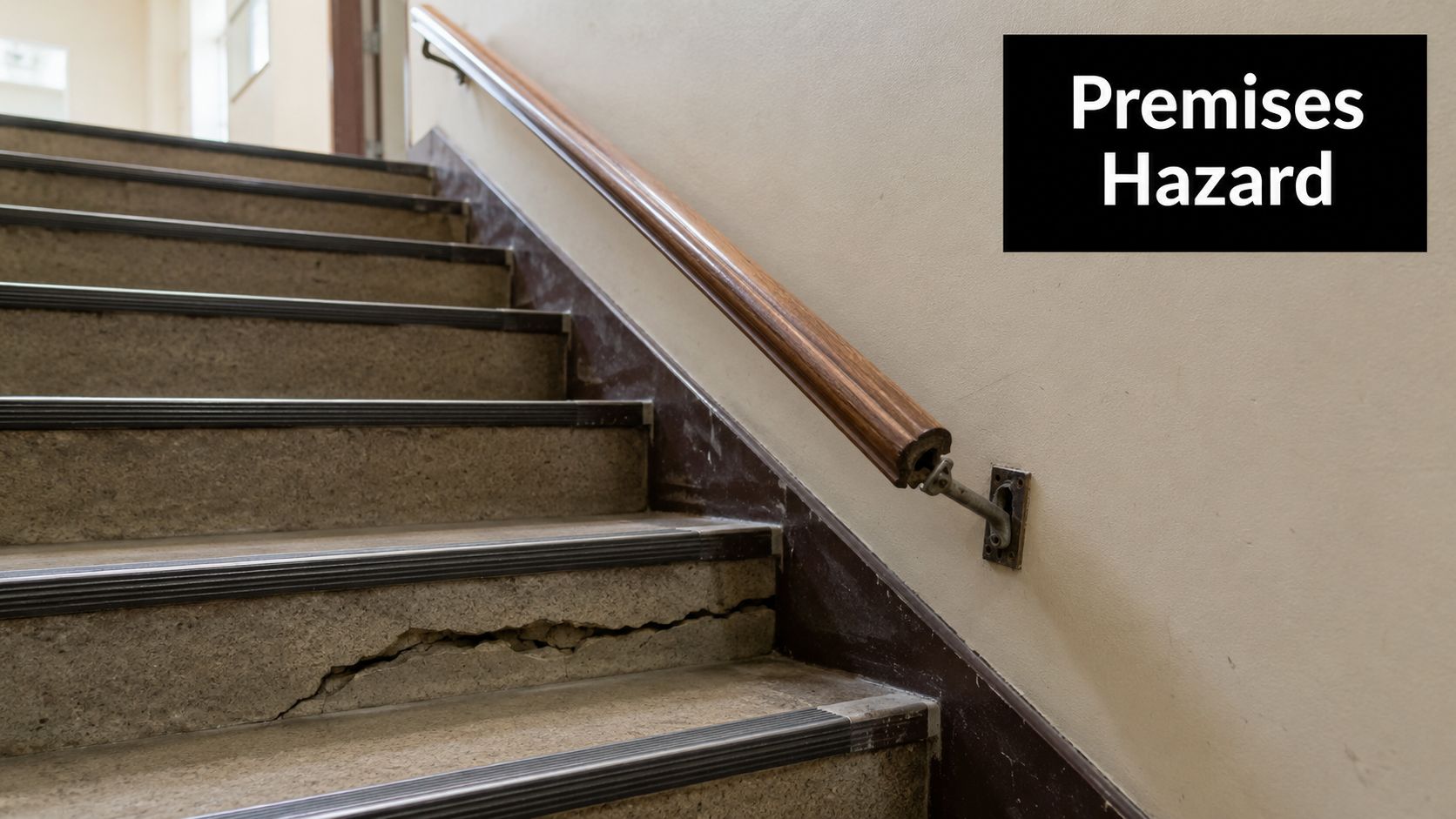
A premises liability death might involve a tenant who falls on a crumbling staircase, a guest electrocuted by a defective system in a hotel, or a drowning linked to absent barriers or broken safety equipment. In some cases, the hazard existed long enough that records show prior complaints or ignored repair requests.
To prove the claim, a family usually must show:
- Control of the property: The defendant owned, leased, managed, or maintained it.
- Dangerous condition: A hazardous condition existed.
- Knowledge: The defendant knew or should've known about it.
- Failure to act: The danger wasn't repaired, guarded against, or properly warned about.
- Causation and damages: The condition caused the fatal injury and resulting losses.
Typical damages, evidence, and next steps
Think of these cases like a paper trail problem. The scene matters, but so do the maintenance logs, inspection reports, emails, text messages, and prior complaints that show the danger didn't appear out of nowhere.
Evidence may include:
- Photographs and measurements: These preserve the condition before repairs happen.
- Maintenance and inspection records: These show what the owner knew and when.
- Incident reports: Prior injuries or complaints can establish foreseeability.
- Security footage: Video may capture the hazard or the event itself.
A realistic example is a fatal fall in an apartment building where residents had repeatedly reported a loose handrail. Another is a hotel electrocution death tied to a known electrical defect that wasn't repaired. In both, the question isn't only what happened that day. It's what the property owner failed to do beforehand.
5. Wrongful Death from Medical Malpractice
A family rushes a loved one to the hospital for help. Hours later, they are left asking a painful question. Did this happen because the illness was unstoppable, or because a preventable medical mistake changed the outcome?
That question sits at the center of many wrongful death cases involving medical malpractice. Research discussed by Johns Hopkins Medicine has helped draw public attention to the scale of preventable medical error in healthcare settings, showing why these cases are not rare one-off events but often failures in diagnosis, communication, monitoring, or treatment. You can read that discussion in Johns Hopkins Medicine's summary of medical errors and patient safety concerns.
Factual summary and legal elements
This mini case file usually starts with a breakdown in care. Common examples include a missed cancer diagnosis, a stroke patient sent home without proper testing, a surgical mistake, a medication overdose, or a failure to monitor a patient after a procedure. Medical care works like a relay race. If one handoff fails, the harm can grow quickly.
The legal question is usually whether the provider met the standard of care. In simple terms, that means asking whether a reasonably competent doctor, nurse, hospital, or specialist in the same situation would have acted differently.
Families generally must prove:
- Provider-patient relationship: The medical professional or facility owed a duty of care.
- Breach of the standard of care: The care fell below accepted medical practice.
- Causation: The mistake caused the death or substantially shortened the person's chance of survival.
- Damages: The death created financial and personal losses for the estate and surviving family.
These cases often require expert review. Medical records can be dense, technical, and incomplete without context. A chart may say "stable" shortly before a crisis, so the records need to be read alongside test results, medication logs, and the timing of symptoms.
Typical damages, evidence, and next steps
Typical damages may include final medical expenses, funeral and burial costs, lost income and benefits, loss of care and support, and, in some cases, the pain and suffering the person experienced before death.
A medical malpractice case is often a timeline case. Small delays can matter. A scan read too late, a lab result missed in the chart, or a nurse's warning not passed to the physician can become the turning point.
Evidence to gather often includes:
- Full medical records from each provider: Hospital, primary care, specialists, urgent care, EMS, and pharmacy records can each fill a gap.
- Medication administration records: These may show the wrong drug, wrong dose, or a dangerous interaction.
- Diagnostic imaging, pathology, and lab results: These help experts evaluate what was visible and when.
- Family timeline notes: Write down symptoms, phone calls, discharge instructions, follow-up advice, and changes in condition.
- Witness accounts: Family members sometimes saw confusion, delays, or warning signs that the chart barely mentions.
A common example is a patient with clear signs of infection or internal bleeding who is discharged too soon and dies after rapid deterioration at home. Another is an anesthesia error during a routine procedure. The medicine may be technical, but the roadmap is familiar. What happened, what should have happened, what evidence shows the gap, and what losses followed.
6. Wrongful Death from Product Liability
Sometimes the deadly act isn't a decision made in the moment. It's a dangerous product placed into someone's hands. Product liability wrongful death cases focus on defects in design, manufacturing, or warnings.
These wrongful death examples can involve vehicles, appliances, tools, pharmaceuticals, heaters, or child products. The product may fail during ordinary use, or it may carry risks the manufacturer didn't adequately warn about.
Factual summary and legal elements
A product case may center on brake failure, an airbag malfunction, a device that overheats and causes a fire, a heater that emits carbon monoxide, or medication with inadequate safety warnings. The family's burden often includes proving that the product was unreasonably dangerous and that the defect caused the fatal injury.
The legal theory can differ:
- Design defect: The product was dangerous as designed.
- Manufacturing defect: Something went wrong in production.
- Failure to warn: The instructions or warnings were inadequate.
In practice, these cases often require engineers, medical experts, or fire investigators. A family doesn't have to reverse-engineer the product on its own, but preserving the physical evidence is critical.
Typical damages, evidence, and next steps
The product itself is often the star witness. If it gets thrown away, altered, or repaired, the case may become much harder to prove.
Useful evidence includes:
- The actual product: Preserve it exactly as it was after the event if possible.
- Packaging and instructions: Warning labels matter.
- Purchase records: These help identify the chain of distribution.
- Recall or regulatory materials: These may show prior safety concerns.
- Expert inspection results: Engineers or specialists can test failure points.
A realistic scenario is a family pursuing a claim after a vehicle defect prevented braking during an otherwise avoidable collision. Another is a fatal house fire linked to an appliance defect. Product cases often feel technical, but the common-sense question is simple. Should this item have been sold in this condition?
7. Wrongful Death from Workplace Accidents
The call often comes in the middle of an ordinary workday. A supervisor says there was an incident. Then the family starts hearing a flood of terms that sound similar but mean different things. Workers' compensation. OSHA. Subcontractor liability. Equipment failure. For a grieving family, it can feel like trying to read a map after the lights go out.
Workplace deaths happen across construction sites, warehouses, factories, transportation yards, utility work zones, and other industrial settings. The legal question is usually more specific than families expect. This mini case file starts with the same place a good investigation starts: what happened, who controlled the hazard, and whether someone outside the employer also played a role.
Factual summary and legal elements
A workplace wrongful death case often begins with a fatal fall, a machine that lacked proper guarding, an electrocution, a trench collapse, a toxic exposure, or a struck-by incident involving heavy equipment. Some losses are handled only through workers' compensation. Others support a separate wrongful death claim against a third party, such as a general contractor, property owner, equipment manufacturer, maintenance company, or outside vendor.
That distinction matters. Workers' compensation usually functions like a limited safety net for on-the-job injuries and deaths. A wrongful death claim asks a different question. Did a person or company, beyond the basic workers' compensation system, cause this death through negligence or another legal wrong?
A recent example often discussed by lawyers involved a 2024 Texas case tied to a scissor lift collision at a Frito-Lay facility that resulted in a $72 million verdict. The reported facts included alleged failures in equipment maintenance and safety training, along with evidence such as surveillance footage, autopsy findings, and expert testimony about workplace safety practices.
Typical damages, evidence, and next steps
Families usually want one clear starting point. Ask who had the power to prevent the hazard. That answer often shapes the entire case.
Typical damages may include funeral and burial costs, the income the worker would likely have provided, loss of household support, and the loss of care, guidance, and companionship suffered by close family members. The exact categories depend on state law and on whether the case stays in the workers' compensation system or also includes a civil wrongful death claim.
Evidence can disappear fast after a workplace death, especially when a site reopens or a machine goes back into service. Useful materials often include:
- OSHA reports and citations: These may identify unsafe conditions or rule violations.
- Training records: These help show what instructions the worker and supervisors received.
- Maintenance logs and inspection files: These can reveal missed repairs, recurring malfunctions, or ignored warnings.
- Coworker statements: People on site often know about prior near misses, rushed schedules, or safety shortcuts.
- Photographs, video, and digital equipment data: These can preserve the scene before changes are made.
If machinery was involved, preserve the machine, its safety guards, maintenance history, and any electronic logs before repairs, alterations, or disposal.
A common case file looks like this: a construction worker falls after proper fall protection was never set up, or a warehouse employee is killed by a lift or conveyor after safety rules existed on paper but were not followed on the floor. In many of these cases, the death was not caused by one random moment. It was the last step in a chain of missed inspections, weak training, production pressure, or ignored warnings.
8. Wrongful Death from Criminal Acts and Inadequate Security
A civil wrongful death claim can exist even when the death also involves a crime. That surprises many families. They assume the criminal case has to succeed first, or that an acquittal ends the matter. It doesn't work that way.
Some wrongful death examples arise after shootings, stabbings, assaults, or robberies at apartments, hotels, bars, parking lots, or stores where security was allegedly inadequate. The claim isn't always only against the attacker. It may also be against the property owner or business that failed to take reasonable steps against foreseeable danger.
Factual summary and legal elements
The legal focus is usually foreseeability. Was there enough notice of danger that reasonable security measures should've been in place? Prior incidents, poor lighting, broken access control, lack of trained security staff, or nonfunctioning cameras can all matter.
One related issue families often face is the overlap between civil and criminal proceedings. The verified data for this article notes that many families misunderstand this dual-track process, and that legal content often fails to explain how a wrongful death claim can proceed even when criminal outcomes are limited or disappointing.
Typical damages, evidence, and next steps
In a civil case, the family seeks compensation for losses caused by the death. In a criminal case, the state seeks punishment. Those are different goals, different parties, and different standards.
Evidence in these cases may include:
- Prior incident reports: These help show the danger was foreseeable.
- Crime data for the location: Area patterns may support the claim.
- Surveillance footage: This can reveal both the attack and security failures.
- Policies and staffing records: These show what the business promised and what it provided.
- Criminal case materials: Statements, plea documents, or investigative records may become relevant.
A realistic example is a fatal assault in an apartment complex with broken gates, poor lighting, and a history of similar incidents. Another is a shooting in a bar district where crowd control and screening measures were allegedly inadequate. Even when a criminal prosecution is pending or unresolved, a family may still need to act quickly to protect its civil claim and preserve evidence.
Comparison of 8 Wrongful Death Scenarios
| Category | Process Complexity 🔄 | Resource Requirements ⚡ | Expected Outcomes ⭐ | Ideal Use Cases 💡 | Key Advantages 📊 |
|---|---|---|---|---|---|
| Wrongful Death from Motor Vehicle Accidents | Moderate, accident reconstruction, police/eyewitness analysis | Police reports, reconstruction expert, insurance documentation | ⭐⭐, often clear liability; recovery limited by insurance limits | Fatal car, motorcycle, or pedestrian collisions caused by negligent drivers | Common legal precedents, accessible insurance coverage, jury sympathy |
| Wrongful Death from Trucking Accidents | High, multi‑party liability and regulatory discovery | ELD/black box data, trucking experts, company safety records, federal regs | ⭐⭐⭐, higher recovery potential but aggressively defended | Commercial truck fatalities involving HOS violations, maintenance failures, or defects | Large commercial policy limits, objective DOT standards, electronic evidence |
| Wrongful Death from Traumatic Brain Injuries | High, complex medical causation, delayed fatalities | Neurosurgeon experts, complete imaging and medical records, actuarial analysis | ⭐⭐, substantial damages if causation proven; expert costs high | Fatal TBIs from crashes, falls, assaults, or delayed intracranial complications | Clear medical causation can support significant damages and jury empathy |
| Wrongful Death from Premises Liability | Moderate, notice/inspection and security record focus | Maintenance logs, incident reports, security footage, facility safety expert | ⭐⭐, strong when prior notice or documented hazards exist; comparative fault possible | Deaths from falls, assaults, electrocution, toxic exposure on another's property | Property insurance, documented maintenance/complaint records, duty-of-care standards |
| Wrongful Death from Medical Malpractice | High, proving breach of medical standard and causation | Specialist expert witnesses, full medical records, pre-suit expert affidavit | ⭐⭐, potentially large damages but subject to caps and rigorous proof | Deaths from surgical errors, misdiagnosis, medication or anesthesia mistakes | Insured providers, detailed medical documentation, established malpractice frameworks |
| Wrongful Death from Product Liability | High, engineering analysis, proprietary discovery | Preserve product, engineering/design experts, manufacturer's testing documents | ⭐⭐⭐, strong recovery vs. manufacturers; complex and technical litigation | Fatalities from defective vehicles, appliances, pharmaceuticals, or equipment | Multiple responsible parties, regulatory evidence, substantial manufacturer resources |
| Wrongful Death from Workplace Accidents | Moderate‑High, OSHA standards, workers' comp interplay | OSHA/inspection reports, safety training records, workplace safety expert | ⭐⭐, third‑party claims increase recovery; employer claims may be limited | Construction falls, machinery accidents, electrocution, toxic exposures on the job | Objective safety standards, prior violations/citations, contractor insurance |
| Wrongful Death from Criminal Acts & Inadequate Security | Moderate, foreseeability and notice analysis is central | Crime statistics, prior incident reports, surveillance, security expert | ⭐⭐, high sympathy if foreseeability proven; varies by jurisdiction | Homicides or assaults at properties with known crime patterns or poor security | Demonstrable notice/foreseeability, property liability insurance, strong jury empathy |
Your Next Steps. Seeking Justice for Your Family
Understanding wrongful death examples is a starting point, not the finish line. Once a family suspects negligence played a role, the practical work begins. Records must be requested. Physical evidence must be preserved. Witnesses should be contacted before memories fade. Insurance carriers may already be building their own version of events.
A wrongful death claim is often easier to understand if you picture it as assembling a file for someone who wasn't there. A judge, insurer, or jury didn't know your loved one. They didn't see the crash, the unsafe stair, the missed diagnosis, or the ignored safety rule. The case has to show them, clearly and methodically, what happened, why it was wrongful, and what the family lost.
Some cases are straightforward. A drunk driver crossed the center line. A hospital chart reveals a serious error. A machine lacked basic safety protection. Other cases are harder. The police report may feel defensive. The medical timeline may be confusing. The death may follow complications, not an instant injury. In especially difficult situations, proof may rely on circumstantial evidence, digital records, financial cessation, or a detailed reconstruction of events rather than one dramatic piece of evidence.
The legal standard in a civil wrongful death case is different from a criminal prosecution. That matters. A family doesn't necessarily need a conviction to seek justice in civil court. And if several parties contributed to the death, the claim may reach more than the person who caused the final event. Employers, property owners, contractors, product makers, and medical providers may all become part of the picture, depending on the facts.
Colorado families should also keep timing in mind. Wrongful death cases are subject to strict filing deadlines, and evidence can disappear quickly. Vehicles get repaired. Surveillance footage is overwritten. Hazardous conditions are fixed. Employees leave. The longer a family waits, the harder it can become to reconstruct the truth.
Many people hesitate to call a lawyer because they don't want to make a painful time feel more adversarial. That's understandable. But getting legal advice early doesn't force a lawsuit. It often does something simpler and more important. It protects evidence, explains options, and gives the family a clearer path forward.
For families in Colorado, Nares Law Group LLC is one relevant option. The firm represents people in motor vehicle crashes, truck wrecks, traumatic brain injury matters, and wrongful death claims, and handles cases from investigation through trial and settlement. A consultation can help clarify whether the facts support a claim, who may be legally responsible, and what steps make sense next.
If your family is grieving a preventable loss and needs clear answers, Nares Law Group LLC offers free, confidential consultations to discuss wrongful death claims, evidence preservation, and your legal options in Colorado.