You may be reading this because something feels off, but it's hard to explain. A loved one looks fine. They can hold a conversation. They remember childhood stories. Then five minutes later, they ask the same question again, forget an appointment, or lose track of why they walked into the kitchen.
That disconnect is frightening. It can also be isolating, especially when other people say, “But the scan was normal,” or “They seem okay to me.”
Memory loss after head trauma doesn't always look dramatic. Often, it shows up in quiet, disruptive ways that affect work, relationships, safety, and confidence. Families end up carrying two burdens at once. They're trying to understand what's happening medically, and they're also trying to protect their future if the injury happened because someone else was careless.
The Unsettling Feeling of a Memory Gap
One common scene goes like this. A person survives a crash, goes home, and tries to get back to normal. A spouse mentions a conversation from breakfast, and the injured person has no memory of it. Later that afternoon, they meet a neighbor and forget the name almost immediately. At night, they feel embarrassed, irritated, and scared.
That reaction makes sense. A memory gap can feel like your own mind has become unreliable.

What families often notice first
Memory problems after a head injury usually don't begin with a big dramatic moment. They begin with patterns:
- Repeated questions that were already answered.
- Missed steps in a routine that used to be automatic.
- Forgotten conversations from earlier the same day.
- Trouble tracking new information, even when the person seems alert.
- Frustration or shame because the person knows something is wrong.
Some people describe it like a scrambled filing cabinet. The papers are still there somewhere, but the labels are mixed up, and new papers aren't getting filed properly. Others describe it like a phone that won't hold a charge. It may work for a moment, then the information seems to disappear.
Memory trouble after head trauma is real even when it's invisible to everyone else in the room.
Why this matters beyond the doctor's office
These symptoms affect more than comfort. They can change whether someone can return to work safely, manage medications, drive, supervise children, or keep up with bills and appointments. In a personal injury case, those day-to-day failures are not minor details. They can help show the true extent of harm.
Families often think they need one dramatic symptom to prove a brain injury. In reality, a series of smaller memory failures can paint a much more accurate picture. The challenge is that these problems are easy for outsiders to dismiss unless they are clearly documented.
Why the Brain Struggles to Record New Information
A useful way to think about memory is to compare the brain to a computer that has to process information now and save it for later. In a healthy system, that transfer works smoothly. After head trauma, the “save” function can become unreliable.

The two main kinds of memory disruption
The first is anterograde amnesia. This means the person struggles to form new memories after the injury. They may remember their graduation or their first apartment, but not the conversation they had ten minutes ago. According to the verified research provided, anterograde amnesia is the most common form of memory loss after a concussion.
The second is retrograde amnesia. This means the person has trouble recalling information from before the injury. Sometimes that includes the crash itself. Sometimes it includes events leading up to it.
Here's a simple comparison:
| Type | What it means | What it looks like |
|---|---|---|
| Anterograde amnesia | Trouble making new memories | Repeating questions, forgetting recent conversations, losing track of new instructions |
| Retrograde amnesia | Trouble recalling older memories from before the injury | Gaps around the accident, confusion about events from before impact |
What's happening inside the brain
The brain doesn't store memory in one single drawer. It uses a network. The hippocampus helps convert short-term information into longer-term memory, and the frontal cortex supports working memory, attention, and mental organization. If those areas stop coordinating well, new information may not “stick.”
The verified research explains that after concussion, neurovascular dysfunction can disrupt the network connecting the hippocampus and frontal cortex, which impairs the consolidation of short-term memories into long-term storage. That same research also states that a persistent inflammatory response can last for months post-injury, making memory and learning harder.
A plain-language analogy helps here. Think of a library with a damaged intake desk. New books keep arriving, but the librarian can't catalog them correctly because the computer system is glitching and the carts are going to the wrong shelves. The books exist. The problem is that the system that organizes and stores them isn't working well.
Practical rule: If a person remembers old stories but can't hold onto new information, that doesn't mean they're exaggerating. It often points to a specific kind of post-traumatic memory problem.
This also explains why simple “try harder” advice doesn't help much. If the brain's memory network is disrupted, effort alone won't fix the bottleneck.
Symptoms to Monitor and Warning Signs for Urgent Care
“Memory loss” is a broad phrase. Families often use it to describe several different problems at once. One person may be forgetting names. Another may remember names but lose focus halfway through a conversation. A third may know what they want to say but can't find the words.

Common symptoms to monitor
It helps to group symptoms into categories instead of treating them as one big blur.
Memory problems
- Forgetting recent conversations
- Repeating the same question
- Missing appointments
- Misplacing everyday items
Thinking and attention problems
- Brain fog
- Trouble concentrating
- Losing track of steps in a task
- Slow processing when someone gives instructions
Language and communication problems
- Word-finding trouble
- Losing the thread of a conversation
- Needing extra time to answer
Emotional and behavioral changes
- Irritability
- Anxiety about making mistakes
- Withdrawal from social situations
- Frustration that seems out of proportion
A short visual overview can help families compare what they're seeing at home with common post-trauma signs:
When to go to the emergency room
Some symptoms need immediate medical attention, not observation at home.
- Worsening headache that becomes severe or rapidly intensifies
- Repeated vomiting
- Seizures
- Loss of consciousness
- Slurred speech
- New weakness or numbness
- Sudden confusion that is getting worse
- Major change in alertness or responsiveness
If symptoms are escalating instead of settling, treat that as urgent.
What to write down while you monitor
If the person is medically stable, keep a clear record of what you observe. Note the time, what happened, how long it lasted, and what the person was trying to do when the problem appeared. Specific entries are more useful than broad labels like “bad memory day.”
For example, “Forgot the address of the physical therapy clinic despite being told twice this morning” is stronger than “confused today.” That kind of detail helps both doctors and lawyers understand the practical impact of memory loss after head trauma.
How Clinicians Diagnose a Traumatic Brain Injury
The diagnostic process can feel confusing because families often expect one test to provide a final answer. That's rarely how it works. Clinicians usually build the diagnosis from several pieces.
What the first evaluation usually includes
A doctor often starts with a neurological exam, a symptom history, and questions about the injury event. They may ask about confusion, memory gaps, headaches, balance problems, and changes in sleep or mood. In some cases, imaging such as a CT scan or MRI is ordered to look for structural problems.
Later, a patient may need more detailed cognitive testing. That can include bedside screening or formal neuropsychological evaluation. These tools can identify patterns in attention, processing speed, recall, and executive function that don't show up on a simple conversation in the exam room.
If you want a clearer sense of how these evaluations fit together, this guide to neurological tests for brain damage gives a practical overview.
What standard testing can miss
A normal scan does not always mean normal brain function. Structural imaging shows anatomy. It doesn't always capture the functional problems that disrupt daily memory.
That gap matters because some people are told they're “fine” when they are still struggling every day. The person may look composed during a short appointment, then get home and forget medications, appointments, or conversations.
One often-missed issue is hypothalamic-pituitary dysfunction, or HPD. The verified research states that up to 40% of TBI survivors with persistent memory deficits may have undiagnosed HPD, and that this hormonal problem can affect thyroid and cortisol levels, directly impairing memory encoding. The same research notes that this creates a diagnostic gap because standard TBI evaluations often focus on direct cortical damage instead.
Questions worth asking the care team
If memory problems continue, families may want to ask:
- Do symptoms suggest a need for formal neuropsychological testing?
- Could hormonal dysfunction be contributing to ongoing memory issues?
- What functions appear impaired in daily life, not just on basic screening?
- What specialists should be involved if symptoms persist?
A “clear” test result should never end the conversation if the person still can't function normally day to day.
A careful diagnosis is not just about naming the injury. It's about identifying what's still wrong, what can be treated, and what needs to be documented for the future.
Pathways to Recovery and Brain Rehabilitation
Recovery usually involves two tracks at the same time. One track focuses on healing and rehabilitation. The other focuses on building supports so daily life doesn't fall apart while the brain is still catching up.
Therapies that can help
Several types of rehabilitation may be part of treatment, depending on the person's symptoms.
- Cognitive rehabilitation therapy helps a person practice skills related to attention, memory, and problem-solving.
- Occupational therapy can teach practical workarounds for home, work, and community tasks.
- Speech therapy often helps with language, word-finding, and communication-related cognitive issues.
For people exploring structured treatment options, this overview of TBI cognitive therapy explains the role of targeted rehabilitation in more detail.
Compensatory tools that reduce daily chaos
These tools don't mean a person is giving up. They are supports, like a cast for a broken bone.
Try a mix of external systems:
- Use one calendar only. A paper planner, Apple Calendar, or Google Calendar can work. The key is consistency.
- Create a memory station by the door for keys, wallet, glasses, and paperwork.
- Set phone reminders for medications, school pickups, appointments, and work breaks.
- Keep a small notebook or notes app for instructions, names, and next steps.
- Build routines that happen in the same order every day.
Some strategies commonly used in older adults also help brain injury survivors, especially when short-term recall is the problem. Family members may find useful tips to support senior memory because many of those tools, such as repetition, written cues, and stable routines, work well across age groups.
Recovery is active, not passive
People often think recovery means waiting. In reality, many patients do better when they combine medical follow-up with practical adaptation. Sleep habits, low-distraction environments, written cues, and carefully paced activity can all support progress.
A simple example shows why. If a person forgets verbal instructions but can follow a written checklist, that isn't a minor quirk. It tells the treatment team something specific about how the brain is functioning. It also gives the family a concrete way to reduce conflict at home.
“I know you told me” and “I can't hold onto it” are not the same thing.
The goal of rehabilitation isn't just to restore function. It's also to help the person live safely and with dignity while recovery unfolds.
Recovery Timelines and Long-Term Health Outlook
Many families expect recovery to move in a straight line. It rarely does. A person may have a good morning, a foggy afternoon, and then a decent next day. That uneven pattern can be discouraging, but it's common.
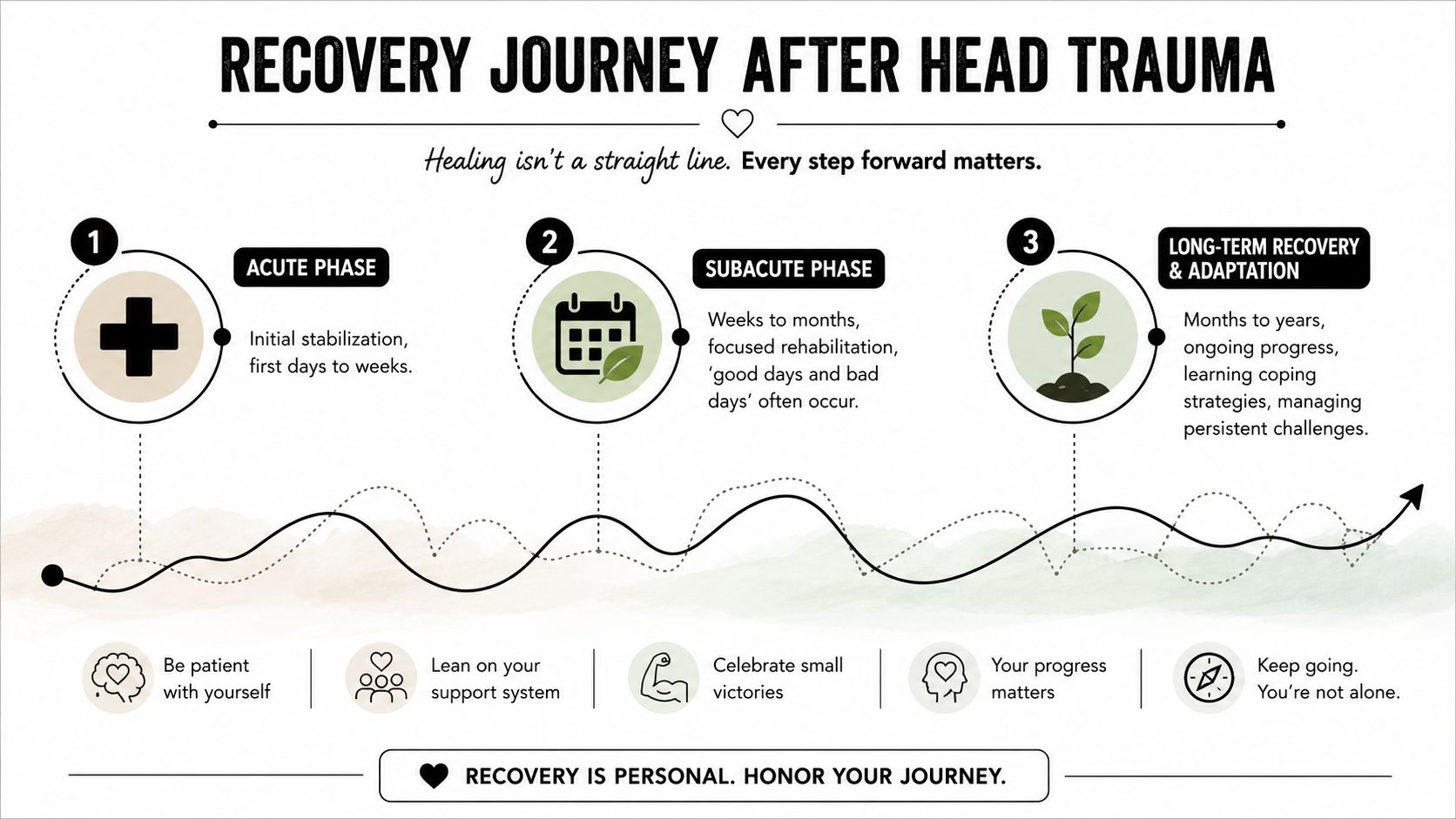
What recovery often feels like
Instead of a staircase, think of recovery as a winding trail. Some days the person can read, follow a conversation, and remember errands. On other days, the same tasks feel impossible. That fluctuation doesn't always mean the person is getting worse. It often means the brain is still vulnerable to overload, fatigue, stress, and poor sleep.
A practical way to judge progress is to watch patterns over time rather than reacting to one rough day.
What the research says about function after TBI
A large longitudinal study published in 2023 found that between 49.3% and 67.5% of participants showed no cognitive impairment across six objective measures at six months post-injury, while only 2.4% to 10.9% displayed global cognitive impairment or decline. The same study reported 10.9% global impairment after mild-to-moderate TBI and between 2.6% to 2.7% after mild TBI. These findings come from JAMA Network Open's 2023 longitudinal TBI study.
That matters for two reasons. First, it offers hope. Many people retain meaningful cognitive strengths. Second, it corrects a common misunderstanding. Ongoing memory problems can be serious without amounting to total cognitive collapse.
The long view also matters
Head trauma is not always just a short-term event. The Alzheimer's Association summary of TBI research states that older adults with a history of moderate TBI had a 2.3 times greater risk of developing Alzheimer's disease, and those with severe TBI had a 4.5 times greater risk. It also notes that the risk of a dementia diagnosis is highest during the first year after injury, when people with TBI were four to six times as likely to receive that diagnosis. You can read that overview in the Alzheimer's Association explanation of TBI and dementia risk.
This is why even “mild” memory problems deserve attention. If symptoms linger, families shouldn't minimize them just because the person can still tell old stories or appear normal in public. For a closer look at what recovery may involve over time, this resource on TBI recovery time can help frame expectations.
Documenting Your Case and Protecting Your Legal Rights
From a legal standpoint, memory loss can be one of the hardest injuries to prove and one of the most expensive to ignore. A person may look capable during a short meeting but still fail at the tasks that keep a job, a household, or a routine intact.
Why documentation matters so much
The verified research provided states that survivors of mild TBI with short-term memory issues experience a 35% higher rate of long-term job attrition. That same research notes that insurance adjusters often dismiss these problems as “non-disabling” because the person can still recall past events.
That mismatch shows up in real cases all the time. A worker remembers their childhood address but forgets safety steps, deadlines, passwords, customer details, or verbal instructions. The legal issue isn't whether they can remember the past. It's whether the injury now limits earning capacity and daily function.
What to collect
Good documentation turns “something seems wrong” into evidence.
- Keep a daily symptom journal with specific examples, dates, and triggers.
- Save work records such as write-ups, reduced hours, missed shifts, or performance concerns.
- Ask family members to write observations about repeated questions, confusion, or personality changes.
- Preserve medical records from emergency care, follow-up visits, therapy, and testing.
- Track practical losses like missed appointments, inability to manage medications, or the need for supervision.
A short table can help organize what belongs in a file:
| Evidence type | Why it matters |
|---|---|
| Daily journal | Shows frequency and real-life impact of memory failures |
| Family observations | Corroborates changes others can see |
| Employment records | Connects symptoms to lost earning capacity |
| Medical records | Ties complaints to diagnosis and treatment |
| Calendar and reminder failures | Demonstrates breakdown in daily functioning |
How the legal process uses this information
A personal injury case often requires more than a diagnosis. It requires proof. That may include records, witness statements, expert review, employment evidence, and formal exchanges of information during the case. If you're unfamiliar with that process, this plain-language guide to understanding litigation discovery can help you see how documents and testimony are gathered.
The right time to speak with an attorney is usually earlier than families think. If the injury came from a car crash, truck wreck, fall, or another preventable event, waiting too long can make it harder to preserve evidence and explain the full story of the damage.
Memory loss after head trauma is medical. It's also legal. If someone else caused the injury, careful documentation can protect access to treatment, wage loss claims, and the long-term support your family may need.
If you're dealing with memory problems after a crash or other serious head injury, Nares Law Group LLC offers guidance for families trying to understand both the medical picture and the legal path forward. Their team helps injured people in Colorado investigate traumatic brain injury claims, coordinate the evidence that matters, and pursue compensation for treatment, lost income, and long-term consequences that insurance companies often downplay.