You just stepped off a wet grocery aisle, or you hit a patch of ice between two parked cars, and your first thought is the pain. Your second thought is whether anyone's insurance will pay. That second question is harder than it looks, because a policy sitting in a file cabinet is not the same thing as a check.
Premises liability coverage is the part of an insurance policy that can fund a defense and pay covered damages when someone is hurt because a property was not kept reasonably safe. It does not, by itself, prove the owner was careless, and it does not pay every person who falls. Colorado law still asks why you were there, what the owner knew, and whether the hazard caused the harm.
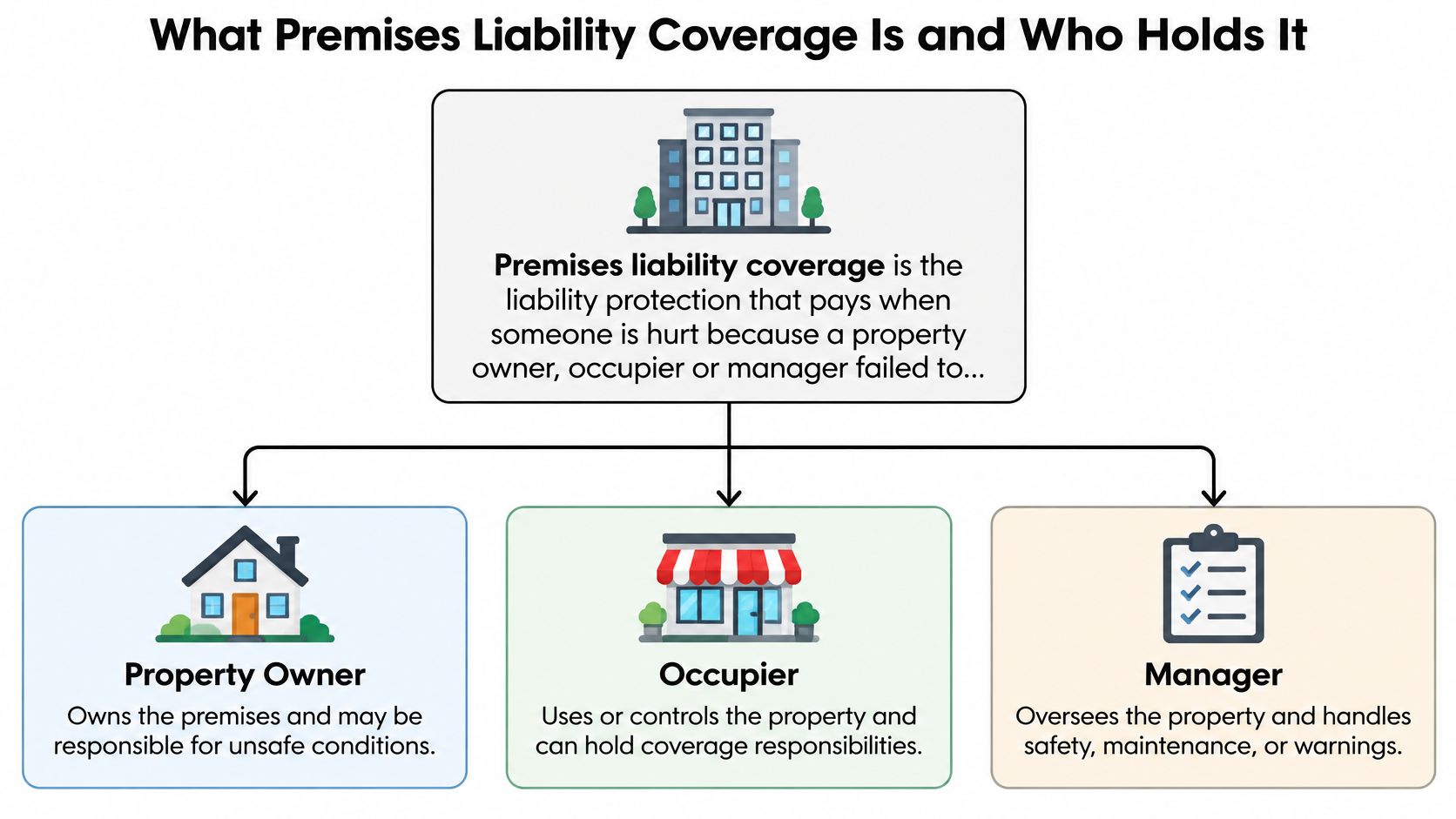
What Premises Liability Coverage Is and Who Holds It
Say you slip on a puddle near the produce case and tear a ligament. The store has a policy. That policy is the insurer's promise to fund the defense and covered damages. It is not proof the manager was careless, any more than a spare tire proves the driver caused the flat.
Premises liability coverage is the liability protection that responds when a person is injured because a property owner, occupier, or manager failed to reasonably maintain safe premises, correct a dangerous condition, or provide adequate warning. A claim usually needs more than proof that an accident happened. Someone has to show the responsible party knew, or reasonably should have known, about the hazard and failed to act.
When the claim is covered, the money can include medical expenses, lost income, rehabilitation, pain and suffering, and, in some cases, future care or wrongful-death damages.
The scale of these injuries is large even before you leave the workplace. The U.S. Bureau of Labor Statistics reported 2,488,400 recordable nonfatal injuries and illnesses in private industry in 2024, including 721,720 cases involving falls, slips, or trips, and 479,480 of those cases involved days away from work. Those figures count workplace cases, not every premises claim, but they show how often floors, stairs, walkways, and lighting hurt people.
Who usually holds the policy
| Policy | Who usually holds it | Where premises coverage sits | What to check first |
|---|---|---|---|
| Commercial general liability (CGL) | Businesses, property managers, commercial landlords | Liability section covering premises operations | Per-occurrence and aggregate limits |
| Homeowners | Owner-occupants of a house or condo unit | Personal liability section | Liability limit and exclusions |
| Renters | Tenants who lease an apartment or house | Personal liability section | Whether the landlord's policy also responds |
| Landlord policy | Residential landlords with rental property | Liability for rental property and common areas | Lease terms and tenant obligations |
Start with the person who controlled the spot where you fell, then ask which of those four policies was in force that day. The policy is the money source. Liability is the legal question that decides whether that money is owed.
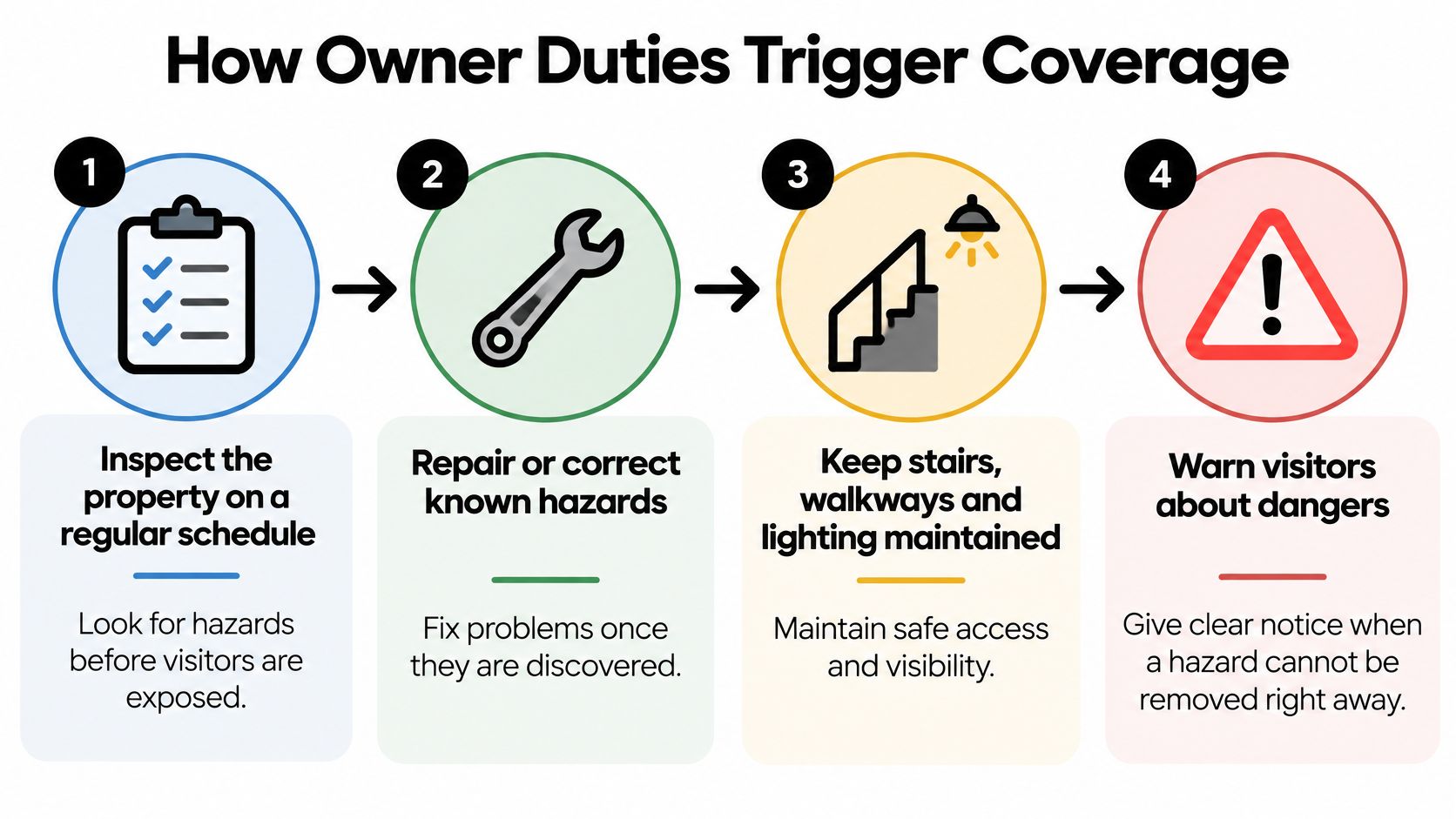
How Owner Duties Trigger Coverage
An owner, occupier, or manager carries four everyday duties. Inspect on a regular schedule. Repair or correct hazards once they're known. Keep stairs, walkways, and lighting in working order. Warn people about a danger that can't be fixed before the next visitor arrives.
Notice is the hinge. The owner answers for a hazard it knew about, and for a hazard a normal inspection should have found. A customer who tells a clerk that the cooler is leaking creates actual notice. A puddle that sat for hours, with no walk-through, is the kind of condition a reasonable inspection is meant to catch.
Facility managers who want a practical inspection routine can start with investigating fall incidents in commercial buildings from Facility Management Insights. Logs, photos, and work orders are what later show whether those four duties were met.
The chain that has to hold
Coverage on a commercial general liability policy follows a cause-and-effect chain. Skip a link and the insurer has a reason to say the loss isn't its problem.
- A hazardous condition exists, or maintenance was negligent.
- That condition is a breach of a legal duty owed to the injured person.
- The breach causes bodily injury or property damage.
- The insurer owes defense and indemnity, subject to the policy terms and limits.
Defense and indemnity are two different checks. Defense costs are what the insurer spends on lawyers while the claim is potentially covered. Indemnity is a settlement or judgment, paid only up to the limits, and only if the insured is legally responsible.
A public-sector CGL specification identifies ISO occurrence form CG 00 01 as covering liability arising from "premises operations," along with independent contractors, products-completed operations, personal and advertising injury, and contractual liability, and it required a $2 million per-occurrence limit, according to the New York Office of General Services bid attachment. That form shows how a CGL policy is built. It does not erase the claimant's job.
A policy may cover defense costs, settlements, or judgments, but the injured person still has to prove negligence, causation, and damages.
Prove the duty and the hazard before you assume the policy will respond. The video below walks through how those duties show up in a real claim conversation.
Visitor Status Decides Who Can Recover in Colorado
Picture a slick step at a store entrance just after closing. A paying customer who slipped there an hour earlier was invited in to shop. A person who wandered in after the doors locked was not. Same step, different duty, and the insurance question waits until that duty is clear.
In Colorado, Colorado Revised Statutes § 13-21-115, as discussed in a Colorado Supreme Court opinion, sorts entrants into trespassers, licensees, and invitees. The duty changes with the category.
| Visitor status | How the person entered | Duty the owner generally owes in Colorado |
|---|---|---|
| Invitee | Entered for a business purpose or where the owner invited the public | Reasonable care against dangers the owner knew or should have known about |
| Licensee | Entered with permission for their own purpose, such as a social guest | Reasonable care for dangers the owner created and knew about, and a warning of known, non-ordinary dangers |
| Trespasser | Entered without consent | Generally liable only for harm willfully or deliberately caused by the owner |
A customer reaching for cereal is the classic invitee. The store has to use reasonable care against dangers it knew about or should have found. A tenant's dinner guest on an apartment stair is usually a licensee, present with permission but for a social purpose, so the focus is dangers the owner created and knew about, plus a warning of known hazards that aren't ordinary. A person who cuts across a fenced loading dock after hours is generally a trespasser, and recovery is limited to harm the landowner caused willfully or deliberately.
Evidence in the order that matters
Build the file in this order, or the status fight swallows the rest of the case.
- Why the person entered: A receipt, a delivery order, an invitation, or a lease shows the purpose.
- The hazard itself: Photos of the spill, the broken tread, or the dark landing.
- Notice: Inspection logs, maintenance records, and earlier complaints show actual or constructive knowledge.
- The link to the injury: Medical records, footwear, and fall-site details connect that hazard to this harm.
Preserve photographs, surveillance footage, incident reports, witness names, and prior complaints while they still exist. The same policy can respond differently for a customer, a social guest, a contractor, or someone who had no permission.
The trial court decides the visitor's status. The fact finder decides liability and damages. Insurance funds a defense and covered damages only after those facts support a covered claim.
Ask two questions first. Why were you on the property, and did the owner invite the public onto that part of it?
Common Claim Scenarios and Where Coverage Comes From
Four scenes come up again and again in Colorado. Each one points at a different policy, and each one fails if the evidence disappears.
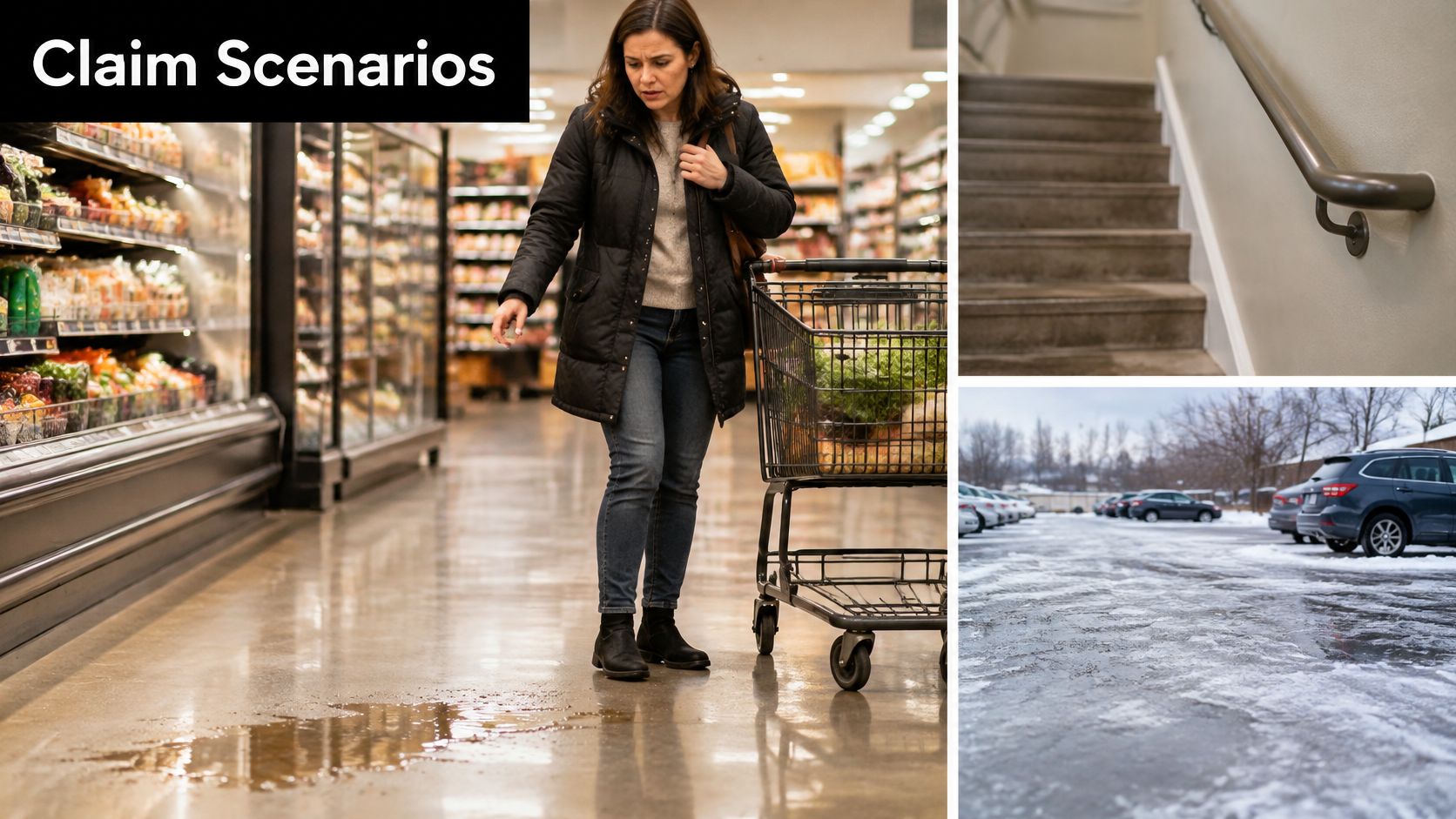
A shopper rounds a grocery aisle, hits a clear liquid, and finds no cone and no mop bucket. The likely source is the business CGL policy, because the store controlled the floor during business hours.
A guest grabs a loose handrail on an apartment stair, the bracket pulls out of the wall, and the guest falls a flight. That points to the landlord's liability policy for the common stair, not the tenant's renters policy, unless the lease put that repair on the tenant.
A driver steps out in a store lot, hits untreated ice, and breaks a wrist. Again the business CGL is the first place to look, along with any snow-removal contractor who had the lot that morning.
At a weekend market, a visitor trips on a lifted sidewalk board just outside the booth row. Coverage may sit with the organizer's or the venue's liability policy, depending on who laid out the path and who invited the public there.
| Scenario | Likely coverage source | Evidence to preserve | Defense to expect |
|---|---|---|---|
| Wet store floor with no warning sign | Business CGL policy | Photos, incident report, cleanup logs | Owner says the floor was just cleaned or the spill was unknown |
| Broken handrail on an apartment stair | Landlord's liability policy | Repair requests, maintenance records, lease | Owner says the tenant knew about the damage |
| Icy store parking lot | Business CGL policy | Weather records, snow removal contract, footwear | Owner says the ice was open and obvious or was cleared reasonably |
| Uneven walkway at an outdoor event | Organizer's or venue's liability policy | Event plan, witness statements, fall-site photos | Owner says the visitor left the invited area |
Insurers treat these files as serious money. In its 2025 General Liability Executive Insights report, Verisk reported that average general-liability claim severity was $101,000 in 2024, up 45% from $70,000 in 2020. A scene that looks minor at the curb can become a large claim once a fracture, a surgery, or a head injury follows.
Name every party who controlled the area. The owner, the manager, a cleaning contractor, and a tenant may each carry a separate policy. Our overview of types of premises liability cases walks through how those parties line up in Colorado claims, including falls and other property hazards. Landlords with pools or spas face a related coverage question, and pool and spa insurance considerations from VerticalRent explain why water features often need their own look at limits and exclusions.
Defenses Insurers Raise and Why Insurance Is Not Payment
A policy on the building does not mean the injured person gets paid. The policy provides defense and indemnity only when the insured is legally liable. "There was insurance" is not the same sentence as "there will be payment."
Colorado materials from the Judicial Branch civil jury instructions put the split in plain terms. An invitee generally enters for a mutually beneficial business purpose, or because the owner represented that the public was expected. A trespasser enters without consent. That classification can change the landowner's duty and whether liability coverage is triggered. The trial court determines status. The fact finder determines liability and damages. Adjusters handle coverage positions. They do not make the final legal call, and neither does the policyholder.
Defenses, in the order they usually appear
No notice. The owner says it never knew about the hazard and that inspections were reasonable. Answer with inspection logs, work orders, and earlier complaints that put the condition on the owner's desk.
Open and obvious danger. The owner says you should have seen it and walked around it. Lighting, viewing distance, a crowd, and missing warnings decide whether that argument holds.
Comparative fault. In Colorado, recovery is reduced by the claimant's share of fault, and it is barred when that share is greater than the defendants' combined fault. Footwear, where you were looking, and the fall-site layout answer this defense. They don't erase it.
An intervening cause. Someone else created the hazard after the last inspection. Timing is the whole fight. A spill five minutes old is a different case from a spill that sat through a shift change.
Unauthorized entry. The owner says you were outside the invitation, in a stockroom, a closed lot, or past a posted line. Your reason for being there, and whether that area was open to the public, is the reply.
An insurer can also send a reservation of rights while it investigates. That letter means the company is defending for now and may later deny indemnity. You still have to prove duty, breach, causation, and damages before the policy pays. Consent, business purpose, warnings, and where the hazard sat can each change that proof, especially at apartments, stores, parking lots, and events.
Limits, Exclusions and Why Serious Injuries Can Exceed Them
A valid policy can still leave a serious injury underpaid. A 2025 Insurance Journal report on an analysis of more than one million small-business policies and claims found that slip, fall, and customer-injury claims rose from 10% of claims in 2015 to 20% in 2025, while average claim costs more than doubled from $20,000 to $45,000. The same reporting describes insurers tightening terms and adding exclusions for risks such as sexual abuse, firearms, animal attacks, and high-crime properties, with some owners moving to more expensive surplus-lines coverage.
That shift is why the declarations page matters as much as the accident photos.
| Policy term | What it means for a claim | Where to find it |
|---|---|---|
| Per-occurrence limit | Maximum payable for one covered accident | Declarations page |
| Aggregate limit | Cap on total payments for all claims in one policy period | Declarations page |
| Exclusions | Risks the policy will not cover, such as assault and battery or liquor-related incidents | Endorsements and policy form |
| Deductible or self-insured retention | Amount the insured pays before coverage applies | Declarations page |
| Umbrella coverage | Extra limits above the primary policy | Separate umbrella policy |
The per-occurrence limit is the ceiling for one accident. The aggregate can stop payment after several claims in the same policy year, even if this accident is the first one you know about. Exclusions and endorsements can remove assault and battery, liquor-related incidents, pollution, professional services, or employee injuries. A deductible or self-insured retention is money the insured pays before the policy does. An umbrella is a separate policy that can add limits above the primary one, but only if it was in force and the loss isn't excluded there too.
A traumatic brain injury or a wrongful death can blow past ordinary primary limits even when coverage applies. Above the ceiling, the claimant looks to other responsible parties or, in some cases, the owner's own assets. Reservations of rights, sublimits, and additional-insured disputes create the same gap.
Ask for the declarations page, every endorsement, and the policy that was in force on the accident date. A certificate of insurance is a summary, not the contract.
Our guide to insurance policy limits shows how those ceilings work when a Colorado injury is larger than the primary policy. Finding out what coverage existed can matter as much as proving the unsafe condition.
What to Do After a Fall on Someone Else's Property
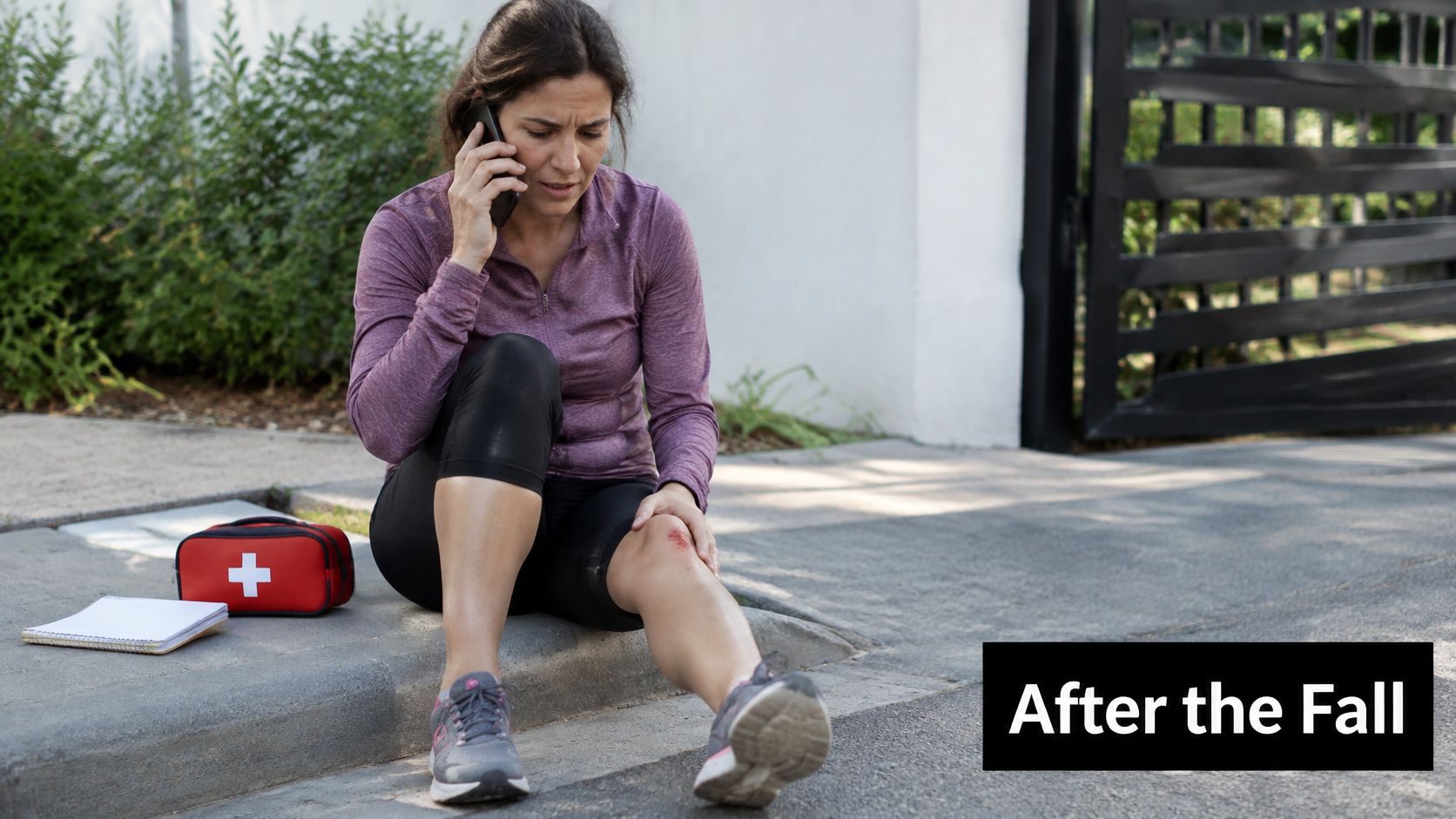
Do these in order. Each one protects a fact the insurer will later question.
- Get medical care and write down every injury, including the ones that feel minor that day.
- Report the fall to the owner or manager and keep the incident report number.
- Photograph the hazard, the lighting, any missing warning, and the shoes you wore.
- Collect witness names and phone numbers before people leave.
- Ask in writing that surveillance footage and maintenance records be preserved.
- List every party who controlled the area, including owner, manager, tenant, contractor, and their insurers.
- Request the declarations page and endorsements for each policy in force on the accident date.
- Track bills and wages, plus any earlier complaint about the same hazard.
- Talk with a lawyer before you give a recorded statement to an insurer.
- Calendar the filing deadline for a Colorado personal injury claim. A missed deadline can bar recovery even when a policy exists, and claims against a public entity often have a shorter notice period.
During an investigation, we collect medical records, accident reports, witness statements, and expert opinions to establish liability and damages. That file is what separates a covered claim from a fall the insurer can explain away. A closer look at how to investigate a premises liability case shows which records usually decide notice and fault.
If you were hurt on someone else's Colorado property, call Nares Law Group at 720-637-7786 and ask for a free consultation on your own facts. In that meeting, an attorney answers questions, puts the case together, and pursues the compensation the facts support. Confirm the timeline and the policies in force before anything is filed.
Nares Law Group LLC represents people hurt by unsafe Colorado property, including falls and other premises injuries, and we investigate coverage, notice, and visitor status before an insurer decides what a policy will pay. If you are sorting medical bills, lost income, and a property owner's insurance after a fall, visit Nares Law Group LLC to request a free consultation and have the policies and the deadline reviewed on your facts.