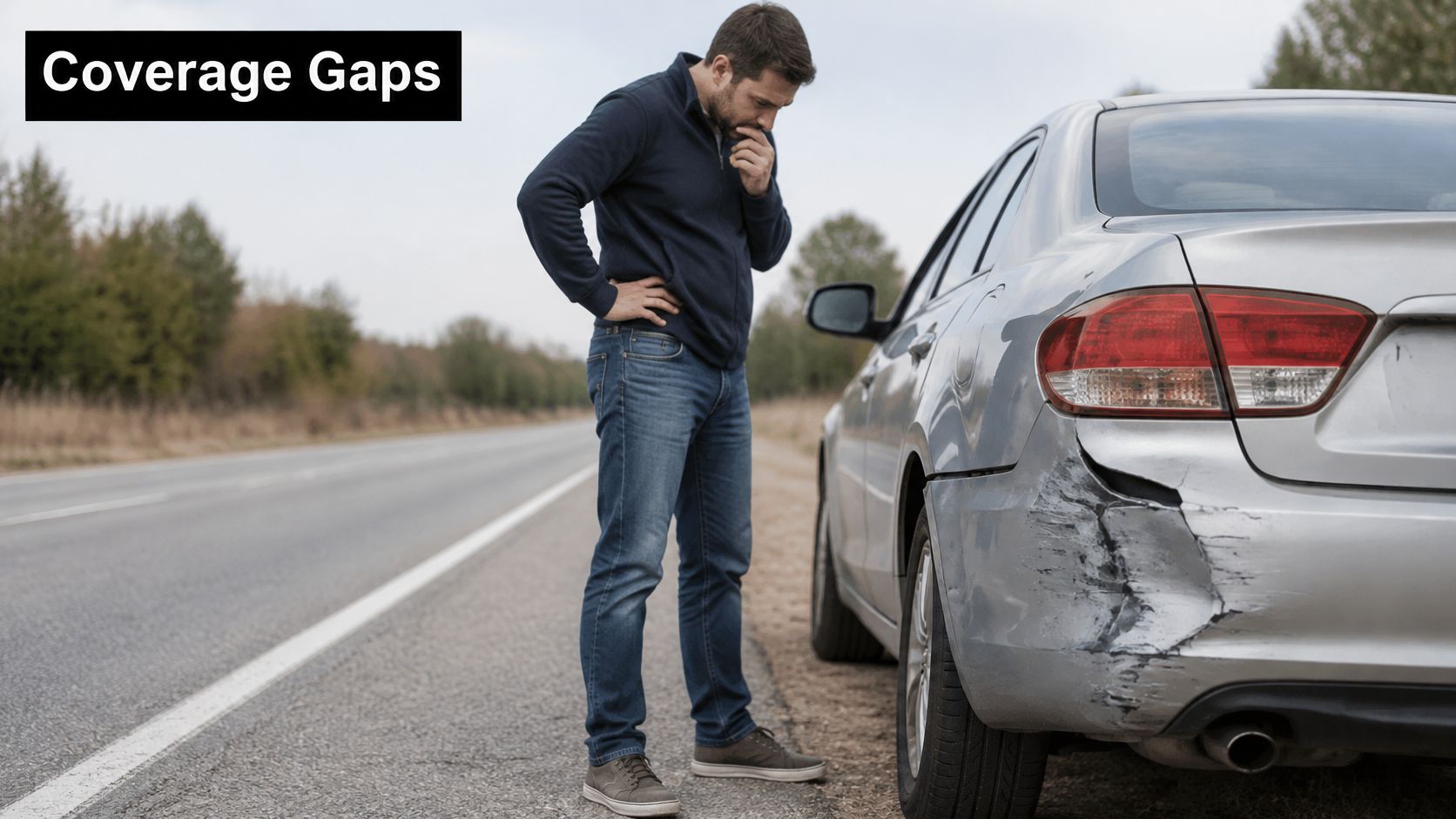
You just walked around the bumper, took three photos, and opened the app to file a claim. The other driver is still on the phone. You are trying to remember whether you kept full coverage or dropped it last renewal to save a few hundred dollars. That question decides who pays for the other driver's injuries, who pays for your car, and whether a deductible comes out of your checking account this week.
Liability, non-collision physical damage, and collision insurance are three different contracts sitting on one declarations page. They do not share a limit, and they do not cover the same loss. One crash can open two or three of them at the same time. Minimum liability can leave a large medical bill unpaid. Dropping physical damage can leave you paying the body shop yourself, even when someone else caused the wreck.
Pull the declarations page before you report anything. Match each coverage name to a dollar limit and a deductible. The rest of this walkthrough shows what each one will and will not pay.
What Each Coverage Pays For After a Crash
| Coverage | Pays for | Covers your own car | Typical example |
|---|---|---|---|
| Liability | Injury and property damage you cause to other people | No | You rear-end a car and injure its driver |
| Collision | Damage to your vehicle from impact with a vehicle or object, including a rollover or pothole | Yes, after deductible | You hit a guardrail |
| Comprehensive | Theft, fire, vandalism, hail, flood, falling objects and animal strikes | Yes, after deductible | Hail dents your roof |
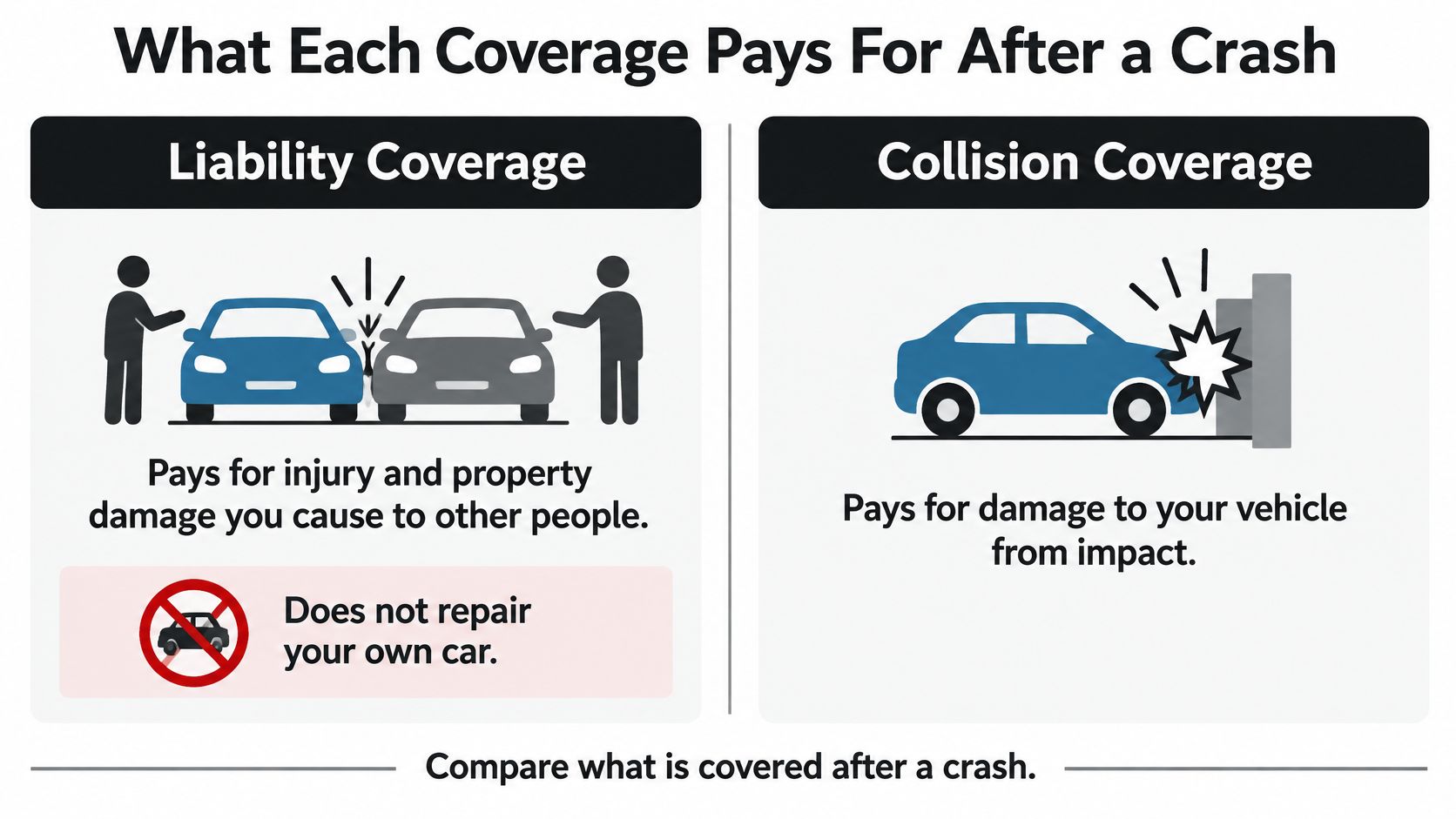
The National Association of Insurance Commissioners treats these as separate risk layers, not interchangeable products. Liability pays claims you cause to other people or their property. It does not repair your car. Collision pays direct physical damage when your vehicle strikes another vehicle or object, hits a pothole, or overturns, after the deductible you chose. Other than collision, also called "other than collision," pays specified non-crash losses such as theft, fire, vandalism, hail, flood, falling objects, and animal strikes, again after its own deductible.
Two questions before you file
Ask who caused the loss, then ask whose property was damaged.
- Who caused it: If you are at fault, your liability policy covers the other person's damages. When no one is at fault, such as in hail or deer incidents, it falls under coverage for physical damage. Injuries from an unidentified driver fall under uninsured-motorist coverage.
- Whose property: Damage to the other person's car and medical expenses relate to liability. Damage to your own vehicle is covered by collision or physical damage coverage.
Say you rear-end a car at a light. The driver ahead needs treatment, and that car needs a new trunk. Your car is a total loss. Liability pays the other driver's injuries and vehicle repairs, up to your bodily-injury and property-damage limits. Collision pays your car, but only after you pay the collision deductible. The other coverage never enters that file. There was no theft, hail, flood, or animal.
Practical rule: Comprehensive does not replace collision after an ordinary crash, and collision does not pay for theft or hail.
Label each limit on the declarations page before you read on. Write the bodily-injury number, the property-damage number, the collision deductible, and the non-collision deductible in the margin. If a box is blank, you do not have that coverage.
Colorado Minimums and What Lenders Require
Colorado's legal floors are small next to a hospital bill or a newer vehicle. A crash that sends two people to the hospital can exhaust the minimums before anyone values the cars, and the driver who caused it can owe the difference personally.
| Requirement | Colorado rule | What it means for you |
|---|---|---|
| Bodily injury, per person | $25,000 minimum | Covers injury you cause to one person; it is a floor, not full protection |
| Bodily injury, per accident | $50,000 minimum | Caps total injury payments for all people in one crash |
| Property damage | $15,000 minimum | Covers damage you cause to other people's property |
| Collision | Not required by Colorado law; optional unless a lender requires it | Pays your own vehicle damage after the deductible you choose |
| Comprehensive | Not required by Colorado law | Often required by lenders until the loan is paid off |
The Colorado Division of Insurance requires owners to carry at least $25,000 for bodily injury or death to one person, $50,000 for all persons in one accident, and $15,000 for property damage. Those are legal minimums. Damages above the limits can remain the responsible driver's personal obligation. A single surgery and a few months of lost wages can pass $25,000. Two injured people can exhaust $50,000 before the cars are even valued.
What the state requires versus what the lender requires
Collision is not a state mandate. Colorado law does not require you to buy it, and you may decline it when no lender is involved. If you keep collision, the deductible is your choice and your cost at claim time. Review Colorado car insurance requirements if you are comparing a new policy against the statute.
Lenders commonly require both damage protection and collision coverage until a financed vehicle is paid off. Dropping them is often not your decision alone. A lease works the same way. The bank is protecting the collateral, not your deductible comfort.
Run this check before you cancel anything:
- Read the contract. Open the loan or lease and find the required coverages and any cap on the deductible.
- Match the declarations page. Confirm both physical-damage coverages are listed, and that the deductible is not higher than the contract allows.
- Ask the insurer to split the rules. Have the agent tell you which coverages state law requires and which ones exist only because the lender demanded them. Write that answer down.
If the car is paid off, the lender rule drops away. Then compare the premium with what the car would bring in a private sale, and with what a serious injury claim could cost your household. Keeping liability high while dropping a worn-out car's collision can be rational. Keeping the state minimum on bodily injury rarely is.
The Real Cost of Each Coverage and Deductible
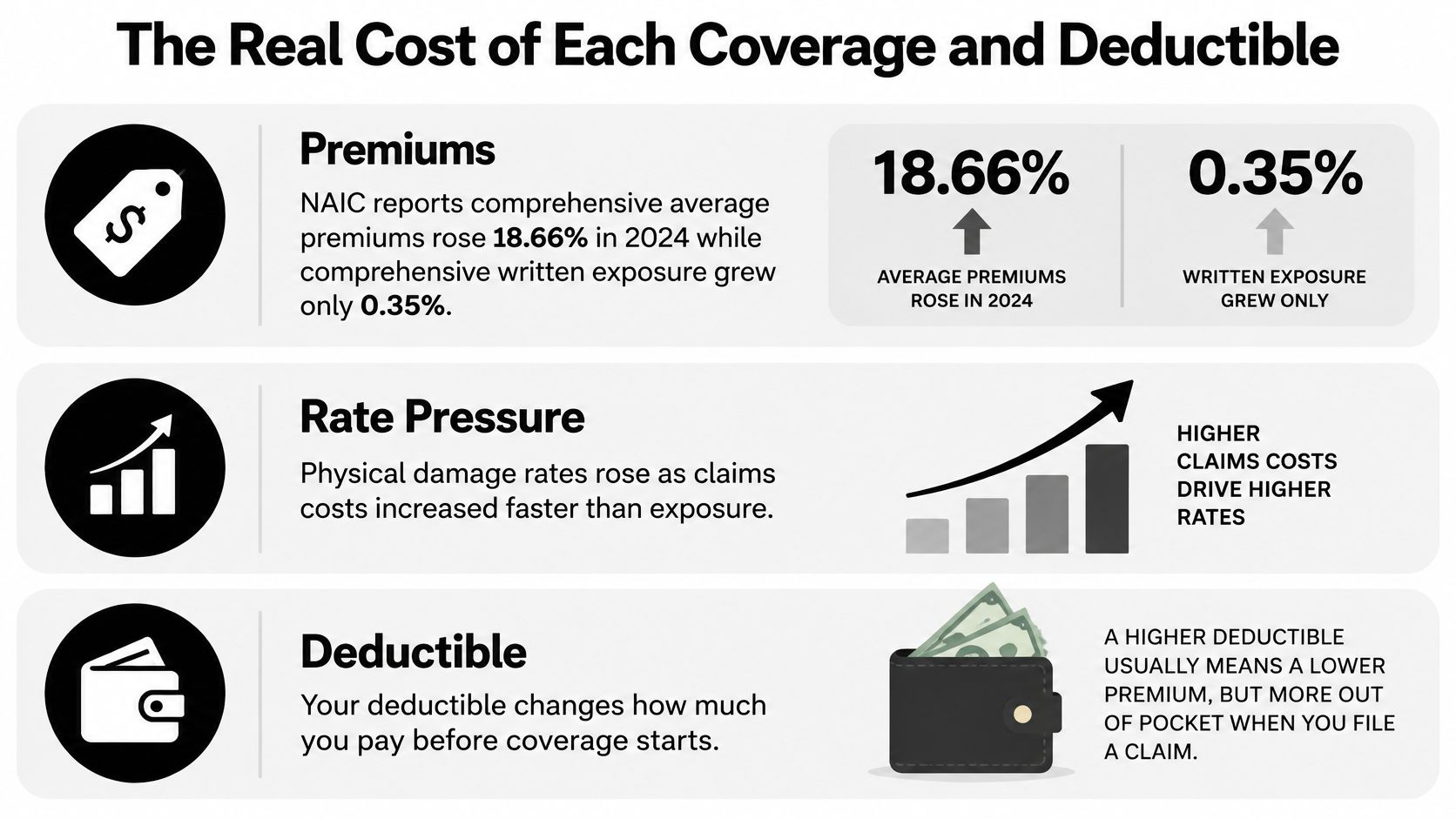
Price shows up in three places: the premium you pay every six months, the claim cost insurers are absorbing, and the deductible you must write a check for after a loss.
Premiums moved faster than the number of cars
In 2024, average premiums for theft, hail, and similar losses increased 18.66%, while written exposures for that coverage increased only 0.35%, according to the NAIC 2024 auto insurance database supplement. The book of insured vehicles barely grew. The price of covering theft, hail, and similar losses jumped. That is rate pressure, not a story about more drivers buying the coverage.
Claim costs explain why underwriters pushed physical-damage rates. The NAIC auto insurance database report put total U.S. liability incurred losses at $120.5 billion in 2022, a 9.4% increase from 2021. In the same period, the average incurred loss per collision claim rose 17.6%, from $6,113 in 2021 to $7,191 in 2022. Incurred loss is what the claim costs the insurer, not merely how many crashes happened. Each collision file got more expensive to close, so the premium followed.
The deductible math you can run tonight
The NAIC buying guide names $250, $500, and $1,000 as common deductible levels. A higher deductible generally lowers the premium. You still have to fund that amount after a covered loss, in cash, before the insurer pays the shop.
Use a break-even test. Divide the annual premium savings by the extra deductible dollars.
Say moving from a $500 collision deductible to $1,000 saves $120 a year. The extra exposure is $500. At $120 a year, you need about 4.2 claim-free years to earn that $500 back, before investment returns, claim frequency, and later premium changes. One crash in year two wipes the savings and leaves you short $500 you would not have paid under the old deductible.
Run the test separately for collision and for other-than-collision. Hail, theft, and glass follow a different pattern than intersection crashes. A Front Range hail season can make a high other-than-collision deductible a bad trade even when your crash history is clean.
Raise a deductible only if you could pay it this month without borrowing, without a credit card, and without skipping rent.
When Liability Limits and Uninsured Drivers Leave Gaps
A single crash can trigger three coverages at once. The other driver's liability pays your injury claim, your collision coverage pays your car after the deductible, and your uninsured-motorist coverage may have to pick up whatever the first policy cannot. When any one of those pieces is missing or too small, the bill comes back to you.
In 2023, 15.4% of U.S. motorists, about one in seven drivers, were uninsured, and only 20 states and the District of Columbia require uninsured or underinsured-motorist coverage, according to the NAIC uninsured-motorist topic page. Uninsured-motorist coverage responds when the other driver has no insurance or flees. Underinsured-motorist coverage responds when that driver's limits are too small for your losses. A policy bought in a state without that requirement may leave both off. Read the declarations page for the UM and UIM limits on your Colorado policy rather than assuming they are there.
Minimum limits are a floor, not a plan
A serious brain injury, months of lost income, and a totaled car can pass a minimum bodily-injury limit in one file. Liability claim volume is still growing. Sedgwick's casualty auto-liability year-end report recorded a 4.0% increase in auto-liability claim volume in 2025 compared with 2024. That figure tracks frequency, not the size of any one claim, so use it to check your limits against your own exposure.
Each coverage has its own limit, deductible, and exclusions:
- Bodily-injury liability pays people you injure.
- Property-damage liability pays property you damage.
- Collision and other coverage pay your car, on different facts, after their deductibles.
- Medical payments or personal-injury protection can pay early medical bills without a fault fight.
- UM and UIM pay you when the other driver cannot.
Say a driver carries $25,000 per person for bodily injury and causes a crash. The injured person's medical bills and lost wages total $80,000. The policy pays $25,000. The uncovered $55,000 is money that person must try to collect from the at-fault driver personally. Many drivers have no assets that cover that gap. A higher limit on your own UM/UIM policy is often the only realistic source of payment. Dropping UIM to save premium moves that exposure onto your savings. The guide to how insurance policy limits work walks through stacking and exhaustion in plain terms.
Confirm the UM and UIM dollar amounts on the declarations page, not in a brochure. When a claim already exceeds the available limits, the firm collects medical records, accident reports, witness statements, and expert opinions to establish liability and damages. That file is what supports a demand against every policy that applies.
Which Coverage Responds in Common Crash Scenarios
Fault decides who is legally responsible. The coverage that writes the check depends on what was damaged and whether a policy exists to pay it.
| Scenario | Who caused it | Coverage that responds | Deductible applies |
|---|---|---|---|
| You hit a guardrail alone | You | Collision | Yes |
| Hail dents your roof | Nobody | Comprehensive | Yes |
| You rear-end another car | You | Liability for the other driver; collision for your car | Collision: yes; liability: no |
| Hit-and-run driver damages your car | Unknown driver | Uninsured motorist coverage for injuries; collision or comprehensive for the car | Yes on the car claim; no on a typical UM injury claim |
| Deer strikes your car | Nobody | Comprehensive | Yes |
| Other driver's limits are too low for your injuries | Other driver | Underinsured motorist coverage, if you carry it | No standard deductible on most UM/UIM injury coverage |
Guardrail, you alone. You caused it, and the damage is yours. Collision pays repair or actual cash value after the deductible. Liability stays closed because nobody else was hurt.
Hail on the roof. Nobody drove into you. Coverage for non-collision damage pays for the dents after its deductible. Collision does not.
A deer at dusk. Same non-crash path. That other coverage, deductible first. Do not report it as a collision just because the hood is crushed. The wrong coverage code slows the file.
You rear-end someone. Their injuries and their car go against your liability limits, with no deductible. Your car goes against collision, with the deductible. Two claims, two insurers or two claim numbers, one crash.
Hit-and-run. If you are hurt, uninsured-motorist coverage is the injury policy to open. Our page on uninsured motorist coverage explains what Colorado policies usually require you to report to police. The car itself is a collision or other coverage question, depending on how the policy classifies an unknown impact, and that part carries a deductible.
Their limits are too low. Underinsured-motorist coverage, if you bought it, can fill the gap between their bodily-injury limit and your losses. If you did not buy it, the shortfall stays with you and with whatever assets the other driver has.
Theft sits outside the crash table, and it is still a coverage test people fail. Theft protection is the policy that responds to a stolen vehicle, not liability and not collision. Peter's Jeep Cherokee theft scare shows how fast a theft attempt unfolds and why knowing the right coverage before the night it happens matters.
Use the same five steps on any new loss:
- Name the loss. Impact, hail, animal, theft, or an unknown driver.
- Name who caused it. You, the other driver, nobody, or unknown.
- Match a coverage. Liability, collision, all-risk, UM, or UIM.
- Check the deductible. Know the dollar amount before you authorize repairs.
- Open the right claims. File a first-party claim with your insurer for your car or your UM/UIM injuries, and a third-party claim with the at-fault driver's insurer for harm they caused you.
Dropping Physical Damage Coverage to Save Money
Cutting collision and other physical-damage coverage is a real financial bet, not a paperwork tweak. It moves the full cost of repairing or replacing your car onto your savings, and the bet only pays when nothing happens to the car.
A 2025 consumer survey summarized in CCC's Crash Course report found that 8% of drivers had moved from full coverage to liability-only, 15% had downgraded or canceled some auto insurance, and one-third said they would temporarily go without insurance to pay for necessities. Over the same stretch, average repair costs reached about $4,768 through the third quarter of 2025. 7% of customers avoided filing a claim because they feared a premium increase. Fewer claims in the system does not mean fewer dents. People are postponing the body shop or paying cash.
Most policyholders will not use collision in a given year. In 2024, 4.16% of collision-insurance policyholders filed a claim, according to the Insurance Information Institute. That low frequency is exactly why the premium looks optional, until the roughly one in 24 policyholders who needs it in a given year faces a repair bill in the thousands.
What to weigh before you drop it
- Vehicle value: Compare the total-loss payout to the deductible plus a year of premium. If those numbers land close together, collision is a weak buy.
- Loan or lease: If the contract requires both physical-damage coverages, canceling them can put the loan in default.
- Emergency savings: A deductible you cannot fund is a coverage you do not really have.
- Likely repair size: A bumper and sensor calibration can exceed an older car's value. A paid-off beater with a scraped door may not.
- Whose fault: If someone else caused the crash and has liability insurance, their property-damage coverage may pay for your car. You still wait on their insurer, and their bodily-injury limit caps what they owe for your injuries.
If you could not pay a repair bill from savings this month, physical-damage coverage is still doing a job for you.
I would keep collision on any car you cannot replace from cash within 30 days. I would raise the deductible before I deleted the coverage.
How to Choose Your Coverage Mix Before Renewal
Set the mix in one sitting, with the declarations page and the loan papers on the table.
- Read every limit. Confirm bodily injury, property damage, UM, UIM, collision, and other physical-damage coverage, plus each deductible.
- Check the loan or lease. Keep whatever physical-damage coverage and deductible cap the contract demands.
- Price the car against your savings. Keep collision and other physical-damage coverage when a total loss would wreck the month. Drop them only on a paid-off car you can replace.
- Stress-test liability and UM/UIM. Ask whether those limits would cover a serious injury and a totaled car for your household, not a fender scrape.
- Run the deductible break-even before you raise any number. If you cannot write the check, do not raise it.
Three mixes cover most households I would advise:
A financed newer car keeps liability well above the legal floor, plus collision and non-crash damage protection, with a moderate deductible you can pay from savings. The lender will require the physical-damage pair anyway.
A paid-off older car with real savings keeps bodily-injury liability and UM/UIM high. Collision and other coverage stay only while the premium still makes sense next to the car's sale value.
A tight budget protects liability limits and UM/UIM first. Adjust the physical-damage deductibles before you delete a coverage. Going liability-only to pay this month's bills leaves the next crash entirely on you.
If a Colorado crash has already produced a coverage dispute, or the damages sit above the available limits, a free consultation is a practical next step. During that consultation, a personal injury attorney at our firm answers questions, puts a case together, and pursues the compensation the client deserves.
Nares Law Group LLC represents people hurt in motor-vehicle crashes when liability limits, uninsured drivers, or a denied physical-damage claim leave medical bills and lost income unpaid. We review the policies that apply, deal with the insurers, and pursue compensation for the harm the crash caused. If that is the file you are holding, visit Nares Law Group LLC and ask for a free consultation.