Your car is at the repair shop, your neck hurts, and an insurance adjuster wants to know whether you'll accept an offer. You may not know how long treatment will last, whether you'll miss more work, or which insurer should pay your bills. You don't need every answer today, but you do need to protect your ability to find them.
Good legal advice for motor vehicle accidents starts with two separate questions: Who caused the crash, and what coverage can pay for the harm? Proving the other driver was careless won't necessarily cover your losses if that driver has little insurance. This guide focuses on the decisions that protect both your claim and your recovery.
When a Crash Needs a Lawyer
When legal advice is needed after a crash
| Situation | Consult an attorney? | Why it matters |
|---|---|---|
| Minor property damage, no injuries, fault admitted | Optional | A small claim may be handled directly with the insurer |
| Any injury that needs treatment | Yes, before settling | Future medical costs may not be visible yet |
| Fault is disputed or unclear | Yes | Evidence must be preserved and competing accounts weighed |
| Hit-and-run or uninsured driver | Yes | Your own coverage may be the main source of payment |
| Commercial truck or rideshare vehicle | Yes | Several defendants and extra insurance layers may be involved |
| Death of a family member in the crash | Yes, promptly | Wrongful death claims have their own filing deadlines |
You don't need a lawyer for every fender-bender. If nobody is hurt, the insurer accepts responsibility, and the repair estimate addresses the damage, you may be comfortable handling the claim yourself. Keep the agreement and payment records, and confirm exactly what you're releasing.
An injury changes the decision. A repair estimate describes damage to a vehicle, but an early medical bill may reveal very little about your eventual treatment needs. Before resolving an injury claim, you need a reasonable understanding of your condition and what the settlement document would close.
Match the help to the problem
Disputed fault calls for investigation, not a longer argument with an adjuster. A lawyer can identify missing evidence, examine conflicting accounts, and assess whether someone besides the other driver contributed to the collision.
A hit-and-run raises a different problem: finding an available payment source. Truck and rideshare crashes may require examination of employment relationships, vehicle ownership, and insurance tied to the activity underway when the collision happened. A fatal crash also requires attention to who may bring a claim and which losses the law recognizes.
For an accessible starting point, AskLegally's car accident legal advice can help you organize questions before speaking with counsel. General guidance is useful preparation, but it isn't a substitute for reviewing your documents and state law.
Write down these answers today:
- Injuries: Was anyone hurt or referred for treatment?
- Fault: Does anyone contest how the crash happened?
- Insurance: Which drivers, employers, vehicle owners, and insurers are involved?
What to Do in the First Days After a Crash
Protecting your health comes before building a claim. The National Highway Traffic Safety Administration's traffic safety report estimated that 1,908,301 passenger-vehicle occupants were injured in 2024, a reminder that crash consequences extend well beyond repair bills.
Use this visual as a quick safety reminder, then work through the documentation steps below.
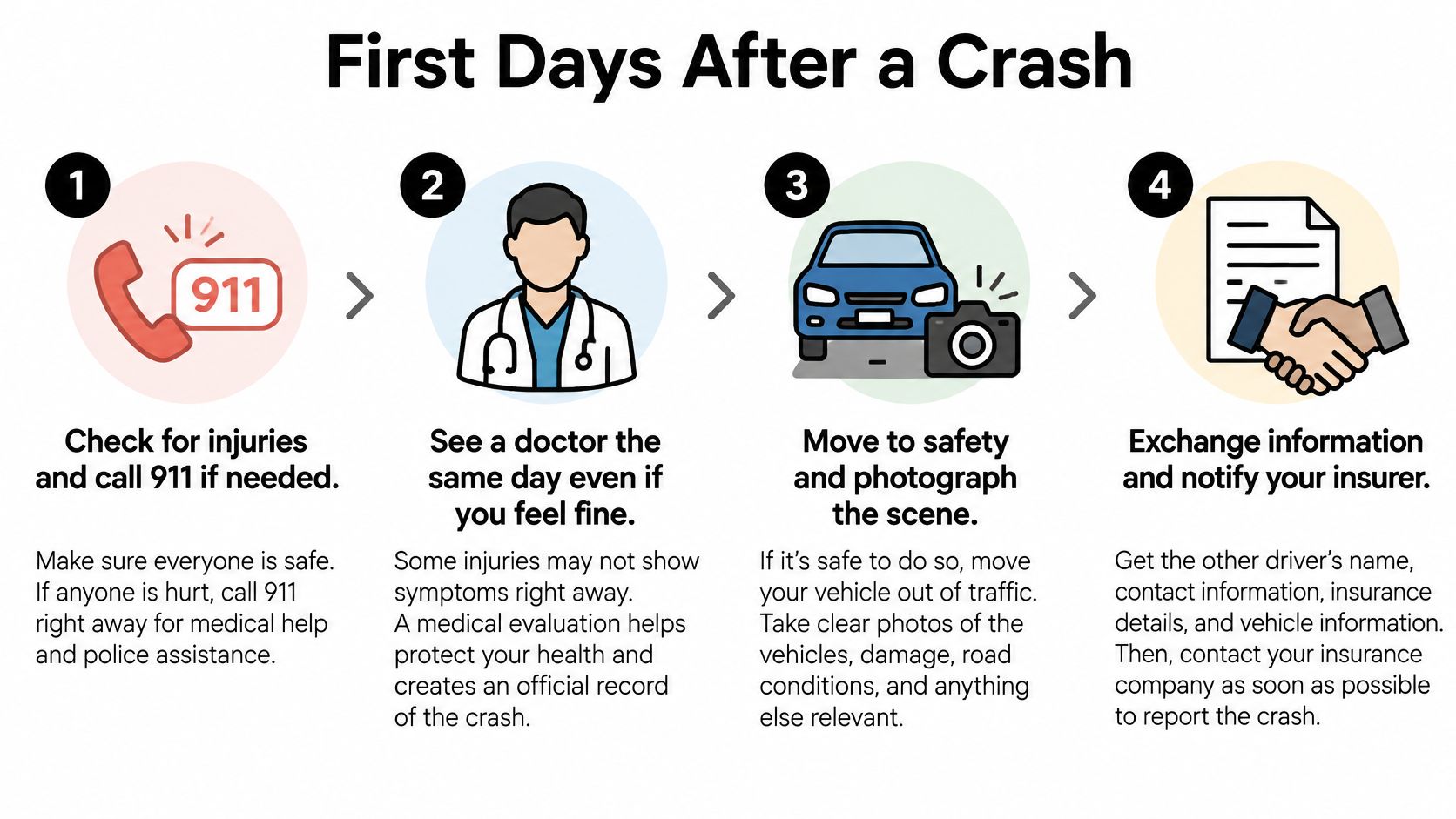
Protect people and preserve the basics
Check for injuries and get medical help. Call emergency services if anyone needs assistance. Seek prompt medical evaluation, particularly after a significant impact or if you have symptoms, rather than assuming that being able to walk means you're uninjured.
Move to safety when possible. Don't stand in traffic to take photographs. Once safe, capture vehicle positions, damage, road markings, traffic controls, weather conditions, debris, and visible injuries.
Exchange information and identify witnesses. Collect names, contact information, insurance details, and plate numbers. Ask witnesses how to reach them instead of assuming their information will appear in the report.
Get the crash report number. Ask the responding agency how to request a copy when it becomes available. Check identifying details and distinguish factual errors from disagreements about the officer's conclusions.
Create a usable record
Start a symptom and expense log. Record discomfort, appointments, missed work, travel for treatment, and out-of-pocket purchases while the details are fresh. Save receipts rather than relying on a later estimate.
Notify your insurer without guessing. Report the collision promptly and explain what you know. Before giving a recorded statement or signing a release, understand the request and your policy's cooperation requirements.
Flag the vehicle for preservation. Tell the owner, storage facility, and insurer that potentially relevant vehicle evidence needs review before repair, sale, or salvage. A casual conversation may not be enough, so ask counsel whether written preservation notices are needed.
Organize documents for an early legal review. Send available records rather than waiting for a perfect file. During our investigation, we collect medical records, accident reports, witness statements, and expert opinions to establish liability and damages.
Policy Quail's checklist for filing an auto claim after accidents can help you keep the reporting paperwork organized. Use a dedicated folder for correspondence and retain copies of everything you submit.
Practical rule: Report facts you know. Don't fill gaps in your memory with guesses just because someone wants an immediate answer.
By the end of the first week, aim to have medical follow-up arranged, the report requested, insurance notices underway, and your records in one place. Unanswered questions are normal. Unrecorded symptoms, missing contact details, and discarded evidence are harder to fix later.
How Fault Is Decided and How Blame Changes Recovery
| Fault system | How it treats shared responsibility | What to verify |
|---|---|---|
| Pure comparative fault | Reduces recoverable damages according to the injured person's responsibility | Which losses are subject to reduction |
| Modified comparative fault | Reduces damages but bars recovery at the state's cutoff | The exact cutoff and how fault is compared |
| Contributory negligence | An injured person's contributing negligence can bar recovery | Applicable exceptions and defenses |
| Claims involving several defendants | Responsibility may be allocated among different parties | How allocation affects each defendant's obligation |
These differences matter because an allegation that you contributed to the crash can affect more than your negotiating position. Under one system, shared responsibility reduces compensation. Under another, it can prevent recovery altogether.
For a simple hypothetical, suppose an injured driver has documented losses and is assigned a smaller share of responsibility than the other driver. A comparative-fault rule may reduce the award proportionally, while a contributory-negligence rule may produce a very different result. Don't accept an adjuster's calculation until someone has checked the governing law.
What a negligence claim must establish
A typical negligence claim connects these elements:
- Duty of care: The driver had an obligation to use reasonable care.
- Breach: The driver failed to meet that obligation, such as by following too closely or ignoring a signal.
- Causation: That failure caused the collision and the injuries claimed.
- Damages: The injured person suffered compensable losses.
These are separate questions. Evidence that a driver used a phone doesn't, by itself, establish that the distraction caused this particular crash. Likewise, showing that a collision occurred doesn't establish every later medical problem as a consequence.
A police report and a traffic citation can help explain what happened, but neither automatically resolves a civil injury claim. An officer may arrive after the impact, interview only some witnesses, or lack access to vehicle data. Insurers, lawyers, and ultimately courts may assess a broader record.
Respond to fault allegations with evidence
Suppose the other driver says you stopped suddenly. The useful response is to examine traffic conditions, following distance, brake-light operation, footage, and witness observations. Repeating that the collision wasn't your fault won't answer those factual questions.
For Colorado claims, our guide to Colorado comparative negligence explains why the applicable comparison rule deserves careful attention. Don't assume Colorado, Texas, and New York use interchangeable rules.
An adjuster's assignment of blame is a position to evaluate, not a legal ruling you must accept.
Before responding to a proposed fault allocation, have counsel verify the current statute, relevant exceptions, and treatment of multiple defendants. This is general education, not a determination of the law governing your particular crash.
Proving Fault With Vehicle Data and Expert Analysis
A disputed claim needs evidence that answers specific questions: where the vehicles were, what each driver did, and how the impact occurred. Start by identifying what exists and who controls it.
This checklist shows the main evidence categories worth preserving.
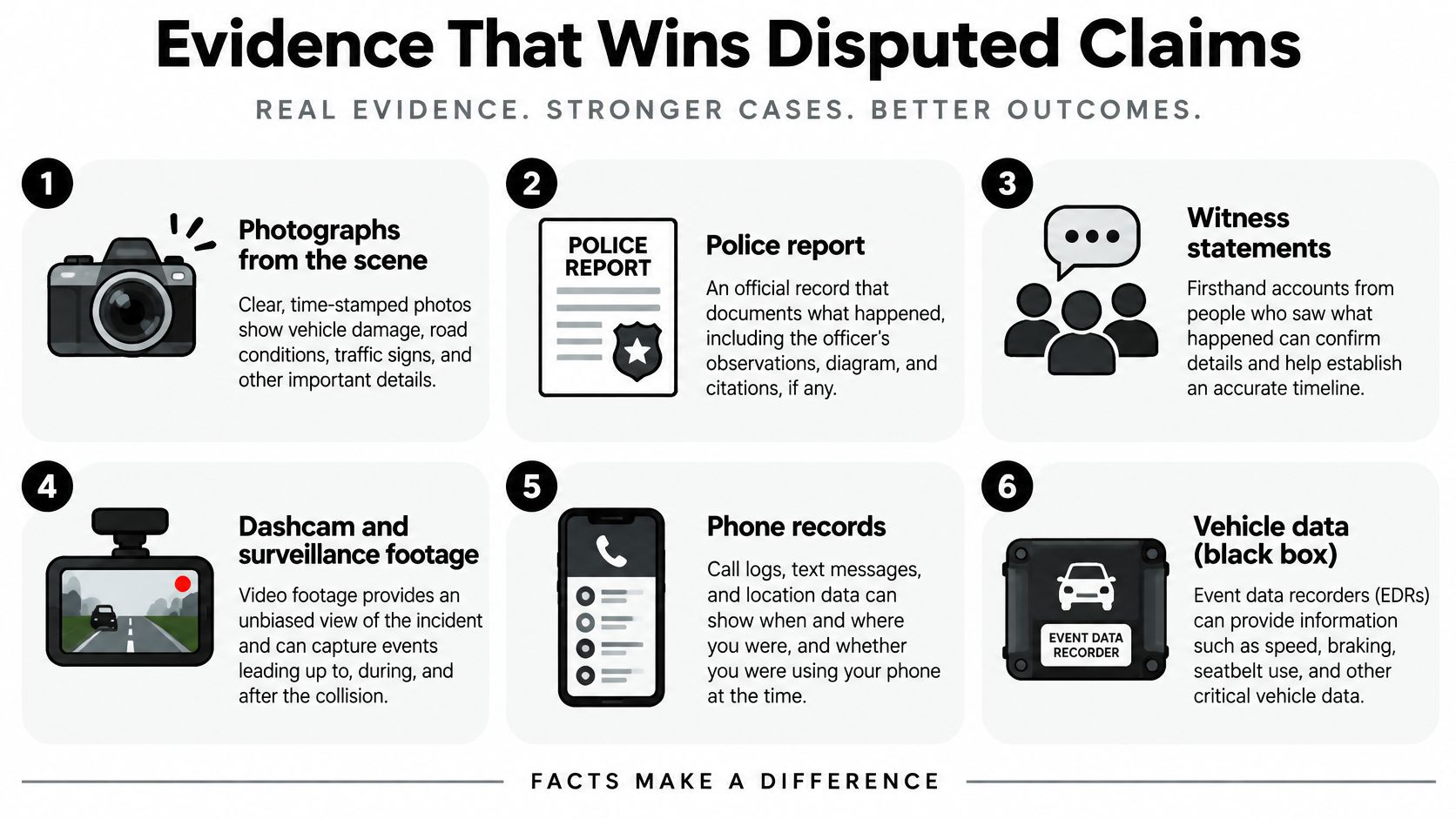
- Scene photographs: Preserve original files, including wide views and close-ups. A cropped picture of a dent may omit lane markings that explain the collision.
- Police report: Obtain the complete report and identify witnesses or attachments that need follow-up.
- Witness statements: Record contact details and what each person observed. Hearing the impact isn't the same as seeing the vehicles before it.
- Dashcam and surveillance footage: Identify nearby businesses, homes, buses, and vehicles with cameras. Ask counsel to seek preservation before recordings are overwritten.
- Phone records: These may help investigate suspected distraction, but access requires an appropriate legal basis. A call log alone doesn't reconstruct a driver's attention.
- Vehicle data: Identify vehicles and electronic modules that could contain relevant crash information before anyone alters them.
What the vehicle's recorder can tell you
An event data recorder, sometimes called a black box, records a limited window rather than a continuous account of the trip. According to NHTSA's event data recorder guidance, recordings typically cover seconds rather than minutes and may include vehicle dynamics, driver inputs, and restraint information.
The available fields depend on the vehicle and recording system. A recorder does not issue a finding of fault. An expert must compare its output with damage, roadway measurements, witness accounts, and other evidence.
The extraction process matters too. Investigators identify the vehicle and compatible equipment, obtain lawful access, preserve the original download, and document who handled it. Missing context or an unreliable extraction can undermine an otherwise useful measurement.
The following video offers additional context for discussing a motor vehicle claim with an attorney.
Turn technical evidence into an explanation
Accident reconstruction specialists evaluate vehicle movement and impact mechanics. Medical experts address injury causation and functional consequences. We have access to medical and accident reconstruction experts who can testify about the cause and impact of an injury.
For the first attorney meeting, bring the vehicle's location, photographs, witness contacts, camera locations, and any repair or salvage notices. Also identify who owns each vehicle and whether any electronic download has already occurred. Those details help counsel decide what must be preserved immediately.
Insurance Claims and Which Coverage Pays
A strong liability case isn't the same as an adequately funded claim. The Insurance Information Institute's uninsured-motorist statistics report that 15.4% of U.S. motorists were uninsured in 2023. Coverage investigation deserves the same attention as proving who caused the crash.
After a hit-and-run, your own uninsured-motorist coverage may provide a route to payment, subject to the policy and applicable law. Report the event promptly and check requirements involving police reporting, proof of the unidentified vehicle, and notice to the insurer.
Accepting the other driver's policy limit can also affect an underinsured-motorist claim. Before agreeing, check whether your insurer requires notice or consent and whether the proposed release would impair its rights.
Which insurance pays after a motor vehicle accident
| Coverage | Who it helps | When it pays | Watch for |
|---|---|---|---|
| Other driver's liability | Injured person, through the at-fault driver's policy | Covered losses attributable to the insured driver | A release may reach beyond the payment intended |
| Uninsured or underinsured motorist | Covered injured person under an applicable policy | When the responsible driver has no or insufficient coverage | State rules, exclusions, consent requirements, and stacking limits |
| Medical payments or PIP | Covered injured people and passengers | Eligible early expenses, generally without resolving fault first | Benefit limits and coordination with other payments |
| Health insurance | Covered injured person | Eligible treatment while the injury claim proceeds | Deductibles, network rules, and reimbursement claims |
| Workers' compensation | Eligible worker injured in a work-related crash | Covered work-related injuries | Coordination with a separate third-party claim |
Keep policy documents with the rest of your crash records.
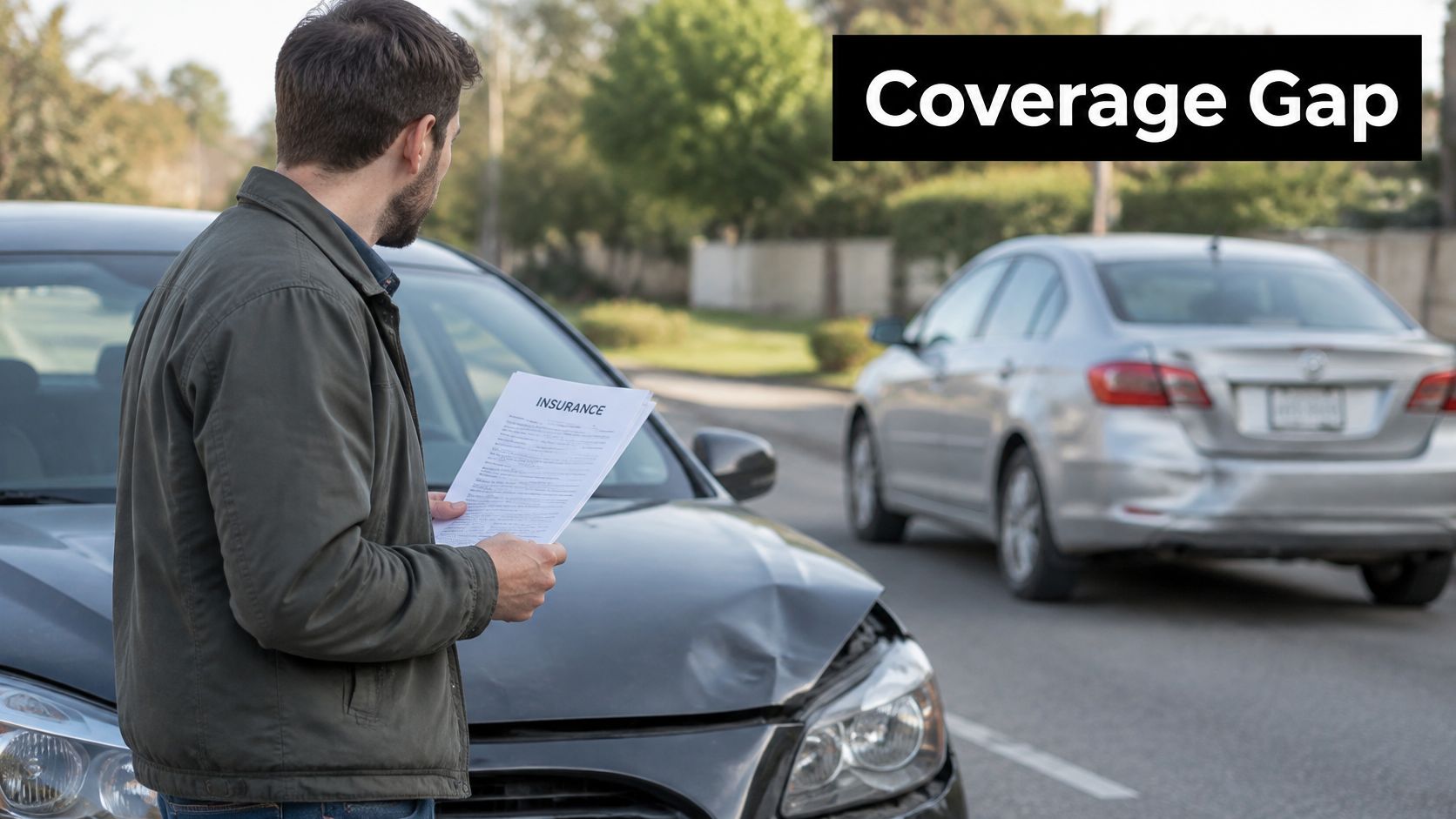
Follow the payment through to your net recovery
A health plan or workers' compensation payer may seek reimbursement from a settlement. Medical-payment or PIP benefits may also interact with other recovery rights. Your attorney should identify those obligations instead of treating the settlement's headline amount as money you'll necessarily keep.
Request declaration pages and complete policy language, not just insurance cards. Review household policies, employer-related coverage, and any policies connected to a commercial or rideshare vehicle.
Before giving a recorded statement, signing a release, or accepting a settlement check, clarify:
- Available coverage: Which policies have been investigated?
- Settlement conditions: Whose consent or notice is required?
- Repayment obligations: Who claims reimbursement, and on what basis?
The review should address the crash location and any other state law governing the policy. Don't assume a coverage rule follows you unchanged across state lines.
Compensation Proof and Delayed Brain Injury Documentation
Compensation categories and the proof each one needs
| Damage type | Example loss | Proof needed |
|---|---|---|
| Medical expenses | Emergency care, surgery, therapy, medication | Itemized bills and treatment records |
| Lost wages | Missed shifts or reduced hours | Pay stubs and an employer letter |
| Lost earning capacity | Permanent work restrictions | Medical opinion and vocational assessment |
| Future medical care | Ongoing therapy or assistive devices | Physician estimate of future care costs |
| Pain and suffering | Chronic pain or loss of daily activities | Symptom journal and statements from family |
| Wrongful death losses | Lost support, funeral costs | Death certificate and economic analysis |
Consider a hypothetical injured driver with emergency treatment, missed shifts, and a physician's recommendation for future therapy. Bills support treatment charges, payroll records support missed earnings, and the physician's explanation supports anticipated care. A journal showing that the driver can no longer manage grocery shopping or tolerate a full workday documents a different kind of loss.
Economic damages concern financial losses. Non-economic damages concern effects such as pain and disruption of everyday life. Neither category should rest on a pile of receipts without an explanation of what the crash changed.
Document changes that aren't obvious in the emergency room
Brain-injury symptoms can become noticeable after someone initially appears functional. A multicenter study published in Scientific Reports recorded 83,687 road-traffic patients, including 15,373, or 18.4%, with at least one head injury. That finding describes the study population, not the probability that any particular reader has a brain injury.
A normal CT doesn't automatically settle whether a concussion occurred. Symptoms emerging later don't necessarily mean an injury newly developed at that moment; the person may only then recognize its effects. Diagnosis belongs with a qualified clinician, not an insurer or an online symptom list.
Record concrete changes rather than writing only that you feel worse:
- Headaches and sensitivity: Note triggers, duration, and difficulty tolerating light or noise.
- Memory and language: Describe missed appointments, forgotten instructions, or trouble finding words.
- Balance and energy: Record dizziness, fatigue, and tasks you stop before finishing.
- Sleep and mood: Track altered sleep, irritability, and changes others notice.
- Work performance: Preserve reduced-hour records, accommodations, and examples of tasks taking longer.
Connect symptoms, treatment, and daily functioning
Family members and coworkers can describe changes the injured person doesn't recognize. Their observations are most useful when specific: needing reminders for medication, leaving meetings because of noise, or making unfamiliar errors at work.
Clinicians may recommend specialist referrals, neuropsychological testing, or occupational assessments. Keep referral records, medication history, and treatment recommendations together. Our guide to delayed traumatic brain injury symptoms offers further context for discussing these concerns with medical professionals.
Be candid about preexisting headaches, anxiety, and prior injuries. Accurate baseline information helps clinicians and experts distinguish an earlier condition from a new injury or aggravation.
Documentation reminder: Describe what happened and what changed. You don't need to diagnose yourself to create a useful record.
Report new or worsening symptoms promptly and ask your treating clinician whether specialist evaluation is appropriate. Seek emergency care for alarming symptoms such as worsening confusion, repeated vomiting, weakness, or difficulty staying awake.
A supported future-care claim needs more than a prediction that treatment might continue. It needs a medical explanation of the expected care, its purpose, and its relationship to the crash.
How Long You Have to File and What It Costs
A lawsuit deadline and an insurance notice deadline are not necessarily the same. The applicable filing period depends on the jurisdiction, claim type, parties, and circumstances. A wrongful death claim or a claim involving a government vehicle may require a different deadline analysis from an ordinary injury claim.
Don't assume settlement discussions stop the clock. Ask counsel to identify the deadline and explain what action must occur before it expires.
Confirm the deadlines and fee terms
Bring the information needed to check:
- Location and dates: Where the crash happened, when it occurred, and when relevant injuries were identified.
- Potential defendants: Whether a city, county, public agency, employer, or commercial operator is involved.
- Policy notices: Any uninsured-motorist notice, proof-of-loss, or other contractual requirement.
- Claim type: Whether the matter involves personal injury, property damage, or wrongful death.
Many personal-injury attorneys use contingency fees, meaning the legal fee is tied to recovery rather than billed solely by the hour. The written agreement should explain the calculation and any changes based on the stage of the case. Our explanation of an attorney working on contingency can help you prepare questions.
Case expenses are separate from attorney fees. Records, expert analysis, and medical reports can create costs even when no hourly legal bill is issued.
Ask these questions before signing:
- Deadline: What is the filing deadline, and are there earlier notice requirements?
- Fee: How is the attorney fee calculated?
- Expenses: Who advances costs, how are they deducted, and who owes them if there's no recovery?
Make the deadline check an early priority. Waiting can eliminate options before anyone has assessed the strength of your claim.
Book a Free Consultation Before You Accept Any Offer
If you were injured, fault is disputed, or an insurer is pressing for a quick settlement, get legal advice before responding. The purpose is to understand both the value of your losses and the realistic sources of payment.
You don't need to arrive with a completed investigation. An initial conversation should help identify what's known, what remains uncertain, and which decisions can't safely wait.
Bring the documents that answer practical questions
Prepare a folder containing:
- Crash information: The report number, photographs, witness contacts, and vehicle location.
- Medical documentation: Available records, bills, referrals, prescriptions, and discharge instructions.
- Insurance materials: Declaration pages, policy documents, claim numbers, and adjuster correspondence.
- Income evidence: Pay records, missed-work information, and employer communications.
- Daily-impact records: Your symptom journal and notes about activities you can't perform normally.
- Proposed agreements: Any release, offer letter, check, or document an insurer wants signed.
Missing documents shouldn't stop you from making contact. Tell the attorney what you have and who may hold the rest.
Understand what happens next
We review the available coverage, investigate liability and damages, and identify the evidence needed to evaluate an offer. That may include obtaining records, speaking with witnesses, or seeking expert opinions. You should understand which unresolved questions affect the decision to settle.
We offer a Free Consultation for auto accident cases in Colorado, where a personal injury attorney answers questions, puts together a case, and pursues the compensation you deserve. Our free settlement resources include the Wrongful Death, Brain Injury, Truck Accident, and Motor Vehicle Accident Case Estimator calculators. An estimate is a starting point for questions, not a promise of case value or proof that insurance will fund it.
Before deciding, ask the attorney to explain the proposed release, available policy limits, outstanding bills, and any reimbursement claims. A useful settlement discussion concerns what the agreement resolves and what you can expect to receive, not just the amount printed at the top.
Don't sign or cash a settlement check because an adjuster says the paperwork is routine. Book the consultation before responding to the offer, and bring the actual documents so they can be reviewed.
Nares Law Group LLC offers free consultations for Colorado auto accident cases and investigates fault, insurance coverage, and the medical consequences of a crash. Visit Nares Law Group LLC to arrange a consultation before signing a release or accepting a settlement check.