The offer arrives in an email at 8:42 on a Tuesday morning. Forty-eight thousand dollars, the adjuster writes, and she needs an answer by Friday. Rent is due on the first. The orthopedic surgeon wants one more scan before he'll say the word "permanent" out loud. And two months ago your lawyer said something that sounded almost casual: if they won't pay what this case is worth, we can try it.
You might hear that sentence as a bluff. It isn't. It's a second door in a hallway you assumed had one exit, and walking toward it changes what happens in the first room. Whether you should settle or go to trial isn't a choice between fast money and a jackpot. It's a comparison between two different kinds of certainty, made in a season when your body is still writing the ending.
What Settlement and Trial Each Give You
The number sits in your inbox, big enough to feel like relief and small enough to feel like an insult. Your wrist still aches when it rains. Nobody will say whether the hardware comes out. Two doors, one hallway, and a Friday deadline.
Settlement and trial don't just pay differently. They ask different things of you and hand back different kinds of certainty.
How rare is a courtroom, really? In 2025, only 1,681 of 407,379 civil cases terminated in U.S. district courts reached or concluded after trial. That's about 0.4 percent, split into 1,182 jury trials and 499 bench trials, according to the Administrative Office of the U.S. Courts' 2025 case figures. Older multi-jurisdiction data runs the same way: the Federal Judicial Center's history of civil case management records that 72.3 percent of general civil cases were settled or dismissed, while only 3.3 percent were disposed of by bench or jury trial across 45 jurisdictions.
Those are national figures. They are not a forecast for a Colorado, Texas, or New York injury case. Venue, court backlog, whether fault is contested, the size of the policy, and how much the defendant has to lose all move the odds. What the numbers do tell you is that settlement is the statistically ordinary ending, not a surrender.
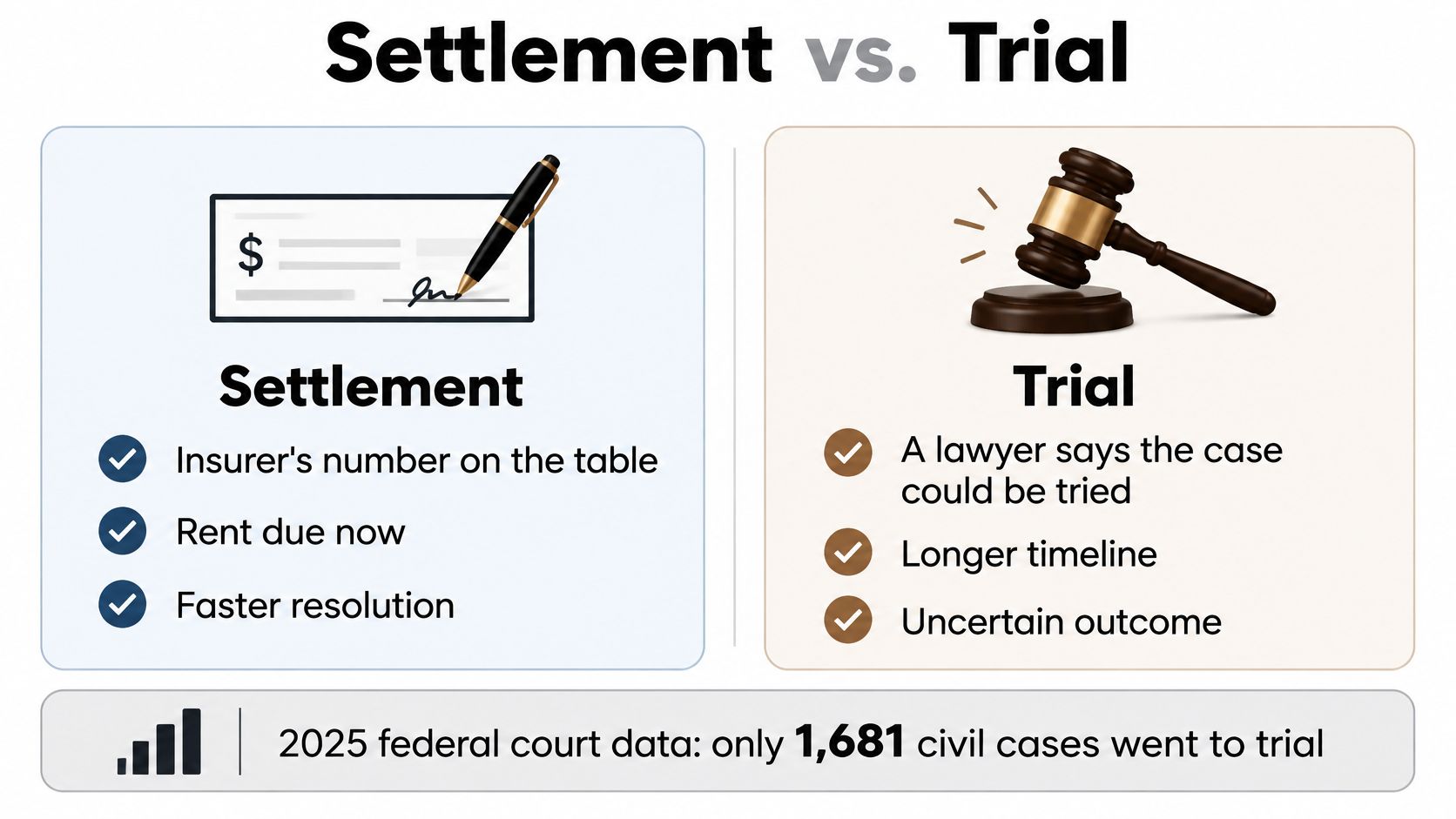
The trade, row by row. No column wins outright. You're choosing which risks you can live with.
| Factor | Settlement | Trial |
|---|---|---|
| Payment certainty | A known amount if you accept | A jury or judge decides; the result can be more, less, or zero |
| Timing | Often weeks to months once the file is ready | Many months to years, plus a possible appeal |
| Control | You can accept, counter, or walk away | The outcome leaves your hands |
| Privacy | Usually private, and confidentiality can sometimes be negotiated | Testimony and the verdict are generally public |
| Cost | Lower ongoing expense, though fees still come out of the recovery | Experts, court time, and trial prep add cost even if the case is lost |
| Best fit | Stable injuries, known limits, and a real need for money now | Strong fault evidence, large future losses, a collectible defendant, and a client who can wait |
Speed and payment certainty sit with settlement: a signed release and a check, usually weeks after the file is complete. A trial date is a horizon, not a promise, and a verdict can be appealed. Privacy cuts the same way. Negotiated terms can stay quiet; a courtroom is a public room where your medical history gets read aloud.
What trial holds is range. A judge or jury can award more than any adjuster has authority to offer. They can also award less, or nothing, after you've spent two years getting ready.
The practical rule: being ready for trial is leverage even when settlement is where the case ends. A case can be trial-ready while everyone in the room still expects a check.
Readiness changes the conversation because it changes what the other side has to price in: your experts, your records, your willingness to sit in a witness box. Being unprepared is not a negotiating position. It's a discount.
Read Award Odds Before You Compare Money
Start with the middle of the distribution, not the top.
Earlier nationwide state-court data collected by the Bureau of Justice Statistics, summarized in the federal courts' trials data, found that about 26,950 tort, contract, and real-property cases were disposed of by bench or jury trial in 2005, roughly 3 percent of all general civil cases. In those trials, plaintiffs who won received a median award of $28,000 across all case types, and $24,000 in tort trials. About 10 percent of winning plaintiffs received more than $250,000, and roughly 4 percent received $1 million or more.
Trial frequency has fallen alongside those numbers. The share of federal civil cases reaching trial dropped from 11.5 percent in 1962 to 1.8 percent in 2002.
| Result band | Figure | How to use it |
|---|---|---|
| Median award, all case types | $28,000 | Don't assume a trial beats a solid offer |
| Median award, tort trials | $24,000 | Compare your net offer with a modest middle, not a headline |
| Higher awards | More than $250,000 for about 10 percent of winners | Possible when damages and fault evidence are both strong |
| Very large awards | $1 million or more for about 4 percent of winners | Rare, and it still has to be collectible |
What a Median Is and Isn't
A median is not a cap. It's the middle of what winning plaintiffs walked away with, which means half did better and half did worse, and every one of them had already gotten past the liability question. The million-dollar verdict that made the news is the four-in-a-hundred tail. It's real. It's just not a plan.
Say the offer is $150,000. It sounds like life-changing money until you subtract a hospital lien, nine weeks of lost wages, and the fact that your surgeon has mentioned a second procedure in a year. Now the gross number and the number that reaches your account are different animals. Run the same arithmetic on a modest verdict that arrives eighteen months later and the offer may look stronger, not weaker.
Then flip it. Suppose a trucking company's insurer offers the $1 million policy limit on a crash that left you with a spinal injury and a future-care plan running into seven figures. No verdict, however large, collects past that policy unless another defendant exists. The ceiling, not the verdict, is the story.
The levers that move a real comparison: future care costs, permanency, lost earning capacity, comparative fault, venue, and whether a judgment can be collected. We commit to fighting for maximum compensation to cover medical costs, lost income, and future care, and sometimes maximum compensation is the money that can be paid this year rather than a bigger number nobody can collect. If you want the broader picture on how many personal injury cases go to trial, that context belongs next to these award figures, not instead of them.
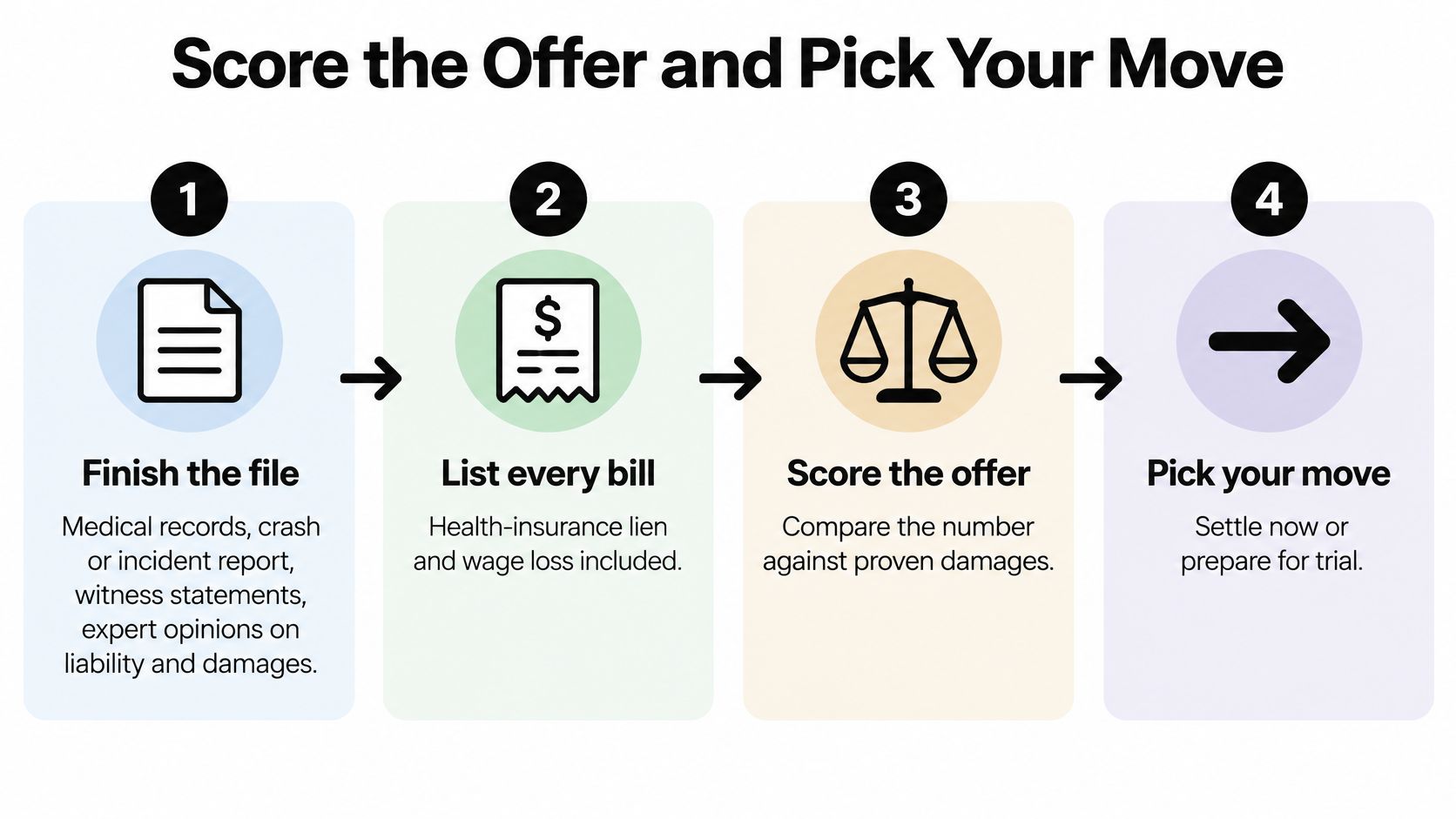
Score the Offer and Pick Your Move
A number on a page is not a decision. A decision has arithmetic in it, a deadline, and a person who has to live inside the outcome. Here is the order that keeps you from signing something you'll regret on a bad morning.
Seven Moves That Turn an Offer Into a Decision
1. Finish the file before you price it. Medical records through the most recent appointment, the crash or incident report, witness statements, and expert opinions on both liability and damages. During investigation, we collect medical records, accident reports, witness statements, and expert opinions to establish liability and damages. A file with gaps gets valued at the level of its gaps.
2. List every bill and every lien. The hospital's lien, your health insurer's reimbursement claim, the ambulance, the imaging, the specialist co-pays. Then wage loss, documented with pay stubs and tax returns rather than a verbal estimate.
3. Name everyone who can pay. The at-fault driver's policy is only the first envelope. Ask about umbrella coverage, a commercial policy if a work vehicle was involved, rideshare coverage, and any second defendant whose insurer could answer for part of the harm.
4. Convert the offer to net. Attorney fees, case costs, lien payoffs, then your monthly household needs. The gross figure is what the adjuster says out loud. The net figure is what pays rent, and only one of them should drive your answer.
5. Build a range instead of a single number. Three results: what you'd likely recover if liability holds, a lower figure if fault gets split, and zero if a jury doesn't believe the injury. If the offer beats the middle of that range after liens, you've learned something.
6. Test the personal side. Can you handle months of waiting, a deposition, and public testimony on a day when your head is pounding? Some clients can. Some discover the cost only after they've committed.
7. Pick one of three moves. Accept, counter with a dated reason and a specific figure, or prepare for trial while keeping settlement open. That third move is one many people never consider, and it's usually the strongest. Our case process runs in five stages: Investigation, Treatment, Negotiation, Trial, and Settlement. If negotiation fails, we're prepared to take the case to court.
Test the Choice Before You Sign Anything
Run your situation through four questions. If the answers split, you're not confused, you're negotiating, and that's exactly the position to be in.
| Test | Points toward settlement | Points toward trial prep |
|---|---|---|
| Medical status | Treatment stable and costs known | Future care documented but unresolved |
| Money | Net offer covers bills and needs | Net offer falls below the realistic range |
| Liability and collectability | Fault is contested or limits are small | Strong fault evidence and a defendant who can pay |
| Client tolerance | Testimony would cause serious harm | You can testify and wait |
You make the call on this. Counsel can't accept a settlement without your authority, and no lawyer should push you toward a release you don't understand. What counsel can do is make the arithmetic visible, including how to calculate a personal injury settlement down to the net figure, so the choice is yours instead of the adjuster's.
Before you sign, fill in one page: the offer, the net after fees and liens, the medical questions still open, and the outcomes you personally refuse. Bring it to your next conversation with counsel, and update it before any release or trial date.
Revisit the Choice When Injuries Are Still Changing
Tuesday was clear. You drove to the store, remembered the list without checking your phone, and came home. Wednesday you sat in the driveway for ten minutes trying to recall the drive at all. That gap is the entire problem with a fast settlement, and it's why the calendar matters as much as the money.
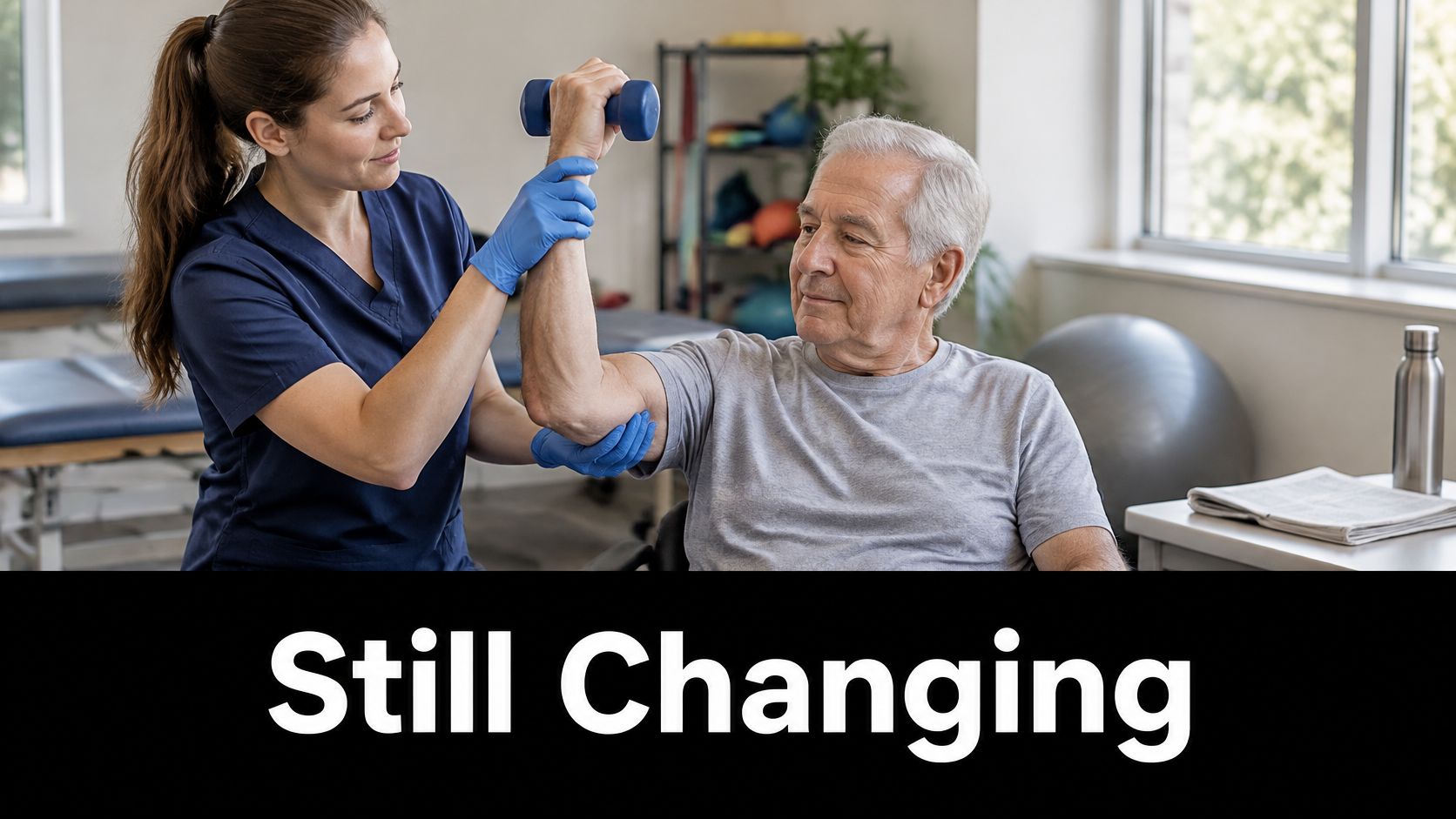
A good Tuesday and a crashed Wednesday don't mean the claim is finished or that healing reversed. A traumatic brain injury, a spinal injury with a delayed surgical recommendation, or a wrongful-death loss with a dependent's future to account for can take months to become measurable. Some of our clients keep symptom notes for Taylorsville crash patients and similar recovery logs, because a written record of the bad days is evidence a one-time exam can't produce.
The staged check. Stabilize treatment and evidence first. Then reassess damages at a defined milestone: maximum medical improvement, a return-to-work attempt, or a neuropsychologist's future-care plan. Only then compare a risk-adjusted settlement against the time, expense, and personal cost of trial. A milestone with a date on it is a strategy. "Soon" is not.
Two households, same injury, opposite answers. In the first, bills are already past due, the savings account is gone, and holding out for a headline number would cost the family their housing. In the second, symptoms are still emerging, the neurologist hasn't finished testing, and signing now would freeze an incomplete picture for the rest of a life. Same decision, different arithmetic.
A smart wait has a date on it. Stubborn waiting has a feeling.
Tools exist that meet interim needs without pretending the future is known: wage-loss documentation, negotiated lien reductions, structured payments, and a written list of open medical questions that any settlement must answer or leave reserved. Timeline data is worth reading with clear eyes here. In England and Wales, the median time from issuing a small claim to trial was 36.1 weeks in October to December 2025, even after becoming 6.4 weeks faster than the prior year, per the quarterly civil justice statistics. A faster calendar is not the same as an affordable or emotionally light one. For a realistic picture of how long a personal injury lawsuit takes in your venue, ask before you decide to hold out.
Wait when the medicine is unfinished. Don't wait only because a larger number feels possible.
Weigh Testimony Stress and Credibility
Testimony day starts earlier than anyone expects. You're in a conference room at 7:40 with coffee you don't drink, wearing clothes you bought for this, rehearsing a story you've told a hundred times to people who already believed you. Now you'll tell it to twelve strangers who don't, and to a defense lawyer who gets paid to find the seams.
That's the cost a spreadsheet skips. Trial means telling a private story in public: how the crash happened, what an ordinary Tuesday used to look like, why a good morning can still end with you in a dark room by two in the afternoon. For a client with a brain injury, the retelling itself can trigger symptoms. Preparation has to account for that, with rest breaks, a simple timeline of events, and a plan for the good-day questions, because the defense will ask how you managed to mow the lawn on Saturday.
Settlement usually stays quieter, and it can include confidentiality. For families who want the harm acknowledged without a public fight, that matters more than people admit before they've sat in a courtroom.
What Actually Hurts Credibility
Three things move results more than eloquence. Gaps in treatment, which the defense reads as recovery rather than lost insurance. Social-media posts that show you lifting a kayak two weeks after a report described you as unable to lift a gallon of milk. A client who shuts down when asked about the injury, because a jury can only weigh what it can hear.
If trial stays on the table, build three habits. Practice the story in plain words until you can tell it without notes and without shrinking. Line up the people who saw the before and after, the coworker, the coach, the sister, so the change is witnessed by someone other than you. Decide in advance which facts are worth the stress of a verdict, and which you'd rather trade for a faster, quieter ending.
Trial work is more than exhibits. Our founder, Sean, describes it as telling a client's story with courage, restoring balance when the odds feel unequal, and making sure the people whose lives have been changed are seen, heard, and taken seriously.
If telling the story would do more harm than the extra money is worth, settlement deserves a harder look.
You don't have to figure out the settlement or trial question alone on a Friday deadline. Nares Law Group LLC investigates the crash, coordinates treatment, and negotiates with carriers while preparing the case for court if the offer stays thin, and a free consultation is where that arithmetic gets done with you instead of about you. With free settlement estimators for motor vehicle, truck, and brain injury cases, and a team led by a trial attorney who takes cases to verdict when negotiation stalls, the firm gives injured families a clear answer to whether to settle or go to trial. Visit Nares Law Group LLC to start that conversation before you sign anything.