Years after a crash, fall, or blow to the head, life can start to feel unfamiliar in small but unsettling ways. You forget appointments you would have never missed. Noise feels harsher. Headaches linger. Your patience is shorter, your focus slips, and the people around you may notice changes before you do.
That experience can be very confusing, especially if the emergency room visit was brief, the scan looked normal, or nobody ever used the words “brain injury.” Many people start by blaming stress, aging, burnout, or lack of sleep. Sometimes those factors are present. Sometimes they're not the full story.
A traumatic brain injury can be a hidden injury. Its effects don't always announce themselves clearly at the beginning, and some people don't get meaningful answers until much later. If you're trying to make sense of symptoms that seem disconnected from an old accident, diagnosing TBI years later may still be possible. Just as important, a late diagnosis can help you pursue treatment, document what happened, and understand whether legal action is still available.
The Unsettling Feeling That Something Is Wrong
Maybe your accident happened so long ago that you barely mention it anymore.
You were rear-ended at a stoplight. You slipped on ice. You hit your head in a work incident. You went home sore, tired, and shaken, but everyone expected you to recover. Maybe you expected that too. Then the years passed, and now your days feel harder than they should.
You might notice memory problems first. You lose track of conversations. You reread emails because the first pass doesn't stick. You walk into a room and forget why you went there. For older adults, those changes can look similar to broader cognitive issues, which is why resources explaining signs of memory loss in seniors can help families think more carefully about what's changing and when it began.
Other people notice mood changes. They say you're more irritable, more withdrawn, less organized, or not quite yourself. You may start questioning your own judgment because the symptoms don't fit the story you were told at the time of the accident.
You are not imagining a pattern just because it took time to recognize it.
That delay is part of what makes brain injuries so difficult. A hidden brain injury can sit in the background while you push through work, parenting, and daily life. Then one day the compensation stops working as well. The symptoms become harder to dismiss.
Late diagnosis can feel validating and painful at the same time. It can confirm that your struggles are real, but it can also raise new questions. What exactly happened? Why didn't anyone catch it sooner? Can you still prove the connection? Can you still get help?
Those questions have answers, but they usually require both medical clarity and legal strategy.
Why TBI Symptoms Can Surface Years Later
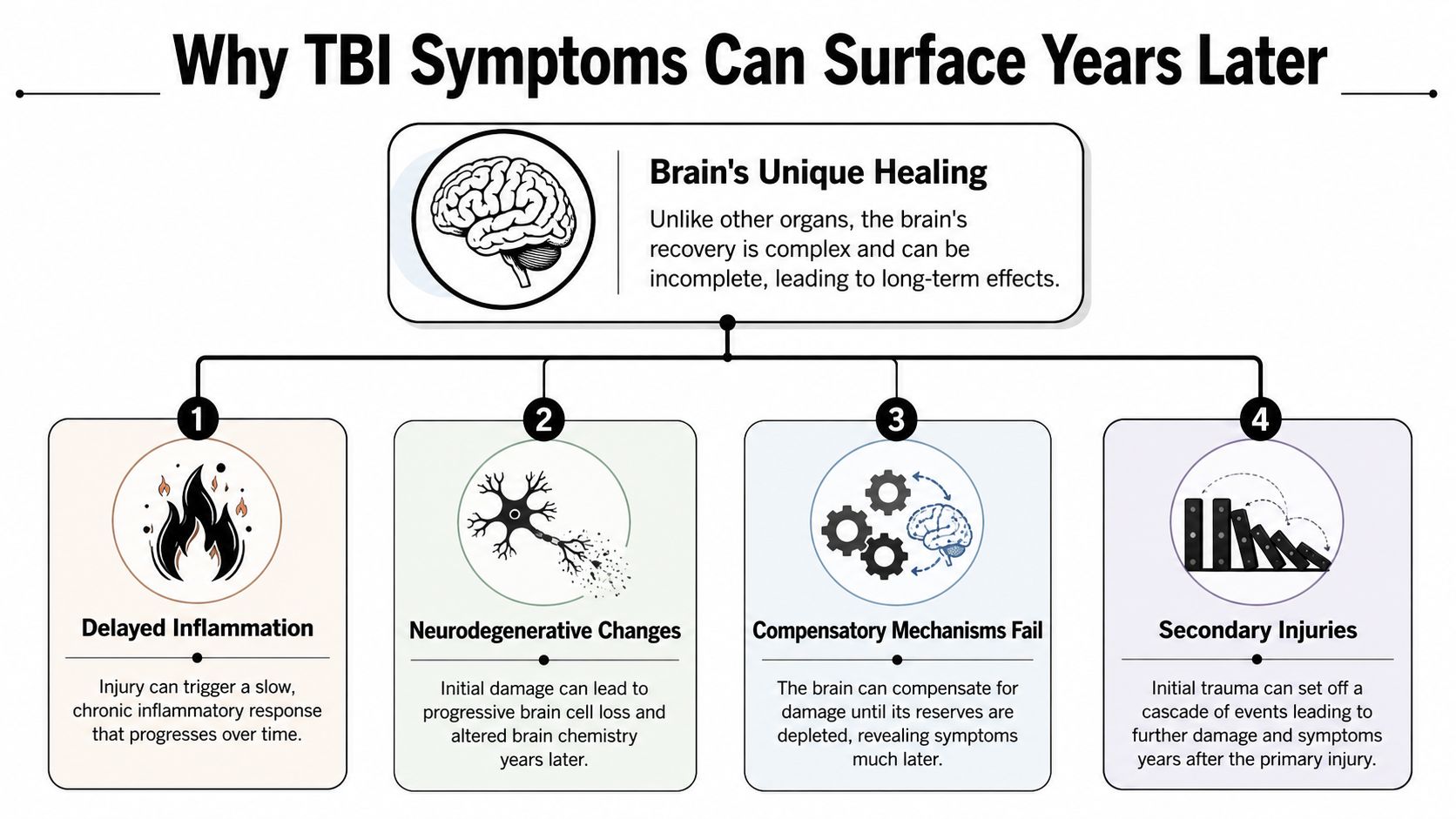
The brain doesn't heal the way a broken bone heals. You can't put it in a cast, confirm full repair on a routine scan, and move on with confidence. Brain recovery is more complicated, and for some people the effects keep unfolding over time.
Research shows that approximately 15% to 30% of people with a mild traumatic brain injury continue to experience symptoms long after the injury, and TBI is increasingly described as a chronic health condition rather than a single acute event according to this review of long-term outcomes after mild traumatic brain injury.
Symptoms often show up in clusters
When people think about brain injury, they often picture dramatic symptoms right away. In reality, delayed or persistent symptoms often appear across several areas of life at once.
| Symptom area | What it can look like in daily life |
|---|---|
| Cognitive | Brain fog, forgetfulness, trouble concentrating, slower thinking, difficulty planning |
| Emotional | Irritability, anxiety, low mood, sudden frustration, feeling overwhelmed |
| Physical | Headaches, dizziness, fatigue, sleep disruption, sensitivity to busy environments |
That combination matters. A person may think, “I'm just stressed,” because they're irritable. Or, “I'm just getting older,” because they're forgetful. But when cognitive, emotional, and physical symptoms travel together, brain injury becomes a more important possibility.
Why symptoms can get worse later
Several things can make an older injury more visible.
Sometimes the brain has been compensating for a long time, using other pathways to keep you functioning. That can work for a while. Then stress, illness, aging, another minor injury, or heavier life demands can expose the limits of that compensation.
A simple example helps. A person may manage a demanding job for years after a crash, but only by working much harder mentally than before. When family responsibilities increase or sleep gets worse, the extra effort becomes unsustainable. The person isn't becoming lazy or careless. Their brain is struggling to keep up with tasks that once felt automatic.
Practical rule: If your symptoms worsen with mental effort, busy environments, or multitasking, that pattern deserves a serious medical discussion.
Why this feels so personal
Many people blame themselves before they consider a neurological cause. They think they've become disorganized, emotional, or less resilient. That misunderstanding adds shame to an already difficult situation.
Persistent TBI symptoms are not a character flaw. They can reflect changes in how the brain processes information, regulates emotion, and handles stimulation. That's why diagnosing TBI years later often starts with relief. At last, there may be a framework that fits what you've been living through.
The Modern Diagnostic Toolkit for Unseen Injuries
One of the hardest moments for patients comes early. They seek help, get a CT scan or standard MRI, and hear that everything looks normal. After that, many stop pursuing answers because they assume a “normal” scan means there couldn't have been a real brain injury.
That assumption is often wrong.
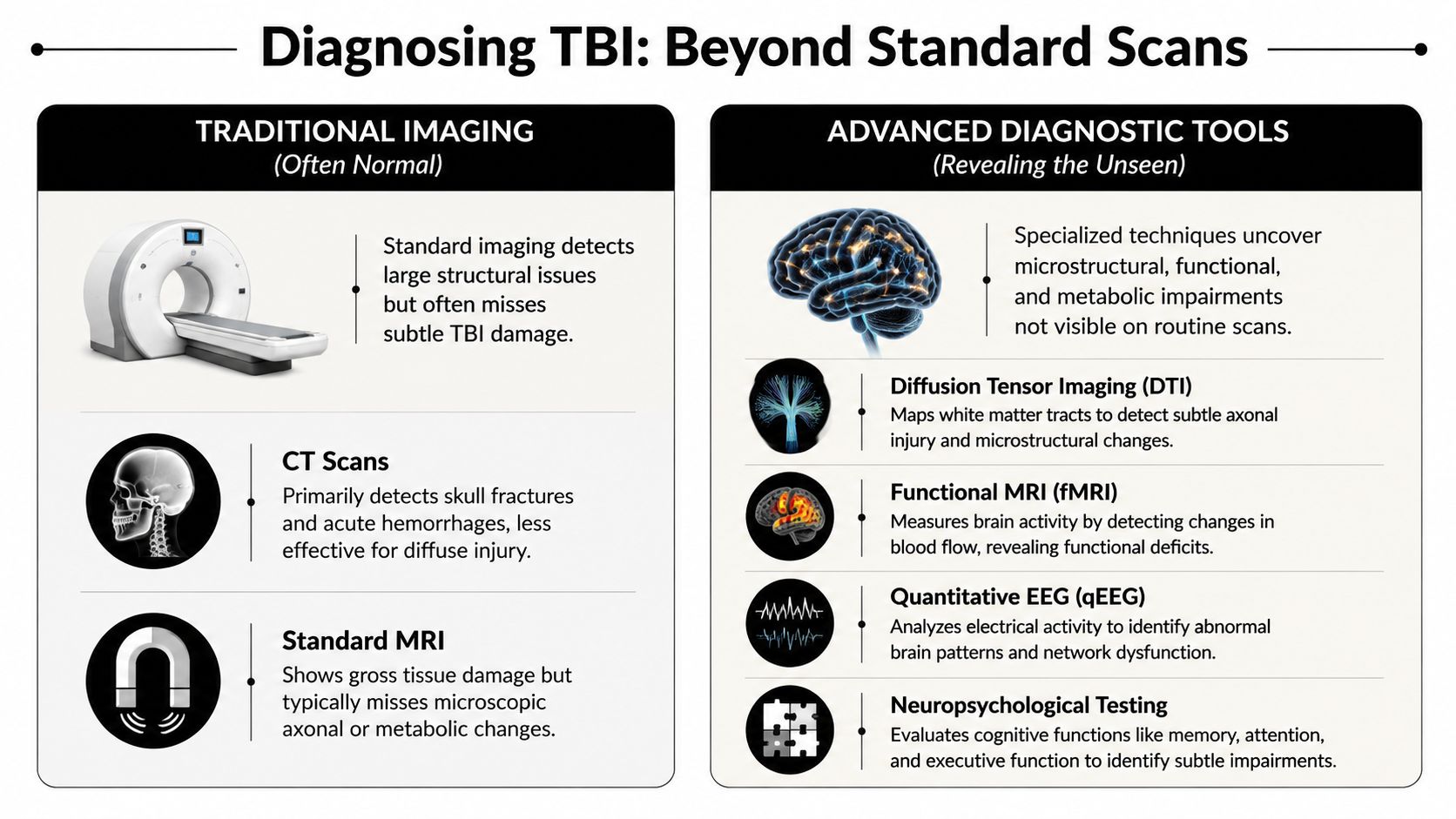
Standard structural imaging can miss chronic mild TBI because it is built to identify large structural problems, not subtle functional or microscopic injury patterns. In chronic cases, late-stage diagnosis increasingly relies on functional MRI and Diffusion Tensor Imaging used alongside multidimensional clinical assessment, as explained in this overview of traumatic brain injury diagnosis methods.
Why routine scans can miss the problem
A CT scan is excellent for urgent questions like bleeding or skull fracture. A conventional MRI can show major structural abnormalities. But many long-term post-concussion problems involve disruptions that are smaller, more diffuse, or more functional than those tools are designed to capture.
That's why patients often feel dismissed. Their symptoms are real, but the first-line tests may not explain them.
A more complete workup may include a detailed neurological exam, symptom history, neuropsychological testing, and advanced testing selected for the person's presentation. If you want a plain-language overview of tools doctors may use, this page on neurological tests for brain damage helps translate unfamiliar testing terms.
What advanced tools actually do
Here's a simpler way to think about the newer toolkit.
- Diffusion Tensor Imaging looks at white matter pathways. Those pathways act like communication routes between brain regions. DTI can help reveal disruption in those routes that standard imaging may miss.
- Functional MRI looks at blood flow changes tied to brain activity during tasks. It can help identify functional problems, including issues connected to how the brain supports thinking and attention.
- Blood-based biomarkers add another layer. The newer diagnostic framework described below uses blood markers to support retrospective diagnosis when imaging alone doesn't tell the full story.
The 2024 four-pillar framework of Clinical Assessment, Blood-Based Biomarkers, Imaging, and Modifiers supports retrospective TBI diagnosis, including the use of GFAP and tau proteins in blood samples, according to this discussion of evolving brain injury diagnosis.
What doctors are looking for in a late diagnosis
A late evaluation usually isn't about one magic test. It's about correlation.
Doctors are trying to answer questions like these:
- Is the symptom pattern consistent with prior brain injury?
- Do cognitive findings line up with the person's history and functioning changes?
- Do advanced tools provide objective support for that pattern?
- Are there other explanations that need to be ruled in or ruled out?
A strong diagnosis often comes from the pattern across history, testing, and objective findings, not from a single image.
That matters medically and legally. If you're diagnosing TBI years later, the quality of the overall record is often more persuasive than any one document by itself.
Connecting the Dots From Past Accident to Present Symptoms
The medical diagnosis is only part of the challenge. You also need a coherent story that links the earlier event to what you're living with now.
That story isn't guesswork. It's built from records, timelines, and observations.

Start with the event, not the diagnosis
Begin with the accident itself. Write down the date, location, what happened, whether you struck your head, whether your body whipped or rotated, and what symptoms followed. Even details that seem minor can matter later.
In legal and medical settings, the mechanics of how the injury happened can shape how experts analyze the case. If you're unfamiliar with that concept, a plain-English explanation of the mechanism of injury can make those discussions easier to follow.
A timeline often includes more than one turning point. Maybe the crash happened years ago, but your performance at work changed a few months later. Maybe your headaches became constant after a stressful period. Maybe your spouse noticed you became less patient long before you realized it yourself.
Build a record that shows change over time
A useful timeline usually draws from several sources at once.
- Early medical records: Emergency room notes, urgent care visits, primary care notes, and any mention of headache, dizziness, confusion, or neck pain.
- Follow-up care: Therapy records, neurology visits, mental health treatment, vision complaints, sleep complaints, or rehabilitation referrals.
- Work and school changes: Performance reviews, missed deadlines, accommodations, disciplinary issues, reduced workload, or withdrawal from training.
- Daily life evidence: Calendars, journals, text messages, emails, and notes showing symptom flares or functional decline.
- Outside observations: Statements from family, friends, and coworkers who saw changes in memory, mood, stamina, or personality.
Many cases achieve greater clarity through careful record management. A person may have only scattered records, but when those records are placed in sequence, the pattern sharpens.
Here is a helpful overview of how clinicians and lawyers think through delayed brain injury issues:
Why witness statements matter
Family members often become the missing link in delayed diagnosis cases.
A spouse may describe how you started forgetting conversations. A coworker may explain that you used to manage multiple projects with ease and now struggle to organize one. A close friend may recall headaches, withdrawal, or emotional changes after the accident that never fully resolved.
The best witness statement doesn't sound dramatic. It sounds specific.
Experts can then compare those observations with the medical picture. That's especially important because standard CT and conventional MRI often fail to detect chronic mild TBI, while later diagnosis may rely on advanced imaging and multidimensional assessment, as noted in the diagnostic source linked earlier.
Overcoming the Hurdles of a Delayed Diagnosis
Delayed diagnosis cases often face skepticism from several directions at once. A doctor may focus on anxiety. An insurer may point to aging. Defense lawyers may argue that work stress, family stress, or a later health condition is the true cause.
Those challenges are common. They are not the end of the case.
The scale of the issue also matters. The United States has an estimated 5.3 million people living with a disability related to traumatic brain injury, and motor vehicle crashes account for 50% of all TBIs, according to the University of Utah Health article on whether traumatic brain injury symptoms can appear years later.
The most common objections
A delayed TBI claim often runs into a familiar set of arguments.
- “It's just aging.” Aging can affect memory and stamina, but experts look at timing, pattern, and whether the decline fits the person's history after the accident.
- “It's depression or anxiety.” Mood disorders can overlap with brain injury symptoms. The real question is whether they fully explain the cognitive, emotional, and physical picture.
- “The scan was normal.” That can be misleading in chronic mild TBI, especially when routine imaging wasn't designed to capture the injury pattern.
- “If it were serious, someone would have found it earlier.” Unfortunately, brain injuries are often missed, minimized, or treated as short-term problems.
What helps separate TBI from other explanations
A careful team looks for distinctions, not shortcuts.
They compare pre-injury and post-injury function. They examine whether symptoms appeared in multiple domains. They review whether the person was stable before the event, then different afterward. They also look for consistency across medical records, work history, and witness observations.
Sometimes there are multiple contributing factors. That doesn't automatically erase the role of a brain injury. A prior trauma can still be a substantial part of the current problem even when life has layered on additional stressors.
When someone says “it could be many things,” the right response isn't to stop. It's to investigate carefully enough to sort those things apart.
You may need second opinions
Some clinicians understand chronic TBI well. Others still think in terms of a short recovery window and may dismiss long-term symptoms too quickly.
If your concerns were brushed aside once, that doesn't mean they were medically unsound. It may mean you need a provider who is more familiar with persistent and delayed brain injury presentation. That can change the entire course of both treatment and documentation.
Understanding the Legal Implications of Your Diagnosis
A late diagnosis doesn't only affect healthcare. It can change how a legal case is evaluated, especially when the central issue is not whether an accident happened, but whether that accident caused long-term harm that wasn't recognized until much later.
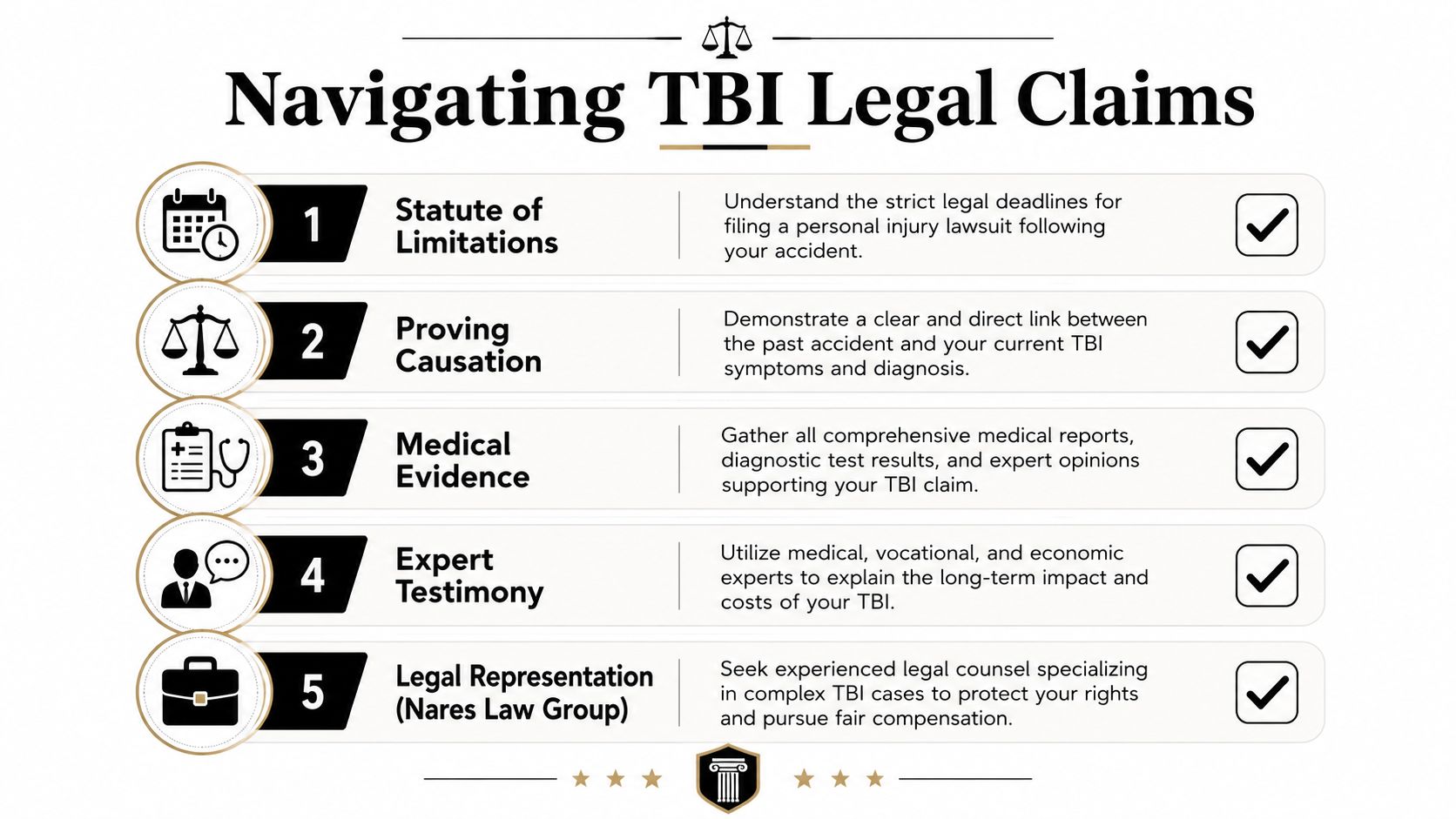
In many personal injury cases, legal deadlines matter immediately. Statutes of limitation can restrict how long a person has to bring a claim. But delayed injury cases raise a harder question. When should the clock start if the injury was not reasonably discoverable until later? That is where the discovery rule may become relevant, depending on the facts and the law that applies.
Because these issues can be technical, people benefit from seeing how medico-legal experts approach complex causation questions in other fields too. This guide for autism ADHD mental health cases is useful not because it covers TBI specifically, but because it shows how expert evidence can bridge medicine and law when symptoms and timelines are disputed.
Why acting quickly still matters
Even if a delayed diagnosis may open legal questions, waiting rarely helps.
Records get harder to find. Witness memories fade. Insurance carriers build their own narratives early. Once you suspect a connection between an old accident and current symptoms, it makes sense to preserve documents, gather names, and get legal advice before avoidable gaps develop.
One issue that often arises is the defense medical exam. If your case reaches that stage, understanding what an independent medical examination is, and what it is not, can help you prepare more confidently.
What a strong legal case needs
In a delayed TBI case, lawyers usually need to prove more than injury alone.
They need evidence that ties together:
- The original event
- The mechanism of injury
- The symptom timeline
- The medical explanation for delayed recognition
- Actual consequences on work, relationships, and daily life
That often means working with neurologists, neuropsychologists, and other specialists who can explain why a “normal” early scan didn't end the inquiry.
Future care can matter even years later
Late diagnosis cases also raise damages issues. If rehabilitation, monitoring, or support remains necessary, those future needs can be significant. That's one reason the science of long-term recovery matters in court.
Recent understanding of neuroplasticity supports that meaningful improvement can still be possible 10, 20, or 30+ years after injury through targeted rehabilitation, which can be important when evaluating future care needs, as discussed in this article on long-term effects and treatment after traumatic brain injury.
A legal claim isn't just about proving you were hurt. It's about showing what the injury has cost you, and what support you may still need going forward.
Your Path Forward A Practical Checklist
When people finally begin diagnosing TBI years later, the process can feel overwhelming. It helps to narrow the next steps to a short list you can complete.
Start here:
- Begin a symptom journal today. Write down headaches, fatigue, memory issues, dizziness, sleep problems, mood changes, and what seems to trigger them. Specific examples matter more than general statements.
- Request old records. Ask for crash reports, emergency room records, urgent care notes, physical therapy records, and any follow-up treatment after the accident.
- Create a timeline. Include the accident, early symptoms, work changes, relationship strain, missed tasks, and any major symptom shifts over time.
- Ask for specialist evaluation. A neurologist, brain injury specialist, or neuropsychologist may help frame the problem more accurately than a routine visit alone.
- Talk to the people who knew you before and after. Their observations may help identify changes you've normalized.
- Be careful with insurance communications. Don't guess, minimize, or casually explain away long-term symptoms before you understand the medical picture.
- Get legal advice early. A delayed diagnosis can create complicated questions about deadlines, causation, and evidence preservation.
Keep copies of everything. Records that seem minor today may become central later.
You don't need to solve the entire case in one week. You need to start building a reliable record. That record can support treatment, protect your credibility, and give you a clearer basis for deciding what to do next.
If you've been told nothing is wrong, but you know something changed after an old accident, trust that instinct enough to investigate it carefully.
If you're dealing with unexplained symptoms after a crash or head injury and need guidance on both the medical and legal side, Nares Law Group LLC can help you understand your options. Their team works with injured people and families facing complex brain injury questions, including cases where the diagnosis came much later than anyone expected. A consultation can help you protect evidence, avoid common insurance mistakes, and take the next step toward answers, care, and accountability.