You may be reading this after a crash, while juggling doctor visits, car repairs, missed work, and an insurance company that keeps asking for documents. Then a new term shows up in your case: discovery. It sounds technical, expensive, and a little threatening.
Most clients don't need a law school definition. They need to know what discovery means for their life, their case, and the stress they're already carrying. They want to know what they have to do, what the other side has to turn over, and whether this process will help uncover the truth.
If you've searched what is discovery in litigation, you've probably seen neat summaries that make it sound automatic and uniform. Real cases aren't that tidy. Discovery is a formal evidence-gathering process, but in many state court cases, especially smaller personal injury claims, access to that process can be more limited than people expect. That's one reason experienced legal guidance matters so much.
The Fact-Finding Mission What Discovery Means for Your Case
When people ask what discovery is in litigation, I usually start with a simple image. Your case is a puzzle, but the pieces are scattered across different places. Some are in your hands, like photos, medical records, and text messages. Some are in the other driver's hands. Some are with the insurance company, the trucking company, a business, or a witness who saw what happened.
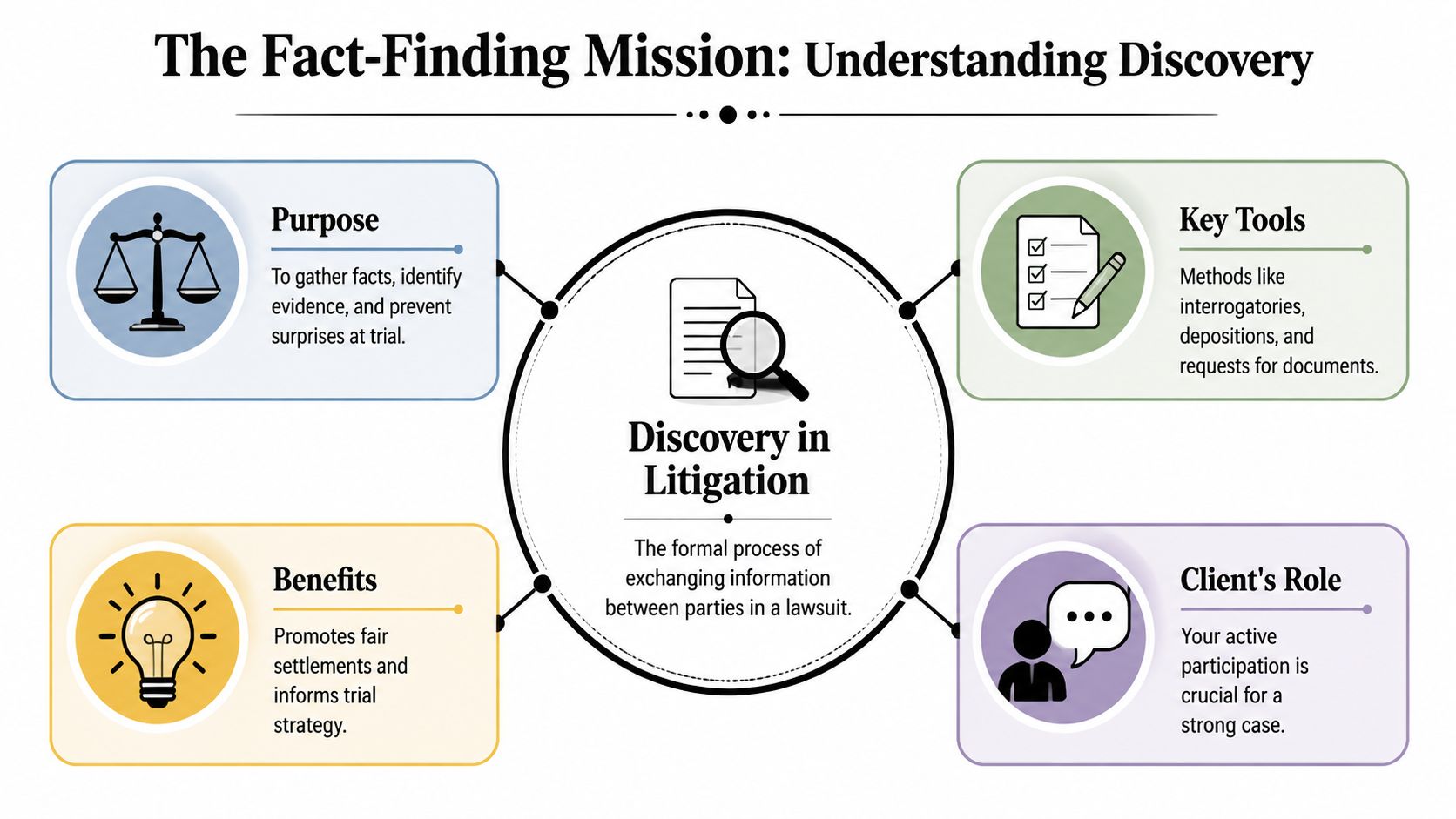
Discovery is the formal pre-trial process of finding and exchanging those puzzle pieces. In civil litigation, it's governed by procedural rules and allows parties to seek information about any unprivileged matter relevant to a claim or defense, according to this explanation of discovery in civil litigation.
Why discovery exists
Without discovery, a lawsuit would feel like walking into a room blindfolded. You'd have no reliable way to learn what documents the other side has, what a witness plans to say, or which defenses the insurance company intends to raise.
That's why lawyers often describe discovery as the safeguard against “trial by ambush.” Each side gets a chance to investigate before anyone steps into a courtroom. In a car wreck case, that might mean locating crash photos, obtaining repair records, identifying eyewitnesses, and pinning down the defense version of events while witnesses are still under oath.
Practical rule: Discovery isn't about curiosity. It's about getting the information needed to prove what happened, show the full harm, and make informed decisions about settlement or trial.
What discovery feels like from the client side
For clients, discovery often feels repetitive. You may be asked for records you already shared. You may need to answer written questions in detail. You may sit for a deposition and retell painful events carefully, one fact at a time.
That can feel invasive. It's also normal.
A strong discovery process gives your lawyer the raw material to build your case. If you suffered a traumatic brain injury, for example, discovery can help show changes that don't appear on a simple bill or scan. If you lost a loved one, discovery may reveal safety failures, company policies, or inconsistent statements that matter deeply to accountability.
The core idea to hold onto
Discovery is not punishment. It's not a sign that your case is going badly. It's the part of the lawsuit where both sides test facts, preserve evidence, and figure out what can be proven.
When handled well, discovery does two things at once. It prepares your case for trial, and it often creates the clarity needed for meaningful settlement talks.
The Legal Toolkit A Guide to Discovery Methods
Discovery isn't one single event. It's a set of tools, and each one does a different job. In personal injury cases, the goal is to match the tool to the problem. If you need a timeline, one tool helps. If you need documents, another does the work. If you need to hear a witness answer under oath, there's a different tool for that.
Interrogatories and document requests
Interrogatories are written questions that the other side must answer under oath. They usually target basic but important information. Who was driving? What defenses are being claimed? What doctors has the person seen? What witnesses do they know about?
Requests for production ask for documents and electronically stored information. In an accident case, that can include photographs, phone records if relevant, company policies, vehicle maintenance records, medical records, or communications about the crash.
If your case involves a large volume of records, tools that help organize and search them can make review more manageable. For example, lawyers and legal teams sometimes use resources like Markdown Converters' discovery search to sort through document-heavy discovery sets more efficiently.
Depositions and requests for admission
A deposition is a formal question-and-answer session under oath, usually recorded by a court reporter, during which your lawyer can question the at-fault driver, a company representative, a witness, or a treating provider. If you want a fuller picture of that process, this guide on what a deposition is in a lawsuit explains how it works in practical terms.
Requests for admission are narrower. They ask the other side to admit or deny specific facts. That sounds small, but it can be powerful. If the defense admits a driver owned the vehicle, was on the clock, or received a certain document, those points may no longer need to be fought over later.
A good discovery plan doesn't ask for everything. It asks for the right things, in the right order.
Common Discovery Tools at a Glance
| Tool | What It Is | Purpose | Example in a Car Wreck Case |
|---|---|---|---|
| Interrogatories | Written questions answered under oath | Learn basic facts, positions, and witnesses | Ask the driver to identify where they were going and what they claim happened |
| Requests for Production | Formal requests for documents or electronic records | Obtain evidence that supports or challenges a claim | Ask for photos of vehicle damage, repair estimates, or company safety records |
| Depositions | Live sworn testimony before trial | Test credibility, lock in testimony, explore details | Question the driver about speed, distraction, or fatigue |
| Requests for Admission | Statements the other side must admit or deny | Narrow disputes and establish uncontested facts | Ask the defense to admit the crash happened on a certain date and location |
Why these tools matter together
Each tool fills a different gap. Interrogatories sketch the outline. Document requests supply the paper trail. Depositions expose detail, memory, and credibility. Admissions narrow what's left to argue about.
That's why discovery often moves in layers. A lawyer may start with documents, use those documents in a deposition, and then send admissions based on what the witness said under oath. Done carefully, the process turns a confusing accident story into a provable case.
The Rules of the Road Scope Limits and Common Disputes
People often assume discovery means both sides must open every file and reveal every thought. That isn't how it works. Discovery is broad, but it has boundaries, and some of the most important fights in litigation happen at those boundaries.
What counts as fair game
In civil cases, the rules generally allow parties to seek relevant, unprivileged information tied to claims or defenses. The process is planned early through a discovery conference and case schedule under the Federal Rules of Civil Procedure, as summarized in Wikipedia's overview of discovery law).
That broad scope helps lawyers investigate what happened. But “broad” doesn't mean unlimited. A request can still be challenged if it goes too far, asks for irrelevant material, or would create an unfair burden.
Privilege and work product
Two limits confuse clients more than almost anything else.
The first is attorney-client privilege. Private communications between lawyer and client made for legal advice are generally protected. The second is often called work product. That covers certain materials prepared in anticipation of litigation, including legal strategy and mental impressions.
In practical terms, that means you usually can't force the defense to hand over the lawyer's private notes, internal case theories, or protected draft work. That can feel unfair, especially when you're trying to understand why the insurer is taking a position that doesn't make sense. But those protections are built into litigation.
Some of the most important information in a case is discoverable. Some of the most strategic thinking is not.
Expert-related discovery can also frustrate people. You may get final opinions and reports that must be disclosed under the rules that apply to your case, but protected draft materials and internal strategy discussions may remain off limits. That's one reason experienced lawyers spend so much time testing the foundation of an expert's opinions through deposition and document review.
The objections you'll hear
Insurance defense lawyers don't just say “no.” They usually object in a specific legal form. Common objections include claims that a request is overly broad, irrelevant, vague, or unduly burdensome. If you want a plain-language list of phrases lawyers use in court and in written disputes, this guide can help you understand common objections.
When lawyers disagree about discovery, they usually try to resolve it first by conferring. If that fails, one side may ask the court to compel a response or to limit the request. Those motions matter because discovery fights can shape what evidence is available later.
A Colorado-specific concern
In Colorado state court practice, the exact scope and pacing of discovery can depend heavily on the type of case, the amount at issue, and the procedural track. That's where strategy matters. A lawyer has to know when to push for records, when to notice a deposition, when to ask the court for help, and when to focus on preserving evidence before it disappears. Spoliation issues can become central very quickly, especially in vehicle and trucking cases, which is why understanding what spoliation of evidence means can be so important.
The State Court Reality Why Discovery Is Not Always Guaranteed
Most online explanations of discovery describe the full toolbox as if every injured person can automatically use it. That's the part many people don't learn until they're already in a lawsuit.
A Columbia Law Review study highlighted a stark problem: discovery may be functionally absent in 98% of state court cases, a gap that can hurt lay plaintiffs who don't have the legal knowledge or resources to force evidence gathering, as discussed in this summary of the Columbia Law Review issue.
Why that matters in injury cases
If you're a person with a concussion, a spinal injury, or a grieving family after a wrongful death, you may assume the court will require everyone to hand over the truth. In many state court settings, it doesn't happen that neatly.
Some cases move on compressed tracks. Some courts limit formal discovery. Some disputes involve defense lawyers who know exactly how to resist broad requests and delay meaningful disclosures. The result is that a right people assume they have may feel thin in practice.
What an experienced attorney actually does
At this juncture, legal representation stops being paperwork and becomes advocacy. Your lawyer may need to identify the most important records early, send preservation demands, narrow requests so the court is more likely to enforce them, and choose depositions carefully because every step has to count.
That's especially important in Colorado cases. If discovery is limited, every request has to earn its place. A seasoned attorney doesn't treat discovery like a form packet. They treat it like a pressure point. Which witness matters most? Which document could shift fault, causation, or damages? Which issue needs court intervention now, not later?
Discovery can be a formal right on paper and still require a fight in real life.
That reality doesn't mean your case is hopeless. It means your case needs a plan. When discovery isn't automatic, strategy matters more, not less.
Your Role in Discovery Practical Tips for Accident Clients
Clients sometimes think discovery is something lawyers do behind closed doors. In reality, your participation can change the quality of the case. You don't need legal training, but you do need to be careful, organized, and honest.

Protect evidence before it disappears
The first job is preservation. Many damaging mistakes happen before formal discovery even starts.
- Save what you already have. Keep photos, video, dashcam footage, medical paperwork, receipts, and repair estimates in one place.
- Don't delete messages. Texts with family, witnesses, employers, or insurance representatives may later matter.
- Be careful on social media. Even harmless-looking posts can be pulled into the case if they seem to contradict your injuries or activities.
- Flag new evidence quickly. If you find a witness, a new bill, or an old photo you forgot about, send it to your lawyer promptly.
Help with written responses
Written discovery takes time because accuracy matters. If the defense sends interrogatories or document requests, your lawyer will help you answer, but the facts still have to come from you.
A few habits make this easier:
- Read slowly. Legal questions are often broader than they look.
- Answer truthfully. Never guess to fill silence.
- Tell your lawyer when you're unsure. Uncertainty can often be clarified with records.
- Be complete, not dramatic. Discovery responses should be accurate and steady, not emotional speeches.
Clients often worry that a forgotten detail will destroy the case. Usually, the larger risk is trying too hard to sound certain when you aren't. Honest limits on memory are far better than an overconfident answer that later changes.
Prepare for your deposition
A deposition is often the most stressful part of discovery for an injured person. You'll sit in a room, swear to tell the truth, and answer questions from the defense lawyer. That sounds intimidating because it is formal. But it's manageable with preparation.
What to remember in a deposition: Tell the truth. Answer only the question asked. Don't volunteer extra details. If you don't know or don't remember, say so.
A few practical reminders help:
- Pause before answering. That gives your lawyer time to object if needed and gives you time to think.
- Keep answers focused. Short, truthful answers are usually safer than long explanations.
- Ask for clarification. If a question is confusing, say that it's confusing.
- Stay calm with difficult questions. Defense lawyers may ask the same topic in different ways. That doesn't mean you're failing.
- Speak from your own experience. Don't speculate about medicine, engineering, or another driver's motives.
Stay engaged in the process
You don't need to micromanage your case. You do need to remain reachable, review drafts carefully, and tell your lawyer when your treatment, symptoms, or work status changes.
Nares Law Group LLC offers practical client education on topics like discovery and truck wreck litigation. In any firm you choose, what matters is whether the legal team gives you clear preparation, realistic expectations, and prompt guidance when discovery requests arrive.
How Discovery Shapes Your Case From Settlement to Trial
Discovery alters the balance of power. Before discovery, each side tells a story. After discovery, those stories get tested against documents, sworn testimony, and hard records.
That shift matters in settlement negotiations. A claim that once looked debatable may look much stronger after a witness admits key facts under oath or a document reveals a safety failure. On the other side, discovery can also expose weak points that need to be addressed candidly before trial.
Why evidence moves cases
In a truck wreck case, one record can reshape the entire dispute. A logbook inconsistency, a company communication, a training gap, or a sworn answer that conflicts with earlier statements can make settlement talks much more serious.
That's one reason lawyers build discovery carefully. The goal isn't to collect paper for its own sake. The goal is to uncover facts that change value, pressure, and credibility.
If you want a closer look at how this phase fits into a personal injury claim, this guide to the discovery stage of a personal injury case gives a useful overview.
Why cost also affects strategy
Discovery is often the most expensive phase of litigation. Median discovery costs can be around $15,000 to $20,000, and in complex cases, expenses such as expert witnesses at $5,000 to $50,000 or more and deposition transcripts at $600 to $3,200 per day can push total discovery costs beyond $200,000, according to the ACS discussion of litigation costs.
Those numbers matter for clients, but they also matter for defendants and insurers. Litigation isn't just about legal risk. It's also about the cost of continuing the fight. Once discovery shows real exposure, some defendants become more willing to resolve a case rather than pay for more experts, more depositions, and more motion practice.
If the case doesn't settle
Not every case resolves in negotiation. When that happens, discovery becomes the foundation of trial.
Documents become exhibits. Deposition testimony can be used to challenge changing stories. Admissions narrow the issues for the jury. Expert opinions are tested against the record. The jury doesn't just hear that something bad happened. They see how the facts fit together.
A strong trial presentation usually begins months earlier in discovery, when the evidence is preserved, organized, and pinned down under oath.
For injured clients, that's the essence of what discovery in litigation means. It means the case stops living at the level of accusation and starts living at the level of proof. And proof is what drives accountability, whether the result is a fair settlement or a verdict.
If you're dealing with a Colorado accident case and need help understanding how discovery may affect the evidence, timeline, and pressure points in your claim, Nares Law Group LLC can help you evaluate the process in plain language and protect your case from the start.