If you're reading this after a crash in Boulder, you're probably not calmly researching legal theory. You're trying to figure out why your neck hurts more today than it did yesterday, whether you should call the insurance adjuster back, how to get your car fixed, and what happens if you miss work again this week.
That fog is normal. After an accident, people often feel pulled in five directions at once. One doctor tells you to rest. An insurer wants a statement. Your phone keeps buzzing. Bills start arriving before you've even had time to understand what happened.
A good personal injury lawyer in Boulder, Colorado doesn't just file paperwork. The right lawyer helps you regain control. That starts with knowing what to do first, when legal help matters, how to choose the right advocate, and which Colorado rules can wreck a valid claim if you ignore them.
The Aftermath of an Accident Your First Few Days
The first few days after an accident rarely feel organized. They feel fractured.
You may remember the sound of metal, the shock afterward, and then a blur of practical problems. Maybe you were hit at an intersection and thought you were fine, only to wake up the next morning with a pounding headache and a stiff back. Maybe you were riding a bike, got knocked down, and now you're dealing with road rash, a damaged bike, and questions about who had the right of way. Maybe you slipped on a property and felt embarrassed before you felt pain.
That sequence matters because people often make important decisions while they're still in survival mode. They say "I'm okay" before they know if they're okay. They give recorded statements before they understand their injuries. They accept quick reassurance from an insurance company because they want one problem off their plate.
Practical rule: In the first few days, your job is to protect your health and preserve a clear record of what happened.
Start there. Get evaluated if you haven't already. Follow the treatment plan you were given. Keep every document, every discharge instruction, every estimate, every message from an insurer. If your symptoms change, note when they changed. If you're missing work, write that down too.
What helps in the first stretch
- Medical follow-up: Go to the appointments you need, even if you're hoping the pain will just fade.
- Basic documentation: Save photos, names of witnesses, the police report number, and insurance claim information.
- Simple daily notes: A few lines each day about pain, sleep, mobility, and missed activities can become important later.
- Slowing down before signing: Fast paperwork often benefits someone else more than it benefits you.
What doesn't help is trying to handle everything at once. You don't need to master the legal system in one night. You need a clear next step, then another one after that.
When to Call a Lawyer After a Boulder Accident
Not every accident needs a lawyer. A minor property-damage-only incident with no injury and no fault dispute may not justify legal representation.
But many people wait too long in cases that are already moving against them.
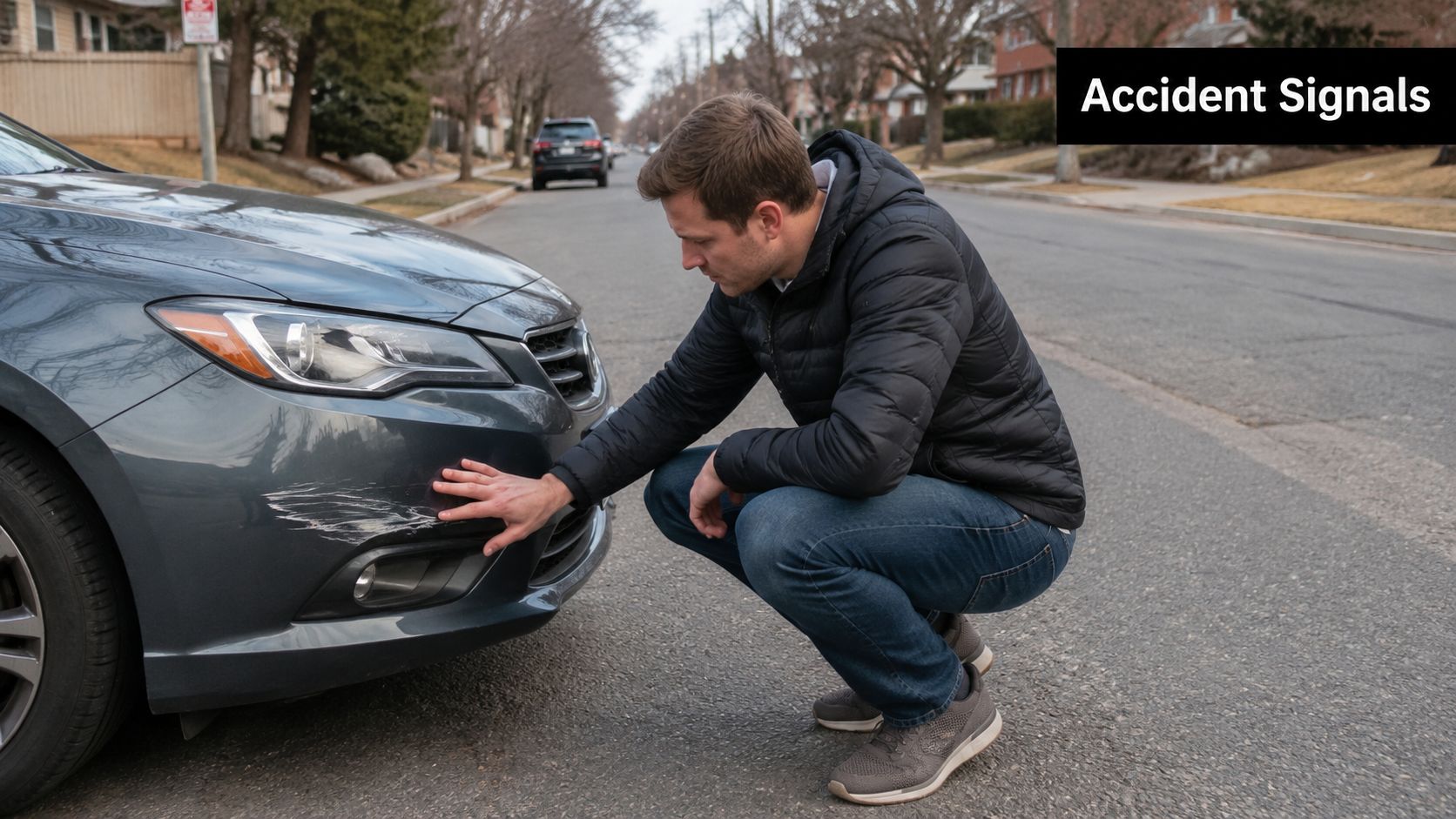
Clear signs it's time to call
If any of these are true, call a lawyer early:
- Fault is disputed: If the other driver says you caused the crash, or the story keeps changing, you need someone gathering evidence before it disappears.
- Your symptoms worsened later: Concussions, back injuries, and soft tissue injuries don't always announce themselves at the scene.
- You were hit as a cyclist, pedestrian, or scooter rider: These cases often turn on visibility, lane position, timing, and who had the right of way.
- There were multiple vehicles involved: The more drivers and insurers involved, the more blame-shifting you'll see.
- The insurer moved fast: A quick settlement offer often arrives before the full medical picture is clear.
- A commercial vehicle was involved: Company vehicles and trucking cases bring more records, more policies, and more defense effort.
A lot of clients think they should wait until treatment is over. That's often backwards. In serious cases, early legal involvement helps preserve the evidence that later drives settlement value.
Why timing matters in real cases
Experienced Colorado injury lawyers don't evaluate a case based only on how bad the injury sounds. They look at proof density: police reports, scene reconstruction, witness statements, medical records, and expert analysis. As one Colorado injury resource notes, most cases settle out of court, but settlement advantage usually depends on building a record strong enough to survive trial, as discussed by Colorado injury case strategy and proof density.
That means this question matters: if the insurance company challenged your version of events tomorrow, what proof would support you?
The strongest claim isn't always the one with the worst injury. It's often the one documented well from the beginning.
If you're unsure whether your case has crossed that line, a practical starting point is reviewing when to hire a personal injury attorney. The right time is usually earlier than people think, especially when the facts aren't clean.
Finding the Right Boulder Injury Attorney for Your Case
Two lawyers can look similar on a screen and handle your case very differently once the insurer starts pushing back. One may build the file as if a jury will read every page. Another may aim for a fast settlement before the full story is documented. That difference affects control, pressure, and often the value of the claim.
Boulder gives injured people plenty of options. A directory of Boulder personal injury attorneys shows how crowded the market is. The challenge is choosing a lawyer whose day-to-day work fits the kind of case you have.
Match the lawyer to the problem
Start with the facts of your injury, not the firm's advertising.
A lawyer who handles routine car crash claims may be a poor fit for a truck collision, a disputed traumatic brain injury, or a wrongful death case. Those cases often require different experts, better record development, and a firmer approach when the defense tries to narrow what happened or downplay future harm.
Local experience matters too. Boulder cases often involve cyclists, pedestrians, mountain roads, weather, and fault arguments tied to visibility or road position. A lawyer should be able to talk about those issues in plain language and explain how they would prove your side of the case.
Ask questions that reveal how the case will actually be handled
The right consultation questions are practical. They show you whether the attorney has a real plan or just a polished intake process.
- Case fit: "How many cases like mine have you handled?"
- Responsibility: "Who will do the work on my case after I sign?"
- Litigation: "If the insurance company refuses to pay fairly, who files suit and prepares the case?"
- Proof problems: "What facts or records do you see as the weak points right now?"
- Communication: "How often should I expect updates, and from whom?"
Listen for direct answers. Good lawyers usually identify the hard parts of a case without hesitation. They do not promise easy money or guarantee a result.
Trial readiness affects settlement value
Insurance companies track which firms prepare cases thoroughly and which firms are likely to fold early. That reputation changes negotiations.
A trial-ready lawyer does not file suit in every case. The point is different. The point is building a claim that can hold up if settlement talks fail. That usually means a clearer liability theory, stronger medical support, and better preparation before the defense starts attacking gaps in the record.
The lawyer you hire should be able to explain not only what your case is worth, but what evidence will be needed to prove it.
Be careful with marketing signals
A strong website can reflect a serious practice. It can also reflect a serious marketing budget. Those are not the same thing.
If you want context on how firms create visibility online, this overview of personal injury lawyer marketing helps explain why search rankings and ad presence should never be your main screening tool. Injured people often feel pressure to choose quickly. Slowing down long enough to test substance over branding usually leads to a better fit.
A simple screening table can keep you grounded:
| What to check | Why it matters |
|---|---|
| Case type experience | Different injuries and defendants call for different strategy |
| Trial history | Defense lawyers price risk differently when a firm is prepared to litigate |
| Communication style | Clear answers reduce confusion during treatment and claim decisions |
| Team structure | You should know whether your file stays with a lawyer or is passed around |
| Boulder-specific familiarity | Local traffic patterns, cycling issues, and road conditions can shape liability arguments |
One Colorado option people may evaluate is Nares Law Group LLC, a firm that handles motor vehicle crashes, truck wrecks, traumatic brain injuries, and wrongful death matters. Whether you speak with that firm or another one, use this section as a checkpoint. The right lawyer should help you regain some control, explain the process step by step, and tell you candidly where your case is strong and where it will need work.
Making the Most of Your Free Consultation
A free consultation isn't a performance where you try to say everything perfectly. It's a working meeting.
Bring enough information so the lawyer can spot the true issues, then use the meeting to decide whether you'd trust that office with a difficult season of your life.
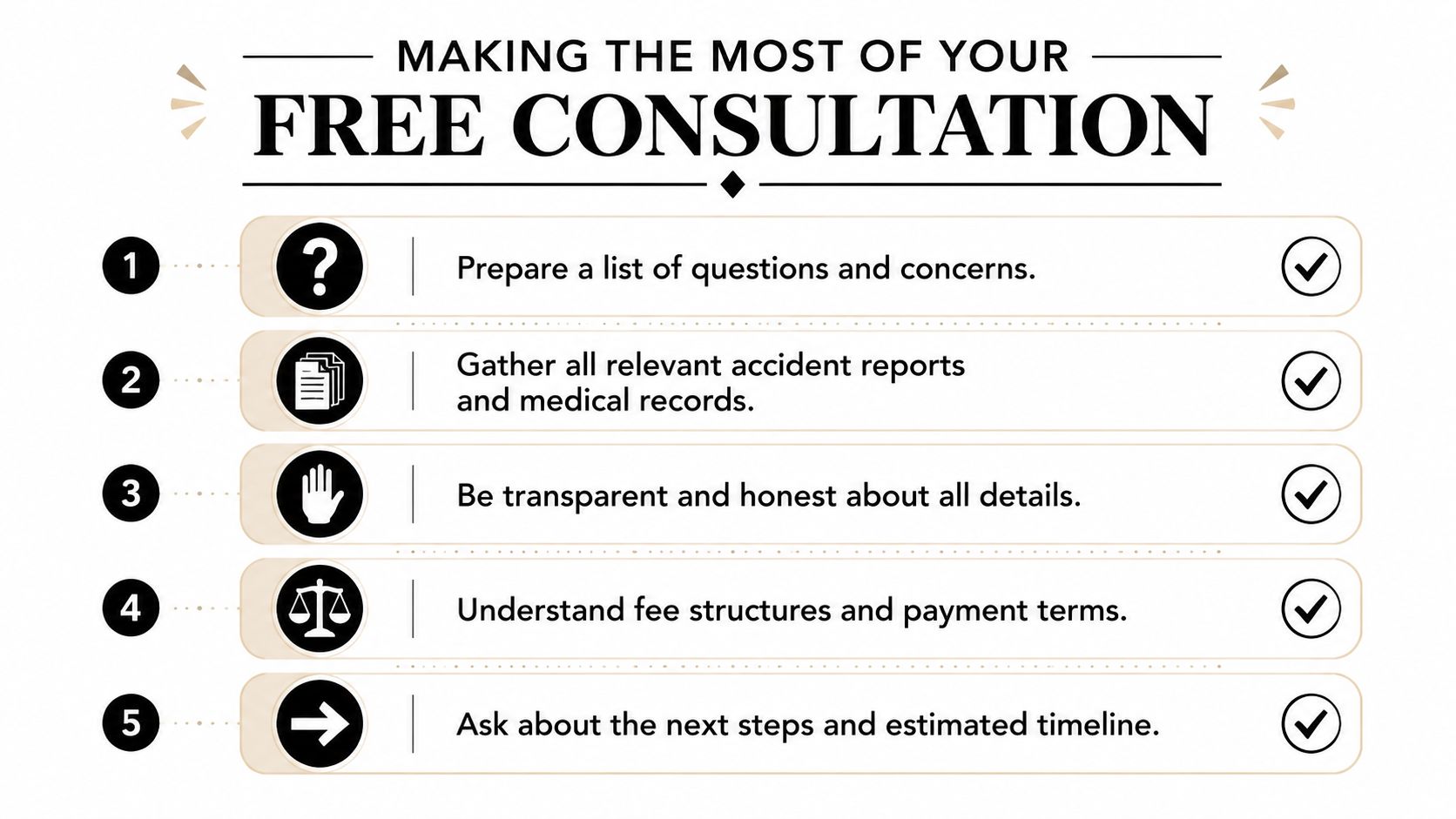
What to bring
You don't need a perfect binder. You do need the basics.
- Accident records: Police report, incident report, exchange-of-information sheet, or claim number.
- Photos and video: Scene photos, vehicle damage, visible injuries, road conditions, helmet damage, or anything else that captures what changed.
- Medical information: ER paperwork, urgent care notes, discharge instructions, imaging reports if you have them, and a list of providers you've seen.
- Insurance correspondence: Emails, letters, texts, voicemails, or settlement offers.
- Work impact notes: Dates missed, restrictions, or changes in your job duties.
If something is missing, still go. Good lawyers can often help identify what needs to be obtained next.
Questions that actually tell you something
Asking about fees is common. That's fair, but it shouldn't be your only question.
Ask the questions that reveal how the case will be handled:
Who will be my main point of contact?
This tells you whether you'll have access to the attorney or be routed through a system.What problems do you see in my case right now?
A strong lawyer won't pretend every case is easy. You want honesty about disputed fault, treatment gaps, preexisting conditions, or limited insurance.What should I do next, and what should I stop doing?
Good answers are practical. They often involve medical follow-up, evidence preservation, and caution around insurer communications.How do you keep clients updated?
Silence creates stress. You need to know whether updates happen by phone, email, portal, or only when something major occurs.What does a realistic timeline look like?
No honest lawyer can promise a finish date, but they should explain the stages and what can slow things down.
If a lawyer answers every question with certainty, be cautious. Injury cases involve medical uncertainty, factual disputes, and insurance strategy.
A short video can also help you prepare before that first meeting:
What a good consultation feels like
You should leave with more clarity than you had when you arrived.
Not necessarily comfort. Sometimes it's difficult to hear. But you should understand the likely pressure points in your case, the next documents needed, who will do what, and whether the lawyer listened carefully instead of rushing to sign you up.
A bad consultation often has one of two problems. Either the lawyer gives vague, inflated optimism, or the office treats you like a file instead of a person with a disrupted life.
That reaction matters. If communication feels slippery in the first meeting, it usually won't improve once the representation agreement is signed.
Understanding Colorado Injury Claim Timelines and Rules
You leave the hospital, the pain is still settling in, and everyone around you says the same thing: focus on getting better first. That advice is partly right. But Colorado law keeps running while you are going to appointments, missing work, and trying to figure out what happened. If you do not understand the timing rules early, you can lose control of your case before any insurer talks seriously about paying it.
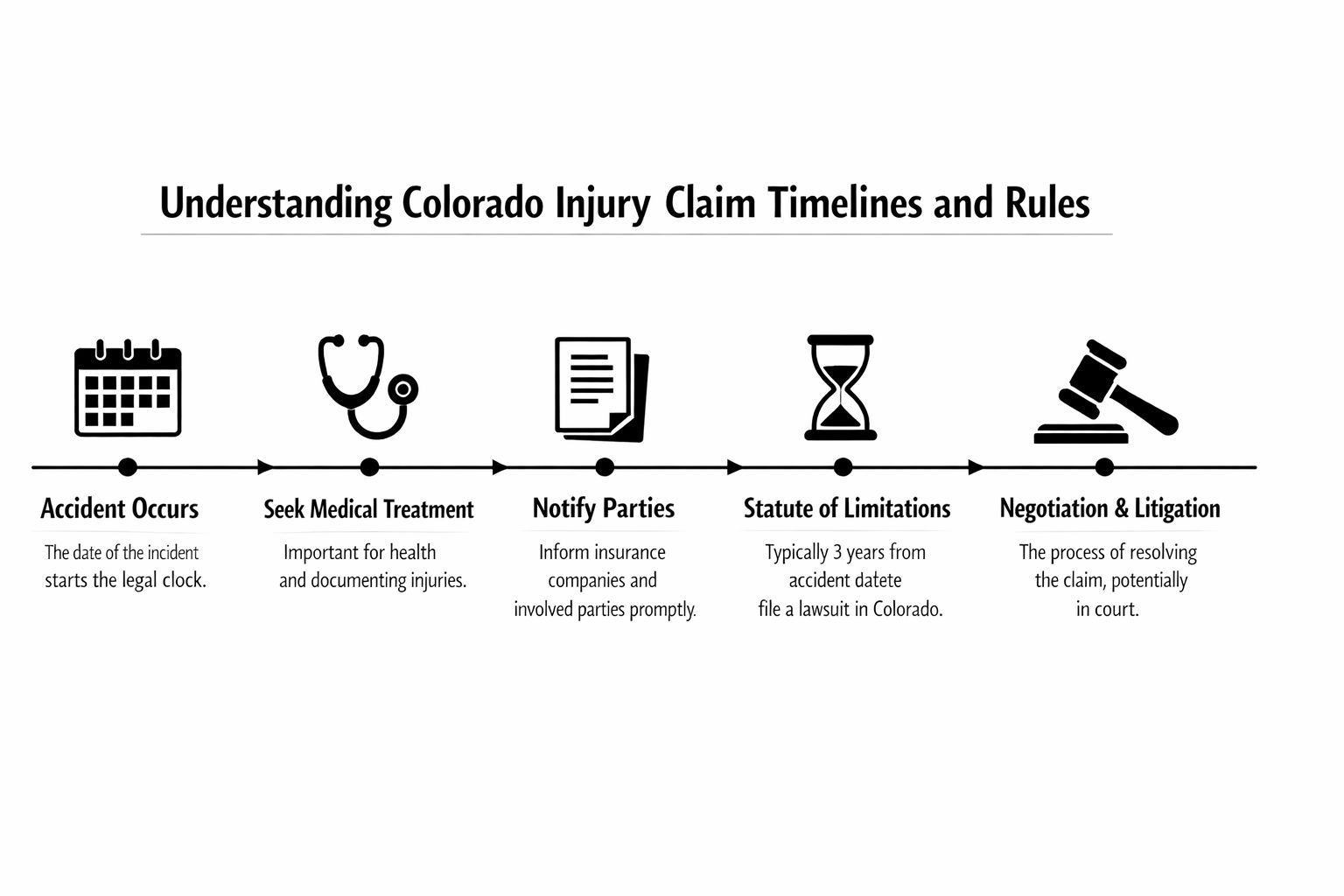
The deadlines that matter
Colorado does not use one deadline for every injury case. Car crash claims usually have a longer filing period than many other personal injury claims. Premises liability, pedestrian, and bicycle cases often follow a shorter window. Claims involving a city, county, or other government entity can trigger a much faster notice requirement, which is where injured people get blindsided.
A missed deadline can end an otherwise valid claim. It does not matter how serious the injury is if the filing window closes first.
For a practical explanation of the filing windows that apply in Colorado, review this guide on the Colorado personal injury statute of limitations.
Government claims deserve special attention. A crash with a municipal vehicle, a fall on public property, or an injury tied to a public agency can put you on a shorter clock than you expected. People often wait because they are still treating or because they assume the insurer will sort it out. That delay can cost them the claim.
The case timeline matters before the lawsuit deadline
Many people fixate on the final day to file suit. That date matters, but it is not the only date that shapes the value of a case.
A claim usually develops in stages. First, the injured person gets medical treatment and learns the scope of the injury. Then records are gathered, liability is investigated, and the insurance carrier starts building its own version of events. Settlement discussions often happen only after the medical picture is clearer. If the insurer refuses to be reasonable, litigation follows, and court rules begin to control the pace.
That process creates a real trade-off. Filing too early can mean you do not yet understand the full medical damage. Waiting too long can mean key evidence is gone, witnesses are harder to find, and the defense has more room to argue that something else caused your condition.
The goal is not speed for its own sake. The goal is timing the claim well enough to protect both proof and value.
Comparative fault can reduce or block recovery
Colorado follows a modified comparative negligence rule. If an injured person is found partly at fault, the recovery can be reduced. If the injured person reaches the legal cutoff for fault under Colorado law, recovery is barred.
That issue comes up constantly in Boulder cases. Bike crashes, pedestrian collisions, ski-related transportation injuries, intersection wrecks, and multi-car accidents often turn on blame allocation more than anyone expects.
A common example helps. A driver turns across a cyclist's path near downtown Boulder. The driver says the cyclist was outside the bike lane or moving too fast. The cyclist says the driver failed to yield. The injury may be obvious. Liability is not. The final result can turn on road position, signal timing, witness statements, camera footage, and how consistently the medical records describe the incident.
Here is the practical effect:
| Fault finding | Practical result |
|---|---|
| Low share of fault | Recovery may still be available, but it is reduced by that percentage |
| Fault close to the legal cutoff | The case becomes much harder to negotiate because blame is the central dispute |
| Fault at or above the cutoff | Recovery is barred under Colorado's rule |
This is one reason early case framing matters so much. Small facts can change how an adjuster, defense lawyer, or jury assigns blame.
If you are comparing how different states handle civil liability rules, broader policy reading like understanding Florida tort reform can provide context. For a Boulder injury claim, though, Colorado's deadlines and fault rules are what control your options.
Decoding Lawyer Fees and Maximizing Your Compensation
A lot of injured people in Boulder wait to call a lawyer for one reason. They are worried about cost. After a crash, cash flow gets tight fast. Copays pile up, paychecks shrink, and the insurance company starts asking for statements before you have a clear sense of what the injury will mean for the next six months.
In most personal injury cases, the fee issue is more straightforward than people expect.
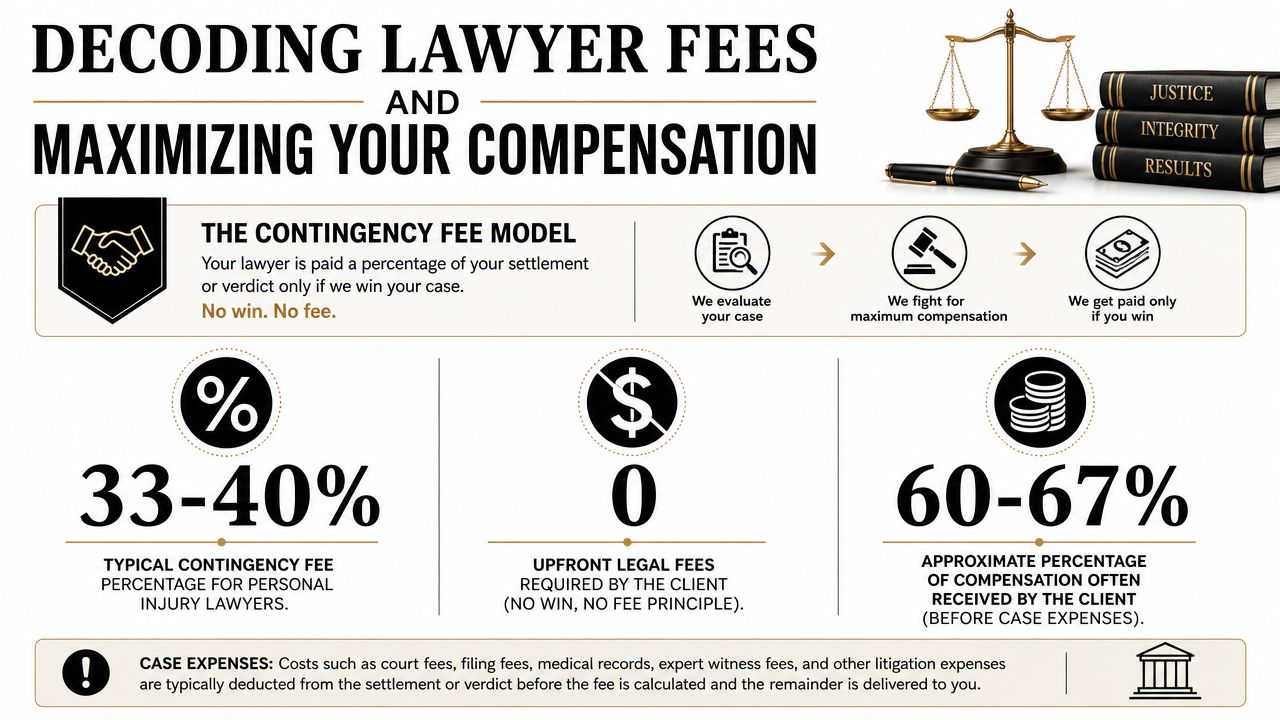
What contingency fees usually mean
Injury lawyers commonly work on a contingency fee. The lawyer gets paid from the settlement or verdict, not through upfront hourly invoices while the case is pending.
That does not mean every fee agreement is the same.
Before signing, ask for direct answers to two questions:
- How is the attorney fee calculated?
- What happens to case costs if the claim settles, goes to suit, or does not recover money?
Those answers matter because fees and costs are different. Fees pay the lawyer for the work. Costs are the out-of-pocket expenses tied to the case, such as medical record charges, filing fees, expert review, deposition expenses, or investigation work. Some firms advance those costs. Some deduct them at different stages. A good lawyer should be able to explain the math in plain language, and a written agreement should match that explanation.
For a practical breakdown, review how car accident lawyer fees work.
What maximizing compensation actually looks like
Maximizing compensation is not about making the biggest demand on paper. It is about proving the full loss with enough detail that an insurer, opposing lawyer, or jury takes it seriously.
That usually starts with the losses people can see right away, like ER bills, follow-up care, time missed from work, and damage to the car. Then the harder part begins. A strong claim also accounts for treatment that is still unfolding, limits on your ability to do your job, pain that disrupts sleep or mobility, and the ways the injury changes ordinary routines at home.
People often lose ground. They settle before the medical picture is stable. They assume they will bounce back on a certain date. They forget to document missed work, canceled plans, or the tasks they now need help doing. Once a case settles, those losses usually cannot be revisited.
In vehicle claims, property damage can create a second negotiation running alongside the injury case. If the insurer says the car is a total loss and the valuation feels low, a guide on your car's true value can help you evaluate that part of the claim separately.
How fault affects the final number
Compensation turns on damages and responsibility. Even a serious injury claim loses value if the insurer has a credible argument that you contributed to the accident.
As noted earlier, Colorado's comparative fault rules can reduce recovery or bar it altogether if fault crosses the legal threshold. In practice, that means the value of a case is rarely just a medical-bills calculation. It is also a proof problem. Can the lawyer tie the injuries to the accident, answer blame arguments, and present the case in a way that holds up under scrutiny?
That is why patience often pays off. The strongest claims are usually built, not rushed.
Bottom line: The best way to protect the value of your case is to understand the fee agreement, document every category of loss, and avoid settling before the medical and liability picture is clear.
Nares Law Group LLC offers free consultations for Colorado injury cases. For many injured people, that conversation is the first real step toward getting control back.