Your phone is buzzing. Your supervisor wants an update. Your shoulder, back, or head is throbbing. Someone has already handed you a form you don't understand, and you're trying to answer three questions at once: Should I see a doctor first? Do I have to use the company doctor? What happens if I can't work tomorrow?
That mix of pain, fear, and confusion is common after a job injury. Individuals in that situation don't need legal jargon. They need a calm plan.
If you're searching for denver workplace injury lawyers, you're probably not looking for theory. You're looking for a way to protect your health, your paycheck, and your future without making a mistake that hurts your claim later. Colorado's system can feel mechanical at the exact moment your life feels anything but mechanical. Forms, deadlines, adjusters, restrictions, follow-up visits, lost wages. It adds up fast.
This guide is meant to slow that chaos down. You'll see what to do first, how workers' compensation fits into the picture, when a separate personal injury claim may exist, what evidence matters, and when legal help becomes necessary. Think of it as a map for the days after an injury, written in plain English for someone who's already carrying enough.
The Moment Everything Changes
It can happen in seconds. A warehouse worker slips while carrying inventory. An office employee falls after a spill near the break room. A delivery driver gets hit while making a work stop. One moment feels ordinary. The next feels split into before and after.

The first shock isn't always the pain. Sometimes it's the uncertainty. You may worry about how serious the injury is, whether your boss will be upset, whether you'll lose shifts, or how you'll pay bills if the doctor says you can't work. People often minimize what happened because they don't want to seem difficult. Then the adrenaline wears off, and the injury starts telling the truth.
What injured workers usually feel first
Individuals don't think in legal categories right away. They think in practical fears.
- Health fear: Is this going to get worse by tonight?
- Job fear: Will my employer think I'm causing trouble?
- Money fear: Who pays for treatment and missed time?
- Process fear: Did I already miss a step?
Those questions matter because the earliest decisions often shape everything that follows. A delayed report can create doubt. A missed appointment can give the insurer an opening. A casual statement like "I'm fine" can come back later when you're clearly not.
Practical rule: After a work injury, treat the situation like a fire alarm, not a minor inconvenience. You don't need panic. You do need action.
Why clarity matters early
Work injury claims involve both medicine and law. That combination confuses people because each side speaks a different language. Doctors focus on diagnosis, restrictions, treatment, and recovery. Insurers focus on records, causation, documentation, and whether they must pay.
A good way to think about it is this. Your injury is the event, but your claim is the record of that event. If the record is incomplete, delayed, or inconsistent, even a real injury can become harder to prove. That's why clear steps in the first day matter so much.
Your First 24 Hours What To Do After a Work Injury
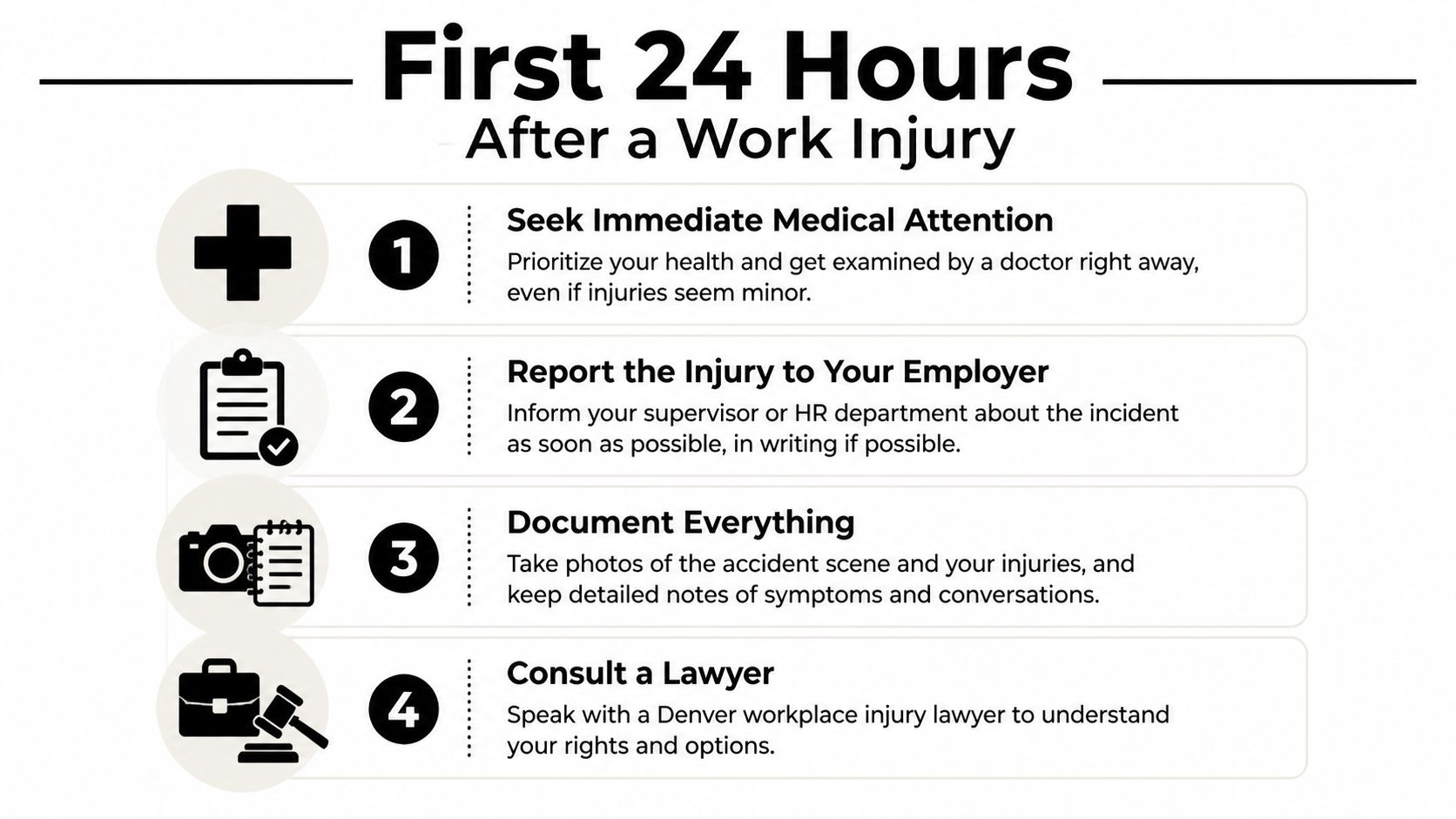
The first day after an injury isn't about building the perfect case. It's about protecting your health and creating a clean, accurate record. If you only remember one thing, remember this. Get medical help, report the injury, and document what happened.
Get medical care first
If the injury is serious, call emergency services or go to the emergency room. Your body comes before paperwork.
If the injury doesn't feel life-threatening, don't assume it's minor. Back injuries, head injuries, neck injuries, crush injuries, and joint injuries often get worse after the initial shock passes. Tell the medical provider that the injury happened at work and describe exactly how it happened.
A common point of confusion in Colorado is the doctor issue. Sometimes employers or their workers' compensation insurers direct injured employees to designated medical providers. That can affect where ongoing treatment happens. But in an urgent situation, the priority is immediate care. Once the immediate emergency passes, get clarity about who is authorized for follow-up treatment.
Report the injury in writing
Tell your supervisor or HR as soon as you can. Verbal notice helps, but written notice is much stronger because it creates a timestamp and reduces future disputes about what was said.
Use simple language. Don't exaggerate. Don't guess. State the basics:
- Date and time: When the injury happened
- Location: Where it happened
- Mechanism: What you were doing and what went wrong
- Body parts involved: What hurts now
- Witnesses: Who saw it, if anyone
- Next step: That you're seeking medical attention
A short email or text may be enough to preserve the basic report if that's the fastest option. Keep a screenshot or copy for yourself.
Report facts, not conclusions. "I slipped while carrying a box and landed on my left side" is better than "I may have torn something badly."
Start a simple evidence file
Think of this as creating a folder for future-you. When people are hurt, memory gets messy. Small details disappear fast.
Collect these items right away if you can do so safely:
- Photos of the scene: Wet floor, broken ladder, damaged tool, vehicle positions, debris, lighting conditions
- Photos of visible injuries: Bruising, swelling, cuts, burns, immobilizers
- Witness information: Names, phone numbers, job titles
- Clothing or gear: Preserve torn clothing, damaged boots, hard hats, gloves, or safety equipment
- Notes: Write down what happened before, during, and after the incident
Watch what you say
You don't need to be combative. You do need to be careful. Avoid phrases like "It was probably my fault" or "I'm okay" if you don't know the full extent of your injuries. Those statements can be repeated later as if they were final.
Keep your communication polite and brief. Stick to facts. If your pain changes over the next day or two, document that too.
If you're unsure whether to call a lawyer
Many injured workers wait because they think calling a lawyer means filing a lawsuit immediately. It doesn't. Sometimes legal help starts with a short conversation about deadlines, doctor choice, denied care, or whether your case may involve someone other than your employer.
If you're overwhelmed, a lawyer can help you understand the road ahead before the paperwork gets tangled.
The Two Paths to Compensation Workers Comp and Third Party Claims
A lot of injured workers hear "workers' comp" and assume that is the whole story. Sometimes it is. Sometimes the same accident opens a second legal path too.
That second path matters because these two claims do different jobs.
Workers' compensation is the built-in system for job injuries. If you were hurt while doing your work, the main question is usually whether the injury arose out of and during your employment. A third-party claim is different. It asks whether someone outside your employer relationship, such as a careless driver, a subcontractor, a property owner, or an equipment maker, caused the injury.
A simple way to picture it is this: one lane helps with work-related medical care and wage loss under Colorado's rules. The other lane seeks accountability from the outside person or company that caused the harm.
Workers' comp is the first lane for many injured workers
Colorado handles a large volume of workers' compensation cases each year, as noted in McDivitt Law Firm's workers' compensation overview. That helps explain why the process can feel mechanical. Forms move fast. Medical authorizations get reviewed. Adjusters focus on rules and records.
That same source explains that workers' compensation cases can become complicated and that denials do happen. It also discusses how legal representation can affect outcomes. For an injured worker, the practical takeaway is straightforward. Even when the system is supposed to be no-fault, disputes still arise over treatment, work restrictions, lost wages, and whether an injury is work-related.
Third-party claims focus on fault and fuller damages
A third-party claim looks more like a standard injury case. Here, fault matters. You must show that another person or business acted carelessly, or sold a defective product, and that their conduct caused your injury.
For example, a delivery worker struck by another driver may have a workers' compensation claim because the crash happened on the job. That same worker may also have a third-party claim against the at-fault driver. The two claims come from one event, but they are not interchangeable.
If you want a plain-language explanation of the civil side, this guide on how to file a personal injury claim explains how negligence-based cases usually work. For readers comparing broader tools and legal process resources, Algomizer personal injury solutions is another useful starting point.
The key differences side by side
| Factor | Workers' Compensation Claim | Third-Party Liability Claim |
|---|---|---|
| Who pays | Employer's workers' compensation insurer | The negligent person or company's insurer, or the defendant directly |
| Need to prove fault | Usually no | Yes |
| Main question | Were you hurt in the course of your job? | Did someone outside your employer relationship cause the injury through negligence or a defective product? |
| Typical losses covered | Medical care and disability-related wage benefits allowed by the system | Broader damages that may include losses not available in workers' comp |
| Pain and suffering | Usually not part of workers' comp benefits | May be available in a third-party case |
| Where the dispute happens | Administrative workers' compensation process | Civil claim or lawsuit |
| Why cases get complicated | Medical authorization, restrictions, denials, rating disputes | Fault disputes, causation disputes, damages proof, insurance defenses |
Why understanding both paths changes your decisions
One injury can create two separate legal problems, a situation many people misunderstand. Each problem has its own rules, evidence, deadlines, and settlement issues.
Workers' comp is meant to keep treatment and disability benefits available after a job injury. A third-party case addresses losses that workers' comp usually does not pay, including pain and suffering in the right case. If you only see the first lane, you may miss the second one entirely.
That is why early case review matters. A lawyer is not only asking, "Were you hurt at work?" The better question is, "Who was involved, what failed, and are there two claims here instead of one?"
Navigating the Colorado Workers Compensation System Step by Step
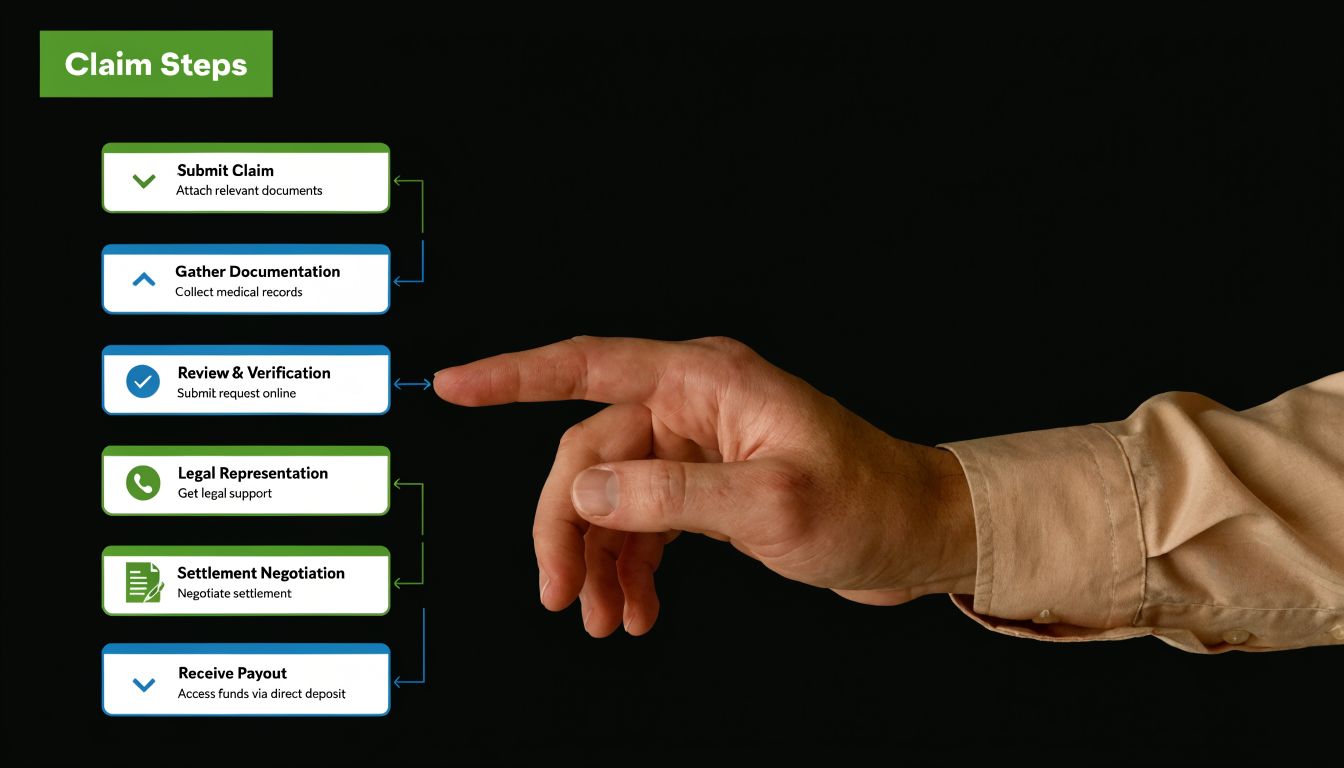
Colorado's workers' compensation process can feel like a conveyor belt. Papers move. Adjusters call. Doctors assign restrictions. You keep trying to heal while the system keeps asking for another document. It helps to see the process as a sequence instead of a blur.
Step one begins with notice and treatment
Once the injury is reported, the workers' compensation process usually starts with medical evaluation and claim reporting through the employer and insurer. At this stage, accuracy matters more than drama. Describe your job duties, the event, and your symptoms clearly.
Your doctor may place you on restrictions. Restrictions can include limits on lifting, standing, driving, bending, climbing, or work hours. Follow them. If you work outside those restrictions, the insurer may later argue that you weren't as injured as you claimed.
The insurer starts evaluating the claim
After the report reaches the insurer, an adjuster begins reviewing the file. That review may include medical records, witness statements, accident reports, and communication with the employer.
This part often frustrates people because it feels like someone who has never met you is deciding what your body needs. That's not entirely wrong. The adjuster is looking at paper first. Your job is to make sure the paper reflects reality.
Helpful habits during this phase include:
- Keep every appointment: Missed visits create gaps in the record
- Describe symptoms consistently: Don't minimize one day and overstate the next
- Save all correspondence: Emails, claim letters, mileage records, prescriptions
- Track work status: Whether you're off work, on light duty, or back full duty
Benefits usually depend on your medical status
In plain English, workers' comp benefits often revolve around how the authorized doctor views your ability to work and whether you still need active treatment.
A few terms tend to confuse injured workers:
| Term | Plain-English meaning |
|---|---|
| Temporary Total Disability | Benefits that may apply when you're temporarily unable to work at all because of the injury |
| Permanent Partial Disability | Benefits that may apply if you have lasting impairment after healing reaches a certain point |
| Maximum Medical Improvement | The stage where the doctor believes your condition has stabilized and isn't expected to improve substantially with more treatment |
| Impairment rating | A medical opinion about the lasting physical impact of the injury |
MMI is not the same as being fully healed
This is one of the hardest concepts for injured workers. Maximum Medical Improvement, often called MMI, does not mean you're back to normal. It means the doctor believes your condition has plateaued for workers' compensation purposes.
A simple analogy helps. Think of recovery like charging a phone with a damaged battery. At first, the battery level rises. Then it stops improving, even though the phone still isn't working like it used to. MMI is that plateau point.
Once MMI enters the picture, the conversation often shifts from active treatment to long-term impact. That's when disputes about impairment ratings, future care, and work capacity can become more serious.
A short visual explanation can help if these terms still feel abstract:
Why small errors become big problems
The workers' comp system isn't only about being injured. It's also about proving each chapter of the injury in the right way. A delayed MRI, an incomplete work note, or confusion about restrictions can affect benefits and settlement discussions.
If a form, diagnosis, or restriction looks wrong, address it early. Paperwork tends to harden into the official version of events.
That doesn't mean every issue becomes a legal fight. It does mean that careful recordkeeping and early questions are often better than trying to fix a file after months of confusion.
Building Your Case The Evidence That Matters Most
A strong injury claim tells a clear story. Not a dramatic story. A documented one.
Insurance companies often look for gaps. They ask whether the scene was really hazardous, whether the injury really happened that way, whether the symptoms really lasted, and whether the wage loss is really connected to the accident. Evidence answers those questions before they become arguments.
Start with the physical story
The scene itself often changes quickly. Spills get cleaned. equipment gets repaired. vehicles get moved. broken parts disappear. That's why early photos matter so much.
If it's safe to do so, gather:
- Scene images: Floor conditions, machinery guards, ladders, pallets, loading docks, vehicle damage
- Close-up injury photos: Bruising, cuts, swelling, stitches, casts, slings
- Damaged objects: Helmet, harness, gloves, phone, glasses, tool, backpack
These items help show what words alone sometimes can't. A written report may say "fell at loading area." A photo may show poor lighting, debris, or a slick surface.
Build the medical story as it unfolds
Medical records are the backbone of a work injury claim, but they don't always capture the day-to-day reality of pain and limitation. That's where your own notes help.
Keep a simple journal with entries about:
- Pain levels: Where it hurts and what movement triggers it
- Sleep disruption: Trouble falling asleep, waking from pain, need to raise or ice
- Daily limitations: Driving, lifting a child, climbing stairs, showering, cooking
- Work effects: Missed shifts, reduced duties, inability to perform normal tasks
You don't need polished writing. A few honest lines each day can be powerful because they show the injury's lived impact over time.
Don't overlook wage and witness evidence
Many workers focus on medical proof and forget the financial side. Save your pay stubs, work schedules, time sheets, mileage logs for treatment travel, and any written light-duty offers. If your hours changed after the injury, preserve records that show that change.
Witnesses matter too, even if they only saw part of the event or the immediate aftermath. One co-worker may have seen the fall. Another may have heard you report the injury right away. A supervisor may have observed you limping before you ever saw a doctor.
Evidence works like bricks in a wall. One brick rarely wins the case. A solid stack creates something insurers can't ignore.
Organize it like a claim file, not a junk drawer
Use a folder on your phone, a cloud folder, a paper binder, or all three. Separate items into basic categories such as accident photos, medical records, work records, correspondence, and out-of-pocket expenses. When documents are easy to find, you're less likely to miss a deadline or lose an important detail.
When You Need to Call a Denver Workplace Injury Lawyer
You report the injury, follow the doctor’s instructions, and expect the process to help you heal. Then a letter arrives saying treatment is denied, your work restrictions are questioned, or you are being sent back before your body is ready. That is often the moment a work injury becomes a legal problem, not just a medical one.
A lawyer is often most helpful when the claim starts to feel less like recovery and more like a tug-of-war over what happened, what care you need, and how long you may be affected.

Red flags that mean you should get legal advice soon
Some claims stay straightforward. Others start showing warning signs early.
You should consider calling a Denver workplace injury lawyer if:
- Your claim was denied. A denial may rest on a dispute about notice, causation, medical necessity, or whether the injury is work-related.
- You need surgery or lengthy treatment. The more serious the injury, the more likely fights over approval, time off, and future care become.
- You cannot return to your old job. If your regular duties involved lifting, climbing, driving, or repetitive motion, the financial effect may last much longer than the first few missed paychecks.
- You were placed at MMI and it does not feel right. Maximum medical improvement works like a checkpoint in the system. If that checkpoint comes too soon, your benefits and treatment options may be affected.
- Your impairment rating seems too low. That number can shape what benefits are available.
- Your employer pressures you or treats you differently after the injury. Being pushed to work beyond restrictions or punished for reporting an injury deserves prompt attention.
- Someone outside your employer may have caused the harm. A crash during a delivery, a defective machine, or dangerous property conditions may point to a separate third-party case.
What a lawyer actually does in a serious claim
A good lawyer does much more than file forms.
In a disputed case, your lawyer works like the person putting together the full puzzle while you focus on healing. That can include reviewing medical records, comparing them to the insurer’s position, gathering opinions from doctors, preparing for hearings, calculating wage-loss issues, and checking whether a third-party claim exists alongside workers' comp.
That team approach matters in harder cases. Colorado Law's workers' compensation overview explains that some firms use multidisciplinary teams, including victim advocates, paralegals, trial attorneys, and in some instances in-house medical professionals to help interpret medical evidence. If you are trying to decide whether your case has reached that point, this guide on when to hire a personal injury attorney can help clarify the signs.
If settlement is already being discussed, timing matters too. Early offers can feel like relief when bills are piling up, but they may come before the long-term picture is clear. ProPlaintiff.ai settlement insights give a useful overview of how settlement value can change once future treatment, work limits, and case strategy are better understood.
Why waiting can make the case harder
Delay does not always ruin a claim. It does make some problems harder to fix.
Witness memories fade. Records pile up without a clear theory tying them together. You may say something to an adjuster that sounds harmless but later gets used to minimize your injury. By the time a hearing or settlement discussion arrives, the other side may already have a head start.
Calling a lawyer is not about creating conflict. It is about getting clear advice when the system stops making sense, so you can protect your health, your income, and your options.
What Your Settlement Could Include Compensation in Colorado
People often ask the most practical question last. What can I recover? The answer depends on which path applies to your case.
Think of compensation as different baskets serving different purposes. One basket is designed to cover medical care and disability-related wage loss through workers' compensation. Another basket may exist in a third-party claim if someone outside your employer relationship caused the injury.
What workers' compensation may cover
Workers' comp is generally focused on the economic effects of a work injury within the rules of that system. That often includes treatment related to the injury and disability benefits tied to your ability to work during recovery or after lasting impairment.
In plain terms, that can mean help with:
- Medical treatment related to the work injury
- Temporary disability benefits while you're unable to work or are limited
- Permanent disability benefits if the injury leaves lasting impairment
Workers' comp usually does not function like a full personal injury lawsuit. It isn't built to compensate every human consequence of an injury.
What a third-party case may add
A third-party claim can be broader. If a negligent driver hits a delivery worker, for example, the worker may receive workers' compensation benefits because the injury happened on the job. But the claim against the driver may also pursue damages that workers' comp doesn't usually cover, such as physical pain, emotional suffering, and the deeper impact on daily life and future earning ability.
That's why settlement analysis can get complicated when both paths exist. The two claims may interact, and workers' compensation liens can affect how recovery is handled. This explanation of a workers' compensation lien on a personal injury settlement is a useful primer if you're trying to understand that overlap. If you'd like a broader consumer-friendly overview of how injury settlements are commonly evaluated, ProPlaintiff.ai settlement insights may also help you frame the questions to ask.
The value of a case isn't just about today's bills. It's about what the injury changes in your body, your work, and your daily life going forward.
Your Questions Answered and How Nares Law Group Can Help
You may be sitting at your kitchen table with an ice pack, a stack of forms, and a phone full of messages from work. That is usually when the hardest questions show up. People want straight answers, not legal jargon.
Can I be fired for filing a workers' comp claim
Colorado law does not give an employer permission to punish you for reporting a job injury or filing a valid claim. Real life can still get messy. If your supervisor starts cutting your hours, changing your duties, avoiding written communication, or pushing you to work outside medical restrictions, keep a careful record of what changed and when it changed.
Paper trails matter. Save texts, emails, schedule changes, and notes from conversations.
What if my employer says I should use my own health insurance
That is often a warning sign that someone is trying to treat a work injury like a personal problem. A job injury should usually be reported and handled through the workers' compensation process, not shifted onto your private insurance.
A simple way to view it is this. If the injury happened in the course of your work, the claim should start in the work system. If someone tries to steer you away from that system, write down exactly what was said and get legal advice before the confusion spreads into your medical records and billing.
What if I was partly at fault
This question worries injured workers more than it should. Workers' compensation usually works more like a safety net than a blame contest. The main question is often whether the injury arose out of and during your job, not whether you made a perfect decision in the moment.
That is different from a third-party case, where fault can matter much more. If both paths are in play, a lawyer can sort out which rules apply to which claim.
What if I already made a mistake
Many injured workers do. Someone waits until the next morning to report the injury because they hope the pain will pass. Someone says, "I'm fine," before the adrenaline wears off. Someone forgets to photograph the machine, the floor, or the vehicle.
A mistake does not automatically destroy a case. It does mean the next step matters more. Good legal advice can work like a map after a missed turn. You may still get where you need to go, but the route needs to be corrected early.
Nares Law Group helps injured workers make sense of what happens next. The firm offers free consultations and works on a contingency fee basis, which means you do not pay attorney fees unless money is recovered for you. That help can include dealing with insurance adjusters, organizing medical and wage-loss issues, investigating who may be legally responsible, and identifying whether a work injury also involves a separate negligence claim, such as a motor vehicle collision, trucking crash, traumatic brain injury, or another serious accident.