The adjuster has sent an offer, your medical bills are still arriving, and you're trying to decide whether the money will get you back on your feet. The number might cover what you owe today without leaving enough for treatment next month. Or it might look low without giving you any explanation of what the insurer left out.
Car accident settlement negotiation starts with your own documented range, not the insurer's opening number. Build that range, make the adjuster explain the offer, and calculate what you'll keep before agreeing to anything.
Build the Evidence File Before You Negotiate
The most common mistake is building a demand around how frightening the crash was rather than what the paperwork proves. Your account matters, but the adjuster needs evidence connecting the other driver's conduct to each injury and each claimed loss.
Start with a folder organized by evidence type. Keep original files, save readable copies, and maintain an index so you can identify exactly what you've sent.
Evidence to gather before negotiating
| Evidence | What it proves | Where to get it |
|---|---|---|
| Police crash report | Fault facts and the parties involved | Investigating agency |
| Photos and vehicle damage | Impact and point of collision | Your phone and repair shop estimate |
| Medical records and itemized bills | Treatment and causation | Each provider's billing office and records department |
| Imaging and diagnostic findings | Injury severity | Radiology and treating physician |
| Treatment chronology | Link between crash and each injury | Your treating providers |
| Wage proof | Lost income | Employer letter, pay stubs, tax returns |
| Witness statements | Liability | Contact details collected at the scene |
| Daily-life journal | Non-economic harm and functional limits | Your own notes, kept from day one |
Read the crash report for incorrect names, vehicle descriptions, diagrams, and witness information. Photographs taken near the collision can help explain impact location, but a repair estimate doesn't establish medical severity by itself.
Request medical records and billing ledgers separately. Treatment notes explain what happened medically; bills show charges, payments, adjustments, and outstanding balances. Don't count a remaining balance again if it's already included in the total bill.
Connect each injury to the collision
Build a treatment chronology showing symptom onset, appointments, diagnoses, referrals, and current restrictions. Causation means the connection between the crash and the condition you're claiming, including any worsening of a preexisting injury.
Ask your treating provider to address that connection when the records are unclear. Don't conceal prior symptoms or explain away treatment gaps yourself. Identify what happened and obtain the supporting medical explanation.
For wage loss, pair an employer's confirmation of missed work with payroll records. For daily-life changes, record specific limitations, such as needing help bathing, abandoning a recreational activity, or being unable to sit through a work shift.
During our investigation, we collect medical records, accident reports, witness statements, and expert opinions to establish liability, meaning legal responsibility, and damages, meaning compensable losses. You can begin that same organizing work today while preserving evidence that may disappear, including surveillance footage and vehicle information.
Working rule: If a number has no document behind it, it isn't yet a negotiating number.
Find Every Policy That Can Pay
The Insurance Research Council estimated that 15.4% of U.S. motorists were uninsured in 2023, compared with 12.4% in 2017, according to the Insurance Information Institute's uninsured-motorist summary. Proving the other driver caused the crash therefore doesn't answer the separate question of where compensation will come from.
Before judging an offer, identify the available coverage. Don't assume the policy mentioned by the first adjuster is the only potential source.
Coverage sources and what to confirm
| Coverage source | When it responds | What to confirm |
|---|---|---|
| At-fault driver's liability policy | Driver is insured and found at fault | Per-person and per-accident limits |
| Your uninsured-motorist coverage | Driver has no insurance or leaves the scene, subject to policy requirements | Your limits and whether they stack |
| Your underinsured-motorist coverage | Driver's limits are below your losses, subject to policy terms | Whether your limits exceed the driver's and how benefits are calculated |
| Commercial or employer policy | Driver was working or in a company vehicle, subject to coverage terms | Additional insured status and limits |
| Medical payments coverage | Covered medical costs regardless of fault | Whether it exists and its limit under the applicable policy and state rules |
Confirm coverage rather than assuming it
Request the declarations page, the policy summary identifying coverages and limits, from each relevant carrier where available. Ask for written confirmation of exclusions, coverage disputes, and any additional commercial or excess insurance under review.
A per-person limit and a per-accident limit answer different questions. When several people are injured, the total available for the collision can constrain what any individual claimant receives. Our explanation of insurance policy limits can help you distinguish those limits before responding.
For your own coverage, check whether stacking, combining eligible limits, is permitted. Don't add policies together without checking the policy language and applicable law.
A company logo on a vehicle is a reason to investigate, not proof that an employer's insurer must pay. Identify who owned the vehicle, what the driver was doing, and which policies potentially cover that activity.
If documented losses exceed available coverage, consider a policy-limits demand supported by a clear account of the uncovered losses. Before resolving the liability claim, check whether your own insurer requires notice or consent to preserve an underinsured-motorist claim.
Set Your Opening Demand and Settlement Range
Set your range before asking the adjuster what the claim is worth. Otherwise, you'll spend the negotiation reacting to a number someone else selected.
Begin with economic losses, the financial harm you can calculate. Separate past treatment, wage loss, and supported future expenses. Keep the injury claim distinct from any vehicle-damage payment so the same loss isn't counted twice.
Build the range from the bottom up
Use this structure:
Documented economic losses + supported non-economic damages = preliminary damages range
Then evaluate responsibility disputes, evidentiary weaknesses, and realistically recoverable funds. Non-economic damages compensate for harm such as pain, disrupted sleep, and loss of normal activities. They need a factual explanation, not just an impressive total.
For a hypothetical worked example, assume medical expenses of $50,000, wage loss of $15,000, and supported future care of $25,000. Those economic losses total $90,000.
If you use a hypothetical multiplier of 1.5 to 3 solely to test negotiating positions, the non-economic component would be $135,000 to $270,000, producing a combined range of $225,000 to $360,000. That's arithmetic, not an accepted valuation rule or a prediction of recovery. A multiplier can overvalue a resolved injury or undervalue permanent functional loss.
In the same hypothetical, applying an assumed 20% responsibility reduction would produce $180,000 to $288,000 before fees and other deductions. Whether shared responsibility reduces or prevents recovery requires a state-specific legal assessment, not an automatic spreadsheet adjustment.
Choose distinct negotiating positions
Keep these positions private:
- Opening demand: The highest amount you can explain through the evidence without overstating the case.
- Target: A resolution that reasonably accounts for documented harm and identifiable litigation risks.
- Walk-away position: The point at which accepting becomes less sensible than pursuing the available alternatives.
Don't treat the walk-away position as permanent. New medical findings, corrected wage records, or a genuine coverage problem can change it.
Summarize the demand under liability, damages, and coverage, with an exhibit supporting each material assertion. If the hypothetical claim has only $100,000 in available liability coverage, investigate a limits resolution and any additional recovery sources rather than assuming a $300,000 request creates more insurance.
A high opening demand is useful only when you can defend the reasoning behind it.
How to Send a Demand and Escalate Delays
A demand package should make the claim easy to evaluate and difficult to misunderstand. Sending a large attachment without an index can create avoidable questions about what the insurer received and what remains missing.
Use this process to keep submission, review, and escalation connected.
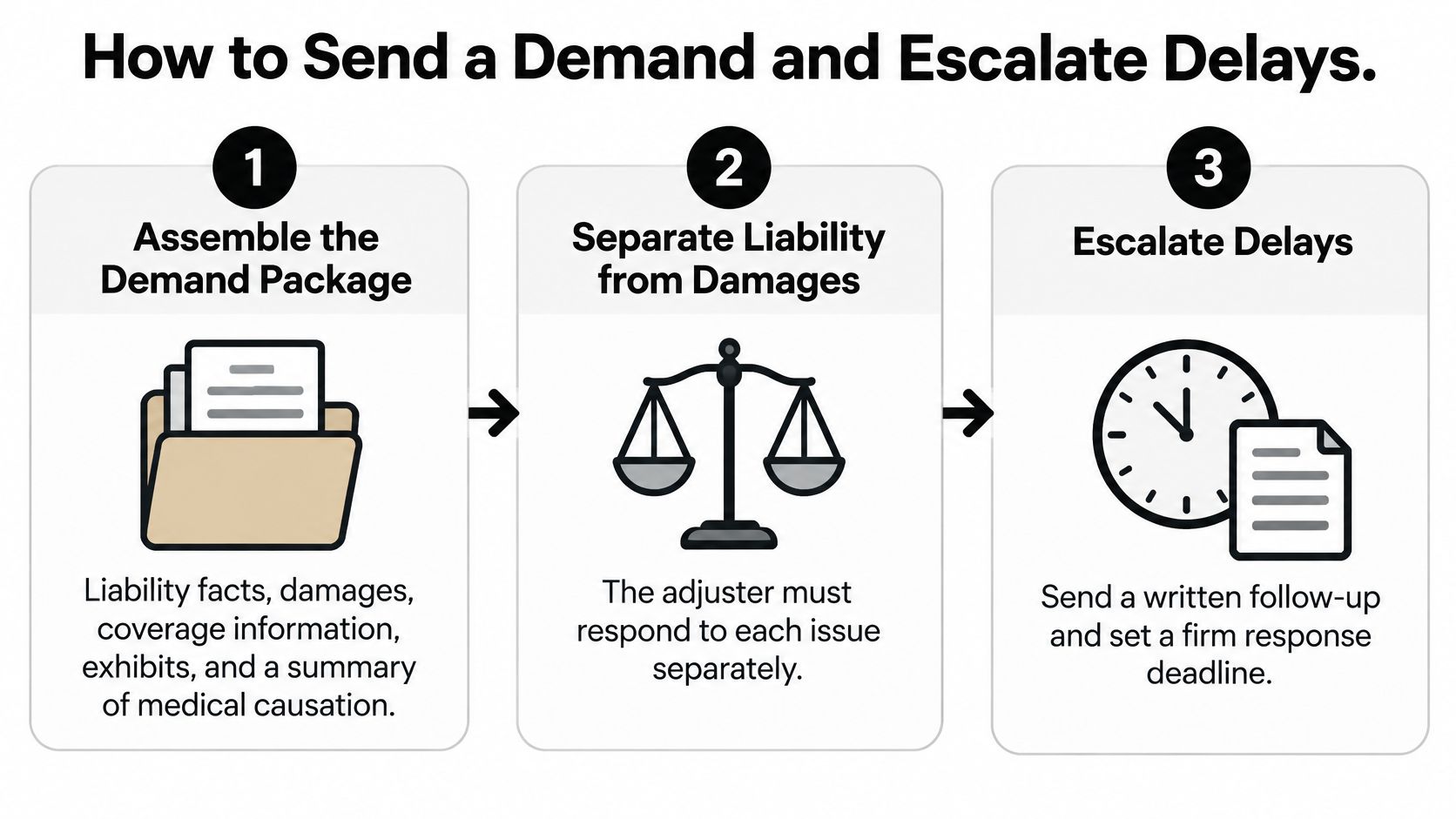
Submit a package the adjuster can evaluate
Assemble the demand package. Include liability facts, a medical-causation summary, damages, coverage information, and indexed exhibits. Give the adjuster a readable explanation rather than expecting them to reconstruct your case from records.
Separate liability from damages. Explain why the other driver is responsible before explaining the injuries and losses. Ask the adjuster to identify which issue remains disputed so a disagreement about fault doesn't become an unexplained reduction in medical damages.
Attach available coverage information. Include the relevant declarations or written coverage confirmations you've obtained. Identify unresolved coverage questions without representing unconfirmed insurance as available money.
State the requested amount and its basis. Show the components and refer to specific exhibits. Our guide to a car accident demand letter provides additional context for organizing the written request.
Set a clear response date. Choose a realistic date based on the package's completeness and applicable requirements, rather than presenting your preferred deadline as a legal mandate. State that you'll request supervisory review or evaluate other action if a substantive response doesn't arrive.
Log communications. Record the date, adjuster's name, reference number, documents discussed, and promised next action. Confirm important telephone conversations by email so there's a written record of what each person agreed to do.
Escalate unexplained delay in writing. Send the supervisor a concise chronology, the unanswered request, and proof of delivery. Consider a state insurance regulator complaint about claim-handling problems, while recognizing that a complaint doesn't replace a lawsuit or decide the injury claim's value.
Protect the claim while review continues
An Australian prospective study of road-crash claimants with mild or moderate injuries found that approximately one in three remained unsettled after two years. That finding illustrates why you need a documented follow-up process, not an assumption that silence means progress.
Ask what specific information prevents evaluation. If the insurer requests records already delivered, identify the exhibit and resend it with confirmation rather than restarting the entire submission.
Negotiations don't necessarily protect a filing deadline. Have the applicable deadline checked independently, including any special notice requirements. Continue updating meaningful medical and wage evidence, but don't let repeated review promises determine when you seek legal action.
Audit an Offer and Challenge Automated Valuations
A larger counteroffer isn't necessarily a better-supported offer. Stop reacting to the headline amount and ask what changed underneath it.
The adjuster should explain which expenses were accepted, which losses were discounted, and why. Treat the following as an audit checklist, not a claim that every insurer must disclose every internal document in every jurisdiction.
Offer components and the proof that challenges them
| Valuation item | What the adjuster must show | Counter-proof to send |
|---|---|---|
| Past medical expenses | Itemized bills and amounts accepted | Itemized bills with paid and outstanding balances |
| Future treatment | Basis for any future-care figure | Treating physician's prognosis and cost estimate |
| Wage loss | Method and income figure used | Pay stubs, employer letter, and tax records |
| Permanent impairment | Medical basis for any rating | Specialist report and functional limits |
| Pain and suffering | Method used to value it | Symptom journal and witness statements |
| Comparative fault | Percentage assigned and reason | Scene evidence and any reconstruction |
| Causation dispute | Records the insurer relies on | Treatment chronology showing symptom onset and medical explanation |
| Policy limits | Available limits disclosed in writing where legally required or available | Written confirmation from each carrier |
| Automated or database inputs | Which tools and data inputs influenced the number | Written disclosure request and corrected records |
Challenge the inputs before arguing about the software
Ask whether a database, estimating program, benchmark, or artificial intelligence tool influenced the offer. Then request the relevant inputs, assumptions, and confirmation that a person reviewed your individual circumstances.
The Washington insurance regulator's proposed valuation rules address concerns involving databases, surveys, estimating software, benchmarks, and artificial intelligence, and propose disclosure and individualized assessment requirements. A proposal isn't an enacted nationwide disclosure right. Use it as context for a practical request, not as proof that a Colorado, Texas, or New York insurer must follow Washington's proposed approach.
Look for errors you can correct:
- Medical information: An incorrect diagnosis code, omitted specialist finding, or prior condition treated as the sole cause.
- Treatment dates: A mistaken start date, duplicated visit, or apparent gap caused by missing records.
- Income inputs: The wrong pay rate, omitted overtime supported by payroll records, or an inaccurate return-to-work date.
- Liability assumptions: An unsupported account of speed, lane position, visibility, or driver conduct.
Request review by a named adjuster or supervisor after submitting the corrections. Correcting inaccurate inputs is more productive than arguing that computers can't value injuries.
A fast offer may reflect a benchmark without adequately addressing future care or reduced earning ability. Speed alone doesn't establish unfairness, but it doesn't establish accuracy either.
Send a focused rebuttal
Create a rebuttal matrix with the insurer's position, your correction, and the supporting exhibit. If future treatment was excluded, send the prognosis and cost basis rather than resending photographs of the crash.
Ask the adjuster to distinguish missing evidence from disagreement with existing evidence. Those require different responses. Missing wage records call for documentation; rejection of documented wage loss calls for an explanation.
Our attorneys negotiate with insurance carriers to secure settlements, and our firm never accepts lowball offers. The practical work behind that position is identifying unsupported reductions and presenting evidence that addresses them.
Don't demand a better number without showing which assumption needs to change.
Preserve the communication record
In the Financial Ombudsman Service's insurance claims-handling report, approximately 31% of 215,000 investigated insurance complaints involved claim delay, administration, or customer service. The practical point is to preserve unanswered requests, conflicting explanations, and missed commitments rather than relying on memory.
If the carrier won't disclose its method, document the refusal and request a written explanation of the disputed components anyway. Don't assume refusal proves misconduct or makes the entire offer invalid.
Use a secure delivery method for sensitive records and retain delivery confirmation. If fax is necessary, SendItFax's comparison of in-store versus online fax prices can help you assess the sending cost; separately verify privacy safeguards, the recipient's number, and successful transmission.
Close your rebuttal with a requested review date, a written component breakdown, and the carrier's policy-limits position where legally available. That gives the next conversation a concrete agenda.
Calculate the Net Amount You Actually Keep
A large gross settlement can leave a much smaller usable recovery. Gross settlement means the total payment before deductions, not the amount deposited for your unrestricted use.
In a hypothetical example, a $300,000 settlement with a one-third fee, $25,000 in case costs, a $40,000 provider lien, and a $30,000 health-plan reimbursement claim leaves $105,000 before other unpaid bills, applicable taxes, or a future-care reserve. That calculation assumes the fee is taken from gross and the listed obligations don't overlap; it doesn't describe our fee agreement.
Settlement net worksheet
| Line item | How it reduces the net | Question to ask before accepting |
|---|---|---|
| Attorney fee | Contractual percentage taken from the applicable recovery base | What percentage, and is it taken before or after costs? |
| Litigation costs | Expert, filing, and records expenses | Which costs are advanced and which come out of recovery? |
| Medical liens | Repayment to providers holding a lien | Who holds a lien and for what amount? |
| Health-plan reimbursement | Repayment of benefits the plan paid | Does the plan have an enforceable reimbursement claim? |
| Unpaid medical bills | Balances still owed to providers | What remains after lien and plan payments? |
| Taxes where applicable | Taxable components reduce usable funds | Which components are taxable in your situation? |
| Future care reserve | Money set aside for ongoing treatment | What does the prognosis require over the coming years? |
Reconcile obligations before accepting
A lien is a claim against settlement proceeds. Subrogation or reimbursement generally concerns an insurer or benefit plan seeking repayment for benefits it paid, although the precise rights require review.
Request current payoff figures and identify which obligations can be challenged or negotiated. Our explanation of a medical lien on a settlement can help you identify questions to resolve before disbursement.
Don't subtract the same provider balance both as a lien and as an unpaid bill. Ask for a written net estimate showing confirmed deductions separately from estimates.
Put a price on waiting
A peer-reviewed study of financial outcomes after acute traumatic injury examined medical debt and bankruptcy by linking trauma-registry information with consumer-credit reports. Financial recovery therefore deserves attention alongside medical recovery, without assuming a larger settlement automatically solves immediate debt pressure.
A faster resolution can be rational when it prevents insolvency or collection pressure and the medical outlook is sufficiently clear. Waiting can be justified when brain-injury symptoms are evolving or future treatment remains unresolved.
Ask what net amount will be available, when it can be distributed, and what must happen first. Don't mistake an accepted offer for immediately available cash.
Decide Whether to Accept, Counter or Litigate
Choose the next step by comparing realistic outcomes, not by deciding whether the adjuster has been pleasant or difficult. The strongest demand still needs a candid assessment of what you can prove and collect.
Keep the written offer beside your damages and net-recovery calculations when making that decision.
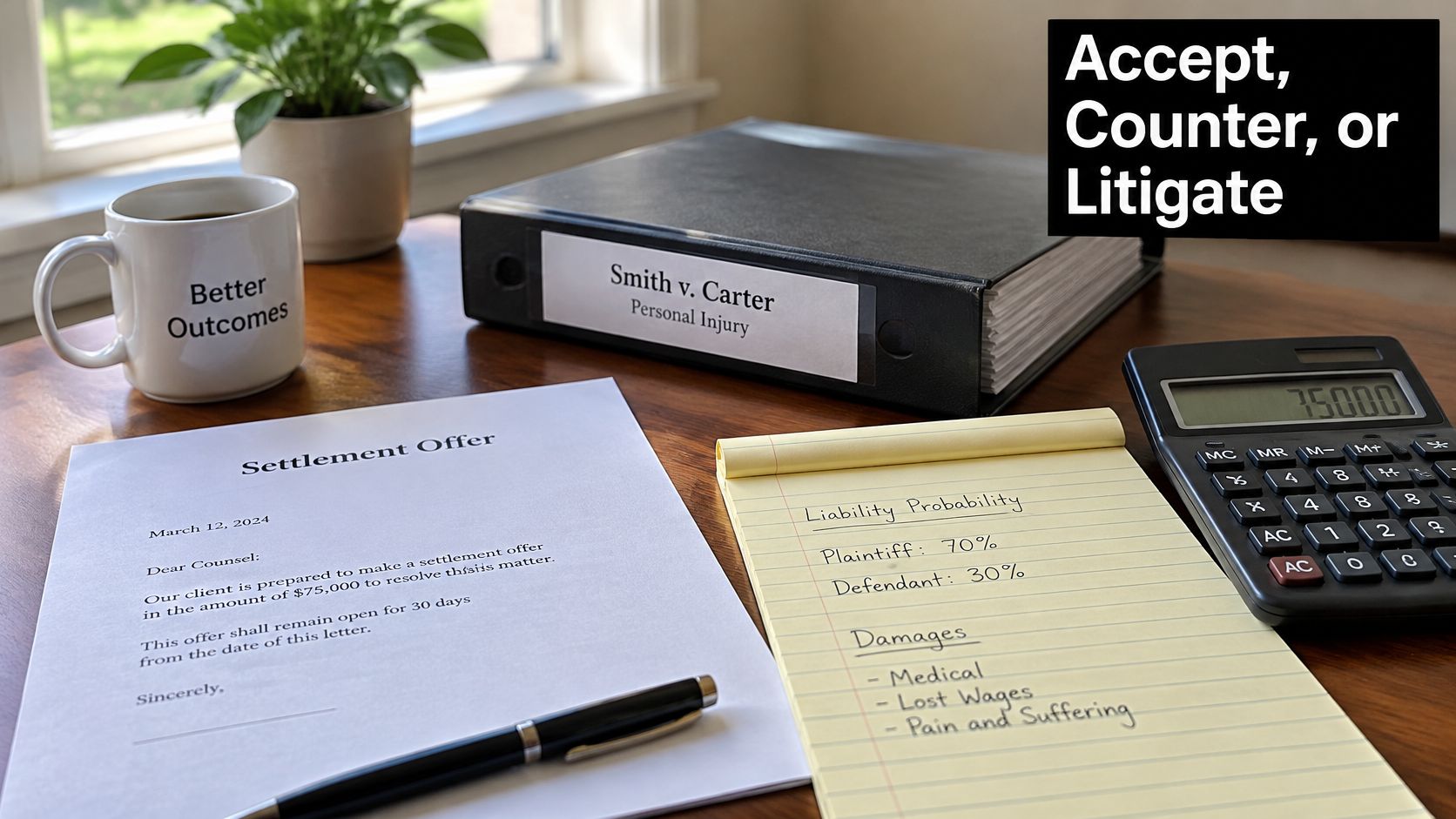
Match the response to the remaining dispute
- Accept when the net result is reasonable. Consider whether it addresses documented losses and future needs, accounting for the risks of proceeding. A compromise can be sound even when it doesn't equal your opening demand.
- Counter when a specific gap can be closed. Identify the omitted treatment estimate, understated wage loss, or unsupported responsibility deduction. Attach the evidence and explain the requested adjustment.
- Consider litigation when the unresolved gap justifies it. Strong liability, substantial documented damages, and an insurer unwilling to address material evidence can support filing suit. A larger theoretical verdict isn't enough if costs or collectability make the likely net recovery worse.
Compare the offer with expected net litigation value: the chance of proving responsibility and damages applied to a realistically recoverable amount, less fees, costs, delay, repayment obligations, and collection risk. That's a decision tool, not a promise that trial outcomes can be calculated precisely.
Our attorneys negotiate with carriers to secure settlements. If negotiation fails, we're prepared to take a case to court.
The video below offers another resource as you evaluate your options.
Review the release before committing
A release is the agreement giving up specified claims in exchange for payment. Check whose liability it releases, which claims it covers, and whether it affects other responsible parties or insurance claims.
Resolve questions about future medical needs, reimbursement obligations, and applicable tax treatment before signing. Don't assume you can reopen the claim if your condition later worsens.
Gather the coverage declarations, itemized medical summary, and written offer breakdown. Those documents give you a practical starting point for testing whether to accept, counter, or pursue court action.
Nares Law Group LLC offers a free consultation for auto accident cases in Colorado to help you evaluate the offer, supporting evidence, and next steps. Visit Nares Law Group LLC to book a consultation, and bring your coverage declarations, itemized medical summary, and offer breakdown so we can examine the numbers before you sign.