You're sitting beside a hospital bed, trying to understand what happened after a crash. The nurse's note says, “Patient localizes to pain.” It sounds alarming, but it may also describe a purposeful motor response that gives clinicians important information about brain function. If the same phrase later appears in an insurance file or lawsuit, its meaning can affect how lawyers interpret the injury's severity and progression.
Medical records often compress a complicated examination into a few words. Those words can guide treatment, influence rehabilitation planning, and become part of the factual record in a personal injury claim. This guide translates localizes to pain into plain English, explains how it differs from other motor responses, and shows why families and attorneys should read the surrounding documentation carefully.
Reading Those Confusing Chart Notes After a Brain Injury
A family member may open a hospital chart and see a sequence of entries that seems impossible to decode. One note says “withdraws.” Another says “localizes to pain.” A later assessment records a Glasgow Coma Scale motor response without explaining what the bedside team observed. The family naturally asks, “Is this good news, bad news, or both?”
The answer depends on the exact examination, the timing, the stimulus used, and the patient's other findings. In ordinary neurological documentation, localizes to pain means the patient made a purposeful movement toward the source of a physical stimulus, such as reaching toward it or attempting to remove it. That response differs from a simple reflexive withdrawal, but it doesn't by itself establish how much recovery will occur.
Why one sentence deserves attention
A chart entry is not a verdict on a brain injury claim. It's one observation made at one point in time. Still, the entry may help show what the clinical team saw during an emergency assessment and how the patient's neurological responses changed.
The record becomes more useful when read as a timeline:
- Early observations: EMS and emergency department notes may document the first motor response after the crash.
- Repeated examinations: Trauma, intensive care, and nursing assessments may show whether the response changed.
- Surrounding findings: Pupils, verbal responses, eye opening, sedation, paralysis, imaging, and vital signs can change how the motor response is interpreted.
- Documentation quality: A note that describes what the patient did is usually more informative than an isolated score with no narrative.
Families should request the complete record rather than relying on a single screenshot or discharge summary. Instructions on obtaining medical records can help clarify which records may be available and how to organize them for medical and legal review.
The phrase may reflect documentation, not a diagnosis
Clinicians also create records under intense time pressure. Medical practices that use tools such as flexible dictation for busy practices may capture observations more efficiently, but a dictation tool doesn't replace clinical judgment. The important question remains what stimulus was applied, what movement occurred, and whether the response was consistent across examinations.
Don't read the phrase as “the patient feels pain normally.” In an unconscious or severely impaired patient, the notation describes a motor response during a neurological exam. It also shouldn't be treated as proof that the patient was fully aware, communicating, or able to describe symptoms.
Plain-English translation: The patient showed a targeted movement toward the stimulus rather than only pulling away automatically.
What Localizes to Pain Actually Means in a Neurological Exam
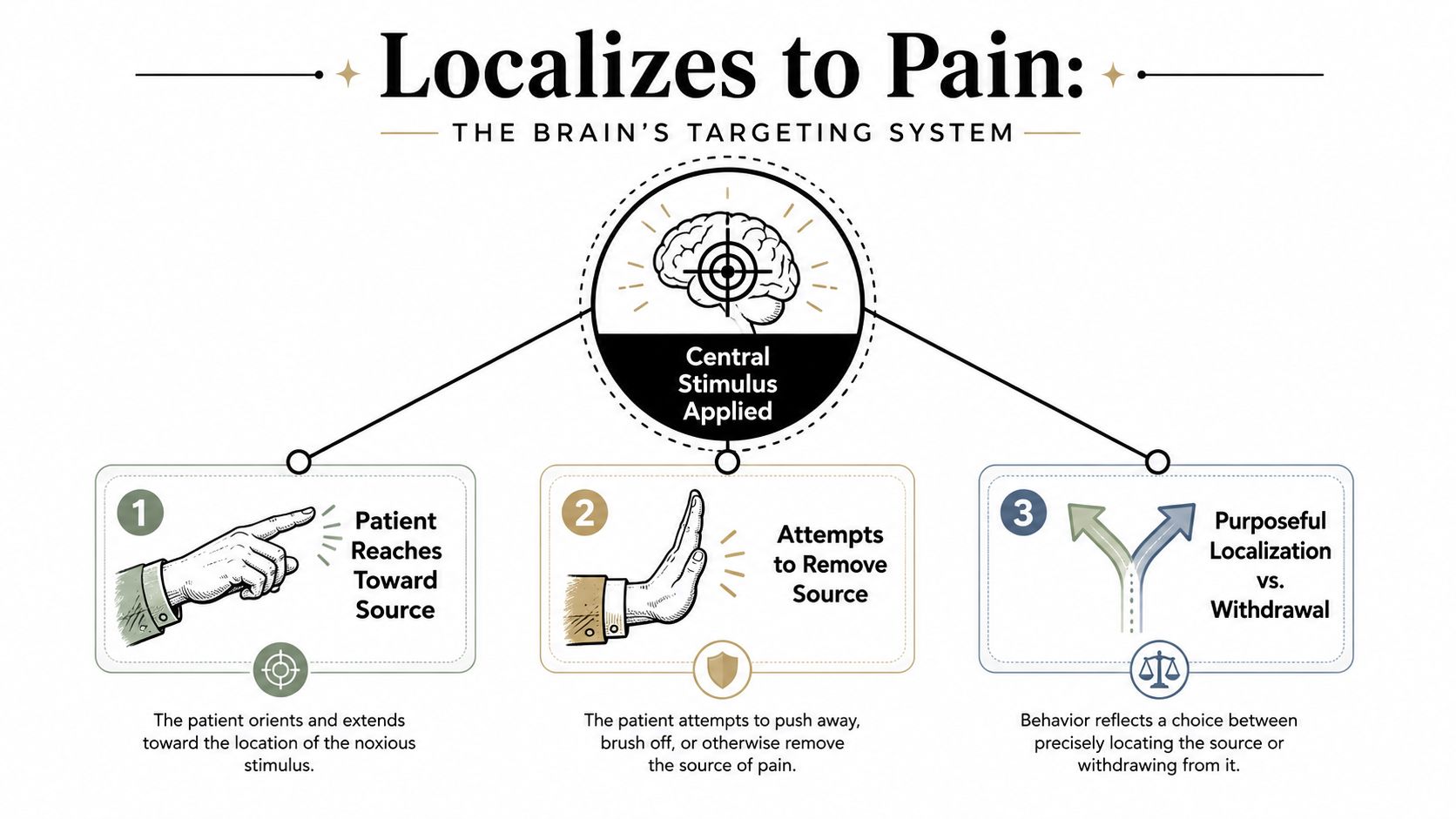
The phrase describes purposeful localization during a motor examination. A clinician applies a central physical stimulus, observes the patient's movement, and records whether the patient appears to identify and reach toward the source or try to remove it.
The distinction becomes easier with two everyday examples. If you touch a hot pan and jerk your hand away, that movement may happen quickly and automatically. If a mosquito lands on your arm in the dark and you deliberately reach toward the spot to swat it, you're directing movement toward a perceived source. The first example resembles withdrawal. The second is closer to localization.
The examination in practical terms
A clinician generally considers several questions:
- Was the stimulus central or peripheral? The examiner may use a physical stimulus to the body rather than only touching a finger or toe.
- Did the patient move toward the source? Reaching toward the stimulus or trying to push it away suggests targeting.
- Was the movement purposeful? The examiner looks for an organized response rather than a generalized jerk.
- Was the response symmetrical? Differences between the right and left sides may matter.
- Could medication or paralysis affect the result? Sedatives, anesthetics, neuromuscular-blocking drugs, severe weakness, and orthopedic injuries can complicate interpretation.
A reflex is like a doorbell wired directly to a light. Press the button and the light responds without anyone deciding what to do. Localization is more like a person hearing the bell, identifying the room, and walking toward the door. The comparison isn't perfect, but it shows why clinicians distinguish a targeted movement from a simple withdrawal.
How the nervous system supports localization
Pain and temperature information travel through the spinothalamic tract, a major ascending pathway. Second-order neurons cross the midline and ascend on the opposite side toward the brain. The primary somatosensory cortex, or S1, helps encode spatial information about painful stimuli, which helps explain why pain from skin and other superficial tissues is usually easier to locate than pain from internal organs. Clinical anatomy references describe superficial somatic pain as sharp and well defined, while deep somatic pain is duller and less precisely located./12:_Peripheral_Nervous_System/12.11:_Pain/12.11B:_Localization_of_Pain)
That neurological pathway is related to the concept of localization, but the chart phrase itself refers to observed behavior during a motor response examination. A patient can have a purposeful movement without being able to speak, follow every command, or explain what they're experiencing.
For a concise visual explanation of the response process, review the following educational video:
The safest interpretation is narrow. “Localizes to pain” means the examiner observed targeted movement during a physical-stimulus assessment. It doesn't independently reveal the full extent of brain damage, the patient's future abilities, or the legal value of a claim.
How Localizing Compares to Other Motor Responses
A neurological examination often places motor responses into a hierarchy associated with the Glasgow Coma Scale. The motor category is not a complete brain injury assessment, but it gives clinicians a standardized way to describe what the patient did during testing.
The terminology can confuse families because “localizes” sounds like a pain complaint, while the Glasgow Coma Scale uses the response to a stimulus as part of consciousness assessment. Newer training materials increasingly use physical stimulus or pressure stimulus rather than “pain” to avoid implying that clinicians should cause unnecessary injury. The wording in a particular chart may reflect the hospital's template, the clinician's training, or the date of the assessment.
The motor response hierarchy
| Response Type | Score | What It Looks Like | What It Indicates |
|---|---|---|---|
| Obeys commands | 6 | Performs a requested movement | The patient can understand and carry out commands |
| Localizes to stimulus | 5 | Reaches toward or attempts to remove the stimulus | A purposeful, targeted motor response |
| Withdraws from stimulus | 4 | Pulls a limb away | A movement away from the stimulus, which may not be purposeful |
| Abnormal flexion | 3 | Arms flex inward in an abnormal posture | A more concerning motor pattern involving impaired brain function |
| Extension | 2 | Arms extend in an abnormal posture | A severe abnormal response pattern |
| No motor response | 1 | No observed movement | No motor response during the examination |
The scoring framework is described in more detail in this guide to the modified GCS score. The table shouldn't be used to score someone at home. Clinicians must account for sedation, intoxication, paralysis, language barriers, hearing impairment, spinal injury, fractures, and other conditions that can prevent movement.
Why localizing is not the same as being awake
A patient who localizes may show more organized motor activity than a patient who only withdraws, flexes abnormally, extends, or doesn't move. That makes it a relatively more favorable finding within the motor-response scale. It still doesn't mean the patient is fully conscious or able to communicate reliably.
A chart may also contain apparently conflicting entries. For example, a nurse might document withdrawal during one check, while a physician later records localization. That difference could reflect improvement, a different stimulus, a different limb, medication changes, or differences in how two clinicians interpreted the movement.
Chart-reading rule: Never interpret the motor response without checking the time, examiner, stimulus, medications, and other Glasgow Coma Scale components.
What This Response Tells Doctors Regarding Brain Injury Severity
A patient who localizes during one assessment may show more organized motor activity than someone who only withdraws or shows no response. That makes localization a meaningful finding within the motor portion of a neurological examination, but it cannot measure injury severity by itself. Doctors also review brain imaging, vital signs, oxygenation, medication exposure, the rest of the examination, and changes over time. A broader overview of neurological tests for brain damage can help families and attorneys understand how these findings fit together.
A single chart entry is a snapshot. Repeated examinations create the timeline doctors use to judge whether brain function is improving, remaining stable, or changing.
Trends matter more than isolated words
Clinicians may compare assessments from the emergency department, intensive care unit, and rehabilitation setting. A change from an abnormal posture to withdrawal, or from withdrawal to localization, may be clinically meaningful. A decline can prompt urgent reassessment, especially when it occurs with changes in pupils, breathing, blood pressure, seizures, or imaging.
The record should show whether the patient was:
- Improving: Demonstrating increasingly organized or responsive movement.
- Stable: Showing a similar response across repeated assessments.
- Fluctuating: Producing different responses as medications, fatigue, seizures, or medical complications change.
- Confounded: Unable to provide a reliable response because of sedation, paralysis, injury, or another limitation.
This pattern matters in both treatment and legal review. For a physician, a change may influence monitoring or additional testing. For an attorney, the same sequence may help establish what the patient could do at different stages, while also showing why one isolated phrase cannot prove permanent impairment.
Localized pain can mean different things
Families sometimes hear “localized pain” and assume the source must be a joint, tendon, muscle, or bone. That is a reasonable clinical question, but pain quality matters as much as location. Nociceptive pain is generally localized and proportional to tissue injury. Neuropathic pain follows a plausible nerve distribution and may feel burning, shooting, or stabbing, with unusual skin sensitivity. Nociplastic pain is often more widespread and disproportionate to visible tissue change. A clinical review compares these pain distributions and mechanisms.
The lateral pain system is associated mainly with sensory-discriminative functions, including locating a painful stimulus. The medial system is more involved in affective and motivational processing. Reviews of pain neuroscience describe a prominent role for S1 in locating and distinguishing painful stimuli, while imaging work has linked attention to pain location with activity in the opposite S1 and inferior parietal cortex. These distinctions are summarized in a review from the British Medical Bulletin.
Localized neuropathic pain can remain confined to a small area while still reflecting nerve injury rather than a simple orthopedic problem. The National Center for Biotechnology Information discusses localized neuropathic pain and its characteristic symptoms.
That distinction may affect referrals, medication choices, physical therapy, and questions about continuing symptoms. Precise location does not automatically mean minor injury.
Why This Phrase Matters for Your Personal Injury Claim
A personal injury claim often depends on the story told by the medical record. Emergency clinicians document what they observed soon after a collision. Later providers document how the patient changed, what limitations remained, and what treatment was required. A phrase such as localizes to pain may become one piece of that chronology.
Insurance reviewers and defense lawyers may focus on the entry in different ways. One side may argue that the response shows purposeful brain activity during a period of impaired consciousness. The other may emphasize that localization is not the same as command-following, full awareness, or proof of permanent impairment. Both arguments can miss the point if they ignore the surrounding facts.
Context determines evidentiary value
A motor response documented at the scene may help describe the patient's initial neurological condition. A response recorded later in the emergency department may reflect changes after airway management, medication, oxygen support, or treatment. A later progression can support a recovery narrative, while a persistent deficit can support the need for ongoing care.
Attorneys should examine:
- Who documented the response: EMS personnel, nurses, emergency physicians, trauma surgeons, or neurologists.
- When it was recorded: Before or after sedation, intubation, surgery, or other interventions.
- What the note says: “Localizes” is different from “withdraws,” “moves spontaneously,” or “opens eyes.”
- Whether the finding was repeated: Consistent documentation carries a different meaning from a lone unexplained entry.
- How the response fits the claim: Imaging, cognitive changes, speech problems, balance issues, work limitations, and rehabilitation records may provide the broader picture.
A chart phrase doesn't assign a dollar value to a claim. It may, however, affect how parties debate the severity of the initial injury, the length of impaired consciousness, and the need for future treatment. Case valuation should account for the full medical course, not just the most favorable or unfavorable sentence.
Avoiding the false either-or
Families sometimes worry that a purposeful motor response means the brain injury wasn't serious. That conclusion is too broad. A person may show localization while still facing substantial cognitive, physical, emotional, or functional consequences.
The opposite error is also possible. A single low motor response doesn't establish permanent disability. Medication, seizures, metabolic problems, orthopedic injuries, or incomplete documentation may affect the examination. A careful legal review treats the phrase as evidence to interpret, not as a shortcut around expert medical analysis.
Questions to Ask Doctors and Steps Attorneys Should Take
Families don't need to become neurologists to ask useful questions. They need a clear timeline and an explanation of what each observation meant in that patient's circumstances.
Questions for the treating team
Ask the trauma or neurology team:
- What movement did you observe? Ask whether the patient reached toward the stimulus, tried to remove it, pulled away, or showed another pattern.
- Was the response consistent? Ask whether the right and left sides behaved differently and whether the finding changed during repeated examinations.
- What medications were active? Sedatives, anesthetics, and paralytic drugs can limit the reliability of a motor assessment.
- How does the response fit the complete exam? Ask about eye opening, verbal response, pupils, imaging, seizures, and command-following.
- What does the trend mean for rehabilitation? Ask which physical, occupational, speech, or cognitive services are appropriate and what abilities the team is monitoring.
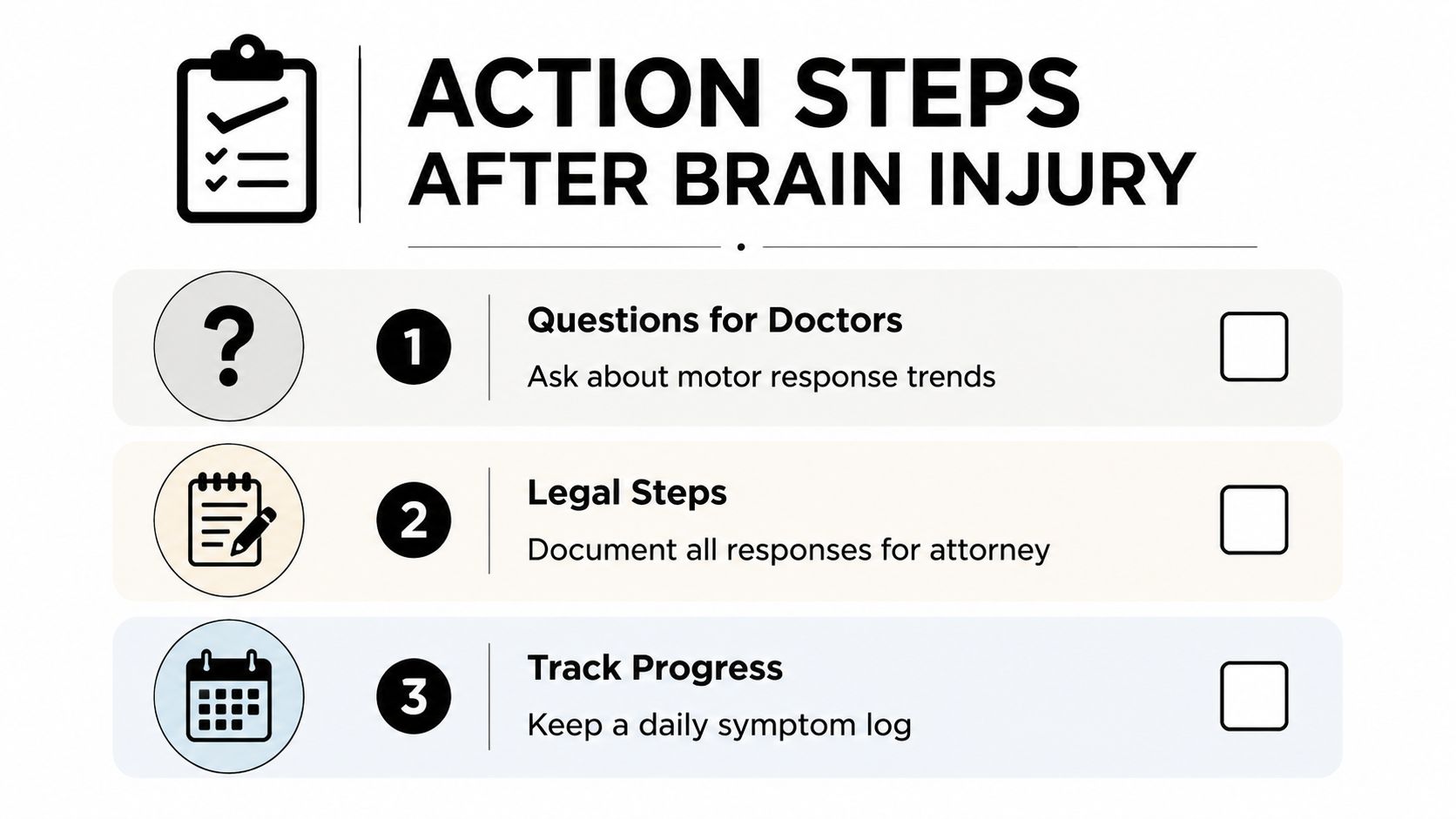
Write down the answers. Families under stress often remember the emotional tone of a conversation but not the clinical details.
Steps for attorneys reviewing the file
Counsel should obtain the earliest records, including EMS run sheets, scene assessments, emergency department notes, medication administration records, imaging reports, nursing flowsheets, and intensive care documentation. The first examination may differ from later findings, and that progression can matter to both medical interpretation and litigation strategy.
A useful review compares the narrative with the score:
- Build a time-indexed chart: Place each motor response next to the time, provider, medication status, and other neurological findings.
- Flag inconsistent wording: Determine whether discrepancies reflect actual change, different examination methods, or documentation error.
- Separate observation from conclusion: Preserve the original note before relying on a later summary.
- Consult an appropriate expert: A neurologist, neurocritical care physician, or rehabilitation specialist may help explain the clinical significance.
- Prepare the client carefully: The client should understand the difference between remembering a hospital event and what the records document.
A structured medical records review for attorneys can help counsel organize a large file, but legal teams still need to connect the findings to causation, damages, and the client's real-life limitations. The phrase may support a timeline, but it won't replace testimony about work, family responsibilities, independence, and quality of life.
Real Chart Note Examples and What They Reveal
The following examples are fictionalized teaching illustrations, not actual patient case studies. They show how the same phrase can carry different meaning depending on the surrounding record.
Example one
EMS note: “Patient extends upper extremities to physical stimulus.”
Emergency department note later: “Patient localizes with right upper extremity.”
Read together, these entries may suggest a change toward a more targeted response. The attorney should still check medication timing, airway procedures, repeat examinations, and whether the clinicians used the same stimulus. The legal narrative may focus on neurological change over time, but an expert should explain what that change means clinically.
Example two
Nursing note: “Withdraws all extremities.”
Physician note: “Localizes to stimulus with left upper extremity.”
The apparent conflict doesn't automatically show poor care or unreliable records. The clinicians may have examined the patient at different times, used different limbs, or observed different responses. The complete flowsheet, medication record, and examination descriptions may resolve the difference.
Example three
Discharge summary: “Patient localizes to pain.”
That short statement may omit the most important context. Was the patient awake? Following commands? Sedated? Moving both sides? Experiencing a fracture that limited one arm? A lawyer evaluating the claim should return to the original bedside notes instead of treating the summary as a complete neurological history.
The phrase is valuable because it records an observed response. Its meaning becomes clearer when families and attorneys place it in sequence, compare it with other findings, and ask clinicians to explain the limitations of the examination.
Nares Law Group LLC helps injured families and attorneys understand how brain injury records, including motor-response documentation, fit into a broader personal injury claim. Visit Nares Law Group LLC to discuss medical-record interpretation, treatment coordination, investigation, negotiation, or trial strategy with a team serving complex brain injury matters.