Most wrongful death lawsuits take 12 to 36 months to resolve, but complex cases involving disputed liability, multiple defendants, or court congestion can stretch to 5 years or longer. The filing deadline is usually much shorter than the time needed to investigate, litigate, negotiate, or try the case.
You may be asking this question while handling funeral arrangements, sorting through medical bills, notifying employers, and trying to make financial plans for a family that has suddenly lost income. Meanwhile, an insurance company may be asking for statements, documents, or a quick settlement. The legal process can feel painfully quiet even while your attorney is working behind the scenes.
The honest answer is that filing a lawsuit starts the legal process, but it doesn't end it. In most states, families have about 2 years from the date of death to file, but that deadline only controls when the case must begin. After filing, the lawsuit may still require 12 to 24 months or more to resolve, and some jurisdictions report a common full-case timeline of 18 to 36 months. Complex cases can take 5 years or longer (Macomb Injury Lawyers).
What Families Need to Know About the Timeline
A family may be arranging a funeral, covering immediate expenses, and wondering when the legal process will end. The question is understandable: when will compensation arrive, and how much of the family's long-term loss will it cover? A fast settlement can help with urgent bills, but accepting too soon may leave future financial losses and other damages unsupported.
The delay often comes from work that happens out of sight. Counsel must determine what caused the death, identify every potentially responsible party, preserve evidence, and calculate damages. Estate administration may need to be completed before the proper person can pursue the claim. A related criminal investigation or prosecution can also slow civil discovery, particularly when key witnesses or records are involved. Court congestion adds another bottleneck, even after the lawyers are ready.
Months may pass while attorneys review records, consult experts, obtain insurance information, and respond to defenses. Silence does not necessarily mean the case is inactive. It may mean the legal team is building evidence that will affect settlement value or trial strategy.
The filing deadline is not the resolution deadline
Many states, including Colorado, set the wrongful death filing window at approximately 2 years from the date of death, though the exact period varies by jurisdiction (Macomb Injury Lawyers). That deadline governs when the claim must begin, not when the family must receive compensation. A filed lawsuit can remain active long after the complaint is submitted.
Colorado families should treat the deadline as a date requiring immediate legal attention. Waiting for an insurer to make a fair offer can create risk while the investigation, estate paperwork, and legal review remain unfinished. Filing does not require the entire case to be resolved first, but missing the deadline can threaten the right to pursue compensation.
Practical rule: Treat the filing deadline as an emergency date, not a prediction of when compensation will arrive.
What the waiting period means for your family
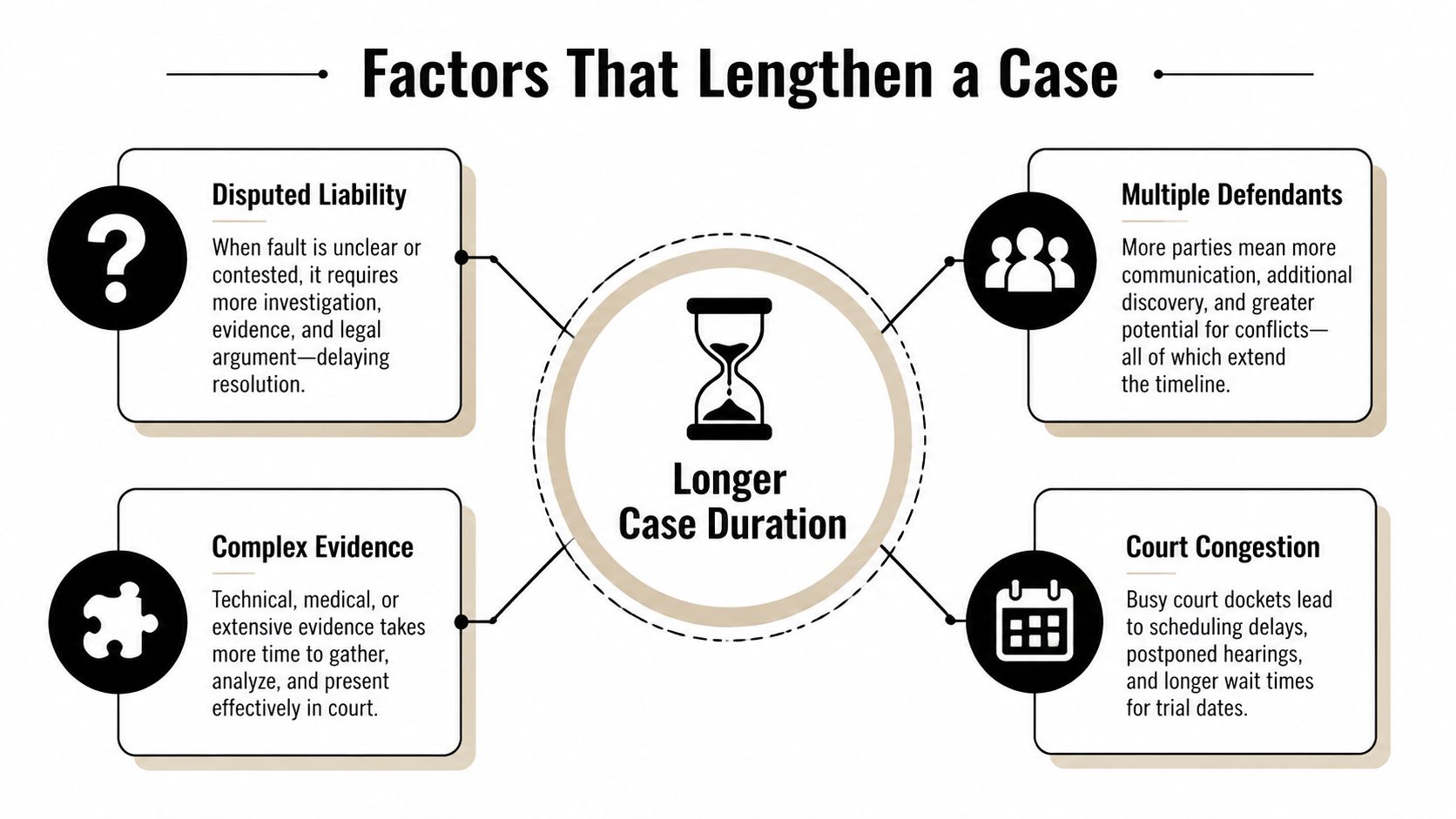
A long case does not automatically signal a weak claim. The defense may dispute fault, several parties may share responsibility, experts may need to examine technical evidence, or the court may lack an available trial date. Some delays also protect the family by giving counsel time to document lost income, household contributions, medical costs, and the broader consequences of the death.
Expect bursts of activity followed by quiet periods. Document exchanges, court scheduling, expert preparation, estate administration, and settlement discussions can each create pauses. Ask the attorney what has been completed, what remains pending, whether another proceeding is affecting the case, and which delay the legal team can control.
The Stages of a Wrongful Death Lawsuit
Each stage follows a defined sequence, but the time it consumes depends on the evidence, the defense strategy, estate administration, and the court's calendar.
Investigation and case preparation
Before filing, the attorney investigates the death and tests whether the evidence supports a claim. That work may include reviewing crash reports, medical records, photographs, electronic records, employment information, witness accounts, and insurance coverage. Vehicle and truck cases can require vehicle data, maintenance records, driver logs, corporate policies, and available video.
The family may need to identify witnesses, provide financial records, explain household responsibilities, and locate documents. If the cause or circumstances of death remain disputed, discuss whether a private autopsy for a wrongful death claim is appropriate. Families seeking background on that option can review private autopsies for wrongful death claims.
Filing and the defendants' responses
The personal representative or another legally authorized representative files the complaint. Defendants receive the lawsuit and respond. They typically have about 20 to 30 days to respond, although procedural rules and extensions can change that period (Folkman Law).
The complaint does not force the court to move immediately. Service problems, motions, jurisdictional questions, scheduling conflicts, and estate issues can delay the first meaningful case deadlines. Families can review the filing process in this guide on how to file a wrongful death claim.
Discovery
Discovery is often the longest stage. The parties exchange documents, send written questions, request admissions, take depositions, and evaluate expert opinions. Legal summaries describe discovery as often lasting 6 to 12 months or longer, especially when liability is contested or expert testimony is required (Global Law Experts).
Family members may answer questions under oath about the deceased, household finances, medical history, and the effects of the loss. The process can feel intrusive, but it exposes the evidence before trial and gives both sides a grounded basis for settlement.
Mediation, settlement, or trial
Mediation usually becomes productive after the parties understand the central evidence. One independent legal source reports that about 75% of litigated cases resolve at mediation, often around 9 months after filing in that firm's experience (Fasig Brooks). That result reflects the cited firm's experience, not a universal outcome.
If mediation fails, counsel prepares motions, witnesses, exhibits, and trial arguments. Trial dates may take 12 to 18 months to obtain, and the trial itself commonly lasts 1 to 4 weeks (Fasig Brooks). A related criminal prosecution or an appeal can extend final resolution beyond the civil trial judgment.
Factors That Lengthen a Wrongful Death Case
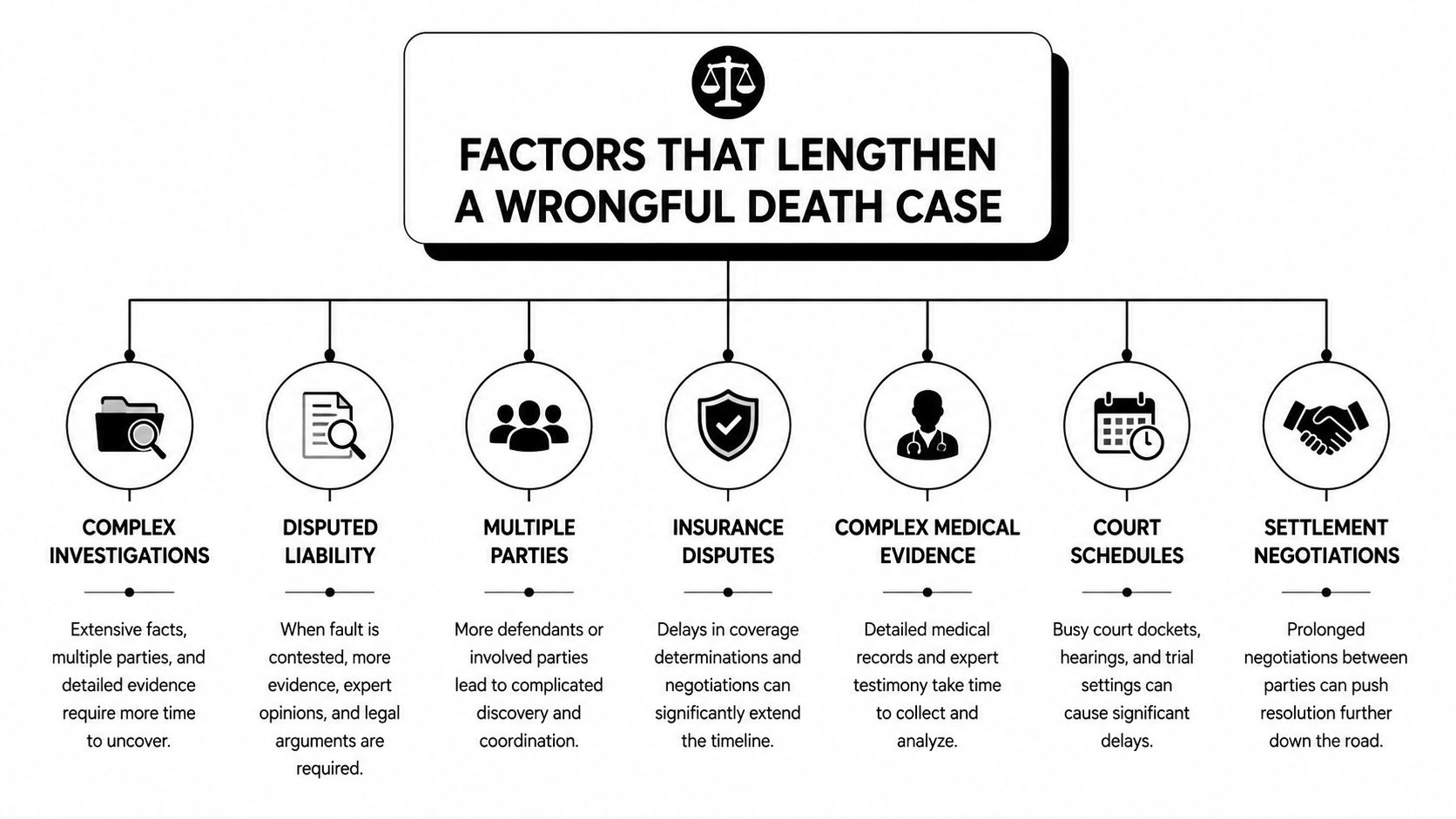
A wrongful death case can stall even when the family has strong evidence. The quiet bottlenecks are usually disputed facts, estate administration, insurance tactics, and crowded court calendars. Each unresolved issue can prevent counsel from valuing the claim or pursuing the right defendants.
Liability disputes create investigation layers
If the defendant accepts responsibility, the parties can focus sooner on damages. If the defense blames the deceased, another driver, a medical provider, a property owner, or an employer, your attorney must test each account against admissible evidence.
A truck wreck may require review of driver conduct, carrier supervision, vehicle maintenance, loading, roadway conditions, and other motorists' actions. Each theory can add witnesses, records, depositions, and expert questions. Parallel criminal proceedings can also slow access to evidence or encourage civil counsel to wait for developments that may affect the liability analysis.
Multiple defendants multiply the procedural work
More defendants mean more lawyers, document requests, scheduling conflicts, and settlement positions. One defendant may seek dismissal while another shifts blame. An insurer may wait for the other defendants to reveal their positions before making a meaningful offer.
Estate administration can create another delay that families often overlook. The proper personal representative may need authority to bring or resolve the claim, and settlement proceeds may require coordination with the estate, beneficiaries, liens, or related claims. Your lawyer must protect the case against every responsible party without releasing one defendant before the family understands the total recovery available.
Experts and damages require careful preparation
Accident reconstructionists, medical experts, vocational professionals, economists, and other specialists may be needed to explain disputed issues. They must review records, test competing explanations, and prepare opinions that can withstand cross-examination.
Damages can broaden the investigation. Counsel may need evidence of lost earnings, household services, future support, medical consequences, and the practical effects of the death. The defense's objections determine how much documentation and expert support the claim requires.
Insurance tactics can extend negotiations
Insurers may request records in stages, repeat questions already answered, dispute coverage, or delay a meaningful offer until they receive every expert opinion. These steps can be legitimate, but they can also keep the family from learning whether the insurer intends to negotiate seriously.
Set firm deadlines for responses, document every request, and ask counsel to identify what information is necessary. Do not accept a low offer because the process has become exhausting. Court congestion remains a separate bottleneck after filing, and a case may take 2 to 4 years or more when settlement fails and extensive pretrial work combines with a crowded docket (Folkman Law).
Settlement vs Trial Timeline Comparison
A settlement may end the case sooner than a trial, but speed alone does not make an offer fair. An early proposal can arrive before the family understands lost support, future earning capacity, medical consequences, and other damages. Counsel should evaluate the evidence and the full damage picture before recommending acceptance.
Mediation may occur around 9 months after filing in some litigated cases, based on one firm's reported experience (Fasig Brooks). The case can resolve before mediation, during it, or afterward, when depositions reveal weaknesses in the defense. Families comparing settlement timelines can also review this discussion of how long to settle a car accident claim.
| Factor | Settlement | Trial |
|---|---|---|
| Typical timing | May resolve after investigation, filing, discovery, or mediation. | Usually takes longer because of motions, trial preparation, and court scheduling. |
| Court control | The parties decide whether to accept or reject an offer. | The court sets the trial date, and a trial-ready case may wait 12 to 24 months for a date. |
| Outcome | The family accepts a negotiated amount and avoids the uncertainty of a verdict. | A judge or jury decides disputed issues, but the result remains uncertain. |
| Evidence needed | Discovery should establish liability, damages, and a strong basis for evaluating the offer. | Counsel must prepare every material fact, witness, document, and expert for courtroom use. |
| Emotional burden | The family may avoid testimony and the public exposure of trial. | Family members may face testimony, cross-examination, and a longer period of uncertainty. |
| Finality | A properly drafted agreement generally resolves the released claims. | Post-trial motions or an appeal may delay final distribution. |
A trial may also take longer because the court controls the schedule, not the parties. That delay should be weighed against the additional preparation, uncertainty, and emotional burden.
My recommendation is direct: don't accept a settlement merely because the case has become exhausting. Ask what evidence supports the offer, which damages remain disputed, whether all responsible parties have been evaluated, and how much time a trial would realistically add. Your attorney should explain the financial tradeoff and the time tradeoff in plain language.
Hidden Delays Most Articles Overlook
A family can provide the records, answer discovery requests, and prepare for trial, yet the case may still sit for months. The delay often comes from the system around the lawsuit, not from a failure to develop the evidence.

Court congestion can control the final stretch
A trial-ready case may wait 12 to 24 months just for a court date. During that time, attorneys may update expert opinions, respond to new issues, and continue settlement discussions. To the family, the case can look inactive while it is waiting for courtroom space.
Court congestion can also extend the overall process when post-trial proceedings or an appeal follow the verdict. Ask your attorney to identify the source of the current delay: unfinished evidence, opposing counsel, estate administration, or the court docket. Each problem calls for a different response.
Estate administration can come first
A wrongful death claim generally requires a legally authorized representative to act for the estate or eligible survivors. If the family has not appointed the proper personal representative, counsel may be unable to file or may need to coordinate the civil lawsuit with probate proceedings.
The appointment can become difficult when relatives disagree, the will is unclear, assets are located in different places, or no one is available to serve. Opening or administering the estate does not remove the need to protect the filing deadline. It adds a separate legal task that should begin promptly.
Keep the civil claim and the estate process organized together. Delays in probate can affect who may approve a settlement, receive funds, or provide instructions to counsel.
A criminal case can change the civil timeline
A DUI, vehicular homicide, or other criminal prosecution may proceed alongside the civil claim. Investigators and prosecutors may control access to evidence, witnesses may be unavailable, and the civil attorney may need to avoid actions that interfere with the prosecution.
Some jurisdictions apply special rules when a criminal case is connected to the death or when appointment of a personal representative is delayed. Guidance from JJS Justice describes possible pauses lasting 6 years in criminal-linked cases and 5 years for delayed estate appointment in Georgia (JJS Justice). Those rules are jurisdiction-specific. Do not rely on a general timeline without advice based on your state and facts.
A quiet case is not necessarily a weak case. It may be waiting for a court, a personal representative, or evidence controlled by a parallel proceeding.
Colorado Statute of Limitations and Filing Deadlines
A family may still be investigating the death when Colorado's filing deadline begins to close. For many wrongful death claims, the ordinary window is about 2 years from the date of death. That deadline concerns filing the lawsuit, not completing settlement or trial.
Colorado claims do not all follow one rule. The deadline may change based on the defendant, the circumstances of the death, the claimant's identity, or a special statute. Claims against a government entity can involve separate notice and filing requirements. A minor claimant may also receive different treatment under applicable law. Do not assume an exception applies. Have a Colorado attorney review the facts and defendant before relying on any deadline.
Protect the claim before investigating every detail
You do not need every answer before contacting counsel. You do need to preserve the right to investigate and file. An attorney can secure accident evidence, send preservation requests, identify witnesses, obtain medical and employment records, and coordinate the estate process.
Gather the death certificate, police or incident reports, insurance information, medical and employment records, and any probate documents. Keep communications with insurers limited until counsel advises you, especially if an adjuster requests a recorded statement or broad medical authorization.
Filing early protects more than the deadline
Evidence disappears. Vehicles may be repaired or sold, surveillance footage may be overwritten, witnesses may relocate, and memories may change. Early preparation gives counsel time to identify every potentially responsible party and address government-claim procedures, minor-claim rules, and estate authority before deadline pressure takes over.
Read this guide to the wrongful death lawsuit statute of limitations and arrange a consultation promptly. The statute of limitations is a legal deadline, not a planning suggestion. A timely filing also preserves the family's ability to pursue evidence and negotiate from a stronger position.
How the Right Legal Team Protects Your Time and Future
You can't control every court delay, defense tactic, or criminal proceeding. You can control how early the investigation begins, whether evidence is preserved, whether the estate is properly organized, and whether your lawyer prepares the case for trial instead of waiting passively for an offer.
An experienced wrongful death attorney coordinates records, expert analysis, insurance communications, estate issues, discovery, mediation, and trial preparation. That structure keeps the legal burden away from the family while preserving informed decisions about settlement and timing.
Nares Law Group LLC handles wrongful death matters through investigation, medical treatment coordination, negotiation, settlement, and trial, with a focus on helping Colorado families understand what happens next. The firm's approach combines compassionate communication with preparation designed to hold negligent parties accountable.
If your family has lost someone because of another person's negligence, Nares Law Group LLC offers a free consultation to review the deadline, hidden procedural delays, available evidence, and likely path toward settlement or trial. Contact the firm promptly so you can protect your rights before estate issues, fading evidence, or court scheduling makes the process harder.