The bumper has a scratch on it and a cracked plastic clip. The body shop quotes two days and a few hundred dollars. You felt fine at the scene, answered the officer's questions, drove home, and slept. Two mornings later your neck has stiffened into something that makes reversing out of the driveway a two-handed job, and the headache behind your eyes hasn't quit since Tuesday.
That gap between the crash and the symptoms is where most whiplash claim after car accident cases are won or lost. Not at the scene, not in the repair shop, and usually not in the emergency room either. The claim turns on what gets written down, when, and by whom, and on whether you protect the deadlines while the medical picture is still forming.
How a Whiplash Claim Moves From Crash to Settlement
A low offer shows up with a photo of a barely marked bumper, as if the scuff were the injury. You felt a jolt, then a neck that is stiff on some mornings and almost quiet on others. The adjuster is not scoring the plastic. The adjuster is scoring whether the file shows those ups and downs, and what they cost you at work and at home.
People filing these claims often meet the process backwards. They call the insurer, accept a repair number, and only afterward ask whether anyone should have examined the neck. Put the medical record first. Every later decision sits on it.
The Eight Steps in Order
- Get a clinical exam within the first days. See a doctor, urgent care, or your primary provider even if the pain feels mild. That first exam is the baseline later notes get measured against. Without it, there is nothing to compare change to.
- Report the crash to both insurers. Notify your own carrier and the at-fault driver's carrier promptly. Keep the statement short and factual: date, location, vehicles, and injuries as you understand them today. You can add detail later. You cannot easily take a statement back.
- Start a symptom diary tonight. Log pain on a 0 to 10 scale, sleep, headaches, dizziness, and the tasks you could not finish, such as carrying laundry upstairs or checking a blind spot. Symptoms that come and go still count, but only if the diary shows the pattern. A quieter Thursday does not erase a bad Monday.
- Collect the paper trail. Get the police report number, photograph the scene and both vehicles, save the repair estimate, and write down witness names and numbers before they go cold. Photos of light damage help show what happened. They do not set the value of the injury.
- Follow the treatment plan without gaps. Attend every appointment and reschedule rather than cancel. Insurers read a three-week gap in care as three weeks without injury. You will spend the rest of the claim explaining that silence.
- Track the money. Keep receipts for co-pays, rides, parking, and anything you bought to manage symptoms, plus a running tally of hours missed from work. Those figures turn "my neck hurts" into a loss someone can add up.
- Wait for stability before anyone values the claim. An adjuster cannot price symptoms that are still swinging week to week, which is why early numbers tend to be low. A release signed while the pattern is still forming freezes a figure based on one stretch of days, not the course of recovery.
- Send a demand package, then watch the calendar. The package pairs medical records with bills, wage loss, and your account of daily impact. If offers stall, a lawsuit has to be filed before the deadline, not after.
Here's how that path looks end to end.
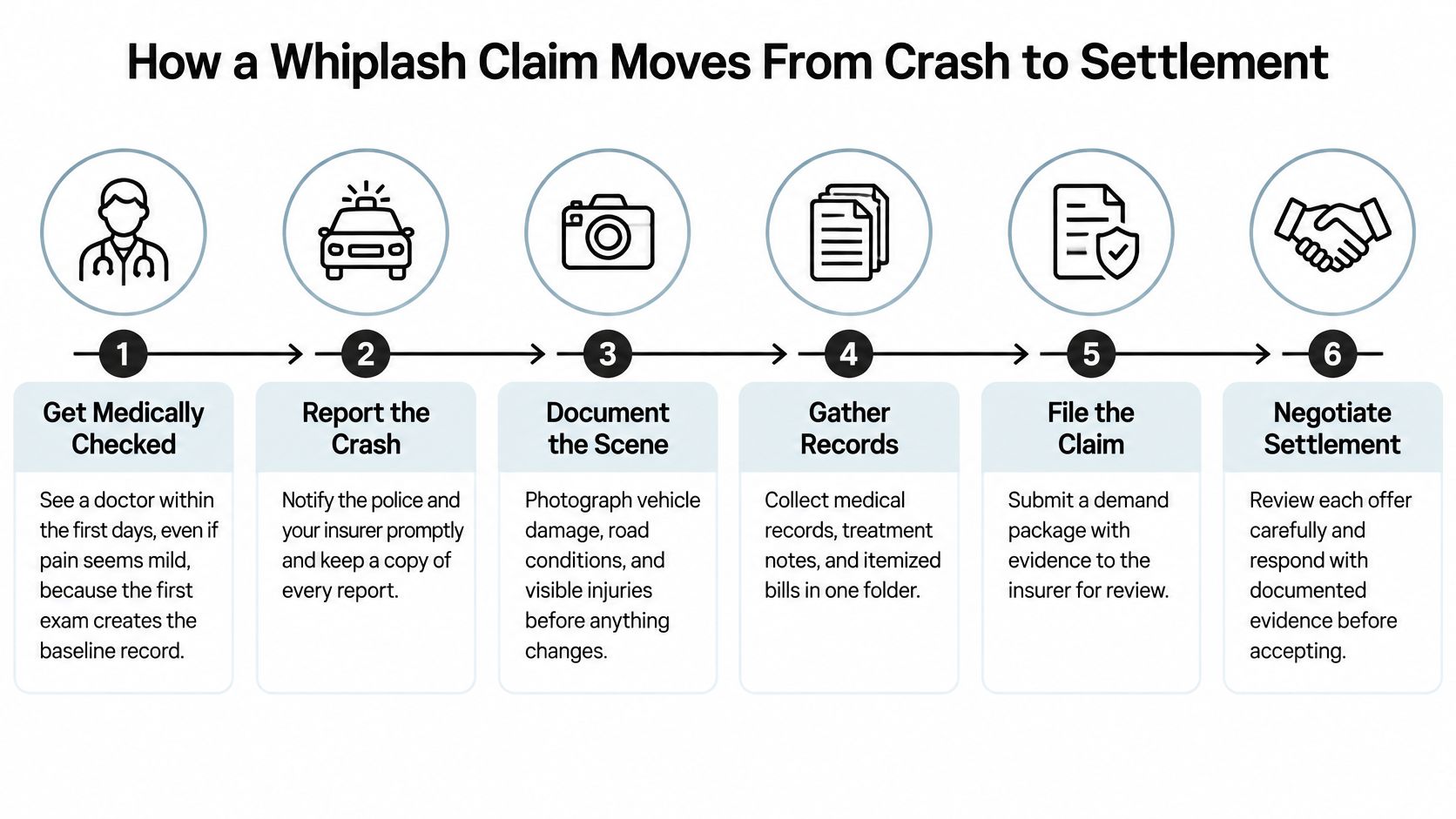
A claim usually cannot be valued until symptoms settle into a pattern a provider can describe. Signing a release while that pattern is still shifting can lock in a number that matches one week, not the recovery you have.
Timing rule: Treat any settlement offer that arrives before your provider gives a prognosis as an opening position, not a valuation.
Tonight, before anything else, write down four things: the crash report number, the name of the provider you will call, the date of your first appointment, and the first entry in a symptom log. That file, not the repair estimate, is what the claim will be judged on.
Medical Records That Prove a Whiplash Injury
Your medical file is the spine of the claim. It's the only evidence that carries a date, a clinician's name, and an objective finding sitting next to your symptoms, which is exactly what an adjuster needs to connect the crash to the pain.
| Timing | What to gather | Why it matters |
|---|---|---|
| Day of crash | Scene photos, police report number, witness names | Records the crash itself and who was present |
| Weeks 1-2 | Follow-up notes with pain level, range-of-motion findings, prescribed treatment | Shows symptoms are continuing and being treated |
| Month 3 onward | Specialist reports, prognosis, updated disability scores | Supports claims for long-term and future damages |
Read that table as a chain rather than a checklist. The day-of-crash material proves the event happened and who saw it. The early follow-up notes prove the symptoms didn't evaporate after a single visit. The later specialist material is what supports any claim for care you'll still need next year.
What to Ask Your Provider to Record
You don't need to script the appointment, but you can ask directly for the details that matter. Most clinicians will document them if you raise them.
- Onset and mechanism: say out loud that symptoms began after a rear-end collision on a specific date, and describe how your head moved.
- Objective findings: tenderness on palpation, measured range of motion, and neurological checks for reflexes, sensation, and grip strength.
- Functional limits: tell them you can't turn your head to reverse, can't lift your child, can't sit through a full workday at a screen.
- Sleep and mood: disrupted sleep and low mood are clinically relevant and belong in the note.
- Two scores that predict persistence: a systematic review of whiplash prognosis identified baseline pain above 5.5 out of 10 and a Neck Disability Index score above 14.5 out of 50 as particularly strong predictors of ongoing symptoms. Ask for both to be recorded at the first visit.
Where Claims Spring a Leak
Three weaknesses show up again and again. Notes that say only "neck pain" with no examination detail give an adjuster nothing to work with. Long gaps between visits invite the argument that you recovered and stopped going. Treatment that ends without a stated reason reads as a conclusion rather than an interruption.
Prior neck or back problems need to be disclosed, not hidden. An aggravated old injury can still be part of the claim, but only if the records separate what was already there from what the crash added. Keeping your records organized in one folder, with visits in date order, makes that separation visible; this guide to organizing medical records walks through a workable system.
If a fact isn't written in the chart, it's hard to prove later. Say it in the room, then check that it appears in the visit summary.
Why Whiplash Symptoms Can Appear Days Later
You drove home, slept through the night, and sat at your desk the next morning. By day three your neck locks when you check a lane, and a headache starts at the base of your skull and climbs. The car looks fine. That mismatch is why people wait to call.
A soft-tissue neck injury does not need a crumpled bumper to be real. A peer-reviewed study of 4,164 people injured in traffic collisions found that 37.7% experienced whiplash-associated disorders, and the authors note that symptoms can occur even when a vehicle has limited visible damage.

The delay follows a physical sequence, closer to a sprain that stiffens overnight than to a cut you see at the scene. Muscles guard and spasm. Inflammation builds over hours. The neck keeps compensating until it can't. A 2026 human-volunteer study of low-speed rear impacts measured real biomechanical loads and transient symptoms in healthy participants. Those findings undercut the assumption that minimal vehicle damage disproves injury. Symptoms after a rear-end crash can still be present more than four weeks later, and they do not affect men and women at the same rate.
Logging a Condition That Changes Daily
A fluctuating injury is the hardest kind to document, because a good morning doesn't erase a bad evening. Later review weighs what you wrote about symptoms and daily limits, not how little the bumper moved. Record the onset date, then note changes rather than averages.
- Triggers: driving, prolonged sitting, screen work, housework, carrying a child on one side.
- Missed activities: the workout you skipped, the shift you left early, the social plan you cancelled.
- Bad days in detail: what you couldn't do, for how long, and what you took or applied to manage it.
- Recovery attempts: rest, heat, ice, and stretches all count. SunnyBay heat and ice guidance can help you apply them sensibly and note what worked.
One afternoon can look ordinary and still belong in the log. You drove to work, left a meeting early because turning your head set off the headache, skipped carrying groceries, and used ice for twenty minutes. That entry shows impact better than "neck felt off."
Symptoms often surface after the repairs are finished or after you've returned to work, which is precisely when an insurer may point to your normal early activity as proof you weren't hurt. Normal activity in the first 48 hours doesn't disprove a condition that developed on day three. If new symptoms appear, call your provider the same day and confirm the conversation in writing, whether that's a patient-portal message or an email summary.
The video below walks through the same question from the patient's side.
How Insurers Judge Evidence and Negotiate
The first offer often lands while you're still in treatment, sometimes within weeks of the crash. That timing isn't generosity. It's a bet that you'll take a number before anyone knows how long the symptoms will last.
What carries weight with an adjuster is unglamorous: the police report, scene photographs, witness statements, medical records, and the treating provider's own opinion about cause and prognosis. Those documents answer the four questions that decide most soft-tissue files. Did you seek care promptly? Do the records describe your symptoms specifically? Is the treatment consistent with those symptoms? And did the injury change your days and your work?
When the Scan Comes Back Normal
Normal imaging doesn't end the argument, and it shouldn't. Clinically meaningful symptoms routinely coexist with clear X-rays and MRIs, because whiplash is largely a soft-tissue and functional diagnosis. What fills that gap is contemporaneous examination findings, documented functional limits, a consistent treatment history, and reporting that doesn't shift from visit to visit.
The United Kingdom's post-implementation review of its Whiplash Reform Programme makes the point sharply. The review examined what counts as acceptable medical evidence, who provides medical reports, and the prohibition on making or accepting settlement offers without medical evidence at all. It also reported insurer estimates that the reforms cut motor insurance premiums by £31 per policy between 2021 and 2024. Those fixed tariffs tied largely to symptom duration don't apply to US claims, but the underlying lesson travels: when a system tightens, disputes migrate to the quality, timing, and independence of the clinical record.
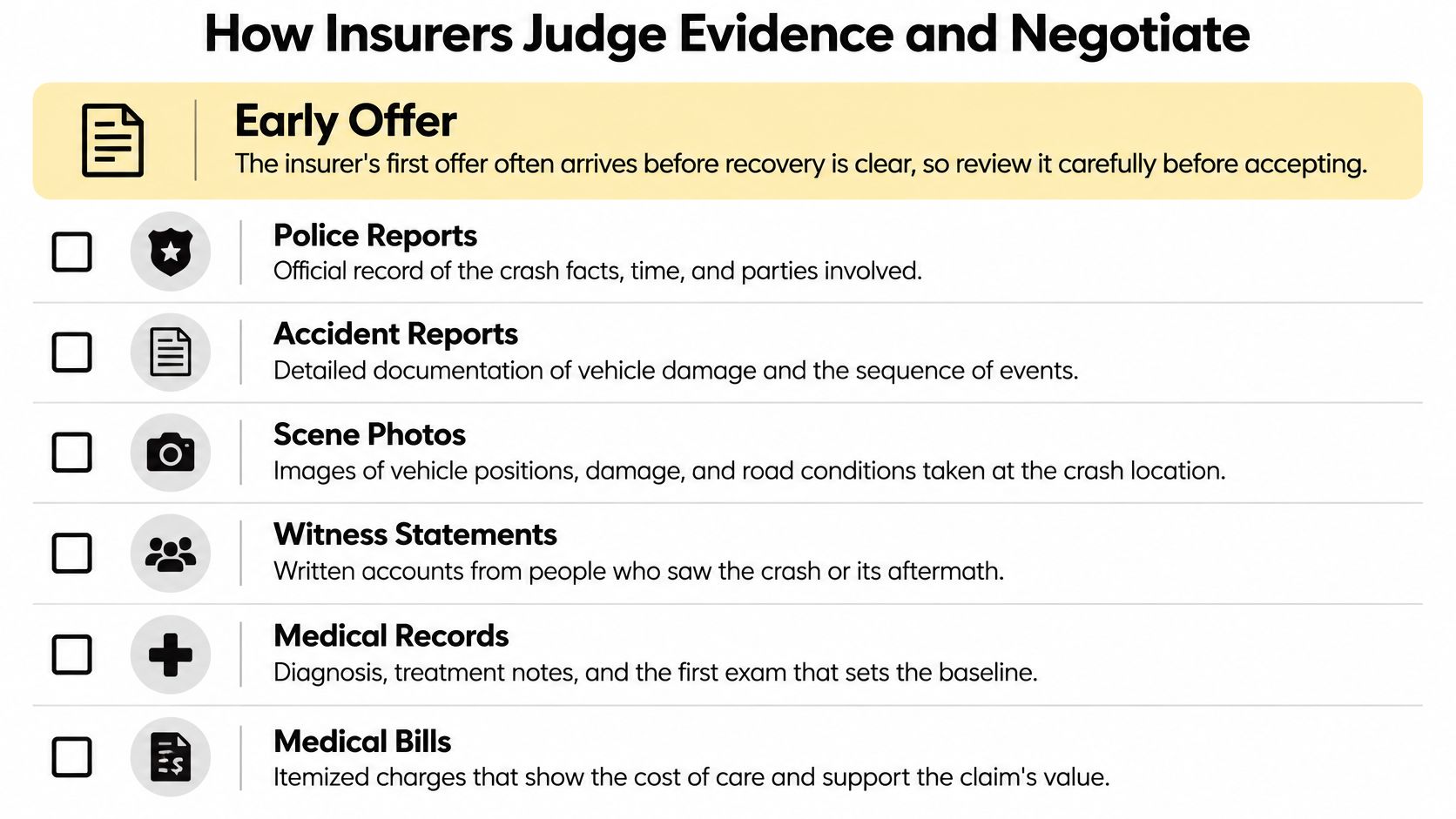
Expect specific tactics. A recorded statement request early, when you're least prepared. A broad medical authorization that lets the insurer pull your entire history rather than the crash-related records. An independent medical exam scheduled months after the crash with a doctor you've never met. None of these are traps in themselves, but each one rewards a claimant who has the file organized.
Negotiation checklist: don't sign a release until the prognosis is reasonably clear, request the complete record set before responding, compare every offer against your documented losses line by line, and ask for a written reason whenever a figure gets reduced.
Building that file is investigative work. It means pulling medical records, accident reports, witness statements, and expert opinions so liability and damages rest on documents rather than assertions, which is the work we do at Nares Law Group before a demand ever goes out.
What Drives Whiplash Compensation Value
Whiplash damages fall into a few recognizable buckets. Past medical costs are the easiest to total from itemized bills. Future medical costs depend on what your provider expects you'll still need. Lost wages and reduced earning capacity cover income you've already lost and income you may not be able to earn. Out-of-pocket expenses pick up the smaller items. Pain and suffering, sometimes framed as loss of enjoyment of life, covers what the injury took away from your days.
No formula converts those buckets into a number, which is why documented facts do most of the work. A car accident injury settlement breakdown shows how those categories get assembled into a demand. Recovery varies enormously: a UK emergency-department study of whiplash injuries cited figures indicating about 50% of people with whiplash-associated disorders had not recovered by three months, while a review of whiplash prognosis reports that roughly 25% to 40% of patients continue to experience symptoms one year after injury.
Why the First Three Months Matter Most
Prognosis can often be estimated early. The same review notes that patients still symptomatic at three months are more likely to have symptoms two years or longer, and reports an 82% success rate for predicting two-year outcomes using neck stiffness plus a psychological assessment at three months. That's why the records from your first twelve weeks carry disproportionate weight: they're the closest thing to a forecast anyone has.
| Factor | How it moves value | Evidence needed |
|---|---|---|
| Length of documented treatment | Longer, consistent care usually supports higher value | Provider notes and itemized bills |
| Work impact | Missed or reduced work increases economic loss | Employer letter, pay stubs, time records |
| Daily functional limits | Restrictions on daily tasks shape non-economic damages | Activity log, disability scores |
| Prior neck problems | Aggravation of a prior condition can still be part of the claim | Pre-crash records separating old and new symptoms |
| Gaps in care | Gaps invite disputes over causation and reduce value | Appointment history with reasons for any gaps |
| Future care needs | Ongoing treatment can add to future damages | Specialist prognosis and treatment plan |
Three things weaken an otherwise genuine claim: unexplained gaps in treatment, symptom descriptions that change without explanation, and no work record at all. An insurer reads the first as recovery, the second as exaggeration, and the third as no economic loss. None of them mean the injury isn't real. They mean the file doesn't show it.
Persistent symptoms are clinically ordinary, not a character flaw. Fear of movement and low mood can slow recovery, and clinicians document them as factors that affect prognosis, not as evidence that anyone is inventing anything.
Claim Deadlines You Cannot Miss
Every injury claim has a clock on it. The statute of limitations is the legal deadline for filing a lawsuit, and in most cases it starts running on the date of the crash, not the date you realized you were hurt.
| State | Typical filing period | Notes |
|---|---|---|
| Colorado | Two years from the injury | General limit for most personal injury suits |
| Texas | Two years from the injury | Same general period; confirm exceptions |
| New York | Three years from the injury | Shorter notice rules may apply to government defendants |
Deadlines That Move Earlier Than You Expect
Two things routinely catch people out. First, claims against a government entity, a city bus, a municipal vehicle, or a public employee often require a formal notice of claim within a much shorter window than the lawsuit deadline, sometimes measured in months. Miss the notice and the claim can be barred even though the filing period hasn't expired.
Second, insurance policies and claims processes impose their own reporting requirements that have nothing to do with the courthouse. Notify your carrier promptly even when liability seems obvious, and keep a copy of everything you send.
Some states allow more time when an injury isn't discovered immediately. Don't build a plan around that exception. Delayed discovery arguments are contested, fact-specific, and expensive to litigate, and they won't rescue a claim where the crash itself was reported on day one.
Three practical steps:
- Write the crash date at the top of a calendar and count forward to the filing deadline, then subtract two months as your working target.
- Ask whether any potential defendant is a public entity, and if so, calendar the notice deadline separately.
- Keep every insurer email, letter, and portal message in one folder, because disputes about what you were told and when are common.
These periods are general guidance. The exact rule depends on the state where the crash happened, who the defendant is, and the type of claim, so confirm the deadline that applies to you before relying on any table, including this one. A statute of limitations overview for personal injury cases covers how the analysis changes.
Decide Whether to Get a Free Case Review
A case review is worth the hour when any of these is true. Fault is being disputed even though the crash wasn't your doing. Symptoms have lasted past a few weeks instead of fading. You've lost shifts, hours, or a contract. An offer arrived early and looks small next to your bills. Someone is asking you to sign a release before your provider has given a prognosis.
A free consultation is a working session, not a sales pitch. You bring the crash report, the records you have, and your symptom log. The attorney answers your questions, reviews the file, and explains the practical options, including the option of handling it yourself.
We offer a free consultation for auto accident cases in Colorado, and during that conversation a personal injury attorney answers questions, puts together a case, and pursues the compensation you deserve.
Ask any attorney three things before you decide: how they handle medical documentation and treatment coordination, how they approach insurer negotiations and what happens if talks stall, and what their fee structure is. The answers tell you more than a website does.
Your next step is concrete. Start the symptom log tonight, list every deadline that applies to your crash, gather the records described above in date order, and schedule a consultation before you sign anything an insurer sends.
Nares Law Group LLC represents people injured in car accidents, truck wrecks, and other collisions throughout Colorado, and we build each whiplash case around the medical record rather than the repair estimate. If your symptoms appeared late, if an adjuster is already pushing a number, or if a release is sitting unsigned on your kitchen table, we can review where the claim stands and what the deadlines require. Visit Nares Law Group LLC to schedule a free consultation and get a clear answer before the clock runs down.