Your rent is due on the first, your bank balance just missed Friday's direct deposit, and your doctor told you to stay off your feet for at least two weeks. Meanwhile, your supervisor is texting to ask when you'll be back on the schedule. Learning how to claim lost wages from car accident injuries feels urgent because the bills don't pause while your neck or back heals.
That sudden income gap hits millions of households every year. According to the National Safety Council motor-vehicle overview, U.S. motor-vehicle crashes in 2024 caused 4.9 million medically consulted injuries and an estimated $559.3 billion in total costs, including wage and productivity losses.
Insurance adjusters don't pay rough estimates or verbal explanations. They pay verified paper trails. When you tie every single dollar claimed to a specific record the insurer already holds or can confirm directly, you strip away the excuses carriers use to delay or discount a check. Every claim still depends on its facts and governing state law, so building a tight file from day one gives you the strongest footing.
What Lost Wage Claims Cover and the Proof Each Needs
Say a warehouse worker misses six weeks after a rear-end collision, pulls out her most recent pay stub, and asks the insurer to cover only her missed base shifts. She leaves real money behind. That single stub ignores the regular weekend overtime she worked all year, the paid time off she burned to cover groceries, and the two weeks she spent on light duty at cut hours.

Lost earnings represent a massive piece of crash-related financial harm. The NHTSA economic impact report estimated that U.S. traffic crashes cost approximately $340 billion in 2019, covering lost productivity, workplace losses, medical bills, property damage, and related expenses. In that model, "market productivity" reflects the present value of lost wages and benefits across an injured person's remaining working life, not just a few missed paychecks. The same report estimated that auto-insurance compensation for productivity losses in 2019 reached $34.6 billion, or roughly 33% of total productivity losses.
Matching Each Income Category to Its Paper Trail
Those national numbers aren't a formula for your individual payout, yet they prove why you need to look beyond base pay. A thorough wage claim separates every stream of lost income and pairs it with hard proof. For an additional breakdown of how earnings losses are categorized across different employment structures, Lighthouse Consultants offers a helpful primer on claiming for lost wages explained.
| Loss type | What it covers | Proof to collect |
|---|---|---|
| Past wages | Pay for shifts missed from the crash until return to work | Pay stubs, payroll ledger, employer absence record |
| Overtime and bonuses | Extra pay you regularly earned before the crash | 12 months of overtime history, bonus plan letter |
| Lost benefits | Health coverage, retirement match, paid leave used | Benefit statements, PTO ledger |
| Reduced hours or duties | Shifts cut or restricted to lighter work | Schedule history, doctor work restrictions |
| Future earning capacity | Reduced ability to earn across your remaining career | Medical prognosis, vocational or economic report |
| Self-employment income | Net profit lost from your business | Tax returns, invoices, bank deposits |
Documenting past lost wages is far more straightforward than proving future earning capacity. Past losses rely on fixed calendars, payroll entries, and signed return-to-work notes. Future losses require medical opinions projecting permanent limits alongside vocational or economic reports showing how your career ceiling dropped.
Start by reviewing the six rows above and circling every category that applies to your work life. Open one dedicated folder (physical or digital) for each category before you ask an employer or clinic for a single page.
How to Document Missed Work Before You File
Your schedule shows a missed shift, but your pay stub includes sick leave and your doctor's note starts the following day. Those records need reconciling before you attach a dollar amount. Each claimed loss should connect to a scheduled shift, payroll evidence, and a medical restriction.
Absences can extend beyond your initial expectations. A historical Bureau of Labor Statistics analysis cited in the NHTSA traffic crash cost study reported 51,000 nonfatal highway injuries in 1994, with a median absence of 10 workdays, rising to 14 workdays for jackknifed or overturned vehicles, 12 days for fixed roadside object impacts, and 11 days for head-on collisions. Those historical workplace figures cannot establish your disability period. Your own records must do that.
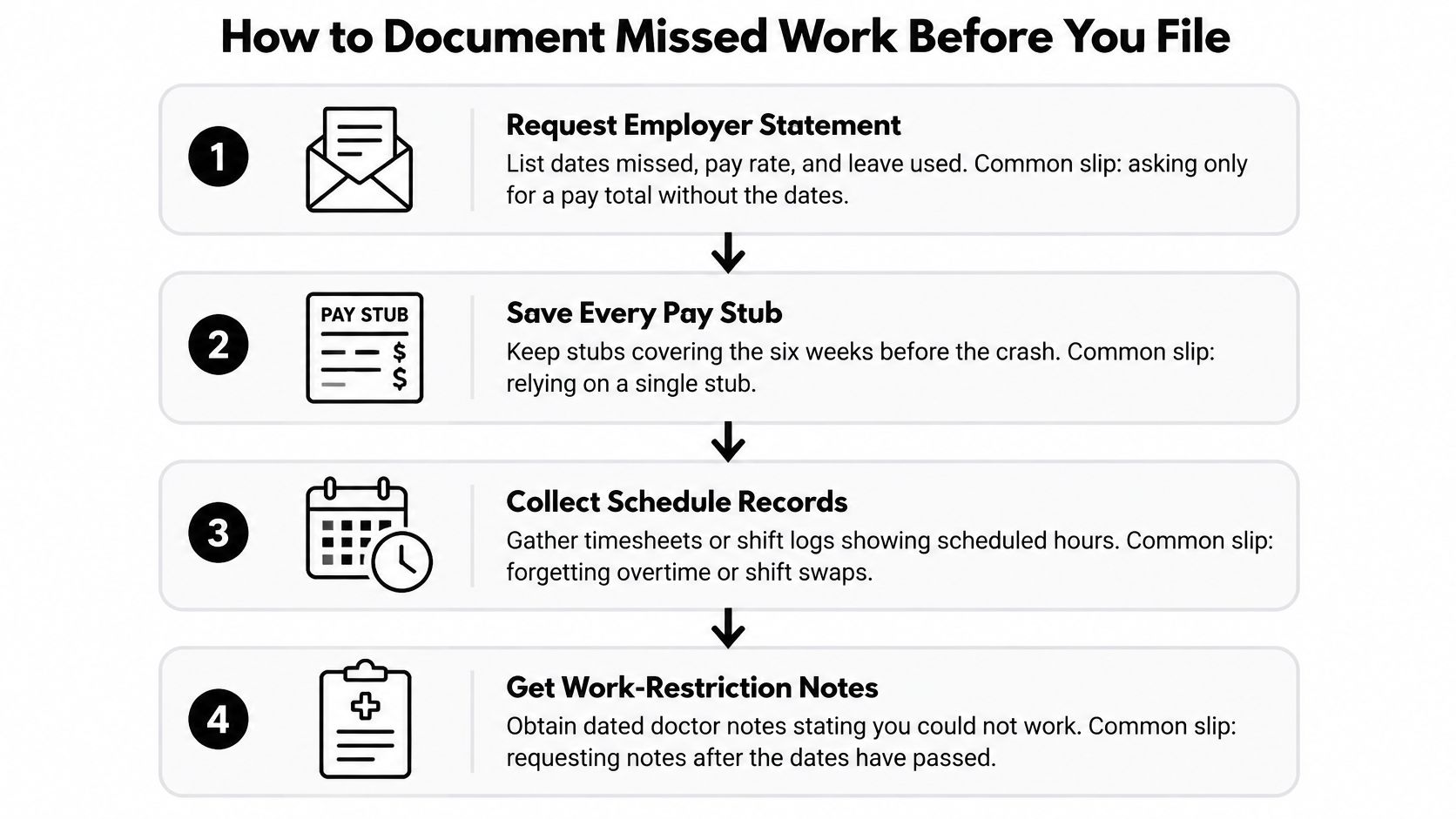
Organize the paperwork around four steps: gather earnings records, confirm work restrictions, log absences and payments, and audit the file. The seven records below support that workflow.
Seven Records to Lock Down Early
Request records while dates and schedule changes are still fresh:
Request a signed employer wage-verification letter. Ask HR or your manager to identify each date missed, regular and overtime pay rates, and accrued leave applied. A lump-sum total leaves the adjuster unable to check which shifts and rates support your request.
Pull 12 months of pay stubs plus W-2s or tax returns. These establish your earnings pattern, especially when commissions, tips, or hours fluctuate. Keep the underlying payroll records with the letter so its figures can be checked rather than accepted on trust.
Obtain a dated physician's work-status note. Ask for restrictions connected to your crash injuries, their start date, and a return or re-evaluation date. If the note says only “off work until further notice,” request clarification. Match the restriction period to the absences you claim.
Archive schedules, shift swaps, and supervisor texts. Save scheduling-app screenshots and timecards showing the shifts you were expected to work. Preserve changes as well as the original schedule; otherwise, a swapped shift can look like an unexplained discrepancy.
Maintain a contemporaneous daily absence log. Record each missed shift, the physical limitation preventing work, and reduced output after returning to modified duty. For freelance work or daily task tracking, BlokNotes on logging billable hours offers work-journal habits. Use the log to connect supporting documents, not replace them.
Track burned paid leave and replacement income. Record vacation and sick-leave hours used, along with short-term disability payments received. Keep these separate from unpaid absences so the file shows both time missed and payments received without treating them as interchangeable.
Audit every scan against the original page. Check dates, employer signatures, and dollar columns for legibility. Replace cropped or shadowed images before submission. Resolve conflicting dates with the employer or clinic rather than leaving the adjuster to interpret them.
What a complete file looks like: One master timeline sheet listing every missed workday in the left column, its matching payroll entry in the middle, and the dated doctor's work restriction on the right. Each dollar requested should trace back to those records.
How to Calculate Lost Income Without Guessing
Small arithmetic slips add up fast when an injury disrupts your career. The National Safety Council cost calculation guide estimated the average 2024 economic cost of a disabling motor-vehicle injury at $174,000, a figure combining wage and productivity losses, medical expenses, and administrative costs. Even on a shorter recovery, guessing your weekly average instead of proving it gives the insurance company an excuse to pick the lowest possible number.
Base every calculation on your normal earnings over a representative pre-crash stretch, never on your single best paycheck of the year. Remember that both completely unpaid shifts and shortened light-duty days belong in your totals. If your claim includes multi-year losses or complex benefit structures, our overview of how economic damages are calculated breaks down how past and projected losses fit together.
Wage Formulas by Pay Structure
Use the row that matches how you earn your living, and plug in verified numbers from your payroll or accounting records.
| Income type | Formula |
|---|---|
| Hourly employee | Hourly rate × scheduled hours missed |
| Salaried employee | Weekly salary × weeks missed |
| Overtime | Overtime rate × overtime hours normally worked × weeks missed |
| Commission | Average monthly commission × months missed |
| Self-employed | Average monthly net profit × months missed |
Notice the distinction in the bottom row. Self-employed workers claim net profit rather than gross revenue, meaning you subtract normal business expenses that didn't occur while you were sidelined, while still accounting for fixed overhead like shop rent or software subscriptions that kept running.
Once you finish the math for each applicable row, sum the categories into a single gross wage-loss total. Then run a strict cross-check against your physical pay stubs and tax returns. Verify that your hourly rate matches the stub dated right before the crash, confirm your weekly salary divides cleanly into your annual W-2, and verify that zero missed dates overlap with paid holidays you wouldn't have worked anyway.
Deadlines, Routing and Offsets to Check Before You File
Before you mail or upload a single page, confirm three structural rules. Getting any one of these wrong can shrink your recovery or push your claim past a hard cutoff.
- Confirm your state and policy deadlines: Every state enforces a statute of limitations for personal injury claims, and auto policies with no-fault or personal injury protection (PIP) benefits often require written notice on a much tighter timeline. Check your state's filing rule and your policy's notice clause right away, then put both dates on your calendar.
- Route the claim to the right insurer first: In a no-fault state, your own PIP or wage-replacement coverage typically pays the initial slice of lost income regardless of who caused the crash, up to policy limits. In a fault state, the at-fault driver's liability insurer pays the wage claim, though optional coverage on your own policy may still provide temporary relief. Pull your declarations page so you know which carrier opens the file first.
- Map every benefit offset transparently: Short-term disability policies, employer sick pay, health-plan benefits, and workers' compensation can reduce or coordinate with a liability wage payout to prevent double recovery. For example, if a $1,760 two-week wage loss was partially covered by $880 in employer sick leave, disclose that sick-leave payment upfront alongside your replacement-income records so the insurer doesn't flag the gap as duplicate billing.
Exact offset rules and reimbursement rights turn on the state where the collision happened and the fine print of each benefit plan. Write your filing deadlines, primary carrier contact, and every benefit offset on one summary page, then clip it to the front of your claim folder.
How to Submit the Wage Claim to the Insurer
Once your records are complete and routed to the correct carrier, timing matters. In most cases, wait to submit your full package until your treating doctor clears you for full duty or establishes a clear long-term prognosis, so you know the exact period of disability. If rent and groceries won't wait, submit a partial wage claim covering a defined cutoff date and state in writing that supplemental documentation will follow.
Reviewing your entire folder at once lets you catch missing signatures or mismatched dates before the adjuster ever sees them.

Ordering Your Submission Package
Stack your paperwork in the exact sequence a claims adjuster audits it, so they can check every dollar without hunting through loose pages:
- Itemized cover letter: Put your claim number, crash date, and policyholder name at the top, followed by a clean list of each loss category and the grand total requested. For detailed guidance on framing damages persuasively, review our walkthrough on writing a car accident demand letter.
- Employer wage verification: Place the signed HR or manager letter directly behind your cover sheet.
- Payroll and tax records: Arrange pay stubs, overtime ledgers, or self-employment profit records in chronological order.
- Medical restriction notes: Include every physician note tying your missed shifts or reduced hours to crash injuries.
- Calculation worksheet: Close the packet with your one-page math summary referencing the attached exhibits.
Send the complete file using certified mail with return receipt or a tracked online claims portal, keeping the assigned claim number in every subject line. Save an exact PDF duplicate of everything you transmit. If the adjuster calls requesting a recorded statement about your employment or missed shifts, I'd decline to answer off the cuff and ask to review your written records first so you don't misstate a date or hourly rate.
Follow-up discipline: Record the exact delivery confirmation date in your claim log, then send a brief written status check if you haven't received written acknowledgment within 10 to 14 business days.
Walking through how adjusters review paperwork can make the process feel less intimidating when you're preparing your packet.
Log every email, voicemail, and written response on the same dated sheet. Consistent tracking signals to the carrier that you're organized and paying attention to every deadline.
Insurer Objections and How to Answer Them
The most common pushback arrives in a short, impersonal letter stating your wage loss "isn't supported by the documentation provided." Many injured drivers read that sentence and assume the carrier won't pay. In practice, adjusters use broad rejection language to test whether you'll accept a quick discount instead of closing one specific evidentiary gap.
Decoding Adjuster Pushback
Most wage denials fall into five predictable buckets. Knowing what the adjuster is really testing lets you reply with targeted proof rather than frustration.
| Insurer objection | What it usually means | Your response |
|---|---|---|
| Pay records do not match claimed dates | Gap between claimed absences and payroll entries | Send the employer ledger and explain any unpaid days |
| Pre-existing condition | Old back or neck problems are blamed for the lost time | Provide pre-crash records and the treating doctor's causation note |
| You did not return to work | Insurer says you failed to reduce the loss | Show doctor restrictions and any light-duty offer you could not safely accept |
| You were active during recovery | Insurer claims your activity disproves the restriction | Document the reduced hours and the reason for each shift |
| Low lump-sum offer | The offer ignores future or reduced earnings | Request a written breakdown showing how the offer was calculated |
Look closely at how those disputes play out in real claims. A pre-existing disc bulge doesn't erase your wage claim if you were working full shifts pain-free before the crash and your physician confirms the impact aggravated that condition. Likewise, an employer's light-duty offer only counts against you if the proposed tasks fell inside your written medical restrictions.
Never argue with an adjuster's opinion when a document can answer it for you. Line-item proof forces a line-item counteroffer.
When a carrier refuses to budge despite solid paperwork, you're no longer just submitting forms; you're navigating an active coverage conflict. Understanding your options during an insurance dispute claim keeps you from surrendering valid compensation under pressure. During the investigation at Nares Law Group LLC, we collect medical records, accident reports, witness statements, and expert opinions to establish liability and damages, which is how disputed wage claims get resolved on the merits rather than guesswork.
Confirm Settlement Terms and Decide on Legal Help
Reaching an agreed dollar figure isn't the finish line. Tax treatment and release wording deserve careful attention before you pick up a pen. Under IRS guidance on settlements and judgments, compensatory damages received on account of personal physical injury or physical sickness, including an amount allocated to lost wages, are generally excluded from gross income under IRC §104(a)(2). That same guidance warns that payments representing true back pay or front pay can be treated as taxable wages subject to reporting and withholding, and economic-loss payments not caused by a personal physical injury may not qualify for the exclusion.
Audit Your Damages Schedule Before Signing
Before approving any settlement release, build a written damages schedule that cleanly separates every dollar into its true category: past wage loss, future earning-capacity loss, medical expenses, interest, punitive damages, and any employer or insurer reimbursement claim. Compare that sheet line by line against the draft settlement agreement. Make sure the agreement states the honest factual basis for every payment and never invents an artificial allocation purely to chase favorable tax treatment.
Run one final quality check across your claimed absences, confirming each missed day matches your medical restrictions, payroll records, pay rate history, and proof of non-duplicative benefits. Because individual recovery depends on causation, proof, limitation periods, offsets, and governing state law, sloppy release language can accidentally waive future claims or leave you on the hook for an unexpected reimbursement lien.
Four Signs an Attorney Should Review Your Offer
Handling a minor, cleanly documented two-week absence on your own can make sense when fault is undisputed. Stepping back to get legal eyes on the paperwork is usually the smarter call when any of these conditions show up:
- Disputed liability: The other driver's insurer argues you share blame for the wreck, slashing your wage recovery by a disputed fault percentage.
- Extended disability: Your time off stretches across months of surgery, physical therapy, or uncertain return-to-work milestones.
- Diminished future earning capacity: Permanent medical restrictions force a career change, lost certifications, or reduced weekly hours over the long run.
- An offer far below your schedule: The carrier's check ignores documented overtime, benefits, or self-employment profit without giving you written math.
If you're weighing whether an insurer's offer reflects what you lost, we offer a Free Consultation for auto accident cases in Colorado so an attorney can review your records and explain your options. You can also get an early framework while gathering your files by testing our four free settlement calculators: the Wrongful Death, Brain Injury, Truck Accident, and Motor Vehicle Accident Case Estimator.
One rule before signing: Do not sign a settlement release until every dollar on your personal damages schedule matches the exact wording and payment terms in the final agreement.
When a crash interrupts your paycheck, Nares Law Group LLC helps injured clients organize wage records, challenge lowball adjuster math, and pursue full compensation for both past missed shifts and long-term earning losses. Our Denver-based team handles motor vehicle accidents, truck wrecks, brain injuries, and wrongful death across Colorado while fighting to protect your financial stability at every step. Visit Nares Law Group LLC to explore our free case estimators or schedule your Free Consultation today.