The driver who crossed the lane line is usually the one officers assign fault to in lane-change crashes, but that's a starting point, not a verdict. Shared fault matters. Lane occupancy, sequence timing, blind-spot evidence, and vehicle data can change how an insurer or court views blame.
The practical question isn't whose car hit whose. It's who entered occupied space, when that space became occupied, and whether either driver had a reasonable opportunity to prevent the collision. A useful lane change accident fault investigation answers those questions before anyone accepts an insurer's allocation of blame.
Who Is Usually at Fault in a Lane-Change Crash
The lane changer usually starts out blamed. An Alabama transportation-safety analysis described in NHTSA's lane-change crash research reported that officers assigned fault to the driver changing lanes in slightly more than 95% of lane-change crashes. That's a historical finding about officer assignments, not a nationwide legal presumption or a prediction of your claim.
The distinction matters. An officer might correctly identify who crossed the line without having enough information to determine whether the other driver accelerated, approached at an unsafe speed, or also moved laterally. Treat the initial assignment as a working explanation that must fit the evidence.
These aren't fringe collisions. A historical NHTSA synthesis of lane-change crashes estimated that they accounted for roughly 4% to 10% of all crashes. That range describes historical U.S. estimates, not a current crash count.
Match the maneuver before arguing blame
The following outcomes are investigation starting points, not guaranteed legal results.
Lane-change crash scenarios and typical fault outcomes
| Crash scenario | Usual fault outcome | What usually decides it |
|---|---|---|
| Driver changes lanes into a vehicle already in that lane | Lane changer | Other vehicle already occupied the lane when lateral movement began |
| Freeway merge where both cars enter the same lane at once | Potentially shared | Which car established the lane first and which moved second |
| Lane changer signals and moves, forcing the adjacent driver to brake or swerve | Lane changer | Whether the available gap allowed a safe entry |
| Blind-spot drift without a signal | Lane changer | Evidence of lane-boundary crossing and visual checks |
| Adjacent driver speeds up to block a signaled lane change | Potentially shared | Proven acceleration, its timing, and the lane changer's gap judgment |
| Commercial truck changes lanes and clips a car | Truck driver, but fact-specific | Blind-zone visibility, signal timing, fleet cameras, and telematics |
| Two vehicles sideswipe in a construction lane closure | Potentially shared, with roadway contribution investigated | Lane markings, warning signs, and temporary configuration |
| Lane changer is struck by a vehicle traveling well over the limit | Potentially shared or reduced responsibility | Approaching vehicle's speed and whether it changed collision avoidability |
Don't read “potentially shared” as an automatic equal split. It means investigators must test competing explanations rather than assign responsibility solely from the fact that a driver crossed a line.
Starting point, not shortcut: Identify who moved laterally, then ask what the other driver was doing before that movement began.
A vehicle can be struck along its side while its driver is making the unsafe move. Conversely, a driver can cross a line while reacting to someone else's dangerous maneuver. Where both cars were moving into the same space, the strongest case usually belongs to the driver whose account matches the sequence, not the driver who describes the impact most confidently.
How Investigators Reconstruct the Maneuver
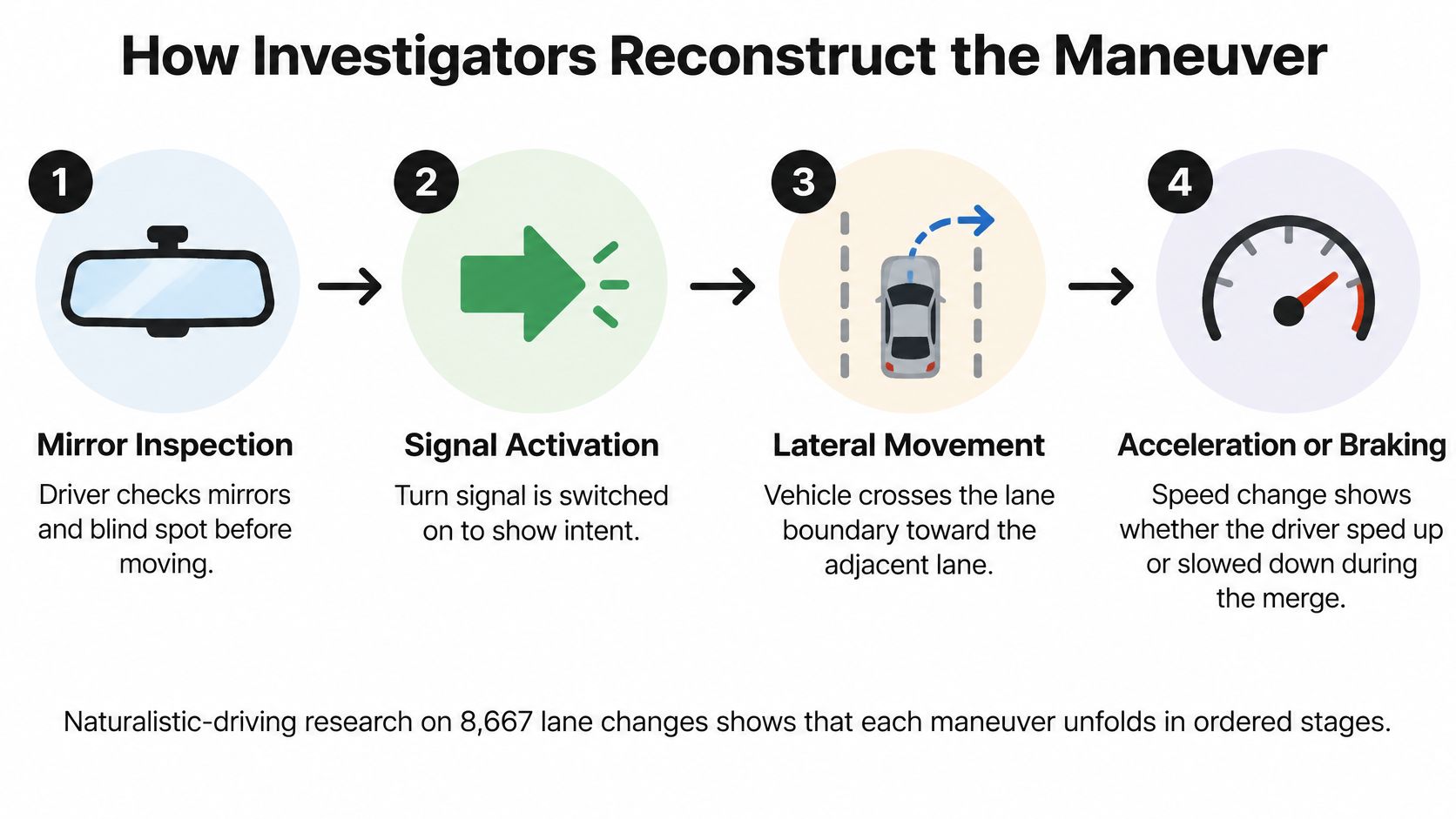
A crash is a sequence, not a still photograph. A U.S. Department of Transportation naturalistic-driving study observed 8,667 lane changes while examining signals, steering, braking, and eye-glance behavior.
That approach matters because an investigator must distinguish a driver who recognized danger and abandoned a maneuver from one who entered before adequate clearance existed. Both can produce sudden steering, but they imply different decisions.
The reconstruction follows the maneuver through these stages.
Build a synchronized timeline
- Mirror inspection. Interior footage may show a head turn or glance. Exterior footage can establish where the adjacent vehicle was, but it usually can't prove where the driver looked. An unsupported claim that the driver never checked is weaker than evidence showing that the vehicle was detectable.
- Signal activation. Video and witness accounts may establish whether signaling preceded movement or began during it. Preserve the original recording so an analyst can examine frames and timing rather than rely on a clipped social-media copy.
- Lateral movement. Side cameras, roadway surveillance, lane measurements, and vehicle positions help locate the first boundary crossing. Damage geometry can support an explanation, but evasive steering may change the angle before contact.
- Acceleration or braking. Available event data recorder information, commercial telematics, and video-derived movement can help establish closing speed and reactions. Not every vehicle records every control input, and not every sideswipe produces a usable event recording.
An accident reconstruction specialist can reconcile those sources, account for clock differences, and distinguish measured facts from assumptions.
Lane-change crash patterns and what each one points to
| Pattern or category | What it looks like | Evidentiary focus |
|---|---|---|
| Cutoff event | Driver enters before adequate clearance exists | Gap size, closing speed, adjacent driver's braking or swerving |
| Blind-spot abort | Driver recognizes occupied space late and abandons the maneuver | Visual-check sequence and warning timing |
| Light-vehicle target scenarios | Intentional movement, drifting, or merging | Signal sequence, blind-zone checks, boundary crossing |
| Heavy-truck target scenarios | Lane movement or drift involving a commercial vehicle | Camera coverage, telematics, vehicle dimensions |
| Blind-zone and merge population | Vehicles overlap or approach within a difficult-to-see area | Relative positions, detection opportunity, lane occupancy |
Test the explanation against the physical evidence
A scrape doesn't supply its own timeline. An analyst compares paint transfer, contact height, wheel damage, and scrape direction with the proposed vehicle paths.
Use the following video alongside the sequence-based approach, not as evidence of what happened in your particular collision.
The final reconstruction should explain whether the driver checked, waited, and entered a usable gap, or began a maneuver that forced the adjacent driver to react. If the explanation requires impossible positions or contradicts the recording, it needs revision.
The Safe Lane Change Rule and When Fault Shifts
A driver must establish that a lane change can be made safely before making it. Colorado's safe-movement requirement, discussed in this Colorado unsafe-lane-change legal guide, focuses on whether the driver confirmed that the movement could be completed safely. In practice, that means assessing the destination lane, not merely glancing at a mirror. The driver needs a usable gap, an appropriate speed, adequate observation, and a properly communicated maneuver. Signaling announces intent. It does not create an opening.
That starting point explains why the lane changer usually carries the larger share of fault. The key question is lane occupancy at the moment the maneuver began. If the adjacent vehicle was already occupying the space, the lane changer forced the issue. If the adjacent vehicle entered the gap after the maneuver was apparent, the analysis changes. Timing matters more than labels like “merging” or “changing lanes.”
For a practical driving refresher, Lendrum's Driving School's guide to safe lane switching on motorways provides context for planning and observing the maneuver. Driving instruction helps explain reasonable precautions, but the governing law comes from the jurisdiction where the crash occurred.
A signal doesn't settle responsibility
A turn signal communicates intent. It doesn't create right-of-way or make an unsafe gap safe. The adjacent driver's conduct still matters if it helped cause the collision.
Investigators should test specific alternatives:
- Acceleration into the gap. Did the adjacent driver speed up after the maneuver became apparent, or was the approaching speed already established?
- Unsafe positioning. Was a vehicle traveling somewhere prohibited or unexpectedly entering from another lane?
- Roadway ambiguity. Did faded markings, displaced cones, or conflicting construction warnings direct drivers toward the same space?
- Limited visibility. Did darkness, rain, glare, or spray affect detection, and did either driver adjust appropriately?
Controlled lane-closure research shows collisions can occur during lane changes, so temporary roadway configuration deserves examination in the right case. That research does not decide fault for an individual crash. It supports looking at cones, lane shifts, markings, and driver expectations instead of assuming the visible impact tells the whole story. A lane changer may still be mostly at fault, while the roadway layout explains why the maneuver appeared reasonable.
Driver-assistance records can change the argument
Blind-spot monitoring is evidence to investigate, not a substitute for investigation. A vehicle's equipment list does not establish whether the system detected another car, displayed a warning, or functioned correctly at impact.
Useful questions include whether the system was enabled, whether repairs affected calibration, and whether diagnostic information is available. A documented warning may undermine a driver's account. A system limitation may explain why no warning occurred. Neither automatically transfers responsibility to the manufacturer. ADAS records, blind-spot camera footage, and event data need to be matched to the lane sequence, not viewed in isolation.
Fault shifts when evidence establishes a contributing act, not merely because someone proposes another possible explanation.
State law determines how shared responsibility affects recovery. Our explanation of Colorado comparative negligence addresses that local issue. Statements about staying in a lane or noticing a blinker do not resolve an overlapping merge without timing and causation. The stronger case rests on lane occupancy, sequence timing, detection opportunity, and physical proof.
What to Preserve in the First 48 Hours
Safety and medical needs come before documentation. Don't stand in a live lane to photograph damage, and don't delay moving a vehicle when responders direct you to move it.
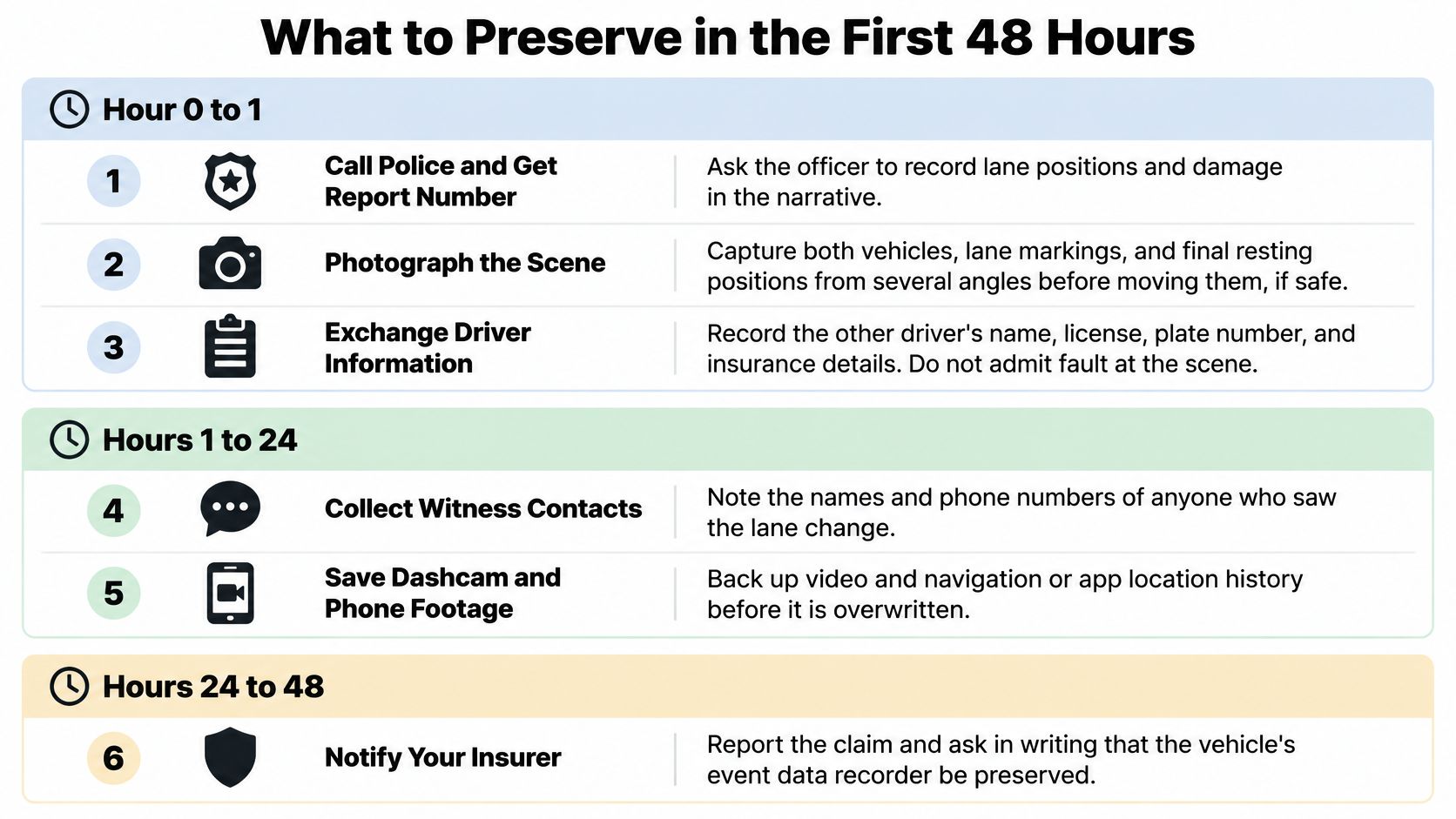
Use this checklist as an action schedule, not a legal deadline. If you're injured or hospitalized, ask a trusted person to help preserve what's available.
At the scene, when safe
- Immediately, contact police. Obtain the report number and ask that lane positions, visible damage, and disputed movements be documented. Describe observations without guessing at speed or distance.
- Before the scene changes, take photographs. Capture each vehicle from its corners, close-ups of contact damage, both lane boundaries, debris, tire marks, signs, and final positions.
- Before drivers leave, exchange information. Record insurance details, plates, and identifying information. Identify dashcams, fleet cameras, and nearby businesses that might have footage.
- As soon as practical, record statements and witnesses. Write down the other driver's actual words about looking, signaling, or not seeing you. Separate quotations you remember accurately from your own summary, and collect independent witnesses' contact details.
During the following day and before repairs
- Promptly, protect recordings. Back up original dashcam files and request preservation from anyone holding relevant footage. Audio Jam Inc.’s explanation of dash cam loop recording setup helps clarify why a camera can overwrite material unless the recording is protected.
- As symptoms warrant, obtain medical evaluation. Describe the collision and your symptoms accurately. Don't minimize discomfort, but don't assume a diagnosis before a clinician evaluates you.
- Promptly, notify your insurer. Follow policy reporting requirements and provide facts. Before giving the opposing carrier a recorded statement, understand the disputed issues and consider legal advice.
- Before repair, disposal, or transfer, address inspection. Ask whether the vehicles should be inspected and whether a qualified technician should preserve available electronic information. Coordinate storage and inspection rather than allowing unnecessary costs to accumulate.
Preservation priority: Keep originals, document who holds each item, and request preservation in writing.
A preliminary police fault notation isn't necessarily a complete causation analysis. Ask the agency about submitting additional footage, a written correction request, or a reconstruction report; don't assume the original report will automatically change.
During our investigation, we collect medical records, accident reports, witness statements, and expert opinions to establish liability and damages. An unexplained or inconclusive report doesn't end that work.
What a Lane-Change Injury Claim Is Worth
There's no reliable average settlement that determines your case. Value depends on provable injuries, treatment needs, work losses, lasting limitations, available insurance, and the legal effect of any shared responsibility.
A sideswipe label doesn't establish injury severity. NHTSA's blind-zone and lane-change-merge crash-population modeling identified approximately 503,070 annual crashes involving 542 fatalities and 188,304 nonfatal injuries in the analyzed population. Those modeled figures describe crash consequences, not settlement values.
Separate damages from collectability
A sound valuation examines distinct questions:
- Medical consequences. What treatment was necessary, what care remains likely, and what records connect the condition to the crash?
- Income consequences. What work did the injury prevent, and is future earning capacity affected?
- Daily-life consequences. How did the injury change mobility, concentration, sleep, caregiving, or ordinary activities?
- Payment sources. What coverage or other recoverable resources exist, and what limits or disputes affect payment?
Shared fault may reduce recovery where applicable law permits recovery. Insurance limits can also constrain settlement even when the documented harm is greater.
Our published results include a $1.5 million policy-limits truck wreck settlement, a $950,000 motor vehicle collision brain injury case, and a $500,000 policy-limits car wreck brain injury settlement. These are different cases with different facts, not lane-change settlement benchmarks or promises about another claim.
Connect the maneuver to the injury
The liability investigation and medical investigation must fit together. A reconstruction expert may address vehicle movement and collision forces, while a medical expert addresses diagnosis, causation, prognosis, and functional consequences.
We have access to medical and accident reconstruction experts who can testify about the cause and impact of an injury. Their role is especially important when the insurer disputes whether the collision caused the claimed condition.
An opposing adjuster may request an early recorded statement or rely on the initial police report. Responding before the medical picture and evidence are understood can create avoidable disputes about symptoms, timing, or responsibility. Evaluate a settlement against documented losses and future needs, not the first amount offered.
Truck and Fleet Cases Add Data and Risk
A commercial truck changes the evidence file because the fleet may control information the injured driver can't obtain from roadside photographs. Electronic logging records, dispatch information, forward and side cameras, telematics, and maintenance records can each answer different questions.
A 2024 U.S. Department of Transportation summary reported that trucks equipped with lane-departure warning had a 21% lower crash rate, based on three years of real-world truck-monitoring data. That association doesn't establish what a particular system did during a particular crash.
Request the right fleet records
- Camera files and metadata. Request relevant views and original files, not only a selected clip.
- Vehicle and driver data. Identify available speed, braking, steering, location, and duty-status information without assuming every system records the same fields.
- Equipment records. Preserve inspection, repair, calibration, and warning-system information relevant to the alleged failure.
- Company instructions. Examine training and operational policies where they relate to the maneuver.
A lane-departure warning and a blind-spot monitor aren't interchangeable. One may address unintended lane departure while another addresses adjacent traffic, so the investigator must identify the actual equipment and its limitations.
The driver's employer, vehicle owner, or another entity may also require investigation. Our guide to truck accident liability explains why responsibility can extend beyond the person steering.
Counsel should identify custodians and send targeted preservation requests promptly. A single usable download can resolve a disputed sequence, but only if someone preserves it before routine deletion, repair, or vehicle transfer.
Your Next Step When Fault Is Disputed
If you were injured and the other driver, insurer, or police report places blame on you, preserve the evidence before debating the conclusion. Be truthful and cooperative, but don't improvise a technical explanation in a recorded interview.
Choose the route that matches the dispute:
- Use your own insurer for covered property damage. Confirm the deductible, coverage conditions, and how the company will pursue reimbursement.
- Present a documented liability claim. Where responsibility is reasonably clear, organize photographs, witness information, records, and losses for the other carrier.
- Get counsel for a contested injury claim. Significant injuries, competing lane-occupancy accounts, and commercial vehicles justify a reconstruction-informed review.
Ask for a concrete case plan
Bring the report number, photographs, insurance correspondence, and a list of possible recording sources. Ask which evidence needs immediate protection, what remains uncertain, and which filing or notice deadlines apply.
We offer a free consultation for Colorado auto accident cases, along with free Wrongful Death, Brain Injury, Truck Accident, and Motor Vehicle Accident Case Estimator calculators. A calculator can help organize preliminary expectations, but it can't resolve disputed fault or substitute for an individual evaluation.
You can't guarantee the outcome by acting quickly. You can avoid surrendering useful evidence while the other side develops its account.
The lane changer is usually blamed, but the driver who preserves evidence and obtains an early reconstruction review is better positioned to challenge an unsupported fault assignment.
Nares Law Group LLC offers a free consultation for Colorado auto accident cases and investigates the records, witnesses, and expert evidence needed to evaluate disputed lane-change fault. Bring your crash report, photographs, and insurer correspondence so we can answer your questions and identify the evidence that needs protection.